
Category: Digital

  • Is social media causing mental illness? Perhaps.

    The hours spent – and the content viewed – by teens on social media can lead to depression, anxiety and body image issues


    By Emily Hemendinger


    Media influences and conventional beauty standards have long plagued society.

    This issue took on new urgency in May 2023 when the U.S. surgeon general issued a major public advisory over the links between social media and youth mental health.

    Research shows that images of beauty as depicted in movies, television and magazines can lead to mental illness, issues with disordered eating and body image dissatisfaction.

    These trends have been documented in women and men, in the LGBTQ+ community and in people of different racial and ethnic backgrounds.

    Experts have long suspected that social media may be playing a role in the growing mental health crisis in young people. However, the surgeon general’s warning is one of the first public warnings supported by robust research.

    The U.S. surgeon general says the youth mental health crisis is the ‘defining public health challenge of our time.’


    Social media can be toxic

    Body dissatisfaction among children and adolescents is commonplace and has been linked to decreased quality of life, worsened mood and unhealthy eating habits.

    As an eating disorder and anxiety specialist, I regularly work with clients who experience eating disorder symptoms, self-esteem issues and anxiety related to social media.

    I also have firsthand experience with this topic: I am 15 years post-recovery from an eating disorder, and I grew up when people were beginning to widely use social media. In my view, the impact of social media on diet and exercise patterns needs to be further researched to inform future policy directions, school programming and therapeutic treatment.

    The mental health of adolescents and teens has been declining for the past decade, and the COVID-19 pandemic contributed to worsening youth mental health and brought it into the spotlight. As the mental health crisis surges, researchers have been taking a close look at the role of social media in these increasing mental health concerns.


    The pros and cons of social media

    About 95% of children and adolescents in the U.S. between the ages of 10 and 17 are using social media almost constantly.

    Research has shown that social media can be beneficial for finding community support. However, studies have also shown that the use of social media contributes to social comparisons, unrealistic expectations and negative mental health effects.

    In addition, those who have preexisting mental health conditions tend to spend more time on social media. People in that category are more likely to self-objectify and internalize the thin body ideal. Women and people with preexisting body image concerns are more likely to feel worse about their bodies and themselves after they spend time on social media.


    A breeding ground for eating disorders

    A recent review found that, as with mass media, the use of social media is a risk factor for the development of an eating disorder, body image dissatisfaction and disordered eating. In this review, social media use was shown to contribute to negative self-esteem, social comparisons, decreased emotional regulation and idealized self-presentation that negatively influenced body image.

    Another study, called the Dove Self-Esteem Project, published in April 2023, found that 9 in 10 children and adolescents ages 10 to 17 are exposed to toxic beauty content on social media and 1 in 2 say that this has an impact on their mental health.

    Eating disorders are complex mental illnesses that develop because of biological, social and psychological factors. Eating disorder hospitalisations and the need for treatment have dramatically increased during the pandemic.

    Some reasons for this include isolation, food scarcity, boredom and social media content related to weight gain, such as the “quarantine15.” That was a reference to the weight gain some people were experiencing at the beginning of the pandemic, similar to the “freshman 15” belief that one will gain 15 pounds in the first year of college. Many teens whose routines were disrupted by the pandemic turned to eating disorder behaviors for an often-false sense of control or were influenced by family members who held unhealthy beliefs around food and exercise.

    Researchers have also found that increased time at home during the pandemic led to more social media use by young people and therefore more exposure to toxic body image and dieting social media content.

    While social media alone will not cause eating disorders, societal beliefs about beauty, which are amplified by social media, can contribute to the development of eating disorders.

    According to a report from the Centers for Disease Control and Prevention, 42% of high school students say they feel ‘persistently sad’ and ‘hopeless.’


    ‘Thinspo’ and ‘fitspo’

    Toxic beauty standards online include the normalization of cosmetic and surgical procedures and pro-eating-disorder content, which promotes and romanticizes eating disorders. For instance, social media sites have promoted trends such as “thinspo,” which is focused on the thin ideal, and “fitspo,” which perpetuates the belief of there being a perfect body that can be achieved with dieting, supplements and excessive exercise.

    Research has shown that social media content encouraging “clean eating” or dieting through pseudoscientific claims can lead to obsessive behavior around dietary patterns. These unfounded “wellness” posts can lead to weight cycling, yo-yo dieting, chronic stress, body dissatisfaction and higher likelihood of muscular and thin-ideal internalizsation.

    Some social media posts feature pro-eating-disorder content, which directly or indirectly encourages disordered eating. Other posts promote deliberate manipulation of one’s body, using harmful quotes such as “nothing tastes as good as thin feels.” These posts provide a false sense of connection, allowing users to bond over a shared goal of losing weight, altering one’s appearance and continuing patterns of disordered eating.

    While young people can often recognise and understand toxic beauty advice’s effects on their self-esteem, they may still continue to engage with this content. This is in part because friends, influencers and social media algorithms encourage people to follow certain accounts.

    Not all teens are on social media.


    How policy changes could help

    Legislators across the U.S. are proposing different regulations for social media sites.

    Policy recommendations include increased transparency from social media companies, creation of higher standards of privacy for children’s data and possible tax incentives and social responsibility initiatives that would discourage companies and marketers from using altered photos.


    Phone-free zones

    Small steps at home to cut down on social media consumption can also make a difference. Parents and caregivers can create phone-free periods for the family. Examples of this include putting phones away while the family watches a movie together or during mealtimes.

    Adults can also help by modelikng healthy social media behaviours and encouraging children and adolescents to focus on building connections and engaging in valued activities.

    Mindful social media consumption is another helpful approach. This requires recognising what one is feeling during social media scrolling. If spending time on social media makes you feel worse about yourself or seems to be causing mood changes in your child, it may be time to change how you or your child interact with social media.The Conversation


    Emily Hemendinger is Assistant Professor of Psychiatry, University of Colorado Anschutz Medical Campus. This article is republished from The Conversation under a Creative Commons license. Read the original article.

     

  • Kapil Sharma collaborates with Zupee gaming platform

    By Our Staff


    Zupee, the online gaming platform, has roped in Kapil Sharma, as its new brand ambassador. By joining forces with Sharma, Zupee seeks to expand its presence and cement its leadership position in Ludo, while also offering a wide array of engaging casual and board games.


    This association is structured by ‘PAB – People As Brand’, conceptualized by Leo Burnett and produced by Prodigious.


    Said Dilsher Singh Malhi, the CEO and Founder of Zupee: “Kapil Sharma, one of India’s most beloved entertainers, joins Zupee as our brand ambassador. With his comedic genius, relatable charm, and ability to connect with the masses, Kapill truly personifies our quest to deliver joyful and meaningful entertainment. With the ‘India Ka Apna Game’ campaign, we aim to celebrate the widespread popularity and sentimental bond people have with the game of Ludo, honoring the affection it holds in the hearts of the nation.”


    Added Rajdeepak Das, CEO & Chief Creative Officer of Leo Burnett South Asia: “Ludo is ingrained in our cultural fabric and appeals to large audiences across ages. Our campaign takes a lighthearted approach to celebrate the country’s love for Zupee’s Ludo as ‘India Ka Apna Game’ in a fun and quirky way.”


  • Amazon Mini TV to dub shows in Hindi

    By Our Staff


    Amazon miniTV, the free video streaming service from Amazon.in, has announced the launch of its newest category, ‘Mini TV Imported’, with International content dubbed in Hindi. It will stream top global shows every month ranging from Korean, Turkish, Mandarin and Spanish dramas.


    Commenting on the big venture, Amogh Dusad, Head of Content, Amazon Mini TV (or miniTV, as Amazon writes it) said: “In recent times, the viewing preferences of digital video consumers in India have changed significantly. They love diversity in content offering and are looking for unique stories & captivating characters from across the world. We have curated a list of blockbuster shows (from Korean, Turkish, Mandarin, Spanish and many more languages) that we believe will resonate with Indian viewers. Very excited to add the international shows in local language to our content slate on Amazon Mini TV!”


    Added Aruna Daryanani, Director and Business Head, Amazon Mini TV: “At Amazon Mini TV, our endeavour has always been to offer exciting content to our audiences across India for free. We are catering to a vast majority of 18-34-year-olds, who are looking for fresh content beyond television. Hence offering a varied choice of international shows dubbed in India is a perfect extension and we believe will appeal to our customers. We believe this is an exciting opportunity, as advertisers are also very keen on reaching out to this audience on our service.”


  • Will 2025 be the year of the arrival of Concierge Intelligence?


    By Ashoke Agarrwal


    Ashoke AgarrwalSince OpenAI launched ChatGPT in November 2022, many have heralded (and some) feared the arrival of the age of Artificial Intelligence (AI)?


     

    The rush to find good use cases for Generative AI is spawning a new class of start-ups and keeping Angels and VCs busy.


    I have always thought the Information Age was a way-stop on the road to the Age of AI. I have also surmised that the Age of AI will amplify the gains and ills of the Information Age. However, being an eternal optimist, I have always focused on the good technology can do.


    In February 2021, in the gloom of the Covid lockdown, when the world had barely an inkling of what Generative AI was, I imagined a use case of AI I called Concierge Intelligence and published a blog post about it.


    Here are some excerpts from the post:

    “I believe one of the critical directions Artificial Intelligence will develop over the next decade is what I call “Concierge Intelligence”.

    Concierge Intelligence will go a long way towards fulfilling the initial promise of the digital age.”


    The era of Concierge Intelligence will avoid the concerns raised by the age of marketing to bots like Alexa or Sirir that I wrote about in my post of April 25th 2018, titled Marketing to Bots: The Coming Paradigm Shift?” 


    Concierge Intelligence will instead be the emergence of AI with an agency. The kind of agency that I wrote about in my post dated June 14th 2019, titled “Machine Intelligence to Machine Curiosity – The Route to Machine Creativity”, as also in my post dated December 19th 2019, titled “Should AI Have Agency.”


    The individual will buy his Concierge Intelligence (CI) – a software application -from the market and load on onto all the devices she uses. I believe CI will be the next big thing in consumer marketing. CI will get to work to learn the consumer’s interests and preferences. The individual will set the scope and depth of this learning. I can imagine the emergence of a new form of Yoga – CI Yoga! CI Yoga trainers will coach the individual on how to refine their CI settings for maximum well-being.


    CI will mediate between the world and the individual. It will map your learning patterns and maximize the speed and efficacy of your learning. It will continuously keep a tab on the individual’s inherent talents and emergent capabilities and connect her with opportunities to use these talents and abilities, in the process not just maximizing her earnings but increasing her sense of self-worth. It will perceive the individual’s relationship and leisure needs and help her meet them. One of the minor duties of CI will be as the gatekeeper to brands and services that seek to message and sell to the individual. While the CI will have powerful capabilities, it will be under the total command of the individual. She can change its functionalities whenever she wants and even switch it off if she so desires, much like today’s smartphones.


    Over the next decade, CI will become the most widely prevalent form of AI. I like to think of a CI as AI with a soul. A form of augmented intelligence that fuses an individual’s psyche, with all its complexity and humanity intact, with AI’s power, speed and reach.


    My concept of CI has so taken hold of me that I even wrote about it in my first column for MxMIndia in January 2022, titled “The Coming Post-Digital World.”


    Post ChatGPT, the concept of an individual-owned and operated AI model is in the air. Sources in the VC world now tell me that a couple of start-ups are proposing systems close to the CI concept. While musings in blog posts do not give me any monetisable rights, I am glad that while some of my prognostications target a future too far out to find vindication in my lifetime, the CI concept will, in some measure, come true in the next couple of years. I would bet on Apple to be the company that will lead the world into the age of CI. Its current stance of developing AI systems that reside entirely on the user’s AI device and use user information without transmitting out of the device is a stepping stone to CI systems. Plus, of course, the fact that it is the most resourced company in the world and among the most trusted brands.


  • Amazon rolls out third edition of campaign

    By Our Staff


    Ahead of Prime Day 2023, Amazon India has announced the third edition of its campaign, #AmazonGotMyBack with a brand film to showcase the convenience it offers to customers across India.


    Talking about the third edition of the #AmazonGotMyBack campaign, Dr. Karuna Shankar Pande, Director, Amazon Logistics, India said: “At Amazon, we constantly strive to make the delivery experience convenient for our customers through our unparalleled reach in the hinterlands of the country with reliable and on-time deliveries. #AmazonGotMyBack campaign gives all of us, especially our associates who work behind the scenes across operations network, an opportunity to see real and unique experiences of our customers.”


  • The Economic Promise & Cultural Peril of AI


    By Ashoke Agarrwal


    Ashoke AgarrwalArtificial Intelligence (AI0 is fast becoming the general-purpose technology that will determine humankind’s future.

    People whose business is to peek into the future approach it from two very different angles.

    Some hard-headed economist types see AI mainly as a disruptor of the world of business and economies.

    Others who study broader and deeper societal trends prognosticate the possible long-term effects of AI on human civilisation.

    Neither school sees AI developing into a threat on the lines of the Terminator-type robot shooting down people in the streets or a Skynet-type all-powerful entity trapping humans in a virtual matrix.

    The book “Power and Prediction: The Disruptive Economics of Artifical Intellgence.” by Ajay Agrawal, Joshua Gans and Avi Goldfarb, a 2022 follow-up to their 2018 book “The Prediction Machine: The Simple Economics of Artifical Inteliigence.” lays out the disruptive but possibly ultimately enhancing effect of AI on the world economy.

    The broader view of the impact of AI on human civilisation comes from Yuval Noah Harari, the historian-philosopher whose three books “Sapiens: A Brief History of Mankind.”, “Homo Deus. A Brief History of Tomorrow” and “21 Lessons for the 21st Century” introduced a deeply thought out yet lucid and vivid view of the factors that governed the evolution of human civilization.

    Harari has spoken at length about his views on AI at various forums. Recently he did a three-hour sit-down with Lex Friedman. Here is a YouTube link to the interview and a transcript. Harari’s views are grounded in his unique approach to the evolution of human civilization and startling in their clarity and scope. It also offers an almost sly but plausible take on the threat that AI poses to human society without going into Terminator and Skynet kind of fevered speculation.

    In their 2018 book “The Prediction Machines”, Agrawal et al. posited that AI at its core was a quantum leap in the science of prediction. Until the emergence of Deep Learning, prediction methods mainly used the science of statistics with tools like multivariate regression. With Deep Learning and its offshoots, predictions became progressively more accurate and cheaper. Agarwal et al. posited that technology finds more widespread use when it becomes more affordable. They offered the instance of electricity and computers. One of the vivid examples they offered about how better predictions could lead to changes in business models was of e-commerce players like Amazon shifting from a “shop-than-ship” model to a “ship-than-shop” model once they had the AI tools that predicted with reliable accuracy what their customers would buy next – that is they would ship the predicted product off to a consumer even before he had shopped for it on their site. In support of this insight, they cite that Amazon had filed for a patent for “anticipatory shipping”.

    In their 2022 book “Power and Prediction.” Agrawal et al. revise their view of the economic future of AI. They posit that the widespread adoption of AI will not happen with point solutions like replacing processes where traditional forecasting is currently the norm with AI-based forecasting. Instead, it will compel economies and businesses to go beyond and identify areas where AI-based prediction enables them to switch to decision-based procedures that optimize resources instead of rules-based processes that compromise efficiency in the face of uncertainty.

    Also, because AI-based predictions will have system-wide ramifications, the optimal adoption will happen when economies and businesses redesign entire systems to accommodate AI. Agarwal et al. identify two design approaches that can drive systemic changes: coordination and modularity. Their book details these approaches and illustrates them with examples from the health, transport and e-commerce sectors. The overall message from Agrawal et al. is that AI and its economy-wide adoption will be systemic and disruptive. And overall, its impact will be positive, like the widespread adoption of the last two general technologies – electricity and computers.

    Mr Harari’s views on the civilisational impact of AI are nuanced.

    Harari’ has been surprised by the pace of development of Large Language Models (LLMs) and their rapid penetration into the social and cultural life of human societies.

    At one level, he sees the threat posed by LLMs as a ratcheting up of the threat posed by social media. The design of social media algorithms captures attention and, in the process, creates echo chambers that fuel conspiracies and tribalism. AI entities based on ever-improving LLMs will capture intimacies. If unchecked, they could monopolise an individual’s personal space, weakening and destroying individual relationships and thus weakening the concept of family and friends and hence the very social framework undergirding human society.

    Harari perceives another more subtle threat. Harari hypothesizes, as explained in his books that the life of individuals, societies, cultures and civilizations is circumscribed by stories and myths that are creations of the human imagination. God, religion, nation, money etc., are all myths that have taken deep root and driven society in all its pursuits – politics, economics, art and culture.

    While Agarwal et al. perceives AI as a disruptive “Prediction Machine”, Harari rotates the prism and perceives AI as a threatening “Culture Machine”. He sees AI ( and sometimes he calls it Alient Intelligence) as “eating” and “digesting” all human culture to come to a stage where it can give back images, words, art and stories that are more compelling than any that humans can process. Because these cultural artefacts govern human evolution, this “Alien Intelligence” will take charge of it. Here in his own words, is how he perceives this threat:

    “...But taking what we do know about human history until now, all the, again, stories, images, paintings, songs, operas, theater, everything we’ve encountered and shaped our minds was created by humans. Now, increasingly, we live in a world where more and more of these cultural artifacts will be coming from an alien intelligence. Very quickly we might reach a point when most of the stories, images, songs, TV shows, whatever are created by an alien intelligence. And if we now find ourselves inside this kind of world of illusions created by an alien intelligence that we don’t understand, but it understands us, this is a kind of spiritual enslavement that we won’t be able to break out of because it understands us. It understands how to manipulate us, but we don’t understand what is behind this screen of stories and images and songs.”

    That is a more alarming picture of the AI-age world than any Terminator or Skynet kind of scenario. It is more disturbing because the process is sneaky and sly, and one can see the beginning of it even at the early stages of the LLM revolution.

    While the forces of commerce and the market will ensure that economies reap, with time and effort, the benefits of the “Prediction Machines”, what remedy do we have against the threat of the LLM-based “Culture Machine.”? Harari has a challenging remedy to offer. Harari believes that we humans do not fully understand ourselves. He suggests that for every dollar and hour we spend developing the AI-based culture machine, we also invest a dollar and hour in understanding ourselves better – perceiving the contours of conscious daily reality that exist in our feelings beyond the stories and the myths that confuse and control us. Is that a realistic goal? Will the story of progress that drives our notions of work and happiness allow us to set and accomplish such a goal? Let me put this question to ChatGPT and Bard and see what they say.


  • Engagement drops for ChatGPT & Threads, with reason

    Representative graphic. It doesn’t give the exact drop in engagement of ChatGPT and Threads


    By Omar H. Fares and Seung Hwan (Mark) Lee


    ChatGPT recently experienced a decline in user engagement for the first time since its launch in November 2022. From May to June, engagement dropped 9.7 per cent, with the largest decline — 10.3 per cent — occurring in the United States.

    Meanwhile, Meta’s Threads platform experienced a significant drop in user numbers, going from more than 49 million users on July 7 to 23.6 million active users by July 14. In the same time frame, the average time users in the U.S. spent on the app dropped from a peak of 21 minutes in early July to just above six minutes.

    In the tech world, companies are always racing to be the first ones to introduce new innovations, aiming for the “first mover’s advantage.” This refers to a firm’s ability to get a head start over competitors by being the first to enter a new product category or market.

    However, being a trailblazer doesn’t guarantee an easy ride. While there are perceived benefits, there are also a plethora of challenges that arise.

    A news story about what the drop in Meta Threads engagement means for the social media app.

    The recent declines of Threads and ChatGPT attest to this reality, demonstrating that rapid and widespread acceptance doesn’t necessarily lead to long-term success.

    There are a few reasons why a fast adoption isn’t necessarily the key to success including unsustainable growth, inadequate scaling infrastructure and a lack of user retention strategies.


    Unsustainable growth

    The idea of unsustainable growth stems from a platform’s inability to uphold or maintain the quality of the user experience while scaling up at a rapid pace.

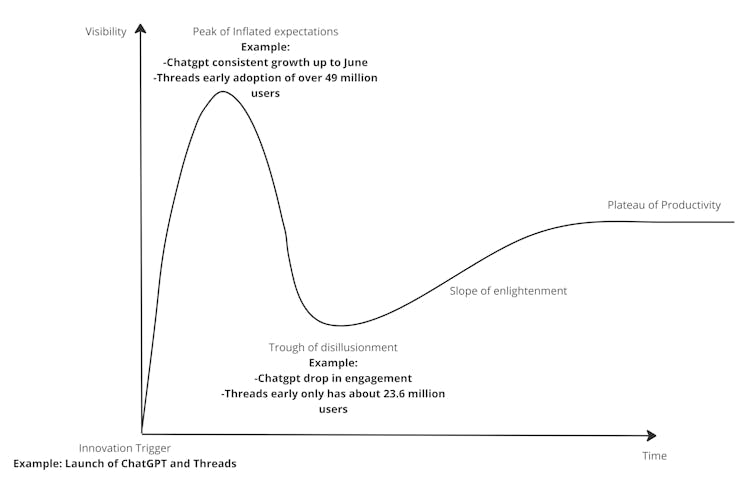
    This is where the real challenge lies: being able to effectively scale up a product or service. It is precisely at this junction that the concept of unsustainable growth intersects with the Gartner Hype Cycle.

    The Gartner Hype Cycle is a model that shows the stages of emerging technology adoption: from the initial hype and inflated expectations, through disillusionment and skepticism, to practical and mainstream productivity.

    A line graph illustrating that Threads and ChatGPT both had a period of significant hype and inflated expectations, followed by a drop in user interest.
    A graph illustrating how ChatGPT and Threads fit into the Gartner Hype Cycle.
    (Omar H. Fares and Seung Hwan Lee), Author provided


    In the context of unsustainable growth, products like ChatGPT and Threads appear to have reached the stage known as “peak of inflated expectations,” where the publicity of a new product generates over-enthusiasm and unrealistic expectations. During this stage, users rapidly adopt the product due to its novelty and the hype surrounding it.

    However, this stage often leads to the “trough of disillusionment.” During this stage, the product fails to meet users’ unrealistic expectations, causing a decline in their interest.

    It indicates the product’s growth may have outpaced its ability to provide an excellent user experience. Without enhancing the product based on user feedback, declining user engagement will ensue.

    This rise and fall underscores the challenge of achieving sustainable growth in the face of rapid adoption. The initial hype often attracts a massive influx of users, but without a clear, scalable strategy for maintaining quality and engagement, platforms can quickly lose their appeal.


    Inadequate scaling infrastructure

    When a platform’s user base expands at a rapid pace, the question of whether that platform’s infrastructure can scale to the demands of its users becomes critical.

    The sudden influx of users that accompanies a successful product launch can be a double-edged sword; it brings a wealth of opportunities for data collection, user feedback and revenue, but also tests the scalability of the platform’s infrastructure.

    If the underlying technology, support services or operational strategies are not built to scale, the product might suffer from slow loading times, frequent crashes or a lack of timely customer support — all of which are detrimental to the user experience and a product’s long-term success.

    For instance, OpenAI, the company behind ChatGPT, had to limit ChatGPT-4 users to 25 messages every three hours due to infrastructure constraints — even for those with a paid membership. While this helps manage the infrastructure load, it presents a challenge from the user’s perspective.

    Users who were accustomed to unlimited interactions with ChatGPT-3 now find themselves paying for a service with limitations. This may inadvertently dampen user engagement and drive some users away, underscoring the delicate balance between managing infrastructure and maintaining user satisfaction.


    Lack of user retention strategies

    One reason why tech businesses struggle to retain users is because they don’t prioritize user-centered design. By failing to incorporate user feedback in product development, businesses can end up offering a product that doesn’t meet user needs.

    In addition, businesses must provide effective support for users. Insufficient or unclear onboarding may leave users feeling lost and overwhelmed, leading them to abandon the product. In the case of ChatGPT, OpenAI provides a basic explanation of platform usage, but users are primarily responsible for exploring it themselves.

    Users experiment with prompts without a clear understanding of how to generate impactful responses, resulting in uncertainty and frustration. This lack of guidance may contribute to lower engagement rates, as observed in the recent decline.

    Lastly, increasing concerns about security threats and privacy have raised questions about how new technologies are protecting their users. The conflict between the need for more personalized experiences and privacy can give rise to a phenomenon called the personalization-privacy paradox.

    As individuals grow increasingly uneasy about how their personal information is stored, the lack of proper regulations can lead to a decline in the use of personalised services or technologies.

    While rapid user adoption is a promising start, it doesn’t guarantee long-term success. Striking the right balance between growth and infrastructure scalability, adopting a user-centric approach, maintaining user trust and investing in continuous innovation are the cornerstones for enduring success in the competitive tech landscape.The Conversation


    Omar H. Fares is Lecturer in the Ted Rogers School of Retail Management, Toronto Metropolitan University and Seung Hwan (Mark) Lee is Professor and Associate Dean of Engagement & Inclusion, Ted Rogers School of Management, Toronto Metropolitan University. This article is republished from The Conversation under a Creative Commons licence.  Read the original article.


  • Times of India & Simpl collaborate

    By Our Staff


    Times of India Digital and Simpl have partnered to enable online news subscriptions. This collaboration enables TOI+ subscribers to enjoy seamless one-tap checkout, eliminating complexities of traditional payment procedures.


    Said Radhika Shukla – Head – Subscription Growth, Strategy and Analytics, TOI+ said: “We are excited to partner with Simpl to make it easier for our readers to access premium news content. Simpl’s 1-tap checkout solution is simple, secure, and convenient, and we believe it will make a big difference in the way our readers subscribe to TOI+.”


    Added Nitya Sharma, Founder and CEO of Simpl: “We are thrilled to partner with TOI+ to bring the power of one-tap checkout to the news industry. This partnership aims to bridge the gap between convenience and quality journalism for millions of readers across the country. By leveraging Simpl’s revolutionary 1-tap Checkout, this partnership seeks to enhance the accessibility and ease of news subscriptions.”


  • Lowe Lintas campaigns for Flipkart Health+

    By Our Staff


    Lowe Lintas Bangalore has recently rolled out its latest campaign for Flipkart Health+.


    Sharing her thoughts on the idea behind the new campaign, Sonali Khanna, President and Branch Head, Lowe Lintas Bangalore said: “Since its inception, Flipkart Health+ has consistently prioritised the needs of its customers, placing consumer challenges at the forefront of its approach. Their trailblazing ‘superfast delivery’ feature is one such example of their commitment to customers. While medicines are a serious business, we felt that highlighting critical health scenarios would only create further anxiety. Instead, we decided to convey our message with a lighter touch in order to break clutter; by humorously demonstrating that while somethings in life can take time, delivery of medicines should not.”


  • SoCheers Films campaigns for BGMI

    By Our Staff


    SoCheers Films, an independent creative digital agency, has unveiled its latest Digital Video Campaign (DVC) for Battlegrounds Mobile India (BGMI). The film is titled ‘Ab Dhadkane Hongi Tez’. celebrates BGMI’s vibrant gaming community and the game’s ability to foster a strong sense of togetherness among its players. The film portrays a diverse range of individuals passionately engaging with BGMI, evoking feelings of excitement, and nostalgia.


    Notes a communique: “In recent years, the gaming industry in India has experienced remarkable growth and popularity. Games like BGMI have successfully carved a niche for themselves, attracting a dedicated fan base that eagerly awaits new releases and relishes the immersive gaming experiences they offer.”


  • Wiredus bags digital marketing mandate for ATS Infrastructure

    By Our Staff


    Wiredus, a digital marketing agency, has acquired the digital marketing mandate for ATS Infrastructure, an infrastructure developer with a focus on residential, commercial, and luxury projects.


    As per the agency, it will be responsible for ATS Infrastructure’s digital marketing and paid marketing – including Social Media Marketing, Search Engine Optimisation (SEO), Online Reputation Management (ORM), Media Buying and Planning, Google Ad, Content Marketing, Website Management and development.


    Said Ravish Yadav, Founder & Director of Wiredus: “We are overjoyed to be working with the amazing ATS team. Their brand already inspires much confidence & trust amongst customers and we look forward to taking this brand awareness to new heights, while also generating profitable leads for the brand”


    Added Siddharth Mall, Head of Marketing, ATS Infrastructure: “We are delighted to be associated with Wiredus, as the team comes with extremely promising experience. And we look forward to taking the ATS brand presence to newer heights with targeted marketing campaigns designed by their team.”


  • Netcore Cloud appoints Mahesh Narayanan as Chief Marketing Growth Officer

    By Our Staff


    Netcore Cloud, a global MarTech and Customer Experience company, appoints Mahesh Narayanan as its Chief Marketing Growth Officer. In his new role, Narayanan will be pivotal in accelerating the company’s global expansion plans and fortifying its leadership positioning by leveraging his marketing expertise to drive growth strategies effectively.


    Said Kalpit Jain, Global CEO of Netcore Cloud: “Mahesh is a world-class business leader whose deep understanding of marketing technology and inspirational leadership will build on the foundations to rejuvenate our marketing team as a high-performance growth engine and take Netcore to the next level. He represents our core values of craftsmanship, entrepreneurship, and can-do attitude, and I am delighted to work with him.”


    The Founder & MD of Netcore Cloud, Rajesh Jain added: “As we welcome Mahesh Narayanan into our Netcore Cloud family, we are not just adding an outstanding leader to our team, we are infusing a new energy into our growth journey. Mahesh’s seasoned understanding of the digital world, sharpened at the forefront of global technology giants promises to be our distinct competitive edge – the unbreachable moat protecting our ‘economic castle’.”