By Ashoke Agarrwal
 Artificial Intelligence (AI0 is fast becoming the general-purpose technology that will determine humankind’s future.
People whose business is to peek into the future approach it from two very different angles.
Some hard-headed economist types see AI mainly as a disruptor of the world of business and economies.
Others who study broader and deeper societal trends prognosticate the possible long-term effects of AI on human civilisation.
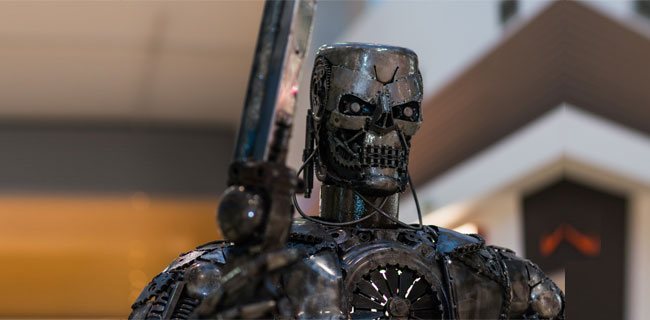
Neither school sees AI developing into a threat on the lines of the Terminator-type robot shooting down people in the streets or a Skynet-type all-powerful entity trapping humans in a virtual matrix.
The book “Power and Prediction: The Disruptive Economics of Artifical Intellgence.” by Ajay Agrawal, Joshua Gans and Avi Goldfarb, a 2022 follow-up to their 2018 book “The Prediction Machine: The Simple Economics of Artifical Inteliigence.” lays out the disruptive but possibly ultimately enhancing effect of AI on the world economy.
The broader view of the impact of AI on human civilisation comes from Yuval Noah Harari, the historian-philosopher whose three books “Sapiens: A Brief History of Mankind.”, “Homo Deus. A Brief History of Tomorrow” and “21 Lessons for the 21st Century” introduced a deeply thought out yet lucid and vivid view of the factors that governed the evolution of human civilization.
Harari has spoken at length about his views on AI at various forums. Recently he did a three-hour sit-down with Lex Friedman. Here is a YouTube link to the interview and a transcript. Harari’s views are grounded in his unique approach to the evolution of human civilization and startling in their clarity and scope. It also offers an almost sly but plausible take on the threat that AI poses to human society without going into Terminator and Skynet kind of fevered speculation.
In their 2018 book “The Prediction Machines”, Agrawal et al. posited that AI at its core was a quantum leap in the science of prediction. Until the emergence of Deep Learning, prediction methods mainly used the science of statistics with tools like multivariate regression. With Deep Learning and its offshoots, predictions became progressively more accurate and cheaper. Agarwal et al. posited that technology finds more widespread use when it becomes more affordable. They offered the instance of electricity and computers. One of the vivid examples they offered about how better predictions could lead to changes in business models was of e-commerce players like Amazon shifting from a “shop-than-ship” model to a “ship-than-shop” model once they had the AI tools that predicted with reliable accuracy what their customers would buy next – that is they would ship the predicted product off to a consumer even before he had shopped for it on their site. In support of this insight, they cite that Amazon had filed for a patent for “anticipatory shipping”.
In their 2022 book “Power and Prediction.” Agrawal et al. revise their view of the economic future of AI. They posit that the widespread adoption of AI will not happen with point solutions like replacing processes where traditional forecasting is currently the norm with AI-based forecasting. Instead, it will compel economies and businesses to go beyond and identify areas where AI-based prediction enables them to switch to decision-based procedures that optimize resources instead of rules-based processes that compromise efficiency in the face of uncertainty.
Also, because AI-based predictions will have system-wide ramifications, the optimal adoption will happen when economies and businesses redesign entire systems to accommodate AI. Agarwal et al. identify two design approaches that can drive systemic changes: coordination and modularity. Their book details these approaches and illustrates them with examples from the health, transport and e-commerce sectors. The overall message from Agrawal et al. is that AI and its economy-wide adoption will be systemic and disruptive. And overall, its impact will be positive, like the widespread adoption of the last two general technologies – electricity and computers.
Mr Harari’s views on the civilisational impact of AI are nuanced.
Harari’ has been surprised by the pace of development of Large Language Models (LLMs) and their rapid penetration into the social and cultural life of human societies.
At one level, he sees the threat posed by LLMs as a ratcheting up of the threat posed by social media. The design of social media algorithms captures attention and, in the process, creates echo chambers that fuel conspiracies and tribalism. AI entities based on ever-improving LLMs will capture intimacies. If unchecked, they could monopolise an individual’s personal space, weakening and destroying individual relationships and thus weakening the concept of family and friends and hence the very social framework undergirding human society.
Harari perceives another more subtle threat. Harari hypothesizes, as explained in his books that the life of individuals, societies, cultures and civilizations is circumscribed by stories and myths that are creations of the human imagination. God, religion, nation, money etc., are all myths that have taken deep root and driven society in all its pursuits – politics, economics, art and culture.
While Agarwal et al. perceives AI as a disruptive “Prediction Machine”, Harari rotates the prism and perceives AI as a threatening “Culture Machine”. He sees AI ( and sometimes he calls it Alient Intelligence) as “eating” and “digesting” all human culture to come to a stage where it can give back images, words, art and stories that are more compelling than any that humans can process. Because these cultural artefacts govern human evolution, this “Alien Intelligence” will take charge of it. Here in his own words, is how he perceives this threat:
“...But taking what we do know about human history until now, all the, again, stories, images, paintings, songs, operas, theater, everything we’ve encountered and shaped our minds was created by humans. Now, increasingly, we live in a world where more and more of these cultural artifacts will be coming from an alien intelligence. Very quickly we might reach a point when most of the stories, images, songs, TV shows, whatever are created by an alien intelligence. And if we now find ourselves inside this kind of world of illusions created by an alien intelligence that we don’t understand, but it understands us, this is a kind of spiritual enslavement that we won’t be able to break out of because it understands us. It understands how to manipulate us, but we don’t understand what is behind this screen of stories and images and songs.”
That is a more alarming picture of the AI-age world than any Terminator or Skynet kind of scenario. It is more disturbing because the process is sneaky and sly, and one can see the beginning of it even at the early stages of the LLM revolution.
While the forces of commerce and the market will ensure that economies reap, with time and effort, the benefits of the “Prediction Machines”, what remedy do we have against the threat of the LLM-based “Culture Machine.”? Harari has a challenging remedy to offer. Harari believes that we humans do not fully understand ourselves. He suggests that for every dollar and hour we spend developing the AI-based culture machine, we also invest a dollar and hour in understanding ourselves better – perceiving the contours of conscious daily reality that exist in our feelings beyond the stories and the myths that confuse and control us. Is that a realistic goal? Will the story of progress that drives our notions of work and happiness allow us to set and accomplish such a goal? Let me put this question to ChatGPT and Bard and see what they say.