Category: RESEARCH

  • Mindshare and Diageo win big at the Smarties India awards 2017

    By A Correspondent


    The Mobile Marketing Association (MMA) announced the winners of its 2017 Smarties India Awards, held in Gurugram last week. As many as 42 awards were presented for mobile strategy in industry-focused categories celebrating innovation, creativity, and success across the mobile marketing ecosystem. Diageo was crowned ‘Marketer of the Year’, while Mindshare was recognised as ‘Agency of the Year’.


    Mindshare received 19 awards over 11 categories, ranging from Brand Awareness, Mobile Native and Programmatic, amongst others.Sony Entertainment Channel’s ‘Waltzing across TV: How 300,000 people switched channels to Super Dancer’ by Zapr Media Labs was recognised as ‘Best in Show’.


    Said Rohit Dadwal, Managing Director, MMA Asia-Pacific:“All our winners have demonstrated the ability to communicate their brand’s story with mobile using creative concepts and innovative technology that lead to real business impact. The Smarties India Awards are our way of recognising outstanding key players in the industry, and we hope that through sharing their campaigns, we can inspire marketers across India to harness the power packed in this tiny device. We’re optimistic about where the industry is headed in India, and look forward to seeing what next year’s Smarties India Awards has in store for all of us,”


    In an ongoing partnership with Knowledge Partner, Kantar Millward Brown, the research-based consultancy presented industry trends and characteristics of the winning campaigns.


    Commenting on the winners, Shaveta Bhardwaj, Senior Executive Director, Kantar Millward Brown said: “We saw very interesting entries in comparison to last year; scale stood out for winning campaigns. Measuring brand outcomes is critical to success. It is important to think what ‘mobile’ can do for your ‘brand’ rather than what ‘brand’ can do on mobile.”


    This year, MMA partnered Gunn Report and WARC to launch the first-ever Business Impact Index.


  • Tata is India’s #1 brand. Reliance & Airtel follow


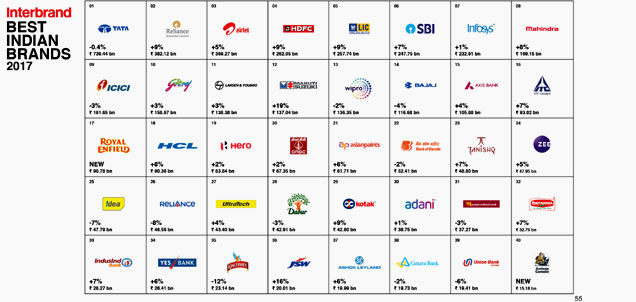
    It’s that time of the year when the Omnicom Group’s Interbrand releases its Best Indian Brands report. For five consecutive years, Tata Group has continued to hold the top position. And while Airtel continues to play strong at #3, Reliance is now a strong #2 on the back of Jio’s omnipresence amongst telecom service providers.


    Following Airtel is HDFC Bank at #4, and then Life Insurance Corporation of India (LIC),State Bank of India, Infosys, Mahindra, ICICI and Godrej round out the Top 10.The best growth performances belonged to Maruti, Reliance, HDFC, JSW and Kotak highlighting the relevance of Purpose Centricity, Technology and Brand in driving their growth.


    Interestingly more than 50 per cent of the Best Indian Brands come from five sectors: Automotive (5), Diversified (10), Financial Services (12), Telecom (2), and Technology (2). Automotive is one of the top growing sectors, leading the change is brand Maruti Suzuki, which posted a 19% increase in brand value versus 2016.


    Breaking into Best Indian Brands for the first time at #17 is Royal Enfield and Ambuja Cement at #40.


    Said Ashish Mishra, Managing Director, Interbrand India: “The Best Global Brands understand that brands are the platform for growth. A quick look at the top growing brands confirms how outgrowing the now and changing at the speed of life creates admirable value growth.  Encouragingly, the top growing Best Indian Brands too have begun to understand and demonstrate the levers that drive growth and value. Maruti Suzuki, our top growing brand for the second year in a row has done an exemplary job with Reliance, Kotak, JSW, HDFC and Ashok Leyland not far behind. Our analysis of the Best Global Brands reveals some simple truths. Truths that are useful for Indian Brands to consider while driving growth in our rapidly changing market.”


    Also present at the launch of the 2017 report was Gonzalo Brujo, Chief Executive Officer of Interbrand EMEA, Latam and India. And this is what he said: “We are living in one of the most exciting periods of change—societal, technological, industrial—that impacts every aspect of commerce and life. In this ever-shifting context, to grow, brands need to outgrow. Outgrow barriers, challenges, markets, competition, mindsets, technology and potential. Which is why businesses need brands more than ever. The Best Indian Brands understand this value  in belief systems and purposes, and hence propel this change without losing the way.”


    The Top 40 Indian Brands have a combined total value of INR 4755.7 Bn, an increase of 5% from 2016. For the complete Top 40 ranking and the report with comprehensive analysis of growth, sector and industry trends, click here


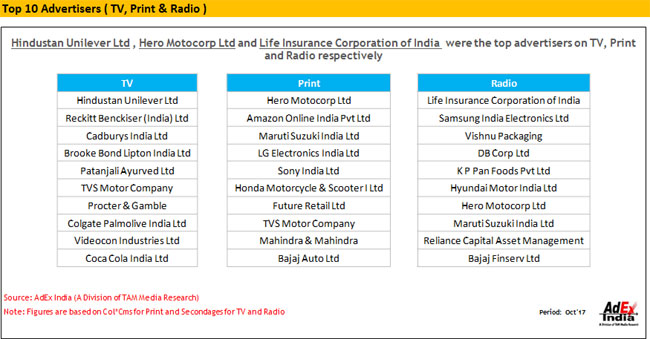
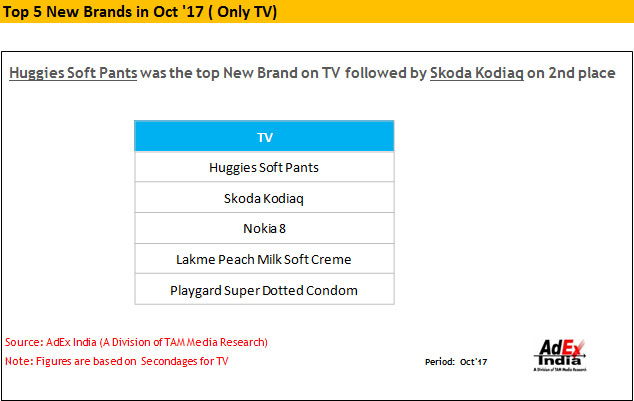
  • AdEx on all media drops in Oct 2017 (vis-à-vis Sep)

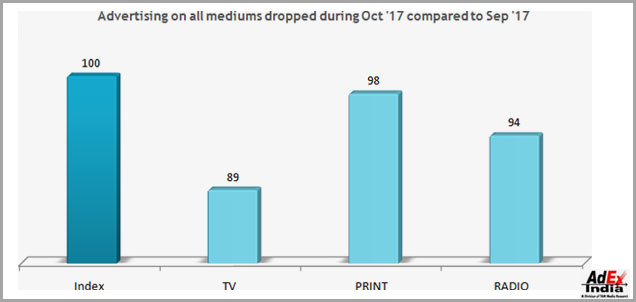
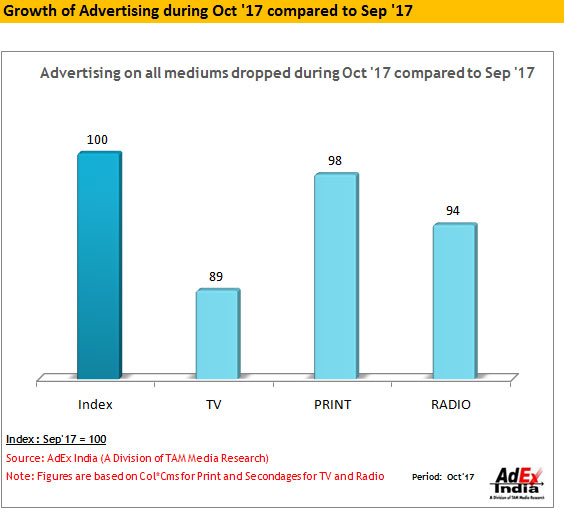
    Index : Sep’17 = 100
    Source: AdEx India (A Division of TAM Media Research)
    Note: Figures are based on Col*Cms for Print and Secondages for TV and Radio
    Period: Oct’17


    By A Correspondent


    Every week, MxMIndia in partnership with TAM AdEx brings you a scan of advertising expenditure across print, television and radio in various categories. And on a monthly basis, we bring you a view on how the adspends have been for a calendar month vis-à-vis the previous calendar month.


    October this year was all-important given that Diwali was on Oct 19, and before that we saw the frenzy towards shopping and sales.


    The data we bring you below is hence of particular interest:

  • Online FMCG will outpace offline in 5 yrs: Nielsen


    By A Correspondent


    Growth in the online FMCG sector has been outpacing offline FMCG growth, with e-commerce sales growth all set to get past traditional retail sales growth within the next five years, according to a new report released by Nielsen, the What’s Next in E-Commerce Report. While total FMCG retail sales growth currently sits at around 4% per annum, total retail e-commerce is predicted to grow by 20%, or an additional $2.1 trillion, by 2020.


    The latest trends in consumer purchasing online within the FMCG sector point to strengthening growth in online adoption and spend around the world according to the report. The report illustrates that while FMCG has historically trailed many other categories such as electronics, mobile goods and travel when it comes to online spending, that trend is set to change in the coming years.


    As many of the existing barriers to e-commerce adoption are overcome, such as retail infrastructure and supply, environmental and cultural factors like credit card fraud, and logistics to support the ‘last mile’, e-commerce is set for exponential growth. These factors are being compounded by surging consumer demand for anywhere, anytime convenience.


    The Nielsen report highlights four key influencers significantly impacting e-commerce growth trends around the world:

    • E-commerce is growing rapidly, but the growth factors are not uniform:Connectivity and accessibility to cheaper data and handsets play a key role in shifting consumer behaviour, and to a large extent smartphone reach is an early indicator of potential e-commerce growth. However, connectivity alone isn’t sufficient to drive e-commerce penetration. Supply factors and cultural nuances also influence consumers’ online purchase behaviour.


    • Drivers and barriers are similar, with one exception:The number one driver across most countries for e-commerce purchases is convenience, with the exception of the U.S. where consumers are more motivated by deals. Conversely, there are three key considerations when examining barriers to e-commerce. Firstly, the desire to examine an item before buying it – from grocery to apparel. Secondly, the lack of trust that retailers will meet expectations around freshness. And thirdly, concern over the level of quality of products bought online vs. in-store. Retailers need to alleviate these barriers to drive their share of the consumer e-commerce wallet.


    • The ability to win the elusive food basket will be key to success in retail e-commerce:The food basket, due to its reptitive purchase pattern, is the Holy Grail for retailers, however, food items remain largely absent from e-commerce sales. Winning the food basket is critical to succeeding in the online FMCG sector.


    • Wooing the omnichannel consumer:When it comes to retail e-commerce, Convenience, Price/Value, Assortment and Customer Experience are the highest-ranked considerations driving consumers’ online purchasing decisions. In order to develop a winning e-commerce strategy, retailers need to ensure they are prepared to over-deliver against each of these four drivers.


    For an in-depth look at e-commerce trends around the world and the factors driving growth across the online FMCG sector, download the Nielsen What’s Next in E-Commerce Report.


  • Does anyone trust online reviews?


    By A Correspondent


    You may have read this report circulating on Whatsapp and online for a few days. But here’s the full report, and which merits consumption of the media, advertising and marketing fraternity.


    While consumers reviews have become very important of the buying process, many consumers say that a lot of these reviews are fake or planted. To find the collective consumer pulse on this issue, Local Circles conducted a survey which received more than 18,000 responses.


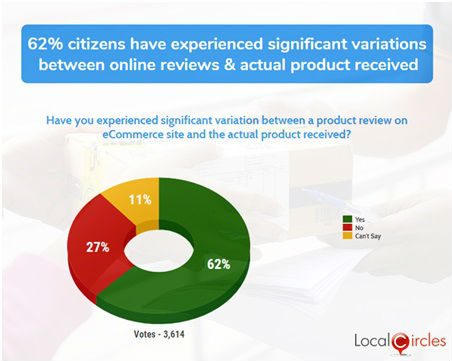
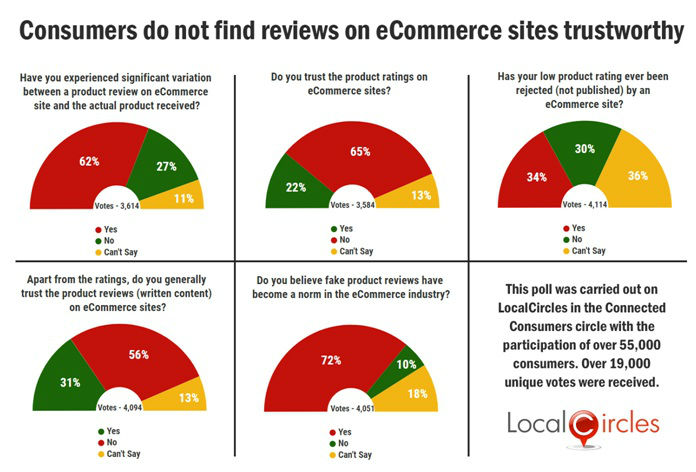
    The first poll asked consumers if they have experienced significant variation between a product review on ecommerce site and the actual product received. Surprisingly, 62% consumers replied with a yes, while 27% replied with a no. 11% chose not to answer.

    Many consumers rely on reviews from other users to decide if the product is fit to be bought or not. Tampering with these reviews leading to a purchase, hence is nothing less than trying to cheating them.

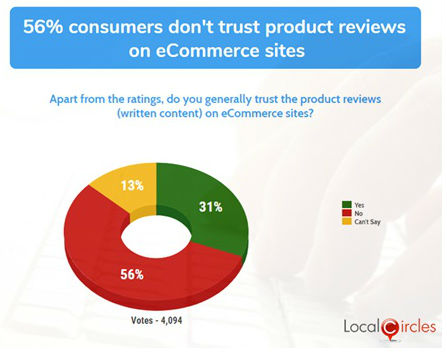
    The second poll asked consumers if they trusted the product reviews on ecommerce sites. 56% responded in a negative while 31% responses were an affirmative. 13% were unsure about it.

    Some consumers in a structured discussion had earlier reported that many e-commerce sites do not publish a bad product review written by the consumer on their site to make sure that the product sales are not hampered.

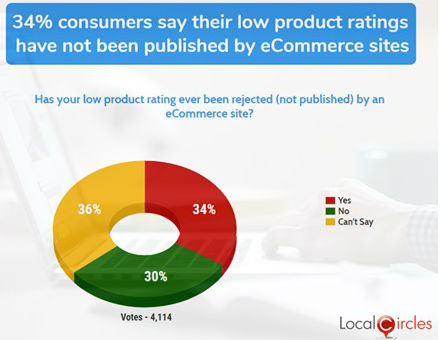
    The third poll asked consumers if their low product rating had ever been rejected (not published) by an e-commerce site. 34% consumers said it has personally happened with them and 30% said it had not happened with them. 36% were not sure about it.

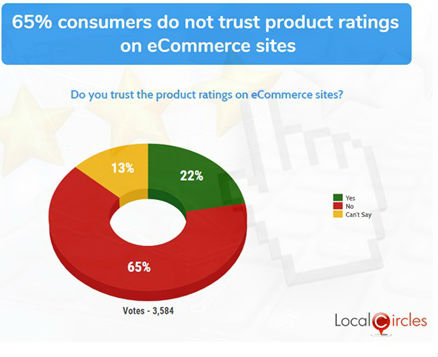
    In the next poll, 65% consumers said they do not trust product ratings on e-commerce sites. Only 22% said they trust them and 13% chose not to answer the question.

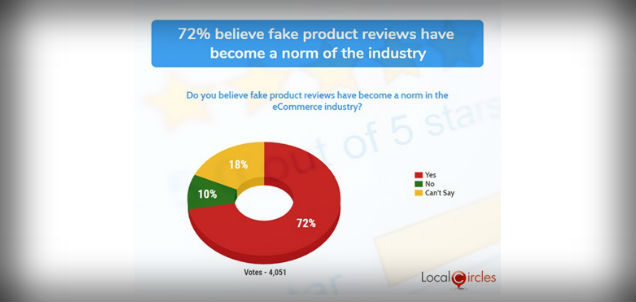
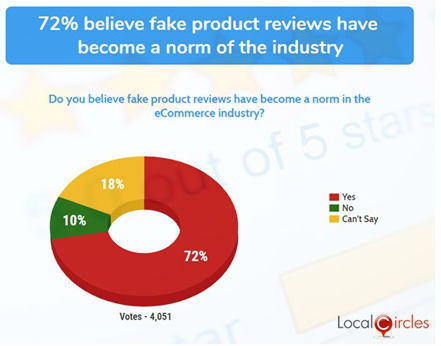
    In the last poll, 72% consumers said that they believe fake product reviews have become a norm in the e-commerce industry. 10% said this was not the case and 18% were unsure about it. Consumers mentioned that many businesses are thriving on their ability to provide fake ‘good reviews’ to the prospect buyers and in most cases once a business lists a product, the seller himself as an individual goes and rates and reviews the product. It is also very common for them to ask family and friends to rate and review their product. Some sellers even go to the extent of making a purchase from their own business so as to getting a “verified purchase” rating and review for their product. Consumers must take into account the number of ratings and reviews when buying on e-commerce sites, suggested some Local Circles members.

    Consumers suggested that publishing of all verified purchase reviews, even if negative, should be made mandatory for e-commerce sites. They also mentioned that PR companies found to be in the business of providing fake online reviews should be identified and penalised. Other suggestions included furnishing real first and last name of the reviewer should be made mandatory, e-commerce sites supporting the practice of fake reviews to be fined and a machinery to be created in the Department of Consumer Affairs, Government of India to keep close watch over the activities of the e-commerce companies as it relates to ratings and reviews.


  • Mobile now World’s 2nd Largest Ad Medium


    By A Correspondent


    WARC, the international authority on advertising and media effectiveness, has released its latest Global Ad Trends report. Focusing on mobile, the report includes key findings based on data from WARC’s 12 key markets – Australia, Brazil, Canada, China, France, Germany, India, Italy, Japan, Russia, United Kingdom and United States – which between them account for approximately two-thirds of the value of global ad trade.


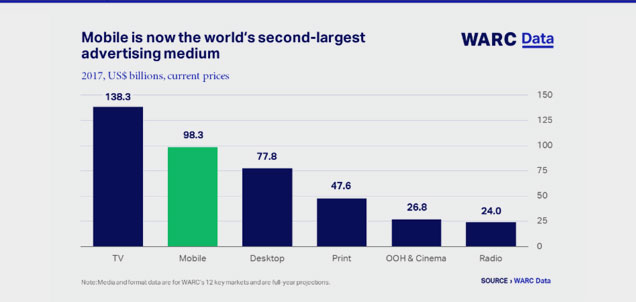
    Mobile is now the world’s second-largest advertising medium: Mobile is now the second-largest ad medium by spend, having overtaken desktop internet for the first time this year. With an anticipated year-on-year growth rate of 35.2%, mobile adspend across all formats is expected to amount to $98.3bn in 2017, representing 23% of global spend.

    WARC estimates that 51% of total mobile advertising expenditure for this year will be allocated to search. Display formats are expected to account for 45% and classified and other spend 4%.

    The largest mobile markets are the US, China and the UK. TV is expected to remain the world’s largest ad medium by spend this year and next, at around $139bn.


    Almost all of Facebook’s ad revenue now comes from mobile: Social networking accounts for over a third of daily online time via all devices (2hrs 15mins), and one in seven people (1.1bn) access Facebook via a mobile device each day.

    Mobile’s share of Facebook’s ad revenue is expected to equate to 88% ($34bn) for 2017, up 5 percentage points from 2016.

    With mobile display adspend expected to reach $45.2bn within WARC’s 12 key markets this year, there is a strong correlation between Facebook’s global mobile ad growth and the growth of mobile display in the markets. However whilst mobile growth will far outpace all other media, as Facebook’s mobile ad revenue growth eases (a forecast rise of 40% in 2017 versus 70% in 2016), global mobile display growth will also cool.


    Facebook and Google account for a quarter of global advertising spend: A comparison of company revenues with data in WARC’s Adspend Database, which contains adspend data for 96 markets, shows that the duopoly of Facebook and Google will account for 61% of all online advertising expenditure this year, up from 58% in 2016 and 47% in 2012.

    Further, the anticipated $133bn in combined revenue will equate to a quarter of all adspend worldwide in 2017, up from a fifth in 2016 and just 9.4% in 2012.

    Said James McDonald, Data Editor, WARC: “Daily mobile time has more than doubled over the last five years – from 1hr 17mins in 2012 to 3hrs 2mins in 2017 – and our research demonstrates how marketers are looking to capitalise on this by investing more in social, video and native mobile formats over the coming years. Much of this influx has been to the benefit of the duopoly – Facebook and Google – where one in four dollars ofglobal advertising is now spent.”


    Global Media Analysis: A round-up of the importance of mobile

    Mobile advertising accounts for:

    • 23% of global advertising spend this year
    • 55% of North American marketers aim to focus on mobile branded content by 2022
    • 88% of Facebook’s ad revenue attributed to mobile in 2017
    • 92% of Facebook’s daily users use mobile
    • 135% increase in daily mobile time since 2012


    Other new key media intelligence on WARC Data

    • Programmatic accounts for over a third of the value of US ad trade
    • Advertising expenditure has grown faster than the global economy since 1980
    • 100% pixels is twice as effective as current online video industry standard


    WARC Data is available by subscription only. For more information visit https://www.warc.com/data


  • AdEx to grow 12.1% in 2018: IPG Mediabrands


    By A Correspondent

    India ​will ​be a ​Rs ​1 t​rillion​ advertising market by 2022 India has waned through the lingering impact of currency exchange in November 2016 and pass through effect of unified tax structure in July this year​, notes IPG Mediabrands.​


    Transitory costs for introducing bold structural reforms have been paid and upswing in economic activity is strengthening. The bank recapitali​s​ation plan coupled with insolvency and bankruptcy code 2016 revives the sector and this will boost private investment. Revival in rural economy and growing middle class will boost economic growth. GDP in real terms is expected to grow +6.7% a speck slower than earlier projected +7.17%. In 2018 IMF report predicts growth of +7.4%.


    Advertising revenue will grow at CAGR of +12.1% in the next five years to touch INR 1.07 tn. Growth will be led by digital with +21.6%. Television will still rule the top as the largest media in 2022 with a market share of 41%. Digital and Print will have equal share of 25%. Mobile will displace desktop as the 3rd largest category by 2020.


    United States and China contribute close to 50% of the incremental ad dollars between 2018 and 2022 while India ranks third with a 6% contribution. The traditional categories like Print are so strong and growing YOY in India that over 60% of this incremental dollars is coming from traditional categories.


    The ​estimated Adex growth rate of +11.5% ​made ​earlier in June ​2017 ​has been revised marginally downwards to +11.1%. In 2018, ​IPG Mediabrands expect​s​ the Adspends to grow +12.1%. Categories driving up spends next year will be:-

    AUTO enjoys a strong domestic demand due to rising income, rising middleclass and a young population. Demand for commercial vehicles due to heightened infrastructure activity and government’s focus on electric vehicles to meet emission targets are some of the growth drivers.

    FMCG penetration will increase with modern trade growing faster in Tier-II and Tier-III cities. Raising disposable income among rural consumers, E-commerce strengthening their offering with daily products, evolving consumer lifestyle and government FDI policy is infusing growth.

    BANKING demand will raise thanks to increase in working population. Housing and Personal finance are key drivers. Government’s financial inclusion plan is expanding the reach of banking services and insurance coverage to rural segment.

    CONSUMER DURABLES demand will grow with rural electrification and e-commerce expansion.

    E-COMMERCE growth is propelled by increasing smartphone penetration, digital literacy combined with affordable data costs. GST will help E-commerce players to streamline supply chain and eliminate dual taxes. The sector is attracting more users from Tier-II and Tier-III cities.


    Net Advertising Revenues by category (​Rs Cr Net)


    Net Advertising Revenues: 2018-2022 (​Rs bn Net)


    Net Advertising Revenues:Top 10 markets (​USD Bn)


  • AdEx on all media drops much in Nov 2017 (vis-a-vis Oct)


    By A Correspondent


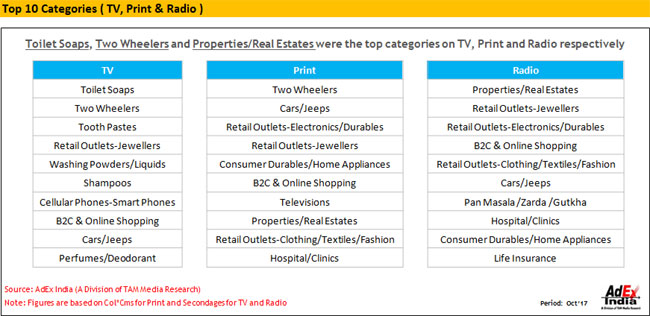
    Every week, MxMIndia in partnership with TAM AdEx brings you a scan of advertising expenditure across print, television and radio in various categories. And on a monthly basis, we bring you a view on how the adspends have been for a calendar month vis-à-vis the previous calendar month.


    October this year was particularly bad for television, though not as bad for print. But, in November, after the frenzy of the festive season, the drop is significant for print too.


    The data we bring you above and below is hence of particular interest:


  • Showbiz rules, and how!


    By A Correspondent


    ESP Properties, the sports and entertainment programming specialist arm of GroupM, has released the first edition of the entertainment marketing report Showbiz, The Indian Superpower. Segmented into three parts – film marketing, the celebrity aspect and content licensing – the first edition of the Showbiz report includes viewpoints of those who work to maximize brand value through film promotions.


    The film entertainment industry is growing at 10% year-on-year in terms of the number of films released. This opens numerous marketing opportunities for brands through alliances and content licensing. In India, marketing budgets for films have grown from 5-6% of production budget, to 10-15%, which is closer to the global average. 20% of films released include brand associations, where brands also share a part of the marketing budget. There is close to 56 hours of entertainment promotion films playing cumulatively through the day across channels. Today producers are working closely with agency partners that help them achieve their marketing objectives efficiently, and drive footfalls into the theatres.


    Vinit Karnik

    Said Vinit Karnik, Business Head, ESP Properties: “The film entertainment industry is an integral part of India’s marketing landscape and drives revenue for film production and exhibition. Traditional film studios and production houses now increasingly rely on advertising and digital media interaction, coupled with research, data analytics and innovation to market movies. At ESP Properties, we bring our client brands and movie marketing together to engage an audience that is spoilt for choice with 1000 movies released every year. Targeted marketing to the consumer has therefore become critical, and this report will give brands and film producers some insights into movie marketing in a media landscape that is so disruptive.”


    India, as a nation, attracts a large film audience, given the popularity of the medium. As the film market grows, the audience too has moved from linear, one dimensional advertising to a multi- channel and interactive dialogue with the film and brand communities. To create deeper engagement with the audience, brands and producers are exploring content licensing as an avenue to bring film characters and storylines into true life experiences. In India content licensing is growing at 7.4% year on year, which a higher than developed markets like the USA, UK and Canada (source: The top 150 Global Licensors report, License Global 2017)


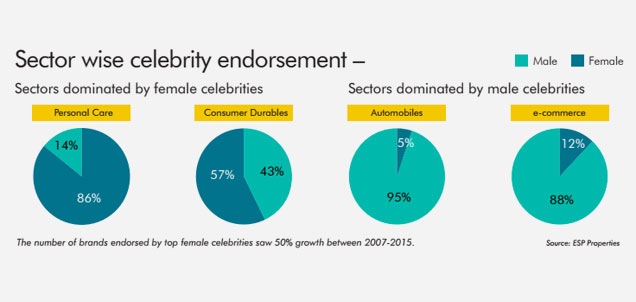
    Another data point that the ESP entertainment report brings out is on Celebrity endorsers. In the last 10 years, 25% of brand advertising on television feature a famous face. While we have seen peaks in ad creatives with celebrities during the summer and festive seasons, this trend is fast moving with the influx of digital avenues. And we see celebrities playing the role of active influencer to the brands rather than just endorsing them.


    As cinema remainsthe No.1 choice of entertainment in the country, the ESP Properties the entertainment marketing report is brief glimpse of the trends, ideas and insights into what will drive the industry.


    Executive Summary of the report

    Brand Alliances:

    • Total co-marketing media spends for Hindi films have reached approximately INR 100 crore around a year, with more co-branding than in-film
    • Keeping aside lack of digital boundaries and the reality of a global village, a regional film artiste still has the ability to converse directly with a specific demographic in a local language.

    That is why 25% of Hollywood films, 15% of south India films, 16% of Marathi films have brand associations

    • FMCG, Apparel and E-commerce for instance, are categories that are most active in in-film integrations and co-branded associations


    Film Marketing:

    • The ‘now-generation’ idea is to create a (film) product that generates positive word of mouth; ‘attracting’ audiences as well as ‘satisfying’t hem
    • Placement in terms of a healthy media-mix accounts for 10-15% of the film’s marketing budget
    • It is vital to identify and amplify the positioning of a film. Once it is identified exactly what kind of audience the film is made for, a marketer can then amplify “positioning elements” that highlight and reflect in all promotions for the film
    • A well-defined promotion plan must be put into place for personifying the cast and then promoting them. The build-up to the characters and creating a sense of one-ness with the audience is the crucial trick (without over-exposing the team)
    • Strategic PR and managing the millions of media outlets is the backbone of a film’s success


    • Partnering with emotion rather than pragmatism is what drives the business of entertainment
    • A typical, full-fledged marketing campaign begins with a teaser and takes the next five to eight weeks to position its stars, music etc. to the target audience


    Media Effectiveness:

    • Making accurate predictions about the scale of a film depends not just on its cost of production but also on how the film utilizes mainstream and ‘new media’ in an effective manner
    • On TV and digital, the song and dialog promotion dispersion is seen at 70:30. Assets related to music still form an integral part of film promotion, with 24×7 music channels assuming importance as vehicles of publicity
    • The film’s promotion budget is higher on television (45-50%) and lower on print (10-15%).

    Digital is getting added (10-15%) and activation is steady (25-30%)

    • The shelf life of a film in theatres is limited to two-three weeks after release (that too, only for big films), the release weekend gets heavy focus. The first weekend is also when production houses expect over 70 per cent of the total collection of the film


    Influencers:

    • Brand chooses endorsers and influencers for multiple reasons- launch, sustenance and revival
    • In a celebrity endorsement, the celebrity is the face of a brand message. In influencer marketing, the influencer is perceived to be ‘creator’ of the entire message
    • Woman power made it to the ‘top three’ of brand endorser list for the first time in 2017
    • Shah Rukh Khan and MS Dhoni have consistently been among the top endorsers in the past decade
    • An influencer’s social media presence is a huge pull for a brand or a film’s promotional plan. It also enables brands to amplify and measure the effectiveness of a campaign


    Licensing the Content:

    • Industry sources predict India’s licensing growth at 7.4 per cent, which is higher than the growth in USA, Canada and UK combined
    • Significant players in the market that represent international and Indian IPs Green Gold who is the market leader among the others who are Disney, Dream Theatre, Viacom, Bradford Licensing, AI Licensing and Sony


    • Hollywood properties dominate the licensing market. Superhero franchises and character-led entertainment takes up bulk of licensing deals. Films such as Captain America and Batman series are windfall for F&B and apparel brands
    • The top 150 global licensors (which include non-film brands too) reported total retail sales of INR 1,751,200 Cr worldwide in 2017. India’s share in the global licensing pie is 5-7%
    • Start-up licensing agencies now eyeing the big millions with popularity of TV series such as Game of Thrones, Indian characters such as Chhota Bheem and Japanese anime such as Doraemon


    Digital Marketing & Strategy

    • The total number of YouTube channels in India at the end of 2016 was 13,99,000+, the views clocking in a neat 22375 crore, our subscribers standing at 4118.5 lakhn and uploads at a staggering 97.5 lakh. Not surprisingly, the top YouTube channel in India across categories is the one that thrives on launching some of Hindi films’ biggest assets – T-Series, followed by SET India and the children’s animation channel Chu Chu TV
    • In the decade of 2007-2017, digital media strategy played a lead role in the industry making a departure from a ‘single-event’ launch or press interaction to an entire campaign spanning weeks or months
    • Hindi films’s most successful digital teams use analytic tools such as ‘Vidooly’ (for video intelligence), Lexalytics (for sentiment scores) and Buzz Engine for film promotions
    • The capabilities of command centers and content analytics will increase exponentially and thus, content (shows, films, events, etc.) will be able to meet larger audiences


    Please click here for detailed PDF


  • Are our Print Pashas mature enough to accept IRS 2017?


    By Pradyuman Maheshwari


    The Indian print industry is much-pampered. While television should rule in a country with a low literacy rate, it’s the print players who appear to get all the sops. There’s a 5 per cent GST on advertising in print. It’s 18 per cent in other media.

    There is no restriction on advertising volume in print. And there is no government rulings or guidelines for bodies in the business of audience/reader measurement of newspapers and magazines.

    Net-net, it’s a near-free-for-all.

    Now what happens when you leave kids without any control. They can grow to be very independent and confident adults, or can go offtrack. Our print players may not have gone astray, but it wouldn’t be incorrect to say that many of them have acted with loads of immaturity when it comes to readership measurement.

    We aren’t recommending government intervention in monitoring as the broadcasters led by news channels invited upon themselves, but there’s reason for worry given that the Advertising Agencies Association of India and the Indian Society of Advertisers, the two apex bodies of agencies and clients, haven’t flexed their muscles and told newspapers and magazines that if they reject measurement studies, they will not get any ads.

    IRS 2017 is due to be released in the third week of January 2017. While there is no specific date given, this would mean any day starting Monday, Jan 15 to Friday, January 19.

    According to a communique, the “IRS Techcom, RSCI, MRUC along with the Nielsen team have left no stone unturned in their endeavour to provide the industry with a reliable and robust study. The team focussed on enhanced levels of scrutiny adopted via frequent field visits, backchecks, use of GPS tracking devices, audio recordings, and quarterly validations. There was also an encouraging response from media agency personnel who took part in field backchecks and accompaniments. Data validation for all the four fieldwork quarters for IRS 2017 was successfully completed last month.”


    Commenting on the release of the report, Ashish Bhasin, Chairman, MRUC and Chairman and CEO – South Asia, Dentsu Aegis Networks, said: “Absence of IRS data in the past three years or so has impacted our industry in many ways. It was difficult for the agencies to plan without the availability of a comprehensive and reliable study, which provides valuable information on product ownership, demographics, and media consumption habits, across markets. Advertisers and Publishers, in particular, relied heavily on intuition and market perception, leading to loss of opportunity in maximising profitability. We are delighted that the IRS is back and we expect that this will set a new standard for Print Research globally.”


    Pratap Pawar, Vice Chairman, MRUC and Chairman, Sakal Media Group, added, “The print industry has been eagerly awaiting the release of IRS. I would like to thank the stakeholders for having shown tremendous patience and also for providing their unstinted support to the industry study, which was really great to see. Going forward MRUC and the IRS would continue to deliver the best and tread on higher paths of glory.”


    And this is what Shashi Sinha, RSCI Managing Committee Chairman, and CEO, IPG Media Brands, stated: “There is no other readership study in the world other than the IRS that caters to a complex and diverse market like India with a sample as large as 3 lakhs plus households, and with a methodology designed to deliver gold standard research. I believe the RSCI Techcom and the MRUC has put in a lot of effort to perfect the upcoming Report, making it future-ready and synonymous with the market truths.”


    Added NP Sathyamurthy, Chairman – RSCI Technical Committee and Executive Director, DDB Mudra Group: “After months and months of dedication, we have come out with a product that we believe is truly world-class. The IRS has constantly innovated with new technology led solutions to improve veracity of data capture quarter-on-quarter, and the sheer focus on data scrutiny which we deployed makes us believe that the new improved IRS would reap rich dividends for the industry stakeholders.”


    It’s important to read the above quotes at what they are stating and what’s possibly written between the lines:


    So let’s interpret these quotes for you:


    Ashish Bhasin: Lack of measurement data has nailed the industry and resulted in loss of opportunity in maximising profitability of newspapers doing well.

    Pratap Pawar: Thanks for the patience folks, we are back.

    Shashi Sinha: Conducting an IRS is a complex task but we’ve achieved it

    NP Sathyamurthy: It’s new, improved


    Now here’s what the four gentlemen possibly wanted to say, but they couldn’t have in an official communique:


    Bhasin: If you don’t accept IRS 2017 as currency, print players are going to get screwed

    Pawar: Grow up, guys. Accept the data.

    Sinha: We’ve done as well as we can. It’s robust. Now junk it at your own peril

    Sathyamurthy: We’ve taken care to not repeat the mistakes of the past, so please accept the data

    Having tracked readership and audience measurement systems actively for a while, it’s clear that it’s a lose-lose if the print majors rejected IRS 2017.


    According to the grapevine, the going may not be as bad as it was the last time. Care has been taken to plug all possible holes, and ensure that there are no booboos. Also, the data has been validated and is kind-of under control.


    But it’s possible that English newspapers will take a hit given the emergence of digital as a big force. And this could lead to some angst. It’s possible that there will be some reversal of fortunes among some regional players too given that a lot has happened over the last five years.


    Does this mean that there could be litigation and MRUC/RSCI will be taken to court? It would be foolhardy to think there wouldn’t be. And MRUC/RSCI would be well-advised to have their lawyer retainership renewed and ready with her/his arguments.


    ~~


    It’s important to note here the tremendous work done on the establishment of BARC for television measurement in the last three years. That BARC has been a super success despite the stakes being much higher in television is thanks to a variety of factors.


    1. Television is largely professionals-driven. While owners are active, professionals understand the dynamics of the business and do know that what is down can also go up.

    2. The importance of the owners and CEOs to deal with data with maturity. One of the primary reasons for BARC taking off was the presence of Punit Goenka as Chairman. Despite flagship channel being humbled in the first few weeks, Goenka is said to have given the green signal to the launch of BARC. Does MRUC/RSCI have someone who is even close to Punit Goenka in terms of maturity to deal with indifferent data?

    3. A robust technical committee: The BARC techcom is headed by IPG Mediabrands CEO Shashi Sinha, who heads RSCI, the real ‘custodian’ of the IRS. It’s critical for any techcom to be wordly wise as well as firm and able to take along the diverse ecosystem. Sinha managed that fantastically, and the print sector is lucky to have him active on IRS.

    4. A superstrong secretariat. No industry-owned body can be successful if you do not have a secretariat that’s strong and can ward off the nasty (if not evil) forces. In CEO Partho Dasgupta, BARC had that. The next few months will need MRUC CEO Radhesh Uchil to be the same with all the holy cows of the business. And if necessary bare his fangs…


    At MxMIndia, we will monitor the launch of IRS 2017 and also give you the real story post that. But in the interests of the industry and the print sector, we hope we don’t have to do burn the midnight oil post the launch.

  • IRS 2017 to release on Jan 18

    By A Correspondent [updated with time and venue]


    So the verdict on how the various newspapers and magazines are doing will be known in a few days from now. On Thursday, January 18, from 3 to 5pm at the Jade Garden, Nehru Centre, Worli.


    Ashish Bhasin

    Confirming the date, Ashish Bhasin, Chairman, MRUC and Chairman and CEO – South Asia, Dentsu Aegis Networks, said in a statement: “IRS has played a vital role in shaping media research in India for the past two decades, and I’m confident that the 2017 report will further enhance its role and credibility of being an industry study. I would like to thank all the MRUC and RSCI Members for their contributions in making the study robust.”


    The IRS 2017 Report records the highest ever sample size of over 3 lakh individuals across the country. Apart from being the currency for print planning, it is the most authentic and widely used source of media and consumer insights for advertisers, publishers, agencies, and broadcasters, notes a communique.


  • Digital will be 24% of advertising ind by 2020


    By A Correspondent


    The digital ad industry is estimated to grow with a CAGR of 32% by 2020, notes a Dentsu Aegis Network-Exchange4media report. Yes, please do note that we have named Exchange4media in this report despite the fact that it is another player in our space. For, it’s important that it be given credit when it’s due. Also, unlike last year, when e4m disallowed hosts Dentsu Aegis Network (DAN) to invite other media, this year, DAN did invite us. Also, we don’t consider exchange4media as competition. And even if it were to be one, we think it’s important that a non-legacy media player thinks progressively.


    Point made, now let’s move to the highlights:

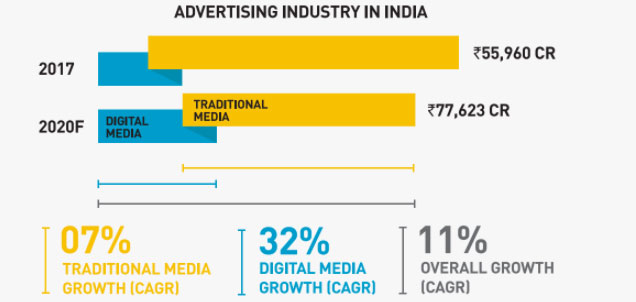
    :: The Indian ad Industry is estimated to grow with a CAGR of 11% till 2020.

    :: Ad spends have seen double digit growth rates in e-commerce, BFSI, Automotive and Telecom.

    :: Digital Ad industry is estimated to grow with a CAGR of 32% by 2020.

    :: Advertisers are now adopting Digital media as a branding medium, not merely a performance medium.

    :: It currently contributes 15% to the total advertising Industry in India and this is expected to reach 24% of the entire market by 2020.

    :: E-commerce followed by telecom and BFSI spend the highest proportion of ad budget on digital media.

    :: Spends on Digital Video is expected to see the highest growth rate followed by Display and Social Media.

    :: OTT and an engaging mobile experience will drive the growth of the Digital Industry.


    And here’s more sector-wise:

    1. Automotive:

    a. Automotive sector has had one of this highest growth in Ad spends.

    b. They still spend a large majority of their ad budget on Traditional media

    c. Within digital, they distribute their budget across all ad formats.


    2. E-commerce:

    a. Growth in ad spends for E-Commerce has been the highest.

    b. They spend the highest proportion of their marketing budget on Digital media.

    c. They spend mostly on search and social media.


    3. Technology: This is a very broad term in terms of industry segments. Including the insights for Telecom.


    4. Telecom:

    a. Telecom sector has seen one of the highest growth in ad spends.

    b. This segment spends a high amount of their marketing budget on Digital media.

    c. They spend their digital media budget mostly on social media and video.


    5. BFSI:

    a. The growth in ad spends for BFSI has been one of the highest, next only to E-Commerce.

    b. This segment spends a high amount of their marketing budget on Digital media.

    c. Their digital media budget is spent mostly on search and display.


    DAN Report Design