Category: RESEARCH

  • Is your company ready for Social CRM?


    By PrabhakarMundkur


    Take what happened to one of my friends last week. A very reputed retail chain owned by one of the most trusted companies in the country let him down very badly. A washing machine he had bought last year and was still under warranty let him down. Unfortunately my friend had opted to buy the own store brand of the retail chain rather than a LG or a Samsung or some other more reputed make. The washing machine stopped working suddenly. There has been no response from this well known retailer for over a week and finally my friends name was struck off the complaints list without his even knowing it. He then had to go through the trouble of re-registering his complaint in which he lost another seven days.


    He decided to complain about his experience on social media since he thought it might be at least mildly embarrassing. To their credit their Twitter handle started conversing with him almost within five minutes. The very next day the Hyderabad call centre of the retain chain called my friend and began to make at least some amends for the neglect shown to him by Customer Service. His case however still remained unresolved. The mechanic attending the complaint said that if my friend went back to the store where the washing machine was purchased from, he would have a replacement with a new machine. But when my friend reached the store all he heard was an ugly altercation between the Customer Service Representative and the Mechanic where the Customer Service executive fired the Mechanic for making false promises of product replacement to the customer. He went on twitter again to update the latest status on his case and the company’s Twitter handle once again promised to get the case resolved at the earliest. In the meantime my friend is biting his nails on what is going to happen to his washing machine.

    While in many ways social media has become the new face of Customer Service(because traditional Customer Service is completely out of touch with customers ) the above case is a sure sign that the biggest brands in the country need to do a better job of their Social CRM. In a way Social CRM takes over where traditional CRM left off. Unfortunately traditional CRM still operates on a 9am to 5pm basis and they wouldn’t care a hoot what happens to customers once they leave their office. Social CRM on the other hand is 24×7. Because customers may need help at any time of day or night.


    What is Social CRM?
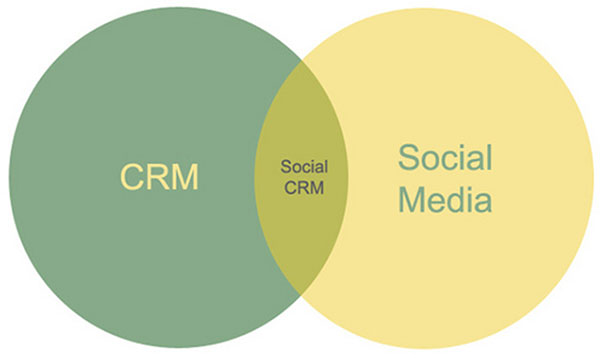
    But first of all let’s start by defining Social CRM. Social CRM (customer relationship management) is a phrase used to describe the addition of a social element in traditional CRM processes. Social CRM builds upon CRM by leveraging a social element that enables a business to connect customer conversations and relationships from social networking sites in to the CRM process. Social CRM may also be called CRM 2.0 or abbreviated as SCRM (social customer relationship management).


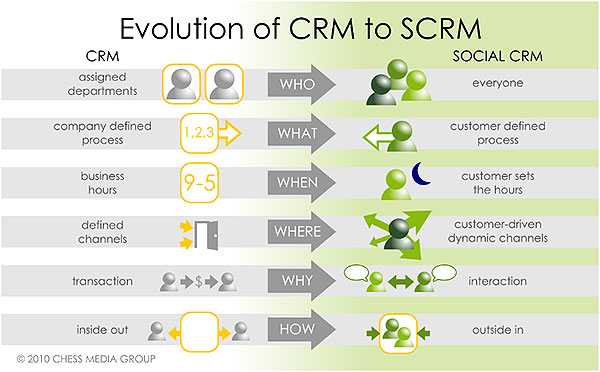
    Social CRM takes over where CRM left off
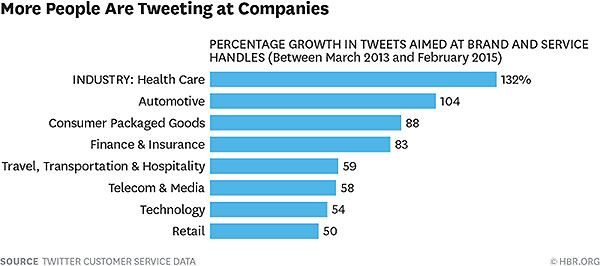
    People under 35 spend almost four hours on social media, and more of that time is being spent engaging with brands. One piece of research has shown that the volume of tweets targeted at brands and their Twitter service handles, for example, has grown 2.5x in the past two years. Similarly, the percentage of people who have used Twitter for customer service leapt nearly 70%, over a two year period. McKinsey’s analysis shows that 30% of social media users prefer social care to phoning customer service.


    The most successful social media interactions are personal, genuine, and relevant. To scale that connectivity requires integrating social media data into your CRM system.


    You could be forgiven for treating the idea of “social CRM” with a certain amount of scepticism. It just sounds like a buzz word. Also it is sometimes hard to distinguish the hype around social media from the genuine value it can bring. But social CRM isn’t a gimmick, and it doesn’t ask you to “forget everything you know” or “reinvent your business”.


    Social CRM simply adds a social dimension to the way you think about customers and your relationships with them.


    Given the current state of customer service, Social CRM would be an important weapon in the armoury of brands that have large number of customers. Its not enough to just have a twitter handle or a Facebook page. That doesn’t complete your Customer Service or your Social CRM.


    Why is Social CRM important?

    It’s a familiar story. Marketing departments are diligently creating and publishing tweets, Facebook posts, and YouTube videos, carefully crafted to make the most of each channel and designed to encourage sharing, retweeting and customer engagement. But the audience doesn’t come.


    Meanwhile, your customers are elsewhere on Facebook and Twitter, having conversations about your organisation – discussing you, recommending you, complaining about you and even trying desperately to talk to you. But they’re not getting the answers they want.


    Social CRM bridges the gap. No more forcing customers to use the channel you prefer. No more losing track of issues when they change channels. You can engage and respond to customers individually and in the way they choose.


    With Social CRM you can place your customer right at the heart of your organisation.


    Veteran adman Prabhakar Mundkur is currently Chief Mentor at HGS Interactive
     

  • Internet users to cross 450mn by mid-2017: IAMAI-IMRB


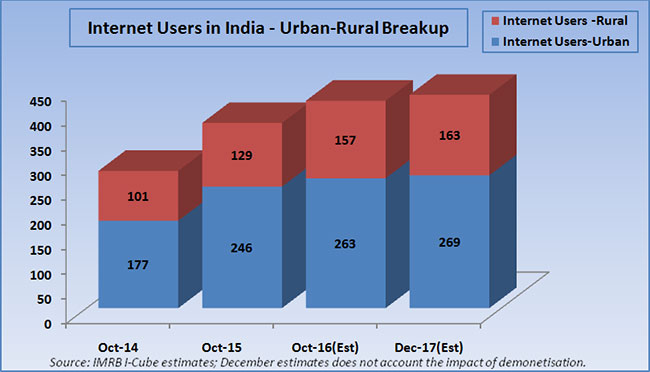
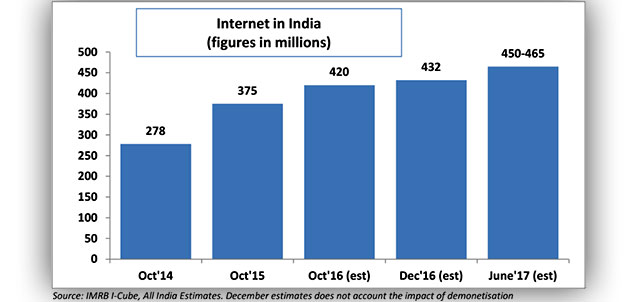
    It’s raining surveys and studies in the A&M industry. But this one is sure to be quoted in various forums through the year. The number of Internet users in India isestimated to be 432 million in December 2016according to a report ‘Internet in India 2016’, jointly published by the Internet and Mobile Association of India and Kantar IMRB on Wednesday. The number of Internet users is expected to reach between 450-465 million by June 2017.


    While the growth of internet usage in India is mainly being fuelled by the rural sector,the urban user base starting to show signs of levelling out.


    In Urban India, there were estimated 269 million internet users in December 2016, while in Rural India, there were 163 million Internet users. The report finds that urban India has close to 60% internet penetration,reflecting a level of saturation. However, with Rural India having only 17% penetration, there is still large scope of development.


    The future growth policies therefore must focus on bridging the digital divide that exists between urban and rural India today. In terms of numbers, Urban India with an estimated population of 444 million already has 269 million using the internet. Rural India, with an estimated population of 906 million as per 2011 census, has only 163 million internet users. Thus, there are potential 750 million users still in rural India; if only they can be reached out properly.


    Frequency:

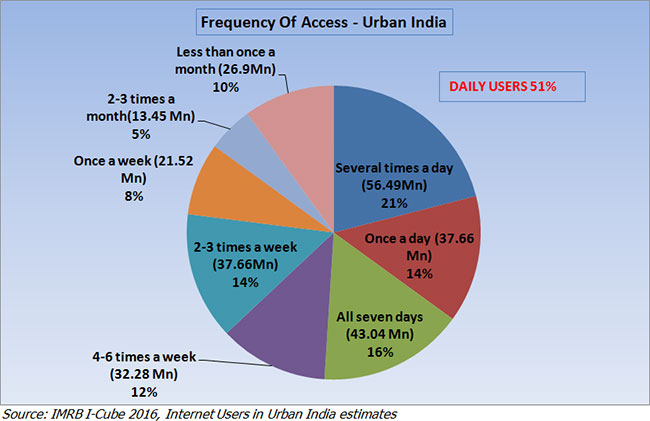
    The report also finds that 51% of urban Internet users or 137.19 million use internet daily. On the other hand, 242 million or 90% of the urban internet user’s user’s use internet once a month.


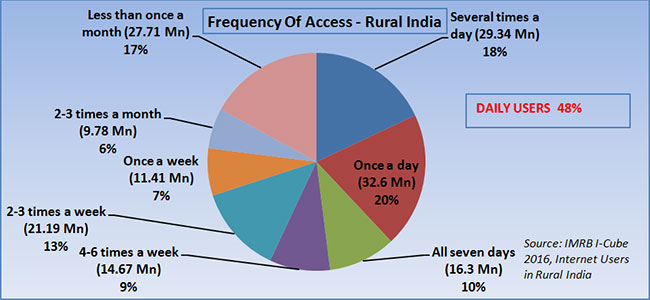
    In Rural India, 48%or around 78 million are daily internet users. On the other hand, around 140 million or 83% of the rural internet user’s user’s use internet once a month.


    Gender:

    Among the Rural Internet users, the ratio between male to female Internet users is 75:25. The proportion of Internet users by gender in Rural India has seen much change over last year with Internet users among rural females growing at 30%. The increasing gender parity in internet usage is a welcome development.


    Demographics:

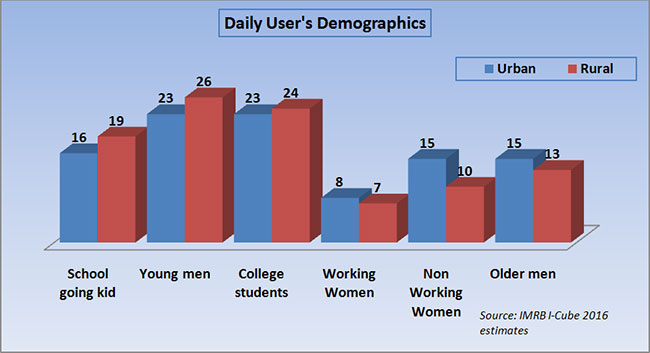
    An analysis of ‘Daily Users’ reveal that both in Urban and Rural India, the younger generations are the most prolific users of internet. The gender ratio is slightly better in Urban India, while both urban and rural India show almost similar ratios of working and non-working women registering as daily internet users.


  • Total viewership jumps 18% as BARC updates TV universe

    By A Correspondent


    BARC India has released its weekly viewership data today (Thursday, March 2) basis a revised Universe Estimate (UE), which is based on the results of Broadcast India Survey undertaken to ascertain the TV universe and Television Viewing Habits in the country.  With this, BARC India has updated and aligned its TV Universe in line with ground level changes in demographics, TV ownership and connection type, language preference, changes in NCCS profiles etc, notes a communique.


    The fieldwork for the Broadcast India Survey was carried out over Nov 2015 to Feb 2016, and covered 3,00,000 homes across 590 Districts comprising about 4300 Towns/Villages. All 1 Lakh+ towns were covered, while towns below 1 Lakh were selected by a Probability Proportional to Size (PPS) method, the communique notes, adding: “With the new UE, Week 8 has seen a significant increase of 18% in Total TV viewership in the country. Total TV impressions have grown from 22.7 billion in week 7 to 26.7 billion impressions in week 8.”


    Said Partho Dasgupta, CEO, BARC India: “BI 2016 is one of the biggest survey’s done in the country so far. The TV universe in India is ever growing and changing and so is the profile and choice of a TV viewer. The last survey done was in 2013 and the last Census was in 2011. The consumer and viewer landscape is changing rapidly – with electrification, prosperity, changing modes of signal and digitisation. We wanted to reflect this change in viewership numbers and hence conducted our own Establishment Survey. This will help our subscribers and the eco system align their strategies for better targeting. The new reality is TV viewership is rapidly growing and how.”


    And here’s more from the communique:

    “The study also highlights the fact that TV HHs have grown faster in NCCS B and C, thus increasing the share of the middle class. While NCCS A has dropped from 22% to 21%, NCCS B and C have gone up from 24% to 27% and 31% to 32% respectively. NCCS D/E on the other hand has de-grown from 23% to 20%. These trends are in line with fragmentation of family sizes (leading to lower average family sizes) and rising economic growth and rising prosperity. It also shows that India has more nuclear families without elders than ever before, and it is also the dominant family group among TV owning homes. While composition of joint families in the universe has come down from 26% to 22%, nuclear families with elders has grown from 53% to 58%.


    “Some key changes have been seen in the BI study like electrification, migration, digitisation, rise in smaller and nuclear family culture, increase in middle class, inclusion of rural markets and single TV households which has an impact on TV viewership behaviour.


    “BI-2016, the report based on the survey, contains not just an updated count and composition of TV homes across urban and rural India, but also offers data and insights that would be of immense value to marketers and advertisers. It contains granular data and information on media consumption habits of Indians, as well as select durable ownership and packaged goods purchase profiles. It is an updated database of Indian consumer behaviour.” 

    Highlights of Week 8 Data:

    Week:8 Top 5 Channels – Hindi GEC

    Rank

    Channels

    Impressions (000s) sum

    1

    STAR Plus

    712076

    2

    Colors

    640525

    3

    Rishtey

    537507

    4

    Sony Pal

    523334

    5

    Zee TV

    508260

    HSM (U+R) : NCCS All : 2+ Individuals


    Week:8 Top 5 Channels – Hindi GEC Urban

    Rank

    Channels

    Impressions (000s) sum

    1

    STAR Plus

    476677

    2

    Colors

    429120

    3

    Sony Entertainment Television

    324587

    4

    Zee TV

    281062

    5

    SONY SAB

    269453

    HSM (Urban) : NCCS All : 2+ Individuals


    Week:8 Top 5 Channels – Hindi GEC Rural

    Rank

    Channels

    Impressions (000s) sum

    1

    Rishtey

    409571

    2

    Zee Anmol

    400799

    3

    Sony Pal

    373988

    4

    STAR Utsav

    342382

    5

    STAR Plus

    235398

    HSM (Rural) : NCCS All : 2+ Individuals


    Week:8 Top 3 Channels – Hindi Movies

    Rank

    Channels

    Impressions (000s) sum

    1

    Sony MAX

    434571

    2

    Sony Wah

    414650

    3

    Zee Cinema

    364194

    HSM (U+R) : NCCS All : 2+ Individuals


    Week:8 Top 3 Channels – Hindi Movies Urban

    Rank

    Channels

    Impressions (000s) sum

    1

    Sony MAX

    255351

    2

    STAR Gold

    217667

    3

    Zee Cinema

    197575

    HSM (Urban) : NCCS All : 2+ Individuals

    Week:8 Top 3 Channels – Hindi Movies Rural

    Rank

    Channels

    Impressions (000s) sum

    1

    Sony Wah

    314442

    2

    Zee Anmol Cinema

    269749

    3

    STAR Utsav Movies

    227191

    HSM (Rural) : NCCS All : 2+ Individuals


    Week:8 Top 3 Channels – Hindi News

    Rank

    Channels

    Impressions (000s) sum

    1

    AajTak

    126940

    2

    India TV

    101439

    3

    ABP News

    93517

    HSM (U+R) : NCCS All : 15+ Individuals


    Week:8 Top 3 Channels – Hindi News Urban

    Rank

    Channels

    Impressions (000s) sum

    1

    AajTak

    66923

    2

    India TV

    56958

    3

    Zee News

    52611

    HSM (Urban) : NCCS All : 15+ Individuals

    Week:8 Top 3 Channels – Hindi News Rural

    Rank

    Channels

    Impressions (000s) sum

    1

    AajTak

    60016

    2

    India TV

    44481

    3

    ABP News

    43232

    HSM (Rural) : NCCS All : 15+ Individuals


    Week:8 Top 3 Channels – English Business News

    Rank

    Channels

    Impressions (000s) sum

    1

    CNBC TV 18

    530

    2

    ET Now

    255

    3

    NDTV Profit and NDTV Prime

    73

    All India (U+R) : NCCS AB : Males 22+ Individuals

    Week:8 Top 3 Channels – Eng News

    Rank

    Channels

    Impressions (000s) sum

    1

    Times Now

    798

    2

    India Today Television

    498

    3

    CNN News18

    404

    All India (U+R) : NCCS AB : Males 22+ Individuals

    Week:8 Top 3 Channels – English Entertainment

    Rank

    Channels

    Impressions (000s) sum

    1

    Zee Café

    275

    2

    STAR World

    232

    3

    Comedy Central

    230

    6 Mega Cities : NCCS AB : 2+ Individuals

    Week:8 Top 3 Channels – English Movies

    Rank

    Channels

    Impressions (000s) sum

    1

    STAR Movies

    2639

    2

    Movies Now

    2636

    3

    Sony PIX

    1883

    6 Mega Cities : NCCS AB : 2+ Individuals

    Week:8 Top 2 Channels – Hindi Business News

    Rank

    Channels

    Impressions (000s) sum

    1

    CNBC Awaaz

    1787

    2

    Zee Business

    1204

    HSM (U+R) : NCCS AB : Males 22+ Individuals


    Week:8 Top 3 Channels – Infotainment

    Rank

    Channels

    Impressions (000s) sum

    1

    History TV 18

    5567

    2

    Discovery Channel

    4897

    3

    Animal Planet

    3082

    6 Mega Cities : NCCS AB : 2+ Individuals


    Week:8 Top 3 Channels – Kids

    Rank

    Channels

    Impressions (000s) sum

    1

    NICK

    105172

    2

    Cartoon Network

    79562

    3

    Pogo TV

    73350

    All India (U+R) : NCCS All : 2 – 14 years Individuals


    Week:8 Top 3 Channels – Music

    Rank

    Channels

    Impressions (000s) sum

    1

    Mastiii

    179053

    2

    B4U Music

    116500

    3

    9XM

    106247

    All India (U+R) : NCCS All : 2+ Individuals

    Week:8 Top 3 Channels – Sports

    Rank

    Channels

    Impressions (000s) sum

    1

    STAR Sports 3

    113412

    2

    STAR Sports 1

    90453

    3

    Ten 1

    75244

    All India (U+R) : NCCS All : 2+ Individuals


    Week:8 Top 3 Channels – Youth

    Rank

    Channels

    Impressions (000s) sum

    1

    Zing

    14374

    2

    MTV

    9992

    3

    Bindass

    7791

    All India (U+R) : NCCS All : 15 – 21 years Individuals


    Week:8 Top 3 Channels – Lifestyle

    Rank

    Channels

    Impressions (000s) sum

    1

    Living Foodz

    1383

    2

    Fox Life

    946

    3

    FYI TV18

    796

    6 Mega Cities : NCCS AB : 2+ Individuals


    Week:8 Top 3 Channels – Kannada

    Rank

    Channels

    Impressions (000s) sum

    1

    Colors Kannada

    375996

    2

    Zee Kannada

    295263

    3

    Star Suvarna

    253946

    Karnataka (U+R) : NCCS All : 2+ Individuals


    Week:8 Top 3 Channels – Malayalam

    Rank

    Channels

    Impressions (000s) sum

    1

    Asianet

    277807

    2

    MazhavilManorama

    99324

    3

    Surya TV

    76831

    Kerala (U+R) : NCCS All : 2+ Individuals


    Week:8 Top 3 Channels – Marathi

    Rank

    Channels

    Impressions (000s) sum

    1

    Zee Marathi

    272174

    2

    Colors Marathi

    75169

    3

    Zee Talkies

    71598

    Mah/ Goa (U+R) : NCCS All : 2+ Individuals


    Week:8 Top 3 Channels – Tamil

    Rank

    Channels

    Impressions (000s) sum

    1

    Sun TV

    1010396

    2

    KTV

    294777

    3

    Zee Tamil

    225022

    Tamil Nadu/ Puducherry (U+R) : NCCS All : 2+ Individuals


    Week:8 Top 3 Channels – Telugu

    Rank

    Channels

    Impressions (000s) sum

    1

    Gemini TV

    551814

    2

    Zee Telugu

    467322

    3

    STAR Maa

    446110

    AP/ Telangana (U+R) : NCCS All : 2+ Individuals


    Week:8 Top 3 Channels – Bhojpuri

    Rank

    Channels

    Impressions (000s) sum

    1

    Big Ganga

    35992

    2

    Bhojpuri Cinema

    21223

    3

    Dangal TV

    12955

    Bihar/Jharkhand (U+R) : NCCS All : 2+ Individuals


    Week:8 Top 3 Channels – Bangla

    Rank

    Channels

    Impressions (000s) sum

    1

    STAR Jalsha

    363445

    2

    Zee Bangla

    198257

    3

    Jalsha Movies

    76437

    WB (U+R): NCCS All : 2+ Individuals


    Week:8 Top 3 Channels – Oriya

    Rank

    Channels

    Impressions (000s) sum

    1

    Sarthak TV

    89468

    2

    Tarang TV

    66156

    3

    Odisha TV

    32140

    Odisha (U+R) : NCCS All : 2+ Individuals

    Week:8 Top 3 Channels – Punjabi

    Rank

    Channels

    Impressions (000s) sum

    1

    DD Punjabi

    53222

    2

    PTC Punjabi

    47270

    3

    Chardikla Time TV

    37129

    Pun / Har / Cha / HP / J&K (U+R): NCCS All:  2+ Individuals

    Week:8 Top 3 Channels – Gujarati

    Rank

    Channels

    Impressions (000s) sum

    1

    Colors Gujarati

    13127

    2

    ABP Asmita

    7913

    3

    TV9 Gujarati

    7469

    Guj / D&D / DNH (U+R): NCCS All: 2+ Individuals

    Week:8 Top 3 Channels – Assamese

    Rank

    Channels

    Impressions (000s) sum

    1

    Rang

    15930

    2

    News Live 24×7

    15561

    3

    DY 365

    9156

    Assam / North East / Sikkim(U+R): NCCS All: 2+ Individuals


  • How Emotions Influences Advertising


    Using Consumer Neuroscience To Create Winning Campaigns

    By Dolly Jha and Moumita Ghoshal

    Numbers have long been known to be coldly accurate but thoroughly incapable of assessing softer aspects like emotions and feeling. However, ensuring that audiences connect with brand messaging is the next frontier of effective measurement.

    Today’s consumers access content across myriad media, but consumers in India continue to view television commercials to be among the most trustworthy sources of advertising. Given the prevalence of TV in consumers’ lives, however, viewers are bombarded with more ads than ever, making it that much more difficult for brands and agencies to create commercials that truly connect with their audiences. So what’s involved in building that connection?


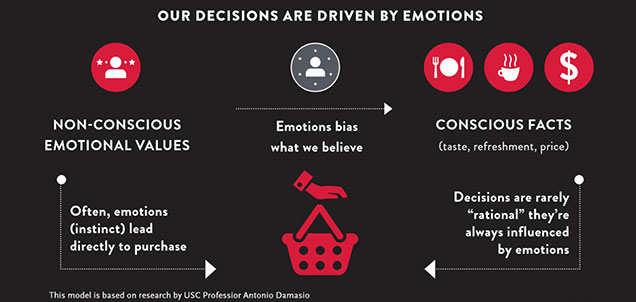
    The media industry has a long history of measurement solutions that assess an ad’s impact on its intended audience—understanding what works and what doesn’t. But they don’t determine whether an ad creates an emotional connection with the viewer. This represents a significant opportunity for marketers because studies show that purchase decisions are driven by emotions.


    Measuring Emotions

    Emotions are intangible, and measuring them is no small task. Direct response surveys can be misleading because they presume that respondents can accurately verbalise their emotions. Verbal responses require respondents to express, and therefore rationalise, their emotions as feelings. Emotions are instinctive reactions to external stimuli, whereas feelings are the mind’s interpretation of those emotions; and are therefore, subject to personal bias, culture, setting, past experiences and ingrained beliefs. Moreover, many emotions don’t break the surface of conscious awareness, making it impossible to be interpreted as feelings.


    For many modern researchers, using techniques that can directly measure neurological and biological reactions are the best way to evaluate emotions. These reactions can include heart rate, sweat, posture, facial reactions, electrical impulses in specific regions of the brain, etc. Those techniques are collectively referred to as neuroscience, and recent technical innovations in this field are helping break new ground in our understanding of consumer behaviour. They’re also setting a new standard for ad testing.


    Using Neuroscience For Ad Testing

    Neuroscience provides a deep, clear view into the real world—the real-time reactions of consumers at the most elemental level: their brainwaves. The human brain reacts to stimuli in milliseconds, and by capturing these reactions deep within the subconscious, consumer neuroscience can reveal exactly how consumers perceive brands, marketing and the message—at the most granular level. Pure, instantaneous, unfiltered responses measured at the subconscious level of the mind offer far more accurate and reliable insights than other consumer research methodologies.


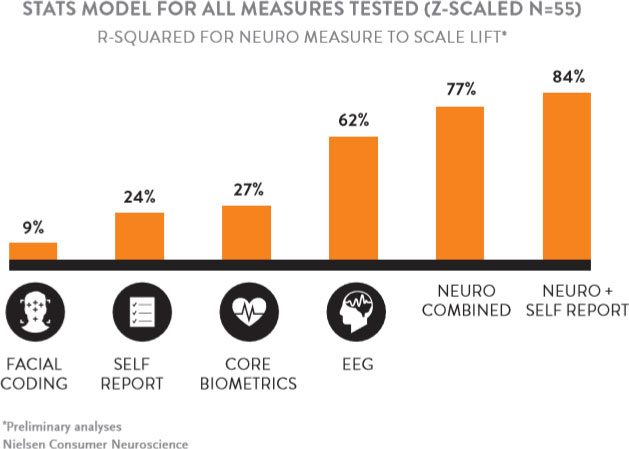
    As of today, the complete neuroscience toolkit includes EEG, core biometrics such as heart rate and skin response, facial coding and eye tracking. While EEG provides detailed second-by-second diagnostics on the effectiveness of the stimulus, biometrics provides the depth of engagement and facial coding reveals the depth of expressed emotion.


    While all of these predict sales to some degree (EEG being the most predictive of them all), a combination of all these neuroscientific measures provides the highest level of prediction – almost 77%. While articulation in itself is much weaker in terms of predictability, when integrated with the combination of neuroscience tools enhances the predictability to almost 84%!


    This clearly establishes how consumer neuroscience scores over articulated research responses, which fail to indicate with sufficient level of precision, which of the aspects of a brand and marketing are going to work, and which ones aren’t.


    Consumer neuroscience measures two sets of neurometrics.


    Primary metrics result from real-time activity in the brain.

    :: Attention: It is a measure of how much brain energy one has to devote to decipher what is being shown to them.

    :: Emotional Engagement: This indicates the extent to which the respondent is ‘drawn’ to the stimulus. It is the assessment of whether one is approaching or avoiding what they are seeing, and is by far the purest form of measuring how connected they feel with the stimulus.

    :: Memory Activation: This metric indicates the extent to which new memory connections get formed (encoding) or past memories are aroused (retrieval).


    Secondary metrics result from the interplay between two or more primary metrics.

    :: Overall Effectiveness: It indicates the holistic appeal that the stimulus is able to generate

    :: Action Intent: This is the likelihood of a change in behaviour or intent to act on a message.

    :: Comprehension: This indicates the extent to which the experience is understood or the extent to which it makes sense.

    :: Novelty: It is the likelihood of the ad standing out and being embedded into memory.


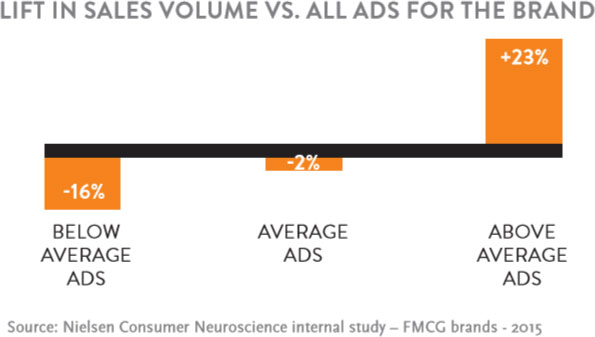
    A growing number of researches validate the fact that neuroscience based measures are predictive of sales. Findings from a study of 100 recent ads across 25 brands in the fast-moving consumer goods (FMCG) industry demonstrate how ads affect sales. The ads in the study were grouped into three buckets according to how they scored on a metric based on people’s electroencephalogram activity (EEG) while viewing the ad (‘Below Average, ‘Average’ and ‘Above Average’). Using robust marketing mix modelling, each ad’s contribution to sales volume was computed against the average ad for that brand. Overall, it was found that ads which generated above-average EEG scores were associated with a 23% increment in sales volume over what an average ad would generate. Similarly, below-average ads were associated with a 16% decline in sales volume.


    Case Study: Vodafone

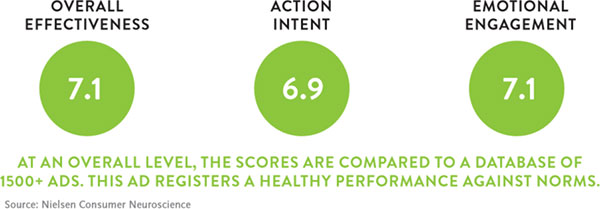
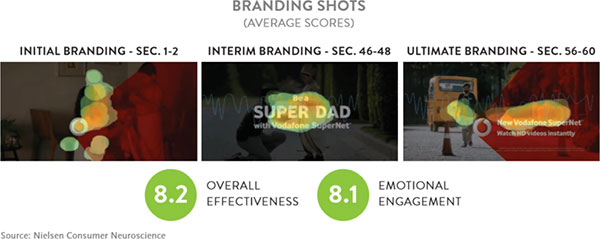
    The predictive ability of neuroscience measures isn’t restricted to the FMCG category alone. Savvy marketers with brands like Vodafone in the telecom category also use the principles of neuroscience to engage with consumers powerfully. A recent ad under the Vodafone SuperNet™ campaign, Vodafone Super Dad, delivered a healthy performance on all the critical neurometrics including overall effectiveness, action intent, and emotional engagement. The brand uses various technologies to assess and deliver a superior experience to its vast spread of customers across the country.


    The brand received positive audience feedback beyond internal expectations. Neuroscience-based research also showed that the appeal and engagement levels were heightened further whenever the brand was referenced in the ad; indicating a positive association with the brand.


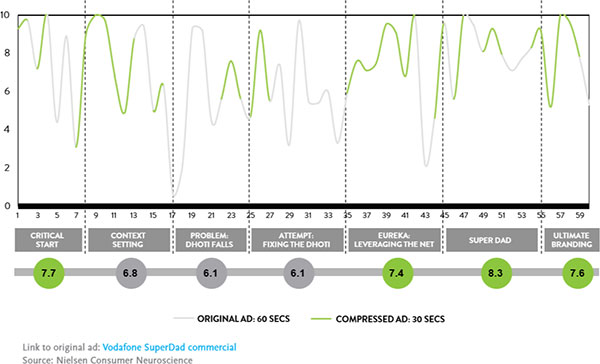
    The study demonstrated that it wasn’t just one segment of Vodafone’s ad, but a positive contribution of most segments that led to its good performance. The ad not only benefited from a really strong start, priming the audience positively to the rest of their viewing experience, but it was able to keep the audience engaged through most of its critical segments. That enabled effective registration of the message.


    Emotional Engagement Scores

    Research algorithms are able to automatically extract compressed versions of the ad based on neurological optimality to achieve the desired output to create the same bang but at a lesser cost. Validations have shown that 95% of scientifically-compressed ads perform as well, or even better than the originals.


    This granular second-by-second deep-dive into the ad equips advertisers with specific, immensely actionable insights. Consequently, understanding which portions to remove and what to retain for effective shorter edits could become much more profitable.


    With such strong and predictive analysis, neuroscience measures are clearly the way forward today for copy-testing applications across categories.

     Dolly Jha is Executive Director, Nielsen India and Moumita Ghoshal is Director, Nielsen India. Reprinted with permission from Nielsen India

  • Surat, Jaipur, others to drive consumption: EY


    By A Correspondent


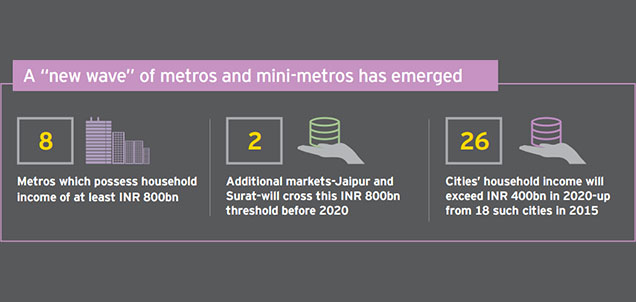
    India will see the rise of two new metros – Jaipur and Surat – by 2018, with a household income of over Rs 800bn by 2018, according to an EY report titled ‘India’s growth paradigm: How markets beyond metros have transformed’. These are projected to record real GDP growth of 8.7% and 10.3% respectively from 2015-20, relative to metros’ 8.3%. As a result, both cities will cross the Rs 800bn threshold within one to two years, with total consumption levels to reach 75%-80% of metros like Pune and Ahmedabad.


    The report identifies 42 new-wave markets, which are expected to grow at 8.9% as compared to the 8 metros that are expected to grow at 8.3% CAGR in the 2015-20 period.


    Said Ashish Pherwani, Media and Entertainment Advisory Leader: “Non-metro growth is out-stripping that of metros in India. There are clear cases of unmet demand in India’s Top 50 cities in certain sectors. This provides a huge opportunity for various sectors to both widen and deepen marketing strategies, and effectively tap into one of the world’s largest earning populations.”


    The report also notes the rise of eight new half-metros, with household income exceeding Rs 400bn by 2020. It also highlights 13 new-wave cities that represent a high-growth opportunity, but are largely untapped, according to the report. These include Patna, Raipur, Warangal, Gwalior, Dehradun, Allahabad, Rajkot, Vishakhapatnam, Jodhpur, Vijaywada, Ranchi, Kota and Jabalpur.


    Additionally, the top 23 untapped markets, as identified by the report, are all new-wave cities. These 23 markets represent 19% of metros’ household income-but only 12% of retail outlets 15% of telecom centres and 17% of malls, notes the report.


    The report further considers the potential of individual markets across each sector – FMCG, Retail, fashion and durables, Auto, Telecom and DTH, E-Commerce, Education, BFSI, and Real Estate. It delves into the expected ad spends across each sector, and highlights the top-10 untapped markets across each sector.


    The report can be downloaded at www.ey.com/in/urban-growth.


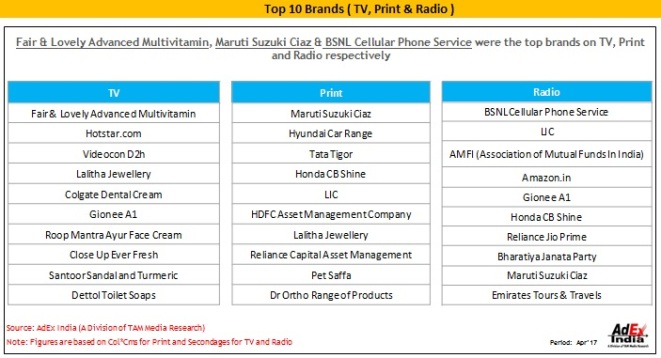
  • Advertising on TV, Print & Radio fell in Apr 2017 (over March ’17): TAM AdEx

    In a special arrangement with MxMIndia, the platform trusted by discerning advertising, media and marketing professionals, ​TAM AdEx, a division of TAM India, provides weekly and monthly scans of spends across television, print and radio.
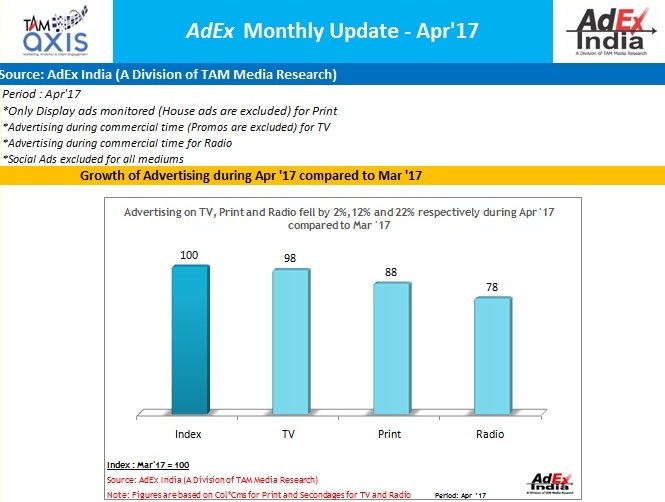
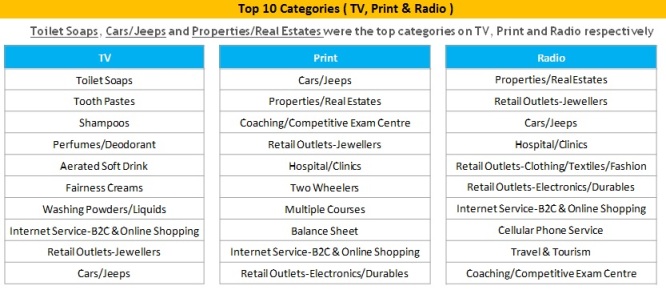
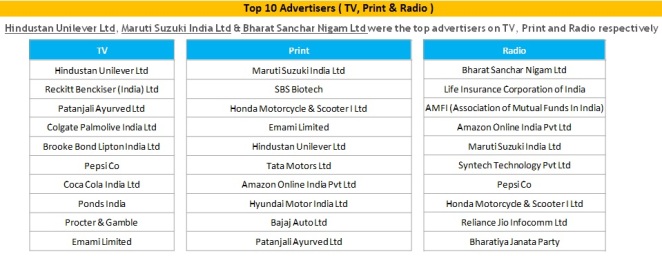
     

    We provided one in April (for March 2017), and here’s the report for April 2017.


    Read on and Enrich yourself.


  • Analysing the MxMIndia-MRSSINDIA Poll on English News Channels


    By A Correspondent


    We can be sure to see a lot of action over the next few days as BARC releases its data for English news channels. Already, there are reports on news broadcast organisation NBA complaining about the presence of multiple feeds of Republic.


    Sadly, the complaint has raised questions on NBA’s impartial conduct but that’s an issue for the channel-managers to decide and sort out.The complaint is bizarre, and one isn’t sure if the TRAI should get into all of this. But, of course, if it does set a rule, it will be applicable to one and all.


    Meanwhile, the MxMIndia-MRSSINDIA poll on English news channels has had huge traction in the media, advertising and marketing communities.


    And the study itself deserves an analysis.

    While commissioning the research, one does of course factor in the issue of how well does research on a sample reflect the mood of the entire viewing population. But, then, that’s how surveys are conducted, and it has been statistically proven that surveys are scientific. Loads of $$$s are spent on research worldwide, and the findings do help guide corporate decisions.


    In the past, a similar factor is attributed to the efficacy of audience measurement tools like the one from BARC India, TAM and IRS.


    Be that as it may, the findings of the study are interesting.Here’s the summary of the findings that we published, and our analysis below that in italics:


    :: Majority of English news channel viewers mentioned they are aware of ‘Republic TV’ English news channel and most of them (41%) perceive it to be ‘Better than Others’.


    Since the measurement data seen for English news channels is for 22-year-plus in cities with a population of more than one million homes, this data is critical. However, in the data thrown in the study, Times Now isn’t too far behind Republic. So the BARC numbers could well be interesting to look at.

    :: Centre wise, Mumbai (41%) perceive it as ‘More Credible’, Delhi (39%) find it ‘Old Wine …’, Bengaluru, Chennai, Kolkata and Ahmedabad English news channel viewers find Republic TV ‘Better than others’.


    This had us puzzled. The viewer in Delhi thinks Republic is Old Wine, but the one in Kolkata – who one would assume is more discerning – doesn’t think it’s old wine at all. However, Kolkata viewers find the noise factor very high. It’s important to note that Mumbai finds Republic more credible, given that RajdeepSardesai is the Most Trusted Anchor here. Kolkata trusts Arnab more, nothwithstanding the noise.


    :: Aggressive approach is found more appropriate for Debates, Breaking news and Analysis & interpretations. whereas, softer approach is found more appropriate for News deliver, soft news, sports and business news.


    Well, it’s interesting to see how Kolkata doesn’t mind a noisy and aggressive debate. So obviously some variance from an early view.


    :: Most viewers look at News channels to be opinionated but there is also a strong sense of believe that news channels should also play a vital role in bringing about political or social changes.


    It’s interesting that a majority Mumbai and Delhi viewers don’t think news channels should be opinionated and activisty. However, it’s not a very wide margin.


    :: Overall, print is a more trusted source (51%), closely followed by News channels, currently online (websites) are not considered a trust worthy source. News paper is more trusted by viewers in New Delhi, Bengaluru, Kolkata and Chennai. News Channels are considered better trusted source by viewers in Mumbai and Ahmedabad.


    This is the status as of today, and one is certain that online sources will rise significantly in the future.


    :: When it is need to verify news, the first source is News Television (54%). This is more in Chennai (54%), Kolkata (68%) and Ahmedabad (67%).


    These throw some interesting insights on the choice of media of news followers. Once again, expect the numbers to grow for digital offerings in the next two years.


    :: ArnabGoswamiand RajdeepSardesaiare considered the most trusted news anchor by close to 1/3rd of the viewers. BarkhaDuttcomes at third place. While Goswamileads comfortably in Bengaluru and Kolkata. Sardesai has higher trust value in New Delhi, Mumbai and Chennai. Duttis relatively strong in Ahmedabad and Chennai.


    This is a worry for Times Now as its key anchors don’t fare well here. There’s also an opportunity for India Today with Rajdeep Sardesai scoring high across the cities surveyed.


    :: Among the English news channels visited in last 1 week, Republic TV was 41%, Times Now is 35%, followed by NDTV 24×7 is 32%.


    This is a data point that could obviously change in the BARC numbers. But it’s interesting that Republic TV is ahead of Times Now in this sample, albeit not very significantly.


    All in all, even as we say this ourselves, the MxMIndia-MRSSINDIA study builds the excitement for the numbers that are expected on Thursday and in the forthcoming weeks.


  • Tata is still India’s Most Trusted


    By A Correspondent


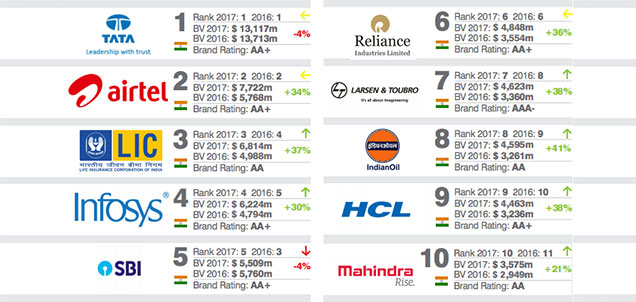
    Every year, leading valuation and strategy consultancy Brand Finance values the brands of thousands of the world’s biggest companies. MxMIndia has carried a few of these rankings in the past. And now there is: India’s 100 most valuable brands as featured in the Brand Finance India 100.View the full list of India’s 100 most valuable brands here


    Here’s a summary from Brand Finance:

    A brand’s strength is assessed (based on factors such as marketing investment, familiarity, preference, sustainability and margins) to determine what proportion of a business’s revenue is contributed by the brand. This proportion is projected into perpetuity and discounted to determine the brand’s value.


    Strong brand value growth characterises the 2017 Brand Finance India 100. The total value of India’s top brands has increased 15% this year, ahead of the global average of 11%. 68 of India’s 100 most valuable brands have grown in value this year, with 54 of those enjoying double-digit year-to-year percentage growth. There are however some notable exceptions, including India’s most valuable brand, Tata, which fell to US$13.1 billion from last year’s US$13.7 billion.


    There has already been intense speculation as to whether brand value has fallen due to Tata’s boardroom drama. In Brand Finance’s view this is emphatically not the case. Tata’s Brand Strength Index score in fact improved significantly this year and its brand rating was upgraded from A+ to AA+. Corrective action has been taken quickly and the stakeholders at large have not been significantly affected.


    Brand Finance’s CEO David Haigh comments, “The brand value drop of 4% is clearly not positive, however it is a lesser decline than between 2015 and 2016, when brand value fell 11%. Tata is present in a number of industries in which operating conditions are very challenging for all participants. In this context the slight decline can be seen as a stabilisation in challenging times. As Tata’s new chairman, Natarajan Chandrasekaran, settles in and attempts to streamline the conglomerate’s activities, we expect Tata to return to brand value growth soon.”


    IT services brands continue to be one of India’s great success stories, dominating not just the national rankings but the international rankings of their sector too. All of India’s major IT services brands have grown in value this year, including TCS within the overall Tata portfolio. Even as other Indian brands perform strongly, IT services brands are managing to improve their national ranks. Infosys is up from 5th to 4th, HCL from 10th to 9th and Wipro from 12th to 11th.


    The biggest improvement in rankings however comes from Indigo Airlines which is up from 95th last year to 62nd now. India’s biggest airline recently announced the addition of 35 new routes and increasing frequency on existing ones.


    At the opposite end of the scale, the iconic Taj Hotels brand has fallen 14 places to 93rd with brand value dropping below US$300 million. Like so many other hotel brands it has been hit by the impact of technology, with aggregator sites creating pricing pressure and Airbnb introducing competition.


    This year’s fastest falling brand is Micromax. The tech firm has lost 39% of its brand value and nearly fallen out of the Top 100, placing 95th. Micromax is struggling to compete following the influx of strong Chinese mobile brands such as Oppo and Vivo into the Indian market in the last couple of years.


    ITC is India’s most powerful brand. It is India’s only AAA rated brand, with a Brand Strength Index score of 86.  ITC has been expanding its strategic presence, beyond tobacco, for over a decade. In the last four to five years it has become a formidable competitor in the food and beverage, personal care, apparel and stationery sectors, challenging incumbents that have dominated those industries for over a century. This broad spectrum of excellence is making ITC a household name across India and contributing to the brand’s strength.


    Mahindra, a stalwart of Indian enterprise has re-entered the top ten this year, after posting healthy growth in its flagship automotive division and strengthening its presence in SAARC countries. Mahindra’s agricultural division and its tractors business are well-established strengths while more recent initiatives such as crop-care solutions, seed distribution and power solutions through Mahindra Powerol are poised to accelerate growth. This year brand value is up 21% to US$3.6 billion.


  • And now, India Today complains to TRAI & BARC on Times Now using multiple LCNs; Times Now says it did it in self-defence

    By A Correspondent [updated]


    Even as English news channels got together on Republic’s ratings, India Today has complained to TRAI and BARC on Times Now also choosing to be piped out via multiple LCNs.

    According to documents in the possession of MxMIndia, India Today has been very scathing in its complaint on Times Now. It has in fact even urged BARC, to stop publishing data for Times Now with immediate effect.

    The development has got some industry seniors to wonder why the two channels – India Today and Times Now – who have joined hands to fight Republic are now fighting each other. Or at least India Today is fighting Times Now.

    When asked to comment on the India Today complaint, this is what a Times Now spokesperson told us (via mail): “Times Now did a defensive manoeuvre. We have never been an advocate of multiple LCNs and have NOT run our channel that way till last week. In fact we have been an affected party more than once and raised this issue at various levels. It was only after a desperate and aggressive move was made by Republic TV on the ground that we upped the ante in self – defence. As part of NBA, and as a responsible brand, we endorse strict action against such destructive and diversionary tactics. Times Now is NOT playing on multiple LCNs anywhere in the country as of now. The impressions of week 19, including our own are tainted and not dependable due to this reason and we had joined the NBA in raising it to BARC earlier this week.”

    However, according to unverified information received by MxMIndia, Times Now is reported  to have taken up dual LCNs… around the time of the launch of India Today channel and also the UP elections.

  • Flipkart, Rivigo in Interbrand’s Breakthrough Brands


    By A Correspondent


    Interbrand has announced its second annual Interbrand Breakthrough Brands report in partnership with Facebook, New York Stock Exchange (NYSE) and Ready Set Rocket. The 2017 report recognises 40 next-generation, disruptive brands that define progress and the potential to grow. The report complements Interbrand’s annual Best Global Brands report, now entering its 18th year, by putting a spotlight on emerging brands—those that are affecting change and embodying growth.


    “There are moments throughout the life of your business when you enter a new stage of growth,” said Jez Frampton, Interbrand’s Global CEO. “For Breakthrough Brands, it’s realizing there’s a gap or a need in the marketplace, and filling it. These brands are catalysts as they are not just setting new standards for other brands, they’re breaking them.”


    After analysing over 350 submissions from global influencers and open public submissions, 40 brands were selected as this year’s Breakthrough Brands; amongst which India’s start-up poster-brand Flipkart and technology-enabled logistics start-up Rivigo have also been featured. Paperboat by Hector Beverages has also been mentioned as one of the exemplified brands for appealing the rising middle class consumer in the APAC countries; by prioritizing craftsmanship and personalization, with an authentic and differentiated story.


    As per the report, Flipkart has a staggering valuation of USD $11,600 million and a funding of USD $4,550 million. The Bangalore based brand has become a hallmark of growth in Asia. It has changed the e-tail landscape in India, providing access to goods in both urban and rural communities at prices that were once unimaginable. Flipkart is also investing in payment and retail tech across the continent, making it one of the region’s biggest Breakthrough catalysts. Recently receiving USD $1.4 billion in funding, the brand is set to break through globally.


    On the other hand, Rivigo has been valued at USD $1,880 million and its funding is recorded at USD $114.9 million. According to the report, Rivigo isn’t just about logistics: it’s about people. The India-based brand improves the working lives of the humans behind its delivery fleets by using big data, IoT sensors, and AI to monitor and manage driver stress and fatigue. With a team of top data scientists, Rivigo is creating systems that increase distance covered and improve turnaround times up to 70 percent—driving productivity for both its people and its clients.


    This year’s report divides the Breakthrough Brands into seven key insights:

    :: The working future: An increased focus on individuals and what they need to be fulfilled within their careers and their lives especially as they become increasingly intertwined, such as Rivigo, Slack and General Assembly.

    :: From lifehacking to better living: Brands that are looking to improve our lives by removing concerns, obstacles, and unnecessary interactions. The good life is not about more, but better; Thrive Global and Sea for example.

    :: Not so artificial intelligence: Brands that are leading this charge—by both creating and harnessing these new tools—are going to dictate the future with this breakthrough technology; like Face++ and Clarifai.

    :: Meaningful mobility: It’s not about the journey or the destination, it’s about fundamentally changing how we move people and things, with the aim of improving our environment, society, and lives through brands like Didi and Ofo.

    :: Funding change: The focus in finance is truly personal, as brands find breakthrough ways to align with individuals’ values, and empower people to take greater control of their financial futures with brands like Square and Wealthsimple.

    :: Experiences on demand: Some brands make it easier to get what we want, others make it easier to find what we want, but all are helping us live an on-demand lifestyle, which is what brands like MikMak and Flipkart look to do.

    :: Health in your hands: By leveraging tech innovation and pooling huge, previously unmanageable amounts of information, these new brands are improving the entire spectrum of care like Babylon and HumanCharger.


    When selecting the brands to be featured in this report, these criteria were key:

    Criteria & Methodology

    :: Age: Is the brand 10 years or younger?

    :: Change: Is the brand driving change by responding to a unique marketplace need, generating a new experience for consumers, disrupting an industry, adopting a new business model or developing a new technology?

    :: Growth: Is the brand demonstrating its ability to grow? Is it operating as a successful business? Is it stretching into new product or service categories—or new geographies? Is it attracting top talent?

    :: Buzz: Is the brand grabbing attention and gaining momentum?

    :: Originality: Is the brand presenting a unique business model that challenges the traditional way of doing things?


    Commenting on the Indian contenders and the overall Breakthrough Brands in the local market, Ashish Mishra, Managing Director, Interbrand India said: “India is emerging as a crucible for the Breakthrough Brands due to our demographic, social, expressive and experiential evolution leading to cross fertilisation of new consumers, markets, lifestyles and touch points. There is a genuine need of improving lives across business and life-critical areas of money & mobility on one hand, health & lifestyle on another. The other big phenomenon is the merging of the breakthrough mindset with traditional organisations. We are seeing many traditional companies spawning breakthrough businesses within their folds. Indeed, it’s no longer about start-ups anymore but about inculcating the breakthrough mindset no matter what you do and who you are.”


  • Khelo, India, Khelo!


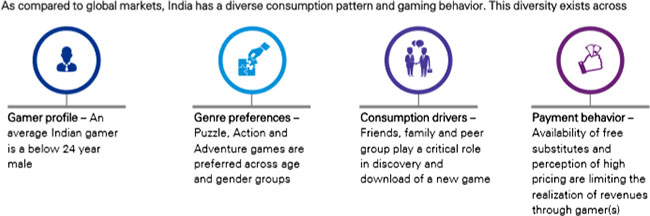
    Republished from a KPMG-Google report on online gaming titled ‘Online Gaming in India: Reaching a new pinnacle’


    The advent of India’s online gaming industry can be dated back to 2000s, when console and PC gaming brought several middle-income group Indians on digital gaming platforms. During mid 2000s, online gaming was largely in the form of social games. This adoption was facilitated primarily through global games by international developers. Indian development ecosystem acted primarily as service providers for international developers. Since then, India has been a volume based story enabled by rise in internet penetration and increase in smartphone user base.


    Online gaming market realised impressive volumes with 120 million online gamer(s) and market value estimated at ~ 290 million USD in 2016. The key driver of market volume was proliferation of low cost smartphones amongst urban and rural population. The monetisation is realized through revenue streams like in-app purchase, pay per download, subscription service etc. by gamer(s) and in-app advertisement, incentive based advertisement etc. by ecosystem. Today, monetisation is dominated by advertisers and publishers.


    However, challenges like limited local games development and monetisation of gamer(s) are still restraining the high potential. In recent years, local internet ecosystem has initiated the course correction by end to end local game development and adoption of digital payment solutions.


    The online gaming consumers market, characterised by large volumes, is rising fast in terms usage and monetisation. The local development is characterised by highly skilled manpower and expertise.


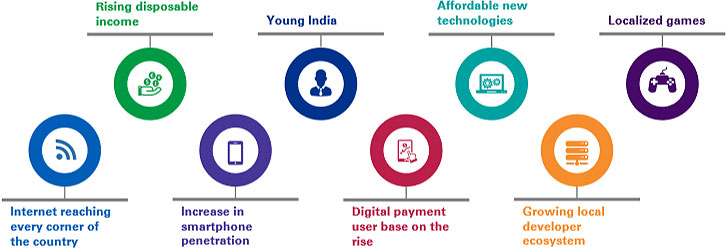
    In the future, India is expected to move towards value driving consumption and comprehensive local development. The industry is expected to gain momentum and reach a market value of 1 billion USD and ~310 million online gamer(s) by 2021. This ~28% CAGR growth will be driven by:


  • M&E brands most confident about business growth: Zenith survey

    By A Correspondent


    Advertisers in the media and entertainment category are most confident about seeing growth in their category this year. They are closely followed by advertisers in pharmaceuticals and healthcare.


    This is the key finding from Zenith’s just-released biannual client survey. Ahead of marketers attending Cannes Lions 2017, the study finds out what are the key drivers of growth and to assess how confident they are about business growth in their category.


    Zenith asked clients how confident they were in the prospects for growth in their category this year. It then ranked each category on a scale from 0 to 100, where 0 means everyone expects substantial decline, 100 means everyone expects substantial growth, and 50 means the average expectation is for no growth.


    The results were as follows: Media &Entertainment advertisers came out on top, with a score of 82.1, followed by Pharmaceuticals &Healthcare and alcohol. The lowest-scoring category was telecommunications, at 33.3, followed by Food &Drink and FMCG (non-food).


    Ranking of categories by advertiser confidence in growth

    Survey of 158 key Zenith clients around the world

    Category

    Confidence index

    Category

    Confidence index

    1. Media & entertainment

    82.1

    7. Travel

    61.4

    2. Pharma/healthcare

    70.3

    8. Retail

    60.0

    3. Alcohol

    70.0

    9. FMCG (non-food)

    55.7

    4. Luxury

    67.6

    10. Financial/insurance

    53.6

    5. Beauty

    67.2

    11. Food & drink

    48.4

    6. Automotive/vehicles

    63.6

    12. Telecommunications

    33.3


    Key drivers of business growth

    The study also asked Zenith clients to look at the drivers of business growth, ranking them according to how important they believed they were for their brand. From most important to least important, the factors were ranked as follows.


    Ranking of contributing factors to business growth

    Survey of 158 key Zenith clients around the world

    1. Data & technology

    2. Business transformation

    3. New competitive positioning

    4. Geographical expansion

    5. Diversification

    6. Automation

    7. Mergers & acquisitions


    The first three factors were ranked closely together, with quite a big gap between numbers 3 and 4. Adapting to the challenges of a transforming economy is clearly the main priority for advertisers.


    Translating growth in data to business growth

    The study asked clients how the huge increase in data has affected three areas of their business: buying efficiency, creating new insights into consumers, and generating profitable brand growth. For each area it gave them five options: data has made it more difficult, has had no effect, has slightly improved it, has greatly improved it, or has revolutionised it. And for each area there was one overwhelmingly popular response, with 50% or more of responses. These were as follows:

    :: The huge increase in data has allowed us to make small improvements in buying efficiency.

    :: It has allowed us to create much better insights.

    :: It has improved brand growth slightly.


    So while most clients agreed that data has significantly improved their consumer insights, it has not yet transformed their buying efficiency or brand growth.


    “Brands have the opportunity to harness data and technology to transform their businesses and accelerate brand growth, but are having difficulty in turning theory into practice,” said Vittorio Bonori, Zenith’s Global Brand President. “Agencies must step up and work in partnership with their clients to unlock the true potential of this revolution in communications.”