Category: RESEARCH

  • CMOspend: More on Data, Less on Ads


    By A Correspondent


    Global media and marketing consultancy NewBase (eka Publicitas) has launched its latest report titled ‘The Evolving Marketer’ where it spoke to 120 global CMOs across 20 markets and asked them about their views on everything from where budgets were increasing to how they used data and good their team is. The report shows that CMOs feel their status has risen as marketing’s value in driving revenue has come to the fore.


    The key findings are:

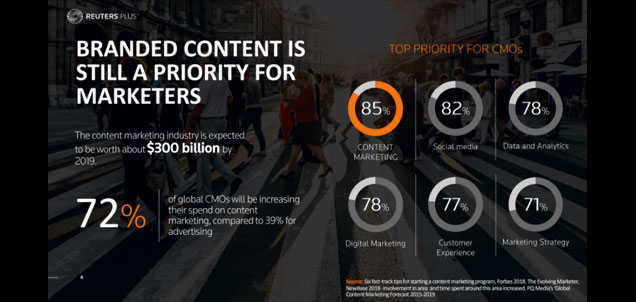
    :: 60% of CMOs are not going to increase advertising  spend. Only four in 10 CMOs are going to increase advertising spend but three quarters (72%) are growing budget in content marketing

    :: CMOs are challenged by data – saying that their businesses don’t use data to the fullest extent – half of all data is unused. Even so three quarters of CMOs are going to be spending more on data

    :: 97% of CMOs don’t have the perfect skill set internally  and more than half say they have an internal skills shortage

    :: Two thirds of CMOs are looking to bring more services back in house


    This global study of senior marketing leaders reveals five key themes firmly on the CMO agenda: revenue generation, customer experience, data, content and processes.
     

    Go for growth

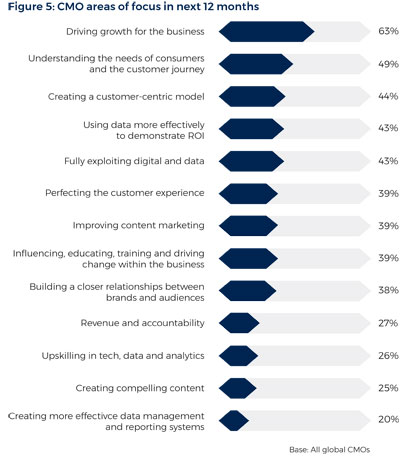
    Business growth is a given and driving this is undoubtedly a core part of the marketing leader’s remit, as underlined by the move to rename CMOs ‘Chief Growth Officers’. The emphasis on revenue is keenly felt by senior marketers with over eight in ten (82%) of CMOs saying the role has become more financial results focused. Almost two thirds (63%) of marketing leaders say their key priority is going to be driving growth for the business. With this concentration on the bottom line it is only natural that the status of marketing should have risen. 82% of CMOs think that marketing’s influence has increased internally.


    Customer minded

    It is understandable that those focussed on growth are going to turn their attention to understanding customers’ needs to see if there are any issues to be addressed or processes to be streamlined. One in two CMOs have looking at the consumer journey top of their to-do-list and almost half (44%) of marketing leaders also say that they are going to ensure a customer-centric model is in play. Two thirds of global CMOs state marketing decisions should be based upon how they impact the customer rather than the business.


    It’s all about the data

    With the heightened focus on both the customer and growth, data is more important than ever. One in two senior marketers say currently they have budgetary control for data and analytics. However, this is set to grow, as more than 80% of CMOs are saying they are getting more money to invest in data. This budget will no doubt be gratefully received as more than three quarters state data management and analytics is taking up more of their time. But simply having more data available does not necessarily mean that it can be used effectively.


    Data mountain

    Global CMOs highlight over half the data available to the business is not being used to its fullest potential and three quarters agree they are only able to use a small portion of the data they have at hand. This is an opportunity for senior marketers, with over nine out of ten (92%) saying that creative and analytics need to work more closely to drive business success. With the budget offered for data increasing but over half of all data not being used to its full potential, there is scope for CMOs to marry the ‘magic and the maths’ using brand awareness advertising, story-telling and experiential with data to drive revenue.
     

    In/Out

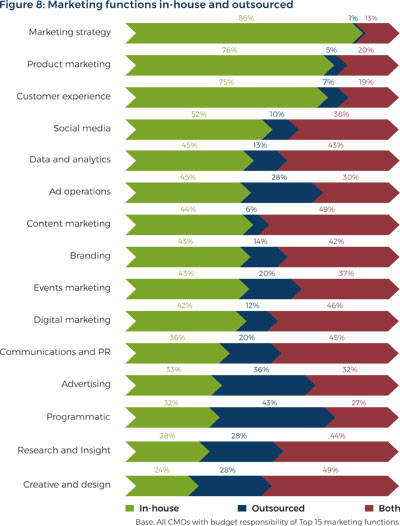
    Two thirds of CMOs are moving towards more in-house marketing services, but only 3% say they currently have the perfect skill set internally. Marketing bosses looking to bring more functions in house are challenged by both budget and team capabilities.


    Just under one in two CMOs have good internal team capability, and 68% say that it is essential to have people on board who are skilled enough to evolve with technology developments. However, due to the martech explosion and dramatic growth of digital marketing and programmatic advertising, more than half of CMOs (55%) state they have an internal skills shortage.


    With the skills gap and implied talent scarcity it looks as if outsourcing suppliers (agencies, martech vendors, etc.) is still going to be essential in ensuring CMOs can deliver on their objectives.


    The results reveal that 43% of CMOs still entirely outsource programmatic, which is the highest fully outsourced function. Over a third of senior marketers outsource advertising (36%), and over a quarter fully outsource creative and design, and research and insight (both 28%).


    Key elements such as marketing strategy, pricing and product marketing as well as customer experience tend to be handled in-house. Among the top 15 areas where marketing leaders have budget responsibility, marketing strategy is the number one function delivered entirely in-house (86%), followed by product marketing (76%) and customer experience (75%).


    Budgets

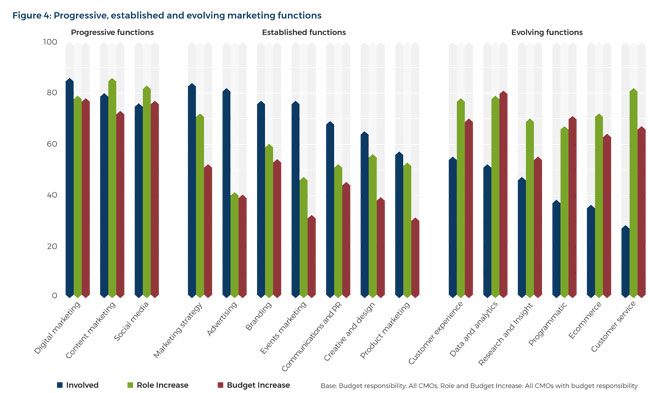
    While CMOs overall say they have to achieve more with less, there are some functions where involvement is already high and budgets are increasing, along with the time investment required by marketing. Marketing leaders are expecting to spend more on digital, content marketing and social in the short term with three quarters of marketing leaders allocating increased budget to these channels. They are also expecting the time that they have to invest in these functions to increase along similar lines. These are described as ‘Progressive marketing functions’.


    For more ‘Established marketing functions’ such as marketing strategy, advertising, branding, PR, design and product marketing, while a minority of CMOs are anticipating budget rises, the majority are not. Four in ten senior marketers are envisaging advertising spend increase, one in two are forecasting a rise in branding investment and almost 40% are going to spend more on design. Just under half are also looking to invest more in communications and PR in the next year.


    There are some ‘Evolving functions’ where currently CMOs are seeing their expertise called upon, and alongside this, budgets increased. Customer experience, customer service, e-commerce, data and research are now increasingly important too. However, because these areas are not solely marketing’s remit the CMO does not presently have total budget control over these, but this is likely to change.


    Three quarters of CMOs say they will receive more budget for customer service and a similar proportion are expecting an increase for customer experience.


    The influence of time

    “The Evolving Marketer” reveals significant variations in the global CMO agenda based on length of tenure. Those in their roles for over five years, the established CMOs, are firmly entrenched, their priorities (bar driving growth) are very different from more recent CMOs (under five years’ tenure). One in two established CMOs are focussing on building internal collaboration (45%) and perfecting the customer experience (47%).


    More recent CMOs (under five years) are still in the set-up stage for their role and thus focussing on sorting out infrastructures, putting new systems and processes in place and creating models to exploit the data they have access to.


    Newer CMOs are emphasising the customer journey (57%) vs. only 39% of established CMOs and creating a customer model that aligns with business strategy (52% vs. 33%). Using data to its fullest potential is prioritised by half (49%) of recent CMOs as opposed to only a third (35%) of established CMOs.


    Revenue and accountability are prioritised almost three times as much by established CMOs compared to newer marketers (41% vs. 17%).


    Making an impact

    84% of newer CMOs claim it takes less than five years to really make a difference, whereas only half (49%) of established CMOs think the same.


    Said Mike Jeanes, Global Head of Insight, NewBase: “Over the past few years, the CMO’s remit has escalated significantly from a largely promotions and creative role to becoming the centralised lift-shaft of the business, servicing every level and function of the organisation, and providing the data-driven connection between the brand and the consumer. The role of the CMO is varied and complex. They are increasingly challenged to drive business growth and adjust their resources to keep up with industry change and consumer demands.”


    The full report can be download here.
  • Net adspend in APAC to expand 6.2% in 2018


    By A Correspondent


    By now, we have published several forecasts for adspends for calendar year 2018 and thereafter. And here’s another from Media Partners Asia (MPA), a leading research and consulting firm specialising in media and entertainment. Accroding to a new report from the MPA, advertising revenue across Asia Pacific expanded by 6.1% in 2017 to reach ~US$173 billion, and is on course to grow by a further 6.2% in 2018 to move close to US$184 billion this year.


    Asia Pacific Advertising Trends 2018 forecasts net adspend after commissions and discounts across 14 major markets in the region. The region’s advertising outlook remains positive with MPA analysts forecasting ad gains in almost all markets in 2018, and ad growth across the board over 2017-22. MPA expects net adspend in APAC to total US$226 billion by 2022, having grown by a 5.5% CAGR from 2017.


    “Market momentum for Asia Pacific as a whole should hold steady over 2018 and 2019, but we expect a slight deceleration from 2020 as online advertising, increasingly the main engine of growth across the region, settles into a gentler trajectory in some large ad markets,” remarked Vivek Couto, executive director, Media Partners Asia. “Much of digital’s growth will be driven by China, which should retain more than 60% of online advertising in Asia Pacific over our forecast period.”


    Added Couto: “Traditional TV advertising is now in or on the verge of decline in most countries, having peaked at US$54 billion across the region in 2017. That said, India, Indonesia, the Philippines and Thailand are notable exceptions, underscoring the ongoing importance of mass-market broadcast as a platform for reach and awareness in these growth economies. Overall, TV advertising should contract very slightlyfrom 2017 to 2022, at a -0.1% CAGR. Print advertising, however, is on the retreat almost everywhere, although both newspaper and magazine advertising will continue to grow at a modest single-digit pace in India. Out-of-home, meanwhile, remains on an upward trajectory in most markets, benefiting from ongoing urbanization as well as digital upgrades.”


    Growth Dynamos In China And India

    China’s ad market, by far the largest in Asia Pacific, also experienced the highest growth in 2017 with a 9.9% increase taking netspend past US$86 billion, powered by increasingly mobile-centric digital platforms as well as a buoyant economy. MPA projects net advertising in China to expand by a healthy 6.9% CAGR from 2017 to surpass US$120 billion by 2022, supported by solid consumer fundamentals and macroeconomic growth. Online platforms dominate with a 56% share of China’s ad market in 2017. This slice should grow to 68% by 2022, an 11.3% CAGR, according to MPA.


    Ad growth in India – a contender for Asia’s most dynamic market – was weighed down in 2017 by the lingering effects of demonetisation as well as a new goods and services tax, which disrupted advertiser supply chains, inhibiting marketing activity in the process. Net ad spend consequently grew by 6.9% in 2017 to total US$9.0 bil., ending three successive years of double-digit growth. Nonetheless, India should re-emerge as APAC’s fastest growing ad market over the next five years. MPA analysts forecast a 10.9% CAGR in net ad spend in India from 2017 to total US$15 billion by 2022.


    This pace just eclipses the Philippines, Asia’s second-fastest growing major ad market over the next five years with a 10.8% CAGR according to MPA. Thailand’s ad market, showing signs of emerging from a prolonged malaise, is on course to grow by an 8.0% CAGR from 2017-22, making it the region’s third fastest growing ad market over the next five years, with China ranked fourth.


    While the overall rate of advertising growth for APAC is slowing, a mixed picture emerges on the ground. Ad spending over 2017-22 should pick up speed compared with 2012-17 in Australia, Hong Kong, Malaysia, the Philippines, Singapore and Thailand. At the same time, cornerstone markets such as India, Indonesia and Japan should be able to sustain the pace they have set over the past five years. Other territories, however, are entering a slower growth cycle. Five markets will see less than a 2.0% CAGR from 2017-22: New Zealand (1.9%), Malaysia (1.8%), Taiwan (1.7%), Korea (1.4%) and Singapore (1.0%).


    Internet Trends Become Market Trends

    The pattern of ad growth across Asia Pacific is becoming increasingly determined by online media, which will soak up the vast majority of new ad dollars in the region for the foreseeable future. MPA estimates that internet advertising in APAC grew by 18.1% in 2017 to nudge past US$76 billion, with a projected 14.4% growth in 2018 taking the total to US$87 billion this year. The overall CAGR for internet ad spend between 2017 and 2022 should slow to 11.1% (10.8% ex-China), although the pace of growth from a low base in India, the Philippines and Vietnam should still top 20%. Online ad spend already accounted for more than half the market in Australia (51%) and China (56%) in 2017. Taiwan is forecast to cross the half-way mark in 2019, while New Zealand should follow suit somewhere around 2020.


    Online video advertising meanwhile is entering into a red-hot growth phase, powered by the rising prominence of high-speed broadband. MPA forecasts that by 2022, online video platforms will contribute at least 10% of all advertising in nine markets: Australia, China, Hong Kong, Indonesia, Malaysia, New Zealand, Singapore, Taiwan and Vietnam, compared with just one market (Taiwan) in 2017. At the same time, online video spend will be near TV’s share in Australia and China, two big internet markets, over the same time-frame, with Hong Kong and New Zealand not far behind.


    About Asia Pacific Advertising Trends

    Asia Pacific Advertising Trends, published annually by Media Partners Asia (MPA), contains detailed analysis of media across 14 markets in Asia Pacific. Key metrics include: historical and projected data (2012 to 2022); net advertising revenues across TV, internet (including local and global online video platforms), print (newspapers and magazines), out-of-home, radio and cinema; macroeconomic analysis and impact; and analysis of key drivers and challenges by market. Market coverage comprises: Australia, China, Hong Kong, India, Indonesia, Japan, Korea, Malaysia, New Zealand, the Philippines, Singapore, Taiwan, Thailand and Vietnam.


  • Are we shortchanging OOH media projections?


    By Indrani Sen


    The FICCI EY 2018 Report on Indian M&E Industry paints a bright prospect for the OOH sector by commenting that “There is a clear shift toward digital OOH which is expected to be the growth driver for the industry.” It mentions about applications of AR and VR technologies and other DOOH applications, integration of OOH with activations, creation of immersive experiences through sponsorships of lounges, etc which will help in the future growth of outdoor. The government initiative for expansion of infrastructure by adding airports and MRTS (Mass Rapid Transport System) across the country is also supposed to boost the growth of OOH in general and Digital OOH in particular. The fact that the “Railways getting into the act” with their offer of increased opportunities for commercialisation of railway properties and services will also tilt the scale in favour of OOH industry.
     

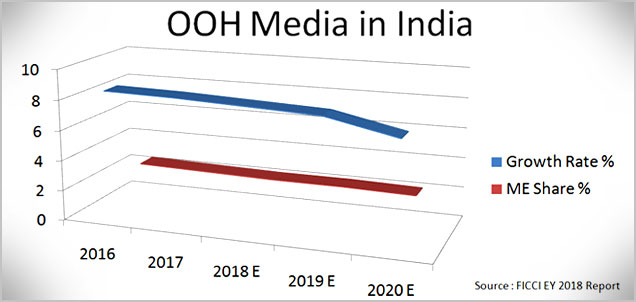
    However, the OOH Industry size shown in the report does not reflect the above prophecies for the OOH sector. On the contrary, the report shows a static/diminishing year-on-year growth rate of OOH media and similarly a static/ diminishing share in the M&E Industry.


    OOH Industry Size & Projected Growth
    CY 2016 CY 2017 CY2018E CY2019* CY2020E CAGR2016-2020
    INR Billion
    OOH Media 31.6 34.3 37.1 40 43
    Growth Rate 8.40% 8.50% 8.16% 8% 7% 7.70%
    ME Industry 1308 1473 1660 NA 2032 11.60%
    Share of OOH Media in ME Industry 2.40% 2.30% 2.20% NA 2.10%

    Source: FICCI-EY 2018 Report, page 11*Estimated by writer


    As per the Pitch Madison Advertising Report 2018, OOH market grew by 6% to reach Rs3085 crores in 2017 with a contribution of 5.8% to the total Advertising Adex.In 2018 it is expected to grow by 10% to reach Rs 3395 crore with a contribution of 5.7% to the advertising pie. The increase in the growth rate in 2018 is based on the upcoming eight State Assembly Elections in 2018 as well as Central Government publicity as a build up to the general Election in 2019. PMAO does not mention about the other opportunities related to growth of infrastructure, etc. There is one common thread between the two reports: the contribution of OOH to the total advertising pie has been hovering around 6% over the years (2013 to 2018E) according to the estimates of PMAO. Admittedly, the percentage shares are different as the two reports deal with different definition of the universe.


    What is the future of the OOH sector in India? Is it really poised for an advertising leap based on the coming of age of our millennial population, increased penetration of mobile and social media and availability of digital technologies? I read an interesting article about a year back on “Top 5 Emerging Technologies of Outdoor Advertising in India -207” (https://www.posterstalk.com/Blog/Post/technologies-of-outdoor-advertising-in-india) which described Digital Billboards, Digital Signage, Geo-fencing Technology,  Beacons and Near Field Communication (NFC) as the five emerging trends in Outdoor advertising which we can expect to become realities as we progress to the next decade.


    It may take a few more years before we see applications of Geo-fencing Technology, Beacons and Near Field Communications in India. But, Digital Billboards and Digital Signage are both poised for immediate growth with huge opportunities of development across our airports, railway stations, MRTS systems and malls, multiplexes, theme parks, sports stadiums and other entertainment complexes. Hospitals and health centres can also benefit from digital signage. Our Ministry of Tourism along with The Archaeological Survey of India can also use this medium for promoting tourism and enabling the travellers with knowledge of world heritage sites and historical monuments.


    I strongly believe that we will witness OOH becoming an integral part of social and mobile strategies within next few years. Closer interaction and collaboration is required between the Social Marketing and Digital Marketing Agencies and the Outdoor Agencies for achieving this transformation which will benefit both the parties. Eventually, digital technology will transform OOH from a passive medium to a direct response medium and our media classifications will have to be re-written. While technological churning of the OOH industry takes place, media analysts have to ensure that their industry estimates do not short change the growth of the sector.


  • BARC issues statement on inadequate claims made by subscribers

    By A Correspondent


    It is fashionable for the world to throw stones at measurement agencies. It happened for years with LV Krishnan’s TAM, it happened with MRUC for IRS and now the knives are being chucked at Broadcast Audience Research Council India (BARC India). BARC has received feedback from its subscribers regarding certain malicious, baseless and inaccurate statements made in public regarding its operations and organisation structure. And hence the joint industry body has highlighted a few points that all and sundry (or the other way round) need to take note of.


    Here goes:

    “Being an industry body promoted by IBF, ISA and AAAI, BARC India Is neither owned by any broadcaster/advertiser/agency, nor controlled by any single company. Therefore, the question of undue influence of any single entity on BARC India’s operations does not arise. It has a strict governance structure as laid down in its Articles of Association, which ensures its arm’s length relationship with all stakeholders.


    IBF President, Punit Goenka said, “We take pride in saying that BARC India works in an extremely transparent and neutral environment. Its data adds immense value to industry, and we would encourage and support it to remain focused on the great work its team does, and not get detracted by false statements and unattributed innuendos. BARC India has established a measurement system at par with international standards, which should be a matter of pride for the industry.”


    BARC India’s systems and processes have been accepted by industry, and also lauded in global forums. The robustness and credibility of BARC India’s data is further testified by regular audit of its processes by reputed international firms like Ernst & Young and CESP. With a sample size of 135,000 individuals across the nation, BARC India operates the largest TV sample/panel in the world – much larger than the US TV sample of 90,000.


    Sunil Kataria, Chairman of the Indian Society of Advertisers added, “BARC India has provided industry with something it has been seeking – a robust and state-of-the-art measurement system that reports all India TV viewership with a high degree of fidelity. BARC India data helps advertisers reach and understand consumers even in the most remote and unexplored areas. It enables the Rs. 25000 crore advertising industry to take informed decisions since the data is truly representative of ground reality.”


    President of Advertising Agencies Association India (AAAI), and BARC India Chairman Nakul Chopra said, “I am dismayed to see these incorrect and baseless remarks that have been made with no facts to support them at all. That too against the sanctity of a body set up jointly by the industry in the best interest of all stakeholders. BARC India should in fact be applauded as a shining example of how an entire eco system has come together to create a world class measurement system that is one of its kind. It should be applauded as in these positive and progressive times it provides essential and reliable data that is powering many industries make better decisions towards economic growth.”


    Hmmm. Guess BARC should’ve also added a statement from the Bad Losers Society of India. Or the Nutcases Association of New Delhi.


  • Online ads to touch Rs 9,700 cr by Dec 2017


    By A Correspondent


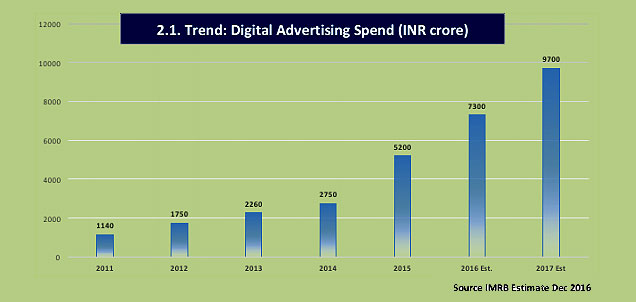
    The digital advertising spend in India was estimated to be around INR 7,300 crore at the end of 2016, growing at a rate of 40% over 2015. The growth in spends on digital advertising is expected to continue at a CAGR of 33% to touch INR 9,700 crore by December 2017. The digital advertising market was pegged at INR 5,200 crore by the end of December 2015. These are the latest findings of the ‘Digital Advertising in India’ report, jointly published by the Internet and Mobile Association of India (IAMAI) and Kantar IMRB Kantar.


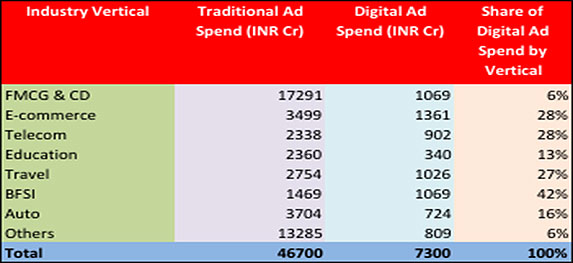
    The report finds that the digital advertising spend is about 14% of the total advertising spends in the country. In terms of volume, E-commerce leads the digital advertising spends with around INR 1,361 crore, followed by FMCG, Consumer Durables and BFSI. However, a comparison of these verticals in terms of share of spends on Traditional vs Digital show that BFSI organisations incurred the highest share on digital advertising spends. 40% of their overall advertising spend was on Digital followed by E-commerce, Telecom and Travel.


    Share: Traditional vs Digital Advertising Spends by Verticals

    Source IMRB Estimate Dec 2016

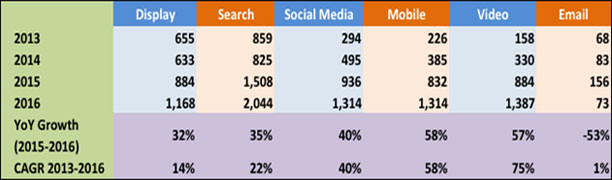
    In 2016, it is estimated that Search ads (close to INR 2,044 crore) constituted 28% of the overall ad spends followed by Video (close to INR 1,387 crore) which contributes to around 19%; Mobile and Social Media (close to INR 1,314 crore) each are at around 18% and Display ads (close to INR 1,168 crore) at 16%. Spends on Video ads have shown a significant increase and accounted for 19% of the overall spends in digital advertising. In all likelihood, this has been driven by new online entertainment (movie, TV series) channel launches, by enhanced monetisation across various platforms and high CPMs on premium content. This category is estimated to witness significant growth till 2020. Spend on mobile advertising (SMS/in-app ads) also recorded high YoY growth of 58% from INR 832 crore in 2015 to around INR 1,313 crore in 2016. Spending on email ads has reduced substantially (-53% YoY) and is now estimated at only INR 73 crore.


    Spend by Ad Avenues & CAGR (INR crore)

    Source IMRB Estimate Dec 2016


  • Branded Content will rule, but…


    By A Correspondent


    Consumers are increasingly interested in content that reflects their personality type and is delivered in their preferred tone and style, according to new research published by Reuters Plus – the branded content studio.


    The Content Connect II report, based on a new global survey of Reuters.com users, reveals that 77 per cent of global consumers expect to see more personalised content in the future. It shows that branded content campaigns are more effective if they include personalised elements, with 63 per cent of consumers agreeing that personally relevant content improves how they feel about the brand associated with it, and 58 per cent see brands in a more positive light if they provide them with content that matches their interests.


    The survey, conducted by Synergy Research and Consulting, highlights the importance of style and tone in branded content, finding specific content topics appeal to different personalities. It finds, for example, that the top personality type for business and finance content is ambitious, whereas arts and culture is creative, politics is outspoken and travel is spontaneous.


    It also identifies the attributes consumers consider most appealing in branded content. It reveals that global consumers consider sponsored content more appealing if it is thought provoking (64 per cent), imaginative (58 per cent), humorous (55 per cent) and innovative (51 per cent).


    The Content Connect II research also finds that consumers are open to new and innovative ways to engage with content, revealing a mix of appealing formats for consumers with short articles (64 per cent), in-depth analysis (60 per cent), video (55 per cent) and infographics (45 per cent) being the top choices.


    In terms of formats, 71 per cent of consumers interested in branded content would prefer to see their favourite brands sponsoring websites, site sections or pages, whereas 57 per cent would prefer to see brands sponsoring articles on websites, webpages or apps.


    Overall, consumers increasingly think brands can benefit from sponsoring quality content – 68 per cent agreeing, compared to 60 per cent last year – and audiences are still receptive to branded content if the subject matter interests them, with 75 per cent agreeing – equal to last year.


    Said Munira Ibrahim, Reuters SVP for Sales and Content Solutions: “Whilst content marketing and branded content continue to grow, consumers are increasingly demanding more relevant and personalised content. This research shows that content marketers need to fully understand audiences’ preferences and personalities in order to maximise consumer interest and engagement. This is a priority for Reuters Plus in delivering effective solutions for our clients.”


  • MRSS beefs up top deck

    By A Correspondent


    Is it fair on senior women executives when the company they join sends out a communique with the headline that three senior women researchers have been onboarded. Why overstate their gender? Have they been hired because they are women? Is there some kind of a reservation? Or is it a badge of honour? While we disagree with the way the press release has been pitched, we wouldn’t like to take away from the appointment of the three top executives as well as in any way undermine the skills they bring to the table.


    Market research company MRSS India has signed up Dr Mridula Savitri Mishra as Research Director, Social Research Practices, Geeta Sachar as Senior Vice President,  MRSS India (Head, South Region) and Ruma Sengupta as Senior Vice President.


    Welcoming the three to MRSS, Raj Sharma, Chairman of MRSS India said: “Dr Mridula will jumpstart our foray into CSR Market Research whereas Ruma will be handling western India while Geeta will lead the South.”


  • The Digital Duopoly targets a Billion-plus


    By Indrani Sen


    Last week,a roundtable discussion on ‘Disrupting Mobile Advertising Duopoly in the Indian Media Landscape’ was held in Delhi NCR, where experts from A&M industry shared their views on the future of the existing market duopoly of Google-Facebook in India. Most of them were of the opinion that the duopoly will continue to exist in India in spite of the growing competition in the market (http://businessworld.in/article/Challenging-The-Digital-Duopoly-Has-The-Change-Begun-/06-06-2018-151336/). A probability of a triopoly including Amazon and its marketing services was tabled by an expert with another expert adding that OTT platforms have began to challenge the duopoly. The need forbrand safe environment with created content rather than curated content and regulations like GDPR was tabled.

    Bharat Sanchar Nigam Limited, which has a limited tie-up with Baba Ramdev’s foray to mobile internet, has also partnered with Call2Action Communication India Private limited recently for launching a new mobile advertising platform. This platform is expected to create disruption in the Mobile Advertising Ecosystem by offering lucrative price points and challenge the duopoly of Google and Facebook in India as reported by the above article in www.businessworld.in.

    Both Google and Facebook have high business stakes in the Indian market and have been investing a lot of time, talent and funds in local development.  Some of these efforts are not well known to the advertisers and agencies that use the two platforms for digital marketing. The common users of the platforms are blissfully ignorant of the same.

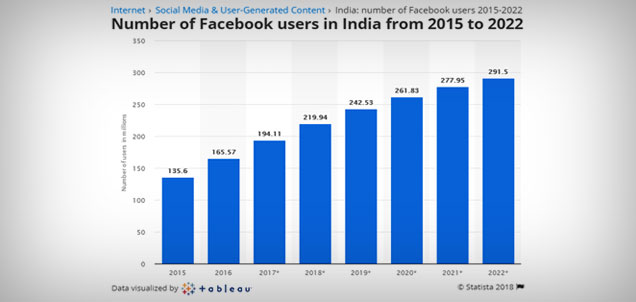
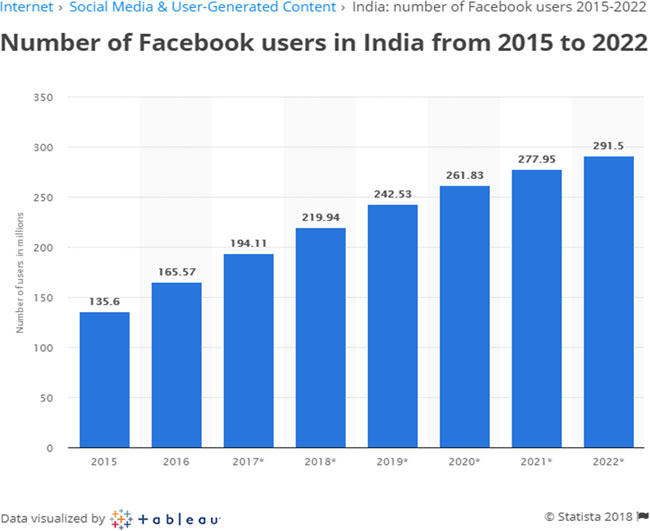
    India has been the country with the largest Facebook users since 2016. There were about 195 million Facebook users in India as of May 2016, against about 191 million in the U.S. and 90 million in Brazil (https://www.statista.com/statistics/304827/number-of-facebook-users-in-india/ ). The number of Facebook users in India is forecast to continue to grow in the coming years, and add up to nearly 320 million by 2021.The penetration of Facebook in India isexpected to jump from almost 15 percent in 2016 to around 23 percent in 2021.Facebook also owns three of the most popular social networks WhatsApp, Facebook Messenger and Instagram which help to increase its strong hold in the Indian market.

    Mark Zuberberg has claimed that globally, Facebook’s advertising-driven business has not been significantly damaged after the Cambridge Analytica bombshell dropped. Its share prices which dropped after March 2018 when the Cambridge Analytica reports broke, has climbed back to slightly above its price Facebook enjoyed before the news break.  Its ability to protect its users’ personal information shared and stored on its social network is yet to be proved to the complete satisfaction of the law makers across different countries

    Our Ministry of Electronics & IT has recently asked Facebook to explain if it allowed phone and other device manufacturers access its users’ data without taking their consent by June 20 following a recent report in media that Facebook has admitted to sharing information with a “small number” of companies including RBC Capital Markets and Nissan Motor Co., advertisers and other business partners (https://brandequity.economictimes.indiatimes.com/news/digital/facebook-kept-sharing-users-data-with-companies-even-after-saying-it-had-stopped-third-party-access-to-information/64516829).

    Google, the leading player in the Digital Duopoly, is comfortably settled in India. Google Search has 90% market share in India, Google’s Andriod OS is used by over 90% smartphone users in India, YouTube is watched by 80% of the internet users in India with a 225 million monthly user base, Gmail enjoys the largest user base in India and Google Map is consumer focussed and free to use. Google has been working steadily on India first tweaks and apps  such as offline videos for YouTube, two-wheeler navigation on Google Maps, Android Oreo (Go edition) to improve experience on low-RAM phones, Google Assistant for Reliance Jiophones, new apps like Google Go and Files Go, built from scratch, Google WiFi stations in partnership with Indian Railways and the mobile payment platform Google Tez, which within a month of its launch in September 2017, captured 60% share of m-payments in India.Facebook should take a lesson from Google and introduce some India specific social apps.

    India is a focus market for Google’s Next Billion Users Plan through which it aims to bring everyone online in India (https://brandequity.economictimes.indiatimes.com/news/digital/google-wants-to-bring-everyone-online-in-india-through-its-next-billion-plan/64457803). As a part of this initiative and based on intensive field research by its technical team, Google launched a multilingual app in Mumbai 10 days back (on May 31),  called ‘Neighbourly’ catering to only Mumbai.Thislocal discovery and community app works in English, Hindi, Marathi and six other Indian languages. The hyperlocal platform helps to find anything from a doctor, ATM or petrol pump to a mechanic or badminton coach, within 2 km radius.In coming weeks and months, Google plans to roll out the app across more cities in India.

    It is a difficult proposition to challenge Google’s total supremacy today In India as it is far ahead of its other competitors. Facebook, which has now become vulnerable, may have to deal with more competition in the sphere of social media. Itmay be compelled to spend comparatively more time to ensure protection of consumer data and implementation of its privacy policy, which may lead to erosion of its market share through competition in the global market. However, in India, there is minimal chance of a similar threat. So, the immediate future of the digital duopoly seems to be secure in India in spite of Baba Ramdev’s plan to relaunch Kimbho after a flamboyant launch followed by a silent withdrawal.


  • Dentsu adspend forecast for 2018 down from 12.5% to 10.5%


    By A Correspondent


    Leading advertising and digital communications group Dentsu Aegis Network released its biannual global forecasts, pointing to a more positive 2018 for Asia Pacific advertising expenditure than previously expected. Adspend growth will rise from 4.0% in 2017 to hit 4.5% in 2018 – higher than the 4.2% forecast in January 2018 and taking total investment to USD 215.95 billion. Regional events such as the 2018 World Cup will be held in Russia, 2018 Winter Olympics South Korea, Asian Games in Indonesia and Australian federal election will play an important role in stimulating growth.


    But the growth forecast for India – 12.5% made in January 2018 – is now 10.5%


    Speaking on the Indian context, Kartik Iyer, President- Media Brands and Amplifi – Dentsu Aegis Network India said, “India’s ad spend is projected to grow at 10.5% as compared to the beginning of the year when the growth was expected to be over 11%. Digital continues its rapid growth (31.9%) with online video –gaining in share. This has been driven largely by the availability of high speed connectivity across the country, it is only set to grow faster. TV with a projected market share of 39.1 % continues to lead the media share of pie with Print at 29.3%. It wouldn’t be a surprise to see some forward thinking brands trying to use Video Instead of TV  in a few test and learn cases.” [As per the communique we received from DAN in January, the forecast was 12.5% and not 11% as mentioned by Kartik Iyer. The table below – supplied by DAN – does give mention the earlier forecast as 12.5%]


    Geographically, Asia Pacific is a major growth region, contributing 41% of the global increase (USD 613.5 billion). Comparatively, North America accounts for 32%, Western Europe accounts for 13% with Latin America at 8% and Eastern Europe 5%.


    Commenting on the latest forecasts, Nick Waters, CEO of Dentsu Aegis Network Asia Pacific, said, “The region as a whole displays a positive outlook with increasing growth rates. We are seeing upward revisions in most key markets, with India, the Philippines and Vietnam showing high rates of growth. Spend in China continues to grow at pace, though driven almost entirely by the ecommerce platforms, Alibaba, Tencent and Baidu. Digital remains the dominant growth area with a quarter of Asia Pacific advertising spend expected to be delivered through mobile for the first time. Digital will be the leading form of advertising in half of the markets that we track in the region.”


    Key market trends

    :: India: India advertising spend market is expected to grow in 2018 by 10.5% to reach 624 billion rupees. Though there had been a slow start in Q1-2018, the market was picking up from March-April, fueled by a stable recovery post demonetisation/GST/RERA buoyed by the State Elections in Meghalaya, Tripura, Nagaland and Karnataka in April. The India South Africa Match in January, Budget announcement in February, lead to continued expansion and growth of regional newspapers and television. Both social and online video will see growth for the next five years as India continues to evolve their internet, mobile, cloud audience.


    :: China: China’s advertising market is predicted to grow 6.5% in 2018, up from the previous forecast of 5.4%, to reach RMB 630 billion – 16.2% of global ad investment. Growth will be driven by digital, which is forecast to command 60% of advertising spend and increase by 14.8%. The online giants Baidu, Alibaba and Tencent (BAT) are projected to contribute around 80% of this growth, underlining their dominance of the marketplace. Mobile payments are also one to watch in the coming years as platforms such as WeChat or Alipay make cash obsolete in large parts of the country.


    :: Australia: Australia advertising spend is forecast to show continued growth in 2018, increasing by 2.8% to reach AUD 15.7 billion. The main driver of growth will be election related advertising which includes a boost in advertising by the governments involved as a means to promote the great things they have done during their time in power. In 2018 we expect more than 40% of growth to come from this sector and a further 40% to come from Gambling, Retail and Finance advertising. Digital media is expected to increase by 6.1% in 2018, representing 48% share of the total media spend, which could be a result of brand safety issues where advertisers and media owners look to more autonomy and control of their content.


    Global Media trends


    Mobile on the go

    The mobile device is steadily becoming our primary point of access to all digital services and content. In 2018, 52.2% of all worldwide online traffic was generated through mobile phones, up from 50.3% in the previous year, according to Statista. People now spend an unprecedented amount of time on their smartphones—more than five hours a day, according to some estimates. This growth in usage is largely driven by the widespread availability of high-quality digital Video. Mobile Video consumption is exploding among all age groups and content categories. 9 in 10 Social media users opt for mobile browsing, with mobile apps accounting for 70% of time spent on Social media.


    Reflecting this, mobile is forecast to represent a quarter of global ad spend 25.2% this year exceeding the previous prediction of 24.8%. With Mobile payments forecast to be more popular in the coming years, Mobile is set to continue on a positive growth trajectory a forecast 23.3% in 2018 and 18.8% in 2019.


    Digital still calls the tune

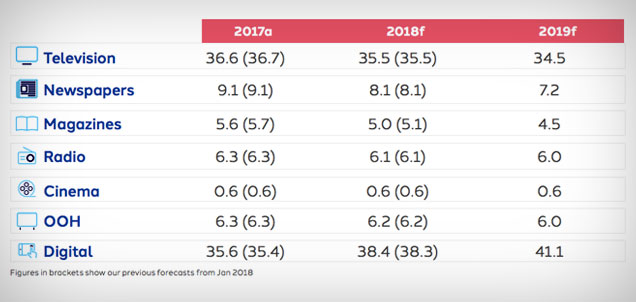
    Worldwide Digital media spend is forecast to increase by 12.6% in 2018, more than three times the rate of all media (3.9%), to reach US$230.6 billion—a US$25.7 billion incremental increase year-on-year. Online Video (+24.6%) and Social Media (+21.6%) are particularly strong. Paid Search continues to account for the largest share of digital (39%). As previously predicted, Digital will overtake TV for the first time this year to account for 38.4% share of total ad spend vs. 35.5%. In the US, Digital spend is forecast to overtake TV in 2019. Programmatic ad spend is expected to grow by 23.2% in 2018 and 19.1% in 2019 as the ability to consolidate programmatic buying strategies across formats and devices continues to be an opportunity for advertisers to reach the most valuable audiences at scale.

    :: Traditional media spend is forecast to decline by just -0.5% in 2018 and -0.4% in 2019. Newspapers and magazines are expected to continue their downward trend, with falls of -7.5% and -6.5% respectively. Radio (+2.0%), Out of Home (+2.2%) and Cinema (+5.9%) spend are expected to show steady growth.

    :: TV spend is forecast to move back into growth in 2018 (+1.2%), following a -0.7% decline in 2017, remaining a major medium in the mix with 35.5% of overall investment.


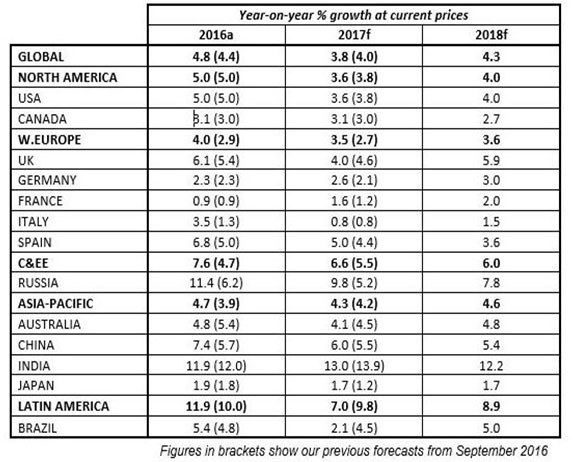
    Growth in global ad spend 2017-19 (% y-o-y at current prices)

      2017a 2018f 2019f
    GLOBAL 3.3 (3.1) 3.9 (3.6) 3.8
    NORTH AMERICA 2.5 (2.5) 3.4 (3.1) 3.2
    USA 2.6 (2.6) 3.4 (3.2) 3.1
    CANADA 0.0 (0.0) 2.3 (1.1) 5.1
    W. EUROPE 3.2 (3.3) 2.9 (2.6) 2.9
    UK 4.2 (3.6) 4.2 (3.8) 4.7
    GERMANY 2.3 (2.2) 2.6 (2.6) 2.9
    FRANCE 2.7 (1.7) 2.5 (2.0) 2.8
    ITALY 0.9 (0.9) 1.4 (1.9) 1.1
    SPAIN 2.3 (1.9) 1.5 (1.4) 1.2
    C&EE 8.8 (8.3) 7.8 (7.4) 6.6
    RUSSIA 14.3 (12.9) 11.7 (10.4) 8.5
    ASIA PACIFIC 4.0 (3.5) 4.5 (4.2) 4.4
    AUSTRALIA 2.3 (2.7) 2.8 (2.9) 2.4
    CHINA 6.3 (6.0) 6.5 (5.4) 6.0
    INDIA 8.9 (9.6) 10.5 (12.5) 11.1
    JAPAN 1.6 (1.0) 1.5 (1.6) 1.2
    LATIN AMERICA 8.3 (8.1) 6.9 (8.8) 7.3
    BRAZIL 2.8 (2.1) 2.3 (5.0) 2.6
      Figures in brackets show our previous forecasts from Jan 2018


  • In the race to the top of M&E industry…


    By Indrani Sen


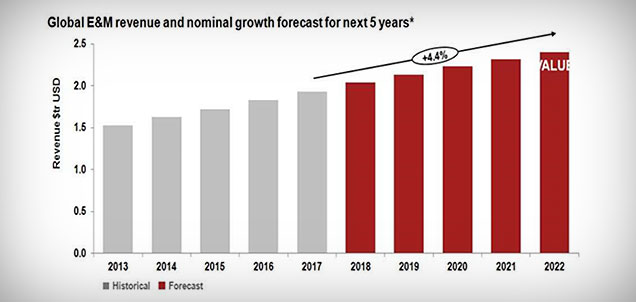
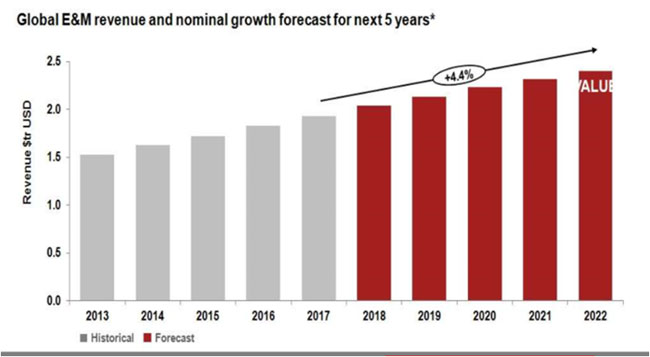
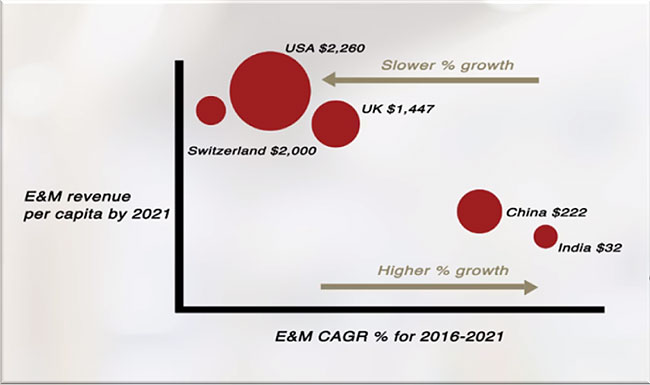
    In early June, PWC released their Global Entertainment and Media Outlook 2018-2022 predicting that in India the Media and Entertainment(M&E) industry will grow at a compound annual growth rate (CAGR) of 11.6% growth of between 2018 to 2022 (https://brandequity.economictimes.indiatimes.com/news/media/indias-me-industry-to-clock-over-rs-353609-crore-by-2022-pwc-report/64477039). This growth rate will be 2.5 times the growth rate of 4.4% predicted for the global M&E industry. However, in terms of M&E revenue per capita in US$, the developed countries will be far ahead and in 2021 US M&E per capita revenue ($2260) will be 10 times of China ($222) and 70 times of India ($32).


    Source: PWC Outlook 2018-2022

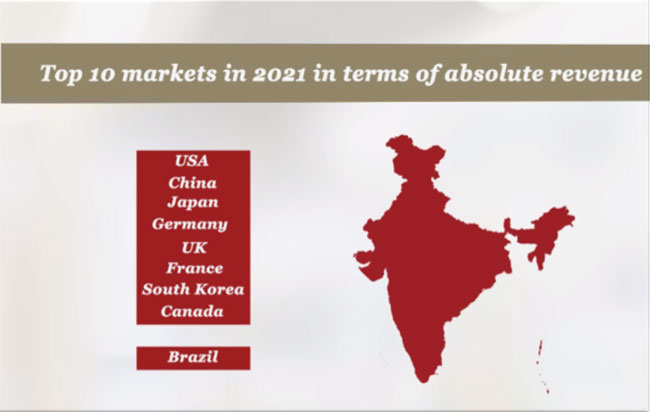
    The PWC analysis also predicted that India will earn a place among the Top 10 countries in terms of absolute revenue for M&E industry by 2021, a fact which is extremely reassuring given the exchange rate of INR and US$. Among the BRICS countries, China, India and Brazil will be among the top ten countries in terms of absolute revenue of M&E industry. China will overtake all other countries and will be in the number 2 position after US, followed by Japan, Germany, UK, South Korea, Canada, India and Brazil.


    Source: PWC Outlook 2018-2022

    Last week, the Dentsu Agies Network predicted that adspend in India will grow by 12.5% in 2018, a substantial increase from 9.6% in 2017 and against a global growth of 3.6% in 2018, up from 3.1% in 2017 (http://www.mxmindia.com/2018/06/dentsu-adspend-forecast-for-2018-down-from-12-5-to-10-5/) The advertising market in India is forecast to grow by a further 12.5% in 2019. Ad spend is a component of the total M&E industry, but any small fluctuation in the affects the industry’s overall revenue and growth. It is reassuring to find that the DAN Global Advertising Forecasts (January 2018)based on data received from 59 markets, supports the trend predicted by PWC in their overall forecast for the M&E industry and particularly for India. Both the studies agree that the future growth will be driven by various forms of digital media. DAN forecasts that during the current year, digital media spend in India will increase by 30% with 43.6% growth in mobile spend, accounting for 47% of total digital spend in 2018.

    In a comparison of the growth rate in adspends across countries the Dan report shows that only India will continue to enjoy a double digit growth rate over the period 2016-2018. Russia and Lain America, who had similar two digit growth rates in 2016, are going to experience declines in their growth rates over 2017 and 2018.


    Global Ad Spends 2016-2018

    Source: DAN Global Ad Spends Forecast (January 2018)


    Going back to the forecast of PWC, after attaining a place among the first ten countries in terms of absolute revenue in 2021, India’s next goal should be to attain a position among the top five countries. Apart from the growth which will come from within the M&E industry fuelled by technological changes and ad spends growth, we will need to improve our exchange rates with other foreign currencies, particularly the US$ which is used as the currency for global comparisons. How much demand there is in relation to supply of a foreign currency determines that currency’s value in relation to the local currency.Other geopolitical and economic indicators that affect the exchange rates between two countries are changes in interest rates, unemployment rates, inflation reports, gross domestic product numbers, data on manufactured commodities, etc. So, in the race to the top of M&E industry we must have a robust economy and the solid financial infrastructure leading to a favourable exchange rate with US$.


  • Shashidhar Nanjundaiah: What ails our communication education

    By Shashidhar Nanjundaiah


    The Indian media and entertainment industry is growing by leaps and bounds—the annual FICCI-EY report this year estimates that the $22.75 billion industry (2017) grew by 18.55% since 2011. Although it is beginning to stabilise to around 12%, it will still be an impressive $37.5 billion industry by 2021. Television leads, but in terms of growth, predictably, the digital segment is growing the fastest. Growing at 26%, digital already enjoys 10% of the advertising expenditure. According to independent estimates, there are about 1,300 colleges in India offering media courses. Well over 50,000 students with media and communication degrees graduate in an average year in India. Employment issues in the industry are compounded by the fact that notwithstanding its high growth, much of the film and television industry relies on independent crew, and a large proportion of employment in production houses is project-based. It is therefore the strategy jobs in the M&E industry that are mostly available to media graduates.

    On their part, independent colleges have the leeway to develop, seek approval and deliver curricula that they believe is better than the “model” curricula recommended by the University Grants Commission (UGC), the overarching regulatory body for much of our higher education system. There is a 30% leeway to operate with independent thought, and we can see how different universities have adopted subjects with nomenclatures that seem different on the surface. But arguably, it is the prescribed format and structure of the curricula that do the most damage, because many colleges do not venture beyond the UGC-mandated structures. Even when they do, it is debatable whether the results match industry expectations.The most well-oiled machines are in independent filmmaking courses. With the usual exceptions of a handful of specialised institutes, graduates do not prepare to enter the industry. They prepare to graduate.

    WYSIWYG. Among aspirants, communication is one of the least understood disciplines, and predictably, this ignorance is far more pronounced in non-metros. (In metros, too, the understanding is incrementally more largely because of the exposure to the environment, not because the school system or any form of intervention creates any awareness.) The average applicant walks in seeking to “do something in” advertising or filmmaking.Because the media and entertainment (M&E) industries afford partial visibility, this parasocial exposure to what appears glamorous and attractive gladly occupies the aspirational mind.The results, too, are accidental. How many communication graduates can claim to have started and ended with the same focus?

    Neither the partially visible nature of our communication industries nor entering communication education on a clean slate is a bad thing. Just the contrary. But in reality, the slate is hardly ever clean. The visible parts of our industries occupy the clean slate. In institutes I have been involved with, I make it a point to create an unlearning atmosphere at pre-admission and post-admission levels, and make efforts to help students do so before they start learning their disciplines. This helps students take the directionbest suited to their aspiration, aptitude and life goals. But in recent times, competitiveness among communication educators has created another business imperative of sorts. As colleges go corporate, with large marketing departments in place, counselling is less about creating awareness and choice, and more about convincing. Everything goes well when a student comes in with that tabula rasa. Because a large proportion of communication jobs are usually hardnosed strategy roles, and “getting a job” in the creative industries often entails financial risks, students and parents are often put off. After all, they came in search of a communication school exactly because they didn’t want a business degree. Isn’t communication a way to make money by using the art of free expression? They want to know. Further complicating these issues is the fact that working in these industries often does not mean creating anything—it entails managing and understanding creativity.

    Wrong reasons. As the discipline matures, there is a slowly changing comprehension of what it takes—with the huge diversity in academic orientations ranging from the arts to statistics, creativity to business strategy. Students often choose their disciplines within communication because i) they want to enter a particular industry, whatever the role, or ii) the discipline seems familiar enough to grasp, or iii) they are clear what they want to do. The last of the three is a dream for a college, but that is because colleges themselves often do precious little to educate students what is at the other end of the journey. This means students choose with a certain amount of randomness. Being an educator should also mean helping students discover the intersections between natural inclinations, aspirations, and aptitudes.

    Then there is the familiar matter of keeping up with industry trends. While there are principles, schools and concepts in all communication disciplines, anda good communication college often does a fair job of grounding students in them, the curricula continue to live in history. The problem is not with the curricula. As I mentioned in last week’s piece about media education, the problem is how we create repeated practice out of existing curricula.

    This problem is usually more prominent in the more conventional disciplines such as film and advertising. With public relations, for example, the experience may be different. As a newer subject, it affords nimblefootedness in approach simply because of a drawback—not enough traditional literature exists. With advertising, students go through the usual motions of learning the features of copywriting. The strategic practice of copywriting remains obscure, because it is seemingly too much driven by individual talent.

    Digital communication—education hasn’t caught up. Among all the gaping gaps we see in communication education, though, is the chasm between the emergence of digitisation of practice and its learning at college levels. Take, for example, satellite-based distribution systems of creative products and the emergence of film marketing. Only a couple of colleges with roots in the industry have even paid attention to these new trends. The practice of digital communication has taken a quantum leap, attracting fresh talent like a black hole. But few students are systematically prepared for the digital industries, entailing the art, science and commerce of storytelling, content creation and the strategies to market and distribute them. For the PR industry, this brings in a whole new function of content aggregation beyond the traditional media functions.

    As much as digital communication is the medium of the youth, recruiters continue to be disappointed at the numbers and quality of graduating students who are experts at digital communication (notwithstanding a handful of good institutes teaching digital marketing). The larger picture with the frenetic growth of digitisation and of digital media platforms is that it has been creating new ecosystems. I have, somewhat in a Marshall McLuhan-esque way, regarded the digital as a new paradigm, not merely a new medium. Digitisation surrounds us through its three new dimensions: New tools (mobile, computer-based) and technology, revised concepts and ideologies, and an increasing role of digital professionals in professions and societies.

    Digital media literacy itself is a huge opportunity that ironically remains undisturbed among academic circles. Digitisation has added a research and analysis dimension to our practice, but again, it is largely being ignored at preparatory levels.Storytelling and (and through) gamification are potential specialisations within media colleges, being new forms that will occupy a big space in Indian mediated communication. The low-cost advantage to digital should have also sounded the opportunity bugle for digital entrepreneurship as part of the curricula. (Fewer communication students than ever before in my experience are interested in entering the workforce through day jobs.)The “new media” course among colleges does not do justice to the rapid evolution of digital as a new ecosystem. We badly need a digital-first approach specifically training students in digital communication practice.

    Digital media vs digital ecosystem. Learning digital media is never going to be enough unless understanding digital practice is embedded while learning any media-related practice.Many media colleges claim to cover much of what is needed. The important difference, though, is for how long and with how much focus do students absorb these subjects? A guest lecture or even a daylong workshop in gamification ain’tgonna cut it. It is even possible to embed many of these subjects within the existing curricular structure. I argue that all this is not the root cause of the mismatch between a student’s learning and her practice upon entering an industry. UGC mandates a large number of subjects, regardless of which discipline within communication you are specialising in. It does not pay enough attention to strategy and business—perhaps because the regulator does not see the practice of communication as a strategic-enough science. There is an array of diverse subjects that are great for general learning, but in a time-limited programme, some are redundant. Students themselves recognise the impracticality of some input. But in the end, it is all about how a college and its faculty approach specific subjects, what pedagogy they adopt, whether students get enough practice on ideas, technology, strategy and their tools. Believe it or not, communication skills—let alone writing—do not form a core part of a typical media student’s curriculum.

    It is impossible to generalise the issues of communication education, as much as it is impossible to club the problems in the practice of all communication industries. Such is the vast diversity in M&E. That brings to a final point: We need a radical change in the way we approach communication education. A distinction between communication arts and communication strategy is the real difference. Calling it “Advertising”, for example, is misleading both in the way its practice hasgrown and in the fact that its practice entails many divisions with completely different aptitudes and approaches. Similarly, subjects are created with a focus on their marketability with aspiring students. Teaching the concepts and practice of advertising or corporate communication may not occupy more than a semester of weekly input. But taking the student through the understanding of various client industries, through practical application of communication strategy, and developing independent projects is important to effective learning. As in journalism, project- and practice-based learning has no substitute. But the key lies in repeated practice.

    The industry is more active than before in participating in curricular delivery and sometimes in building syllabi. This is commendable, yet more embedding is needed because industry-trained faculty are far and few between. A recommendation I have been making since 2013 is that corporate social responsibility (CSR) must necessarily contribute to creating talent at colleges in their respective domains.MNCs are already building labs and imparting training in engineering and, lately, in journalism colleges. Surely more can be done in the digital, film, advertising, media research and PR industries in alignment with the Companies Act’s CSR clause?

    In conclusion, it must be noted that more corporations than ever before are hiring communication graduates, as are the best advertising agencies. That trend is a good acknowledgment of more acceptable communication education.

    Shashidhar Nanjundaiah has led leading media institutes in India, as  Director of Symbiosis Institute of Media & Communication, founding Director of Indira School of Communication, and first Dean of India Today Media Institute. He pioneered research on the socio-economics of a newly liberalised Indian media marketplace. Currently, he observes how India’s media industry is shaping itself in this decade. He has also edited newspapers and magazines in India and the US. The views here are his own.


  • Brandwatch: Tata India’s Most Valuable, HDFC, the strongest


    By A Correspondent


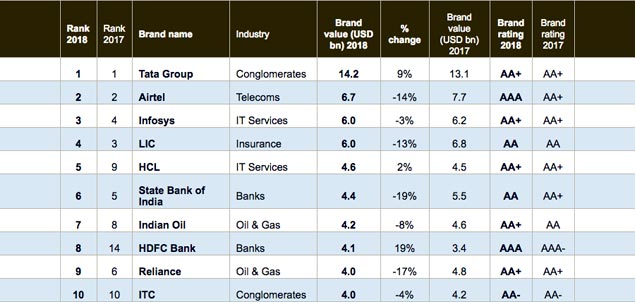
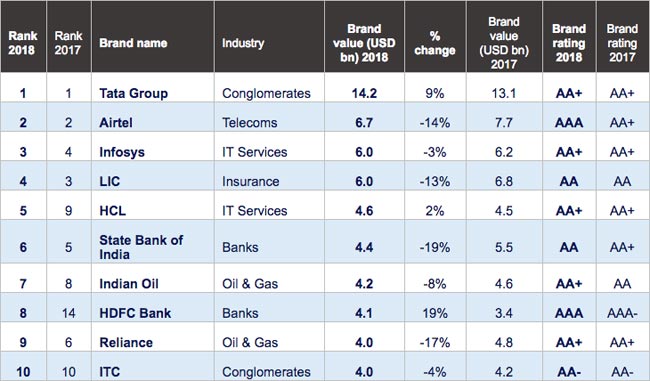
    Tata Group is by far the most valuable brand in India, with a value surpassing that of the second (Airtel) and third (Infosys) ranked brands combined, according to the latest report by Brand Finance, the world’s leading independent brand valuation and strategy consultancy.


    After a few years of below 5% growth in brand value, Tata Group has surged ahead with a 9% growth to US$14.2 billion consolidating its No.1 rank by a huge distance. Considering Tata has been way ahead of the rest at $13.1 billion in 2017, this 9% is a tremendous surge, reflecting a solid year. The US$1 billion increase is the result of much tactical streamlining, refocusing and re-energising of Tata’s key businesses TCS, Tata Motors, Tata Steel and Tata Chemicals.


    Said David Haigh, CEO of Brand Finance: “Under the pragmatic leadership of chairman Natarajan Chandrasekaran, Tata Group is pursuing a consolidated long-term strategy as it ushers in a new era. Chandrasekaran has reviewed the Group’s most senior positions, introduced an experienced team of former bankers tasked with overseeing group finance’s and made tactical leadership changes across the financial services and hotel brands. This year’s success can truly be attributed to a productive first year in office for the new chairman.”


    India’s 10 Most Valuable Brands


    HDFC Bank takes title of India’s strongest brand

    A similar surge is observed in HDFC Bank which has broken into the top 10 this year, following a 19% brand value growth and claiming 8th rank among India’s most valuable brands with a US$4.1 billion valuation. Over the past year, HDFC Bank has grown steadily, making small and sensible acquisitions whilst maintaining its focus on digital banking. The bank has cleverly attracted young customers who want to buy, pay and invest at the click of a button, directly through their cellphones, even offering preapproved personal loans that can be expended within seconds. HDFC Bank is clearly proving its resilience and growth in the face of banking scrutiny and headwinds sweeping the sector.


    Aside from measuring the overall brand value, Brand Finance also evaluates the relative strength of brands, based on factors such as marketing investment, customer familiarity, staff satisfaction, and corporate reputation. Along with the level of revenues, brand strength is a crucial driver of brand value. According to these criteria, HDFC Bank is India’s strongest brand this year with a Brand Strength Index (BSI) score of 88.0 and a corresponding brand rating of AAA.


    And Kotak Mahindra Bank is India’s fastest-growing brand

    Another banking brand which has had a successful year is Kotak Mahindra Bank, (up 74% to US$2.1 billion), making it the fastest-growing brand in the Brand Finance India 100 2018. The brand has not only expanded its countrywide presence but also shown tremendous discipline in shaping its governance and customer experience. It has also recently strategically partnered with Ripple, to provide near-instant cross-border remittances using blockchain technology.


    Public-sector banking brands take a dent

    On the whole, India’s public-sector banking brands have taken a big dent in both their brand value ranks and growth, whilst the country faces its worse crisis of confidence across the banking sector. Most of the top 100 PSU banks have seen a decline in brand value growth: SBI at 19%, IDBI Bank at 30%, Punjab National Bank at 16%, Syndicate Bank at 9%, Central Bank of India at 21%, and Bank of Baroda at 14%.


    Addd Haigh: “In a year of non-performing assets hitting the major banks, with further tightening of India’s financial sector alongside market uncertainties, the towering strength of strong governance is now more important than ever. The year ahead will be a test for brands navigating their way through the changing governance landscape.”


    Telecoms dial down brand values

    There are huge changes afoot across the telecoms sector too, courtesy of Reliance Group’s disruptive operator Jio, triggering a drop in brand value of Airtel (down 14% to US$6.7 billion), Idea Cellular (down 15% to US$1.7 billion) and BSNL (down 23% to US$ 0.5 billion).


    The Indian mobile ecosystem has witnessed incredible growth in recent years, with package offerings and cut-price plans expanding, and 4G becoming more popular in a bid to satisfy the needs of a mobile-data-hungry population.


    Brands to watch

    From among other notable brands featuring in this year’s Brand Finance India 100 league table, Maruti Suzuki has zoomed ahead with a 26% brand value growth to US$3.2 billion over the past year, jumping from 17th to 13th spot in the ranking. It has certainly been a year of many successes for Maruti Suzuki where it has redefined its brand standards, maintained growth of Nexa, its alternative retail dealership format for premium cars, alongside a plethora of product offerings that charmed the market.


    In this year’s Brand Finance India 100 2018, it is evident that brands with strong fundamentals have stood to gain significantly: Bajaj Group (up 30% to US$2.4 billion, ranked 19th), Bharat Petroleum (up 21% to US$2.4 billion, ranked 20th), Yes Bank (up 21% to US$0.7 billion, ranked 36th), and TVS (up 19% to US$0.5 billion, ranked 53rd).


    Finally, there is one brand that has been consistently making its presence felt in the rankings over the last 3 years. The motorcycle manufacturing brand Royal Enfield is gradually taking the “Made in India” tag to a global scale, and it has again registered a 25% brand value growth this year, making it one of the steadiest-growing brands in India. With a brand value of US$0.6 billion it moved up from 59th in 2017 to 43rd this year.


    View the full Brand Finance India 100 2018 report here