 Two very interesting global reports have been published over the last one week. The first is the Reuters Institute Digital News Report 2023 and the second is the 2023 edition of the World Happiness Report. As a marketer and ‘brand-o-phile’, I see a subliminal connect between the two.
The Reuters Institute Digital News Report is an outcome of more than 90,000 responses across 46 countries on how much one trusts news, through conventional as well as digital media. While the overall global trust score has dropped a few percentage points, the report states that “it is not surprising that news consumers are increasingly feeling overwhelmed and confused, and many are turning away temporarily or permanently. Selective news avoidance and news fatigue have been exacerbated by the challenging times we live in.”
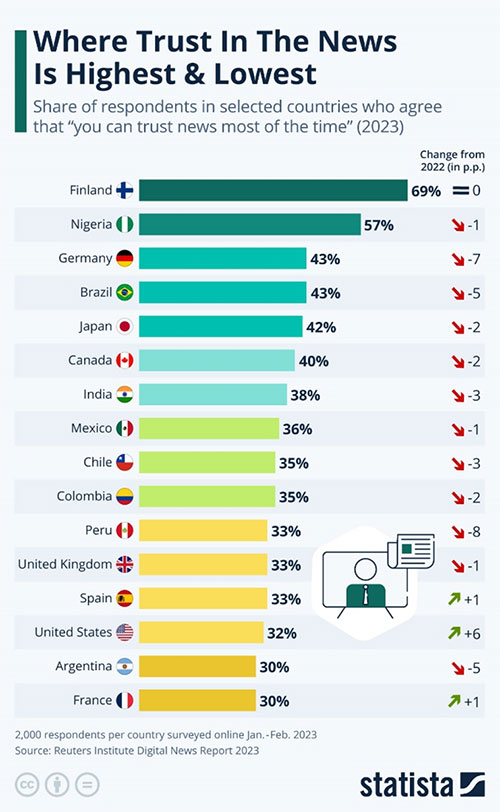
India is somewhere middling with 38% of news consumers trusting what they read and see. It has dropped 3 % points since the 2022 report. Now with the election season looming upon us, one can expect a sudden drop in the score with every political party resorting to downright unethical and fake communication without batting an eyelid on the impact on an already tense social fabric.
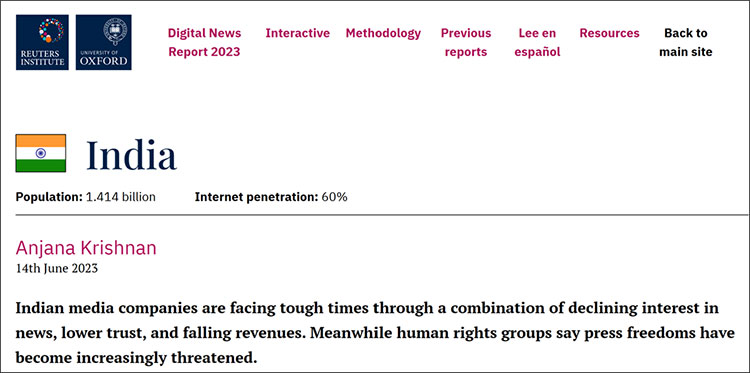
The special note on India in the report is quite telling.
Credibility is a huge factor. With the latest Press Freedom Index ranking of 161 out of 180, however much one may want to downplay the Reporters Without Borders study as being driven by agenda and deliberately disparaging towards the world’s biggest democracy, one cannot cross one’s heart and denounce it.
The note states that “our Digital News Report survey finds steep falls in both the consumption and sharing of news. There was a sharp decrease in access to online news (12 percentage points lower than last year), particularly through social media (-11pp), the main sources of news for a predominantly younger audience. Television, popular among a large section of the population, also saw a 10pp decline as a news source with our younger and more urban-based sample.”
While the government has brought checks and measures for media platforms, especially digital, on the authenticity of the news and its possible impact on factors like social harmony and national security, there are none for the social media teams of all political parties who deliberately churn out one-sided or fake posts, with the clear objective of misleading the populace and even instigating it into unrest. When the digital platforms dig up and expose these untruths, there is no legal recourse to punishing these people. All the Johnnies are consuming too much sugar without remorse.
As the judiciary at the highest level seems to be the only panacea for most ills in the country, some sane citizens should file a PIL against such lie-spinners and let the court pull them to task.
The second report is the much debated and hated World Happiness Index by Gallup wherein certain sections of our thought leaders and citizenry cannot understand how can people in Pakistan, Bangladesh and Sri Lanka be happier than us, especially when we are going through our “Amritkaal” towards becoming the undisputed “Vishwaguru”. They need to understand that once again, this global report is not being undertaken with the sole purpose of showing India in bad light, but to help us introspect.
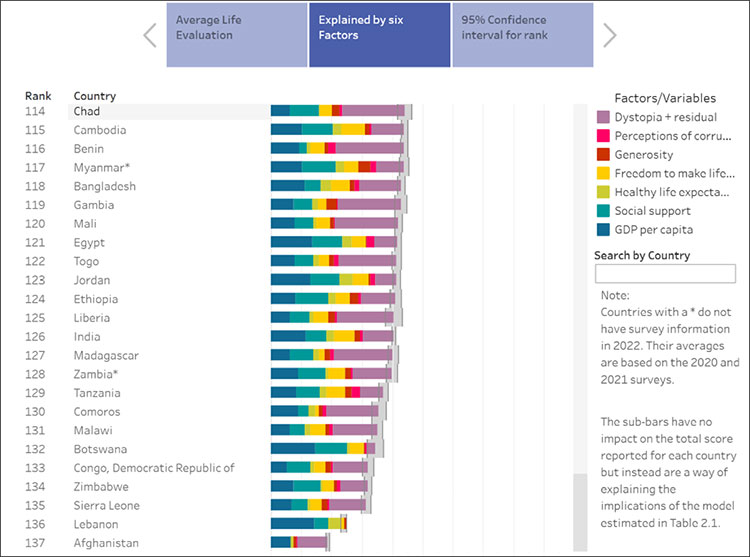
If we study our score across the seven parameters in the second chart below, we will observe that we score badly on factors like life expectancy, corruption and generosity. These factors may not be as easily measurable like per capita income and are largely perceptual, but strong enough to take our score down. Also, the dystopia score is significant enough implying an undercurrent of social stress, possibly amongst certain communities.
How are these two reports interdependent? Happiness is an active ingredient for trust. The lack of the first leads to increased scepticism and therefore the tendency to discount what you consume as news. You may put up a brave face in one report but the mask comes off in the other one.
You posture to amplify the news that you opt to believe in as it shows you in better light. That is a fundamental defence mechanism, borne out of deep down insecurity and an inferiority complex. It is not that you openly consume and debate all sorts of news and digital content to logically establish that you are in the right. Similarly, you pose as happy, taking selfies next to objects, visiting places or doing things that take you away from your uncomfortable harsh reality. When it comes to responding to a survey, your disappointments with aspects of life around you get exposed. It is not the proverbial bed of roses.
No external intervention can work in this case. Only a slow and gradual improvement in collective consciousness can shake the citizenry out of this sucrose-induced slumber.
As a common citizen, you too are consuming enough sugar without even admitting to yourself. That is far worse than the media magnate spinning fake stories to drive you into a frenzy.
The festival of democracy is less than a month away. Look before you leap.
Jai Hind!
Avik Chattopadhyay is a Gurugram-based brand and business strategist and commentator. He is currently also working along with XLRI to set up the Indian School for Design of Automobiles. He writes on MxMIndia every other Thursday. His views here are personal.


