Tag: OTT

  • TRAI’s OTT recommendations uphold vision of Digital India: IAMAI

    By A Correspondent


    The OTT regulation recommendations by TRAI is a progressive judgment that upholds the Digital India vision of the government and will help achieve the vision of the National Digital Communication Policy (NDCP) as envisaged by the Ministry of Telecommunications, states the Internet and Mobile Association of India [IAMAI] while welcoming the recommendations by the Telecom Regulatory authority of India (TRAI) suggesting no regulatory intervention on digital services based on data services by telecom operators, referred to as Over The Top (OTT) services.


    Notes a statement: “IAMAI expresses gratitude to TRAI for upholding the Association’s longstanding position that digital services are not similar to conventional telecom services or even comparable to them in terms of regulating them. TRAI has also acknowledged the fact that the argument for economic loss does not hold given digital services lead to added revenues for telecom services in terms of data consumption. The decision to allow market forces to deal with the economic aspects of the popularity of OTT services is a landmark decision that augurs well for the fast-emerging digital services sector in India.


    TRAI has also satisfactorily addressed the concerns of security and privacy by giving due recognition to the ongoing developments and has categorically refuted any need for regulatory intervention in this regard. IAMAI had highlighted in its submission that the various new regulatory provisions like Personal Data Protection Bill adequately address all such concerns and hence no further interventions were required.


    On the overall issue of Regulation of OTT services, TRAI recognizes the various global development taking place and suggests putting matters on hold till more clarity emerges. IAMAI reiterates that the digital services under consideration are suitably regulated by the Information Technology Act or the forthcoming Data Protection framework or cybersecurity provisions being discussed. The sector is as well-regulated as any telecom service and any future needs can be adequately addressed without stifling its development.


    IAMAI expresses optimism that the Indian digital sector will respond positively to these recommendations that allows the sector to evolve unfettered.


  • How India’s Gen Z is addicted to Streaming


    By Indrani Sen


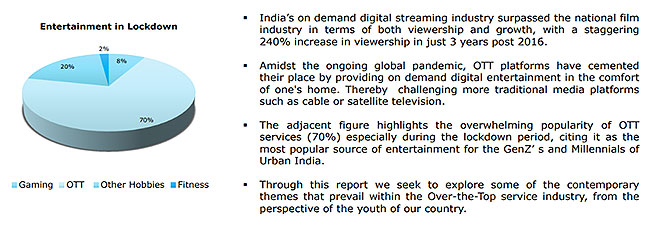
    Covid-19 has transformed the media consumption trends in India. Globally, streaming platforms gained in a big way since the pandemic struck and India is no exception. The report published by Dentsu Agies Network – “Now Streaming: The Indian Youth OTT Story” – is a study conducted among urban India’s Gen Z & Millennial reconfirms this trend. These trends could be reflecting behavioural changes of the two younger generations which are likely to last even after the cloud of pandemic shifts from the Indian sky. The highlights of the findings from the report are shown below:

    Source: https://dentsumarketing.cloud/dmcinsights.php


    As many as 74% of the respondents came from the Top 8 metros with 26% coming from rest of urban India. 47% of the respondents were male and 52.2% were female. 78.5% came from Gen Z (5 to 25 years) and 21.5% came from Millennials (25 to 39 years).  The report therefore cannot be taken as uniform trends across urban youths across India but trends which are visible among youths residing in the top 8 metros and mostly below 25 years of age. They are, however, the future targets of marketing and advertising in India.


    Average daily time spent in hours

    Gen Z Millennials
    On line Gaming 1.97 1.11
    Binge Watching 4.45 3.66


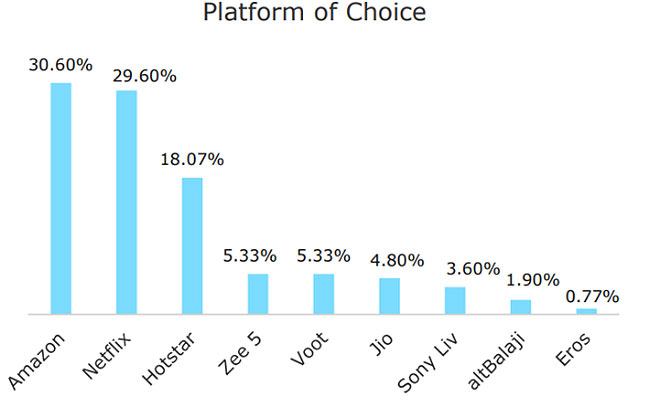
    Among the various OTT platforms, Amazon Prime and Netflix lead the pack, followed by Hotstar. The other OTT platforms are yet to build up significant presence among the Indian youths. Gen Z spends more time than Millennials both on gaming and binge watching on OTT platforms.


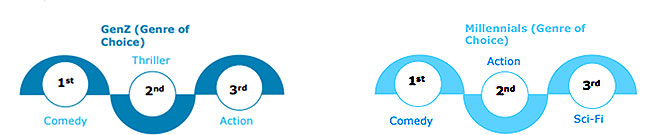
    The choice of genres by the two sections of youth explains the popularity of the top three platforms which offer more content as per their preference. Zee 5, Voot, Jio, Sony Liv, etc have less content to offer in the Comedy, Action, Thriller and Science Fiction genres. Amazon Prime, Netflix and Hotstar have also invested more in production of original content. However, the report has also shown that both in North and South India across different demographics the primary usage of OTT platforms were for viewing TV shows and movies.


    During the lockdown north Indian youths invested on an average in three OTT subscriptions than their counterparts in south India who invested on an average in two OTT subscriptions. The Gen Z invested on an average in 3 OTT subscriptions while Millennials invested in 2 OTT subscriptions during the same period. The report does not give details of the demographic profile of the sample, but we can safely assume that the sample was skewed towards higher SECs as indicated by higher spends on OTT subscription by Gen Z, most of whom would not have been financially independent and had to ask their parents for the subscription money. Obviously their parents were not financially affected due to the economic slowdown during the lockdown and could afford to indulge their children. The report therefore captures mainly the trends of OTT consumption of urban youths from 5 to 25 years age belonging mostly to NCCS A and the top 8 metros.


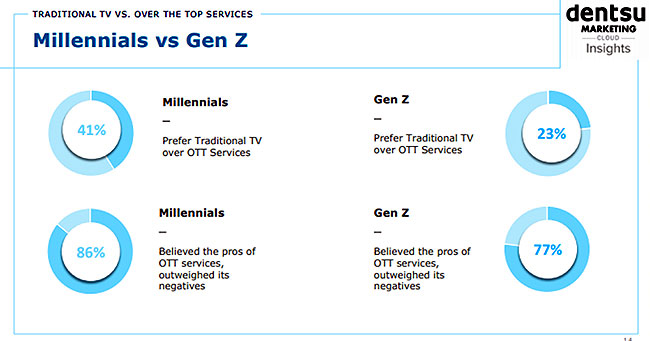
    The report has also captured that 73% have no concern about the content of the OTT platforms. The other 27% have stated obscene content, anti-national content, strong and bold language of the content as well as content hurting sentiments of religion/ caste as causes of concern related to OTT platforms. On the other hand all respondents had concerns about internet connections, pop-up ads and buffering related to steaming of the contents. Both Millennials and Gen Z have shown a clear preference for OTT services and believes that the positives factors outweigh the negatives.


    The report concludes that content distribution, attractive marketing, transitioning the gaming industry and personalisation are the key factors which is helping consumption of OTT platforms to dominate over consumption of traditional TV viewing. The analysis does not mention about the tie ups between OTT platforms and Telecom giants like Airtel, VI and Jio, a practice which began in 2017/ 2018 and has been continuing since then.


    As per the range of packages offered by the three telecom companies, it appears the leading OTT platforms do not believe in exclusive tie ups with any single telecom company and have created a level playing field for all the service providers by having tie ups with all of them. It seems this survey did not probe into this aspect of free subscription with mobile connection among the Gen Z and Millennials, most of whom would have been enjoying some such free benefits through a single sign in. The findings of the reports outweigh the apparent skewing of the sample and a few gaps and have provided all of us a crystal globe for gazing into the future of media consumption.


  • Viacom18 veteran Sonia Huria to join Amazon Prime Video to head India comms

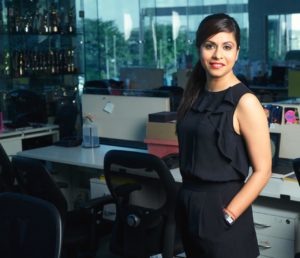
    Sonia Huria
    Sonia Huria

    By A Correspondent


    Sonia Huria, Head of Corporate Marketing, Communications and Sustainability for Viacom18, will move to Amazon Prime Video to lead all communication efforts for its India business. Huria will be a part of the global communications team – leading PR and Communications for Amazon Prime Video in India. She will report to Tobias Tringali – Head of Amazon Prime Video PR Asia Pacific & Canada who is based in Seattle.

    Widely regarded as one of the most influential PR heads in the M&E space, Huria has moved up the ladder at Viacom18 from heading PR for Colors in 2008 to the entire Viacom18 brand portfolio including corporate and then the key roles of corporate marketing and sustainability.

    In the areas of sustainability, Huria successfully created a model of multi-partner-funded behaviour change communication content at Viacom18… from the Navrangi Re! series to the more recent MTV Nishedh. In addition to managing internal and external communication, she also spearheaded trade marketing and digital media for the organisation.

    Huria serves as a managing committee member at The Advertising Club. Under her leadership, Viacom18 has won several awards on the global and India stage. She has been featured in Impact magazine’s Top 50 Women Leaders in Advertising, Media & Marketing for four years in a row.


  • Don’t have a godfather in M&E? Try Ullu Music

    By A Correspondent


    OTT platform Ullu has launched the Ullu Music Channel. What makes it so different from others is its focus on giving opportunities to budding singers, songwriters and musicians who might not have settled contacts in the music industry, to present their work.


    Talking about the same, Vibhu Agarwal, Chief Ullu (err, CEO, Ullu) said: “I have always believed that talent deserves the right chance irrespective of any connections in the industry or not. Ullu Music has been launched keeping in mind to give equal opportunities to all the talented musicians out there. While we will support independent music, we will at the same time also give deserving chances to them to give music to our shows which stream on ULLU App.”



  • Dil Bechara: Success of Serendipitous Proportions


    By Shailesh Kapoor


    Over the last seven weeks, following Sushant Singh Rajput’s death, allegedly by suicide, a murky Bollywood story has been playing out in the media. It started with a nepotism narrative, and has eventually snowballed into a larger controversy that’s an incoherent concoction of various sub-narratives, including nepotism, clique culture, allegations of a botched-up police investigation, celebrities using Rajput’s death to make their presence felt, and journalists using his death to get some primetime traction. There’s neither class nor grace in any of this, and one only wishes that chapter is resolved and closed soon within the legal framework.

     

    In the midst of all the mess, Rajput’s last film Dil Bechara dropped on Disney+ Hotstar last Friday. The film was originally scheduled for a theatrical release, but with theatres closed indefinitely, it has made its way to the audience via streaming, like many other Hindi films have, and will, in the next few weeks.


    Under normal circumstances, the film would have been a usual streaming release, getting its share of viewership based on its content and its credentials. But the events of the six weeks leading up to the film’s release are anything but “normal circumstances”. Disney+ Hotstar wisely decided to not put the film behind the paywall, hence opening it up to a wider AVOD audience base. While streaming platforms do not share numbers publically, our estimates suggest the film would easily be the most-sampled streaming content piece in India ever, with upwards of 50 million streamers accessing it. This number could be higher, closer to 75-80 million, and even more over the lifetime of the film. How much duration of the film they eventually sampled is another data point for which no estimates are currently available.


    In the Ormax OTT Audience Report: 2019, a research conducted in the second half of 2019, the estimated regular OTT Audience in India stood at 76.5 Million. This number would have increased significantly over the last year, especially because of the surge in OTT consumption during the long-running lockdown. And then, there is a wider audience base that are irregular OTT audience, who may come to watch that occasional ‘event’. And Dil Bechara is as ‘eventful’ as it can get on streaming.


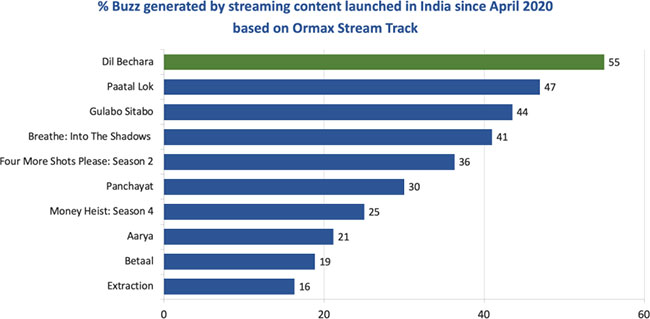
    Dil Bechara is not a usual romantic film either. ‘Death’ is a central element in the film’s story, and the emotions it generates in the last half hour get amplified several notches because of the context one is watching the film in. That has ensured that the film has generated both pre and post-viewing conversations. The chart below lists the Top 10 shows/ direct-to-OTT films launched in India since April 2020, based on the ‘buzz’ they generated in the week of their release. Dil Bechara’s takes the top position by some distance.


    There have been some silly media stories trying to convert the film’s estimated sampling into theatrical box =0office, by multiplying it with an average ticket price number. This cross-media mumbo-jumbo is so silly that inspires me to mathematically prove that if the Hindi GEC show Kundali Bhagya released in theatres in a movie spin-off, it will beat the collections of Bahubali 2, Avengers: Endgame and Dangal put together. There is no vaccine yet for media illiteracy, and journalists in some of the biggest publications in India can desperately do with some immunity.


    Like Ramayan earlier this year, Dil Bechara’s streaming performance is a serendipitous event in which the timing, more than anything else, contributed to an immensely successful outcome. Disney+ Hotstar would know, better than anyone else, that this cannot be replicated.


  • Eros Now partners Dish TV

    By A Correspondent


    Eros Now has announced a partnership with Dish TV whereby Dish TV and D2H users can access Eros Now’s content library including 12,000 plus movie titles, original shows, short-format content Quickie, music through their android set-top boxes – Dish SMRT Hub and D2H Stream, respectively.


    Commenting on the partnership, Ali Hussein, CEO, Eros Now said: “Eros Now has a vast movie catalogue that features cult classics to modern, new-age films. The massive content library offers high-quality experience to the consumers who can consume the content from their homes on smart TVs, at their convenience. This transformation of OTT consumption moving from personal, private devices to television sets in the living room, is a growing trend with movies and other long-format content being consumed on large screens. Eros Now’s endeavour has always been to present the best of online streaming content and provide seamless access to consumers across markets as well as different mediums. The association with Dish TV’s innovative services keeps its vast consumer base glued to the television sets with the inclusion of Eros Now’s content that offers premium OTT experience.”


    Added Anil Dua, Executive Director & Group CEO, Dish TV India: “In our endeavour to provide the best of both the linear and online entertainment options, we have recently introduced a whole range of connected devices including Android STB’s and streaming sticks. We are happy to partner with Eros Now and this partnership will enable our customers to have access to their vast online content library across both our Dish and D2H platforms. Dish TV India is committed to delivering the best TV viewing experience while offering unique content options to its customers and this partnership is another step in the same direction.”


  • Mogi to launch branded OTT app

    By A Correspondent


    Mogi, an AI-enabled video tech startup, has announced the launch of a white label solution with which content companies can launch their branded app and start monetising via subscription or ad revenue streams.


    Commenting on the announcement, Vikrant Khanna, Co-founder and CEO of Mogi said, “Mogi is a cutting edge, AI based video tech start up that has the vision to be a catalyst in this process and democratize the OTT industry, with the launch of our white label OTT solution we wish to empower companies that are creating content to start monetizing it by launching their own branded app in just 24 hours. The best part is there is there is no upfront cost for it, they can simply pay per use ie. based on the number of hours of content they stream. We are already finding tremendous interest across content genres such as media, entertainment, sports, religion, education & training, not just from India but the overseas markets as well”.


  • Will OTT consumption trends last beyond the Lockdown?


    By Indrani Sen


    Starting March 25, Covid-19 imposed four phases of a lockdown over 68 days in India. We have seen many changes in our Media & Entertainment industry during this period. The rise of consumption of video streaming or OTT platforms is a major one among the various changes. As we enter the Phase 5 of lockdown with gradual unlocking of restrictions, the questions which are foremost among the various sectors of the M&E industry ‘will the gain made during the Lockdown last/ can the loss made during the Lockdown be reversed?’


     

    How long does it actually take to form a new habit? Maxwell Maltz, a plastic surgeon published his thoughts on behaviour changes in an audio book called Psycho-Cybernetics which was not only a blockbuster hit, but also influenced thinkers like Zig Ziglar, Brian Tracy, Tony Robbins etc. Maltz’s submission “it takes minimum 21 days to form a new habit” was shortened to “it takes 21 days to form a new habit” and the ‘21 days’ myth was born.


    There have been other scientific studies on the subject and a study by Phillippa Lally published in European Journal of Social Psychology found that on average, it takes minimum 66 days before a new behaviour becomes a habitual one. Though we have had 68 days’ of lockdown, the consumption of OTT platforms did not increase at one stroke at the beginning of Lockdown, but has increased gradually over this period. Still, it would be fair to assume that a large percentage of the viewers contributing to increased OTT consumption is on the verge of forming a new habit which is likely to last as we slowly emerge from the lockdown.


    From only nine in 2012, today the number of OTT platforms in India now stands at 35. The technique of personalisation of content for individual viewers has been helping them to increase their subscriber base which in turn has started attracting distribution of recent movies and other interesting contents. According to TAM AdEx data, the OTT platforms have been advertising aggressively during the Lockdown period on national and regional TV channels across different genres. Most of the platforms have been rewarded with growth of paid viewers and rise in viewing time.


    Apart from the above increases, what other trends we can expect to emerge in OTT viewing in India? As the consumption of OTT platforms increase both vertically and horizontally, the bandwidth required for delivery would continue to remain as an issue. The Cellular Operators’ Association of India has already asked OTT platforms to limit the quality and quantity of video to reduce the strain on the cellular network infrastructure.


    The shift of OTT viewing from small screen to large screen would be a trend to watch out for. As we would be living under the cloud of COVID 19 till an effective vaccine is discovered and is available globally at an affordable price, we will be accepting ‘new normal’ in various wakes of life including spending more time at home with family. The urge to view content together as well as the limitations of the broadband internet may lead to a shift of OTT viewing from the small screen of the mobile to the large screen of TV, a fact which was highlighted in the recent KPMG study.


    Another trend to watch out for would be a shift in prime time viewing of OTT platforms due to WFH and early return from work to home due to night curfew.  A recent article in Financial Times stated: “According to a recent survey by mobile marketing platform InMobi, 46% viewers are watching more content online. Another consumer survey conducted by Hammerkopf has found that OTT consumption primetime has moved to 7 pm onwards, as opposed to 10 pm-12 am before.” (https://www.financialexpress.com/brandwagon/how-is-coronavirus-impacting-the-streaming-platforms-with-an-increasing-appetite-of-viewers/1919916/).


    Various websites have recently carried articles on the ad spend on OTT platforms based on the TAM AdEx report of January to April 2020 showing that ad insertions doubled from 16000 in March to 33000  in April on this medium. An article on www.warc.com made an excellent analysis of the same ( https://www.warc.com/newsandopinion/news/adspend-on-ott-platforms-double-as-advertiser-mix-shifts-in-india/43633) pointing out that while some  categories/advertisers/ brands withdrew their advertising from OTT platforms, many new categories/ advertisers/ brands started advertising in their place. The churning of traditional to new advertisers would be the third trend that we can expect to see in near future on OTT platforms.


    Could there be a negative impact on the Lockdown on OTT business? If there is a further spike in Coronavirus cases after unlocking and the Government is forced to impose Lockdown again, then the economy may take a grievous down turn due to prolonged Lockdown resulting in a severe cash crunch and loss of employment. In such a situation, there may be de-growth in subscription of the video streaming platforms along with de-growth across M&E industry.


    The OTT platforms have restructured the content creation and distribution in the entertainment industry and it appears that the Lockdown would be acting as catalyst to accelerate the growth of this sector and the current consumption trends would last beyond the Lockdown period.


  • OTT is great, but no Goodbyes to Theatres. Not yet


    By A Correspondent


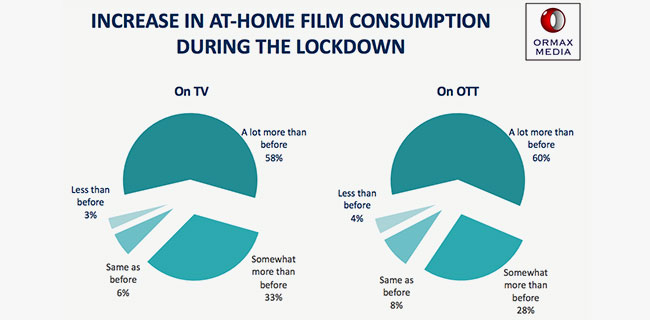
    Ormax Media conducted a special study on theatre-going behaviour given the impact it has had by the Covid-19-led lockdown. The study measure audience sentiment about visiting theatres when they re-open, expectations and change in behaviour at the theatres, audience trust in various exhibitor brands in effectively implementing safety measures and the consumption of films on television and OTT platforms during the lockdown.


    Here is the Executive Summary of the findings:

    1.Audience have given whole-hearted endorsement to the theatrical experience, with 82% missing going to the theatres a lot during the lockdown

    2. A dominant section of audience believe that they will go back to the theatres within 2-3 weeks of them re-opening. However, social distancing and sanitization precautions taken by theatres will play a crucial role in their decision to visit

    3. Contrary to a perception being built in the trade and the media, high consumption of films on TV and OTT has not reduced the audience attraction for the theatrical experience

    4. 69% audience said they will visit theatres not just for big-scale films but for medium and small films too

    5. Economic considerations don’t emerge as a major factor in the decision to revisit theatres. Audience would rather have theatres keep the ticket price unchanged and spend money on implementing safety measures, than offer discounting to boost footfalls

    6. F&B consumption at the theatres is likely to be impacted by about 60% during the period of Covid-19

    7. The national chains score high on audience trust to effectively implement safety measures. However, chains with limited geographical presence, and single screens, are seen to lack this credibility

    8. Communication of safety measures undertaken by theatres will be a crucial factor to persuade audience to visit theatres when they reopen


    BackToTheTheatre-OrmaxMedia-May2020_compressed

  • The Content Crisis That Awaits Us


    By Shailesh Kapoor


    One blurry week after another, the wait for restoration of normalcy continues. Even as some sections of the economy open up in parts of India and the world, the wait for return to old routine, if there can be anything like that all in these times of Covid-19, is going to be a long one.


    Different sections of the media and entertainment industry have been impacted to different degrees. Television has seen viewership boost and redistribution of viewership share across genres and channels. But the advertising moneys are drying up, and for a business that relies on that as its primary revenue source, the next few months can be really tough. Theatres are closed and will be the last thing to open. The film business is hence at a virtual standstill. OTT has emerged strong in this period, with most platforms registering record new subscriptions and time-spent numbers.


    But there’s a bigger crisis that awaits us. That of content availability. Television ran out of original content in early April itself. Most OTT platforms have launched the originals they had completed shooting before the lockdown. A handful of films are ready for release, but many others are in various stages of production. Hence, as we limp back to normalcy, the big question that will begin to bother all three sectors is: When can we start shooting?


    The answer to this question is not a pleasant one. Shoots are inherently chaotic, and even more so in India. Social distancing while visiting a mall or even a theatre can still be ensured, but how do you ensure it on the sets of a film or a show using an elaborate crew to manage a multi-camera set-up? There is close physical contact involved, between actors in a scene, and between actors and their staff, especially those handling hair, makeup and styling. There are a lot of workers involved, and there is equipment and more equipment. Let it be said in no uncertain terms: You cannot socially distance on a set, especially in India, beyond a point.


    Producers have, of course, started thinking of measures they will need to put in place. But at whichever stage shooting restarts, being on a set will still involve its share of risk. While the South film industries may be less impacted (Kerala has already put out some guidelines related to start of shoots), but Mumbai and Delhi NCR, from where a large part of Hindi content is shot, are going to take a while to reach any level of feasibility to start shooting.


    Then there is the additional complexity of travel. Everything is not shot in a studio. How do you shoot abroad? How do you shoot in a small town, for which you have to make an extensive crew travel? How do you get actors residing in other parts of the country to Mumbai, even if you are shooting at the Film City here?


    Halting of production will create a deep-end content availability crisis that could last months. Can OTT survive only on library content? Netflix and Prime Video perhaps can, but what about the newer platforms, and those that get a large share of their daily users from catch-up television? What will GECs show for another three-four months, before they can start shooting? How much can one sustain on nostalgia and how many versions of Ramayan and Mahabharat can you run how many times? I’m surprised more shoot-from-home formats are not out on television already.


    Films is a peculiar case of its own. Theatres may reopen at some stage with social distancing measures, and some of the films that are ready will eventually be released too. But that can take care of only two-three months. If producers cannot shoot much, we will soon have no content available, leaving theatres open but empty.


    We are in for a long haul. And the content availability crisis is in for an even longer one.

  • DAN launches Dentsu Marketing Cloud Video+ for OTT

    By A Correspondent


    The data sciences division of the Dentsu Aegis Network (DAN) India has announced the launch of ‘DMC Video+ [Dentsu Marketing Cloud Video+]’, a tool that provides an agnostic approach towards planning and buying on over-the-top TV (OTT) platforms.


    Shamsuddin Jasani

    Commenting on the launch, Shamsuddin Jasani, Group MD, Isobar- South Asia said: “The Indian OTT ecosystem is hyper competitive and has attracted varying types of players, each of whom offer varied value propositions to consumers. This has created a somewhat fragmented ecosystem with no accurate measure of how brands should engage and activate these audiences. With rapid increase in consumption of online content – primarily fueled by OTT Video, audio and gaming, the ecosystem suffers from the absence of a single source of truth when it comes to buying inventory from these platforms. The Dentsu Marketing Cloud Video+ presents a unique solution to this problem by creating a single ecosystem to understand and buy these audiences in a seamless manner, limiting the rise of another walled garden ecosystem.”


    Gautam Mehra

    Added Gautam Mehra, CEO, DAN Programmatic & Chief Data Officer, DAN – South Asia: “In an environment that is now heavily focused on reducing wastage, brands know they need to move budgets from linear TV and traditional advertising towards digital advertising driven by OTT. They however, tend to play it conservatively when they aren’t sure exactly how much of shift will achieve the best ROI. In the absence of transparency, unified insights and audience buying system for OTT consumers, there exist several inefficiencies within the ecosystem. The promise of the Dentsu Marketing Cloud Video+ product is to plug this gap, thereby guiding brands on their journey of capitalizing on audiences who are increasingly mobile and engaged in consuming high quality production content on OTT rather than traditional video consumption of user generated content.”


    The tool has been launched under the umbrella of DMC Explore through which clients are not only enabled to gain deep insights into the content consumption of audiences in the OTT ecosystem, but can also activate selected segments for their campaigns.


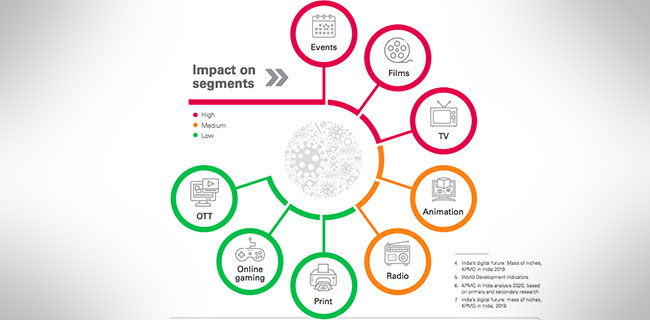
  • Impact of Covid-19 on M&E: KPMG


    By A Correspondent


    Given the ongoing Covid-19 pandemic, KPMG has released a report titled “Covid-19: The many shades of a crisis- A media and entertainment sector perspective” which discusses the impact of Covid-19  in the media and entertainment industry.


    The report highlights that media consumption overtime has tended to be income inelastic, however the current environment could result in a dip in media consumption in the near term; and also foresees key trends across Television, Print media, Films, OTT platforms during Covid-19 along with the recovery time for the same.


    Furthermore, the report highlights that due to Covid-19, traditional media could face some challenges in the near to medium term, and there is likely to be a long-term upward shift in the integration of digital technologies into our everyday lives with media and entertainment being an immediate beneficiary.


    Speaking on the ongoing situation, Satya Easwaran, Partner and Leader – Markets Enablement, Technology, Media and Telecom (TMT), KPMG in India said: “The Covid-19 pandemic has resulted in a drastic cut in advertising expenditure across all media. However, with people being homebound, consumption of media and entertainment – and digital media in particular – has seen considerable growth. Post crisis, we anticipate an even greater integration of technology into our everyday lives with a marked digital progression of Indians across socio-economic classes. Monetisation however might remain a challenge in the near term.”


    Added Girish Menon, Partner and Leader – Media and Entertainment, KPMG in India said “The Covid-19 experience is likely to result in a long-term upward shift in the integration of digital technologies into our everyday lives, with India’s ‘digital billion’ trajectory likely to accelerate materially. We expect greater affinity to be seen for at-home entertainment with subscription models, cord-shaving and streaming to larger screens seeing exponential pick-up in the near to medium term. Outdoor entertainment options including – films, events, theme parks – particularly in Covid-19 hotspots could see lingering risk aversion even in the medium term. With monetisation, particularly ad-spend, under pressure, the focus for M&E companies in the near to medium term would be on cash management and profit protection with greater technology integration. Organisations might need to be risk focused and innovate existing business models and processes to survive and emerge stronger.”


    Below are the key highlights of the report:


    Insights into the crisis and its aftermath:

    • Ad-spend pressures to linger on the back of weak economy and lower domestic consumption

    • Longer time lag to return to normalcy for weaker economic sections of the populations

    • Digital consumption to see rapid incremental growth with India’s digital billion trajectory likely to accelerate materially

    • At-home entertainment options (digital, TV, gaming) to see an upswing as ‘lockdown behaviour’ results in habit formation

    • Outdoor entertainment (films, events, theme parks) particularly in Covid-19 hotspots to see lingering risk aversion even in the medium term. ‘Pent-up’ demand behaviour among some sections of population may provide some respite

    • Delayed expansion plans though digital businesses aggressively target market opportunity


    Impact on the Media and Entertainment sector:

    • Supply chain:

    ¤ Innovations in content pipeline: A focus on building a stronger content bank may result in working capital being locked up across the value chain, leading to higher cash flow requirements

    ¤ Innovations in delivery models: With outdoor entertainment and recreation facing challenges in the near term, innovative outreach and delivery models are likely to evolve

    ¤ Greater emphasis on predictive analytics: Companies could place an increasing amount of reliance on Artificial Intelligence (AI)/ Machine Learning (ML) to predict consumer behaviour in these uncertain times


    • Consumption:

    ¤ India vs. Bharat dichotomy could likely widen

    ¤ At-home consumption, particularly OTT and gaming, to see continued accelerated growth

    ¤ Outdoor media consumption: M&E segments such as films, events and theme parks are looking at a prolonged recovery cycle, owing to risk aversion towards social gatherings, particularly in COVID-19 affected cities and hotspots, which unfortunately includes some of the major cities

    ¤ While India’s media consumption remains upbeat during the lockdown, indulgent expenses around purchase of latest hardware, technology upgrades etc. could be postponed for a while

    • Monetisation:

    ¤ Longer timelines for ad spend recovery

    ¤ Penetration of subscription based digital models to accelerate: Digital subscription revenues could see an upswing post Covid-19 as habit formation in terms of OTT video consumption sets in

    ¤ Print will get a new lease of life

    ¤ Medium term downside risk for outdoor entertainment segments: Aversion to social gatherings in the medium term (particularly in major Covid-19 hotspots) could result in lower footfalls and ticket sales for films, events and theme parks

    ¤ M&E services build on domestic opportunities: There is likely to be a greater emphasis on domestic markets in the services space, particularly in the animation and VFX segments, as global pipelines come under severe pressure


    Framework to help companies work through the transition to normalcy:

    • Immediate focus for companies will be on value preservation and protection

    ¤ Protection of the workforce:Focus first on the physical and mental well-being of the workforce with a gradual reintegration process. Time for leadership to deliver clear messages on organizational priorities and provide a fair assessment of the impact of the crisis on their business to employees

    ¤ Stakeholder communication includes not just employees but also external parties including vendors, partners and customers

    ¤ Identify short-term cash flow challenges and enable cost levers for savings opportunities


    • Medium term objective will be value creation

    ¤ Agree and implement the recovery plan

    ¤ Incorporate learnings from the crisis to streamline processes and potentially provide better insulation from such shocks

    ¤ Devise tactical working capital projections in acknowledgement of the changed environment

    ¤ Invest in upskilling teams to adapt to the new normal


    • Long-term vision will be value realisation

    ¤ Carve-out of non-core businesses to unlock value

    ¤ Identify strategically aligned inorganic growth opportunities

    ¤ Develop deep and credible succession plans