

Tag: OTT

  • OTT: Ride Along, Because It’s Buzzing!


    By Shailesh Kapoor


    It’s all buzzing on the original content front in the OTT space. The five-year-old category in India began to find its feet in 2018, as covered in this column written in September 2018. Since then, over the last six months, the buzz has got stronger by the month. Hotstar is the latest entrant in the big-ticket original content play in the digital space, with the much-publicised launch of shows under the umbrella ‘Hotstar Originals’. Netflix and Amazon Prime Video continue to scale up their India offerings, while Zee5, ALT Balaji and others continue to launch shows by the week. There’s another new entrant in MXPlayer from the Times group, and of course, the guys who started it all, TVF, are very much in the mix too.


    The original OTT content ecosystem in India can no longer be called nascent. Over the last 12 months, its broad contours have evolved in a definitive way. The column linked above spoke about the need to prioritize ‘quality over quantity’. While quantity still dominates, quality is slowly beginning to come our way too. And as someone who has had the opportunity to get a peek into some of what’s lined for later this year, I can say with some confidence that 2019 will be the best year for the category quality-wise.


    No one is currently bothering themselves too much with the question on where the money (revenue) is going to come from. It’s apparent now that there’s a sound future in this category, and eventually, its economics will work themselves out as the category settles down, maybe by 2021. But you need to be an early entrant and have a substantial subscriber base by then, and that’s what the top players, most of which have deep pockets, are prioritising.


    The myth that OTT will kill mainstream television still prevails, and keeps coming up in coffee machine conversations across media houses. It’s the only genuinely-misguided piece in the OTT story. Over the last two weeks, in the aftermath of Pulwama and then Balakot, news ratings have more than doubled. As mentioned in this column last week, sports and news may gain big this year, at the cost of general entertainment. But television will survive alright. Cord-cutting is still a hugely niche metro phenomenon, and there isn’t much to say on it in a country as large as ours.


    The intriguing question, then, is: Where are people getting all this additional time in their lives to watch digital content, especially in an age when ‘fast life’ and ‘not enough time’ are commonly-expressed grouses? The answers may not please social or medical experts. It seems that this time is being created at the cost of more ‘developmental’ activities like reading, spending time with family and friends, and… sleep. But that’s another topic for another day.


    Last week, Akshay Kumar, currently Bollywood’s most popular male star, walked onto a stage after setting himself on fire, to announce the launch of his new Amazon Prime series (working title: The End). That visual, coming within days of the launch ad of Kumar’s 2020 cop flick Sooryavanshi, sums up where the OTT category is heading. It’s going to be about big guys and big bucks. It’s going to be quite a ride over the next two years, and I, for one, am not blinking.



  • 2018: OTT’s Sacred Year?


    By Shailesh Kapoor


    Permanent Roommates, TVF’s 2014 romcom, is where it all started. There had been a few OTT originals (more popularly called ‘web-series’ in India) before it, but Permamnent Roommates initiated several members of the fledgling digital population in urban India to this new category. TVF followed it up with a classic for the ages, Pitchers. A new medium of storytelling had arrived.


    However, the OTT original content journey since then has been a frustrating one to track from the sidelines. Year after year, we saw launches by the dozen. But quantity ruled over quality, and except TVF’s Tripling (2016) and Y! Films’ Bang Baaja Baaraat (2015), nothing really stood out in a sea of evident mediocrity. An OTT production ecosystem was up and running, but what they were delivering left a lot to be desired.


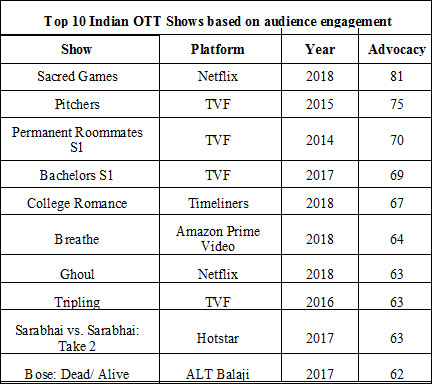
    It’s only since the second half of 2017 that the OTT original content movement has gathered some real steam. The list below indicates that. Out of the Top 10 shows based on Advocacy (a measure, on a 0-100 scale, of audience engagement leading to recommendation to peers), four are from 2018 and another three from 2017.


    Netflix’s Sacred Games broke the 80-point barrier this year, usurping Pitchers, which had held the distinction of being India’s most-loved OTT show for three years. Just six months ago, an Advocacy score of 56 was enough to get a show into the all-time top 10 list. Today, 21 shows stand at 56+.


    The willingness to pay (via subscribing to an SVOD platform) is a marketing challenge most platforms are trying to address. While SVOD and AVOD platforms cannot be compared on the size of their viewer pie, when it comes to engagement, any two pieces of content (even across media) can be compared. When there was a lot of talk about the SVOD boom in 2015-16, the engagement was lacking, outside three TVF shows. What has changed then, in 2017-18?


    The advent of Netflix and Amazon Prime Video seems to be an obvious factor. Till last year, there was an over-dependence on TVF (which still holds four of the top 10 slots in the list above, and another one on sibling brand Timeliners) to deliver quality. The new platforms have brought in more budgets, and hence been able to attract stronger talent, leading to better-produced, better-directed and better-acted content in general. Not all of it has worked, but at least the success ratios look better now.


    But some evident opportunities still remain untapped. Most of the top 10 shows are heavily metro-skewed, getting a dominant share of their viewership from the top 8 cities. While this may be understandable for the SVOD platforms in the short run, even the AVOD shows, including those on YouTube, exhibit this trend.


    Almost all shows outside those on TVF are dark and edgy, limiting their audience base to a specific palette. Variety in genres is evidently missing. For example, there hasn’t been a definitive love story on OTT yet in India. And music, which is core to a lot of our storytelling, hasn’t found a meaningful outlet on OTT yet.


    But at least, there’s been a start of some kind. Quality over quantity will always rule. And 2018 has reaffirmed that for the OTT original content category in India.


  • SonyLIV partners Amagi to grow OTT revenues

    By A Correspondent


    Amagi has announced that SonyLIV is using its Thunderstorm cloud-based platform for targeted OTT dynamic ad insertion. As part of the deal, Amagi will monetise premium GEC and movie channels on SonyLIV OTT platform, generating additional ad revenues for the hugely popular on-demand and linear OTT service.


    Said Uday Sodhi, Business Head, Digital at Sony Pictures Networks India:“SonyLIV is growing its subscriber-base at an impressive rate, making it an ideal digital platform for advertisers to target clearly defined audience segments. We are continuously looking to enhance value for our advertisers. Amagi is a pioneer in the targeted advertising space and this technology partnership provides additional options for advertisers to work with us.”


    Added Deepakjit Singh, CEO, Amagi: “We are delighted to partner with SonyLIV, and deploy our next-generation ad tech solutions that create new revenue opportunities,”. “The Thunderstorm platform is designed for high concurrency, and to deliver frame-accurate ad insertions at scale. These capabilities become vital for SonyLIV, especially since many of its premium channels have high number of concurrent users.”


  • Chrome Data publishes report on OTT rise

    By A Correspondent


    Chrome Data Analytics and Media, a leading research and data analytics firm, has released ‘Now Streaming: OTT’, a report around the rise and penetration of OTT players in India.


    The report covers key aspects of the evolution of the OTT industry, which primarily gives broadcasters, advertisers and OTT players a deeper insight into their key target markets. The report points out a range of findings that would help one understand the OTT Landscape in deeper detail. Here are some findings:


    1) In Urban India, 6% and 24% of the population accesses OTT on a daily and weekly basis, respectively.

    2)  More than 50% of the viewers still prefer TV as the 1st screen for viewing.

    3)  Exclusivity of content helps increase awareness and eyeballs for the Platform.

    4)  User Experience on smartphones plays a vital role in driving penetration. Currently, smartphones hold only 29% penetration.

    5)  On Subscription,

    i. More than 75% of the audience prefers free services with Ads as they are already paying for Internet services.

    ii. Rest of the population is ready to pay for the services with subscription amount varying on the basis of gender, age group and geography.

    6)  The potential of ‘Offline’ mode in India is quite high because of infrastructural issues & high cost of unlimited internet.

    7)  The potential of ‘Offline’ mode varies with gender, age group and geography of the consumer.

    8)  The same Viewer behaves differently over Television & OTT.

    i. Solo Viewing is not the only reason for pushing viewers to OTT.

    9)    OTT players should focus on Regional content as inclination towards Regional content is increasing.


    Talking about the growth potential of OTT, Pankaj Krishna, Founder and CEO, Chrome DM said: “The entire internet base which is 464 million today, qualifies for OTT’s growth potential. However, infrastructure enhancement and low-cost unlimited internet plans are the key drivers that will exponentially help in reaching and further increasing the potential base itself.”


    According to a communique, Chrome DM has also outlined the consumer profiles in detail, by classifying them into broad segments, listing out characteristics basis genres consumed. The characteristics defined for each of them gives consumer insights that will be of use to OTT players, Broadcasters as well as advertisers.