Tag: OTT

  • Television, Smartphone consumption leapfrogs


    By A Correspondent


    The disruption caused by Covid-19 continues to result in television viewership, smartphone usage and video-on-demand (OTT) consumption. Week 12 of the BARC ratings saw Total TV consumption skyrocket. This was determined in the insights provided by TV audience measurement body BARC and research major Nielsen on Thursday. The second edition of the ‘Crisis Consumption – An Insights Series into TV, Smartphone and Audiences’ was presented by the research bodies.


    According to the report, there has been growth in TV and Smartphone consumption across geographies, socio-economic classes and age groups. Television viewing in Week 12 stood at a record 1.2 trillion minutes and the average daily viewers grew by 62 million ad 622 million viewers watched television daily for four hours, forty minutes.


    The lockdown period registered many ‘firsts’ in television viewing history. News and Movies recorded an all-time high growth in viewership, in fact Hindi movies surpassed Hindi GECs The all-India consumption increase was 37 percent over the previous week. Viewership grew significantly post-lockdown on March 25, 26 and 27.


    Being the first week of lockdown there was a sizeable growth in all demographics, thought particularly amongst males. Non-primetime viewership surged by more than 70 per cent, and growth in Hindi-speaking markets was higher than the south.


    While movie channels along with News and Kids grew higher than GECs, the general entertainment channels grew in non-primetime by 32%. News saw a growth of more than 200 per cent. In fact the share of news to Total TV leapfrogged from 7% to 21% at an all-India level in both primetime and non-primetime.


    As for advertising, the average FCT in Week 11-12 grew 15 per cent – by 6 lakh seconds. Week 11-12 saw a growth across genres except for sports and youth.


    On the digital front, consumption of news continues to show a huge increase, and Chatting and Social networking show a significant increase in timespent. E=commerce though has suffer due to difficulties in logistics management in the lockdown


    According to the report, The re-telecast of epicserial Ramayan garnered the highest ever rating for a Hindi GEC show since 2015.


  • Dish TV premieres new comedy series on Watcho

    By A Correspondent


    Dish TV is set to premiere its comedy web series ‘4 Thieves’ on its OTT platform Watcho. Written and directed by Gautam Parvi and produced by Filmcurry, the five-episode web series revolves around the lives of four college graduates who are on a mission to steal 125 paintings from an art gallery warehouse.


    Commenting on the launch of new series on Watcho, Sukhpreet Singh, Corporate Head – Marketing, Dish TV & Watcho, DishTV India Ltd, said: “Carving our own identity in short format storytelling category, we are excited to announce the launch of our new lighthearted comedy series 4 Thieves. With the launch of this new series, we further demonstrate our commitment to scaling up and sustaining the quality of the original web series. At Watcho, we understand the need to recommend the right content and roll out shows that are refreshing and engaging for our viewers.”

  • MPA unveils ‘Asia Pacific Sports Media 2020’ study

    By A Correspondent


    Sports rights costs across 11 Asia Pacific markets grew 2.4 per cent in 2019 to reach US$5.5 bn in aggregate while sports revenues across TV and online video increased 7.8 per cent in 2019 to reach US$5.2 billion in total, according to a new report published today by Media Partners Asia (MPA). MPA projections indicate sports rights costs will grow 3.8 per cent CAGR between 2019-24 to reach US$6.6 bn by 2024 while sports revenues in TV and online video will grow at a 6.7 per cent CAGR to reach US$7.2 bil. by 2024.


    The report, entitled ‘Asia Pacific Sports Media 2020’ tracks the growth trajectory of sports rights and TV and online video sports revenues across 11 markets in Asia Pacific with historical data and projections as well as analysis of key players and sports properties by geography.


    The report notes that OTT accounted for 21 per cent of sports media revenue generation in 2019 in the 11 Asia Pacific markets. This is likely to almost double over the next five years to reach 40 per cent by 2024. Excluding China, OTT will account for 23 per cent of sports media monetization in 2024 across the measured markets, up from 12 per cent in 2019. The MPA report notes: (1) Sports rights costs and revenues are seasonal and lumpy; major global events typically occur every 2-4 years and can either inflate or adversely impact sports economics on a year on year basis and (2) Global sporting events in 2020 (i.e. the Tokyo 2020 Olympics and UEFA Euro 2020) are a key driver of value in Asia Pacific markets but are subject to risk given the global spread of the coronavirus.


    Commenting on the findings, MPA Senior Analyst Srivathsan A R said: “The market for premium sports remains relatively healthy in Asia Pacific, in spite of uneven structural dynamics and the corrosive impact of piracy. Sports rights investments in China, India, Australia and Japan are driven by a strong domestic sports ecosystem, supported by premium international rights for football, basketball and baseball. Rights costs in China are driven by growing appetite for domestic and international football as well as basketball. Growth momentum, strong between 2016-19, will stabilize post 2021-22. Cricket continues to drive more 85 per cent of India’s costs. Rationalizing of pay-TV spends on domestic rights in Australia will affect the overall market in the future while domestic baseball and football will drive growth in Japan’s sports rights market. Greater Southeast Asia, including Hong Kong, is dependent on growth in international football and basketball. Local football in markets such as Thailand, Indonesia and basketball in Philippines will continue to deliver additional growth.”


    Added MPA Executive Director Vivek Couto: “A number of themes are emerging across the region. Investment in premium sports rights is often proving scalable and sustainable, when driven by: (1) Large scale internet players with pole position in a vast digital ecosystem, which helps subsidise investment in premium content (i.e. Tencent in China) or integrated pure play entertainment and sports OTTs with AVOD and SVOD business models (i.e. Hotstar in India and iQiyi in China); (2) Pay-TV operators investing to retain high-ARPU customers and grow a new OTT segment, anchored to product innovation with premium sports at the forefront (i.e. Foxtel, Sky Network TV, Astro and PCCW’s Now TV); and (3) Local & regional TV broadcasters that have a combination of mass reach and premium segmentation with branded sports networks (i.e. Star and Sony in India; select free TV players in Southeast Asia and regional pay network beIN Sports).”


  • Word-of-Mouth rules in OTT


    By A Correspondent


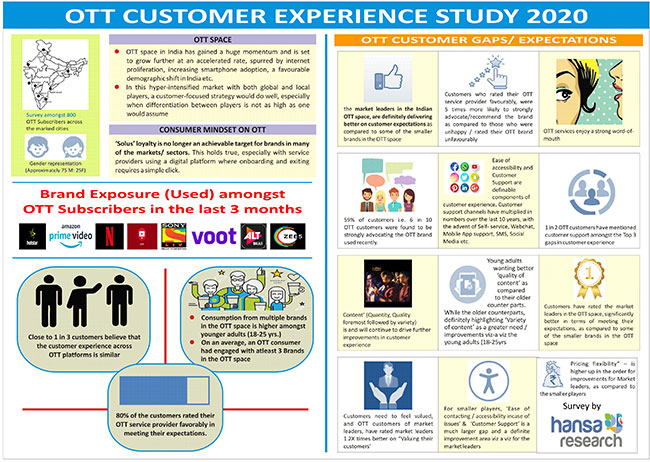
    Leading research firm Hansa Research has curated a study based on Customer Experience in OTT media. The study was conducted among approximately 800 OTT subscribers in India administered to a consumer panel – Hansa Cheetah.


    OTT subscribers were represented from across Delhi, Mumbai, Bengaluru, Chennai, Hyderabad, Kolkata, Pune and Ahmedabad with approx. (75 M: 25F). Brand Exposure (Used) amongst these OTT subscribers in the last three months- included Netflix, Prime Video, Hotstar, JioTV, Voot, Zee5, SonyLIV, ALTBalaji amongst other brands.


    Said Praveen Nijhara, CEO, Hansa Research Group: “Focusing on customer experience now is more critical than ever, with the customer evolving, being more explorative in nature and more ‘polygamous’ in their choice of brands. Today, customer experience is amongst the top ranked strategic priority amongst leading companies, especially in markets where there is intense competition,” adding: “Customer experience includes the entire interaction between the customer and the brand across all touch points. It is the sum total of the entire experience including everything from purchase, on boarding, usage experience, advertising, content, communication, customer support channels etc.”


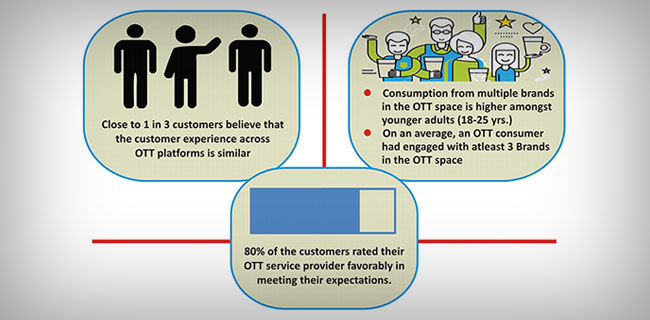
    ‘Solus’ loyalty is no longer an achievable target for brands in many of the markets/ sectors. This holds true, especially with service providers using a digital platform where onboarding and exiting requires a simple click. The report suggests that on an average, an OTT consumer had engaged with atleast 3 brands in the OTT space in the last 3 months, the survey also found that consumption from multiple brands in the OTT space is higher amongst younger adults,” said Mr V. Sudarshan, VP Hansa Research referring to the OTT CX Study.


    Excerpts from the study


    • OTT services enjoy a strong word-of-mouth.

    • 59% of customers i.e. 6 in 10 OTT customers were found to be strongly advocating the OTT brand used recently.

    • The market leaders in the Indian OTT space, are definitely delivering better on customer expectations as compared to some of the smaller brands in the OTT space

    • ‘Content’ is and will continue to drive further improvements in customer experience. ‘Better user interface  flexibility and features’ as well as ‘Ease of contacting / accessibility incase of issues’ are other areas that have been highlighted as improvement areas

    • 1 in 2 OTT customers  have customer support amongst the Top 3 gaps in customer experience


  • MMA and GroupM launch Mobile Ecosystem Report 2020

    By A Correspondent


    The Mobile Marketing Association India (MMA India) in collaboration with GroupM has launched the third edition of ‘Mobile Marketing Ecosystem Report 2020’.


    This year’s theme for the report revolves around how mobile is a bigger platform than digital platforms. The report also delves deep into various trends impacting consumers and marketers, and highlights reasons why it’s necessary to go beyond the traditional realms of digital marketing to drive business and brand outcomes. It analyses where mobile marketing stands today, what has led us here and what the future holds.


    Speaking on the announcement, Moneka Khurana, Country Head, MMA India said: “Considering the importance that mobile marketing holds for brands, marketers must be armed with the information on the trends and changes in the landscape and leverage the opportunities they provide. With the ecosystem report, our aim is to highlight these trends and opportunities, some of which have already become active in 2019 and will likely form vital elements of mobile marketing campaigns in the coming years. It is our hope that this report acts as a guide for marketers, highlighting the key focus areas, their challenges, and helping them to decipher what they must expect from this ever-changing mobile ecosystem”.


    Added Prasanth Kumar, CEO, GroupM South Asia: “India will continue to witness an upward trend in the growth of mobile ad spends this year. Cheaper data tariffs, the exponential growth of entertainment on mobiles and a variety of smartphones have led to the emergence of ‘mobile-first consumption’ users in the country. India is a diverse and mobile-first country, and this will further boost the growth of mobile advertising compared to digital. The availability of content in regional Indian languages is driving consumption of the mobile internet in India. We have also witnessed the use of e-commerce apps on mobile phones growing in the last few years. With a mix of utilities, mobile is going to be bigger and better in the country.”


    Key highlights from the report:


    Ephemeral Content: Ephemeral content is a rich media format which disappears after a short duration. Due to its temporal nature, ephemeral content forces creator to be more spontaneous and thus increases the likelihood of the content being authentic.


    AI: About 80 per cent of large corporate giants have adopted some or the other form of machine learning in building new competent systems, complementing their core business.


    E-Wallets: India’s local UPI (Unified Payments Interface) platform crossed the 1000 million user mark in October 2019, making it one of the fastest adopted payment gateways in the world, leading to a massive rise in social commerce.


    Gaming: There are approximately 250 million mobile gamers in India, spending about 60 minutes every day playing mobile games.


    OTT: With more than 30 OTT players and 10 music streaming apps in existence catering to various entertainment and media demands, Indians are prone to consuming content across an array of digital formats and platforms.


    Original Content on OTT: OTT players are estimated to make hefty investments of approximately INR 2.5 billion for content creation as well as distribution.


    Influencer Driven Content: Marketers believe that influencer marketing helps them engage with customer in an interactive way and thus 80% of them would increase ad spend next year.


    Video: With attention spans of consumers being short, short-format advertising content is key. Currently, India is the sixth largest market in consumption of video ads.


    Vernacular: 90% of new internet users over the next five years are expected to prefer regional languages to access the internet.


    Voice: 25 per cent of search queries in India are through voice commands. 38 per cent of consumers who have engaged with voice ads find it less interfering as compared to other forms of advertising.


    MarTech: CRM to programmatic ad buying, automation and artificial intelligence are making the advertising process more efficient. Nearly 80 per cent of large corporates have adopted machine learning in some form; 30 per cent of new-gen start-ups.


  • Star Gold 2 set to launch on Feb 1, 2020

    By A Correspondent


    Entertainment is a critical component for any broadcast business and despite the growth of OTT platforms (its own Hotstar included), Star India has announced the launch of Star Gold 2, its newest offering in the Hindi movie channel category. One can now expect various premieres of newly acquired Bollywood movies on both Star Gold and Star Gold 2.


    Star Gold has acquired 25 recently released blockbusters and upcoming Bollywood movies of 2020, further strengthening its library of over 1500 titles including Tanhaji: The Unsung Warrior, Baaghi 3, ’83, Angrezi Medium, Panga, War, Chhapaak, Bala, Housefull 4, Mardaani 2, among others


    Said Hemal Jhaveri, Executive Vice President & GM, Hindi Movies Business, Star India who has helmed the movies cluster for Star for many years: “Consumers are at the front and center of everything we do. Having acquired the latest top quality Bollywood content of 2020, it made perfect business sense to launch a second screen to be able to showcase the best of Hindi cinema to our viewers.”


  • Voot scales 100 million monthly active users

    By A Correspondent


    Voot has achieved a key milestone reporting about 100 million monthly active users, according to a communique issued on Tuesday. Said Akash Banerji, Business Head – VOOT, Advertising Video Platform (AVoD): “Achieving 100 mn MAUs in just three years is not a mean feat.  We have been able to achieve this new viewership benchmark through our focus on driving constant engagement and reach through impact partnerships, product and tech innovations and versatile content strategy.  Our constant pursuit of building a digital business using a user first strategy and basing all decisions that drives higher engagement is the only reason that has made us achieve a quality 100 mn user base leading to 2x increase in monetisation.”


    Editor’s Note: Since there is no third-party measurement available in the digital sector, MxMIndia typically doesn’t carry reports based on viewership of digital entities. However, given that OTT is an emerging sector and OTT properties like Voot in this case, Hotstar, Zee5, Alt-Balaji, Sony Liv et al are run by well-known broadcast organisations which one can trust, until further notice, we are making an exception to our own rule. Readers are advised that MxMIndia has made no independent verification of the data provided.


  • The Most Successful OTT Brands of the Decade


    This is the third in a series of six decade-ender lists in this column by Shailesh Kapoor. The previous lists:

    The most-defining Hindi TV shows of the decade

    The most-defining Hindi films of the decade


    By Shailesh Kapoor

     

    The OTT category in India saw a major boost in the latter half of the decade, especially 2017 onwards. From a handful of originals and OTT platforms that you could count in single digits, the category took off with the arrival of Netflix and Amazon Prime Video in India. In 2019, more than 100 original OTT shows launched in Hindi language alone. Add regional content, sports, movies, animation etc. to it, and you know that the end of the decade belonged to OTT.

    Ranking “successful” brands in an emerging category can be tricky. This list is based on impact created in the Indian market, both from a content and a marketing perspective. Social media brands have not been considered, and special mentions are due to regional players like Hoichoi, and niche players like FilmCompanion and Ullu, for managing to find a strong need gap and catering to it.


    5. ALT Balaji

    Balaji’s entry into OTT category in 2017 made it one of the earlier entrants. It took ALT Balaji some time to get going, and it can be argued that the launch of the more premium services like Netflix actually helped ALT Balaji position itself as “mass” and more mainstream, especially for the non-metro markets in India. The platform has relied on quantity, launching shows every other week, and Gandii Baat, which explores the erotic genre from the small-town/ rural lens, is arguably its most successful show till date. When compared to other platforms that didn’t make it to this Top 5 list, like Zee5, Voot and Sony LIV, ALT Balaji’s run is impressive, particularly because it did not have much GEC catch-up content to provide an early cushion.


    4. Netflix

    It’s difficult to split Amazon Prime Video and Netflix on rank. Netflix is clearly the more niche of the two, operating as a standalone content service at a much higher price-point than Amazon. When Netflix launched, its price-point was seen as prohibitive by many. It took some time for Netflix to customise, and the launch of the Rs 199 mobile-only service in 2019 was a sign that they are willing to adapt to the unique rules that the Indian market can demand from global players. Netflix’s content strategy has been to focus on less but high-quality content, though some of their 2019 India shows, such as Sacred Games 2 and Bard Of Blood, fall short of that high standard. The platform’s imagery, however, remains strongly associated with high-quality international content, and that’s a sub-genre in which it’s a clear leader.


    3. Amazon Prime Video

    Amazon Prime Video’s launch in India was in line with its global strategy to create content to fuel the retail business through content engagement. Compared to its competitor Netflix, Amazon’s OTT strategy in India relies on higher number of big-ticket launches and more aggressive film acquisitions. Through Mirzapur last year and The Family Man this year, the platform has managed to create top-end Indian content, which puts it in a very credible space as we enter a new decade.


    2. TVF

    TVF (The Viral Fever) is the only content creator in this list of OTT platforms. Being the early innovators (remember Permanent Roommates and Pitchers), TVF had its OTT moments much before the big players came. Some argued that TVF would fizzle out as big budgets come into play, but the platform continues to be amazingly consistent with its quality, and this year’s Kota Factory is the latest testimony to that. Having addressed a definitive segment of the urban Indian youth, especially men, TVF is in a rock-solid position to be the most-sought-after content creator in the new decade.


    1. Hotstar

    Hotstar came before everyone else, in early 2015. And with each passing year, the Star-owned platform has managed to stay ahead of the OTT evolution curve, especially in the area of marketing. Taking IPL digital rights, even before Star had the broadcasting rights, was a clear indication that Star meant business with Hotstar, and this year has seen a lot more action to support that line of thought, with the launch of the VIP service and Hotstar Originals. In the new decade, Hotstar will have to do a bit more to more away from its image of being primarily a catch-up TV and digital sports platform. But that work has already started, it seems.




  • Milestone Year for Mobile


    By Indrani Sen


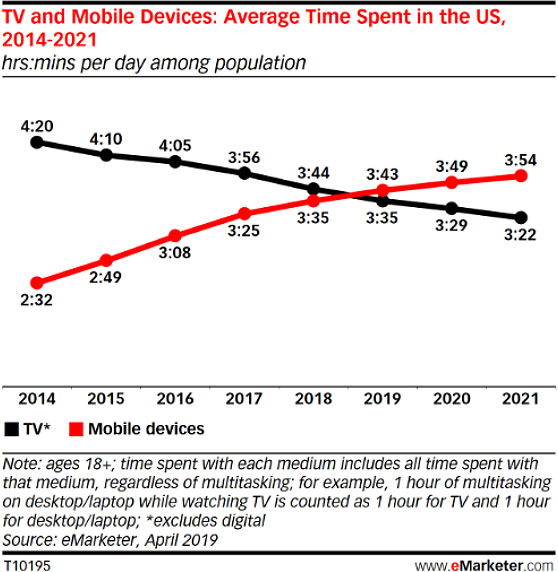
    The current year will go down as a milestone year in the history of Mobile when 5G networks, the next generation of mobile internet connectivity was launched and in US TV was dethroned for the first time by Mobile as the media channel where Adults in US spend the most time.


     

    In April, 2019 Verizon surprised most of the world by launching first its 5G network in Chicago and few other locations. UK was not far behind as EE launch its 5G network, switching it on in six cities in UK in May 30 2019,  followed by Vodafone launching 5G  in seven cities in July 3, 2019. Australia soon followed suit. China and Korea have also been planning 5G network for a long time and launched the services around mid- 2019. China has officially announced that they will have 150 million 5G mobile subscribers by 2020. By end of 2019, 5 million Koreans are expected to have 5G phones.


    On December 19, 2019 www.emarketer.com  announced in a report that the average US adult spent 3 hours, 43 minutes (3:43) on their mobile devices in 2019, compared with the average 3:35 spent watching TV (https://www.emarketer.com/content/mobile-year-in-review-the-launch-of-5g-is-the-biggest-story-in-a-busy-year-for-mobile?ecid=NL1001). Only three years back, in 2016 the same US adults watched nearly an hour more of TV than they spent on their smartphones and tablets (4:05 vs. 3:08). The forecast made by www.emarketer.com shows that the trend is going to continue with the share of time spent on mobile climbing higher year on year.


    In India, we are seeing the trend of increasing time spent on digital media driven mainly by mobile, but we have still years to go before an average adult Indian starts spending more time on mobile than on TV. But the trend has set in among select target audience groups including millennials at the upper and lower end of the economic ladder. A survey is conducted among college going students who including their travel and class hours spend a lot of time outside their home about time spend on TV and on mobile, may find that they are already spending more time on mobile than on TV, helped by the choices available on OTT platforms. The student community is a mix of young people coming from lower middle class to upper class homes, but almost everyone today owns a mobile which has become a necessity rather than a luxury.


    Reliance Telecom Services celebrated three years of Jio in 2019. Jio has revolutionised the use of mobile among certain working class people like auto rickshaw drivers, household maids who often indulge in seeking entertainment through their mobiles during short breaks in their work schedule. Such people usually have long working hours and as a result may have started spending more time on their mobiles than on watching TV at home. Again a survey conducted among such target audience groups may reflect the truth, but as these people have poor purchasing power, a survey among them will serve only academic interest.


    Current research conducted by different agencies are showing that time spent on digital media including mobile is growing at a faster rate than all other media in India. A recent report by McKinsey showed that with data becoming more accessible, monthly mobile data consumption per user is growing at 152 per cent annually in India — more than twice the rates in the United States and China and internet users will rise by about 40 per cent and number of smartphones will be double by 2023.
    (https://economictimes.indiatimes.com/tech/internet/internet-users-in-india-to-rise-by-40-smartphones-to-double-by-2023-mckinsey/articleshow/69040395.cms?from=mdr ) Time spent on mobile internet has gone up from 9.4 minutes daily in 2013 to 54 minutes in 2019 and is expected to reach 79 minutes by 2021.


    Global Web Index’s Social Media Trends 2019 Report showed that Indian users spent 2.4 hours on social media, in line with the global average (https://www.globalwebindex.com/reports/social) This finding is confusing as if the average time spent on mobile internet is 54 minutes then how can Indian users spent 2.4 hours on social media which is mostly consumed through mobile internet? The sample size of the social media survey covered 15000 Indians among 2.78 lakh respondents across 45 countries, but the details of the sampling frame work is not available, so it is difficult to figure out if the survey was limited to mobile users only which will explain the discrepancy.


    The writings on the walls are very clear, like the rest of the world the average adult Indian will also be gradually moving to spending more time on mobile than on TV. The global milestone year 2019 should be an inspiration for our telecom industry to accelerate their growth plans and move in that direction.


  • Rajesh Bahl appointed Director and Group CEO at Optimystix

    By A Correspondent


    Rajesh Bahl

    Optimystix has appointed Rajesh Bahl as the Director and Group Chief Executive Officer. He was until recently Founding CEO, of Times Studio, a Times of India group entity where he played a pivotal role in setting up Times Studio business.


    Said Vipul D Shah, Chairman & Managing Director, Optimystix Entertainment: “Till date our focus as a company has been in growing our TV production business which has shown credible growth YOY and now to create  more significant value and harness the growth across three big content spaces i.e. TV, OTT & feature films we need someone to guide us strategically and be the torch bearer of our next round of growth. In order to reimagine and reinvent Optimystix I have invited Rajesh Bahl to lead this initiative for us,”


    Added Bahl: “I am very excited to join hands with Optimystix at this time when the demand for premium content is on massive upsurge and is being consumed by various audience segment across screens, across platforms, across languages, across genres and across story-telling formats which in turn is fuelling demand from the TV broadcasters, OTT services and feature film business alike. This presents a great opportunity for Optimystix to expand businesses furthermore”,


  • Promoting or Muzzling the Digital Media


    By Indrani Sen


    The Ministry of Information and Broadcasting issued a public notice on November 25 soliciting suggestions/ comments/ inputs from the stakeholders on the draft “Registration of Press And Periodicals (IPP) Bill, 2019”. It also announced that the IPP Bill 2019 will replace the “Press and Registration of Books (PRB) Act, 1867‟. The 152-year-old PRB Act of 1857 has been amended from time to time in the past and it is high time that a comprehensive new version replaces the act of the British period. On the face of it, industry would have been ready to accept MIB’s move.


    However, the salient features of the IPP Bill 2019 highlighted by the Ministry in the Annexure to the draft bill have raised many questions. It appears that the process of title and registration of all press and periodicals will be controlled centrally by the Press Registrar General (who will replace the current Press Registrar) appointed by the Government, doing away with the custom of publishers and printers furnishing declaration to local District Magistrate for authentication. This will undoubtedly raise the cost of the process for small publications that will have to travel to Delhi for registering their publications.


    The IPP Bill 2019 also proposes to strengthen the hands of Central and State Government by giving them the power of framing appropriate rules/ regulations for controlling the accreditation of publications and releasing of Government advertisements. This is ambiguous as if such power is entrusted with both Central and State Government and if in a particular state the local government does not belong to the ruling party at the centre, then a controversy may arise related to accreditation and release of government advertisements in the publications published from that state.


    One salient feature assures that the Bill proposes to do away with the provision under the PRB Act, 1857 of prosecution of publishers. However, going through the details of the draft, one discovers that the publishers can be fined by the Press Registrar General for not abiding by the rules and guidelines provided in the bill, but would not be prosecuted for jail terms. Reading between the lines, it appears that the publishers will have less scope of defending themselves as they would be given a dictate by the Press Registrar General and most likely would have to first pay the fine before starting a court procedure to protest against the dictate/ the fine imposed on them.


    Not highlighted as a Salient Feature but very salient for the publication industry is the proposed clause that Editors must be Indian citizens. MIB should look into how many Indian journalists work abroad as editors of foreign publications. Why should we impose such clauses restricting the scope of employment in India in the era of globalisation?


    Last but not the least, is the Salient Feature “The Bill proposes to have a simple system of registration of e-papers”. The modus operand of the simple system has not been spelled out in the draft bill. As and when MIB finally details it out, one may find it complex instead of simple. However, it is obvious that the intention of the Ministry is to bring all digital platforms dealing with news, e-papers and digital news websites under the governance of MIB.


    Some people within the industry are arguing that the registration requirements for periodicals do not apply to digital-only media houses as the definition of ‘publication’ in the draft bill says anything which is printed on paper and is meant for public distribution including periodicals, newspapers & books”. I would like to point out that the draft Bill does include a definition for ‘news on digital media’, and Section 18 of the draft RPP Bill, 2019 says that publishers of news on Digital Media shall register themselves with the Registrar of Newspapers of India in such manner and giving such particulars as may be prescribed.


    Apart from the fact that the phrase “such Particulars as may be prescribed” is dangerously open to unforeseen and unwelcome possibilities, Section 18 raises the question how do we define publishers of news on digital media? Who all are included in the definition? The digital version of traditional newspapers and TV News Channels; digital-only websites dealing with different types of news (political, sports, entertainment, industry specific, etc. etc.); OTT platforms carrying news sections; websites of various industry and technical associations carrying specialised news; websites of companies carrying news about them, their associates and links to related media releases; websites of academic institutes carrying news about their admission, courses, academic delivery, etc.- the list is endless. How will MIB control news websites not registered in India but available to Indian Netizens?


    In this game of playing catch with the digital media, MIB poses not only a severe threat to the freedom of digital media, but may also end up scrapping the proposal and making a fool of themselves. If it was so simple to control the digital media, then more advanced western nations would have done so by this time. No Democratic country in the world has been able to implement such rules and regulations for controlling the digital media. It would be interesting to wait and watch the developments in India.


    Indrani Sen is a veteran media professional and now an educator. She writes weekly for MxMIndia. Her views here are personal


  • The Big OTT Growth Story: Chapter 3


    This is the third in a series of columns on the OTT Growth Story in India.

    Links to previous chapters: Chapter 1, Chapter 2

    By Shailesh Kapoor

    76.5 Million. That’s the all-important number to look at from The Ormax OTT Audience Report: 2019. The recently-concluded research, designed to size and profile the OTT audience market in India, took up the task of first measuring the number of ‘regular’ OTT audience that exist in the country currently.

    The definition of ‘regular’ can be subjective. Based on our category experience and market feedback, we defined it as: Audience who watch online videos for at least two hours every week, and use at least one OTT platform/ app, apart from YouTube and social media, to watch videos.

    The study covered 15+ audiences, and hence, does not include kids. It emerged that 76.5 Million, or 7.65 Crore, is the size of this market in India currently. The next track in 2020 will establish the growth rate. The question is: How small or big is this number?

    Comparing to TV universe can make the number look very small at this early stage of the OTT category. But a more obvious comparison can be made to the theatrical universe. The Bollywood regular theatre-goers universe stands at 33.3 Million, or 3.33 Crore. Add the unduplicated components of regional universes, especially the bigger ones in Tamil and Telugu, and the overall regular theatre-goers universe in India touches the 6 Crore mark.

    Let that sink in. The regular OTT audience universe in India is already bigger than the regular theatre-goers universe in India. And the former is growing in top gear, while the latter has flattened out for almost a decade now. This gap will only get wider.

    Only 15% of the regular OTT universe belongs to the top 6 metros in India. There’s a healthy longtail, created because of falling data costs and the penetration of Jio into small towns and villages in the last 2-3 years. But there’s enough scope for growth across markets. Mumbai and Delhi, the top 2 cities, have about 3.0 Million regular OTT audience each, which is nowhere close to saturation, given the huge adult population of these big metros. The equivalent theatre universe size in these metros is 3.2 Million (Mumbai) and 2.8 Million (Delhi). Hence, the two biggest cities have similar OTT and theatrical universe sizes. It’s beyond the metros, where theatre penetration, content relevance and ticket pricing remain key issues, that theatre-going habit loses out to OTT, a scenario that would have seemed quite unlikely till three years ago.

    The recent trend of films going directly to OTT (read here) is another sign of how OTT has emerged as a robust option for entertainment, and the price factor, which would have earlier been a big discussion point (“Indians are not used to paying for ‘television’ content”) is slowly becoming a lesser factor, with most OTT platforms coming up with rationalized pricing packages for the Indian market.

    As an aside, Amazon Prime Video’s The Family Man has emerged as the big show of the year, scoring an Advocacy Rating of 80, just a point below Sacred Games S1, to become the second most-liked India OTT show ever. A few more such winners and the OTT universe will continue to flourish.

    125 Million by 2020?