Tag: OTT

  • Pad Integrated creates campaign for Telugu OTT Aha

    By A Correspondent


    Pad Integrated Communications has developed a campaign for Aha, the OTT platform. The promotional film is titled ‘Orange Is The Colour Of Entertainment | aha Everywhere’.


    Said Gautam Reddy, CEO, Pad Integrated Communication: “In less than eight months since its inception, Aha has seen a staggering rise of 5 million downloads and 18 million unique viewers and that is what we wanted to celebrate. The phenomenal rise of the platform by showcasing how the states are turning orange – the colour of Aha which depicts 100% Telugu entertainment felt the right way. The film has the essence of Aha’s true story – how quickly they took over the regional market.”


    Added Ramu Rao Jupally, Promoter, Aha: “At Aha, we seek to serve audiences of all age-groups across the globe. Through our 100℅ Telugu catalogue, we want to offer entertaining, relatable, and captivating content – and our brand anthem reflects on our aim to be a wholesome family entertainer. And the fact that within a few months, we have recorded 7 million downloads and 20 million unique visitors, further testifies our growth in terms of engagement, time spent, and subscriptions.”


    Sharing his thoughts, Ajit Thakur, CEO, Aha said: “We are excited and grateful for the tremendous response that we received from our Telugu-speaking audiences across the country. Our main objective through the brand anthem is to showcase the excitement and celebration amongst our viewers with Orange becoming the new colour of entertainment.”


  • Talkies for Tulu, Konkani, Kannada etc

    By A Correspondent


    OTT is the flavour of the M&E world. Talkies bills itself as the world’s first digital entertainment OTT platform for Tulu, Konkani, Kannada and various regional languages. While there are several platforms for movie rentals, shows and other forms of entertainment, the team behind Talkies – Swayam Prabha Entertainment & Productions, helmed by Nikhil Acharya, realised the true need for a local OTT platform for regional content which otherwise would not get the recognition and viewership it truly deserves, in India and globally. Wonder what they think of Hoichoi, Aha etc, but let’s leave it at that.


    Notes a communique: “Completely bootstrapped, Talkies was built using the best technologies to make it a product of global standards with a native Android, iOS, and TV application. While the pilot version of the app was released on April 14, 2020, as of November 26, 2020 – a mere seven months later, the app stands at 5-star rating on the Google App Store, with over 100k downloads, nearly 1k daily active users and more than 45k monthly active users since the launch! It even has over 148+ subscribers on its YouTube channel and was recently awarded the Silver Play Button as well,” adding: “The application provides a plethora of content like movies, dramas, shows, and Yakshagana (a traditional Indian theatre form). “Gulab Jamun” was released this Diwali on November 14 as a part of Talkies Originals. It is the first Tulu Webseries ever made with eight episodes. Kanasu Maratakkide, a Kannada film, is scheduled to launch on January 15, 2021 as a part of Talkies Premiere. It is the first Kannada feature film to be released exclusively on an OTT platform by selling offline tickets.”


  • Shailesh Kapoor: Whose Ratings Are They, Anyway?


    By Shailesh Kapoor


    The last few weeks have seen eruption of a fresh debate around television ratings. Before the formation of BARC India, ratings-related controversies in the TAM era were frequent, and different broadcasters, at different times, expressed their discontentment privately and publically, with some like NDTV even taking the legal route. When the currency shifted to BARC India in 2015, these debates expectedly became less frequent. The key difference, of course, was that BARC India is an industry body, and not a private organisation like TAM.


    For the last five years, despite stray voices and uncalled-for government interference, there has been an overall sense of calm around TV ratings in India. But trust 2020 to challenge the status quo. One concern after the other, the ratings system has come under the scanner again in recent weeks.


    It started with BARC India’s decision to use an algorithm to remove the impact of landing pages on viewership. This evidently-controversial decision has not gone down well with several news broadcasters. Even as we await the unfolding of this contentious piece, the Peoplemeter-tampering controversy came to the fore, wherein the Mumbai police charged certain news channels, most noticeably the Republic TV network, of breach.


    In a large, pan-India panel that’s being managed manually at the last mile, some Peoplemeter homes being compromised is not such a surprising development. It’s bound to happen once in a while, and a swift and decisive response it all that such incidents needs, on behalf of BARC India.


    But such incidents bring the topic up in the media, and we know that questioning voices don’t worry much about facts and details anymore. By suspending channel-level ratings for the news genre, BARC India has, in effect, admitted there’s a need to get things in order. And that can, arguably, be called a constructive decision.


    t the events of the last two months have worked as a perfect trigger for the ever-eager I&B ministry and TRAI to step in. Last week, the ministry constituted a four-member committee to review the existing guidelines on television ratings agencies in India.


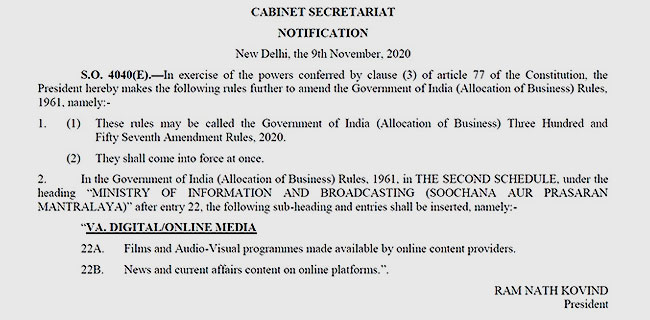
    The government’s interference in the television industry can be exasperating for any sane mind that has the industry’s best interest at heart. Under the excuse of protecting consumer interest, TRAI has interfered repeatedly by setting the price points and guidelines regarding pay TV subscription. Why TV industry even comes under TRAI is a larger question in the first place. But even if one ignores that by seeing TRAI and the I&B ministry or any other such body as a generic entity called the Government of India, the interference is a blatant violation of the principles on which a free market operates. Why are cinema and live event ticket prices not regulated? I hope I’m not giving them more ideas to widen their interference net, but the Government could have done well to stay away from areas it has no business of being a part of. But that ain’t happening anytime soon. In fact, the latest development, that online news portals and the OTT category will come under the I&B ministry, is a new cause of concern.


    The ratings committee has two months to put up its recommendations. Irrespective of how good a job they do of it, the direction in which this discourse is going is deeply problematic. It’s been a tough year for all industries, and television broadcasting is no exception. Hope some common sense prevails, and trigger-happy authorities stay away from shooting at will. Else, 2021 could spell some more trouble for the business. Trouble that, unlike the pandemic, is eminently avoidable.


  • MxMIndia is now under the jurisdiction of the government


    By A Correspondent


    The headline was clickbaity. So please ignore it. It’s not just MxMIndia, but all news, current affairs, films and audio-visual content will be under the jurisdiction of the Ministry of Information and Broadcasting of the Government of India.


    We don’t know what it will actually mean. We don’t know what the jurisdiction of the government will be. We don’t know if the PRB Act will also apply to news and current affairs websites. We don’t know if apps or platforms like InShorts and Daily Hunt will also be held liable. We also don’t know if platforms like Google News will also now be monitored closely. We don’t know if it will impact ownership rules of news/current affairs offerings on the Web… especially foreign ownership. And what about sites that are headquartered abroad. Uff. We don’t know so many things.


    There have been attempts to set up self-regulatory bodies by OTT players and there exist some associations of digital publishers. There is also the internet and mobile association (IAMAI).


    But we now have a situation where all these are under government jurisdiction. As we said, we need to get the interpretation.


    Prima facie, it may appear harmless.


    It may have been necessitated by certain content that has caught the attention of the ministry, Parliamentarians and the Courts.


    So let’s wait and hear it from the minister.


    Meanwhile, we must add here, that the law of the land continues to govern online content. One can still take an online content maker to Court if you believe it has harmed you/your reputation etc. For instance, there’s this online portal that was taken to Court by the close relative of a senior political functionary.


    And it’s not that an online media entity owner can’t be arnabed (err arrested indefinitely) if it does something wrong.


  • Yet another OTT player: Mojoplex

    By A Correspondent


    Yes, there’s another OTT app. Kolkata-based Mojoplex promises a “renaissance in the industry”. Along with movies, web series and short films, viewers will also be served stand-Up comedy, travel and adventure vlogs and music jamming sessions. Inhouse production will start in December 2020.


    Said Tufan Mukherjee, Co-founder, Mojoplex: “The explosive growth of the OTT segment really will change things for the better, and it’s only the next smart thing to integrate everything a consumer defines as ‘entertainment’ on one platform. These past few months have shown how OTT platforms shined bright through these tough times; entertainment has certainly made its position invaluable in our lives, which is why the industry, from an entrepreneur’s point of view, will never witness the opposite of success. With Mojoplex, we wish to provide the “over” in ‘over the top’, and truly be the one-stop destination for all things entertainment in every shape and form.”


    Added Abhishek Mishra, Co-founder, Mojoplex: “This pandemic has made people realise that entertainment is no longer restricted to the traditional screens airing scheduled programs made for in-show advertisements. Now the power has come into the hands of the viewers. And having that very opportunity for grabs, we have made Mojoplex’s purpose align with this value of ‘power to the consumer’ certitude. With a foray of entertainment consumers engaging in digital content, we wish to place Bengali content on a national pedestal so that it’s not only accessed by the Bengali audience, but the entire country.”


  • IPL 13 Rules. And how!


    By Indrani Sen


    Ever since IPL 13 began on September 19, 2020 with a massive 20 crore viewers on Star India Network and Disney + Hotstar, the tournament has been delivering high ratings on TV and OTT platforms.


    On the digital media front, IPL 13 is generating huge tractions over and above its coverage through Star India’s OTT platform Disney  + Hotstar. On October 30, 2020 Wavemaker published a press release on their mid-season report of “IPL Mesh 2020” covering matches from September 19 to October 24. Mesh is Wavemaker’s Realtime Data Intelligence tool which has integrated data from “multiple consumer touchpoints across Digital ecosystem ranging from Social Listening, Google Searches, Website visits, BARC, Video analytics in partnership with VIDOOLY, Interaction data points collected from Facebook, Twitter, Instagram and YouTube” to arrive at the observations and predictions shared in the report.


    The press release by Wavemaker contains a few charts and whets the appetite for the total report. The report predicts that the IPL buzz volume of the digital track will grow from 37 Mn in 2019 to 60 Mn + in 2020. During the first 36 days of the tournament, CSK was the driving force behind the interactions on social media. Now that CSK has failed to secure a place in the playoff matches, it will be interesting to watch if the buzz volume of the track gets affected. Similarly, it would be interesting to see who takes the place of M S Dhoni as wicketkeeper in the Leading Player Index Leader Board.


    In the Leaderboard ranking of most loved ads, Dream 11, Oppo and Tata Motors took the first three positions in desending order. IPL 13 has also seen a never before engagement in gamification of Cricket Fantasy League with the top five Fantasy League in September 2020 generating 30 million google searches and 90 Million web traffic. Based on historical data, the report claims that there will be huge surge both in TVP and social buzz during the next two weeks which will counter the drop in the social media buzz over during the last few weeks as shown in the chart above.


    While the Wavemaker’s report reconfirms the accelerated growth of the digital media intractions in India, in traditional TV media also IPL 13 continues to deliver high ratings to the satisfaction of the advertisers who have invested their advertising rupee in cricket. A fortnight back on October 15, TAM released “IPL 13 Advertising Report 1” based on their ADEX data covering the period from September 19 to October 10 (25 natches).  The report has shown an 8% growth registered in average ad volumes from IPL 12 to IPL 13 during the same time span/ number of matches. 5 out of the top 10 categories have been from E-commerce with 35% share of IPL 13 advertising volume and Oppo India’s commercial made it to the top position quite fast during IPL 13 compared to 2nd position in IPL 12.


    The most interesting fact which has emerged from this Advertising Report is the participation of new categories and brands in IPL 13. According to the TAM Adex report 30+ new categories and 150+ new brands advertised during IPL 13 compared to IPL 12. It remains to be seen how the advertising frenzy builds up further during the last two weeks of IPL 13, strategically scheduled during the pre-Diwali season in this pandemic hit year.


  • OTT platform Me TV launched

    By A Correspondent


    Binge-watchers in Australia and South Asia now have Me TV, an Indo-Australian broadcasting company, which has unveiled a multi-lingual Over-the-Top (OTT) Plus platform called Me World. The app has been available from October 18 across the globe. It is available on Android, IOS and even on Smart TV’s


    The highlight of the novel application is its hyperlocal reach wherein viewers can not only watch entertainment ,news, movies, or listen to podcasts; they can also book tickets via Me World for events to be held in their locality or neighbourhood and watch events live from home. Me World even allows viewers to showcase their talent and upload their content on the platform. It will be showcased after meeting Me World standard criteria.


    Said Sri Hari Kommineni, CEO & Founder, Me World: “I am delighted to release Me World for download for netizens. It is our signature offering that instantly connects communities in and around the world irrespective of the geographical barriers.  The application will provide wholesome and varied content ranging from entertainment, events information, movies, local news, business, web series, podcasts among others. Moreover, its interactive interface even allows the viewers to create and upload their content for wide accessibility and engagement. It’s a one shop stop for every app lover, it will also advertise local business add viewers can avail coupons and offers of favourite restaurants, spa, movie tickets etc.  The release of ME World reaffirms our commitment to curate outstanding content inline with our viewers’ preferences.” MEworld programme category ranges from Movies, Events, web series, celebrity talk show, Multiple Talent shows and many more.


  • Three Key Media Trends Sweeping the Pandemic-hit World


    By Indrani Sen


    Over the last couple of months, we have seen many surveys which have looked at the current level of global and local media revenue and its recovery path over the next two to three years. Most of these surveys have highlighted the bright picture looming at the end of the tunnel. Last week, I came across a survey released by www.emarketer.com which has focussed on three key media trends sweeping the pandemic hit world, providing the advertising and media industry with deep insights.


    On October 23, 2020 eMarketer released Global Media Intelligence Report for 2020, produced in collaboration with Starcom and GlobalWebIndex covering 42 major markets in the world with a focus on internet users’ engagement with digital and traditional media.


    The first trend observed in the study indicates that ownership of PCs and tablets are declining in many countries including India. “Between H1 2019 and H1 2020, ownership of desktops, laptops, and/or tablets declined most sharply in developing markets, including Brazil, China, Egypt, and India—all countries where the focus has long been on mobile devices and services. But the same trend appeared to a lesser degree in several other countries too, including France, Russia, Sweden, and the US.” This trend indicates that smartphones are consolidating their position as the primary screen across the pandemic hit world both in the developed as well as in the developing countries among the internet users. (https://www.emarketer.com/content/3-key-trends-shaping-media-landscape-this-year?ecid=NL1009)


    We already know that in India mobile phones are playing a crucial role in spreading digital media communication with more and more mobile-first internet users coming to the market. This study shows that while there has been hardly any change in the ownership of smartphones from HI2019 to H12020 as it is already near saturation level, the time spend on the device has gone up marginally. “96.0% of internet users ages 16 to 64 owned a smartphone in H1 2020—a figure unchanged since H1 2019. In addition, one in 10 respondents had a feature phone. Time spent with mobile devices averaged 3 hours, 37 minutes (3:37) per day, 1 minute more than in 2019.” Compared to 2019 the ownership percentage of PCs and tablets have come down from 72% to 54.2%, showing a significant decline. Comparatively, ownership of tablets was less affected with only a drop from 24.5% to 22.3%. Time spent by Indians with their PCs and tablets declined sharply from by 45 minutes per day (https://www.emarketer.com/content/global-media-intelligence-2020-india).


    The second trend emphasises on digital video which continues to close its gap with broadcast TV.  In the western countries the share of internet users watching free or paid for digital video have already surpassed the share watching live TV or are almost equal to it. In India, it will take a longer time for a similar trend to set in, but the warning signs should not be ignored by the TV channels who have not yet invested in OTT business.


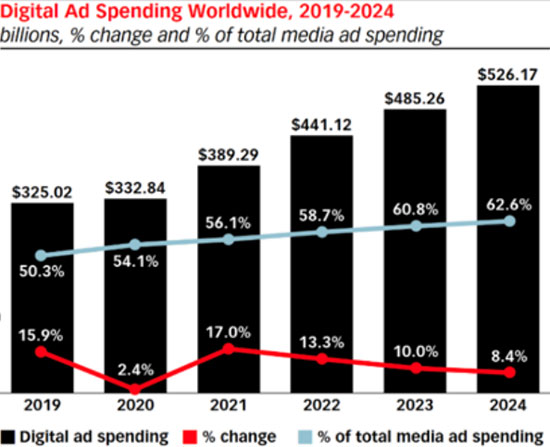
    Based on the various trend of digital media consumption among the internet users, the study predicts that by 2024, digital ad spending worldwide will become $526.17 billion and will account for 62.6% of the total media ad spending. The growth rate of digital ad spend will fall sharply during 2020, but will rise equally sharply in 2021. Over 2022 to 2024. The growth rate of digital ad spending is expected to fall gradually, but its share in the total media ad revenue will continue to grow year on year as shown in the chart below.


    Source: eMarketer


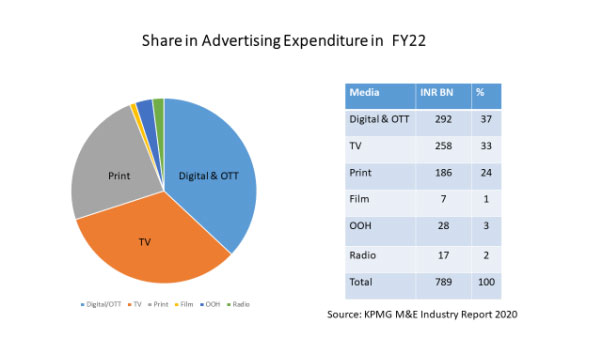
    In India, it will take many years before the digital ad spending crosses 50% of the total media ad spending. However, as shown  in the recently published M&E industry Report 20202 by KPMG, the trend of ad spending on digital and OTT crossing the ad spending on TV media, is expected to set in by FY 2022 (https://www.mxmindia.com/2020/10/the-great-churning-of-the-media-cauldron/).


    The third trend observed in the study indicates that the pandemic is probably hastening the decline of print media: “Print audiences aren’t shrinking everywhere, but print newspapers and magazines did register many of the most dramatic decreases in media engagement this year.” In India, traditional print industry seems to be in a buoyant and positive mood during the current festive season. Some large newspaper houses have also posted good growth during the third quarter of 2020. But, the Pitch Madison Advertising Midyear Review 2020 released in August, 2020 estimated a loss of 31% to 36% in print ad expenditure from 2019 to 2020 (https://www.mxmindia.com/2020/08/dramatic-changes-in-indian-ad-industry/).  Only time will tell if COVID 19  will hasten the process of decline of the print media in India.


  • M&E expected to grow at CAGR of 10.1%: PwC


    By A Correspondent


    According to PwC’s Global Entertainment & Media Outlook 2020-2024, the Indian M&E industry’s long-term outlook remains robust as it is expected to grow at 10.1% CAGR to reach 55 billion USD by 2024. A K-shaped bifurcated recovery is on the horizon in which sectors like OTT, internet advertising, video/games/e-sports, and music and podcasts are expected to spearhead growth in the industry. Globally, Digital revenue is expected to contribute 60% to the total E&M revenue by 2020, alone.


    In terms of individual segment market size as a percentage of total E&M revenue, OTT video in India is expected to see the largest gain and reach 5.2% by 2024, closely followed by internet advertising. Segments like advertising and those dependent on physical locations are likely to be further impacted in a negative manner whereas digital E&M spending will increasingly be regarded as a non-discretionary expense. While globally, newspapers and magazines are dropping the free online model and starting to ask readers to pay for quality content online, digital paywalls are yet to become commonplace in India. Furthermore, while India will remain the world’s biggest cinema market in admission terms, cinema revenue in India will contract at a -2.6% CAGR to total US$1.5bn over the next 5 years.


    Said Rajib Basu, Partner & Leader – Entertainment & Media, PwC India: “We find ourselves in extraordinary times, and the pandemic has accelerated ongoing shifts in consumers’ behaviour, pulling forward digital disruption and reaching industry tipping points that wouldn’t otherwise have been reached in the next few years. Our research shows that India will be the fastest growing entertainment and media market globally in terms of pure consumer revenue. Coming out of Covid-19, a K-shaped bifurcated recovery  is expected in which some sectors rise while others fall. Over the next five years, the outlook remains highly positive for digital led segments such as OTT, Internet Advertising, Online Gaming and Music & Podcasts that were perfectly positioned to meet consumers where they are in 2020 – predominantly at home and online,” adding: “However, companies simultaneously have to prepare to meet them where they will be two years from now. They will need to build and maintain direct-to-consumer relationships, offer enough differentiation or scale to compete, and unlock greater value using the right technologies. This is a unique window of opportunity for E&M businesses to transform and make themselves more resilient and relevant for the future.”


    Top 4 segments to advance rapidly:

    1. OTT Video: India holds the most potential of any market in the world and its breakneck rate of growth will see total OTT video revenue overtake South Korea, Germany and Australia to jump to being the sixth-largest market in 2024. Subscription video on demand will be the prime driver of revenue, increasing at a 30.7% CAGR from US$708mn in 2019 to US$2.7bn in 2024. OTT video growth is coming from both inside and outside the home as Internet-connected devices proliferate as the new ‘at-home’ environment has led to the rise of direct-to-consumer apps, local ‘bite-sized’ entertainment platforms and user-generated content (UGC) formats

    2. Internet Advertising: India is now the sixth-largest Internet advertising market in the Asia Pacific region. Mobile will be the primary driver of revenue in the Internet advertising market revenue due to increased data affordability, new mobile-first formats, ability to measure, and strategic targeting. Nonetheless, from a global perspective, Internet advertising in India remains underdeveloped and has massive headroom for growth

    3. Video, Games & E-sports: Gaming and e-sports are capitalizing on the need to bring live experiences into the home in more personalized and more engaging ways. E-sports represented less than 1% of overall market in 2019, but has become one of the fastest growing segments today with a projected 33% CAGR by 2024. However, despite surging growth and enormous potential, the sector tackles with the biggest challenge of low levels of app monetisation

    4. Music, Radio & Podcasts: Podcast industry was already experiencing rapid growth prior to the COVID-19 outbreak. Fuelled by the uptake of music-streaming brands, the overall space is expected to grow at a 13.5% CAGR, to total revenue of nearly US$1.7bn in 2024. India will also see strong increase at a 30.4% CAGR in its monthly podcast listener base over the next five years, supported by entry of foreign players and original content on topics including news, society and culture


    As the industry navigates into the post-pandemic world, one can witness new opportunities for capturing growth:

    > Players bolster subscription offerings – With consumers increasingly paying a monthly fee to access a library of entertainment content, such as films, music, content, fitness etc., media and entertainment industry players are catching on to the value of subscription based models to bring in business. Optimising revenue mix or pricing models to emerge more resilient and capture a bigger share of the wallet will be the focus


    > Physical events look for digital alternatives – Another opportunity made more compelling by the pandemic is bringing live experiences into the home in a more personalized and engaging manner. Digital spaces—e-commerce platforms, virtual event spaces, gaming channels, podcasts—are evolving into powerful new platforms for marketing. Creating new content propositions will help realise new revenue streams


    > OTT will thrive in 2020 as cinema and traditional TV degrow – OTT sector will directly benefit from the closure of cinemas, as some film studios choose to fast-track new releases to home video platforms. Since OTT platforms offer convenience and accessibility to consumers who are likely to hold on to their new habits of streaming ‘at home’, global SVOD revenue may overtake box office spend very soon


    > Landmark acquisitions are out; buying growth and cash flows are in.  – As companies look for ways to navigate barriers, strategic investments & alliances in search of scale and growth will be crucial to determine success in the E&M media industry


  • SonyLIV to air Sucheta Dalal-Debashis Basu’s Harshad Mehta scam series

    By A Correspondent


    On Friday, October 9 SonyLIV will unveil ‘Scam 1992 – The Harshad Mehta Story’, an original around the stockmarket operator Harshad Mehta and the securities scandal of the early 1990s.
     

    The 10-episode show is produced by Applause Entertainment in association with Studio Next and is based on the bestseller book ‘The Scam’ written by journalists Debashis Basu and Sucheta Dalal.


    Said Indranil Chakraborty, Head, Studio Next: “We are delighted to foray into OTT with a series like ‘Scam 1992 – The Harshad Mehta Story’ that reflects on a landmark event in the Indian stock market. The incident was integral to shaping up India’s financial security systems and hence was a story waiting to be told. It’s a new storytelling format for us and we had the visionary – Hansal Mehta leading us through this process.”


    Added Sameer Nair, CEO, Applause Entertainment: “With ‘Scam 1992: The Harshad Mehta Story’, we have raised the bar of premium series in India in terms of creativity and production. We have put together a great ensemble of actors directed by the National award winner Hansal Mehta and a team of talented writers who worked tirelessly on the show. Based on the book written by Sucheta Dalal and Debashis Basu, this show marks another chapter in Applause’s slate of book adaptations where we have dramatised the story while staying true to the essence of book. This is the fourth show under our partnership with SonyLIV after the successes of Your Honor, Undekhi and Avrodh.”


    Said Ashish Golwalkar – Head-Content SET, Digital Business, Sony Pictures Networks India: “’Scam 1992 – The Harshad Mehta Story’ is our fourth offering with Applause Entertainment and also a special one as we have Studio Next venturing into OTT with this for the first time. The story offers an apt mix of talent, storytelling and technique. We are hopeful that like our previous offerings, Scam 1992, will also open to a warm audience response and reinstate our promise of bringing ‘stories of India’ to the audiences.”


  • The Great Churning of the Media Cauldron


    By Indrani Sen


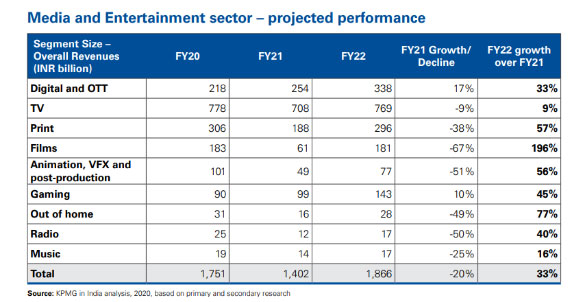
    Last week, KPMG published its M&E Industry Report 2020, six months after the FICCI EY Report on M&E Industry 2019 was published on March 27, 2020. KPMG had ample time to study the effect of Covid-19 on the M&E sector during the lockdown and the unlocking period before coming up with its final report by FY20 and its predictions for the next two years FY21 and FY 22.


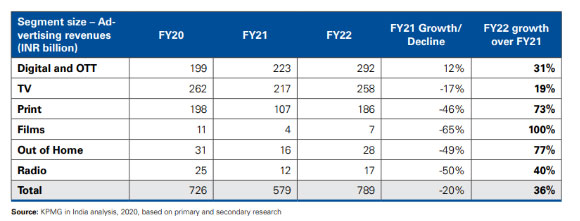
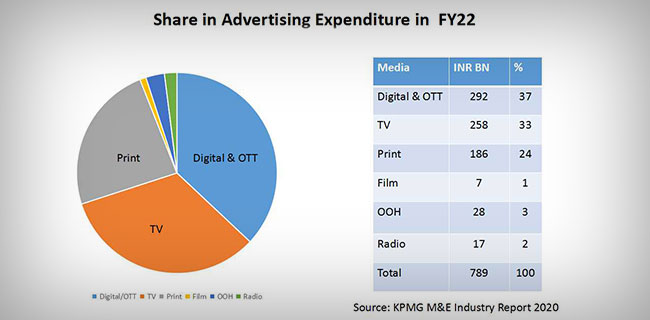
    As we all have realised by now, 2020 is a milestone year in Indian M&E Industry, with digital and OOT emerging as the number 2 in the share of the overall industry size as well as in the share of advertising revenue. The KPMG report confirms the same and springs a surprise by predicting that in FY21 and FY22 Digital and OTT will become #1 in terms of share in advertising revenue, overtaking TV. As per the trends seen in western countries, this seismic shift was written on the cards, but we were definitely not expecting this shift to happen so soon. The pandemic COVID19 seems to have acted as a catalyst accelerating the process of change.  As a result, the KPMG Report 2020 predicts a great churning of the media cauldron over the next two financial years.


    As far as the overall industry size is concerned, TV is by far ahead of Digital & OTT as shown in the next chart, though the growth rate of TV is much lower than Digital & OTT. The absolute size (769 INR BN) of the TV industry in FY22 will be slightly below their size (778 INR BN) in FY20, while Digital & OTT will be growing year on year in their overall size. Print will take a big hit in FY21 with 39% de-growth and will recover hugely in FY22. However, like TV their overall size (296 INR BN) in FY 22 will be slightly below their size (306 INR BN) in FY20. Similar trends are reflected in case of Films, OOH, Radio and Music while Gaming shows a huge gain in size (143 INR BN) in FY22 from (90 INR BN) in FY20. Animation, VFX and post-production is the only sector which in FY22 (77 INR BN) will be much below the size in FY20 (101 INR BN), in spite of the recovery of the Film industry.


    The chart showing the share in advertising revenue represents a different picture with Digital & OTT predicted to overtake TV in FY21 and continuing in the #1 position in FY22. Print which had neck-and-neck share with Digital & OTT in FY20, is predicted to go down to the #3 position in FY21 and FY22. In FY21, the size of Print advertising (107 INR BN) will be less than half of the size of Digital & OTT advertising (223 INR BN). In spite of a growth of 73% in FY22 over FY21, Print advertising will be 106 INR BN less than Digital & OTT advertising in FY22. As per KPMG’s predictions, Films, OOH and Radio will also not be able to regain in FY22 the size of advertising revenue which they had in FY20, with Radio being the worst affected among the three media.


    All is not well for Digital & OTT as a comparison of the total industry size and the share of advertising revenue in the same both in FY21 and FY22 reflects a lack of growth in subscription revenue and an unhealthy dependence on advertising. In FY21 and FY22 the share of advertising revenue will be respectively 87% and 86% in Digital& OTT, which does not reflect the trend of growth in subscription. This is also contradictory to the findings of FICCI EY M&E Industry Report 2019 which showed that growth rate of subscription outpaced the growth rate of advertising led by digital media. The pandemic should have boosted the subscription growth which however is not getting reflected in the KPMG report.


    It is very difficult to compare the two reports on M&E Industry as FICCCI EY reports are based on calendar years and KPMG reports are based on financial years. However, at the time of the release of their report in Mach 2020, FICCI EY promised to review and revise their estimates for future. As and when the revised report of FICCI EY is released, we would be able to assess if similar shifts in the share of the advertising pie is also reflected there reconfirming the predictions made by KPMG and the churning of the media cauldron.


  • Dentsu Programmatic targets premium OTT susbcribers under Dentsu Play

    By A Correspondent


    In an effort to plan for activating OTT audiences from premium platforms such as Netflix, Dentsu Play partnered with sibling WATConsult  on Tata Motors and came up with a solution to target premium, behind-the-pay-wall OTT audiences on platforms outside of the OTT through integrations using first-party and second-party data partnerships.


    Ramesh Dorairajan

    Commenting on the success, Ramesh Dorairajan, Head – Sales, Marketing and Customer Care, Electric Vehicle Business Unit, Tata Motors said: “The Great Reset has highlighted several audience trends that will help us enhance our overall brand reach. The increase in OTT content consumption has transformed the way people consume content. This unique data-driven approach from dentsu Programmatic has opened up additional avenues for us to interact, particularly with the audience behind the paywall, while creating a phenomenal impact on our campaign performance as we pioneer an industry-first approach.”


    Gautam Mehra

    Added Gautam Mehra, CEO, Dentsu Programmatic and Chief Data & Product Officer – APAC: “With our industry first partnerships and integrations enabling insights from platforms such as Netflix, Amazon Prime Video, Zee5 and large players in the sector, coupled with our proprietary technology, dentsu Programmatic is proud to have unearthed a unique way to drive business success for clients wishing to target OTT audiences. Using Machine Learning at its core, coupled with intelligence from platforms such as Facebook and Google, we aspire to deliver many such industry leading solutions to common client challenges.”


    Heeru Dingra

    Sharing her views on the same, Heeru Dingra, CEO, WATConsult said: “As OTT platforms grow and evolve at an exponential rate, they seem to emerge as one of the key focus areas for brands as well as marketers. Therefore, dentsu Programmatic’s tool to effectively tap those audiences has efficiently helped us in actioning a campaign for our brand Tata Nexon EV. From targeting the right set of audiences to creating awareness about the brand and attaining the right amount of consideration, it delivered some remarkable results for the brand.”