Tag: OTT

  • Parents prefer Youtube over OTT platforms for kids : Akatsuki survey

    By Our Staff


    Akatsuki Inc.,  a Japan-based entertainment and technology company looking to expand its kid’s animation footprint in India, recently conducted a survey on ‘What Indian Parents Want From Animated Content For Kids’.


    The survey revealed 69% of Indian parents feel that the Covid-19 wave has increased their child’s content consumption habits leading to a 4-6 hours screen time on an  average. The Top 5 voted content IPs according to the survey are: Cocomelon, Peppa Pig, Shinchan, Doraemon, and Tom &Jerry.


    Said Yuki Kawamura, Head of Business Development and Partnerships, Akatsuki Inc: “We at Akatsuki are committed to bringing joyful and meaningful animation IPs for the growing and underserved kids animation space in India. We want to thoughtfully co-create our content roadmap with on-ground insights and need gaps. This survey is the first step in that direction and findings have strengthened our conviction in the potential of the untapped demand of kids animation in India and synergies with our IPs.”


  • Majority Indians spend 1 to 4 hours on Connected TV


    By Our Staff


    ‘India CTV Report 2021 – Mapping Connected TV (CTV) Viewership in India and the Opportunities for Brands’, a report from Mediasmart, an Affle company, highlights the changing media consumption patterns of the Indian consumer. India is undergoing digital transformation and consumers are steadily moving away from traditional linear TV to CTV and OTTs. This change presents an untapped advertising opportunity for brands and advertisers. The report highlights consumer adoption insights layered with an expert view on possible advertising potential of the CTV medium.


    According to the report, key CTV viewership trends and insights include:


    Out of the select audience surveyed, 78% own a Smart TV and 93% of these smart TV users access internet based content Mobile-first, active and aware CTV consumers: CTV users are young, urban adults who are already mobile-first and are actively engaging with diverse apps such as – 89% of the respondents are social media users, 82% are e-commerce, 44% are gamers and more


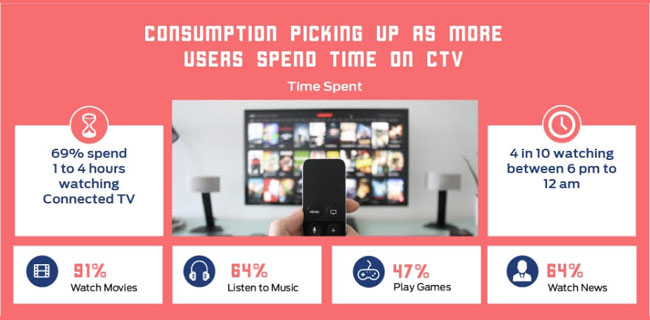
    Content on demand: over 59% respondents prefer downloading apps via Smart TV App Store, while 26% respondents primarily consume content via pre-installed apps and a small section (15% respondents) use the dongle to stream content on TV One device, many uses: Close to 70% respondents spend between 1 to 4 hours on CTV watching movies (91%), streaming music (64%), playing games (47%) or watching news (64%) Spending ability and OTT preferences: Over 65% respondents subscribe to more than one OTT app.  There is 40%+ adoption for the leading eight OTT apps in India: Disney+Hotstar, Amazon’s Prime Video, Netflix, Zee5, MXPlayer, Sony LIV, VOOT and Alt Balaji. The inclination on app usage is also heavily dependent on seasonality and timing Limited barriers to viewership and adoption: Unlike mobile usage of internet, which requires literacy levels, CTV consumption cuts across age, language, and city barriers. By going vernacular, advertisers can engage with users in ads of their language Said Nikhil Kumar, Senior Director, Mediasmart: “The world is moving towards immersive watching experiences and CTV is an exciting space to be at. It is interesting to see leading advertisers in the country adopt CTV advertising as a critical new addition to their media mix. CTV advertising is here to stay and with evolutionary solutions provided by mediasmart on Household Sync technology, we are powering brands to engage with relevant consumers across the connected devices.”


    Added Amardeep Singh, CEO of Interactive Avenues, on the CTV opportunity in the report: “Advertisers globally – and in India – are lapping up the CTV opportunity as it continues to grow as an exciting medium for digital advertising. We have seen great results and ROI for some of our top clients who are already using the CTV ad technology from mediasmart. This research is a step in the right direction to build standard industry metrics, even as technologies like Household Sync make CTV more measurable and impactful.” It may be recalled that Interactive Avenues, an IPG Mediabrands company, partnered with Affle’s mediasmart platform for programmatic and Connected TV (CTV) advertising in India.


  • The Age of False Binaries


    By Shailesh Kapoor


    Shailesh KapoorSimplification is always tempting, and generally a good thing too. But increasingly, the world around us is showing a tendency to over-simplify narratives. With attention spans reducing, nuance is becoming an elusive idea too. And a direct offshoot of this socio-political trend is the emergence of false binaries: a debate that’s framed as either-or, with no room in the middle.


    If you carefully notice, false binaries are all around us. And the discourse around the Indian media industry has not been spared either. Here are five false binaries that you are likely to encounter at some time or the other if you are associated with this industry.


    Progressive v/s Regressive
    This is perhaps the oldest false binary in the industry, dated back to a time when the term ‘false binary’ was not even in vogue. It’s a peculiar way in which the Indian media, especially the English press, has framed the debate around our mainstream GEC content for more than two decades now. If a show is not proactively progressive, it must be termed “regressive”. The lens applied is very urban and elitist, which makes this binary particularly flawed. Here’s a column I wrote on this topic back in 2014.


    TV v/s OTT
    This false binary mushroomed about three-four years ago, with the rise of streaming platforms in India. Health warning: Discussing this topic can be a yawn-including exercise in pointlessness. Pitching two media as different as chalk and cheese, against each other, and suggesting that only one will eventually survive, reflects poor understanding of the video content market in India. TV has not only survived through these last few years, it has grown stronger. Neither have the number of TV households come down, nor has the time spent watching TV reduced, since the emergence of OTT platforms. The reason is simple: Television viewing is the only daily family habit in India today, and its existence is secure till the institution of family remains relevant in India. Which is at least another 25 years, if not more.


    Nationalistic v/s Anti-National
    This is a news nuance that we must learn to live with in the current times. If you question anything that’s even remotely ‘patriotic’ in its framing, you must be an anti-national. This false binary plays out every night on news channel debates, and is now acquiring bizarre proportions and mutating into variants too, like pro-Hindutva versus anti-Hindi. In a recent debate on the Ayodhya Ram Mandir land ‘scam’ on a Hindi news channel, a political spokesperson from the Opposition was chided by the anchor: “How much did you donate for the construction of the temple? And if you have not, what right do you have to talk about it?” To come up with something as twisted as that extempore on a live debate takes some special talent!


    Data v/s Gut
    As someone who uses data to aid informed decision-making for media companies over the last 13 years, one has learnt to live with this rather tempting-to-believe false binary. Gut (or instinct or experience) is a powerful thing. A good instinct can often be key to how well one can contextualise and use data to one’s advantage. Data, when combined with a good gut, is a potent tool. Data, with poor gut, can be dangerous. Give three people the same data points at the same time, and meet them one month later to discuss it. The three discussions won’t have much in common. And this is a true story.


    Theatrical v/s OTT
    This variant of the TV versus OTT binary is the latest irritant on my list. Every other journalist covering the media sector wants to headline a story on films releasing directly on OTT during the pandemic through the lens of this false binary. OTT platforms are not designed to replicate the outdoor experience offered by cinema. And hence, both will find a place under the sun. The framing of a false binary such as TV vs. OTT or theatrical versus OTT assumes that the consumer has a finite, fixed time to spend on entertainment, and hence, there must be a trade-off. This seemingly-reasonable assumption is not true, but that’s a complex topic for another day.


  • Bigg Boss 15 to air first on Voot, 6 weeks ahead of Colors

    By Our Staff


    Bigg Boss, India’s biggest reality show, will first air on Voot, not the GEC where it’s grown into the phenomenon that it has been.


    Called Bigg Boss OTT, it will premiere next month (August 2021) with “unprecedented access, engagement, and interactivity empowering viewers to immerse themselves in the journey of contestants in the Bigg Boss house”. In addition to the hour-long episode on Voot, viewers will get a chance to watch exclusive cuts, round-the -clock content drops and an interactive 24×7 LIVE feed from the house. After the completion of the digital exclusive, the show will move seamlessly to Colors after six weeks as Bigg Boss Season 15.


    Gourav Rakshit

    Speaking about the launch of Bigg Boss first on Voot, Gourav Rakshit, Chief Operating Officer, Viacom18 Digital Ventures, said: “Voot has grown to become home to entertainment in India through industry leading engagement and shareworthy content across originals, international, catchup and content-around-content segments. The launch of Bigg Boss OTT exclusively on Voot before TV is poised to be yet another game changer in digital entertainment and a step forward in further cementing our position as the most loved consumer entertainment brand. This season is set to empower our audiences through unparalleled category defining innovation through interactivity which we are sure will provide significant to our users, advertisers and brands alike.”


    Explaining the content strategy behind Bigg Boss OTT, Manisha Sharma, Chief Content Officer, Hindi Mass Entertainment, Viacom18, said: “Bigg Boss, over the years, has grown to become a phenomenon that drives conversations across the country. With the launch of Bigg Boss OTT, our digital audiences are in for a treat. The new digital exclusive format will take the show’s fandom to its next level through active engagement with viewers being able to play a part in the show’s progress. The beauty of this show lies in the versatility of format and the massive popularity it commands – both aspects helping us in customizing the show as two different content offerings for the two different platforms while maintaining its core ethos.”


  • Will Indian netizens lose their digital rights?


    By Indrani Sen


    Indrani SenOn February 25, 2021, the Electronics and Information Technology ministry notified the Information Technology (Intermediary Guidelines and Digital Media Ethics Code) Rules, 2021 for news publishers and OTT platforms giving a three-month deadline to websites to comply with the same.


    The Government introduced the new rules aiming to “establish a soft touch progressive institutional mechanism” for adherence to Digital Media Ethics Code by the news publishers and OTT platforms “featuring a Code of Ethics and a three-tier grievance redressal framework”. The new rules are applicable to all digital news publishers, social media platforms like Facebook, WhatsApp, Twitter and all OTT platforms like Disney Hotstar, Netflix, Amazon Prime, Zee Live, etc.


    The time limit of three months expired on May 25, 2021. Subsequently, on May 26 the Digital Division of the I&B Ministry has extended the deadline for OTT platforms by 15 days till June 10, 2021 through a public notice. The public notice has three different formats for furnishing information designed for three types of publishers:

    1. Digital news publishers who also publish/ telecast news through traditional media
    (newspaper/ TV)
    2. Other digital news publishers
    3. Publishers of online curated contents (OTT platforms)


    There is not much difference between the three types of forms except that for the first category under “Entity Information” the digital news publishers are only required to furnish the RNI registration number or details of TV channels licensed by the I&B Ministry under Uplinking and Downlinking rules. Where as the publishers of the other two categories have to provide various other details about their entity. In all the three formats, the publishers have to provide details of their membership of Self-Regulatory bodies in the industry.


    The first two categories of publishers are required to give details of their News Editor while the OTT platforms have to give details of their Content Manager. All three have to furnish the details of their Grievance Redressal Officer (GRO) in India.


    In the meantime, both News Broadcasters Association (NBA) and News Broadcasters Federation (NBF) have requested the I&B Ministry that traditional news broadcasters also publishing digital news should be excluded from coming under the purview of the new IT Rules. With only three days left before the new deadline on June 10, 2021 the Ministry has not yet replied / given a clarification to MBA and NBF. A reminder has issued a reminder on June1, 2021 asking all publishers on the digital media to furnish the required information to the Ministry.


    Over the last three months we have seen lot of debates in various media websites on if live news will continue on the OTT platforms and what will be the implications if OTT platforms stop live news. There has been hardly any discussion on mainline media on the implications of the proposed Information Technology (Intermediary Guidelines and Digital Media Ethics Code) Rules. If we deep dive into the three-tier structure for grievance redressal or for observance and adherence to the Digital Code of Ethics, then we find that the Level I comprise Self- regulation by the specific entity and Level II comprise of Self-regulation by the self-regulating bodies of which the specific entity is a member of. It is Level III which becomes an area of concern where Oversight mechanism by Central Government will be acting over and above the Self-regulatory bodies with power to censor and even block the contents.


    The Wire published an excellent analysis of the proposed IT rules on February 27, 2021, day after the new IT Rules were announced and commented on the three-ties system “All of this is being planned to be done without any legislative backing or a clear law made by parliament.” (https://thewire.in/tech/explainer-how-the-new-it-rules-take-away-our-digital-rights). On the same day https://scroll.in also published a detail analysis of the new It rules explaining why the same is anti-democratic and unconstitutional
    (https://scroll.in/article/988105/explainer-how-indias-new-digital-media-rules-are-anti-
    democratic-and-unconstitutional).


    Under the disguise of introducing a soft touch progressive institutional mechanism, the Central Government is about to introduce an autocratic digital censorship and rob all Indian netizens of their digital freedom as well as of expressing their own views on social media platforms. And this move is being executed when the country is still struggling with the second wave of Covid-19, when digital media is acting like a lifeline for many Covid patients, Covid volunteers and frontline medical practitioners all across the country.


    Indrani Sen is a veteran advertising professional and academic. She writes on MxMIndia on Mondays. Her views here are personal

  • Covid Impact: A Fast-Drying Content Pipeline

    By Shailesh Kapoor


    The devastating second wave of Covid-19 in India has brought with it various lockdowns, being managed by the various state governments individually. A direct impact of lockdown-like restrictions is the inability to produce video content, such as TV shows and films. In any case, the fear of the second wave is real and palpable, and many actors and technicians are wary of being on sets. The much-touted IPL bio-bubble bursting last week does not inspire confidence either.


    We are hence staring into an inevitable situation of a hugely-constricted content pipeline. This time, the problem is worse than 2020, because the reluctance to venture out is not just law-enforced but a result of caution being exercised at an individual level too. Since one cannot shoot in Maharashtra, many TV shows have shifted their base to other states, e.g., Gujarat, where the lockdown is partial in nature. But the caution is evident when you notice that despite IPL season being indefinitely suspended, launch promos of not a single new Hindi GEC programme have gone on air. Channels are just about managing their existing line-ups, and would rather not have more on their plates right now.


    The situation gets a lot more complex when it comes to films and OTT content. Outdoor shoots are a given in most projects in these categories, and that involves extensive travel, even if one limits the crew size to the minimum possible number. As a result, there is hardly any film or OTT content being shot currently, in Hindi at least, as a result.


    Even when the second wave subsides over the next month or two, complications related to vaccine shortfall and the inevitable third wave will continue to disrupt life. One cannot expect things to return to even late 2020 levels till a sizeable population in India is vaccinated. And that’s some time away.


    We can, hence, expect a huge content shortfall, especially in theatrical and OTT genres. The signs are already evident. Over the last two months, there have hardly been any big-ticket OTT properties that have gone online, despite a large section of the core OTT audience being locked down at their homes. What is coming out is largely the second line of content. A lot of big-ticket content is semi-produced, and will need at least a few more weeks of work before it’s out for public consumption.


    2020 was OTT’s breakout year in India, with a huge surge in subscriber bases and watch-time across platforms. 2021 looks far less so. The theatrical business was just about beginning to get back on its feet, before the second, more debilitating blow came its way.


    Good old linear TV may end up being the saviour after all. But even that will take some doing. It may be time to go retro with your content consumption once again, but this time out of no choice.

  • State of the Trade Media: Pre-Crisis Alert


    By Shailesh Kapoor


    Shailesh KapoorNews about government guidelines on content regulation and ‘censorship’ in the digital space, including social media and the OTT platforms, has been dominating the trade media over the last week. This topic has been in the discussion for a while, and continues to get written about extensively in business newspapers and online trade websites.

    But it is not as if the trade media covers digital content only when there are regulatory developments. There has been extensive reporting on content itself, including show launches, slate launches, content analysis, the works. For years, the trade media was largely focused on linear television as its primary industry of analysis, and print got its share of coverage as a secondary medium. But now, digital media is right up there, ahead of television, in terms of its visibility on top media websites in India.

    From an advertising perspective, free platforms like social media, YouTube and AVOD offerings of OTT players form an important domain to report on. Digital advertising is growing, and is shaping the future of how advertising may look like in a future. But SVOD platforms do not interest advertisers as such. And yet, they are being covered extensively. A platform like Netflix India gets more trade coverage than big TV channels whose daily viewership is 20 times Netflix’s India subscriber base.

    Evidently, it seems the digital story is an exciting one, especially because it’s evolving, and everyone, including the platforms, are learning on the go. Consumer tastes are still shaping up, and data is not easily accessible, which opens up the topic for explorations in various directions.

    While the extensive coverage given to digital media makes a lot of sense, the contrast between how digital media is being covered far more meaningfully in the trade than traditional media has been a pet peeve for me for a couple of years now. Search the internet for pieces on Indian television or print industry, and you will largely get press releases, or interviews that look more like plugs than actual interviews. As a student of media, if you looked towards the internet for some knowledge, you will get ample to read on the digital front, but very little insights coming your way on television or print. There is hardly any content analysis or marketing stories on TV or print brands, for example.

    The situation has been worse for the other traditional industry, i.e., films. Reporting on theatrical content has been limited to a few box-office and film trade sites. The latter are more promotional platforms than knowledge hubs. For the longest time, I thought this was the case because the theatrical medium is not ad-driven, and hence doesn’t interest the trade media. But with so much coverage on SVOD content, that argument is not valid either.

    Even at an overall level, trade websites have generally been reduced to being information disseminators than thought drivers. Very few like MxMIndia have regular guest columns from industry experts. Views, and not news, shape up the thinking of a human being. Young executives entering the industry can definitely do with more of them.

    Because of my work, I often get to speak to media trade journalists. If I were to make a list of those who truly understand the medium, the audience and the business, the list will come to less than a dozen.

    We may not realise it yet, but the Indian media industry is running into a crisis of poor reporting around it. This problem may even be linked to the larger issue of falling levels of journalism across domains. But B2B journalism doesn’t even have the excuse that it needs to cater to the lowest common denominator!

    Let’s hope that this growing industry gets a more nuanced B2B media ecosystem in the coming years. It surely deserves better.

  • M&E revenue to rebound 27% next fiscal


    By Our Staff

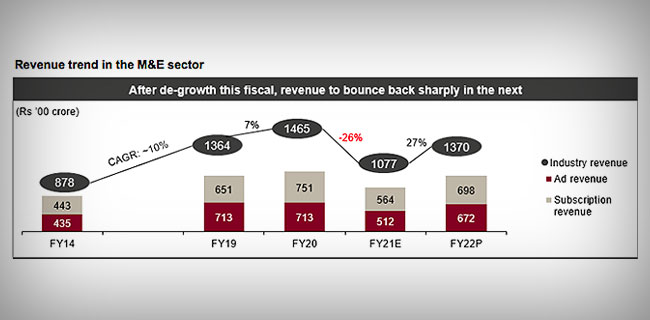
    Revenue of India’s media and entertainment (M&E) sector should script a strong 27% rebound to ~Rs 1.37 lakh crore in fiscal 2022, after contracting ~26% this fiscal. Optically, the de-growth this fiscal and growth expectation next fiscal may sum up to a full rebound. But that won’t be true because the 27% growth will be on a much lower base. Industry revenue next fiscal will still be lower than that in fiscal 2020 (refer to Chart above).

    The time to bounce-back to pre-pandemic levels will be relatively shorter for segments such as digital and television (TV), while print, films, outdoor, and radio would take longer

    Credit profiles of large media companies would be unaffected due to strong balance sheets, liquidity and the revenue rebound, while mid-sized and small ones could see stress, an analysis of over 80 of them rated by Crisil Ratings shows.

    Said Nitesh Jain, Director, Crisil qually to the overall M&E sector’s topline, but since the former correlates strongly with economic growth, the pandemic has had a bigger impact on it. Next fiscal, with strong economic rebound on the cards, ad revenue should grow 31% on-year and subscription revenue ~24%.”

    The TV segment – contributing around half of the sector’s topline – has recovered fully and will report healthy growth next fiscal. Ad revenue saw a sharp contraction initially, but recovered swiftly thereafter, aided by airing of new content, sports events such as the Indian Premier League and a buoyant festive season.

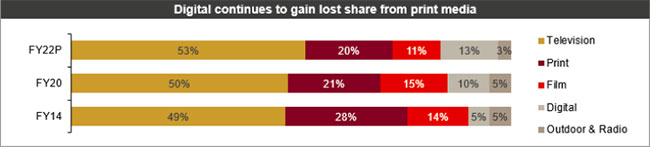
    As for subscriptions, TV was resilient even during the peak of pandemic as people remained indoors. The print segment – contributing a fifth of the M&E sector topline – is recovering, though at a much slower pace, and should be able to rebound fully only by the end of next fiscal. Print is losing share in ad revenue mainly to the digital segment (refer to chart 2. Circulation too, especially for English language, could see a loss of 8-10%, because of increased preference for e-papers in metros.
    However, print companies are rebooting their cost structure and accelerating digital adoption to stay relevant. Films – contributing a sixth to the sector topline – is one of the most impacted segment. But occupancies in theatres should improve with the vaccination rollout and a strong pipeline of content. However, this segment is likely to remain impacted even next fiscal due to social distancing norms and fear of closed spaces.

    Other traditional media – radio and outdoor – are seeing persisting pain, and will likely take much longer to recover (Radio and outdoor segments don’t have any subscription revenue). This is because commuting as well as ad budgets for micro, small and medium enterprises – the key drivers for these segments – will remain restricted even in fiscal 2022.

    Added Rakshit Kachhal, Associate Director, Crisil Ratings Ltd: “Digital has emerged as the medium of choice. The pandemic accelerated adoption of over-the-top (OTT) platforms, online gaming, e-commerce, e-learning, e-papers and online news platforms. This has meant the focus of advertisers has shifted from traditional to digital media. We expect the digital segment revenue to grow 14-16% annually over the medium term. Its share of M&E sector revenue is expected to double to ~20% by fiscal 2024 compared with last fiscal.”

    Given the sharp impact on revenue, cash accruals this fiscal will weaken for all M&E companies except TV distributors. Credit profiles of the large companies are cushioned by strong balance sheets (with most of them net debt-free), while those of small and mid-sized media companies have weakened. More downgrades among the latter led to the Crisil Ratings’ credit ratio (upgrades to downgrades) for the sector sliding to 0.33 in the first nine months of the current fiscal from 0.75 in fiscal 2020.

    Liquidity pressure may intensify for them if recovery in ad revenue is delayed. That said, there is a silver lining to this cloud, too. M&E companies have adopted aggressive cost rationalisation initiatives. Besides, the pandemic-led change in consumer behaviour has accelerated monetisation opportunities for these players through integration of digital media into their traditional businesses. Some of these aspects can lead to structural changes in business models of the M&E sector over the longer term.

  • IAMAI seeks public consultation on OTT

    By Our Staff


    Given the news that the government intends to notify guidelines for OTT streaming, members of the Internet and Mobile Association of India (IAMAI) have decided to not stay quiet.


    Notes a communique sent by IAMAI vice-president Gaurav Chopra: “IAMAI is of the view that they have recently in consultation with the Ministry of Information & Broadcasting agreed to a Universal self-regulatory code that has been adopted by 17 of the leading Online Curated Content Platforms [OCCPs] in India, and have committed to its speedy rollout through an ’Implementation Toolkit’. The self-regulatory code, which is under implementation, effectively delivers on the goal of providing strong consumer protection, while delivering a solid foundation for content providers to build from.

    “Unfortunately, as things stand, as a responsible industry body and an ardent supporter of all Government policies and regulations, IAMAI is surprised to be not consulted on the draft guidelines for OCCPs that is being quoted in the media. Also, apart from the 17 OCC platforms that are signatories to IAMAI’s Universal Self-Regulation Code, there are producers, actors and other stakeholders who too should have been consulted before the guidelines are published. We firmly believe that regulations arrived at through wide stakeholder consultations are much more effective and more easily implementable.

    “On behalf of its members, IAMAI would like to appeal to the concerned Ministry to consider initiating a public dialogue by inviting comments on the draft guidelines for OTT Streaming Platforms, as was done in the case of Personal Data Protection Bill, Non-personal Data Governance Framework and numerous other rules and regulations.

  • Eros Now Select on Apple TV in 11 new countries

    By A Correspondent


    OTT platform Eros Now is now available through Eros Now Select for Apple TV channels on the Apple TV app on iPhone, iPad, Apple TV, iPod touch, Mac, and other platforms in 11 new countries. After its successful launch in the US, Canada and India, Eros Now Select is now available to customers in Australia, New Zealand, Singapore, South Africa, Cambodia, Indonesia, Israel, Malaysia, Philippines, Sri Lanka, and Tajikistan.


    Ali Hussein

    Said Ali Hussein, CEO, Eros Now: “The rise in OTT consumption worldwide opens up immense opportunities for Eros Now Select – widely known for its extensive Bollywood and Indian originals – to expand reach and ramp up distribution in 11 new territories on the Apple TV app.”


  • Digital video share @ 15%, 2 years ahead of forecasts: BCG-CII


    Boston Consulting Group (BCG) and Confederation of Indian Industry (CII) have unveiled a report, ‘Lights, Camera, Action…and the Show Goes On’. The report seeks to evaluate the impact of 2020 on the Media and Entertainment industry and highlights key imperatives for increasing the industry’s resilience in the face of adversity. Said K Madhavan, Chairman, CII National Committee on Media & Entertainment and Managing Director, Star & Disney India: “The pandemic outbreak created many unique challenges to the Media & Entertainment sector. It was commendable to see the entire industry rise to the occasion to engage and entertain millions of viewers while they were confined at home. It’s the sheer willpower and persistence showcased by the stakeholders that have helped convert adversities into opportunities.”


    According to the report, 2020 has seen a massive surge in TV and smartphone video viewership during the weeks of lockdown and beyond as people spent more time at home, and OTT witnessed its presence increase in Tier 2-4 cities due to the high quality, original, and local content marketed using free trials. Covid-19 has had a major impact on how we consume content, both in-home and outside and some of these will have long term implications for the industry. Added Mandeep Kohli, Partner, Boston Consulting Group India: “India continues its unique multimodal growth. TV consumption surged ~40% during lockdown due to an increase in non-prime time viewing. Smartphone video consumption is up as well, with a 50-60% increase in subscribers over last year. Going forward we expect the digital trend to intensify, OTT adoption to continue rising, and the emergence of new business models better suited to the new reality. The share of digital in advertising will also continue to grow, having reached 15% in 2020, a full 2 years before its pre-Covid forecast.”


    Said Kanchan Samtani, Managing Director & Partner, Boston Consulting Group India: “Recent developments such as the resumption of operations and recovery of ad campaigns has resulted in optimism in the industry” explains


    One of the major themes in this year’s report is the potential economic impact that the Media & Entertainment industry can create. This is especially important in the context of the ambitious GDP target of $5 trillion that has been set by the government. The report demonstrates how in economies such as South Korea, the Media & Entertainment industry form a large and growing part of GDP due to concerted efforts by stakeholders to take Korean culture global. The report also highlights opportunities in attractive parts of the value chain such as Visual Effects and Animation, and also calls out imperatives that will need to be acted upon to seize these opportunities. “Countries are developing media hubs to drive impact of M&E – Spain has setup a content city in Madrid to tap into the growing global demand for Spanish content. This gives a boost not only to the M&E industry but also to the tourism and India should aspire to do the same. Continued focus on customer value, increasing our presence in areas such as VFX and animation, and concerted investment in skilling and technology can lay the groundwork needed to help Indian M&E achieve greater heights,” said Samtani.


  • Studio Bodhi to focus on regional content for OTTs

    By A Correspondent


    The promoters of Bodhi Tree Multimedia with the backing of Sumukha Capital have announced the launch of Studio Bodhi, a joint venture under the aegis of Sumukha Bodhi tree Pvt Ltd to cater to the ever-growing need for content across the country.


    With accomplished writers and directors on board, Studio Bodhi has 10 projects at different stages of production and will continue to work on numerous IPs in the near future. The studio is currently working towards producing a rich slew of original offerings in languages such as Tamil, Bengali and Marathi in 2021 and further expanding into Telugu, Punjabi and Malayalam by 2022.


    Speaking on the launch of Studio Bodhi, Mautik Tolia, Managing Director, Bodhi Tree Multimedia, said: “Content today is region agnostic with good rooted stories transcending all barriers and can travel across the world. This content studio will prove to be a game changer in this space. Content consumption has witnessed an upsurge across all genres with regional content gaining momentum. Recognizing this growing demand in regional content, Studio Bodhi is our earnest endeavor to further widen our horizon to build a vast range of successful digital series to cater to every audience palate. Studio Bodhi will mark our foray into the regional OTT space starting with exciting shows across various regional languages like Marathi, Bengali, Tamil, Telugu and further expand to other regions in the coming year. Over the past few months, with projects at various stages of development, we have diligently worked towards acquiring best of talents to put together a team together which we believe will deliver compelling content. With our new venture, we are looking forward to explore different genres and narrative styles.”


    Added Santosh Kanodia, Founder, Sumukha Capital, a division of Sumukha Group: “We are committed to investing Rs.200 Crores in the entertainment industry ventures in the coming years. We recognise the need gap for regional content that is produced at top-notch quality standards and feel this has the potential for exponential growth. The lineup is extremely exciting and the ambition is to move to producing a slate of 10 originals every year.”