Tag: OTT

  • Men Rule OTT in India. 66% males dominate viewership


    By A Correspondent


    The audience size of regular OTT (online video content) audience in India stands at 76.5 Million (7.65 Cr), according to the findings of The Ormax OTT Audience Report: 2019. Mumbai and Delhi lead the top markets, with 3 million regular OTT audience each, followed by Bengaluru, Hyderabad, Kolkata, Ahmedabad, Surat, Chennai, Pune & Jaipur.


    The study, conducted among 15+ age group, also profiles the OTT Universe. 66% regular OTT audience are men, while 34% are women. 25% belong to the 15-21 yrs. age group, 34% in the 22-30 yrs. age group, 21% in 31-40 yrs. and 20% in the 41+ age group.


    The research report covered a sample size of 10,000 audience over the period of May to September 2019, whereby audience were sized and profiled based on their OTT consumption behaviour, usage of various OTT platforms/ apps, and their content choices. The study defined ‘regular OTT audience’ as someone who watched two or more hours of OTT content every week, and uses at least one website/ app besides YouTube and social media to watch video content online.


    Speaking about The Ormax OTT Audience Report: 2019, Shailesh Kapoor, CEO – Ormax Media, said: “OTT is an emerging and fast-growing category in India. While individual platforms have a lot of a data on their own audience, there is little industry-wide understanding available on who the OTT audience in India exactly is, how many are they in number, where do they exist, how do they watch, which genres do they prefer, what are their subscription triggers, and many other such questions that are extremely relevant to any OTT business. This report, which will be an annual feature, answers many such questions in a manner that’s highly actionable, with direct implications in decision-making in the areas of content selection, target audience choice, media planning, market research and brand communication”.


    Among the OTT platforms, YouTube emerges as the most-preferred OTT brand, followed by Netflix, Amazon Prime Video and Hotstar closely vying for the second position. ALT Balaji’s Gandii Baat emerged as the most male-skewed show, while Amazon Prime Video’s Mind The Malhotras emerged as the most female-skewed show.


    The report also highlights how solo consumption is still the dominant viewing behaviour seen in the OTT category, with 82% audience typically watching online videos alone. Hindi emerges as the most-preferred language of online video consumption at 62%, followed by English at 22%, while regional languages, led by Telugu and Tamil, control the balance 16% share.


    The Ormax OTT Audience Report: 2019 is a syndicated report that’s now available for subscription.


  • As SVOD Grows, Media/Marketing Plans can Diversify


    By Brian Wieser


    In most countries, we have seen the proliferation of subscription video-on-demand services.  Balancing a deep library of older programming alongside premium original content for streaming, Netflix is, of course, the leading player in most countries around the world. They have nearly 160 million subscribers in total, including approximately 60 million U.S. subscribers (equal to half of all US TV households), 12 million in the UK (more than 40% of households), 10 million in Brazil (close to 20%) and 6 million in France (nearly 25%).. The competitive offering from Amazon’s Prime Video, is nearly as widely subscribed, while other services primarily operating in single countries including Baidu’s iQIYI, Alibaba’s Youku-Tudou and Tencent Video (all in China); Hotstar and Hulu (in India and the US, respectively, and both owned by Disney) have also emerged over time. There are also a growing range of specialist and niche services and streaming replacements for traditional TV networks now widely available.  And of course, much more is set to come in the year ahead with pending launches of new services from studio owners including Comcast/NBC-Universal’s Peacock, AT&T/Warner Media’s HBO Max and Disney+.


    Precise impact on access to traditional TV services and program viewing is hard to identify with precision. With poor or non-existent measurement of these new offerings, let alone data covering media consumption habits of large like-for-like groups over long time periods of time, most assessments of the impact of SVOD services require some interpretation. However, U.S. Nielsen data illustrates what is currently playing out in the world’s most mature TV market:

    :: Data covering October 2019 indicates that cord-cutting and cord-shaving has accelerated to record-levels, with total pay TV subscribers falling by -3.0%, the median network losing -4.6% of its subscribers

    :: Consumption of television using internet-connected devices during August 2019 accounted for 15.6% of all TV, and rose +31% year-over-year.  A majority of internet-connected device viewing is directed to SVOD services.

    :: While total consumption of all TV (including internet-connected devices) is down -3% year-to-date through the end of August, total consumption of traditional ad-supported TV across all dayparts and all audiences was down -7% over the same time period.   Viewing on those same networks is down by even more for younger audiences and for prime time only.


    Trends playing out in the U.S. may occur in some countries, but probably won’t everywhere in the same ways.  We see cord-cutting in some other countries as well, such as Brazil where the most recent data through June indicates mid- to high-single digit annual declines in pay-TV subscribers there.  However, in many other places, the concept of cord-cutting is not meaningful, especially in countries where digital terrestrial TV makes it possible for consumers to access what Americans might think of as “basic cable” with a simple antenna, or through a free set-top-box provided by an internet service provider. Viewing trends will also be impacted by the fact that pay TV penetration has often been low to begin with in many countries. This would limit the amout of hours consumers spend with TV, at least relative to the United States. Where that has been true, it is possible that the wider availability of SVOD services (and the premium content they offer) could lead to an expansion in viewing of the medium in its broader definition.


    Whatever the impact of SVOD services, for now ad-supported TV’s advantage over all other media is generally unaltered in most countries.  TV ads continue to allow advertisers – especially those who focus on awareness of their brand’s attributes – the opportunity to reach more consumers than any other medium (typically including young ones) with sight, sound and motion in a viewable environment, and borrow the brand equity of the content around which those ads run.  Further, even where cord cutting occurs, most streaming video offerings have some advertising, and free-to-air TV is still widely relied upon – and arguably will be increasingly relied upon in countries where consumers eliminate pay TV subscriptions.


    Will that advantage hold?  There is still a sense among many advertisers that the declines in consumption and reach of ad-supported content we see in some countries or among some audiences is a sign of what is yet to come in the years ahead.  Toward these ends, many advertisers want to prepare for the chance of such an eventuality. For those who believe it prudent to make such plans, what should advertisers do?  It bears repeating that ad-supported TV in its broadest definition – including streaming equivalents – remains strong in absolute terms and generally maintains superior reach relative to alternatives for most audiences.  Of course, there are signficiant challenges to be overcome in managing campaigns optimized for reach and frequency given the manner in which those campaigns must be run across different sellers of advertising and different devices, given the limitations of existing measurement systems.


    If ad-supported TV declines relative to alternatives, different approaches to media planning may be considered.  Beyond premium video, many advertisers may find that running video across environments which include other digital content or on digital out-of-home in an effort to sustain broad reach, albeit without the borrowing of content’s brand equity.  Another alternative includes optimizing reach across a wider range of media, with a focus on using each medium to drive awareness as best as each can.  Other marketers might find that a focus on outcomes rather than proxies for long-term outcomes (which brand awareness is arguably best at) rather than reach is a preferred approach.


    For the foreseeable future, total ad revenue for media owners will grow or decline for reasons unrelated to the rise of SVOD services.  Anticipating whether or not the medium of television – whether broadly or narrowly defined – will grow or decline will be more of a function of whether or not economies produce brands who want to capitalize on the medium’s unique attributes relative to alternatives.  This means that in countries such as the United States, where new categories or groups of advertisers emerge who consider television to be a highly effective platform, television might grow even as some advertisers shift resources away from the medium. Ironically, the new advertisers coming in may include the new streaming services launching in the year ahead; they may find their best target audiences among today’s traditional TV viewers.  In other countries, viewing trends might very well be stable, but as economies weaken or as marketers in dominant categories mature, growth could transition into decline.


    A future with less premium video advertising should present an opportunity to take a fresh look at how marketing is budgeted.  If the insights and ideas supporting brands will be more impactful than any individual media execution, processes should focus more on investing in those insights and ideas. Investing in a broader notion of a consumer’s potential life cycle with a brand – ranging from brand ideas to media exposures, brand experiences and word-of-mouth (including all of the data and marketing technologies which support them) – will probably be impactful as well.

    The status quo won’t hold in the long-run for the medium of television, as it is constantly evolving. Toward that end, brands should similarly plan for a world where evolving approaches to media and marketing planning are a new norm as well.

    Brian Wieser is Global President, Business Intelligence GroupM. This article was first published at https://www.groupm.com/news/svod-services-grow-mediamarketing-plans-can-diversify


     

  • YuppTV join forces with BSNL for a triple-play service partnership

    By A Correspondent


    YuppTV has announced its partnership with telecom service provider BSNL. The two have entered into a triple play partnership for video and broadband technology services for mobile and fixed line.


    Commenting on the association, Uday Reddy, Founder and CEO of YuppTV, said: “We are glad to join forces with an industry incumbent like BSNL. Following the association, we have an opportunity to leverage the vast network cultivated by BSNL and bring forth superior technology products and features to a burgeoning user base. AT YuppTV, we are determined to democratize access to cutting-edge entertainment solution through simple yet effective and innovative technology. We look forward to a long-term association and an affirmative response from BSNL’s extensive user base.”


    Added Pravin Kumar Purwar, CMD of BSNL in a communique: “As a pioneer in the OTT space for 10 years, YuppTV has been quick to evolve with the changing times, leveraging disruptive technology for providing superior digital and video entertainment products and services such as Live streaming or catch-up TV or exclusive Originals. We are glad to associate with YuppTV to provide an impressive value proposition for consumers in India”.


  • Voot works it up with TikTok

    By A Correspondent


    OTT platform Voot has collaborated with short video service TikTok to make B-town favorites sweat out secrets as they ditch the usual couch and ‘Work It Up” in a new celebrity chat show – TikTok India presents “Work It Up”. Hosted by Sophie Choudry, the show will go live starting October 13 on Voot.


    ‘Work it Up’ is produced by Voot Studio which offers advertisers and brands creative, production expertise and interactivity offerings.


    Said Akash Banerj, Head – AVOD Business, Voot: “Voot has continuously created content that is immersive and provides an ideal opportunity for brands to integrate and effectively deliver their brand proposition. The recently launched Voot Studio is focused on leveraging this story telling capability by providing high engagement, innovative and relevant brand solutions for advertisers beyond the conventional 30-seconder format. Work it Up created in association with TikTok India is one such initiative that will entertain while educating viewers.”


    Added Sachin Sharma, Director-Sales and Partnerships, TikTok India: “#EduTok was conceptualised with an aim to ensure that learning becomes fun and engaging. Fitness is a popular and prominent category among on TikTok’s #EduTok. We are thrilled about our collaboration with VOOT as it’s the perfect platform to encourage people to adopt fitness as a lifestyle and inspire them through some of their favourite celebrities. We are excited to see the reaction of our users for the show and look forward to being a part of something that is entertaining and trendy yet inspirational.”


  • The Big OTT Growth Story: Chapter 2


    This is the second in a series of columns by Shailesh Kapoor on the OTT Growth Story in India. Click here for Chapter 1.


    By Shailesh Kapoor


    It’s raining OTT show launches. Over the last few weeks, about two-three major and another five-six minor OTT shows have been launching every week. At this rate, the number of OTT shows that launch in 2019 will be higher than the Hindi GEC shows launched over a five-year period (2015-19). And you may not be wrong in believing that this is just the start, and things can only get more exciting from here.

    While the launch rate has accelerated significantly in 2019, it has been accompanied by a parallel improvement in the quality of content too. Till last year, among the many OTT shows that launched, only a couple would pass muster on quality. Most of the shows that won audience appreciation were from the TVF stable. ‘Quantity over quality’ seemed to be the OTT mantra.

    While that mantra continues to hold true for the second line of OTT players in 2019, there has been a significant jump in the quality of the top shows in 2019. If we look at the Ormax Advocacy Score (a measure out of 100 on how well-appreciated a show was among the audience who watched it), 2019 has some strong candidates in the reckoning.

    November 2018’s launch Mirzapur (Amazon Prime Video) continued to get audience appreciation early this year. Then came the deliciously compelling Delhi Crime (Netflix), which continues to grow its audience base till date, six months since it launched in March.

    The big success of the year, however, is a somewhat low-profile show Kota Factory (TVF). Presented in Black & White, this funny and insightful series on the student life in the education hub Kota has received widespread acclaim from young audiences, become the third-most liked Indian OTT show till date on the Ormax Advocacy scale, after Sacred Games (Season 1) and TVF Pitchers.

    Another potential top-end show dropped last night: Amazon Prime Video’s The Family Man. The unusually-textured spy thriller cum family drama stands apart from the dark and gritty world that shows like Sacred Games and Mirzapur espouse.

    However, all good things come with a word of caution. Almost 80% of OTT shows that have launched still have an Advocacy Score below 50, symptomatic of active audience dislike, even rejection. Many of these have been actively promoted by the respective platforms, indicating that the platform sensed good potential in them. So, even though the top-end has become stronger, the success rate may still be a mere 15-20%, or even lesser. Quantity may still be prevailing over quality after all.

    The Top 10 Hindi films of 2019 based on audience advocacy (word-of-mouth) average at a staggering Advocacy Score of 73. The equivalent number for the OTT category in 2019 is only 60, which is only a notch higher than the Hindi GEC category average of the year. And the Hindi GEC category has not exactly been in the pink of its health in recent times.

    A long tail of flop shows will continue to be churned out in a category where everyone wants a share of the pie. 2019 has been good so far in providing a strong top layer of quality content. This layer now needs to expand from three to four shows to 10-15 shows a year. And 2020 may just be the year to achieve that.


  • OTT player Wows gets funding from RazorPod, other investors

    By A Correspondent


    OTT infotainment platform, Wows, has raised an Investment from RazorPod and few other angel investors. The platform is created to help users discover and explore a range of content available online on different OTT platforms including Netflix, Amazon Prime, Hotstar, Voot, Alt Balaji, TVF Play, SonyLiv to name a few.


    Mayur Sethi

    Commenting on the development, Mayur Sethi, Co-Founder & COO of Roaring Wolf Media said: “OTT platforms have seen massive growth in terms of subscribers in the last few years, with 2018 being the turning point for both subscribers and the platform itself. Artificial Intelligence algorithms have become extremely relevant in the OTT space, especially with the enhanced processing power of devices. With the availability of innumerable OTT platforms and AI suggestions, Wows will become their one-stop-platform for all OTT related Information and Entertainment. We are delighted to have received this Trust on us, we recognize and acknowledge their efforts and assure to take Wows globally in the coming years.”


    Chirag Alawadhi

    Added Chirag Alawadhi, Co-Founder & CEO: “The funding goes on to prove that the field of digital holds much promise. Wows, in specific, combines market updates, trailers, premiers, OTT stories, podcasts, exclusive music library from different OTTs and Labels in a way that’s unique and powerful. The platform’s intervention makes it simple for a user looking for content to choose from different genres. Going ahead, users will see a lot more interactive content along with a new array of content to binge on. We are sure to abide by our brand line – “Kuch Naya Dekho” and let them discover new series every day.”


    Mukul Chowdhary

    Said Mukul Chowdhary, Co-Founder & CGO: “We are keen in exploring all growth hacks to take content from various OTT platforms to users across India. Today, India and Bharat are two broad targeting audience that exists with a very clear distinction of the genre of content however have likings for various titles in all genres and thus our target would be to help them watch the same by providing more information about the series and let them make an informed decision.”


  • The Big OTT Growth Story – Chapter 1


    By Shailesh Kapoor


    The rise of OTT/ digital consumption in India is a narrative that has dominated media discourse over the last year or two. The sheer volume of launches from the top players is reason enough for it to be a hot topic of discussion. The creative muscle backing many of these shows, especially those from Amazon Prime Video, Netflix and Hotstar, makes the OTT story even more persuasive.


    There’s an element of scepticism about how, and to what extent, is the OTT content delivering, both in terms of eyeballs and revenues. Absence of a unified currency means that there are no numbers in the public domain. Individual platforms may release specific data, such as Hotstar talking about the growth of IPL on the digital platform year-on-year. But the larger picture is incomplete, because a central data source is missing.


    This has been a topic of great interest for us at Ormax, and a lot of work has been happening in the background over the last year in this area. Over the next few weeks, you can expect to read more on this aspect here, in this column.


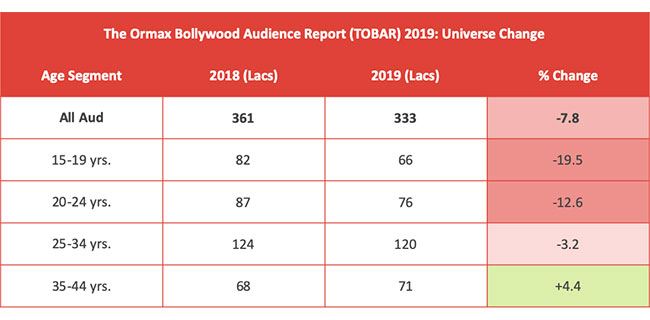
    A few weeks ago, we got one of the first definitive evidences on the OTT impact on media consumption in India. In the 2019 update of The Ormax Bollywood Audience Report (TOBAR), which sizes and profiles the Hindi moviegoers’ universe, the market size of regular theatregoers (defined as those who watched three or more Hindi films in a theatre in the previous calendar year) fell by 8%, from 3.61 Cr to 3.33 Cr. This itself is not much of a story, especially because this drop coincided with a higher incidence rate, i.e., while less people may have gone to theatres, they went more often, leading to higher box office in 2018 than in 2017.


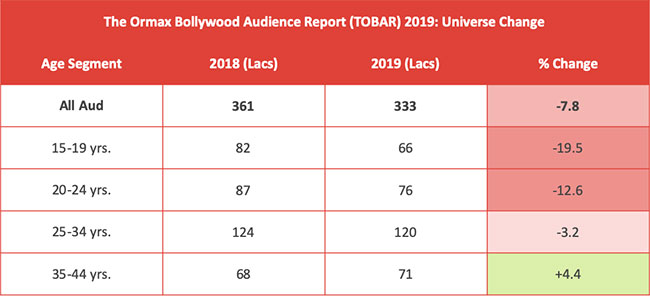
    However, if we see the age break-up of the Hindi moviegoers’ universe over these two years, there’s a striking pattern. The table below shows this break-up:


    The drop in the universe size shows a clear negative correlation to age. From a 20% drop in the teenage segment to a 13% drop in the college youth, it becomes a mere 3% in 25-34 yrs. And then, there is actually an increase in the 35+ segment. In effect, the 15-24 yrs. segment lost 27 lac audiences within a year, but the 25-44 yrs. segment lost only 1 lac audiences.


    It is not very difficult to attribute this trend to the ascendancy of digital content in India over the corresponding period of time. The youth have been the early adopters of original OTT content, and a section of them have moved away from theatrical consumption of Hindi film content as a result. A parallel rise in Hollywood’s popularity in India adds a layer of complexity to this argument, but that’s another story for another day.


    While this may be a compelling concern for the theatrical business, it is also a validation of the OTT growth story. And the OTT growth story may have only just begun. The 25-34 yrs. age group could be next on the line.


    What’s the likely impact on TV in the coming years? Watch this space!


  • SonyLIV to launch OTT gaming destination with AR and show-based games

    By A Correspondent


    SonyLIV announced the launch of India’s first OTT gaming destination with over 100 exclusive show-based games, to be launched in a phased manner. With this move, SonyLIV aims to reach out to 50 million new users offering them a one-stop gaming destination. These games are curated around some of Sony Pictures Networks’ (SPN) biggest IPs across channels like KBC, CID, Crime Patrol, The Kapil Sharma Show, Patiala Babes, Baalveer, Kicko & Super Speedo, amongst others.


    Said Uday Sodhi, Business Head – Digital, Sony Pictures Networks India said: “India houses 10 per cent of the world’s gamers and this number is slated to rise exponentially. With the launch of our OTT gaming platform, we intend to trigger this target segment and capture the market to an extent of 50 million users. This falls in line with India’s OTT market share predictions, which is expected to triple its size in the next four years. Our database of 100+ games will cater to every generation of gamers that we aim to engage with through a plethora of events to capture their attention.”


    Added Amogh Dusad, Head – Content, Partnerships & New Initiatives, Sony Pictures Networks: “At SonyLIV, we always try to push the envelope in user engagement by diversifying our offerings. The launch of our OTT gaming destination with absolute in-house expertise is a leap ahead in content innovations and ushering in an experience unexplored before on OTT. The Multi-player Video Quiz and Augmented Reality format Games also give our audience a chance to reconnect with their favourite shows and characters in a completely different and engaging context.”


  • India-Pakistan Ratings: Busting the Fragmentation Myth

    The Amul ad on the India-Pakistan World Cup match


    By Shailesh Kapoor


    The ratings for the India-Pakistan World Cup cricket match on June 16 are out. The hopelessly-one-sided game scored a whopping 18+ TVR (Urban All India). Ratings nearing 20 can only evoke nostalgia for those following the Indian TV market over the years. It’s in the first half of the decade of 2000s that one would see such numbers for daily shows, with Kyunkii… and Kahaani… leading the way for a while. Thereafter, the numbers progressively dropped, a trend that’s generally believed to be an outcome of the launch of more channels and the resultant fragmentation of content choices available.


    The top Hindi GEC show moved from the 20-mark in early 2000s to the 10-mark late in that decade. In the first half of the decade starting 2010, the 5-6 level was aspiring enough. Today, even a 3-level is gold.


    Movie ratings have also shown a downward trend, but nowhere close to soaps. The top movie could do 15+ rating about 15 years ago, the equivalent of which is a 7-8 rating today. That’s a 50-60% drop, vis-à-vis an 80%+ more drop when you compare the top Hindi GEC shows across the same two periods.


    The popular belief has been that with the expansion of the measurement universe over the years, the true heterogeneity of the Indian market has a more and more significant impact on the TV ratings. That, combined with a multiplication in the number of channel options, would mean that fragmentation, and the resultant creation of a long tail, is inevitable.


    The India-Pakistan match ratings challenge this notion head on. The message from the audience is clear: If there’s content that carries a certain level of appeal and viewer pull, India can be fairly homogenous after all. Yes, there are more options and more diversity in the universe today. But there’s always content that cuts through, because it enjoys that broad-based appeal. And hence, justifying sub-3 numbers as the best-case scenario is only a self-fulfilling prophecy, whereby content creators and broadcasters are justifying low ratings as a market behaviour, than questioning them as symptoms of a loss in the collective ability of the industry to make truly mass, pan-India shows.


    One may argue that big-ticket sporting events have the ability that genres like drama, comedy and non-scripted content lack. That’s a fair argument too. But one is not expecting the top show to deliver 18-rating. Even the inert and one-sided India-South Africa match touched the 6-mark (averaged over more than seven hours, no less!). That’s surely a level a top Hindi GEC show should aspire to achieve. But today, even half of that is being celebrated as an outright success.


    If these signs continue, we may soon be a television market where sports, news and movies become the staple, and drama the alternative. It has already started happening during events like the IPL, the elections and now the World Cup. It could be a matter of time when more routine days begin to exhibit this trend too.


    If all the content creators can take a week’s break from their OTT pre-occupation and think about this, I’m sure they have the collective ability to come up with something worthy. The real question is: Do they have the will? Or has television already been reduced to a fuddy-duddy medium that’s not even cool to ideate about?


  • Goodbye, Satellite TV. Hello, OTT!


    By Ranjona Banerji


    I can actually remember the last few times that I watched a TV broadcast through a set-top box subscription in the past three months. The 2019 Lok Sabha election results on May 23, the French Open and the Halle Open, which finished on Sunday. One major news event and tennis.


    Last week, I got an urgent call from close family friends, in their early 80s. Their Fire Stick wasn’t working! What were they to do? How would they cope. I had helped fix up this Fire Stick only months ago. It turned out to be an internet problem and by that evening, they had rushed out and bought a back up internet device. They have, you know, satellite TV and all that. But.

    Convenience and choice. That’s what we want. I pay as much for Netflix as I do for TataSky but I feel that Netflix gives me more bang for my buck. There is no extraneous matter, there are no rain clouds to disrupt transmission and there are no intrusive text messages. It is a seamless experience, which I can share with friends and family. I have the whole Star package on satellite TV. But how does one watch Game of Thrones or Masterchef Australia on a satellite subscription, 24 hours late or worse, three months late? Instagram told me who won last year before the serial was aired on TV, so Hotstar it is!

    The television industry hasn’t fully twigged on yet, I fear. “Television is here to stay,” says one head honcho. “Streaming services are a disruption,” feels another. The coffee has gone cold, gentleman, before you’re even woken up to smell it.

    The manufacture of TV sets will possibly continue until we get live interactive walls built into our homes or something. But buying a cable TV subscription or a satellite TV subscription, how long will that continue? There was a time when we had antennas, remember? Where are they now? Wirelesses? Storytelling around a fire in the village? Under a tree? Things change.

    My Father is 81. He watched cricket and the news on subscription TV for two nights this week and decided that since nothing had changed, he’s done with it. Back to streaming.

    Years ago, when sports channels refused to show the tennis tournaments I wanted to watch, I learnt how to stream and taught my parents too. Given the way the internet and its services have improved since then, watching sports online is a breeze. And a legal breeze too. The same providers which won’t show you tournaments on subscription TV, will stream them on their online platforms. Go figure!

    For viewers, the choice and variety in OTT platforms is a huge boon. Apart from Netflix and Amazon Prime, there are all the traditional TV channels which offer online services. Hulu is awaited. All we need is for the BBC to twig on! It’s not just English though. OTT platforms are picking up in Hindi, Bengali, Tamil. It’s just a matter of time. Manufacturers have jumped in with Smart TVs. Google needs to rework the roadblocks on Chromecast to stay in the game. So that we have more choices.

    The multiplier or whatever the jargon is, has to be improved internet services. And after that, the spread of smart phones. Indian TV companies may be happy that as long as India remains at this level, and feel that they are safe. Maybe. But for how long? I know no young people who actually sit down and watch TV in the traditional sense any more. And increasingly, all the older people I know have jumped ship too.

    Of course, people being people. They still get confused. A US-based Christian group petitioned Netflix to stop the Terry Pratchett-Neil Gaiman show, Good Omens.

    https://www.theguardian.com/books/2019/jun/20/petition-netflix-cancel-amazon-prime-good-omens-christian-neil-gaiman-terry-pratchett

    Netflix sarcastically agreed.

    https://www.thedrum.com/news/2019/06/24/netflix-sarcastically-bows-erroneous-petition-calling-good-omens-ban

    The show runs on Amazon Prime. Ah well.

    It is an excellent show though. Funny, irreverent, clever. And you can “binge-watch”! I do.

  • A Wishlist for the New I&B Mantri


    By A Correspondent


    We know that Information and Broadcasting is not only the ministry Union Minister Prakash Javadekar is going to be overseeing. The all-important, future-critical environment ministry is also something that the Pune politician is going to be concentrating on. And given the challenges that prevail on the environmental front as India races towards an infrastructure upgrade, clearly I&B will be Javadekar would do well to ensure the ministry runs on an auto-pilot.


    The minister is affable, even as he conscientiously follows the party line on all issues. He is friendly with the media, but that’s about it… we know how much the media – especially the part dealing with news – is truly independent.


    But there are many things we expect the new minister to do (and not do):

    1. Ensure minimum government intervention: The MIB should have minimal role in the functioning of MIB. It must monitor the role of the TRAI in broadcast and digital. Empower industry associations to take decisions, and if necessary have a body like TRAI to ensure these things happen. Just that. The TRAI shouldn’t be issuing diktats to the industry.


    2. Ensure self-regulation proliferates: And in order to be able to do that the government must ensure that all those who wish to take advantage of its largesse (DAVP ads), must be active participants in the self-regulation process


    3. Stay away from measurement: The MIB and the TRAI are actively engaged in television viewership measurement. Thankfully, for all players, not in print, radio, digital and outdoor measurement. The government must have no role in BARC, MRUC, RAM etc etc. These are funded by industry, and the forces within each trade will ensure that the measurement agency (and currency) performs.


    4. Allow news on FM Radio: This is an old demand that we have tried to impress upon every I&B minister. Insisting that private FM players can only air All India Radio news is pointless. If the government really wants Radio to grow, it must allow news on FM Radio. Let self-regulation and industry associations ensure that quality is ensured and national security isn’t compromised. If it’s okay to have news on TV, print and digital, why not Radio?


    5. Minimal controls on OTT: puhleez. OTT is set to grow exponentially and we hear that the government is planning to set rules on the content that will play on the platforms. If that happens, it would be unfortunate, and meaningless because there are enough and more ways to access content. Adequate viewing advisories should be enough, we think.


    6. Level and Just Taxes: The industry has been pushing for some relaxations on the GST front. This applies to advertising and the various media and entertainment entities. Minister Javadekar would do well to ensure a level and just playing field for everyone.


    7. Continuity: Can we have one single I&B Minister for the next five years, or at lease 2.5 years. Wishful thinking?


  • Will Skinny Bundles work in India?


    By Indrani Sen


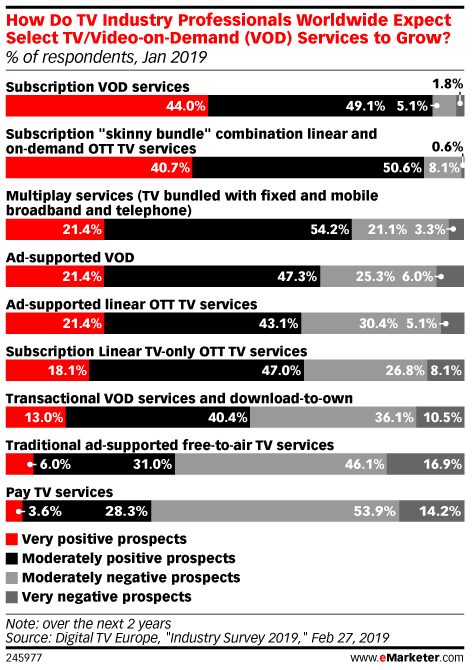
    I recently read an interesting article “TV Industry Eyes Hybrid Linear, On Demand OTT services” in www.emarketer.com based on the findings of Digital TV Europe’s “Industry Survey 2019.” According to the survey, nine in 10 industry professionals worldwide had positive outlooks on the two-year growth of “skinny bundles,” or subscriptions that offer both linear and on-demand OTT services as against subscription of only SOVD services like Netflix and Amazon Prime Video.


    The term “skinny bundle” was first coined to describe pared-down cable TV packages in the United States. In recent times, the concept of ‘skinny bundle’ has been introduced into the digital video sphere with an aim to describe either linear OTT services that offer customizable channel packages or a service that combines linear and on-demand content, as defined in the Digital TV Europe’s survey. As the article explains “The latter definition alludes to linear OTT services like Sling TV and fuboTV, which now have subscriptions that offer additional access to premium, on-demand content from services like HBO and Showtime. But it also represents SVOD services like Hulu, which bolstered its offerings with Hulu with Live TV, a linear service. (Source: https://www.emarketer.com/content/tv-industry-eyes-hybrid-linear-on-demand-ott-services?ecid=NL1001)


    In the US and other European countries, there is a growing trend of “cord-cutters” every year, referring to the consumers who are cancelling their subscription to cable and opting for other digital services. There are also a significant number of “cord-nevers” among younger generation (those who have never subscribed to traditional cable). It would be interesting to wait and watch what impact the growth of mobile internet in India has in the next few years on the cable TV and Dish TV subscribers.


    This model of skinny bundles can be adopted easily to suit the Indian TV industry, against our unique scenario of rapidly growing access to internet through mobile phones. Among the various options of skinny bundles shown in the above chart borrowed from the article, the option of Multiplay services (TV bundled with fixed and mobile broadband and telephone) looks like an ideal solution for Indian TV industry in near future.


    To sum up, it is going to be an exciting time for Indian TV industry from 2020 onwards with constant changes and innovations in the way of doing business. Needless to mention that the TV channels who were early adopters of OTT platforms will enjoy a distinct advantage.