Tag: OTT

  • Zapped Technologies launches Pocket Cinema

    By Our Staff


    Zapped Technologies has announced the launch of tits app – Pocket Cinema, a gaming platform that allows one to watch OTT content and play a simple skill based game around it, to win.  It’s being called #GOTT, a combination of gaming and OTT.


    Pocket Cinema founders and Co-CEOs Anshuman Singh and Anil Verma hope to make gaming technology inclusive and accessible to one and all. They believe that the options available online are either too complex or high-end and most often, intimidating. By that accord, they alienate a major chunk of the population from Tier 2-3 cities.


  • Best of 2021: Top 10 Shows or Films


    By Shailesh Kapoor


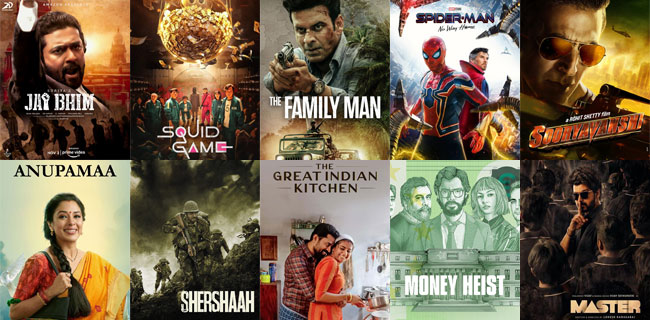
    Shailesh KapoorTwenty twenty-one, with all its disruptions, saw a lot of content being produced and distributed in India, across media. While much of it did not have any lasting impact, some shows and films stood out during the year, not only because they received appreciation and commercial success, but also because they played a role in shaping the future of video entertainment in India. Here’s my list of the Top 10 shows or films of 2021:


    10. Master: It needed a full-blown Tamil superstar vehicle to get audiences back to the theatres in January 2021. Even as Hindi cinema waited, this Vijay and Vijay Sethupathi entertainer reaffirmed that the big screen will never be out of business.

    09. Money Heist: Netflix may have struggled with its Indian originals for most part of 2021. But the final season of Money Heist, with its multiple dubbed versions, managed to receive a lot of love from the audience, recording more viewership than most prominent Indian series in 2021.

    08. The Great Indian Kitchen: The much-appreciated Malayalam film, along with Drishyam 2 and a few others, spearheaded the Malayalam cinema movement in 2021. The national audience, especially in big cities like Mumbai, Delhi, Pune and Kolkata, took notice of Malayalam films, which became a popular OTT sub-genre among those seeking discerning content.

    07. Shershaah: While many theatrical films went the OTT way, very few of them made you feel they deserved a theatrical release. Captain Vikram Batra’s biopic Shershaah topped this list, and was also the soundtrack of the year by a wide margin.

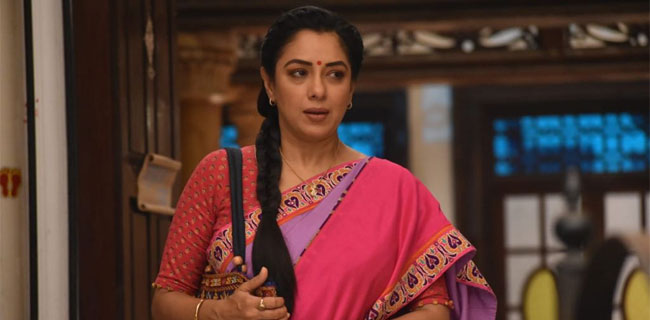
    06. Anupama: The lone GEC show in the list, Anupama set new benchmarks for success, breaking the 4-TVR barrier, something unthinkable for any show at the start of the year. The show continues to go strong, providing a silver lining to an otherwise inert year for Hindi GECs. You can read my recent column on the show here.

    05. Sooryavanshi: It took a while, but Rohit Shetty’s Sooryavanshi finally got the Bollywood box-office back on track in Diwali 2021. Like Master, the film was a confirmation of the power of the theatrical medium, and of the value of larger-than-life, mass entertainers.

    04. Spider-Man: No Way Home: In December 2021, the true might of the Marvel Cinematic Universe (MCU) was on display at the Indian box0office, as the new Spider-Man film became the biggest theatrical success of the year in India, becoming only the third Hollywood film to break the Rs 200 crore barrier at the Indian box-office.

    03. The Family Man S2: In a year that saw many webseries (more than 130 in the Hindi language itself), one stood out as being head and shoulders above the rest. The first season of The Family Man was an unqualified success, but the second season actually managed to raise the bar further, with its nuanced handling of characters, relationships, politics and plot. From ‘Don’t Be A Minimum Guy’ to ‘Chellam Sir’, the show has found its way into pop culture too, and is now the definitive gold standard for Indian web-series to surpass.

    02. Squid Game: Korean content found a sizeable audience in India in 2021. But it was Squid Game that went truly mass, attracting viewers from the smallest of towns in India, capturing their imagination through a story that combined human emotions with thrills and adrenaline.

    01. Jai Bhim: It is only fitting that the top entry in this list is not in the Hindi language. Suriya-starrer Jai Bhim received whole-hearted appreciation from across the country, recording more viewership than many starcast-led Hindi films in the Hindi markets. The film worked both as social commentary and a legal drama, and proved decisively that good content can find audience across languages and geographies.
     

  • Voot Select goes original for Kannada

    By Our Staff


    Voot Select, the Viacom18 OTT plaform, is set to launch its maiden Kannada-language series ‘Humble Politiciann Nograj’. The 10-episode web series is produced by Applause Entertainment in association with Firstaction Studios and Danish Sait. The show is written and directed by Saad Khan.


    Speaking on the launch of its first Kannada Original, Ferzad Palia, Head – SVOD & International Business at Viacom18 said: “At Voot Select, we have been constantly growing our content offering. The release of our first Kannada original, reinforces our commitment to cater to audiences across the country and serve them entertainment in a language of their choice. Humble Politiciann Nograj is the first in a robust list of Regional originals that will drop over 2022. Over the next 12 months, we will significantly dial up our regional language roster, while we continue to strengthen our Hindi, international, sports and kids offering.”


  • The Year to Remember… The Year to Forget


    By Shailesh Kapoor


    Shailesh Kapoor2021 has been a treacherous year, and it’s been generally hard to predict what’s in store next. Even as I write this on the last morning of the year, a third Covid wave knocks on our doors, and this time, we know it’s an inevitability. That it’s likely to be a wave of milder infections is the silver lining we latch on to.


    The media and entertainment business has done well to stay afloat in a difficult year. Two categories had the maximum opportunity to make the most of it: OTT and News. The streaming players did their part, and came up with content across languages to keep us engaged while we were locked down. The focus, however, was on quantity over quality. More than 200 series and 75 films launched on streaming platforms in India in 2021, and only about a dozen of these managed to make an impact. It often came down to international content to save the day, such as Squid Game and Money Heist for Netflix. That does not reflect well on an industry that, till not very long ago, had announced itself as the torchbearer of a new content revolution in India.


    The news story has been a dichotomous one. While television news shed all pretense and became unequivocally subservient to the powers that matter, the print media, especially in the Hindi language, kept the flag of good journalism flying high. If I had to choose a media brand of the year from India, I’d seriously consider Dainik Bhaskar for that award. It takes courage to go against the tide, and stand up for the truth. Even the subsequent IT raids did not deter them.


    Digital news platforms were persistent in their coverage of the second wave too. But that ecosystem is still struggling to find a viable business model, as they try and convince Indians to pay for their news, which is at least two degrees away from the first frontier for any pay digital platform to surpass: To convince audience to pay for content, of any kind at all.


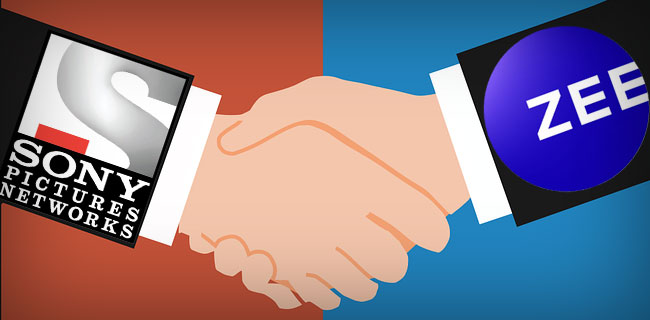
    The television sector, in general, would have had another forgettable year, with stagnant viewership and no breakthrough achievement in content. But we can always bank on TRAI to inject some nuisance to counter the dullness. Much of the year saw broadcasters and TRAI tussle over NTO 2.0, and the last chapter of that story has still not been written. There was also the mega-merger of Zee and Sony, which opens immense opportunities for the new entity, with their complementary strengths. But that’s another topic for another day.


    We can hope for a lot from 2022, but it’s not a year you want to write a script for. There are going to be surprises on the way, and this time, one hopes they are more pleasant than those in 2021.


  • #SonyZee Merger in ~8 months, Cricket rights & OTT key to future


    By Our Staff


    As most of the paperwork has been completed with the two parties having signed a definitive agreement, all eyes are now on the regulatory approvals. The 75 per cent shareholder approval is being given much importance, given the problems that Invesco had with the Zee promoters. But that we hear isn’t much of a problem. Invesco wants maximum bang for its invested buck, and is not known to be a predatory investor. Either in India or the rest of the world.


    However, it must be noted that while the Zee-Sony merger is being called a done deal, there have been a few instances when the final closure hasn’t happened. The much touted Publicis-Omincom merger, for instance, fell through. In India too, some like HDFC and Max Life, RCom-Aircel, Snapdeal-Flipkart and IDFC-Shriram Finance are said to have failed at the ‘due diligence’ or a variety of circumstances, most often dubbed ‘unforeseen’.


    But both Zee and Sony have been wanting to get this done, with each other and with others. Given that it’s been discussed in their own offices for a while, care would’ve been taken to ensure their books and operations are merger-ready.


    A lot is being said about what the merger and what it will mean. Other than it becoming a behemoth and the biggest broadcast conglomerate in the currently, there is a great amount of soul searching that the combined entity needs to be done.


    01. Other than the Sony Sab in the Tier 2 (or shall we say 1A), none of the general entertainment channels are #1 the pack.

    02. The sports channels have some good properties, but without IPL and the various India cricket matches, it doesn’t have the desired clout

    03. Both Sony Liv and Zee 5 have some good content, but Disney+Hotstar among the Indian entities, and Netflix and Amazon Prime Video are bigger. Plus there’s Voot that’s getting into sports and could emerge as a significant player. It’s gambit for Bigg Boss, for instance, was significant. Perhaps a merger of Zee5 and SonyLiv will be a good idea

    04. The strength of Zee has been in its regional play, but its mainstay Marathi offering has taken a beating in ratings. The others are good, and there is an urgent need to consolidate that franchise

    05. The studio business is good and strong, but the likes of an Endemol, Balaji and now even Applause are doing some great, buzzy work


    In the light of the above, and some exceptional talent that both organisations have, there is a clear advantage of a merged entity.


    One of the factors discussed in the run-up to the agreement signing on Tuesday was the factor that Zee will be reduced to a minority shareholder, even as Punit Goenka will be the boss. Founder and chairman emeritus Subhash Chandra is known to never be a silent member in the M&E space. He is sure to spring back to something significant soon with a few of his other M&E interests. Also, what about the charges that Invesco had made about Zee and its governance. If indeed they are incorrect as Zee has said, will the conglomerate file a defamation suit against it? Or will there be a settlement.


    All eyes are clearly on the merger happening sooner that. Most in the A&M&E arena have welcomed the move.


  • Podcasts hit a high note


    India is witnessing a steady uptick in the usage of podcast entertainment over the last few years. The rise of DIY platforms has facilitated the emergence of independent content providers, resulting in an increase in the availability of new content. The popularity of smart gadgets like Amazon Echo, Apple HomePod and Google Home has made it easier to find and listen to podcasts. Here are some key insights into the industry.


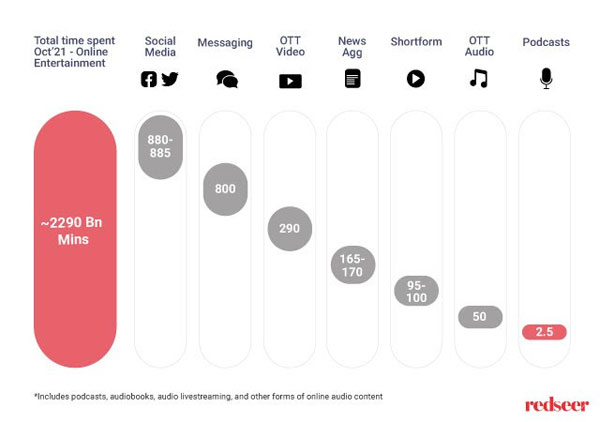
    1. Podcast has picked up well in India and already constitute 1% of the total time spent

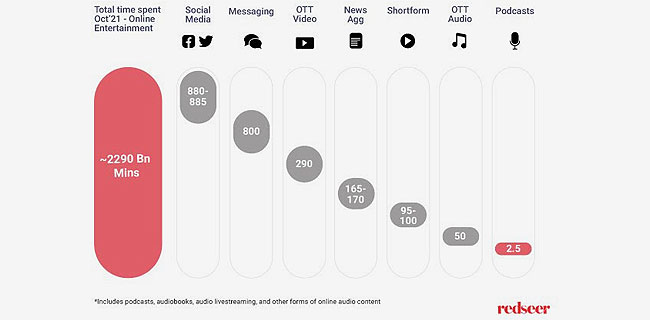
    According to our RedSeer analysis, the total time spent in Oct’21 – Online Entertainment was around 2290 billion minutes. Social media takes up the most time (885 billion minutes), followed by Messaging, OTT Video, News Aggregation, and Shortform App. In the month of October, podcasts accounted for 2.5 billion minutes.


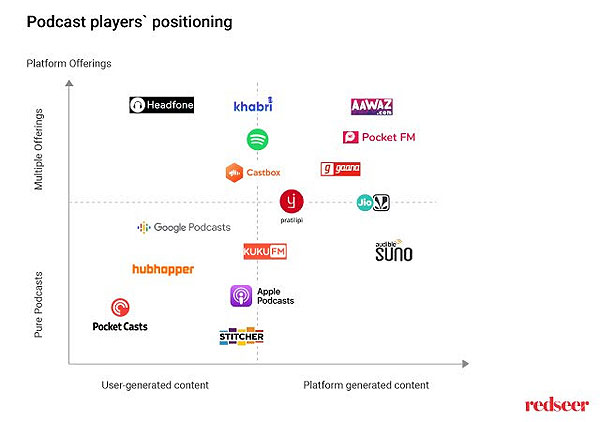
    2. In order to keep the audience engaged platforms are focusing on and generating their own content, high-quality UGC would take longer

    To acquire popularity and keep content development costs low, Indian platforms started with both UGC and PGC models. However, the platform’s ability to preserve brand value and quality is hampered by UGC material. Platforms are increasingly devoting more resources to producing high-quality content and bringing on celebrities to narrate and host shows. Few platforms, such as Headphone and Khabri, are investing in stronger UGC filtering and recommendation engines.


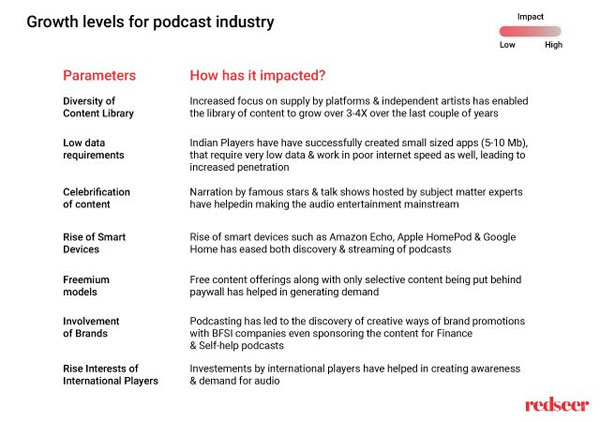
    3. This growth is happening on the back of diversified content, smart devices and low data tariffs

    Indian players have successfully created low data usage apps to deliver podcast content, with diversification around vernacular, and celebrity-driven content. The mix of free and premium models to subscription also allows new users to experiment and consume this new form of entertainment.


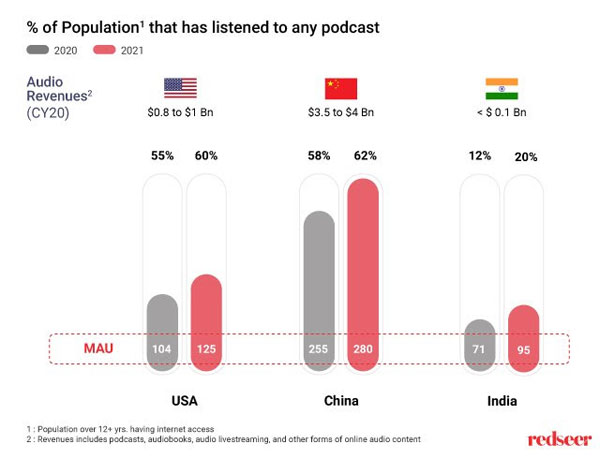
    4. We have seen a 34% jump in the MAU during 2021, capturing 20% of the potential market

    By the end of 2021, India will have 95 million monthly active users, a 34% increase from 71 million active users in 2020. The report also suggests that only 12% of the Indian population has ever listened to the podcast, indicating immense room for growth.


    The newfound popularity of podcasts is attracting advertisers and brands. Platforms with multiple offerings generate the highest traffic. Although players are diversifying into other audio entertainment avenues to increase user engagement & traffic, still podcasts are the major focus for all the players. As India’s internet user base grows with a larger audience warming up to this new entertainment format, the podcast market will unravel in exciting ways.


  • Death of the Niches


    By Shailesh Kapoor


    Shailesh KapoorThe last two years have been ridden with anxiety for the Indian television business. The uncertainty around the pandemic continues, and with all the NTO mess that has been inflicted upon the industry, a general sense of instability prevails, especially in the group of channels popularly called “niche channels”.


    The term “niche channels” came in about two decades ago, to describe channels that cater to specific interests, and hence, cannot be expected to have ‘mass’ viewership numbers. There is no formal definition, and the term is loaded with subjectivity. For example, is a Hindi movie channel that airs only retro films niche or mass? Is the top Punjabi music channel, which garners more viewership than any Punjabi GEC, niche or mass?


    The ambiguity in terminology notwithstanding, the issue with genres outside the Top 4-5 is for everyone to see. English entertainment channels have either shut down or contemplating the same. It’s not just the NTO but also the rise of the paid OTT market that has led to this reality. Core viewer base of English entertainment genre, when it was at its peak about four-five years ago, is far less than the paid OTT subscriber base in India today. Which essentially makes the genre irrelevant. English movie channels are currently in a more favorable position, but it’s not going to be a comfortable one over the next two-three years.


    Music and youth channels have struggled too, for very similar reasons. Audio streaming apps and YouTube are now primary destinations for new music, and channels running old music cannot claim to be offering much beyond digital music options either. It’s a matter of time that we see more music and youth disappear from our TV sets.


    The infotainment genre is facing the challenge too, because of the same two factors: NTO and digital content. So far, they have managed to stay afloat. But the consumption is gradually shifting to the OTT options being offered by the same networks, and it may just be a case of slow death of the linear versions.


    That essentially leaves us with five genres, including their language variants: GECs, Movies, News, Sports and Kids. These genres address a wider demographic, where the rising OTT penetration is unlikely to be a cause of concern anytime soon. These genres are also family-friendly (unlike youth channels, for example), and hence, largely immune to the OTT factor.


    A medium that was known for its variety may no longer be holding that position. The number of channels on your TV may continue to go up, but the number of channel types (or even sub-genres) will not. You can churn a movie library across six (or even more) network channels, but it’s simply more exposure to the same movies. The total viewing time will not drop, but will consolidate around these five genres.


    That’s the nature of a mass medium like TV, in India. It does not go well with the idea of segmentation and niches. It’s more like a one-size-fits-all medium within each language, now more than ever before. Segmenting audience to identify niches from a content perspective may be a sub-optimal, even flawed, approach for a channel operating in any of these genres to take.


    Segmentation is the strength of the streaming medium, where the target audience can conceptually be one in number. This polarisation of approaches is perhaps the single-biggest impact of OTT growth in India. In a way, OTT has shaped Indian television’s immediate future in a definite direction. And big networks should not hesitate to accept this reality, than prolong the agony that their niche offerings in the linear space will have to inevitably face.


  • Anupama: The Rare Hindi GEC Success Story


    By Shailesh Kapoor


    Shailesh KapoorAmid all that’s wrong with the Hindi GEC category (and readers to this column will know that I have a long list), there is an occasional spark that brings some joy. After being the most-loved Hindi GEC character on Ormax Characters India Loves for 39 consecutive months (from July 2018), Jethalal from Sony Sab’s Taarak Mehta Ka Ooltah Chashmah passed on the top rank to Anupama, the titular character from Star Plus’ 2020 launch.


    Anupama, an adaptation of the Bangla show Sreemoyee on the same network, has been a runaway hit, achieving the unthinkable 4% rating mark in urban Hindi-speaking markets in recent months. In a category where a 2% rating is now considered an achievement (though Netflix’s Dhamaka tells you that you lose your job as a new anchor at 70% ratings, which is available live!), Anupama’s numbers have been exceptional. An average Anupama episode doesn’t rate much less than an IPL game, for example. And while IPL airs only 45 days a year, the show has managed to sustain this for several months, six days a week.


    With its multitude of well-etched characters, Anupama is one of the few well-written Hindi GEC shows currently on air. The storytelling is in broad strokes, but the characters and the conflicts are consistently engaging, and there’s enough entertainment on offer too in what is essentially a high-voltage drama of late.


    The casting and the performances are a notch above the operating level of the Hindi GEC category too. And the lead actress Rupali Ganguly has made the character very much her own, layering the portrayal with mannerisms that can possibly not be written on paper. It’s easy to guess that the show’s creative development process has managed to break away from the daily soap assembly line rut.


    If an OTT show would have even been half as good as Anupama, the press and the internet would have gone ballistic singing its praises. But GEC content earns no such respect in recent years. Not that the channels, including Star Plus, have anyone else to blame but themselves. They continue to diss their own category on air, an inexplicable thing to do. “Don’t act like a daily soap mother-in-law” and “There’s always a daily soap running in your house” are just two examples of dialogues (translated from Hindi) that you will hear in some of the top HGEC shows, including Anupama. When a category decides it can write a joke on itself, and the joke does not even come across as a joke but is taken in all seriousness by the audience, you know there’s a lot wrong at so many levels.


    Nevertheless, Anupama deserves even more love. It’s that rare sensible show that can potentially change some people’s perception about Hindi serials, only if it reached them. But the more important question is: Can there be more like it, or is Anupama a one-off? If there’s enough talent in the Hindi fiction television industry to pull off a show as interesting as Anupama, why are other shows so drab in comparison?


  • Endemol Shine elevates Anaya Mohanty

    By Our Staff


    Anaya Mohanty
    Anaya Mohanty

    Endemol Shine India announced the promotion of Anaya Mohanty into the role of Head of Development for Premium Scripted and Non-Scripted, reporting to Abhishek Rege, CEO, Endemol Shine India.


    Mohanty has nearly two decades of experience in the creative field. Prior to joining Endemol Shine India, she worked with Colour Yellow Productions Pvt. Ltd in Marketing for Digital Media and Operations, was a Creative Producer at Eros Now, and producer at CNBC-TV18.  She has also worked as a Creative Consultant, Writer, and Senior Producer on multiple projects.


    Said Abhishek Rege, CEO, Endemol Shine India: “Given Anaya’s experience, I have no doubt she will thrive in this role. In her new capacity, she will play a key role in ensuring we devise and execute a standout premium slate, which garners attention from our network and OTT clients across the county. Quality has always been key to our strategy and in setting this new role, we will continue to commit to delivering in line with this goal.”


  • Woken up, and smelling the popcorn!


    By Shailesh Kapoor


    Shailesh KapoorAfter 20 long months of what seemed like a never-ending wait, Bollywood box-office sprung back to life last week. Rohit Shetty’s Sooryavanshi opened to very good numbers, and has since sustained its box-office run, becoming the first major Bollywood hit since Tanhaji in January 2020.


    There have been hit films in the South languages over the last year, but Bollywood has waited for its turn. And the floodgates have now opened. Of India’s 146 million (14.6 cr) theatre-going population (number of people who visited a movie theatre at least once in 2019, as per Ormax Media’s pre-pandemic report titled Sizing The Cinema), an estimated 47% (69 Million) have already visited a movie theatre at least once since theatres re-opened in October 2020. In the coming weeks, we can expect this number to rise further, and touch at least the 100 Million mark by the end of January, if not earlier.


    It just took one Diwali weekend to debunk the argument that OTT may have killed the movie-going habit. As I walked into a theatre earlier this week, for the first time in 2021, the smell of the popcorn was unmissable, even in a somewhat sparsely-occupied multiplex on a Tuesday evening. In that instant, I wondered if analysts who have been scripting the death of the big screen factored in the rich sensory experience the theatre environment provides.


    The road ahead is not free of challenges. A few states, including Maharashtra, are still on 50% occupancy cap. Multiplex owners and producers are sparring over revenue sharing. Films are going to clash despite release dates being available for both films to come on separate weekends. But none of that takes away from the huge positive endorsement the Hindi audience has given to the cinema halls since November 5.


    Ironically, streaming platforms, who were supposed to be responsible for the doomsday scenario for the theatres, will be one of the biggest beneficiaries of the return of the cinema culture. Big-screen friendly event films like Sooryavanshi will get more audience on streaming eight weeks after the theatrical release, than any direct-to-OTT film will ever hope to get. The stamp of scale that a theatrical film carries makes it reach wider. And these are the films that can pull in new subscribers for the platforms, while the originals are more suited to retaining these subscribers over time by offering them variety.


    2019 saw a gross business of INR 10,948 Cr (109 Billion) at the India box-office, across languages. Can that mark be breached in 2022? Even with headwinds like a weak first-quarter pipeline because of shooting disruptions over the last year and a half, I’d be tempted to put my money on a new record in 2022. In any case, even if it falls short, it will only be by a small margin.


    More power to the movie-going habit. And to the popcorn too!


  • Nannditaa Kothari joins DigiflixTV as COO

    By Our Staff


    Inception Media’s Creative Director Nannditaa V Kothari has joined OTT and short video platform DigiflixTV as Chief Operating Officer. Kothari, a vastly experienced professional in creative and business processes in commercial, television and feature film production, has previously worked with giants like BIG Magic, Viniyard Films, Shashi Sumeet Productions, Endemol among others.


    Said Nannditaa Kothari, COO: “I have joined DigiFlix with a vision to provide wholesome entertainment – where the entire family can sit together and watch a show on an OTT platform. Our platform will have shows  of all genres. With DigiFlix we want to give a fresh perspective to OTT content. So far a certain kind of content has taken precedent and we plan to change that and address the masses in doing so. A large chunk of TV audience have been neglected or rather over looked, those are the audience that we want to cater to.”


  • Ranbir Kapoor inks deal with Tata AIG

    By Our Staff


    Tata AIG General Insurance has unveiled its new campaign “#Trusted Naam, Fantastic Kaam” featuring actor Ranbir Kapoor. The campaign will be spread across digital, TV and OTT platforms. It has been conceptualised by What’s Your Problem.


    Talking about the campaign, Parag Ved, President, Consumer Business, Tata AIG General Insurance, said: “Tata AIG General Insurance has undergone a remarkable evolution and has been on an upward growth trajectory. We have been witnessing a transition in our customer interactions and the way we function. Our digital-first approach, product differentiation and exceptional customer service has helped us built strong connections with our customers. To live upto our trusted name, we carry an added responsibility to stand up to the expectations of our customers.”