FoxyMoron, a digital products and services agency and part of the Zoo Media network, has won the creative digital mandate of the south content, video on-demand and over-the-top (OTT) streaming service giant aha Tamil. The mandate will be handled by the agency’s Bengaluru office.
Prachi Bali
Commenting on the win Prachi Bali, National Head Client Partnerships, FoxyMoron (Zoo Media), said: “After having immense success as a network in the OTT industry, we are exhilarated about the opportunity to collaborate with aha Tamil, one of the biggest players, as they build their audience amongst the new internet users in India. The internet penetration in Tamil Nadu is one of the highest in the country and our work in ‘Naya Bharat’ (our regional content focus at the network) has already seen a positive impact across various industries. With the rising popularity and widespread audiences of regional content in our country, there couldn’t be a better time for our partnership.”
Ajit Thakur
Added Ajit Thakur, Chief Executive Officer, Aha: “There are very few players in the industry which offer you expertise on an industry level, on digital marketing and have the knowledge and bandwidth to understand and help us scale, amongst the Tamil speaking population both in India and abroad. We are glad to have found business partners in FoxyMoron and look forward to a successful collaboration.”
As per the latest Performance Indicator Report (PIR) released by the Telecom Regulatory Authority of India (TRAI), subscription to the private DTH service continues to decline. A comparison between Q4 2021 and Q1 2022 shows a collective loss of 1.6 million paid active subscribers to DTH. It seems the various marketing initiatives introduced by the private DTH operators in 2021 have failed to arrest the slow and steady decline of the subscribers.
The same TRAI report shows that the cumulative active pay subscriber base of the top 13 cable and HITS platforms rose Marginally from 4.58 crore to 4.59 crore in Q12022, while the subscriptions to some other smaller MSOs declined. On the whole, it can be said that there is a stagnation in the subscriptions to cable TVs.
The dark horse in the arena of DTH operators is the DD Free Dish. According to various reports available, increase in number of channels available through DD Free Dish between 2017 and 2021 as well as addition of better-quality channels has doubled its subscribers from 22 million in 2017 to 43 million in 2022. Different Government sources have been claiming that DD Free Dish is the largest Dish operator in India covering more than 25% of the TV viewing households. The growth of users of DD Free Dish presents a totally different picture from the slow decline seen in the private DTH subscriptions. However, we have no clue regarding who are the users of DD Free Dish or what is their demographic profile. We often assume that the use of DD Free Dish is prevalent in the lower income groups in small towns or rural areas, but the actual penetration of DD Free Dish may be quite different from our assumptions.
We need to take into account three additional factors for a complete understanding of the source of TV viewing in India. First is the rapid growth of the OTT market in India; the second is the growth of smart TV sets and the third is the partnership of the telecom operators with the OTT players which are providing the TV viewers with alternative platforms for viewing TV content.
According to the Ormax OTT Audience Report 2021, the Indian OTT space has 353 million users and 96 million active paid subscribers. Most of the TV content is available today through various OTT platforms promoted by the TV Channels. The growth of internet and introduction of smart TV sets have eliminated the need for separate subscriptions to the TV content through Dish operators or Cable TV operators. So, the decline in direct subscription to TV through DTH or cable TV needs to be reviewed along with the growth in OTT subscription and smart TV sets by households.
Today, all telecom operators offer free access to more than one OTT platforms along with their pre-paid and post-paid services. A typical telco-OTT partnership is an ideal example of a symbiotic relationship which allows both parties to benefit. The strategy enables the telecom operator to ensures customer retention and adoption and the OTT players to enlarge the viewership of their content.
However, when we try to get an overview of TV viewership in India, we find that we do not have a complete understanding of the source of TV viewing. It is high time that research organisations provide the Media & Entertainment Industry with a Household Establishment Survey which indicates the type of TV subscription along with the ownership of TV, so that the users of the data get a clarity on the total picture. We have come a long way from the time when such household establishment surveys used to provide information on B&W and colour TV sets. We now need to know about the platform used for viewing TV contents, the type of TV set owned by the households as well as the type of subscriptions made by the household. Both BARC and MRUC should plan for household establishment surveys accordingly.
Zee5 has launched the fourth edition from its knowledge series ‘Zee5 Intelligence Monitor’ offering the latest trends prevailing in the smartphone industry.
The research discovered that more than 50% of smartphone users in the metros are planning to replace their gadget within the next six months, quite a departure from the earlier behaviour where it was triggered from declining handset performance. The post-Covid trend is to grab the latest model; with latest features’ scoring well above price as the key motivator. Consuming the exciting and wide variety of content on OTT apps is another new driver for this upward movement.
Launching the report, Rajiv Bakshi, Chief Operations Officer – Revenue, Zee Entertainment Enterprises Limited, said: “By deep diving into the smartphones segment, we have unearthed amazing new insights on user behaviour which can lead the brand marketers to attract millions of customers eager to upgrade and replace their smartphones. We hope this report will act as a guidebook for marketeers and smartphone brands and serve to be distinctive for the industry at large. Marketers and business leaders can use these findings to make smarter business decisions and hyper-target campaigns utilizing the ZEE5 platform to connect with audience in 12 languages.”
If the naughtiness on earlier seasons often got crass, sometimes downright vulgar (remember the Hardik Pandya show), get ready for some more of it. Since it’s OTT, all of this can work perhaps. Even if it’s Disney-owned Disney+ Hotstar. Crassness – in the garb of edginess – however doesn’t seem to upset the advertising community which shuns toxicity on news channels. While one isn’t criticising the move (god bless them!), a communique reports 100% of its ad inventory for the just-started Season 7 has been sold. The advertisers are some discerning names in business: Ajio Luxe, Bru, Amazon Alexa, BoAt, Only Natural Diamonds, Audi, Jaquar Bath+ Light and MyGlamm. The host is the same: Karan Johar.
Said an unnamed Disney+ Hotstar spokesperson: “The popularity of reality shows has been growing, and as one of India’s longest-running reality talk show, Koffee with Karan establishes new standards with each new season, creating extraordinary excitement and for viewers and advertisers alike. The complete sell-out of the show’s ad inventory is a testimony to this fact, and with Koffee with Karan going Disney+ Hotstar exclusive, it offers a great opportunity for our advertisers to connect with their audiences said a. He further added, “We are thrilled to welcome onboard our sponsors for the latest season of the legacy talk show and are excited to see the response of the audiences.”
Sharp Sight Eye Hospitals has roped in Film and OTT actors Sheeba Chaddha and Shishir Sharma as its new brand ambassadors.
Said Deepshikha Sharma, CEO of Sharp Sight Eye Hospitals said, “This is a great association. Sheeba Chaddha and Shishir Sharma are renowned actors and popular faces who believe in the Sharp Sight ideology. Sharp Sight envisages a world where there is no blindness and will continuously strive ahead to reach out to more people and benefit them through our various programs. With this alliance, we have found astrong voice from both the stars to reiterate our own ideology to a larger audience. Sharp Sight and I, warmly welcome both of them as a part of our family.”
Last week, on June 14, 2022, the final results of the e-auction conducted by the Board of Control for Cricket in India (BCCI) were declared with the Board earning a whopping Rs 48,390 crore for all the packages offered by them for auction. The amount is almost three times of Rs 16,376.5 crore, the money which Star India paid for TV and Digital media rights for the 2017-2022 cycle. This has made IPL the second most valued sports league in the world, next to America’s National Football League pushing English Premier League to the third position.
By now everyone knows that this time Disney Star India has won only Package A containing telecast rights (India sub-continent) for next five years 2023-27 by bidding Rs. 23,575 crore. Viacom18 has bagged Package B containing digital rights (India subcontinent), Package C containing digital rights of 18 matches per season and part of Package D containing media rights (both TV and digital) for three global regions, Australia + New Zealand, the UK and South Africa, the main cricket playing countries whose players have been regularly participating in the IPL tournament. There is some confusion in the market related to the total payment of Rs.23,758 crores made by Viacom 18 to BCCI as lot of people have concluded that the amount has only been paid for the domestic digital rights whereas Viacom18 actually paid Rs 20,500 crore for the domestic digital rights. The media rights for the balance global regions have been won by Times Internet.
Lalit Modi has been getting lot of coverage related to IPL media rights auction this time as cricket historian and author Boria Majumdar timed the release of his book on Lalit Modi “Maverick Commissioner” last week right after the announcement of the winners of IPL’s e-auction for media rights for 2023- 2027. Majumdar also announced that his book will soon be made into a film. Suddenly. media channels are busy interviewing Lalit Modi who is having a field day. At the time of writing, I read his interview on www.mykhel.com where he has said that BCCI should make it mandatory for all IPL franchises to own a women’s team in order to start a Women’s IPL in India. Last week, in an interview to NDTV Sports, he said that value of media rights will double again in next cycle as IPL viewership is probably the highest in the world in terms of people watching the matches (https://sports.ndtv.com/ipl-2022/ipl-viewership-probably-highest-in-the-world-lalit-modi-to-ndtv-3079226 ).
While the Indian M&E industry is still struggling with its overall growth after the pandemic, one wonders from where the growth in the value of IPL media rights will happen? According to the EY FICCI report 2022, digital advertising grew by 29% in 2021 and TV advertising grew by 25% in 2021 which was still slightly short of the pre-Covid 2019 level. TV subscriptions continued to fall in 2021 for the second consecutive year. In the last few weeks of IPL, there was a sharp fall in the TV viewership which had raised doubts about the base rates fixed by BCCI for the e-auction. If any particular media property grows at a much higher rate than the market average for a certain period, it does so at the cost of other media properties in the same media bucket which cannot be sustained in the long run. Only time will tell if the value of IPL media rights based on the current e-auction will be actually attained.
Back in 2016, when Star India won the TV and Digital rights for IPL (2017-2023), a lot of doubts were raised about the possibility of their success in achieving the targets. This time, industry people are speculating more about the winning bid of Rs 20,500 made by Viacom 18 for the digital rights and the implications of TV and digital rights going to two different organisations. The Reliance-backed Viacom18 seems to have played its cards well based most likely on a deep-routed strategy for increasing their market share in online video viewing backed by the huge share of Jio in the telecom market. The introduction of 5G is expected to change consumers’ choice for live viewership of sports events from TV to mobile during this 2023-2027 cycle.
According to an article by Javed Farooqui on Exchange4media on May 7, 2022, London-based Omdia’s recently published report on online video viewing trends shows that in India Disney+Hotstar leads the chart with 41% share. The article also shared the following graphic from the research.
Disney+ Hotstar’s subscription base tripled during pandemic years from 8 million to around 25 million by the end-2020, thanks mostly to IPL’s coverage and the competitive pricing of its annual plan. Omdia believes Disney+ Hotstar will continue to lead the standalone subscription online video market. The same report estimated that online video-on-demand (VOD) subscription market in India reached a value of $639 million in 2020, up by 142% from 2019. Disney+ Hotstar and Netflix together accounted for 78% of the total online video subscription market.
ViacomI8 may be planning to revive Voot with this bid for digital media rights of IPL and may be also ready to write off losses, if any, as part of marketing cost for promoting Voot. With 41% marketshare, Disney+Hotstar was not required to invest proportionately high amount in winning the digital rights of the IPL. On the other hand, Disney Star India has a greater need to protect its turfs in the various TV genres where competition is much stronger.
Ormax Media, a specialised Insights consultancy firm, was established in 2008. In its own words: “Over the last 13 years we have pioneered the usage of various testing, tracking and forecasting-based tools, designed to achieve higher profitability in films, television, streaming, print, radio and other categories in the Indian media industry… We are constantly innovating to introduce new tools and build knowledge that can help the Indian media & entertainment industry use consumer insights and data analytics to create businesses, brands, shows, films and campaigns that are both consumer-centric and profitable.”
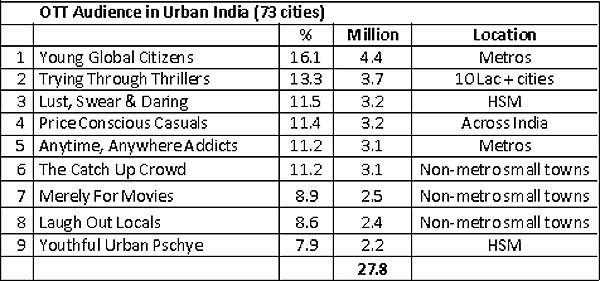
Ormax Media launched the first edition of its Ormax OTT Audience Report 2019 with a promise to conduct similar reports year on year. In its first report, Ormax analysed the viewing behavior by preference of content watched and divided the urban OTT audience into interesting segments of nine different types.
Source: OTT_AudienceSegments_OrmaxMedia__1_.pdf
The onslaught of Covid-19 and the national lockdown forced them to miss the opportunity of conducting field research in 2020. But Ormax was back in 2021 with the 2021 report based on a 12,000 sample size across urban and rural India. As per that report, OTT audience universe in India in 2021 stood at 353.2 million (35.32 Crore) people. In other words, the penetration of OTT viewing was of 25.3% of the population, “which means that one in four Indians watched online videos at least once in the last one month”. The report was aligned to other syndicated media research and presented analysis of the universe by gender, age, NCCS, pop strata, states and cities. This second report elevated OTT from a niche medium to a mass medium with huge prospect for further growth. It was possible to calculate reach of the OTT medium in different target audiences for the first time. The report also revealed that in 2021 there were 353 million OTT users in India of which 40.7 million were paying (SVOD) audiences accounting for 96 million active OTT subscriptions. In other words, each unduplicated paying audience member was subscribing to 2.4 OTT subscriptions on an average. This SOVD audience were dominated by male members who constituted 66% of 40.7 million.
Last month, Ormax Media released TheOrmax OTT Audience Report 2022, which has some interesting insights related to viewing habits of OTT audiences including content watched in different languages. The latest report is based on a sample size of 6,000 SVOD and AVOD audiences in urban India, and is probably India’s largest profiling study of the streaming /OTT audience.
The report has revealed that Indian SVOD viewers use the dubbing and subtitling options on their OTT platforms and watch content in four to five languages on an average, while AVOD viewers watch in at least two languages, primarily due to less content options available to them. AVOD viewers watch a lot of content on YouTube where no dubbed content available.
Content in the four South Indian languages have a large audience outside their home states, 88 per cent Malayalam SOVD content viewers and 82 per cent Tamil SOVD content viewers are respectively from outside Kerala and Tamil Nadu.
This research also has highlighted the difference in preferences for content between SOVD and AOVD audiences. The latter do not prefer to use web series instead they want more of shorter formats, like comedy scenes, songs, knowledge videos, including recipes, education and health, and films.
The research has predicted that the next level of growth of SOVD viewers would come from small towns as 60-70 per cent of the top six metros’ population has already converted to SVOD audience, making the metros a near-saturated market. The male domination of the SOVD audience segment continues which may be due to other socio-cultural reasons and not just financial independence of women.
On the whole, TheOrmax OTT Audience Report 2022 has opened up a new vista of opportunities for content strategy and content creation for the Indian OTT platforms. It is interesting to note that Ormax media so far has not repeated any research on OTT audience in India, but has looked at a new concept for research every year to provide the users in the industry with either better estimates or in-depth insights.
In major research reports, amid all the crucial, perspective-changing insights, occasionally comes a finding that makes you chuckle at the silliness of it. This column is about one such finding.
In our recently-released report on the Indian OTT audience, there’s a section where we quantify the various reasons because of which medium and light AVOD streamers (i.e., those not watching content on any paid platform) do not spend more time watching online videos. This ranking effectively helps OTT platforms understand why Indian AVOD audience have not engaged with digital videos enough to make them consider paying for subscriptions.
Using qualitative research, we identified 11 reasons, and the report ranks them based a large sample quantitative study. The reason right at the top of the list is “can damage eyes”. A staggering 78% medium and light AVOD audience in India believe watching online videos (largely on their smartphones) damages their eyes, and hence, consumption time must be controlled. This reason is 18 percentage points higher in the list than all other reasons, including some compelling ones related to pricing of paid content, cost of mobile data, reservations about sexual and abusive content, etc.
If you have grown up in an average Indian household like me, I’m sure you have been fed this bogey at some point of time in your early years. “Can damage eyes” has been the go-to explanation for Indian parents, to dissuade their kids from watching more television in the 1990s and the 2000s, and then from using the smartphone excessively, for the last decade or so. “You will have to wear glasses all your life”, for example, is a common scary consequence mentioned.
As a heavy TV watcher, I had to hear this every other day, and it didn’t help that I already had glasses prescribed from a very early age to begin with. I believed in the reason for many years. Only in my 20s, I discovered that the consequence I was repeatedly reminded of was only a grand old myth.
A simple internet search on “Does watching TV damage your eyes” or “Does using smartphone damage your eyes” will give you some easy answers. Excessive usage of devices can cause eye strain, but it does not “damage” eyes, or any other part of our physiology, in any way. I’m not endorsing excessive device usage, as there are indirect health consequences that one needs to keep an eye on, pun intended. But the “can damage eyes” reason is simply untrue.
It’s fascinating, then, that such a myth is the top reason for a section of audience, leading to them controlling their consumption of digital video content. The belief that this is true is so deep-seated that you cannot say that parents lie to their kids when they use this argument. They actually believe in it!
As puerile as this finding is, it tells us a thing or two about the Indian audience. We may have progressed rapidly in the digital space, but there are some uniquely Indian challenges that the Indian market continues to pose. It seems this myth existed in the Western markets too for a while, but has become a marginal one over time. But in India, this is a consumption barrier that has direct business impact, on both unpaid (AVOD) and paid (SVOD) streaming businesses.
I almost wish one of the leading players did a tongue-in-cheek campaign to bust this myth. But busting myths created over decades is not easy.
GroupM, the media investment group of WPP, has announced the launch of Finecast in India, a first-to-market addressable TV service that enables advertisers to target households with relevant TV ads across multiple TV channels, pay-TV platforms and set-top boxes, a range of video on demand (VOD) services, over-the-top (OTT) providers, and game consoles.
Said Prasanth Kumar, CEO, South Asia, GroupM: “As the largest media advertising company in the world, GroupM is able to create the scale of partnerships required to find relevant audiences in the fragmented TV landscape. With Finecast, we have partnered the top content providers, broadcasters, platforms and data providers in India to build this market that will inevitably add more value to GroupM’s clients in India.”
EORTV, the LGBTQ+ OTT platform, has named Falguni Shah as Managing Director of its OTT business. Shah will be responsible for the rollout and management of EORTV’s content and revenue. She will also be handling the brand to create awareness for the Indian market.
Speaking on the occasion, Falguni Shah, Managing Director said: “We have a huge responsibility to entertain our audience with relevant content. Also because LGBTQ is a sensitive topic in India, we are catering to the content demand with utmost care taking into consideration the sentiments of our audiences. Content is of prime importance to us. We’ve been building an innovative OTT business which we now plan to further accelerate this year.”
ShemarooMe, over-the-top (OTT) video streaming app, has announced a partnership with BSNL, telecom service providers to penetrate deeper into India. With this partnership, ShemarooMe will be a part of BSNLs newly launched Broadband plan of Rs. 999 where the users will get full access to ShemarooMe and ShemarooMe Gujaratis vast content library absolutely free.
This partnership will help leverage BSNL users to view entertaining content across various categories while ShemarooMe will be able to reach a wider audience. In addition to the access to its vast content library, partnering with ShemarooMe will have several benefits. It includes increasing the ticket price of their sale, increasing their revenue and engagement on their apps, amongst others. ShemarooMe has a strong partnership network with over 50 partners across platforms such as E-commerce, Banking & Payment App, Telecom, OEMs, Media, and ISPs/Broadband, etc.
This move comes as a strategic expansion as the brand gets access to the deeper pockets of India by way of reaching the diverse audiences. In its endeavour to continue entertaining through variety of content, ShemarooMe will offer the best of formats and mediums to consumers to choose from for their entertainment needs. This further strengthens Shemaroos partner ecosystem and brings immediate benefits to users of BSNL.
Banijay Asia, the media company creating premium content for television, films and OTT platforms, has appointed Rajesh Chadha to head the scripted business as the Executive Vice President and Business Head. As a part of his role, Chadha will be responsible for developing the scripted slate for Banijay Asia, building its legacy going forward and taking the organization to its next phase of growth.
Speaking about the new addition to the team, Deepak Dhar, CEO & Founder, Banijay Asia said: ”Innovation and creation is the way forward in the rapidly changing content industry and we are delighted to have Rajesh join the leadership team. His determination and affluent experience in the space will certainly add immense value to our future endeavours.”



 As per the latest Performance Indicator Report (PIR) released by the Telecom Regulatory Authority of India (TRAI), subscription to the private DTH service continues to decline. A comparison between Q4 2021 and Q1 2022 shows a collective loss of 1.6 million paid active subscribers to DTH. It seems the various marketing initiatives introduced by the private DTH operators in 2021 have failed to arrest the slow and steady decline of the subscribers.


 In major research reports, amid all the crucial, perspective-changing insights, occasionally comes a finding that makes you chuckle at the silliness of it. This column is about one such finding.