Tag: OTT

  • Zee5 marks its fifth brand anniversary

    By Our Staff


    ZEE5 marks its fifth brand anniversary. It is celebrating the occasion with a week-long campaign in India titled ‘5xThankYou’ from 13th to 19th February, featuring exciting offers on annual plans, Indian and international blockbusters and exclusive titles.


    Sharing his views on the milestone, Amit Goenka, President – Digital Businesses & Platforms, ZEE Entertainment Enterprises Limited (ZEEL) said: “ZEE5 was launched five years back with a vision to take Zee into its next phase of growth through leveraging the rapidly growing digital ecosystem to bring audiences extensive content choices and enhanced viewing experiences across screens. Today, I am happy to see ZEE5 emerge as India’s largest homegrown multilingual platform and the leading global platform for South Asian content representing the rich linguistic and cultural diversity of the region to the world. The journey has been enthralling with many learnings as we strengthened our presence across international and local markets in the last few years, and our teams have a lot to be proud of. The appetite for digital content with advancements in emerging technologies has catapulted the demand for OTT content, paving the way for us to step into our next phase of growth with a robust content-led digital-first strategy.”


    Added Manish Kalra, Chief Business Officer, ZEE5 India: “As a leading player in India’s OTT industry, we at ZEE5 have helped in expanding the contours of entertainment business over the last 5 years owing to the large appetite of Indians for quality content across languages. We, as a customer focused platform, believe in delivering high quality content for consumers, as well as engage with creators that could propel sector’s growth and address the demands of the culturally diverse and discerning audiences. With innovative storytelling, evolved character arcs, compelling narratives and content that transcends all barriers of languages and geographies we have grown remarkably over last 5 years across SVOD and AVOD. Our investments on content development increased significantly as well, as we strengthened our regional presence making inroads into the smaller pockets of India. Charting the next course for ZEE5, we will focus on producing good-quality stories, enhanced viewing experiences, creative collaborations, and increased choices for our viewers.”


  • Aha OTT unveils expansion plans

    By Our Staff


    Aha streaming service, offering Telugu and Tamil-language content, unveiled plans for expansion in new languages and genres.


    Allu Aravind
    Allu Aravind

    Giving details about the investment, Allu Aravind, Promoter, aha said: “We are happy with the run we’ve had in these three years. We know that aha came in and catered to a gap in the OTT space by offering 100% local content. Today three years since, we are successful in Telugu and we are growing fast in Tamil and I believe the time has come for us to grow further into more languages. I am happy to say that over the next three years, we have a solid plan of growth with expansion into new languages and genres; and to that end, we are committed to infusing Rs 1000 crores.”


    Ajit Thakur
    Ajit Thakur

    Ajit Thakur, CEO aha added: “Today aha is synonymous with 100% local entertainment. We believe within our current markets we have a lot more to offer beyond the films and original series that we have come to be known for. We are committed to making aha a super app for our local audiences, and towards that over the next three years we will offer gaming, news, K-dramas, short form, interactive content, and a host of other features on our platform. In addition, we have also started working on our plans to launch in Malayalam and Kannada.”


  • Are you barking up the right tree?


    With apologies to none at all

    By Vikas Mehta


    Vikas MehtaIndians want free programming. Indians will not pay more for data. Indians buy the cheapest option.

    Jio succeeded because it gave free data for more than six months. Netflix is not doing well because it is not cheap.

    Sometimes, I am amused at such cliches which are used to define success or hide failures. Sure, price is important. Definitely, everyone loves free. But it would be imprudent to define failure or success due to such unidimensional thinking. And, no, Indians are not some out of the world consumers who live by a different paradigm.

    There are two factors here. One is the definition of value and the second is the role of other marketing factors which accentuate the free or cheap story.

    Let’s look at some examples. Netflix which became a household name globally worked on a simple premise. Great programming which is ad-free. The OTT channel invested a huge amount of money into producing independent programme content and dished it out on the back of subscription fees. It was lapped up globally and even in India its numbers initially were impressive. But then after it had reaped the low hanging fruit of urban, English-speaking affluent Indians, it stuttered and spluttered. The reason trotted out was its premiumness. Its subscription cost was Rs 799 per month. Compare that to Amazon Prime which then was Rs 999 a year and Hotstar which was around the same. Netflix was almost 10 times more expensive. To woo the Indian audience, the channel put out a Rs 199 a month mobile phone offer and then reduced that to Rs 149. Other rates were also slashed by around 20-60%. It seems, that barely moved the needle and Netflix subscription in India languishes at around 6 mllion subscribers.

    So, the above statements about Indians and cheap or free etc.

    But that’s barking up the wrong tree. Let’s look at the Netflix product. It has very little programming in Indian languages and the subtitles option relevant for India are only in Hindi and English. According to the 2011 census 46% of Indians claim Hindi to be the first language and 11% claim English to be the same. So, even if we ignore that some percentage of such Hindi speakers may not be comfortable reading Hindi, this means that more than 55% of Indians have a problem with Netflix as a product. And mind you, subtitles is always a compromised product. The bare minimum that Netflix needs to do in India is start dishing out subtitles in at least six-seven more languages.

    This brings me to the second point. There is not much value to pay for a channel whose product to a big majority of Indians is not suitable. Specially, when compared to local competition like Hotstar or Amazon Prime or Sony Liv. Because these, offer something extra too. Some sports like cricket or football or free online delivery which Amazon Prime offers. And of course a deluge of Indian language programmes.

    Indian consumer is not just price conscious but value conscious too.

    What about Jio, you say. Of course, Jio gave free services for about 9 months after launch. But do not forget, it had a great product. Not only was it 4G but Jio was giving it out in spades. Till Jio came on the tariff of all telecom service providers was call centric. So many calls, so many SMSs and a miniscule amount of data per month. A typical post-paid plan which cost around Rs 400 per month would give 2-3 GB a month data. Jio turned it around on its head. It’s launch plan for Rs 149 for 28 days included 1.5 GB a day data and unlimited free calls and SMSs. The price was down by 80% and data had increased by almost 20 times. Was that cheap or was it more value?

    Now let’s look at a category like soaps. This is a category where brand loyalty is tested quite often. And enough brands are available which cover not just all price segments but also all imaginable features and benefits. In the plethora of these brands Godrej No.1 was launched with a high TFM Grade 1 claim. Not an easy differentiation to express but they did a decent job. And they did not stop at that. They discovered a new pricing. Actually, pricing in the garb of an offer. Buy 3 get 1 free. And then they made only these packs available. Value? Yes. Indians love more value for the same price.

    But India is not a large pack market. Sachets have revolutionised the Indian market. So, by making only buy 3-get-1 free packs available was Godrej barking up the wrong tree?

    Actually, it was a classic case of right product with the right pricing, right promotion and also right retail push. Retail push because the retailer now had the opportunity to pocket more money. India being a single unit market, the retailer would break open the pack of four and sell each pack individually. Even if he sold it at a lower price than the MRP he was actually selling one extra pack, the whole value of which was his earning. Not just the margin but actually the selling price. And this was being done by the retailer. So, he was not just happy but would actually push the brand, citing TFM, grade1 soap. And currently I see the brand being sold in large packs only. Sometimes even pack of 8 or 9. It’s not being targeted just at the consumer but at the retailer. It’s value for the retailer too.

    Value and price is fast evolving into a challenge for the brands. Traditional discounts are being traded with value. When one is dealing with aspirational products like say 5-star hotels, it hurts them if they have to offer big discounts during off season or when occupancy is low. If an average room costs Rs 25,000 per night and occupancy is low then the standard way of looking at the situation is to cut prices. For a hotel, at midnight the value of an unoccupied room becomes zero. Their thinking is that instead of zero even if I can get Rs 10,000 then it’s a bargain. Therefore late night deals and sites like booking.com give massive discounts to very late bookings. But Hotels now are changing the game. They are trying to attract a different target, those who aspire to stay at 5-star or want the comfort of a great room but till now cannot afford it. The concept being used is less value for less price. So, the room is available at Rs 15,000 or even Rs 12,000 but the resident cannot use the gym and the swimming pool and of course, no free breakfast. Suddenly, a whole new market opens up for the hotel.

    We Indians are famous for jugaad. But the above sort of thinking where value is redefined, where product is redefined and where new rules are explored is what is redefining jugaad and making  marketing more exciting today. The question that every marketer needs to ask themselves today is “Are we barking up the right tree?”


  • Pandemic: Not the driver of change but the change accelerator


    With apologies to none at all

    Vikas MehtaBy Vikas Mehta


    With the turn of the year, there was a splurge of articles on trends, what awaits us in 2023 and of course life post-pandemic. Trends were being captured and changes were being highlighted. A lot of debate on how life has changed for good and bad post-pandemic.

    So, I reflected on these changes, tried to relate it to my own life and read some researched articles.

    My conclusions however differ than the most. I don’t think there was much change. What though did happen was that a lot of change that had already started, accelerated. Let me explain with a few trends that are being hailed as change due to the pandemic.


    Digital payment: From Wallets to UPI: The UPI phenomena picked up immediately after demonetisation. Wallets, which was what was the first new age Digital Payment method, quickly gave way to UPI. While it grew as it eschewed the perennial problem of cash exchanges including small change, the pandemic accelerated it considerably. Let’s also not forget that UPI payment needs bank accounts and the opening of millions of jandhan accounts enabled even a streetcart hawker to open an account and get a UPI link. And while we talk about the role of jandhan accounts let’s not forget to give due credit to the 4G revolution and the availability of cheaper smart phones in promoting UPI payment. The timing of pandemic was the catalyst which got all these elements together and UPI payments have since ballooned exponentially reaching 782 crore transactions estimated at Rs 12.82 lakh crore in December 2022.


    Online shopping: From novelty to necessity: The miracle of shopping from home had entered our lives more than a decade ago. And the convenience of card payments followed by UPI made online shopping catch on and also achieve penetration in smaller towns. What the pandemic did was to make it a habit. So, when it was not safe to be in a shop or any crowded place online delivery became a preferred mode of shopping. And even the neighbourhood kirana caught on to it. No, every kirana store did not rush to put up a website but they used WhatsApp to communicate availability of the merchandising and whatever offers and promotions were on. These kirana shops facilitated delivery by getting a hired help or even the regular staff, whose workload had decreased due to less footfalls, to do home delivery. So, the concept of online shopping became more acceptable, and more user friendly. But let’s not ignore that there was a huge class of consumers like the government employees who did not suffer a salary cut or loss of employment and whose savings during the pandemic went up as their spending avenues like travel or shopping during holidays got curtailed. As a result, this type of consumer not only picked up the nuances of online shopping but embraced both, the technology and the offers that came along with it. The boom was therefore accelerated. And let’s be sure it has also slowed down. The same consumers are now rushing offline to experience the rush of shopping.


    WFH: From Work to Personal Life. Video conferencing and apps like Zoom were not just in place but they were being used by corporates pre pandemic. The pandemic made them verbs. Zoom, Meet, Facetime etc crossed the threshold of corporate world and became household names. Birthdays, anniversaries, even prayer meetings went online. Housewife groups, student groups, educational institutes, understood to use video conferencing as a mean to not just work from home but to also socialize, do part time work and peddle their interests into small business. Again, here the timing was important. Broadband connections were already being rolled out giving faster internet speeds and affordable prices, which the whole family could use. Suddenly everyone, not just working professionals realized that one need not spend time travelling to work or even to meet someone socially. The need to safeguard their health made an individual realise that what was considered non-negotiable like travelling to work, physical meeting with customers had an alternative. And this available also gave the individuals to indulge in new habits.


    Reels: From a passive receiver to an active creator. Software combined with smartphones and apps like Tik Tok had already whetted the appetite of the youngster to indulge in expressing themselves through videos. The pandemic gave the youngsters time to explore various technologies and software. The allure of fame and instant recognition added to it. Extra time in hand allowed the youngsters to indulge in their creative language and it also helped ignite a deeper connect with technology. Technology moved from an exclusive domain to a more generic domain. It also fuelled more liberal arts interest in areas like film making, music and liberal arts. Tik Tok had already shown the way. Pandemic fueled it to much greater heights


    OTT: Primetime slots to personal primetimes. Time in hand, coupled with more savings, enabled consumer segments like government employees, software engineers etc buying OTT subscriptions. Anyways, movie theatres were shut. TV serials had stopped production so new episodes were not available. These consumers spread their net wide by dipping into the old inventory of OTT channels. Plus, they also started looking at other language programmes which had subtitles. And then, they started taking more than one subscription. As a result the OTT channels which already had good inventory took off. It was not just films or serials it also applied to old sports footage of cricket and international football. It was a win0win situation for both the consumers and the channels. As the consumers opened their wallets the channels started investing in new films or programmes. Pandemic was the rocket fuel for the OTT channels.


    Education: From home tutions to online tutions: Forget the role of edutech companies, private tutions, which seem to be a staple for every middle class Indian child were not only a financial burden but also meant parents having to spend time picking up and dropping their children for tutions. So, when online tutions was tried out by some enterprising teachers, the trend caught on. Even now, I hear of one to one online tutions which involves student getting slots at an unearthly hour of 5:30 am or 6 am. But that is manageable as it involves no travel or getting ready.


    Tourism: From global to local. Local tourism, a trend that had started around a few years back blossomed during the pandemic. Many youngsters in small towns and even metros had started exploring and then organising local tours which featured forgotten heritage, architecture, natural spots and local cuisine. When the lockdown relaxations started, long distance tourism was still a no go but these local tours picked up. Coupled with the fact that these were mostly walking, and gave an opportunity to get away from the confines of homes, I have seen these flourish and thrive almost everywhere.


    Social Media: From gossip to extra income. While social media has fueled enough gossip, innuendos and fake news it has also been used to whet the appetite of work from home housewives or youngsters who channeled their hobbies like cooking or knitting or even worked for social commerce sites like Meesho to earn an extra buck. Even now I come across some students who use Instagram or whatsapp to make some money baking cakes and goodies during festival season. Again, the pandemic enabled these people to use the time available to monetise their hobbies. 

    On a personal level, I saw and experienced some of these explosions. Before the pandemic I would be using Zoom for some business meetings, so as a family we were happy with 4G data plans or using wifi hot spots. But with both me and my spouse working online and my daughter into online schooling, an unlimited data plan backed by higher speeds for video consumption meant that we opted for two broadband plans with the second one as a backup. Online shopping for even daily needs like milk and bread became a habit. My bank statement transactions doubled and tripled due to the increased use of UPI. DTH connection was pruned down to some sports and news channels and Netflix, Sony LIV, Disney Hotstar, Amazon Prime became staple entertainment medium. Zoom became the default verb for any family gathering across countries and continents.

    And when the pandemic struck my mother-in-law in Mumbai, we did tripartite online medical consultation twice daily. The chemist near her house would be sent a list of medicines and nutrients by WhatsApp, his delivery person would place it at the doorstep and we would make UPI payments. Fruits and groceries followed a similar pattern. Even for her food, a tiffin person in her neighbourhood was employed. And finally, a healthcare worker was contacted who physically moved in to tend to her.

    The point to be noted is that many of the abovementioned habits were accelerated due to the pandemic. One would have tried them and adapted them at one’s own pace but the pandemic did not allow the luxury to do so. The pandemic put into perspective the difference between needs and wants and many of the wants became needs. This led to immediate change in habits and trends, instead of a gradual acceptance. And that has made all the difference.


  • Forbes India unveils the first-ever Showstoppers edition

    By Our Staff


    Forbes India magazine unveils the first-ever Showstoppers edition in January, featuring 50 personalities from entertainment and sports whose achievements made them outperformers in their respective fields in 2022. The list of 50 – 20 from films, 15 from OTT and 15 from sports-is unranked and is curated by a jury of experts. The latest issue will be available on stands this week.


    The Showstoppers list is part of a six-cover special edition. There’s actor Alia Bhatt, in one of her first conversations with the media after the birth of her daughter Raha. And actors Manoj Bajpayee and Shefali Shah, have finally got their due, thanks to OTT. The edition also tracks the rise of actor Deepika Padukone as a powerful fashion ambassador. It explores how Smriti Mandhana, the opening batter for the Indian women’s cricket team, is just getting started after notching up quite a few milestones early on in her career. There’s also a profile on how, after thirty years of multiple National Awards, two Oscars and Grammys, AR Rahman continues to push boundaries: As a musician, producer, writer and filmmaker.


    Said Brian Carvalho, editor, Forbes India: “This year we deviate from the familiar script. Sure, we have the celebrities, but along with them, there are up-and-comers from the OTT and non-Bollywood brigade, and sportspersons (not just cricketers), who blazed a trial on track, field, in the boxing ring and over 64 squares.”


    Added Preeti Sahni – COO, Forbes India: “The Celebrity issue is all about mapping milestones and achieving new landmarks of success. This year, we have curated a list of celebrities who are breaking barriers in their fields. Whether it be sports or entertainment, Forbes India has covered them.”


  • The Year of Moving On… from the Pandemic


    By Shailesh Kapoor


    Shailesh KapoorWe are nearing the end of 2022. It was a year when a lot seemed to be going on, in the Indian entertainment business, but not always towards any lasting impact. Mostly then, it was the year of recovery, which saw a semblance of normalcy for the first time since 2019, in audience behaviour and sales figures across domains. It was also a year of mergers and acquisitions, with some big-ticket agreements (Zee-Sony, PVR-INOX, Adani-NDTV, ShareChat-MX Takatak) making the headlines. Such deals can be seen as an indirect outcome of the pandemic, which has fundamentally altered business models of all shapes and forms.


    On the content front, there was less to speak about. Theatres reopened and 2022 will end up being the second-highest grossing year ever at the Indian box-office. But except the highly imaginative RRR and Kantara, the box-office came from the usual franchise-led cinema that’s driving theatrical footfalls globally now.


    The linear television industry has been devoid of surprises on the content front for a while, and 2022 was no different. Some of the better content, then, came in the streaming space, which entered a settled phase post the windfall gains from the pandemic. To begin with, there was more genre variety on offer, with many stories going beyond the staple action-suspense-thriller box. A list of some of the defining shows and direct-to-OTT films of 2022 deserves a piece of its own, in the coming week or two.


    But the streaming industry has its task cut out. Our recently-released OTT audience sizing report reveals that the bigger markets have reached saturation levels on OTT penetration and SVOD subscriptions. The average OTT penetration in the top 20 cities in India stands at a high 72%. While more than half of these are still watching only ‘free’ content, the finding that should set alarm bells ringing is: Among SVOD subscribers, the average number of subscriptions taken has remained exactly the same as last year (2.4 subscriptions per paying subscriber).


    Expecting the (relatively) early adopters to keep subscribing to more apps is, hence, a wishful proposition. The next level of growth for pay platforms can, therefore, come from converting free (AVOD) audiences into SVOD, especially outside the top 6 metros. And this is easier said than done, because neither the content being churned out, nor the audience’s willingness to pay for their entertainment, are aligned to this growth path.


    Streaming platforms have managed to bail out the Hindi film industry for much of 2020-22. As they face growth pressure themselves in 2023, ripples will be felt in the theatrical business too. Early signs of this could be felt this year, when we saw several small films release theatrically, only to legitimize their OTT licensing deals.


    With so much going on (and I haven’t even mentioned sports and news in this round-up), 2023 is unlikely to be short of excitement. Hope the quality of content measures up to all the action on the business front.


  • Agony & Ecstasy…


    With apologies to none at all

    By Vikas Mehta


    Vikas MehtaThe Fifa World Cup is now reaching its crescendo. My social media feed is full of comments on football and I can see lot of angst as the traditional superpowers like Germany, Spain, Netherlands and Brazil have been eliminated. Teams like Morocco or Croatia do not have the same universal appeal and at best are seen as outsiders. But football fans in India have one more angst. The patchy and glitchy coverage of the event in India on the Jio Cinema OTT channel.


    I am surprised at the criticism as I was watching the matches on the Sports18 TV channel and the coverage seemed pretty good. But what really got me puzzled was why were most of the people I know, watching the matches on the OTT channel and why not on the traditional DTH channel?


    Subscribing for a month or even a quarter was very cheap and no connectivity or downloading speed issues to tackle. Turns out from my limited friend circle that not many knew about the TV option and the addiction to OTT is so great that many have actually given up on DTH TV. The reality had hit home.


    Now that I am travelling, I too have started watching the matches on OTT, mobile screen. And to me all seems fine. The glitches about buffering etc have not affected me even though I am in the interiors of Tamil Nadu with some Mandous-related weather issues.


    My biggest disappointment with the Football World Cup, as indeed it was with the T20 World Cup is the lack of interesting World Cup-related commercials. On a global scale, Nike, Coke, Pepsi have launched some interesting commercials. Pepsi has brilliantly used its global stars like Messi Ronaldinho, Pogba etc and weaved in the lingo and feel of the Gen Z with slang like nutmugged etc. It also has a flashes of irreverence, chutzpah and of course football. Living upto the expectations of what Pepsi calls “Generation Thirsty”, the ad is about being thirsty for more. The commercial has got a strong backlash too as it seems to have adopted a lot of Moroccan locales and cultural icons which could be interpreted as Qatari. But I guess with the Moroccans having knocked out Spain and now Portugal and having advanced to the semi finals, this anomaly will be overlooked. Watch the Pepsi World cup ad.


    Expectedly, Coke, which is the official sponsor of World Cup, has come out with a simple yet strong film which stays true to Coke’s global sign-off of ‘Believing is Magic’. Depicting a young girl swept away in a carnivalesque celebration of football, the film stays true to the brand personality of Coke. Watch it here: Coke World Cup


    But Coke has been breaking new grounds of late and it tries to go beyond just advertising. I was therefore not surprised to come across a whole digital campaign which captures a wide range of fans’ devotion for their beloved teams. The ads show the outlandish promises many fans would make if their team could win the World Cup; from getting a tattoo, to shaving their head, to running to work every day—while inviting viewers to share their own promises for possible inclusion in Coca-Cola packaging, digital content or outdoor creative. And Coke is also issuing NFT’s associated with this world cup. Digital Memories that will be for the buyers to own. Watch this: Coke World Cup promise


    The piece de resistance for me was definitely the Nike Multiverse campaign. It has a simple global insight of fans’, in this case two scientists in a lab, debating the greatness of their favourite player, across different eras. And then the whole campaign turns into a science induced multiverse universe where players Mbappe and Ronalidinho (he seems to be getting into an advertising renaissance), are zapped into a multiverse universe to have them play against each other. Soon other employees at the lab weigh in with their favourites, present and past, like the Brazilian Ronaldo, Ronaldo CR7, Alex Morgan, Kevin De Bryun, Virgil Van Dijik etc and the film gets into some crazy football shots with a nice touch of technology. Nike has again outdone itself. Watch the ad. World Cup Nike


    All this makes me wonder why brands like Coke or Pepsi who have a strong presence in India and who splurge a lot on advertising, not show any world cup related ad. Coke is a global sponsor of the World Cup and yet it has no presence in either the TV or the OTT telecast. I understand the winter months low soft drink consumption issue but seriously, the world cup is a brand building exercise, not just an increase in sales time. The winters in Europe are much more severe. I also believe that initiatives like the outlandish promises, will work very well in India. Just yesterday I saw a post from a Bengali friend, who, while moaning the exit of Brazil was also depressed that he will have to go non vegetarian till the end of the world cup. Some outlandish promise or wager, is my guess. So why total silence by the brand during world cup football is beyond my comprehension.


    I did see a Pepsi ad on TV during the matches but it was a rerun of an old “more fizz” ad featuring the more older Salman Khan. Nothing to do with football.


    Byju’s has hired Messi as a brand ambassador for its social cause of education for all. Hyundai is one of the official sponsor of the world cup. Visa is another global sponsor. And Amul is the regional sponsor (whatever that means) of Argentina and Portugal teams. So, let’s look what these brands, who have a strong presence in India, are doing around the world cup in India.


    Byju’s had an ad which I saw a month or so ago which announced the partnership with Messi along with Byju’s being an official sponsor of the world cup. A very forgettable and predictable piece of ad which featured some stock footage of Messi and a few supers announcing from India to the world (whatever that means, again) and Byju’s sponsorship. Shoddy, poor quality and unimaginative. There is a separate long video which uses Messi to talk about the importance of choosing the right coach not just in football but in education too. Interestingly done but it’s a long video which is expected to go viral and not being telecast during the matches. Byju’s Messi Ad


    Amul has gone the same tacky route. Some stock shots of players of each team with a milk splash effect added on. Mind you, these are still shots, not even video footage. There is a bit of a generic milk benefit lyrics added on which rhyme with the name of the team. Sample this. Go go Portugal. Doodh se mile bal. Tasty har pal. Daud aur uchal. Or this one. Amul Khana peena tasty aur proteina. Cheer Argentina. Some really corny stuff with absolutely no production values. It has an interesting thought in its tagline of being the original energy drink. But it has been relegated to just a tagline. Amul had a budget for sponsoring the teams. Amul has a budget for buying media time. But Amul kept hardly any production budget. Go figure. Amul Argentina Regional sponsor


    The auto brand, Hyundai, has followed a global diktat. They are using a global film which is very high on tech with a message of “Beyond Mobility”. The ad is more manufacturer speak rather than consumer benefit or language. Leaves one cold. Watch here. Hyundai beyond mobility


    And Visa is re-unning some old ads which showcase the advantage over paying cash by using Visa cards. Tap to pay with Visa. A network that’s fast, secure and convenient. Seriously? In a world dominated by UPI payment that’s Visa’s competitive advantage? Watch here. Visa India


    Definitely the World Cup ads in India are a huge disappointment. Rather, these are a case of missed opportunity. The brands have missed out on a chance to use the world cup in a creative and engaging way. The plethora of similar looking automobile ads or RBI ads or Mutual Funds sahi hai ads featuring cricketers and film stars are just using world cup as another event where the brands are throwing good money but not creating any impact. It’s just an item ticked off. And that’s really a pity.


    P.S: Ok, I now understand the furore about the Jio Cinema glitches during live telecast. While writing this, I am watching the Morocco vs Portugal match and at half-time for two-three minutes there was nothing happening. Just some shots of the stadiums and some graphics. No commentary, no explanation. And then after 2-3 minutes the match centre came on with a half time report. Very shoddy and unprofessional indeed.


  • Ormax Media releases study to size OTT audience

    By Our Staff


    Media consulting firm Ormax Media has released an audience research to size the OTT universe in India, titled The Ormax OTT Audience Sizing Report 2022. The research, based on a sample size of 13,500 across urban and rural India, was conducted from July to September 2022.


    Ormax Media released select findings of the report, which reveal that the Indian OTT audience universe is currently at 423.8 Million (or 42.38 Crore) people. This translated into a penetration of 30%, which means that 3 out of 10 Indians watched online videos at least once in the last one month. The report breaks this universe by gender, age, NCCS, pop strata, states and cities.


    Speaking about the need for the report, Shailesh Kapoor, Founder & CEO – Ormax Media, said: “India’s OTT audience universe has grown rapidly since 2018, with a boost during the pandemic years of 2020 and 2021. Now that we are in a more settled, post-pandemic period, this annual report is an important reckoner for the OTT industry to understand how their audience base is growing, and where this growth is coming from. Unlike other reports that rely on desk research, this report is based on primary audience research across India.”


    The report also reveals that there are currently 119 Million active paid OTT subscriptions in India, across 49 Million paying (SVOD) audiences, i.e., an average of 2.4 subscriptions per paying audience member. 65% of these paid subscriptions are with male audience. The top 6 metros contribute only 10% to India’s OTT universe but 33% to total paid subscriptions in India. Mumbai, Delhi and Bengaluru, Delhi and Mumbai are the top 3, with more than 8.5 Million active paid subscriptions each.


    Speaking about the findings, Kapoor said: “A large share of the 20% growth in audience base has come from rural India and small towns. The metro cities have reached saturation levels, with more than 79% OTT penetration. Platforms will have to rely on the smaller markets for the next phase of growth. From an SVOD perspective, the most significant finding has been that the average number of subscriptions have remained static at 2.4 per paying user. This data point holds immense strategic value, as it suggests that subscriptions growth will come from more people paying for subscriptions, than the same people paying for more subscriptions”.


  • Rohit Jain appointed new chairman of Digital Entertainment Committee at IAMAI

    By Our Staff


    Rohit Jain
    Rohit Jain

    The Internet and Mobile Association of India (IAMAI) has appointed Rohit Jain, MD, Emerging Markets Asia, Lionsgate, as the new Chairman of their Digital Entertainment Committee for the period of 2022 to 2024. Jain succeeds Amit Goenka, Head of Zee5 Global. Amit Doshi, Head, IVM Podcasts has also been appointed Co-Chair, alongside Rohit Jain.


    Said Jain: “Indian media sector has shown immense potential in the last decade and now the OTT industry is in the spotlight owing to the work that’s happened for the last many years. I would say we are at the cusp of greatness; India truly has the scope of becoming one of the largest OTT markets in the world. It’s looking like we will end 2023 with a whopping 125 Mn OTT subscribers and that’s just the tip of the iceberg. India today is clearly the innovation hub for OTT be it technology, pricing, or content experimentation. This rocket ship has the potential to lead the Indian media and entertainment sector to 2.5 trillion dollars in the next few years. There can’t be a more exciting time to be in this business and I am truly humbled to play a small role in contributing towards the vision of creating a promising digital entertainment ecosystem that will provide access to the best of experiences for all.”


  • Dish TV India launches Watcho OTT plans

    By Our Staff


    Following a successful run on its original content, Watcho is expanding its offering by providing bundled packages of the most popular OTT platforms, thus providing its subscribers with a whole new world of digital content along with the convenience of a single subscription.


    Watcho will offer OTT content from Disney+ Hotstar, Zee5, Sony LIV, Lionsgate Play, Hungama Play, HoiChoi, Klikk, EpicOn, Chaupal, and Oho Gujarati via a single login and subscription model. Additionally, subscribers will also be able to enjoy the massive library of original content including 35+ enthralling web series, Swag (UGC content), snackable shows, and live TV from WATCHO exclusives. DishTV will further enhance its plans as more OTT platforms are in the pipeline to join Watcho to make it a comprehensive entertainment destination.


    Speaking on the launch, Anil Dua, Group CEO, Dish TV India Limited said: “As pioneers of DTH technology, Dish TV India has played a significant role in changing the Indian television landscape. With rapid digitization, evolving consumer preferences, and a paradigm shift in the industry dynamics, we are moving a step ahead by aggregating video streaming apps (OTTs) and thereby expanding  Watcho’s offerings. With Watcho’s new service, we have strengthened our OTT content distribution platform by creating a single subscription gateway that delivers amazing value and convenience to our subscribers. With the introduction of this new services, we intend to make Watcho a one-stop entertainment destination with original content, linear TV and on-demand diverse entertainment anytime, anywhere, and on any screen.”


  • Movies are no longer memory milestones


    By Sanjeev Kotnala


    Sanjeev KotnalaThe movie theatre experience has changed from a multi-week successful run on single screens to weekend success across multiplexes.  From a time people would smoke inside the theatre and even step out to their favourite tea shop during intervals to a highly closed, no concession experience.  Have not seen a song-and-dance or throwing of coins during item numbers or aarti done of the stars because they played god and goddesses in a movie.

    The small single screen slowly kept getting out of the system and the multiplexes multiplying. The movies released in multiple screens survived two weeks with decent runs became the new hit. The print, sound quality, projection, and VFX technology enhanced the experience. However, there has been a shift in audiences preferring to watch movies on TV and over OTT platforms.

    Movies for me have been more than entertainment. Some movie experiences are memorable life milestones. There were set timings, unlike today when you have a show starting every 30 minutes. The whole movie-going task needed planning. It was an event, the main event of that day. ‘First Day, First Show’ was a concept that many collegegoers religiously followed- at least when the movie featured their favourite stars. And the hero-heroines were Hero Heroines, part of one’s fantasies. There were no behind-the-scenes that killed the fun and awe of watching action.

    My life is packed with such milestone movie experiences  in the late seventies and early eighties, when I was in high school or moved to college. What about you?  I wonder why when I have seen so many movies in the last two decades, there is hardly a memorable experience.


    FAMILY OUTING: Hare Rama Hare Krishna, 1971

    I saw Dev Anand’s ‘Hare Rama Hare Krishna’ on the only screen in Lansdowne, Garhwal. Movie outing was a family affair but a rare occurrence. Dev Anand’s movie was considered a safe bet for family viewing. The highlight was Zeenat Aman in the song Dum Maro Dum.


    THE BUBBLY LOVE: BOBBY, 1974

    I was in Class 4 or 5 when it was released. I saw it from the second row of Imperial Talkies, Paharganj, right next to an uncle’s house. I don’t think it was rated ‘A’ and clearly there were no checks on who saw the  movie. One became a fan of Dimple Kapadia for a few years.

    I remember, When we reached home, we were royally scolded and punished because we were missing without informing anyone. But my cousin, elder brother, and I kept the secret.


    THE DIALOGUE LP: SHOLAY, 1975

    You could hear Sholay dialogues played in every community function event. In fact, we could recite the dialogue in sequence.  Kitne Aadmi The, Sardar Maine Aapka Namak Khaya Hai, Toh Tumarah Naam Kya Hai Basanti all iconic dialogues that became part of life. 


    THE RELIGIOUS FEVER: JAI SANTOSHI MAA, 1975 

    Jai Santoshi Maa took smaller towns by storm. It ran for weeks; Women watched it multiple times and did aarti of the screen. I remember going for it with my mother and her friends, sitting in the women’s section of Sharada Talkies in Gorakhpur market, Jabalpur.


    STAR TREK: THE MOVIE FROM SCHOOL, 1979

    At Kendriya Vidyalaya- GCF Jabalpur, the students were taken to the sci-fi movie of its time- STAR TREK. We were packed in to buses and then entered in a three-column to Sheela Talkies premises. The school did take students to a few more movies, but I don’t remember the titles.


    FIRST BOND: THE SPY WHO LOVED ME, 1980

    The Spy who loved me was my first ever James Bond movie. It hit Indian screens in the second half of 1980. I was unprepared for the start. In the beginning, Roger More jumps off the snow cliff and keeps falling for two minutes. I, the smalltown Jabalpur teenager, gaped at the screen, wondering if the hero who had jumped with no apparent precaution and support would die. I was getting ready for a flashback story when suddenly the parachute opened, and I relaxed.


    BROOKE SHIELDS ATTRACTION: BLUE LAGOON, 1981

    Who can forget Brooke Shields, the heartthrob of many? Blue Lagoon, when first released, was rated ‘A’. I had just entered college, and as per the ID card, still a few months from qualifying to watch it. One knew it was a bit easier to watch it at the Empire Talkies, not particular about who was buying a ticket or watching the movie. For Brooke Shields, we watched the movie more than a few times, and that too when we could hardly understand the dialogues, which were in English.


    THE RISKY MOVIE: TEXAS DETOUR 1981

    One bunked college to see it in the afternoon show, which was a safer show with fewer chances of meeting someone. It was rated ‘A’ and had a few shots that were the talk of the young crowd. It was an easy-to-follow movie; anyway, language was not a barrier, as sex needed no language. And trust me, there was equal fun in watching a movie that you were not supposed to watch and planning in such a way that you were not caught watching the movie.


    LOVE IN AIR: LOVE STORY & EK DUJE KE LIYE, 1981

    The two movies were released within six months of each other. After watching ‘Love Story, I became a big fan of Vijyeta Pandit. Her poster and pictures were on the walls, and I must have seen the movie Love Story eight-nine times. Looking back, it does seem silly.

    Ek Duje ki leye’ meanwhile became the trivia question at the ragging in engineering college. The question was simple, who plays the role of Madhavi’s brother. And the person who knew the answer had no option but to slap his batchmates hard, or the senior would hit him, demonstrating how hard slaps are delivered.


    COMEDY CROSSFIRE: BLAME IT ON RIO, 1984

    I saw this movie twice. Once in 1984, when it was released in India and after many years on a VHS. From the first time, I had a sketchy memory of the story. I was in the theatre not to see the movie but to have a private time with someone in my life. We were in the couple’s balcony at Empire Talkies, the opera-styled twin-seat balconies with independent access. There was no better private space for young adults in Jabalpur.

    This was also the day my elder brother decided to bunk college and watch the movie. In that single screen theatre with a semi-circular structure with posters of coming shows, my brother and I came face to face. He caught me. But after the movie, I reached home earlier than him and told my mother that bhai bunked college to see a movie. There was no reference to me being at the movie. So, when he came home, he was scolded for bunking college, and I stood innocently denying I was at the movie. The argument: if I also bunked and watched the movie: would I be telling- won’t I plan with Bhai that no one knew. The argument held its ground, and I was saved while bhai got a earful.


    THE LAST MOVIE WITH FATHER: LAMHE, 1992

    I do not remember seeing many movies theatre with my father other than a few like Jai Santoshi Maa and Har Har Mahadev. So, Lamhe we saw in 1991 in Odeon in Connaught Place, Delhi, was a new experience. My wife, my father and I watched this uncomfortable storyline that I believe was much before its time. Today, it would have been a blockbuster, and it was the 10th biggest success of 1991 and did decent business abroad.


    THE HAIRLINE FRACTURE: KAMOSHI, 1996

    My wife, my four-year-old son and I went for the late-night show at PVR, Vasant Kunj, New Delhi. We reached a bit late when the hall was already darkened. While searching for the seat, my wife twisted her ankle. I spent most of the time outside pacifying my son who had decided to cry. The next day as her ankle was swollen, we met the doctor to realise there was a hairline fracture.


    NET-NET

    I have seen many movies at the theatre. Some months as a family we saw four-five movies, but they were just movies, pure entertainment- if I can use that term. As luck would have, nothing happened outside the movie that would make it a milestone, an episode remembered for something more than the movie.

    How many of your movie outings have side memories to make them milestones and a memory which is more than the film.


     

  • ‘61% watch online video content like YouTube/OTT on their mobile/home TV’


    By Our Staff


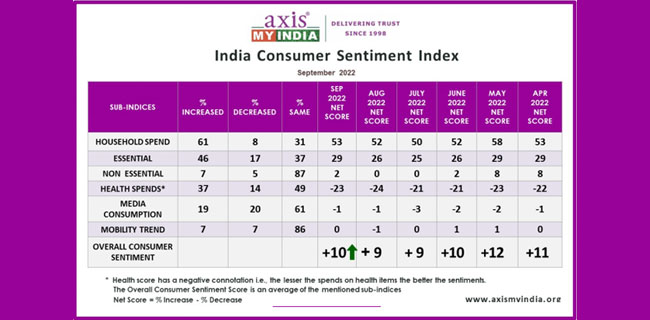
    Axis My India, the consumer data intelligence company, has released its latest findings of the India Consumer Sentiment Index (CSI), a monthly analysis of consumer perception on a wide range of issues. The September 2022 report highlights that 20% are planning to shop more this festive season. On media consumption 61% mentioned that they watch online video content either on their mobiles or connected TV. 32% mentioned that they notice advertising on TV, followed by digital (26%). An interesting observation was on app usage, on an average there are 9 apps on the mobile phone of a smartphone user.


    The September net CSI score, calculated by percentage increase minus percentage decrease in sentiment, is at +10, from +9 last month reflecting an increase/decrease by 1 point


    The sentiment analysis delves into five relevant sub-indices – Overall household spending, spending on essential and non-essential items, spending on healthcare, media consumption habits & mobility trends.


    The survey was carried out via Computer-Aided Telephonic Interviews with a sample size of 10014 people across 32 states and UTs. 68% belonged to rural India, while 32% belonged to urban counterparts. In terms of regional spread, 23% belong to the Northern parts while 24% belong to the Eastern parts of India. Moreover 29% and 23% belonged to Western and Southern parts of India respectively. 59% of the respondents were male, while 41% were female. In terms of the two majority sample groups, 32% reflect the age group of 36YO to 50YO, while 31% reflect the age group of 26YO to 35YO.


    Commenting on the CSI report, Pradeep Gupta, Chairman & MD, Axis My India, said “After compromising past two festive seasons to the pandemic and its related constraints, this year consumers are expected to shop more during festivities. One can witness slight increase in expenses across essential and discretionary products already. Further improvement in mobility sentiments highlights the fact that more and more people are enjoying the stores and malls experience of discovering, shopping and gifting. This sentiment is also extended among the Indian farmers, wherein a significant percentage of 15% intends to buy a brand new tractor in the next one year. This is thus a crucial time for the Indian advertising business as spend are expected to bring a lot more returns than usual. As more and more people (61%) are watching online video content (YouTube/OTT) on their mobile/home TV and thereby noticing ads across TV, online and social media platforms, it is of utmost importance for the media industry to tap the right medium for addressing differentiated consumer needs.


    Key findings:

    • Overall household spending has increased for 61% of families which is the same as last month. The net score which was +52 last month has increased by +1 to +53 this month

    • Consumption of media remains the same as last month, which is 19%. The overall, net score, which is -1, this month, also remains the same

    • Mobility has increased for 7% of the families, reflecting an increase of 1% from last month.

    • Spends on essentials like personal care & household items has increased for 46% of the families which is an increase by 1% from last month. The net score which was at +26 this month has increased by +3 to +29

    • Spends on non-essential & discretionary products like AC, Car, and Refrigerator has increased for 7% of families which reflects an increase by 1% from last month. The net score which was at 0 last month has improved to +2 this month. This could reflect the spirit of festive season approaching.

    • Consumption of health-related items has increased for 37% of the families, which reflects a decrease by 1% from last month. The health score which has a negative connotation i.e., the lesser the spends on health items the better the sentiments, has a net score value of -23, as compared to -24 last month.


    On topics of current national interest:

    • In an attempt to understand consumer’s engagements with mobile apps, the survey discovered that on an average consumers have 9 apps on their smartphones. 16% use minimum of 4-8 apps, through their smartphone and 22% have more than 8 apps. A significant 24% mentioned that they use a feature phone

    • In order to understand in which medium advertisements get noticed more, the survey found out that a majority of 32% notice advertisements on TV, while 26% notice it through online mediums. It also discovered that only 17% notice ads on social media platforms, 15% on Print, 6% on Outdoors and 2% on Radio.

    • The survey further revealed that a majority of 61% watch online video content like YouTube/OTT on their mobile/home TV.

    • Digging deeper into the festive spirit, the survey shows that 20% plan to shop more this festive season compared to last year. However 32% plan to shop the same as last year

    • According to Axis My India Consumer Sentiment Index Survey, 48% of consumers shop/purchase more products during the festive season as compared to rest of the year

    • Exploring farmer’s sentiments towards new tractors, the survey found out that 10% are planning to purchase new tractors in the coming year, while 3% and 2% plan to but within 6 months and 3 months respectively. Also, a significant 86% of farmers don’t own a tractor, because of reasons like smaller land size, renting or affordability.