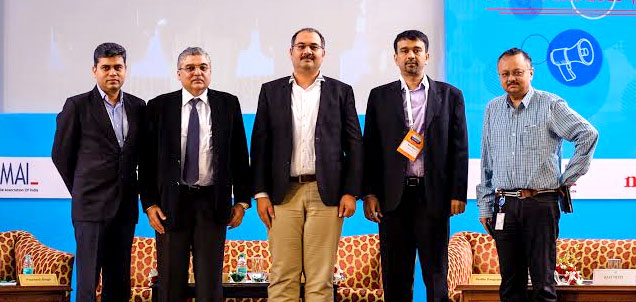
The Internet and Mobile Association of India (IAMAI) has named Kunal Shah, Co-founder & Chief Executive Officer, FreeCharge as the new Chairman of IAMAI. The move was necessitated following Nishant Rao’s move to join Freshdesk as the global Chief Operating Officer, from Linkedin.
The Association has also announced Vishwas Patel, Chief Executive Officer – CCAvenue as the new treasurer. Vinodh Bhat, Co-founder, President & Chief Strategy Officer at Saavn remains the Vice-Chairman of the Association.
Vinodh Bhat is a serial entrepreneur, who co-founded Saavn, which is a revolutionary streaming music service, reinventing how people listen to and share music, in India and around the world.
UCWeb, India’s leading mobile browser with an over 54% market share, said e-commerce traffic during the Diwali shopping season surged a whopping 75.5% this year.
“The number of users who visited e-commerce sites Flipkart, Amazon and Snapdeal via UC Browser in the month leading to Diwali 2015, increased over 75% compared to last year,” Kenny Ye, Managing Director of UCWeb India, said Thursday.
Parent UCWeb Inc, which is a leading provider of mobile internet software and services, is a business within Alibaba Group’s mobile division.
“Indians are increasingly embracing shopping on-the-go, splashing out on various items through mobile shopping during festive sales. There’s no doubt m-commerce is prospering,” he added.
A big portion of users eventually placed orders on Amazon via UC Browser through the campaign, the company said in a media statement.
Popular items including lifestyle products such as electronics, ethnic and fashion apparel as well as household products that received most visits contributed to the vast majority of total page views.
According to UCWeb India, the traffic upsurge reflected the public perception of Diwali in the age of e-commerce. “As e-tailer giants rolled out sales promotions to usher in the festive season, UC Browser and Amazon India also joined hands distributing coupons and vouchers to users through a #HarGharUCDiwali campaign launched exclusively on UC Browser,†the company said.
The two-week long shopping carnival eventually saw over 17 million users coming on board trying their luck for coupons and vouchers.
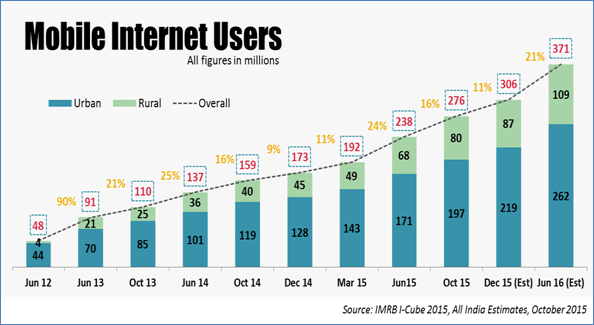
According to latest reports by IAMAI and IMRB, mobile Internet users in India are roughly at 306 million, up from 276 million in October this year. The number of mobile users who shop via their smartphones has also seen a steady rise, with 75% increase in e-commerce traffic throughout Diwali shopping season.
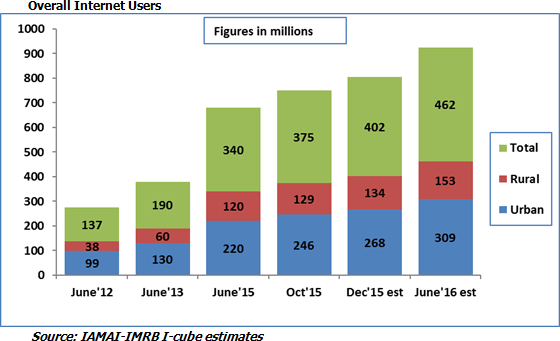
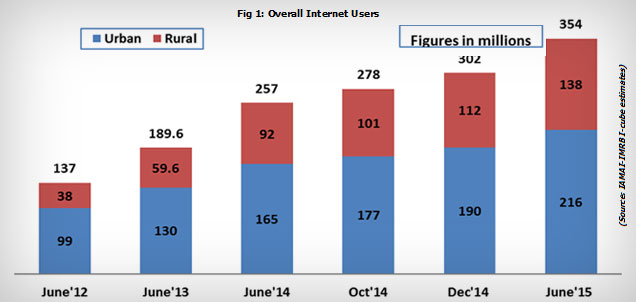
The number of Internet users in India is expected to reach 402 million by December 2015, registering a growth of 49 per cent over last year, according to a report ‘Internet in India 2015’, jointly published by the Internet and Mobile Association of India (IAMAI) and IMRB International. While Internet in India took more than a decade to move from 10 million to 100 million and 3 years from 100 to 200 million, it took only a year to move from 300 to 400 million users. Clearly, Internet is main stream in India today. And the large internet users base is definitely a good news for the overall growth of the digital industry.
In October 2015, there were 375 million internet users in India. Currently, India has the third largest internet users’ base in the word but it is estimated that by December, India will overtake the US as the second largest Internet users’ base in the world. China currently leads with more than 600 million internet users. This makes India the second largest internet user’s base in the world behind China, but is ranked first as the largest internet users in a free market democratic setup.
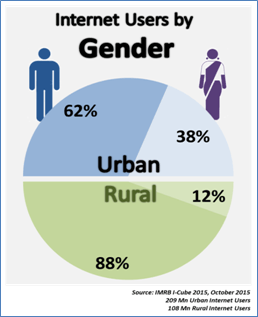
According to the report, 71 per cent male and 29 per cent female are Internet users in India. The Internet usage among males has been growing at a rate of 50 per cent while it is growing at 46 per cent for female users. However, in Urban India, the ratio between male to female Internet users is 62:38. Significantly, Internet users among females are growing at a rate of 39 compared to 28 per cent among males.
Among the Rural Internet users, 88 per cent are males. The Internet users among females are growing at 61 and 79 per cent among males. 75 per cent of the rural internet users belong to the age group of 18-30 years. Another 11 per cent are in the age group of <18 years, while 8 per cent belong to 31-45 years age group.
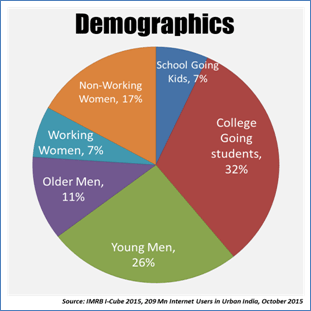
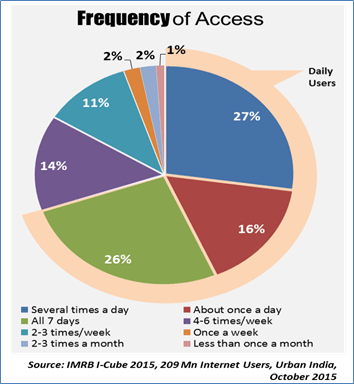
Significantly, there has been a huge spurt in the number of people accessing internet on a daily basis in Urban India. As on October 2015, 69% of Users are using Internet on a daily basis. This daily user base has gone up by 60% from last year. However, the high frequency usage is not restricted to only the youth and the College going students; this habit of accessing the Internet daily can be seen among other demographic segments as well including Older Men and Non-Working Women. 75% of the Working Women access Internet daily. 37% of the male internet users are daily users whereas only 23% of the female internet users are accessing internet daily. 75% of internet users among both genders access internet at least once a week.
The findings of the report further reveal that in Urban India, Mobile Internet user base has grown at a rate of 65% over last year to reach 197 million in October 2015. The Mobile Internet Users have surged to 80 million by October 2015 growing at 99% over last year. The user base of Mobile Internet users in Rural India is expected to reach 87 million by December 2015 and 109 million by June 2016.
Interestingly, the report also reveals that out of all the Internet non-users surveyed in the 35 cities as part of this study, 11.4 million Non-Users are willing to access the Internet in the next one year and over 2/3rd of them intend to do so through mobile phones.
The Internet and Mobile Association of India [IAMAI] believes that the year 2014 was the year of internet and is of the firm view that internet has reached an inflection point. The consolidated numbers taken out by IAMAI for FY 2014 affirms the fact that internet in India has now becoming inclusive, which augurs well for the industry and society at large.
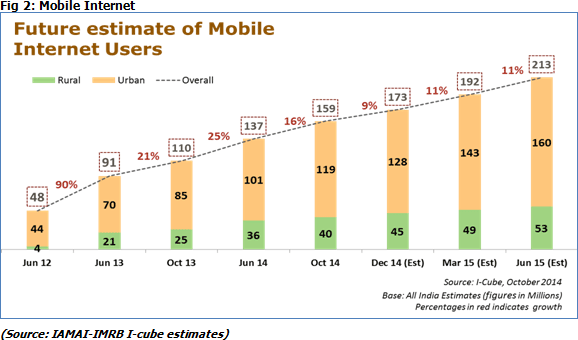
The Mobile Internet in India also witnessed significant growth rate. If the following chart is anything to go by, the future of Mobile Internet in India is set to growth at an exponential rate. India had 159 million mobile Internet users as on October 2014. Out of this, 119 million users were from Urban India and the rest 40 million were from Rural India. There has been a growth of 45% from October 2013. Mobile Internet users reached 213 million by June 2015.
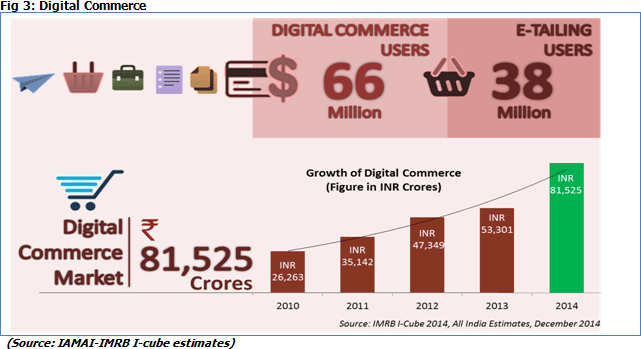
The impact of internet penetration has seen a huge spurt in Digital Commerce. The digital commerce market was valued at INR 81,525 crores by the end of December 2014, and registered a growth of 53% over 2013. According to IAMAI-IMRB estimates, the industry is estimated to grow further at a rate of 33% and cross INR one lakh crores by the end of 2015.
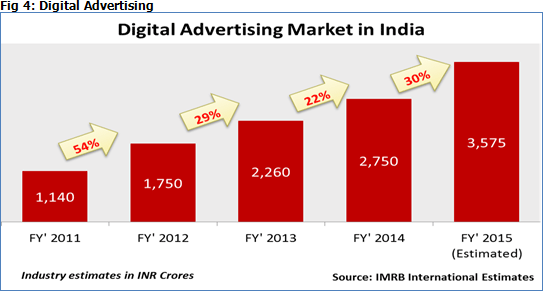
Digital Advertising has also been witnessing a steady growth. The online advertising market in India was projected to reach INR 3,575 Crore by March 2015 with a Y-o-Y growth rate of 30%. The online advertising market was pegged at INR 2,750 Crore in March 2014. Search and Display are the top two contributors to the total Digital Advertisement Spends in India. Of the INR 2,750 Crore Digital Advertisement Market, Search ads constitute 38% of the overall ad spends followed by Display ads which contribute 29% and Social Media contributing 13% of overall Digital Advertisement spends.
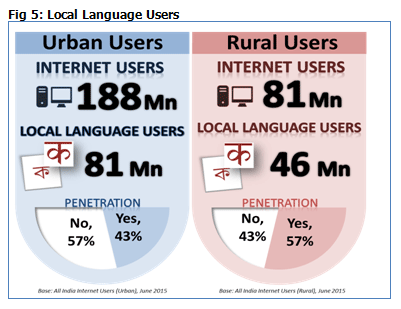
IAMAI has also said that increase in local language content on the Internet will lead to a growth of 39% in the current Internet user base. Rural India will be the primary driver of this growth (75%) while in Urban India, the growth will be 16%. The local language user base is growing at 47% Y-o-Y to reach 127 million in June 2015. IAMAI believes that the next set of internet users will come from rural India and the availability of local language content on internet will be the key for the growth of Internet industry in India.
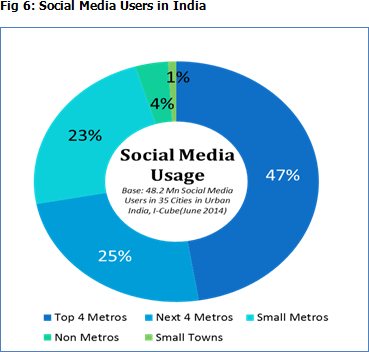
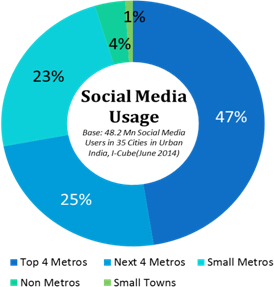
Data on social media users also reflect that the usage of Social Media in Rural India has grown by an impressive 100 percent during the last one year with 25 million users in Rural India. On the other hand, Urban India registered a relatively lower growth of 35% with the total number of users at 118 million as on April 2015. According to IAMAI and IMRB estimates, there are 143 million social media users in India as on April 2015. The report also finds that the top 4 Metros continue to account for almost half of the Social Media users in Urban India.
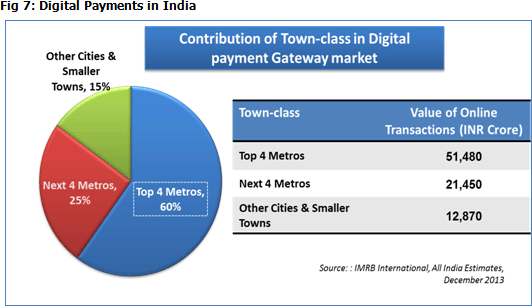
The digital industry is also buoyed by the fact that the digital payments industry is maturing at a fast clip. The digital payments industry grew at a rate of 40% to reach INR 120,120 crore by December 2014. The digital payment industry was pegged at INR 85,800 crore in December 2013. The report finds that the top 4 metros which include Delhi, Mumbai, Kolkata and Chennai are approximately 60% of the total Digital payment gateway market size. Next 4 metros – Bangalore, Hyderabad, Ahmedabad, Pune together contributes only 25% to the total market size.
In its recent response to the DoT paper on Net Neutrality, the Internet and Mobile Association of India [IAMAI] has clearly and unambiguously opposed zero-rated plans of any type. In its submission made last week IAMAI has held that “these plans will ultimately harm Internet content and service providers by limiting competition among them, and, by extension, limit consumer choice”. Such plans will also “allow the operators, if given control of which apps/services to push to consumers, to discriminate and privilege certain web services over others, and throttle innovation”. The association has also reiterated that it does not support any plans that violate principles of net neutrality “especially paid or unpaid prioritization or other discriminatory practices”.
IAMAI has also reacted strongly against the proposal to license domestic and national VoIP, as suggested by the DoT paper. The association contends that such a regime will be directly against consumer interest and against future innovations. The association contends that licensing any domestic and national Internet based voice communications services would be impractical especially since such services in many instances are offered as bundled services. The association also feared that licensing one type of internet service may be the beginning of a “slippery slope” and may lead to a clamour for so called “same service same rules” for other internet services.
The association has also cautioned that while traffic management is a technical right vested with telecom operators, this right should not be misused to charge customers differentially for different types of data. Technical requirements of traffic management should also not be used to promote operators own services at the cost of other services, the association cautioned.
Internet and Mobile Association of India [IAMAI], in a press statement has said that the latest Government notice dated August 4, 2015, to the Intermediaries (ISPs) is vague and has led to a chilling effect.
The notice states that the intermediaries (ISPs) are free not to disable any of the 857 URLs, as provided in the list earlier, which do not have child pornographic content. However, the problem is with the caveat in the notice mentioning “which do not have child pornographic content.â€
The problem is that the said notice is not accompanied by any specific list of sites or links and the Intermediaries (ISPs) are expected to find out the links or sites containing child pornography themselves. This is not how it works under the law. The correct procedure should have been to provide the Intermediaries (ISPs) with a specific list along with the notification, as was done in the earlier notice dated July 31, 2015.
The ISPs have rightly asked the Government to withdraw the notification. The ISPAI letter states: “We urge you to withdraw the said vague directive as it is not only confusing, but also putting responsibility on ISPs of the website on which ISPs does not have any control.” However, they are wrong in saying “But till further directives, the said 857 sites will continue to be blocked.â€
India is projected to have 23.6 crore mobile internet users by 2016, and this will leapfrog to 31.44 crore by 2017. This was reavealed in a report by the IAMAI & KPMG “India On The Go – Mobile Internet Vision Report 2015â€.
The report also points out that India will have over 50 crore internet users by 2017. As of June 2015, internet users in India stood at over 35 crore. According to the report, 2G user base in India is projected to decline in the coming years as more and more customers are expected to migrate from 2G to 3G. The 3G user base in India is rapidly gaining market and is projected to grow at a CAGR of 61.3 per cent from 2013-17. There were approximately 8.2 crore 3G subscribers in India by the end of year 2014 and the number is projected to reach 28.4 crore by end of year 2017.
Commenting on the release of the IAMAI-KPMG report, Ashvin Vellody, Partner – Management Consulting, KPMG in India said, “With more than 30 crore internet users, India has the second largest internet user base in the world. But the internet penetration at 19 per cent (approx) is poor and limits the potential. The next wave of growth in penetration of internet will driven by adoption of mobile internet. The mobile internet growth story would be written by the large population in the hinterland and meaningful and compelling content/ use cases would enable adoption of mobile internet.†He further stated, “It is imperative to connect Indians through internet of which the mobile internet will play a key role since reliable accessibility will be the killer app that will bind the internet ecosystem together, increase adoption and enable innovation in business models around voice and data services.â€
Speaking at the launch, Dr Subho Ray – President IAMAI reiterated that growth in the internet space will come from the non-metro and rural areas. He said, “While the urban market has not reached its saturation point, it will be non – metros and rural India that will be driving internet growth in India. And this is where mobile internet will be playing a pivotal role. The advent of low cost smartphones coupled with low mobile tariffs has empowered consumers in the hinterland to use data connectivity and we will seeing more usage of internet from these areas in the months to come.â€
As per the Report, rural India is steadily moving towards a more Internet friendly and exploratory mind-set. As of 2014, the Active Internet User (AIU) base in rural India was 6.7 per cent of the overall rural population of 90.5 crore and accounted for 61 million users. 4.4 per cent of the total rural population used a mobile device to access the Internet; a figure that stood at a meagre 0.4 per cent in the year 2012.
The Report has found that the rural growth story in the coming years will likely be written by 2G technologies. 3G and 4G may continue to be primarily an urban phenomenon for the next few years. Increased Internet enabled device penetration, decreasing handset prices and data plans tariffs are helping to create a suitable environment for a rapid growth of Mobile Internet in India, with rural India set to take the lead. As of June 2014, nearly 50% of the AIU in rural areas accessed Internet using mobile phones, Community Service Centers (CSC) and Cyber Cafes. 38% of the Active Internet Users use Mobile phone as the main access point.
The Mobile Marketing Association (MMA), the leading non-profit trade mobile marketing association, has announced the appointment of Preeti Desai as Country Manager in India. The MMA serves the growing mobile marketing ecosystem in India with support from GroupM, in a collaboration that was recently extended for the third year running.
“The MMA currently leads the growth of mobile marketing and its associated technologies in Singapore, India, China, Indonesia, and Vietnam,†said Rohit Dadwal, Managing Director, Mobile Marketing Association APAC. “Preeti’s appointment marks MMA’s continued commitment toward building and implementing mobile marketing best practices in India. Her solid industry experience, and vision will be crucial in helping us pave the way forward for the mobile industry in the country.â€
Some of the MMA’s priorities will include increasing the adoption of existing MMA Best Practices and Guidelines; recommending adaptations for local market conditions where appropriate; promoting education and skills development for practitioners; and developing suitable measurement metrics and tools for the industry. Preeti Desai’s appointment as country manager for India is a step toward ensuring that all players in the mobile marketing ecosystem get adequate support.
Desai joins the MMA after a stint at Rediff.com India where she was Vice President Strategic Alliances, evangelising the spliced TV advertising opportunity to the leading SME’s across sectors and geographies. Between 2004 and 2006, Desai was the Founding President of the Internet and Mobile Association of India, working with industry and government stakeholders and end users to address key industry challenges, raise awareness of Internet and mobile effectiveness, and set up industry standards and benchmarks.
The MMA has also announced the return of its two flagship events, MMA Forum India and the Smarties India Awards taking place on September 16, 2015.
Usage of Social Media in Rural India has grown by an impressive 100 percent during the last one year with 25 million users being recorded in rural India. On the other hand, Urban India registered a relatively lower growth of 35 percent with the total number of users at 118 million as on April 2015. According to the Social Media in India 2014 report by the Internet and Mobile Association of India [IAMAI] and IMRB International, there are 143 million social media users in India as on April 2015.
The report also finds that the top 4 Metros continue to account for almost half of the Social Media users in Urban India.
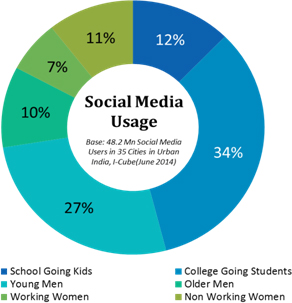
According to the latest report, the largest segment accessing Social Media consists of the College Going Students with 34 per cent followed by Young Men at 27 per cent School going children constitute 12 per cent of the social media users. College Going Students and Young Men still form the 60 per cent of the Social Media users in Urban India.
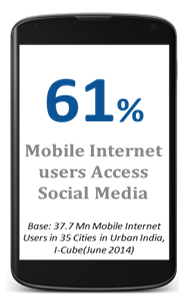
The report further finds that 61 per cent of these users access Social Media on their mobile device. The fact that almost two thirds of the users are already accessing social media through their mobile is a promising sign. With the expected increase in mobile traffic the number of users accessing social media on mobile is only bound to increase.
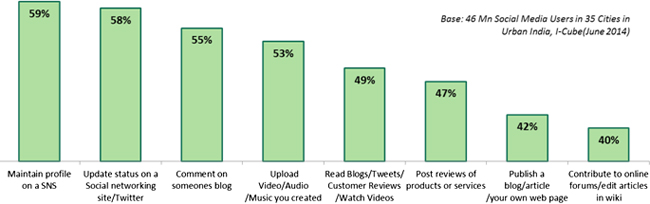
According to the report, maintaining a profile on social networking sites are a top activity of users followed by updating status. Commenting on a blog site is the third most popular activity among users in social networking sites.
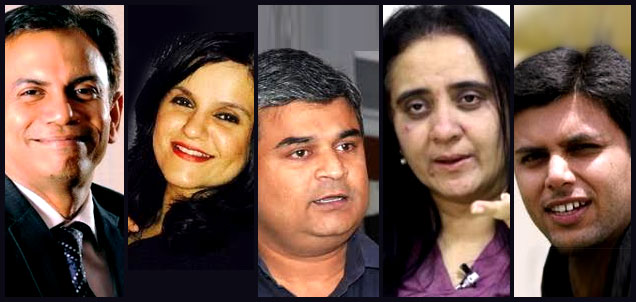
L to R : Sanjay Tripathy, Uma Talreja, GK Suresh, Anuradha Narasimhan and Chinmay Bajpai
By Dyanne Coelho
At the Internet and Mobile Association of India (IAMAI)’s marketing conclave last week, industry stalwarts delve into the topic of ‘Untangling Marketing Convolutions’. In this digital era, the role of the chief marketing officer (CMO) has expanded at a fast pace and it now requires him or her to act as the Digital Media Officer, Customer Experience Officer and Chief Content Officer all rolled into one. The CMO’s role is no longer about just creative skills, but about being able to crunch data and interpret and analyse the behavioural patterns and buying habits of consumers. Dinesh Mishra, Partner – Advisory Services and Customer Practice Leader (India), Ernst & Young, who moderated the discussion said: “The speed at which the CMO needs to react is increasing gradually. The CMO is enjoying his/her role in an organisation, as compared with other C-Suite roles. About 44 per cent of senior leadership says the CMO cannot strive without big data. By 2020, the CMO will spend more than the CIO on IT.â€
Now, let’s hear it from the CMOs.
Chinmay Bajpai, Head – Enterprise Sales and Alliances, Thoughtbuzz
It is important to understand that a marketer is more connected to the consumer. Hence, he or shee needs to be more connected to the CIO to get consumer details from IT systems. The customer experience design has always been important. Before, the customer never had a voice after he purchased the product. That has changed with the digital era. We cannot rely on just customer service teams any more. Today analytics have to move beyond the product to the consumer. That’s where the skillsets of technology partners have to be imbibed by CMOs.
Anuradha Narasimhan, EVP – Sales and Marketing, Global Consumer Products
I don’t believe the CEO is the stakeholder for the CMO. The CMO-CIO relationship is the youngest in an organisation. The partnership with the CTO is yet another new one. The consumer is no longer a passive participant in the process. The customer experience design is not a new thing for the CMO role, it has always existed. The customer experience has always been the focus. The CMO needs to be like the conductor of an orchestra, someone who leads it. Then, it won’t matter who plays in the orchestra as long as s/he is a specialist.
GK Suresh, Head of Marketing – Foods Division, ITC Limited
I don’t believe that the CMO will spend more than the CIO. As a marketer I have to know my consumer, even if that means spending the entire day with the consumer at his/her house. I would say invest in the consumer rather than on technology. A lot of communication going into the digital space is unsupervised. I don’t know if youngsters should be handling digital. It’s as good as saying that a housewife watching TV seven hours a day should make TV ads. The fundamentals of brand building don’t change. At the end of the day, engagement has to result in business. The rules of the game have changed. Just like in hockey, we’ve moved from grass to Astroturf. So now the way you play changes and the way you score a goal also changes.
Uma Talreja, CMO, Burger King India
We all have a vision for the consumer. But contact with the CIO is necessary to deliver that vision. You need to change the environment for your consumer. Public opinion on your brand is out there. Your consumer is reaching out to other consumers. If you don’t reach out in time, then you have no control of the situation. Today, data is moving faster than you; public opinion is moving faster than you.
Sanjay Tripathy, Senior Executive VP – Marketing, Product, Digital and E-Commerce, HDFC Life
We are seeing spends in the digital space increasing in our industry. But the question to ask is, is the CMO capable enough to deploy the money? Who is taking the lead in understanding what is needed for the company? People are changing today; the ways of interaction and engagement have changed. CMOs are now ahead of others in the C-Suite in terms of understanding what is happening in the market. Marketing understands the consumer, but cannot enable the systems and processes. We at HDFC Life have created a team to digitise the company. It has become an organisation within an organisation. Ours is an intangible product that lots of people buy. What customers talk about is very important. With digital, marketing has moved from one channel to multiple channels. Now marketing gets information from various channels and needs to pass it on to multiple channels as well.
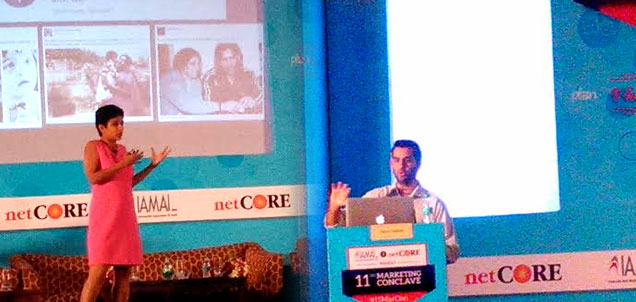
The first Indian Facebook employee, Kirthiga Reddy, now Managing Director, Facebook India left quite an impression on the audience with her talk entitled ‘Winning in a mobile first world’ at the 11th Marketing Conclave organised by the Internet and Mobile Association of India (IAMAI). FOBO or the Fear of Being Offline is a new term that is picking up in this day and age, she said. On Mother’s Day, India had the second highest ranking in terms of interactions with 1.8 billion interactions on the network. The older generation did exactly the same things we do, she explained, the only difference is that they did it in a different way.
63 percent of young people would prefer to give up TV rather than their phone, she said of a study. 62 percent of young people feel lost if they are not connected to social media. An IAMAI-BCG report estimates that by 2020, a whopping 500 million people will be connected to the internet. Back in the day, your kirana shop owner knew exactly what you needed when you walked into his store. That personalisation is missing today with the advent of the mass media, Reddy explained.
Satyan Gajwani, Chief Executive Officer, Times Internet, backed her up saying, “Technology allows the platform of digital advertising to enhance and create advertisements targeted at certain consumers. Hence we are seeing the growth of native advertisement, which breaks clutter and stops disruptive ads.â€
“Facebook is constantly and consistently integrating virtual reality. Innovations on the creative side of the real estate industry has provided enormous boost to virtual reality concept. Brands are focusing on reaching out to consumers in a personalised and creative manner. And the digital platform provides the best solution,†Reddy said. Out of 1.44 billion people who are on Facebook, 1.2 billion connect to it on a mobile device; she informed highlighting the genesis of a mobile-first world. There is also a growing trend of visual communication, Reddy added. First it started with text, then photos and now the world of video is expanding. Reddy cited the example of Facebook’s feature that allows a user to watch videos without sound on the mobile phone. The feature that is one of the latest, plays a video without sound as the user scrolls through his newsfeed. This will allow users to watch videos on their phones even during a seminar or meeting at work, she joked. Marketers ought to strive to drive awareness and retarget their audience, she said. The ‘cookie’ the dominant web metric used to track customer behaviour online will soon be ditched as it doesn’t correctly evaluate business results, she explained. This is the mobile first world and if we don’t adapt, we will be left far behind, she said.
There are 150 million smartphones users today, and that number is expected to go up to 500 million by 2018. Digital is the new advertising paradigm, Gajwani explained. The internet is driven by smartphones and the amount of digital content being created is skyrocketing. “The 300×250 size banner doesn’t have the same impact today, spots don’t have the same impact either,†Gajwani said. Smart and targeted advertising and marketing with precise solutions is what will drive the numbers, he added. We ought to be enablers and educators of what’s working and what is not. “The opportunity to get creative is here and is bigger than ever before,†he concluded.
L to R: ​​Prashant Singh, MD, Nielsen, Ashish Bhasin, Chairman and CEO, Dentsu Aegis Network ( South Asia), Tushar Vyas, Chief Strategy Officer – South Asia, GroupM, Ravi Dixit, Head – Market Insights, Google and Partho Dasgupta, CEO, BARC India.​
By Dyanne Coelho
The eleventh edition of the Marketing Conclave organised by the Internet and Mobile Association of India (IAMAI) saw industry stalwarts from across platforms highlight key trends in the marketing world from the digital evolution, the changing role of the CMO, cross-platform marketing and the dawn of the mobile as the ‘first’ screen.
Day One kickstarted with a keynote address by Tushar Vyas, Chief Strategy Officer, South Asia, GroupM. “Today’s consumer doesn’t believe in the values of yesterday,†he began talking about how the mobile has taken over the internet and created a complexity in advertising.Rajesh Jain, Founder and Managing Director, netCORE Solutions emphasised that the trend of tracking consumer behaviour has grown mainly in the digital era. There is little or no data tracked in an offline world, like what a consumer goes and picks up in a grocery store, he said. “We ought to start thinking customer journeys,†Jain added. CVL Srinivas, CEO, GroupM South Asia delved into the challenges of marketing in the digital age.“There’s so much talk about digital, we forget that at the end of the day we’re in an ideas business,†he said, talking about how at times we get so overwhelmed with data that we lose focus of our core competency. “We ought to be able to change mindsets, not just technologies,†Srinivas added.
A panel discussion on the expanding roles of the CMO highlighted a study which said that by 2020, the CMO will be spending more on IT than the CIO. The speed at which the CMO needs to react is increasing, the panelists discussed.The argument of whether digital is being effectively integrated with other marketing media, or is just an extension, was the next hot topic of discussion. The panelists concluded that though the digital medium has taken the marketing world by storm, at the end of the day, it all boils down to how well you know and recognise your consumer and give them what they want, when they want it. The final session for Day One discussed whether we are ready for the transition from ‘mobile first’ to a ‘mobile only’ era. High value products like airplane tickets and high value electronic devices are likely to be purchased on the desktop rather than the mobile phone, the panelists discussed. Anurag Singh, Co-founder and ED – India (Ads Platform), Affle concluded by saying that there is no wrong and right, you have to decide what’s best for your consumer depending on what your product and service is.
Day Two saw industry captains like Kirthiga Reddy, MD Facebook, Satyan Gajwani, CEO Times Internet, Ashish Sahni, Head Digital Marketing Tata Motors, Ashish Bhasin, Chairman and CEO, Dentsu Aegis Network, Partho Dasgupta, CEO, BARC, among others. The bias of the internet towards the English language was discussed in depth, with panelists arguing that an increasing number of regional languages, especially Hindi are picking up and the internet needs to adapt, lest consumers feel choked by the pressure of being force fed English language content online. With availability of cheaper smartphones and accessibility to internet, vernacular content is going to drive growth in digital marketing. Gyan Gupta, COO, DB Digital said, “Hindi as a language is witnessing 40 percent penetration in the online space. With non-metros witnessing steady growth in internet penetration, the vernacular language is certainly the flavor of the day.â€
Ways and means of tracking consumer behaviour without being ‘creepy’ was the key point of discussion in the session entitled ‘Digital Footprints’ Data and Automation in Marketing: The modern marketers’ success mantra.’ How much is too much, was much talked about in the context of following consumer footprints in the digital space.
“The first thing advertisers ought to do if they want to undertake programmatic marketing is allocate 25 percent of the total marketing budget to it,†Reem Saied, Business Head, Cadreon India said while discussing ways and means of optimizing marketing efforts for an enhanced performance. The quality of talent that marketers need to hire have changed, Apurva Chamaria, AVP and Head of Global Brand and Digital Marketing, HCL Technologies said. “We now hire statisticians, technology experts and bring them into the marketing team. The pool we hire from has changed,†he explained.
“This is the age of technology where you can get hold of a specialised doctor on an app,†Rathin Lahiri, CMO, Meru Cabs said speaking at the session titled ‘Simplifying the Mobile Marketing Ecosystem’. The panelists discussed the advent of the digital evolution especially in the mobile space. Madan Mohapatra, Head Customer Strategy, Future Group, said, “If we are to look at the global advertising market, the industry around US $600 billion, with mobile advertising pegged at around US $100 billion. In India, mobile advertising is a fraction of global spends. The time has is ripe to increase mobile ad spend as growing captive consumers are found mobile.â€The mobile screen has forced the marketing ecosystem to evolve. “Digital is not something you can ignore. If you don’t speak for yourself, your consumers will take you down,†Akshay Sharma, Head – Marketing, Eros Digital exclaimed.
Kirthiga Reddy, Managing Director, Facebook India, highlighted how Facebook is attempting to innovate. “We are constantly and consistently integrating virtual reality. Innovations on the creative side of the real estate industry has provided enormous boost to virtual reality concept.†Talking about Digital Marketing, Satyan Gajwani, Chief Executive Officer, Times Internet, said, “Technology allows the platform of digital advertising to enhance and create advertisements targeted at certain consumers. Hence we are seeing the growth of native advertisement, which tears through the clutter.
Having an absolute, standard method for measurement of the attributes of all digital platforms is the need of the hour the panelists discussed at the session entitled ‘Establishing a common digital standard’. “Cross media measurement has been talked about for a while. We keep measuring the media, we forget to measure the consumer,†Ashish Bhasin, Chairman and CEO, Dentsu Aegis Network (South Asia) stressed. India is still far behind in trying to understand the consumers’ buying behavior, Prashant Singh, Managing Director; Nielsen said adding that the next step is for BARC to look at digital. BARC CEO Partho Dasgupta said it may not be correct keep citing examples of progress of digital in the US and the UK because “they may not be the best one can haveâ€. “95 per cent of videos are still consumed on television sets in the UK,†he added.
Thoughts, ideas, statistics and case studies made the two-day conclave an insightful and informative event. The programme brought together some of the brightest minds in the marketing fraternity together on one platform and thus enabled an educative exchange of thoughts and ideas to light the path forward for marketing in India.