Tag: IAMAI

  • Study reveals interesting data consumption habits of pre-paid users


    In a study conducted on pre-paid smartphone users by IAMAI and Times Internet Limited, it has been revealed that the users spend nearly 72 per cent of their time to access online content while merely 15 per cent of their time is spent on making voice calls.


    According to the report, of the 72 per cent of time spent on their smartphones, only 22 per cent of the time is spent on apps while a majority of their time is spent on consuming online content, which includes reading articles, listening to music and watching videos. Interestingly more time is spent consuming content through browsers (WAP) compared to apps.


    Revealing the apps usage behaviour, the report states that on an average, users have 29 apps installed on their smartphones. Significantly, the rate of installed apps is higher than uninstalled apps, per month. Data reveals that users on an average install eight new apps, while they uninstall seven apps every month.


    The study also revealed that many of the English news readers on the news apps, watch vernacular content regularly. The study was conducted among 750,000 app users in India.


    The number of mobile internet users in India has reached 371 million by June 2016. There were 306 million mobile internet users in India in December, 2015. Of the 306 million internet users, 219 million users are from Urban India, which registered a Y-o-Y growth of 71per cent, while the user-base in Rural India has gone up by 93per cent from December 2014, to reach 87 million in December 2015.


  • IAMAI hosts ‘India Affiliate Summit’

    By A Correspondent


    Underlying the importance of affiliates in the digital marketing age, Ravi Bansal, Head Traffic and Content, LeEco, said, “Affiliates have the potential to be as big as AdWords or FB, but the only thing stopping is the visibility to the advertisers. The way we have AdExchange, we could have an Affiliate Exchange.” He was participating in a panel discussion on ‘Anatomy of Perfect Affiliate Marketing’ at the India Affiliate Summit, organised by Internet and Mobile Association of India (IAMAI), in association with VCommision.


    The speakers at the two-day event were unanimous in their views that Affiliate Marketing is a key enabler today. In her address, Parul Bhargava, Co-founder & CEO, vCommission Media, mentioned that the affiliate network has been growing steadily in India despite the fact that it is still at a nascent stage. She underlined the importance of a strategic partnership amongst the various channels such as advertisers, brands, publishers, which could be a win-win for all the stakeholders.


    Anurag Gupta

    In his address, Anurag Gupta, Founder & MD, DGM India, said that the advertisers would need to recalibrate their affiliate strategy to derive best mileage out of the Affiliate Channel. This will continue to be one of the most cost effective channels of customer acquisition.”


    A whitepaper titled, ‘Affiliate Marketing – What is the big deal’, jointly prepared by IAMAI and Tata Strategic Management Group was also released on Day 1 of the event. Releasing the paper, Sourabh Gupta, Engagement Manager – Technology & Digital, Tata Strategic Management Group, said “Industry often takes a myopic view on affiliate marketing by limiting it to sales. We, at TSMG believe that technology evolution would not only drive but also re-shape affiliate marketing in India. Companies across industries should re-align their conservative outlook towards affiliate marketing thus driving disproportionate results.”


    Speaking at the summit, Milind Pathak, Chief Operating Officer, Madhouse India, emphasised that in today’s connected world the modern marketer has to think beyond the obvious. He said: “Affiliate Marketing is not only about getting the downloads; with technology moving towards programmatic, data intelligence and attribution, marketers today can identify the time when a consumer will convert and that to in real time.” Marketers today can take all these innovations, combine them together and create a cracking campaign with effective strategy that will surge brand impact and customer engagement, at the same time driving a defined  outcome, he opined.


  • Kunal Shah leads IAMAI CEO’s trip to China

    By A Correspondent


    Kunal Shah, Founder & CEO, FreeCharge and Chairman of the Internet and Mobile Association of India (IAMAI) would lead 20 CEO’s for a week-long trip to China, beginning June 24.


    Members of the team include: J Murugavel, Founder & CEO, Bharat Matrimony; Amarjit Batra, CEO, OLX India; Pawan Gadia, CEO Retail & Online, FernsnPetals; Ms Neelu Singh, CEO Ezeego1; George Antony, MD, UAE Exchange; Dippak Khurana, Founder & CEO, Vserv & Vmax; Nitin Gupta, Co-founder & CEO      PayU India; Ankur Singla, Founder & CEO, Helpchat, Vivek Pani Co-founder & CTO, Reverie; JRK Rao, Founder & MD, Rage Communications; Badri Sanjeevi, CEO, Mauj Mobile; Manish Chopra, Co-founder & CEO, Zovi; Sahil Chalana, Founder, College Dunia; amongst others.


    The focus of the week-long trip is to invite the Chinese companies to set up in India; invest in Indian start-ups; gain Ideas for new businesses and exchange insights for scaling-up.


    The delegation will meet officials from Alibaba, Baidu, Ctrip, Cheetah Mobile; Xiaomi in Beijing and Shanghai. The team would also meet investors like Ant Financials and Start up Street during the week-long trip.


    Speaking about the delegation, Dr. Subho Ray President, IAMAI, said, “Scale and scalability is one of the most important things to learn in China.  Apart from key meetings, the delegation will also visit large internet and ecommerce companies to get first hand feel of scalability.”


  • E-commerce to touch Rs 2.1 trillion by Dec 2016: IAMAI-IMRB


    By A Correspondent


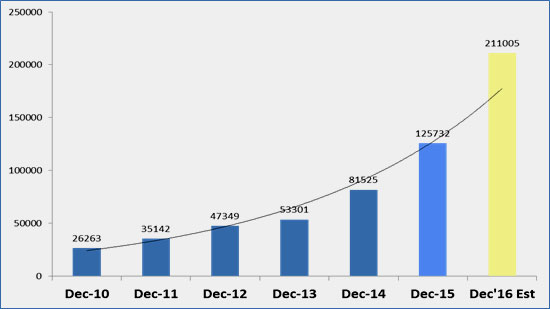
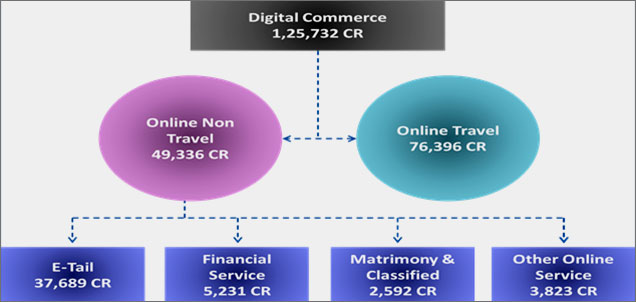
    The Digital Commerce Market has grown at a CAGR of 30%, between December 2011 and December 2015 and was valued at Rs 125,732 crores by the end of December 2015. It is estimated to reach Rs 211,005 crores by December 2016, according to the Digital Commerce Report 2015, published by the Internet and Mobile Association of India (IAMAI) and IMRB today.


    The report finds that Online travel industry continues to grow strongly with 61% share while share of online non-travel has improved over the previous year to reach 39%. In December 2015 share of e-Tail was 29%. Mobile Phone and Accessories, PCs and Apparel and Footwear continue to be the dominant categories that are selling within the e-tail segment. According to Nilotpal Chakravarti, AVP -IAMAI, “The growth trajectory of digital commerce signifies the coming of age of online transactions in India. No longer Indians are wary of transacting online. Another notable facet of the report is the substantial growth in non travel online transactions.”


    Domestic air ticket and railways booking continue to be among top contributors to the Online Travel spends.  These were the segments that were the top contributors in previous year also. Hotel Booking has seen a substantial movement in Y-o-Y growth at 165%, from Rs 1965 crores in December 2014 to Rs 5200 crores in December 2015. Spend on online railway ticket booking has also grown at around 34%, from Rs 16200 crores in 2014 to Rs 21708 crores in 2015. Online travel is expected to grow at a CAGR of around 40% to reach Rs 122815 crores by end of 2016.


    The report also finds that E-Tailing maintained a strong performance with a 57% Y-o-Y growth. Among E-Tail categories, Mobile Phone and Mobile Accessories continue to be the top contributor to the overall pie. Given that there is an increased demand for Smartphones in India, this could be a contributing factor. Computer and consumer electronics, as well as apparel and accessories, account for the bulk of India retail ecommerce spends contributing close to 49% collectively to overall spend in E-Tail segment. Apparel and Footwear sale has almost doubled as compared to the previous year, recording a 52% Y-o-Y growth from Rs 4699 crores in December 2014 to Rs 7142 crores in December 2015. This segment is expected to gain further momentum and reach Rs 72639 crores by end of 2016.


    Component share of E Tail (Rs 37,689 CR)

    Mobile Phones + Mobile Accessories

    14,109

    37%

    Apparels + Footwear + Personal / Healthcare Accessories

    7,142

    19%

    Consumer Durables + Kitchen Appliances

    6,452

    17%

    Laptops / Net books / Tablets / Desktops

    4,726

    13%

    Home Furnishings

    1,468

    4%

    Jewellery 

    1,120

    3%

    Other Products (Vouchers / Coupons, Toys, Gifts, Flowers, Handicrafts, Stationary etc.)

    994

    3%

    Books

    875

    2%

    Cameras + Camera Accessories

    803

    2%


    According to the report, Financial services market grew at a CAGR of around 17% between 2012 and 2015. The market reached close to Rs 5231 crores in terms of transactions as of Dec’15.  The demand for online utility payment is expected to reach Rs 6068 crores by Dec’2016.


    Other online service market that includes booking movie tickets and tickets for other events, online commuting or cab hire, online grocery and food deliver, was Rs 3823 crores in Dec’2015. In December 2014 the market was around Rs 2025 crores. In future online grocery and online food delivery are expected to emerge as big ticket items. Demand for other online service is expected to grow at a CAGR of 36% to reach Rs 5207 crores by December 2016.


  • Day 2 of IAMAI Marketing Conclave: The Digital story continues


    By Anuka Roy


    It was the twelfth edition of the Internet & Mobile Association of India (IAMAI)’s annual marketing conclave. And as the proceedings concluded on Thursday, some of the takeaways from the two-day event were: focus on context and content, understand your target group, utilise social media tools properly and mobile marketing will be the next big thing.


    The digital storytelling journey continued on Day 2 of the Conclave. Saurabh Varma, Chief Executive Officer- South Asia, Leo Burnett Group, carried forward the topic of ‘Art of Storytelling with Digital Marketing’, which was touched upon a little on Day 1. In his presentation, Varma emphasised on the point that organisations need to find a purpose and once they find that everything falls in to place. He also cautioned that in the process of getting the act and purpose right, brands sometimes become too noisy while implementing their plan, which should be avoided. “We need more human brands, especially in digital,” stated Varma. He focused on the need for the right content and context, which eventually helps a brand to be successful. This was explained through two videos, one by Gatorade which paid tribute to a retiring baseball player and the other was Bajaj V, which showed motorcycles being made from the metal of, now dismantled, INS Vikrant. By giving examples of these two videos, he tried to reason that if the context and content of the brand are in proper place, everything gets going for a brand. Varma also spoke about ‘Functional integration’, something which is followed in his company and it pushes agencies to focus more seriously on client needs. He also pointed out that Social tools need to be used more efficiently.


    In a marketing conclave which has been mostly dominated by discussions about digital marketing, how can a discussion focused on social media not take place? Karthik Nagarajan, National Director- Content and Social Media, GroupM moderated the discussion on ‘Social Media- Marketing through Videos’, with Sameer Pitalwalla, Chief Executive Officer, Culture Machine, Malay Dikshit, Chief Communications Officer, Tata Sky, Vijay Nair, Chief Executive Officer, Only Much Louder and Shreyas Rao, Senior Vice President, #fame as his panelists. Before the discussion, each panelist made a short presentation on the same topic. Pitalwalla presented the case study of ‘Being Indian’- a brand which they are associated with. Through the case study he showed how this brand expanded using different social media platforms. Taking the unconventional route, just like the videos that Nair’s company makes, he chose to just talk about the topic rather than showing a PowerPoint presentation. Jain stated, “Creators are going to be the agencies themselves and content marketing should not be confused with advertising.” Dixit’s presentation highlighted the fact that very soon traditional media platforms will merge with internet. The presentation ‘Video is the new text’ by Rao showed how just through videos and live video streaming his company made an impact within one year of its launch. The panelists agreed to the attention required for correct content and context, just like Saurabh Varma did in his session. Another very important change in today’s scenario that surfaced in the discussion was that due to the plethora of digital platforms, consumers give their feedback almost immediately and they can be brutal. So, brands need to be very careful about what they are offering. This pre-lunch discussion definitely gave the audience some great food for thought.


    The session on ‘Programmatic Marketing- Make the best out of it’ was moderated by Nadeesh Ramachandran, Vice President- Sales and Strategy, Vserv. The panelists of the session were Ashish Sahni, Head- Digital Marketing (Passenger Vehicle Bussiness Unit), Tata Motors, Manish Kalra, Chief Business Officer, Craftsville.com, Hitesh Malhotra, Chief Marketing Officer, Nykaa and Henry Stokes, Vice President of Client Development- APAC, Xaxis. When the moderator asked the panelists to define programmatic marketing, Kalra was quick to reply, “It is a jargon and basically, the use of technology that enables marketers to target right people at the right time.” The discussion was mostly about how advertisers should know their audience and should be clear about the target group. This discussion was carried forward by Stokes, who made a presentation about the same topic immediately after the discussion, explaining the concept of ‘Programmatic Marketing’ more extensively. “Take control, by defining and managing your own target audience,” he said in conclusion.


    From programmatic, the discussion moved to ‘Performance Marketing- pay for outcomes only’. The post-lunch session moderated by Siddharth Puri, Chief Executive Officer, Tyroo with panelists Sevantika Bhandhari, SVP- Marketing and Head Products, DHFL, Shivani Dhanda, Director Marketing, eBay, Nikhil Rungta, Chief Executive Officer, Housing.com, Venkatesh C R, Chief Executive Officer, Adatha, Atit Mehta, VP and Head of Media, Sequoia Capital and Vivek Singh, Sr VP- Marketing and Analytics, Firstcry, made sure the audience was attentive through their insightful discussions. Dhanda and Singh had contradictory opinions on the definition of Performance Marketing, as the former said: “From eBay perspective, performance marketing is when you are paying for a click or the end transaction that takes place, while negotiating with a vendor, the performance metrics come in to play” while the latter opined: “Performance marketing is the process in any kind of marketing. It is about having an end goal while using any form of performance marketing.” The discussion concluded with each panelist giving their view on what they will be discussing about in a year from now, the common consensus was “about integrated marketing devices.”


    The last panel discussion was quite a fiery one, with quite a few contradicting views on the topic ‘Using mobile marketing to build healthy brands’. The session was moderated by Chandranshu Mishra, Consultant, Tata Strategic Management Group and the panelists included Ritza Trivedi, Director- Marketing India and South Asia, Visa, Uday Sodhi, Executive Vice President and Head- Digital Business, Sony Pictures Network, Anuj Kumar, Co-founder and MD, Affle, Martin Nygate, Founder and Chief Executive Officer, Gentay Communications and Lavin Punjabi, President, Affinity. While discussing about mobile advertising, Nygate said that his company conducted a survey which should people are annoyed by mobile advertising. “We believe the industry is in crisis,” he said. Kumar disagreed and said, “I do not buy the survey. The data consumption aspect in terms of mobile ads is overrated. This platform is giving free content.” Punjabi was quick to ask in reply to the statement, “Are viewers ever going to be ready to pay for content?” But everyone agreed to the fact that the future of mobile advertising is brand and eventually the obstacles of this platform will go away. “Mobile content is getting very exciting now. It allows you to communicate to the individual directly. It is the fastest growing space in the advertising ecosystem.”


    Day 2 also had three case study sessions taking place parallel to the panel and individual sessions. The case study session on ‘Building a brand on digital’ was taken by Anindita Chatterjee, Senior GM Marketing, Spaces and Ajit Nair, Region Head, Quasar. ‘SME Advertising Market- Big opportunity, bigger challenge’- case study session was taken by Samir Chaudhary, Co- Founder, The Media Ant and another session was taken by Priya Jayaraman, Co-founder and Business Director.

     

  • Social media to play key role in Kerala & Tamil Nadu elections: IAMAI

    By A Correspondent


    The poll outcome in as many as 71 high impact assembly segments out of 140 constituencies in Kerala will likely be influenced by social media users, a report by IAMAI said. Ninety two percent of social media users in Tamil Nadu are following the election on social channels, with 28 per cent of the 234 constituencies likely to see netizens play a decisive role in determining the winner.


    Taking the theme of “Impact of Social Media on Elections” a level deeper than General Elections, the Internet & Mobile Association of India (IAMAI) with the support of The Campaign 360, has released a report titled “Social Media Impact on the Kerala & Tamil Nadu Elections, 2016.” This report is a part of the series of assembly election reports, and follows the hugely successful social media impact report that IAMAI published in 2014 on the eve of the General Elections.


    According to the report, there are 71 High Impact constituencies in Kerala, the results of which are likely to be influenced by social media users in the state. There are 4 medium impact and 65 low impact constituencies in the State. The report contends that 51 per cent or as many as 1 out of 2 constituencies, which have been classified as High Impact could determine the eventual winner in the State.


    There are 66 High Impact constituencies in Tamil Nadu, the results of which are likely to be influenced by social media users in the state. There are 14 medium impact and 154 low impact constituencies in the State.  The report contends that 28% or more than 1 in 4 Constituencies, which have been classified as ‘High Impact’ could determine the eventual winner in the State.


    Conducting a web survey of a representative sample of 250 social media users each in Kerala and Tamil Nadu, it was found that in Kerala, TV (53 per cent) and Print (48 per cent) still stand as the most trusted media sources for election related content, while 31 per cent rely on Social Media and only 9 per cent access Digital News. In Tamil Nadu, 32 per cent rely on Social Media and only 15 per cent access Digital News, while reliance on TV is 46 per cent and print is 40 per cent.


    During the 10 day tracking period between 11-20 April, using social media “listening tools”, Corruption emerged as the topmost topic of discussion. Oommen Chandy, the incumbent Chief Minister was the most discussed leader in Kerala while BJP was the most discussed party. The LDF has minimal presence on Facebook and Twitter both from a Party and Leadership perspective. The incumbent UDF makes up for 1 in 3 mentions with a 9% negative sentiment. The Left on the other hand makes up for the least negative sentiment though its share of volumes are significantly lower than its vote share in the State.


    In Tamil Nadu, the DMK alliance dominates the conversation on social media channels. However, the net sentiment is negative. The AIADMK has significantly lower presence but also very high negative conversations, with 1 in 3 conversations about the AIADMK on Social Media are negative. The same trend impacts all the other parties/alliances except the small PMK which has more positive than negative conversations.


  • Interest of Internet users should drive “Encryption Policy”: IAMAI

    By A Correspondent


    Encryption is a fundamental and necessary tool to safeguard the digital communication infrastructure. The interests of Internet users should be foremost in framing any encryption policy, according to a “discussion paper” released by the Internet and Mobile Association of India [IAMAI]. “Trust, convenience and confidence of users are the keywords to designing an ideal encryption policy that will help in getting more people online with safe and secured internet platforms,” said Dr. Subho Ray, president, IAMAI.


    The association has published this discussion paper with the view to encourage discussions and debates around the issue, and has suggested that a broad-based public consultation with all stakeholders including users groups should precede the making of an encryption policy.


    According to the paper, the foundation of a user centric Encryption Policy consists of: Freedom of Encryption, Strong Encryption Base Standard, No Plaintext storage and Mandatory legal monitoring or No Backdoor Entry.


    The most essential element in the paper suggests that support for strong encryption is critical to counter cyber security issues around the globe. Mandating a framework of legal monitoring or building backdoors will affect the users’ trust in the internet. It will make the system weak and prone to illegal hacking without eliminating the real concerns. There is no point in having the world’s best lock if the keys are kept under the doormat.


    In addition, the paper suggests the importance of freedom of encryption for the users, organizations and the business entities. Prescribing a minimum standard is quite retrograde considering various users and internet companies need different encryption strength given the fast pace at which technology is changing.


    Instead of a low ceiling, a high base should be specified based on the internationally proven encryption standards viz., AES-128 and 3DES and 256-bit. In India at present a low ceiling of 40-bit standard is prescribed, beyond which prior approval of the government and handing over the keys is mandatory. This standard is the weakest, outdated and can be easily hacked.


    Antiquated policies such as mandatory plaintext storage and key disclosure violate the objectives of a strong encryption policy. It burdens the users and internet companies while not affecting the actual offender. Instead practices such as forward secrecy and authenticated encryption should be adopted where decryption keys are deleted immediately after use so that stealing encryption keys used would not compromise data protection and privacy.


    Careful consideration should be given to the impact and effectiveness of any proposed policy so that it does not compromise the existing robust system in place or pose unnecessary burdens on the internet users and firms.


  • How Social Media is influencing WB polls


    Taking the theme of “Impact of Social Media on Elections” a level deeper than General Elections, the Internet & Mobile Association of India (IAMAI) with the support of Facebook India and The Campaign 360, has released a report on the impact of social media in the West Bengal Assembly elections. This report, the first in a series of Assembly election reports, follows the social media impact report that IAMAI published in 2014 on the eve of the General Elections.


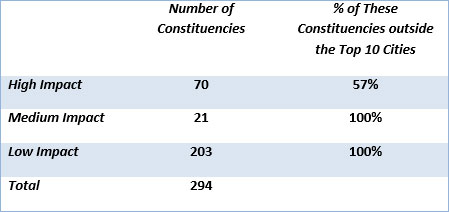
    According to the report, there are 70 High Impact constituencies in West Bengal, the results of which will likely be influenced by social media users. There are 21 medium impact and 203 low impact constituencies in the State.  The report contends that 24% or 1 in 4 Constituencies which have been classified as ‘High Impact’ could determine the eventual winner in the State.


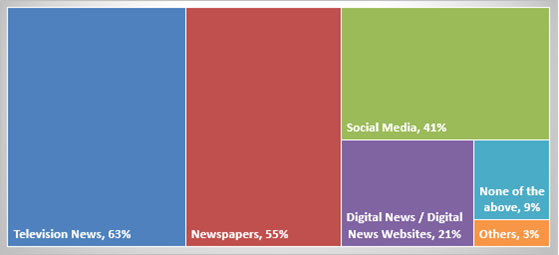
    A web survey of a representative sample of 250 social media users also found that TV and Print still stand as the most trusted media sources for election related content, while 41% rely on Social Media and 21% access Digital News. The report finds that 2 out of 5 Social media users in West Bengal also consider Social Media as the most reliable source of election information.  A vast majority, 90% of Social Media users are following the Bengal Election on Social Media.


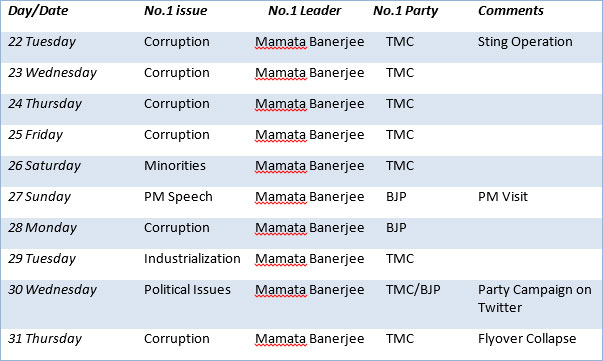
    Additionally, during the 10-day tracking period between March 22 and 31 using social media “listening tools”, corruption emerged as the topmost topic of discussion. Mamata Banerjee was the most discussed leader in Bengal while TMC was the most discussed party. The Left Front has minimal presence on Facebook and Twitter both from a Party and Leadership perspective. The BJP on the other hand has high exposure but relatively little presence (39% Social Media Share versus 17% vote share in 2014) on the ground. The new Facebook feature ‘Facebook Live’ (Live video feature) is among the most popular with politicians.


  • Vanakkam! Indian languages need to rule. Theek hai?


    By A Correspondent


    Advocating the need for more content in Indian languages to propel internet penetration, a report titled ‘Proliferation of Indian Languages on Internet’ finds that enabling local language content on the Internet will lead to a growth of 39 per cent in the current Internet user base. 75 per cent growth will be from the rural users while only 16 per cent growth will come from urban India.


    The report, published by the Internet and Mobile Association of India (IAMAI), finds that English language still accounts for 56 per cent of the content on the worldwide web, while Indian languages account for less than 0.1 per cent. However, while Internet in India is predominantly English, there is high potential for regional language content. According to the report, in the last year alone, Hindi content on the web has grown by about 94 per cent, whereas English content has grown only at 19 per cent.


    The report further asserts that there is significant scope for various stakeholders to benefit financially while addressing the needs of the local language content consumers. If the Indian language book publishing industry moves online, it can create a digital opportunity worth nearly US$ 7 billion for both the content providers and technology players.


    According to the report, accessing the internet in local language broadly has two challenges.

    1. The first challenge is to generate content in local languages and popularising such content for broader adoption2. The second challenge is on the technical front, pertaining to availability of Indian scripts for generating digital content


    Currently, local content availability is restricted largely to news agencies as other forms/sources of content generation are extremely limited. User generated local content is still very low, as adoption of local language usage in social media and other such fields are still restricted.


    The report cites some of the following initiatives that can help increase public awareness and engagement in local language content.


    1. Development of websites in local languages and providing a user-friendly interface for local language user can be an integral part of e-governance initiatives by the State Governments.

    2. Media companies should adopt digital media as a separate entity from print media and actively expand their e-presence. Currently, the former is seen as merely an extension of the latter.

    3. Increased spending on online advertisements in local languages would help the companies generate higher revenues through online content in local language.

    4. Digitalization and online release of the various local language archives and books in various libraries and universities across the country can be undertaken to increase local content availability

    5. Social media companies need to support local languages and promote their availability. The interface has to be user friendly to provide easy interaction for the users.


  • 6th India Digital Awards felicitates worthy achievers

    By A Correspondent


    Anand Mahindra was adjudged as the Social Media Person of the Year at the 6th India Digital Awards presented by IAMAI. The winners of the 6th India Digital Awards coinciding with 10th India Digital Summit, 2016, were announced at a ceremony recently. The awards, this year had 6 Categories and 32 sub-categories for the internet and mobile value added services industry. The categories were Digital Advertising; Website; Mobile; Digital Payment; Digital Social & Economic Empowerment and Special Awards. While WatConsult’s “Sony SIX” was awarded Advertising / Marketing Award on Mobile, the coveted Best Digital Person of the Year was awarded to Vijay Shekhar Sharma of PayTm & Bhavish Aggarwal of Ola. Interactive Avenues won the best Digital Agency of the year award.


    Vijay Shekhar Sharma received the coveted Best Digital Person of the Year from Shri. Jayant Sinha, Minister of State – Finance.


    Winners of 6th India Digital Awards include:

    Award Winner
    Best Advertising / Marketing on Mobile WatConsult for Sony SIX
    Display Madison for Marico
    Search Marketing iProspect for ShopClues
    Viral Marketing Campaign Star India
    Email Marketing Campaign netCore for BIBA
    Social Media Marketing Campaign Interactive Avenues for Micromax Interactives
    Digital Integrated Campaign Experience Commerce for Lenovo India
    Execution of Performance Campaign Realty Redefined for The Wadhwa Group
    e-Commerce Website for a Retail Brand www.trendin.com – Madura Fashion & Lifestyle
    e-Commerce Website in a Specialised Category www.pepperfry.com
    Local Language Website www.chuttuvattom.com – Malayala Manorama
    News Content Website NDTV.com
    Travel Website Thomas Cook
    Financial Website www.bankbazaar.com – A & A Dukaan Financial Services
    Educational Website www.simplilearn.com
    Brand / Product Website www.hotstar.com – Star India
    Consumer Mobile Service National Mobile Number Portability – Vodafone India
    Mobile Enterprise Product or Services Abbott India Radio
    Mobile Game Star Chef by 99Games
    Innovative Mobile App Inshorts
    Mobile Money Prepaid Card / Product Happay and Payback
    Money Product / Service mVisa
    Digital Payment Facilitator Avenues India
    Digital Wallet PayTm
    Money Transfer Programme MobiKwik
    Payment Technology / Solution Provider PayU Payments
    Best use of Mobile for Social and Economic Development Karnataka MobileOne by Centre for e-Governance
    Best use of Internet for Social and Economic Development Intelligent Grid & Smart Metering Solution by Essel Infraprojects
    Start-Up of the Year OYO Rooms
    Digital Person of the Year Vijay Shekhar Sharma & Bhavish Aggarwal
    Digital Agency of the Year Interactive Avenues
    Social Media Person of the Year Anand Mahindra


  • Mobile net users to be 371 mn by June ’16

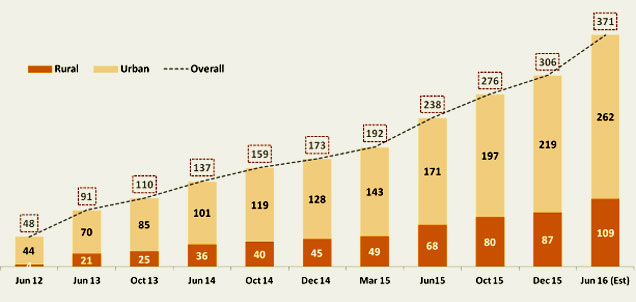
    Figure: 1: Mobile Internet Users


    By A Correspondent

    The number of mobile internet users in India is expected to reach 371 million by June 2016. There were 306 million mobile internet users in India in December  2015. Of the 306 million internet users, 219 million users are from Urban India, which registered a Y-o-Y growth of 71 per cent, while the user-base in Rural India has gone up by 93 per cent from December 2014, to reach 87 million in December 2015. These are the major findings of a report titled ‘Mobile Internet in India 2015’, released by the Internet and Mobile Association of India (IAMAI) and IMRB International, recently.

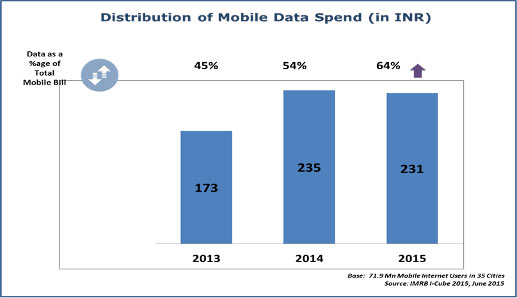
    The report also finds that the share of mobile internet spend out of average monthly bill has increased to 64 per cent in 2015 as compared to 54 per cent in 2014. The average monthly bill has reduced to the extent of 18% compared to last year.


    Figure 2:


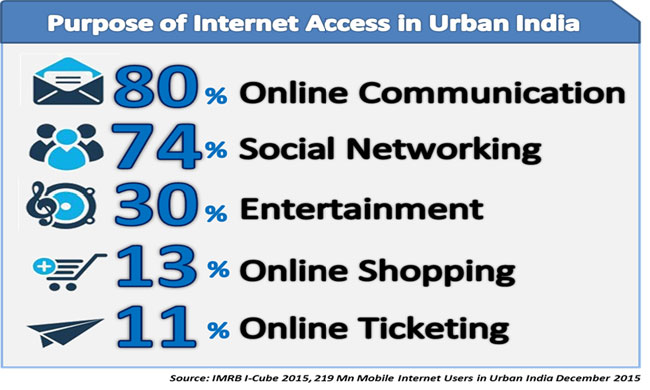
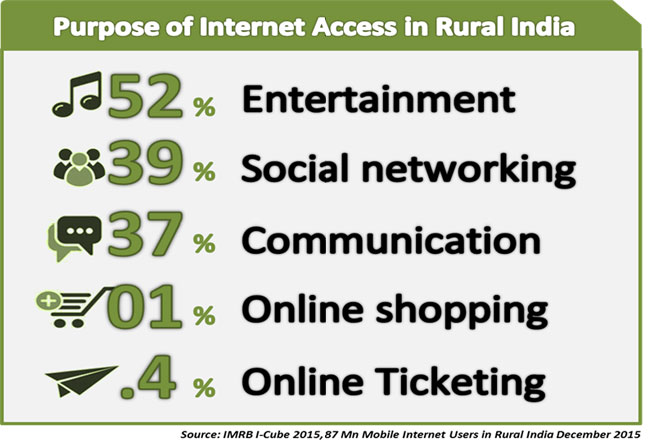
    For the first time “Online Communication” has surpassed “Social media websites” to top the purpose to access mobile internet list. 80 per cent of the urban users use mobile internet for communication whereas 74 per cent access social networking sites using their mobile internet. In Rural India however, majority of the users access Mobile Internet for Entertainment. This is followed by Social Networking & Online Communication.


    Figure 3:

  • Digital start-ups need specific incentives: IAMAI

    By A Correspondent


    To implement the Prime Minister’s twin vision of ‘Stand-up India’ and ‘Digital India’, the industry body Internet and Mobile Association of India (IAMAI) has come up with specific fiscal and non-fiscal measures required by the internet industry. According to the association, the digital start-up ecosystem in India should be systematically encouraged by focussing on specific fiscal interventions.


    On the fiscal incentives, the association has suggested the following:

    1.   Improve Investment Environment:

    India’s entrepreneurs need early stage venture capital – but the domestic venture capital sector needs to develop further. In the US, the VC industry took off when their government allowed the large pension funds to put 5-10 per cent of their assets into VC firms.

    1.1 Angel Tax: Angel Tax under Sec 56 (2) of the Income Tax Act has not been actually tailored to restrict start-ups funding but it has put start-ups under the Income tax scanner, questioning the valuation by domestic individual investors. The criteria to qualify as an angel fund are stringent and need to be eased to support the start-up ecosystem in the country.


    The association suggests that there should be tax breaks and incentives for individuals supporting start-ups with capital.


    2. Incentivize Internet Services Start-ups:

    These are the largest chunk of internet companies in India. This sector, which comprises of aggregators, digital advertisers, online classifieds, bring in a lot of efficiency, and are the largest employment generators. They are either enabling businesses, or they are creating lot of employment in the country, resulting in many people are earning a lot of money than they should otherwise have.

    2.1 Service Tax: Unfortunately, Start-ups have to pay huge amount over the first three years in way of service tax. It is not that they don’t want to pay, but they have survival issues and this takes a back seat and penalties just make a struggling start-up’s life harder.


    The association recommends that for the first three years, the service tax could be waived off or incentivizes the start-ups, if they pay their service taxes on time.


    3. Streamline taxation for e-Commerce marketplace Start-ups:

    Online market places are changing the way businesses are done in India. Small players are setting up niche businesses in India and are attracting lot of investments in India. Online marketplaces bring in a lot of efficiency in the entire retail value chain from customer experience to payments and delivery.


    3.1 Taxes on e-commerce Transactions: The e-commerce marketplace industry is being subjected to onerous VAT demands from several states. They should be recognized as marketplaces and exempt from VAT demands in states. As market places they provide a service to online sellers and pay the service tax on that account. The State of Rajasthan for example treats e-commerce players as market places.


    4. Boost FinTech Start-ups:

    FinTech plays a significant role in serving those underserved or not served by formal institutional mechanisms. They are also likely to play a significant role in various financial inclusion programmes of the government. Various forms of FInTech services such as pre-paid instruments, wallets and others create efficiency, transparency and wider reach in financial transaction.


    4.1  P2P lending and crowd-funding need an impetus and clarity from Government: While some early inroads have been made in the P2P lending segment in the country, individual efforts have not translated into a policy from the government. The lack of clarity of rules and regulations has meant the industry is shooting in the dark. In the absence of dictated policy or scriptures, it is quite plausible that misguided individuals may fall prey to unscrupulous operators that may look to make a quick buck.


    4.2 Easy KYC through aadhar will allow innovators build new services which in turn will help bring more people under the ambit of financial services: Various forms of digital payments such as pre-paid instruments, wallets and others create efficiency, transparency and wider reach in financial transaction.