Tag: IAMAI

  • IAMAI’s Digitally Native Brands committee appoints Vikas D Nahar as chairman

    The Digitally Native Brands (DNB) Committee of the Internet and Mobile Association of India (IAMAI) has appointed Vikas D Nahar, Founder & CEO, Happilo, as the new Chair and Swagat Sarangi, Co-Founder, Smytten, as the new Co-chair, following their election to the posts.

    Said Nahar: “As I step into the esteemed position of Chairperson of the DNB Committee within IAMAI, I am profoundly grateful for the trust placed in me. The election represents not only a transition of leadership but also a reaffirmation of our shared dedication to the growth and progress of our industry. With heartfelt gratitude, I envision fostering collaboration, innovation, and ethical standards, knowing that together, we can make a lasting impact on the future of digital businesses. Let’s embark on this journey with gratitude and determination, knowing that our collective efforts today will shape tomorrow’s success.”

    The DNB Committee Co-chair Swagat Sarangi shared his perspective on the potential of India’s Digitally Native Brands sector and consumer brands, stating, “I am honoured and excited to take on the role of Co-Chair for the Digitally Native Brands Committee. There can’t be a better time in India to build consumer brands. I hope to contribute meaningfully to the ecosystem, fostering collaboration and ensuring better access and support from all stakeholders for the digitally native brands”.

  • Yashwant Deshmukh highlights ISEC role in digital world

    At the IAMAI’s India Digital Summit 2024 held earlier this week in Mumbai, the Indian Socio-Economic Classification (ISEC) was much discussed. Central to this initiative is the COTN survey by senior researcher and founder-CEO/Editor of CVoter, Yashwant Deshmukh who is CEO, Dataeye Asia aimed at tracking consumer sentiments across the nation especially in digital consumption. To be conducted year-round in 11 Indian languages and commissioned by a leading media house.

    The survey helps CMOs with two essential batteries: the COTN Economic Battery and the COTN Product Battery. The first COTN survey report is scheduled to be released this month (March 2024). Additionally, this will be the first ISEC-aligned initiative, the survey will introduce a media consumption tracker. More details on what COTN is all about is awaited, and this report will be updated thereafter.

    The conversation led by Yashwant underscored the imperative for CMOs to embrace the transformative power of data analytics and new segmentation in navigating India’s dynamic media landscape. As evidenced by the early adoption of digital media in regions like Bihar and Uttar Pradesh, traditional media consumption patterns are in the midst of transformation.  Deciphering and understanding India’s growth in the digital space requires advanced survey methods due to the complexity and dynamism of the Indian consumer landscape.

    The summit highlighted ISEC’s potential with the debut of this study.

  • OTT Originals Growing Significantly in Regional Languages: MIB Secy Sanjay Jaju

    OTT platforms are growing significantly in various regional languages across India, said Sanjay Jaju, Secretary, Ministry of Information and Broadcasting, Government of India, at the India Digital Summit (IDS) 2024, in Mumbai, on Wednesday. In his keynote address, he pointed out that there were over 60 OTT platforms in India out which 30 per cent OTT Originals were operating in regional languages. The number is expected to go up to 50 per cent this year. The session was moderated by Vivek Malhotra, Group CMO & COO, Consumer Revenue, India Today Group.

    Jaju also said that the media and entertainment sector was a huge sector and played a pivotal role in the Indian economy. “It’s been growing phenomenally at a rate of 20 per cent and is approximately Rs 2 lakh crore. In that, the digital media segment is the second largest sub-segment, and has been showing a growth of approximately 30 per cent — around Rs 60,000 crore — and the film segment has a 25 per cent growth rate,” he said. Sharing data he added that over 200 films were released on the digital platforms in the last year, including 75 films which were released directly on the digital platform without a theatrical release.

    Regarding the growth of the digital gaming industry, Jaju said: “The online gaming industry has been growing by 34 per cent and animation and VFX have close to around 30 percent growth rate, expected to become a $2 billion industry by 2025.”

    Jaju also announced some new initiatives that the government is taking to provide a boost to the media and entertainment sector in India. These include the setting up of a National Centre of Excellence in Maharashtra to create world class media talent and an incentive scheme to attract international projects. He pointed out that, this would help the industry undertake a lot of co-production treaties with multiple countries and create a number of audiovisual co-productions.

    IDS 2024 was being organised by IAMAI in partnership with the Ministry of Electronics and Information Technology (MeitY), the Ministry of Information and Broadcasting (MIB), the Union Ministry of Tourism, UIDAI, Indian Cybercrime Coordination Centre (I4C), Government eMarketplace, In-Space and Skill India Digital.

  • IDS24: Optimising campaign impact is key challenge

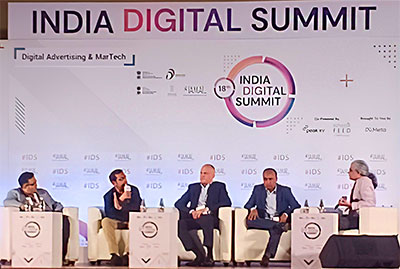
    At the IAMAI’s India Digital Summit 2024 held in Mumbai earlier this week, a panel discussed the challenge for digital marketers lies in navigating personalisation and measurement in a post-cookies era. Those on the panel included Shuvadip Banerjee, Chief Digital Marketing Officer, ITC; Shashank Srivastava, Senior Executive Officer, Maruti Suzuki India; Arnaud Frade, President, Commercial – (Asia), Nielsen and Mohit Joshi, Chief Executive Officer, Havas Media Network India. The session was moderated by Vivek Malhotra, Group Chief Marketing Officer and Chief Operating Officer – Consumer Revenue, India Today Group.

    Highlights of what the panelists said:

    Srivastava: “In earlier times, this understanding of the customer relied on sampling, market research, and analysis of demographics and psychographics. However, the abundance of data and advanced technologies now allow for a significantly more personalised approach to customer insights. Maruti Suzuki’s sustained market dominance, holding approximately 45% market share over four decades, stems from aligning with evolving consumer behaviours and processes. Extensively researched, the car purchasing journey involves 26 touchpoints, 24 of which Maruti Suzuki has seamlessly digitised. Aspects like test drives and delivery are transitioning to digital.”

    Frade: “Technological advancement also generates vast amounts of data, which must be leveraged more effectively. The challenge lies in obtaining precise, high-quality data that empowers marketers, brand owners, and other stakeholders to make informed decisions. In this rapidly evolving landscape, understanding the changing dynamics of the shopper journey is paramount. The proliferation of mobile technology and diverse forms of commerce has fundamentally altered how consumers engage with brands. We are witnessing a transition from discrete ‘moments of truth’ to a continuous journey, where decision-making occurs at various touchpoints. Marketers must excel not only at the final interaction but throughout the entire marketing funnel.”

    Banerjee: “The marketing landscape has evolved, with real-time multi-touch attribution and market mix models becoming commonplace, aiding investment allocation. Despite lacking a unified media measurement standard, metrics like scroll depth on owned assets and engagement within communities offer insights into consumer behaviour. Additionally, distinguishing between always-on and start-stop campaigns and measuring baseline improvements helps gauge campaign effectiveness. Despite the abundance of data, the challenge lies in harnessing it effectively to inform decision-making and optimise campaign impact across different funnel stages and mediums.”

    Joshi: “At Havas, we’re addressing this challenge of misinterpreting data head-on. We aim to refine our approach to a market mix model and ensure clients receive accurate input-output assessments. While data is invaluable, we must ensure it guides us in the right direction. By striking a balance between bottom-of-the-funnel optimisation and top-of-the-funnel investment, we can sustainably drive acquisition and growth. The key is to navigate the complexities of data and maximise its potential to drive client success.”

  • OTT, not communication, tops internet use in India

    OTT, not communication, tops internet use in India

    As high as 86% of internet users in India, that is 707 Mn people, enjoy OTT audio and video services, making it the top use-case for internet in the country. These numbers were revealed by the ‘Internet in India Report 2023’, jointly prepared by the Internet and Mobile Association of India (IAMAI) and Kantar, the leading marketing data and analytics company.

    The report was released by Harsh Jain, Chairman, IAMAI, and CEO and Co-founder Dream Sports, at the inaugural session of the two-day India Digital Summit 2024, being held in Mumbai (Feb 27 and 28). “‘Internet in India’, which is based on the ICUBE 2023 study, covering over 90,000 households across all states and Union Territories of India (barring Lakshadweep), is the most comprehensive survey of internet usage in the country,” he said.

    Puneet Awasthi, Director, Specialist Businesses, Insights, South Asia – Business Development, Kantar, India, presented the key figures of the report.

    The rise of digital entertainment services is also bolstered by the rise of non-traditional devices (smart TV, smart speakers, Firesticks, Chromecasts, Blue-Ray etc) that has witnessed a growth of 58% between 2021-23 at all India level. The adoption is driven by the new generation ‘cordcutters’ as for the first time, there are more people accessing video content over internet only devices (208Mn) than over conventional linear TV (181Mn).

    Other top use-cases of internet in the country are communications, with 621Mn users, and social media with 575Mn users. These are the second and third most popular services availed by Indian internet users. OTT refers to audio/video streaming either from subscribed or user-generated content UGC platforms while Communication refers to text/ voice/ video chat or used email, video conferencing, etc. using an online website or app in the last one year.

    The report points out that users from rural India are driving all these use-cases, accounting for more than 50% of the user base for each use case.

    The growing internet penetration in India surpassed a new milestone of 800Mn as total Active Internet Users reached 820MN in 2023, meaning more than 55% of Indians have used internet last year. Internet penetration grew across the nation at a modest 8% YoY. Rural India (442 Mn) is a clear majority accounting for over ~53% of the total user base.

    From a Male:Female ratio of 71:29 in 2015 we have reached 54:46 in recent times, which is almost at par with the overall sex ratio of the addressable population in the country.

    Reading between the lines the report reveals that the growth has decelerated in both urban and rural areas. Rural India, which has been driving internet growth rates for the last many years has been witnessing a slowdown lately (11% YoY), effectively in the post pandemic period, that is lowering overall growth rates (8% YoY). However, while the growth rate has slowed down, in terms of actual numbers it is still phenomenal, since 8 per cent and 11 percent in a base of over 800 million are huge numbers.

    One of the ways to accelerate the growth may be to focus on Indic languages which shows a healthy sign of growth in some states. The report finds that 57% users prefer to access content in Indic languages, with languages such as Tamil, Telegu and Malayalam having the strongest language preference for content.

    Finally, it is also a matter of great optimism that states with the lowest internet user base is also showing signs of highest growth rates. States such as Jharkhand (46% penetration) and Bihar (37% penetration) are showing above average growth rates of 12% and 17% respectively.

    For a copy of the full report please visit: thought-leadership | India Digital Summit.
  • Online Gaming Industry signs voluntary Code of Ethics

    By Our Staff


    The online gaming industry signed a voluntary ‘Code of Ethics for Online Gaming Industries’ at the Indian Gaming Convention (IGC), organised by the Internet and Mobile Association of India (IAMAI) and co-powered by the Federation of Indian Fantasy Sports (FIFS) and the E-Gaming Federation (EGF). The voluntary Code of Ethics, curated by the Internet and Mobile Association of India (IAMAI), was signed by the Federation of Indian Fantasy Sports, the E-Gaming Federation and the All India Gaming Federation (AIGF). It will serve as a ‘Joint Declaration of Intent’ by the signatories to commit to building a safe, trusted, and accountable digital gaming industry with a focus on user protection.


    Said Dr Subho Ray, President, IAMAI: “We at IAMAI are happy to have curated the Voluntary Code of Ethics for Online Gaming Intermediaries, which has been signed by four industry bodies representing the digital gaming sector in India. This is a progressive step towards building a transparent and accountable gaming ecosystem with a focus on consumer protection.”


    Added Joy Bhattacharjya, Director General, FIFS: “With close to 50 crore actively engaged users, India’s gaming industry is a sunrise sector. The ‘Code of Ethics’ for Online Gaming intermediaries reinforces the industry’s commitment towards growing the sector, contributing to the Hon’ble Prime Minister’s vision of becoming a $1 trillion Digital economy and creating a safe, trusted and accountable gaming ecosystem.”


  • Justice Sikri kickstarts campaign for responsible OTT content viewing

    By Our Staff


    Led by its chairperson, Justice (Retd) A.K. Sikri, former Judge of the Supreme Court of India, Digital Publisher Content Grievance Council (DPCGC), a self-regulatory body under the IT Rules 2021 and operating under the aegis of the Internet and Mobile Association of India (IAMAI), has initiated a year-long all-India campaign to enhance awareness regarding OTT content consumption and the redressal mechanism of related grievances. The campaign aims to make law enforcing agencies and consumers of OTT platforms aware of the various tools that the law provides for an enhanced viewing experience, and to foster collaboration between parents, law enforcement agencies, and educational institutions, promoting responsible content consumption practices for all.


    Speaking on the goals of the campaign Justice (Retd) Sikri said, “In their right wisdom, our legislature and our parliament, guided by the MIB, have collaboratively established a robust framework to integrate OTT platforms into the legal landscape. DPCGC formed under the IT Rules aims at efficiently addressing concerns or grievances related to OTTs through self-regulation. It is essential that all stakeholders, particularly viewers and law enforcement agencies, remain well-informed about this mechanism.”


  • IAMAI’s Digital Advertising Council gets new heads. Vivek Malhotra, Bharat Gupta & Arun Srinivas elected

    By Our Staff


    Bharat Gupta
    Bharat Gupta
    Vivek Malhotra
    Vivek Malhotra

    Vivek Malhotra, Group CMO, India Today Group, has been elected Chairperson of the Digital Advertising Council (DAC), which functions under the aegis of Internet and Mobile Association of India (IAMAI). Bharat Gupta, CEO, Jagran New Media and Arun Srinivas, Director & Head – Ad Business, Meta, have been appointed Co-Chairs of the DAC.


    With over 110+ active members including agencies, publishers, affiliates, adtech and martech companies, DAC engages with more than 500 brands, 250 agencies and 100 publishers through various conferences, roundtables, and offsites.


    Notes a communique: “The new leadership team will play a pivotal role in guiding DAC and its digital advertising stakeholders to work towards the goal of the growth of the digital advertising sector. Along with this they will also be overseeing and supporting the three Task Force Groups viz. Unified Standard Measurement, Cookieless Future and Affiliate Best Practices. Additionally, they will continue to interact regularly with the Ministry of Information and Broadcasting, ensuring that the interests and concerns of the digital advertising community are effectively represented in regulatory discussions and decision-making processes.”


  • Demands for imposing revenue share by OTTs smack of ‘rent-seeking’: IAMAI

    By Our Staff


    The Internet and Mobile Association of India (IAMAI) has in its counter comments submitted to the Telecom Regulatory Authority of India (TRAI) on the consultation paper ‘Regulatory Mechanism for Over-The-Top (OTT) Communication Services, and Selective Banning of OTT Services’ said that demands for imposing revenue sharing mechanisms between internet companies and telecom service providers (TSPs) smack of rent-seeking.


    IAMAI also flagged demands made by the Cellular Operators Association of India (COAI) and the Indian Council for Research on International Economic Relations (ICRIER). The COAI has called for regulatory intervention to ensure “largest traffic originators” pay a ‘fair share charge’ to telecom companies to account for capital investments made by the latter to “accommodate surging data traffic”. Similarly, ICRIER has called for the imposition of a ‘Broadband Infrastructure Levy’ to be applied at 3% of India operations of “significant” OTT service providers based on “specialised contracts” between service providers and network operators.


    According to IAMAI members, by requiring “largest” OTT service providers to pay TSPs for data used by consumers, TSPs would effectively be charging twice for the same service – as they already charge consumers for data. In any case, “surging data traffic” is merely data consumed by consumers that they have already purchased from telecom companies. Therefore, the “strain” on infrastructure of TSPs occurs when they sell data to consumers beyond their infrastructural capacity – a fact that has been conveniently ignored.


    Opposing demands to bring OTT service providers under regulations typically reserved for telecom companies, IAMAI highlighted that such demands fail to recognise that telecom service providers are subject to a special regulatory and licensing regime by virtue of the control that they exercise over valuable national resources such as spectrum. Therefore, the introduction of a telecom regulatory regime for OTT service providers would be an act of over-regulation.


    Over-the-top service providers have provided high quality content for little-to-no cost to users. This in turn has spurred the rapid growth of data consumption and economic activity in India. Mandating revenue-sharing mechanisms between OTTs and TSPs would effectively reverse this phenomenon by disincentivising growth for OTT based businesses, for whom a volume-based revenue sharing mechanism would be a glass ceiling for continuing growth and may prove to be an entry barrier for startups.


  • Harsh Jain to be IAMAI Chairman

    By Our Staff


    The Internet and Mobile Association of India (IAMAI, www.iamai.in) announced today that based on the governing council election, Harsh Jain, Co-founder, and CEO of Dream Sports has been elected the Chairman of the association.  He replaces Sanjay Gupta, Vice President and Country Manager, Google India. Rajesh Magow, Co-Founder & Group CEO, MakeMyTrip, and Satyan Ganjwani, Vice Chairman, Times Internet, have been elected the Vice Chairman and the Treasurer of the association replacing Shivnath Thukral and Harshil Mathur respectively. They would together form the association’s executive council along with the ex-officio member Dr. Subho Ray, President, IAMAI.


    The new 24-member Governing Council and the new Executive Council of the IAMAI will take charge from the present councils at the upcoming Annual General Meeting. The IAMAI Governing Council election is held every two years.  Eighty-three members of the IAMAI contested the elections this year following the end of the two-year tenure of the previous council.


  • Digital Personal Data Protection Bill Industry-Friendly: IAMAI

    By Our Staff


    The Internet and Mobile Association of India (IAMAI, www.iamai.in) in a statement issued today has lauded the Digital Personal Data Protection Bill (DPDP) as industry-friendly. It has struck the right balance between protecting the interests of the data principals while leaving enough room for tech start-ups to innovate and grow.


    According to the feedback received from the majority of IAMAI members, the reconceptualization of the data protection framework in the DPDP to balance innovation and economic growth with the interests of users will go a long way to assuage concerns of digital businesses and help make India a trillion-dollar digital economy by 2025. In particular, IAMAI appreciates the more liberalized framework for cross-border data flows and the exclusion of non-personal data from the ambit of the DPDP Bill. IAMAI also appreciates that the Bill imposes only financial penalties for non-compliance as opposed to both financial and criminal penalties.


    Commenting on the Bill, Dr. Subho Ray, president, IAMAI said: “By following a deep and wide process of consultation including that of a joint parliamentary committee, excluding non-essential provisions, by making a clear commitment that no Rules exceeding the provisions of the Act would be made, and yet protecting the interests of the state, citizens and the digital economy, this Bill has possibly set up new standards of law-making.”


    On behalf of its members, the association has requested the government to provide clarifications regarding the DPDP so that once it is passed into an Act, there is better compliance by IAMAI members. In particular, there remain ambiguities surrounding the timelines for implementing the various provisions of the Bill and mechanisms for obtaining verifiable parental consent to process the personal data of children. As the inclusion of specific timelines will provide a roadmap for the industry to better comply with the Bill, IAMAI has requested the government to clearly indicate reasonable timelines by which the various provisions of the DPDP will be implemented and to adopt a graded approach to prescribing such timelines. IAMAI has also urged the government to consider a flexible approach to obtaining parental consent, as prescriptive mandates may have an adverse cascading impact on sectors that provide services to younger individuals.


    IAMAI is confident that through consultation and collaboration, the final version of the law will help stakeholders who are invested in and committed to the digital ecosystem of India.


  • Rohit Jain appointed new chairman of Digital Entertainment Committee at IAMAI

    By Our Staff


    Rohit Jain
    Rohit Jain

    The Internet and Mobile Association of India (IAMAI) has appointed Rohit Jain, MD, Emerging Markets Asia, Lionsgate, as the new Chairman of their Digital Entertainment Committee for the period of 2022 to 2024. Jain succeeds Amit Goenka, Head of Zee5 Global. Amit Doshi, Head, IVM Podcasts has also been appointed Co-Chair, alongside Rohit Jain.


    Said Jain: “Indian media sector has shown immense potential in the last decade and now the OTT industry is in the spotlight owing to the work that’s happened for the last many years. I would say we are at the cusp of greatness; India truly has the scope of becoming one of the largest OTT markets in the world. It’s looking like we will end 2023 with a whopping 125 Mn OTT subscribers and that’s just the tip of the iceberg. India today is clearly the innovation hub for OTT be it technology, pricing, or content experimentation. This rocket ship has the potential to lead the Indian media and entertainment sector to 2.5 trillion dollars in the next few years. There can’t be a more exciting time to be in this business and I am truly humbled to play a small role in contributing towards the vision of creating a promising digital entertainment ecosystem that will provide access to the best of experiences for all.”