Tag: IAMAI

  • LinkedIn’s Nishant Rao appointed IAMAI Chairman

    By A Correspondent


    Nishant Rao

    Nishant Rao, Country Manager – LinkedIn, is the new Chairman of Internet and Mobile Association of India (IAMAI). Rao would be taking over from Rajan Anandan, Managing Director – Google India.


    Nishant Rao takes over at a time when the industry is going through a growth trajectory with more than 300 million internet users and more than 200 million mobile internet users. He said: “This is an exciting phase in growth story of internet in India. The digital industry is growing steadfastly and with that we now have regulatory and policy issues cropping up. IAMAI has been working persistently towards the growth of the medium and is also working with all stakeholders to create a conducive digital eco-system. It is our vision to work closely with the government, agencies and members to ensure a healthy growth and functioning of the digital eco-system.”


    Vinodh Bhat, Co-Founder & President – Saavn is the new Vice-Chairman, who will take over his new role from Kirthiga Reddy, Managing Director, Facebook India. Kunal Shah, Founder – FreeCharge has been elected as the new Treasurer.


    The new team was announced at the 11th Annual General Meeting, which was held today.


  • Digital growth takes a 53% leap over last year


    By A Correspondent


    There was always talk of digital surging ahead of the others in its quest to be the fastest growing medium. But never was this trend more visible than in 2014-15 where a host of e-commerce players put up some never-seen-before action and beat industry expectations on the parameter of growth and excitement.


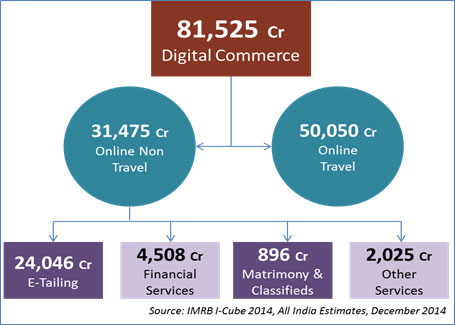
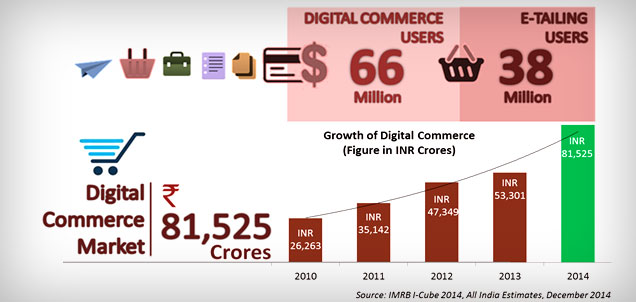
    According to the latest Digital Commerce Report by IAMAI and IMRB International, the digital commerce market was valued at INR 81,525 crores by the end of December 2014, and registered a growth of 53 per cent over 2013. The report further states that the industry is estimated to grow further at a rate of 33 per cent and cross INR one lakh crores by the end of 2015.


    The report also finds that online travel comprised a majority 61 per cent of the whole Digital Commerce pie. Significantly, e-Tailing has grown by around 1.4 times over 2013 and constitute nearly 29 per cent of the overall share.


    According to the findings of the report, Mobiles & mobile phone accessories contribute the most, i.e., 41 per cent (INR 9,936 crores) to the e-Tailing segment followed by apparels, footwear & personal items which contribute 20 per cent (INR 4,699 crores). Consumer Durables along with Kitchen Appliances contribute another 14 per cent (INR 3,404 crores). Out of the remaining 25 per cent, Laptops/Net Books/Tablets, Home Furnishings and Books contribute another INR 2,780 crores, INR 1,059 crores and INR 648 crores respectively.


    The report also finds that 45 per cent of the Online Shoppers prefer Cash on Delivery as a mode of payment. 21 per cent prefer payment through Debit Card and 16 per cent via Credit Card. The other modes of payment include Internet Banking (10 per cent) and other payment modes viz. prepaid cash cards, mobile wallets etc (8 per cent).


    According to the report, the Financial services market has grown at a CAGR of 20 per cent since 2010. In December 2014, this market was valued at INR 4,508 crores. The Classifieds markets have seen a significant growth and are valued at INR 896 crores by Dec 2014.


    Other online services market has grown with a CAGR of 73 per cent since 2010 and was valued at INR 2,025 crores by December 2014. This segment includes emerging service categories like Online Entertainment Ticketing, Online Commuting, Online Food and grocery Delivery. Online Food Delivery market has seen the maximum growth (40 per cent) over the last year in this segment and it is now valued at INR 350 crores by the end of 2014.


  • India’s e-Commerce growth to be driven by digital payments

    By A Correspondent


    The Indian e-Commerce market as of December 2013 stood at INR 62,697 crore though only 25 million of over 231 million internet users transact online. And, security still emerges as the major issue for online transactions.


    As per IAMAI, PCI & IMRB report the digital payments industry is expected to grow at a rate of 40 per cent to reach INR 120,120 crore by December 2014.


    According to Asit Oberoi, Sr. President & COO – Yes Bank, “Though security is a concern for many, it is imperative to point out that the evolving and tech savvy customer today, is more confident transacting online. The digital payments industry is witnessing a steady growth and that goes on to show the acceptance of online transaction.” While global online utility bill payment hovers around 18 per cent, in India it is around 10 per cent.


    Speaking at the 6th IAMAI National Conference on Digital Commerce, Ravi Sundarajan, Chief operating Officer – Webaroo said that China is set to be the world leader in e-Commerce in the next 18 months. “With over 240 million online shoppers, China is set to be the new leader in e-Commerce. In China 6 per cent of retail sales accounts for online shopping and has been growing at an exponential rate in the last ten years and compared to that only 1 per cent of retail sales accounts for online shopping in India.” According to him, “If India has to become a world leader in e-Commerce, mobile apps; sms marketing has to evolve.”


    Speaking about engaging internet users in online retail, Nitin Bawankule, Director – e-Commerce & Online Classifieds, Google India, said, “When Google started GOSF in 2012, 50 per cent of the shoppers were first time buyers. In 2013 GOSF, 55 houses and 285 cars were sold with 40 per cent of the shoppers being women. This clearly shows how consumers are increasing spend on through the internet, though India is way behind when compared to other countries.”


    In the US, there are 245 million internet users and 156 million online buyers, while China has 538 million internet users with 270 million online buyers. Closer home, Sri Lanka, with 3.2 million internet users, has 2 million online buyers and Australia, which is a similar economy to India, has 20 million internet users with 11 million online buyers. Unfortunately, India, with over 231 million internet users, has mere 25 million online buyers.


  • IAMAI unveils digital agenda for new government

    By a correspondent


    Even before the election results are declared, it is believed that Internet and social media may have played a major role in the outcome of the 2014 General Elections, as all major political parties have leveraged the medium to reach out to voters and put across their message and vision for the country. In fact, in 2013, IAMAI, in a report, had predicted that social media would have a very high impact in 160 constituencies, out of a total of 543 constituencies involved in the Lok Sabha polls.


    IAMAI thus believes that whichever dispensation comes to power, will have a strong agenda of growth for the Internet industry. It is in this context that IAMAI has prepared a 100-day Internet agenda for the new government, given the importance of this medium to India’s future and efforts to ensure good governance. While portions of this agenda may require continuing efforts beyond the first 100 days of the next government, the kick-starting of this effort to have empowered and high level policy-maker engagement on these issues is key to ensuring India’s position as an Internet leader. The six point submissions are summarized below and explained in further detail in the agenda paper attached herewith.


    1) Old Laws and New Technology:

    Ensure that Indian laws help Internet platform businesses to have a conducive environment to operate. Carry forward reforms to the rules issued under the Information Technology Act and ensure copyright law allows Indian web developers to innovate


    2) India’s contribution to a connected world

    Create an environment allowing India to be a hub for global data flows and processing and shape India’s global Internet governance agenda in such a way that we drive global consensus to expand its multi-stakeholder administration and its collaborative benefits for our industry and users


    3) Accelerate the growth of meaningful Internet Access for Indian users and businesses

    Existing projects like the NOFN should be accelerated using additional support along with stakeholder review of its strategic plan. Indian broadband policy efforts need to widen their focus to include the promotion of 100 per cent meaningful Internet access coverage in urban areas to bridge the growing deficit there. Telecom policy measures also need to be reformed to promote shared infrastructure models as well as new technologies such as dynamic and shared spectrum, along with removing impediments to large public wi-fi projects.


    4) Innovation

    Safeguard India’s digital opportunities by keeping the Internet open and allowing innovation to thrive. Remove roadblocks to greater investment in the e-Commerce sector and look to understand the regulatory and business hurdles affecting India’s efforts to be a leader in cloud based services. Provide incentives to mobile app technology development and digital finance, along with ensuring regulations are not holding back the growth of these industries in India


    5) Harnessing benefits for Governance

    Establish a focused effort around understanding how the Internet and other technologies can help enable greater information sharing, feedback, and transparency in Government using experts from government, industry, and academia.


    6) Promote Indian venture capital

    Make sure the environment is more conducive for angel investments and other sources of funding used by startups and Internet businesses in India. Ensure India’s financial and commerce policy-makers study the problem affecting the sector and prevent further regulatory roadblocks from developing.

     

  • SMEs deliberate on role of digital in brand building

    By a correspondent


    CMOs at the 10th Marketing Conclave organized by the Internet & Mobile Association of India (IAMAI), were united in their opinion that digital world is on the cusp of finally becoming the leaders in brand building. They concurred that brands are becoming social and digital in attitude as well as in using the media and all this has meant that brands have to use different tools and give up on the tenets that they hold dear.


    Addressing a session “Transformation in the digital age”, Priya Jayaraman,Co-founder and Business Director- Propaganda India said, “Digital medium has become the new way of doing business. SMEs are leveraging business through digital medium most. Today digital medium has changed the way business is done, it has changed the playing field”.


    The session saw marketing heads discuss about how brands are and should be transforming in growing digital age. “Sometimes we do not have control over digital medium. Now digital marketing has become the world of data. It has become the way of life not just the medium. The main focus for any digital marketer should be to make consumer aware that we are accessible,” added Rameet Arora, Director Marketing and PR, McDonalds.


    The first session had panelists discussing about the brand presence on the digital platform. According to them, the digital platform is a double-edgeds word. On one hand it can do wonders to the business while on the other it can scar the brand. The digital platform, most of them concurred, should be used to as a valuable interface instead of flooding the customer with information.


    Speaking at the session “Creating digital first strategies”, Namrita Sehgal,Director – Internet Marketing, Taj Group, opined, “The digital platform has provided an interface for product improvisation. Today, we are taking in to consideration what customer wants in a more effective way and digital marketing helps us to connect directly with the customer. Thanks to this interactive platform, we are able to convince the board on improvisation.”


    K T Poovanna, Head- Marketing, Vodafone Solutions- Emerging Markets,Vodafone Group observed, “Customers should realize that social media is not the place to lodge complaints. For that, there is dedicated customer care services.Digital platform is more for interactive interface on what the customer is looking for and how we can improvise our products.”


    Stressing on the importance of digital medium, Mahesh Murthy, Founder -Pinstorm said, “It is imperative for brands to create a product and services before they use the digital platform. Social media should not be used to promote a product or a brand unless the product is ready and customer service excellent.”


  • Online railway ticket booking witnesses a spurt

    By A Correspondent


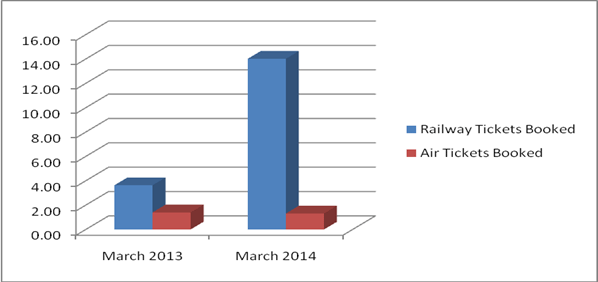
    According to the latest Internet Economy Watch, published jointly by the Internet and Mobile Association of India (IAMAI) and IMRB, the online booking of railway tickets increased from 3.63 million in March 2013 to 14.02 million in March 2014 registering a y-o-y growth of 286 per cent. While online booking of railway tickets grew phenomenally, the air tickets booked online in March 2014 were 1.31 million as compared to 1.40 million in corresponding month last year.


    Source: IAMAI/ WAM Data March 2013-14


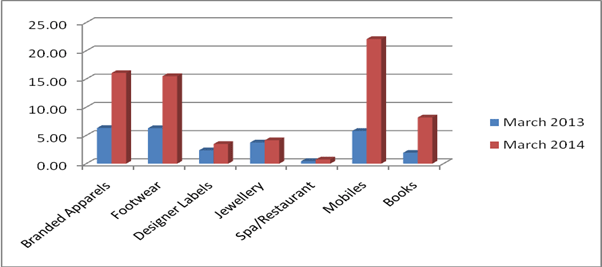
    The monthly tracker also finds a y-o-y growth of 154 per cent in online user visits to branded apparel category. While branded apparels witnessed 16.08 million online user visits in March 2014 as compared to 6.34 million user visits in March 2013, the footwear segment registered 15.51 million online user hits in March 2014 as compared to 6.30 million user hits in March 2013.


    Source: IAMAI/ WAM Data March 2013-14


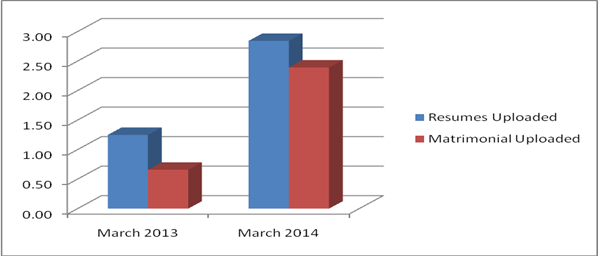
    According to the data captured from major matrimonial sites in the monthly tracker, the number of profile uploads in March 2014 were 2.39 million as compared to 0.66 million in the corresponding month last year. The number of resume uploads increased to 2.84 million in March 2014 from 1.25 million in March 2013.


    Source: IAMAI/ WAM Data March 2013-14


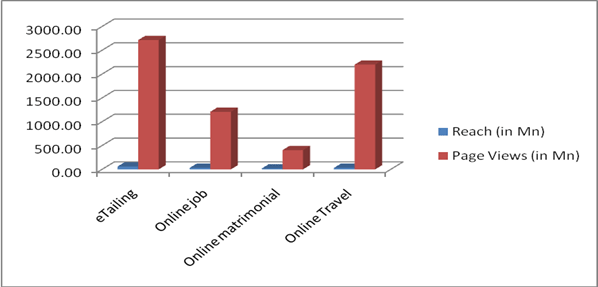
    The monthly tracker further indicates 59.48 million people accessed various e-tailing sites. There were 2714.28 million page views in the category. The user reach for job and matrimonial websites is 31.18 million and 19.86 million respectively with 1209.48 million and 403.20 million respective page views. Online travel segment has reach with 32.13 million reach and 2198.801 million page views.


    Source: IAMAI/ WAM Data March 2013-14


    Sourced from all India active internet data, the monthly internet tracker is based on WAM data captured from various relevant sites, and encapsulates online usage for e-tailing, online travel and vertical classifieds.


  • A million retailers sell online, notes IAMAI

    By a correspondent


    IAMAI has estimated that nearly 1 million large and small retailers make use of online marketplaces to reach out to their customers. These online retailers represent a wide range of categories including electronics, books, apparel, accessories, footwear, jewellery. The presence of such a large number of online sellers testifies to the efficiencies, disintermediation, lower capital costs and deep outreach that online marketplaces provide to the retailers.


    In fact, the association contends that for millions of small sellers who can neither afford an expensive shop front nor has a brand to sell, online marketplaces have come as a boon by giving them a low cost business model, wider market access and as well the support of a well-known brand.


    It is for these reasons that many of the “original equipment manufacturers” [OEMs], apparel, jewellery and other brand owners sell their products exclusively through the online channel. In recent months quite a few OEMs have even launched their products exclusively through online marketplaces.


    Online marketplace have helped the retailers with a physical store to sell across the country creating an employment opportunities for thousands of educated and uneducated Indians. It also gives buyers even in remote areas of the country a wide choice of products to choose from and facility to do comparison shopping at the click of a button.


    Therefore, the future lies in an integrated channel strategy to best benefit the remote consumer and the manufacturer which is a combination of both offline and online retail sales. These two channels do not conflict with each other but complement and amplify each other.


  • IAMAI pledges support to EC directives for election

    By a correspondent


    Following a meeting with representatives from social networking websites in November 2013, the Election Commission has sent a communication to concerned players to enact the Code of Conduct during elections.


    The internet industry and IAMAI has been very appreciative of the EC’s efforts to broaden Indian democracy and conducting efficient free and fair elections through innovative use of internet and IAMAI would continue to support the EC it its endeavor.


    Some of the guidelines that have been issues by EC to political parties include

    – No political advertisement shall be accepted and displayed on the internet and internet based media without pre-certification.

    – Internet sites shall inform the Commission regarding the expenditure incurred by political parties / candidates on political advertisements, when requested for.

    – Internet based media will do active scrutiny to ensure that content displayed by them during the electoral process is not unlawful or malicious or violative of the Model Code of Conduct.

    – In case of any unlawful content coming to the notice of the election machinery and brought to the attention of internet based media, the same would be removed forthwith.


  • Internet accessed most on mobile, says IAMAI report

    By a correspondent


    A report released by the Internet and Mobile Association of India has revealed that about 95 per cent of the mobile Internet users are using the internet to communicate online.


    With the phenomenal growth that mobile has seen in recent times, marketers have begun to adopt it as a one of the primary tools used to generate brand visibility and awareness. Leading marketers at the Internet and Mobile Association of India’s second Email Marketing Summit 2014 were of the view that mobile will be the key driver in coming times.


    Speaking at the Summit, Kalpit Jain, Chief Operating officer – netCORE Solutions, said, “India is expected to have 185 million mobile users by June 2014, and 35 per cent subscribers view their mails on mobile, which provides a huge opportunity to market your products.”


    Stressing on the importance of email marketing, Vivek Gaur, Chief Executive Officer- Yepme said, “With over 290 billion emails sent everyday you need to keep evolving your email marketing strategies accordingly. You have to understand what a consumer wants. People have reservations in getting promotional emails. Communication which goes to the consumer should be relevant.”


    Speaking on relevance of data in email marketing, Naveen Kukreja, CMO & Director- Non Insurance business- PolicyBazaar.com, said, “‘Data has become the buzzword for email marketers. Every brand is sitting on big data for marketing. The need of hour is to make maximum use of that data. Lesser the content and relevant the communication the better it is for marketers.”


  • IAMAI report shows spurt in internet users across verticals

    By a correspondent


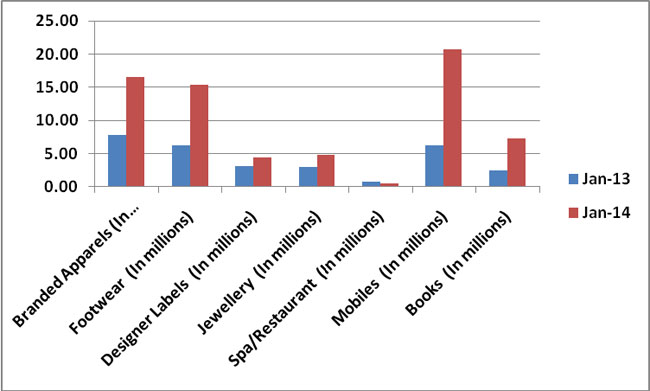
    The latest Internet Economy Watch, a report published jointly by the Internet and Mobile Association of India (IAMAI) and IMRB has noted that the number of online users visiting the mobile segment has gone up from 6.31 million in January 2013 to 20.70 million in January 2014, registering a YoY growth of 228 percent. According to the data captured from major e-tailing sites in the monthly tracker, online visit to branded apparels and designer label segments have increased by 113 percent and 41 percent respectively, when compared to the numbers of corresponding month last year. The online users visit to spa and restaurant segment saw a decline from 0.76 million in January 2013 to 0.54 million in January 2014.


    Fig: 1

    Source: IAMAI/ WAM Data January 2014


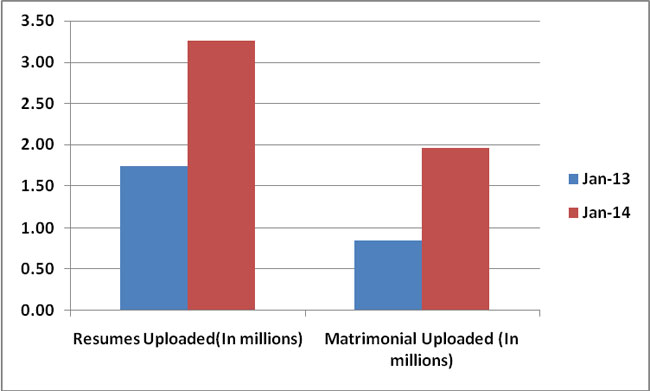
    According to the January data, the number of profile uploads on matrimonial sites also witnessed an increase. Profile uploads on matrimonial sites increased to 1.96 million in January 2013 as compared to 0.85 million in the corresponding month last year, a YoY growth of 130 percent.


    Fig: 2

    Source: IAMAI/ WAM Data January 2014


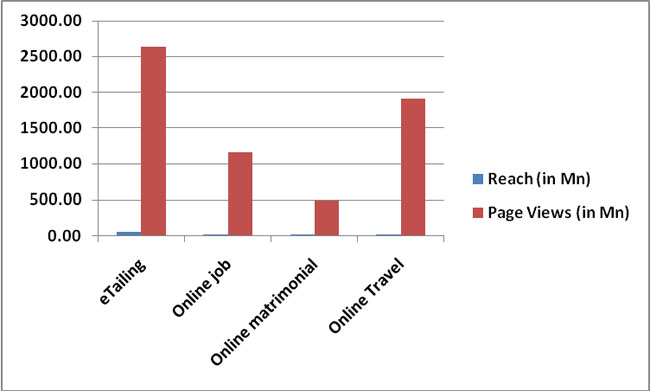
    The monthly tracker further indicates 56.44 million people accessed various e-tailing sites. There were 2641.22 million page views in the category. The user reach for job and matrimonial websites is 29.37million and 18.95 million respectively with 1166.10 million and 495.08 million respective page views. Online travel segment has reach with 29.99 million reach and 1905.77 million page views.


    Fig: 4

    Source: IAMAI/ WAM Data January 2014


    Sourced from all India active internet data, the monthly internet tracker is based on WAM data captured from various relevant sites, and encapsulates online usage for E-tailing, Online Travel and Vertical Classifieds.


  • Local language content could push internet users drastically, says IAMAI

    By a correspondent


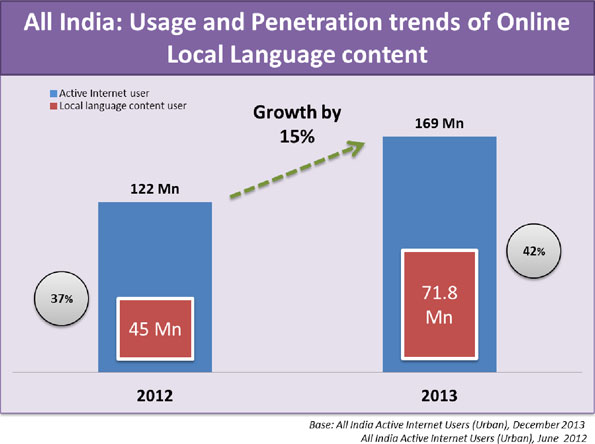
    ‘Local Language Study 2013’ published jointly by the Internet and Mobile Association of India (IAMAI) and IMRB International has predicted that the internet users in India could increase by 24 per cent if local language content is provided on the internet.


    According to the study, in the rural areas 43 per cent of the non-users of internet said they would adopt the medium if the content was provided in a local language while in the urban areas, 13.5 per cent of the non-users mentioned that they would use internet if content is provided in local languages. The report prima facie identifies local language as the single largest driver of internet growth in rural areas. The findings were based on a survey of 35 cities across seven states.


    Among the current users of Internet, the report found the current local language usage penetration among the active internet users is around 42 per cent.


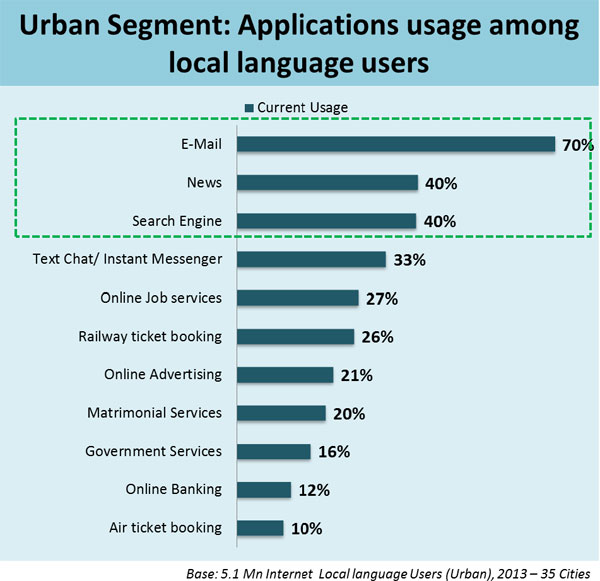
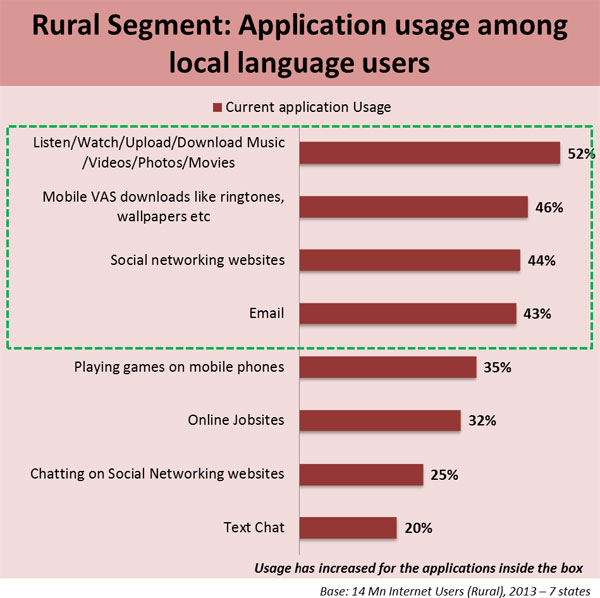
    While the local language content users in urban India are not much different from English language content users with e-mail, News and Search being the main activities, in rural India, however, entertainment, social networking and email remains the primary purpose of using online local language content.


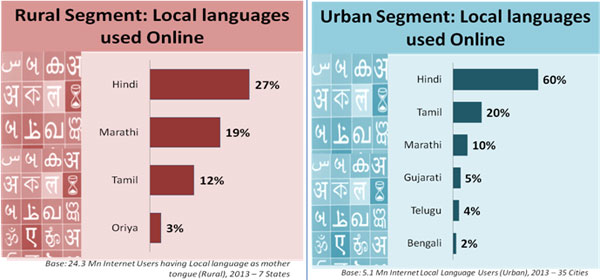
    In rural India, 27 per cent of the users use Hindi to access online content followed by Marathi and Tamil. In urban India too, 60 per cent of the users access online content in Hindi followed by Tamil and Marathi.


  • Online user visit for mobile phones witnessed 162% growth: IAMAI

    By A Correspondent


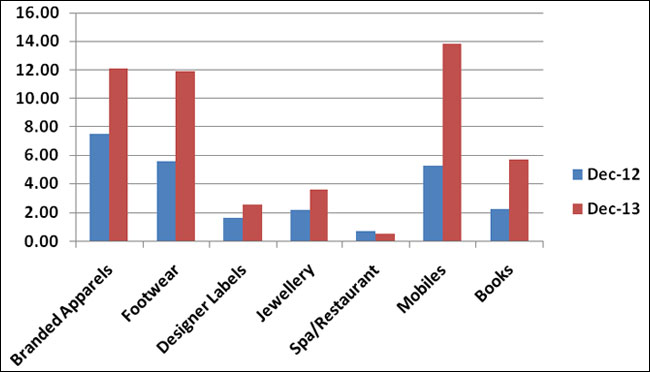
    According to the latest Internet Economy Watch, published jointly by the Internet and Mobile Association of India (IAMAI) and IMRB, the user visit to various websites to look for mobile phones has gone up from 5.26 million in December 2012 to 13.79 million in December 2013 registering a year-on-year growth of 162 percent. While branded apparels witnessed 12.09 million online user visits in December 2013 as compared to 7.45 million user visits in December 2012, the footwear segment registered 113% y-o-y growth in December 2013 when compared with user visits in December 2012.


    Fig: 1

    Source: IAMAI/ WAM Data December 2013


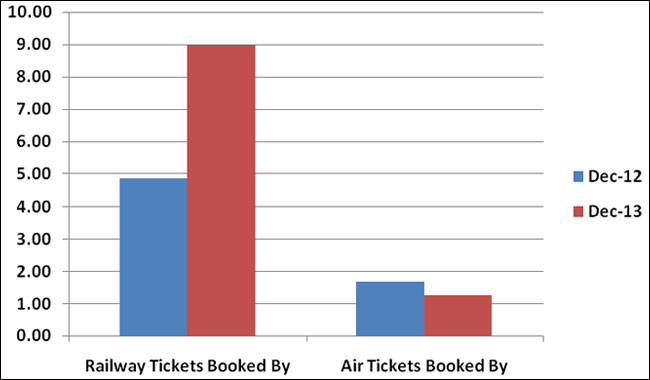
    The monthly tracker also finds a y-o-y growth of 85% in online booking of railway tickets when compared with the numbers of corresponding month last year. Railway tickets booked online in December 2013 were 8.97 million as compared to 4.84 million in December 2012. The online bookings of air tickets witnessed a decrease from 1.68 million in December 2012 to 1.26 million in December 2013.


    Fig: 2

    Source: IAMAI/ WAM Data December 2013


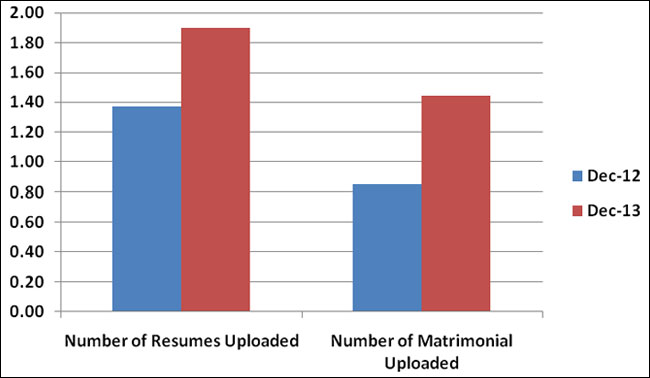
    According to the data captured from major matrimonial sites in the monthly tracker, the number of profile uploads in December 2013 were 1.44 million as compared to 0.85 million in the corresponding month last year. The number of resume uploads increased to 1.90 million in December 2013 from 1.37 million in December 2012.


    Fig: 3


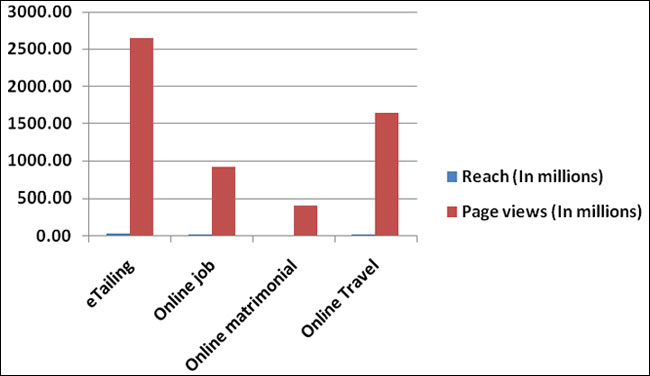
    The monthly tracker further indicates 39.73 million people accessed various e-tailing sites. There were 2648.57million page views in the category. The user reach for job and matrimonial websites is 20.76 million and 15.27 million respectively with 917.01 million and 417.19 million respective page views. Online travel segment has reach with 23.11 million reach and 1650.813 million page views.


    Fig: 4


    Sourced from all India active internet data, the monthly internet tracker is based on WAM data captured from various relevant sites, and encapsulates online usage for E-tailing, Online Travel and Vertical Classifieds.