Tag: IAMAI

  • Web firms fully cooperating with govt: IAMAI

    By A Correspondent


    Following the government’s clampdown on SMSes, social media and its concerns about the misuse of this media by miscreants or anti social elements, the Internet And Mobile Association of India (IAMAI) also urged authorities and citizens to use online tools positively for spreading true and useful information in the current situation.


    “Our members believe that hate speech and other illegal content should be removed when duly notified in accordance with Indian laws. All member companies have been responding expeditiously to requests from various government and law enforcement agencies,” the IAMAI said


    “All our members have been cooperating in the best possible manner to stave off the current situation since last week and we will continue to do so,” stated Dr Subho Ray, President of IAMAI. He further added that any government order to be effective should be based on the present context and not a general order to remove un-contextual or legal content.


    In a related development, the association also welcomed the notification of the government’s policy paper titled “Framework & Guidelines for Use of Social Media for Government Organisations”. With the formal adoption of this paper, the government is now said to be prepared to use social media. It may be recalled that the Department of Electronics and Information Technology has been working on this policy since September 2011 and the final version has emerged after wide consultations and an Open House discussion led by the Honourable Union Minister of Communications and IT.


    The current situation drives home the importance of this paper. It states, “One of the big challenges for government is to avoid propagation of unverified facts and frivolous misleading rumours with respect to government policies. Government must have presence on these platforms to counter such perceptions to present the facts to enable informed opinion making by the populace”.


  • The Anchor: Dr Subho Ray on why the clampdown on SMSes is not the best way to maintain law & order

    By Dr Subho Ray


    #1 Revenue loss for more than 100,000 enterprise customers who advertise through this cost-effective medium and depend heavily on SMS as one of the most important or only medium to reach their potential customers.


    #2 150+ million opt-in subscribers in India want to get the information pertaining to the services/ information/ offers they want and have subscribed to and paid for.


    #3 Members of the IAMAI are registered and responsible telemarketers fully recognised by the DoT / TRAI. We are willing to assure the government that we have a capability to screen content and ensure that no inflammatory message pass through our platform and if it at all does then it is very easy to catch hold of the culprit – the way we have been doing all this while for much less evils (example: promo messages through transactional connects)


    #4 The ban makes sense on P2P messages as the identity of 95 per cent of prepaid mobile subscribers in India is not certain. But P2P messages are the lifeline of the youth; also, P2P messages can be sent from non-operator networks, and mischief-makers can use these channels if they want to.


    #5 As responsible telemarketers, members of the IAMAI are willing to come forward to spread the message of peace.


    #6 Members of IAMAI are not unpatriotic or a greedy bunch of business owners, but want to contribute into the nation’s cause in the best possible manner, responsibly.


    Dr Subho Ray is President, Internet and Mobile Association of India (IAMAI)


  • IAMAI Internet Economy Watch: E-com continues to surge

    By A Correspondent


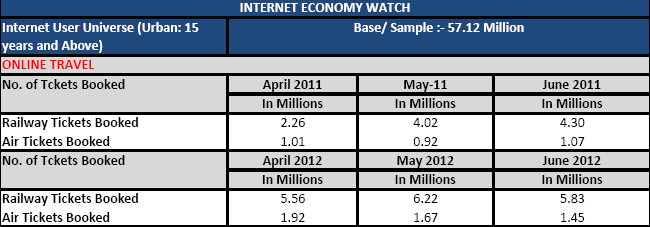
    The Internet & Mobile Association of India (IAMAI) on August 01 released ‘Internet Economy Watch’ for the month of June 2012. According to the findings, the e-ticketing category with irctc.com (Indian Railway Catering and Tourism Corporation) and airlines continues to grow robustly. It recorded a year-on-year growth of 36 per cent as compared to the corresponding months last year.


    As per the findings from the Internet Economy Watch data released by IAMAI (Internet and Mobile Association of India), there has been an increase in online railway ticketing and air ticketing. But figures for matrimonial profile uploads, activities on e-commerce sites and resume uploads on recruitment sites continue to show decline. Interestingly in the April-June quarter, the month of May has seen the highest traffic of online users across categories.


    The Internet Economy Watch data is said to be based on absolute numbers captured from various relevant sites, encapsulating online usage for e-tailing, online travel and vertical classifieds.


    In an email interaction with MxMIndia, Dr Subho Ray, President, IAMAI talked about the factors behind the surge of e-ticketing: “Technological advancement and more and more people getting internet savvy coupled with convenience is the key factor leading to the rise in online booking of train and air tickets. Online tickets can now be booked on the move, through mobile, tablets and of course PCs. A deeper PC penetration in rural areas is also one of the reasons for the rise in online booking.”


    On the takeaways for brands and marketers from these findings, Dr Ray said: “The Internet Watch Report is a recent initiative by IAMAI and is out with its third report. Going forward, the monthly data will help marketers and brands to map the consumer behaviour online and devise their digital strategy accordingly – to be in sync with the online behaviour of the consumers.”


    Besides e-tailing, online travel and vertical classifieds, in the near future IAMAI is expected to introduce newer categories: “Yes, going forward we would be incorporating more segments” added Dr Ray.


    Some of the finding of the report are:

    Online Travel Portals:

    The report states that 5.83 million bookings were registered on irctc.com in June 2012 as compared to 4.30 million in June 2011, whereas airlines witnessed 1.45 million online bookings for the month of June 2012 as compared to 1.07 million in the corresponding period last year. During the quarter April-June 2012, irctc.com registered an all time high of 6.22 million e-bookings in May 2012, while e-ticketing with airlines touched 1.92 million bookings in April 2012.


    Source: IAMAI/ Online Travel Portals


    E-tailing Sites:

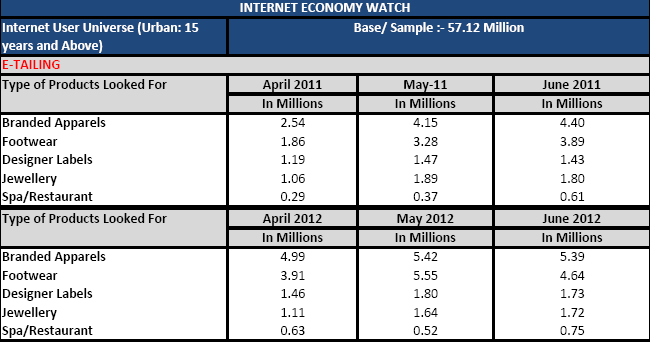
    Data captured from 29 e-tailing sites reports an annual increase in online user visit to spa & restaurant category from 0.61 million in June 2011 to 0.75 million in June 2012, showing a year on year growth of 24 per cent. The branded apparel category witnessed 5.39 million visits in June 2012 as compared to 4.40 million visits in the corresponding period last year. On the other hand, designer labels segment saw a y-o-y growth of 21 per cent with 1.73 million online visits registered in June 2012 as compared to 1.43 million visits in June 2011.


    Source: IAMAI/e-Commerce sites


    Vertical Classifieds:

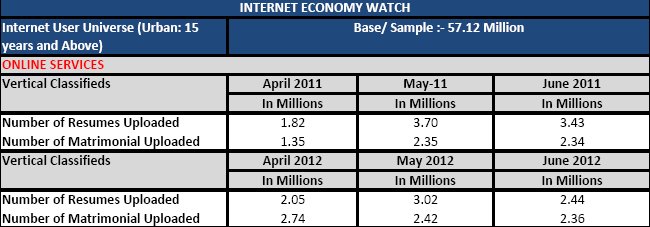
    While the number of resume uploads on recruitment sites has gone down from 3.43 million in June 2011 to 2.44 million in June 2012, the profile uploads on matrimonial sites is marginally up from 2.34 million in June 2011 to 2.36 million in June 2012.


    Source: IAMAI/ Vertical Classifieds


    Online Traffic:

    During the quarter April-June 2012, the month of May has seen the highest traffic of online users with e-ticket bookings at irctc.com, resume uploads on recruitment sites and visits in e-tailing of branded apparels, footwear and designer labels.


    Source: IAMAI


  • Industry remembers V Ramani’s path-breaking work

    By A Correspondent


    V Ramani

    August 1, 2012 will be remembered as a sad day for  digital media as V Ramani, the man who championed the sector way before most others, , passed away. A prayer meeting will be held in his memory at 6pm on August 3 at the Bombay Tamil Sangham Hall in Sion in Mumbai.


    Mr Ramani worked as a media professional for nearly three decades, with years of experience in advertising with stints at Lintas, Draftfcb Ulka, McCann Ericsson, Contract and Euro RSCG.


    Mr Ramani helped establish Internet and Mobile Association of India (IAMAI) and was also the first Indian Cyber Jury Member at the Cannes. He is the Co-founder, Ignitee, and also the man behind the first ever branded programmes (Surf Mashoor, Philips Top 10).


    In 2011 he launched Pariental Innovative Solutions, a full service cross media consultancy and planning company, along with Harminder K Datta as co-founder and principal consultant.


    Remembering Mr Ramani, Ravi Deshpande, Chairman and Chief Creative Officer, Contract Advertising said: “From what I recollect during my brief interaction with V. Ramani at Contract, he was truly a passionate person and a professional who would always be committed to the task at hand. Sadly, today media industry has lost an important contributor.”


    Ishan Raina, MD and CEO, OOH Media remembers Mr Ramani as an outstanding mediaperson and a loyal friend: “He was an outstanding media person with a high degree of intelligence, and a loyal and an emotional friend. He would be remembered for a lot of path breaking initiatives, right from Philips Top 10 which is the first sponsored programme on television 25 years ago to various internet initiatives. But he would also be remembered as a good friend.”


    Said Atul Hegde, CEO, Ignitee Digital Services: “V Ramani was a true trailblazer, always pushing the boundaries to see new ideas come to light. He gave us gems like Philips Top 10; was the first jury member at Cannes for the digital category and always had an eye for great talent. He mentored many a career in the media industry and will always be remembered for making the media function in an ad agency ‘Creative’.”


    Even Twitter was abuzz after media professionals heard about Mr Ramani passing away, Former CMO, Tata Teleservices, Lloyd Mathias tweeted: “RIP V Ramani. A man who embraced digital long before it became fashionable.”


    Karthik Nagarajan, National Director, Social and Insights, Group M tweeted: “Just heard about V Ramani. Feel genuinely down. Rarely happens with someone you knew only professionally.”


    Lakshmipathy Bhat, Advertising Professional, New Media Enthusiast, Vice President, Draftfcb+Ulka - Bangalore tweeted: “Ad Industry veteran V Ramani passes away – he was one of the earliest in the digital space inIndia. Sad.”


    Dhunji S Wadia, President, Everest Brand Solutions, tweeted: “Sad to hear the news of V Ramani. RIP.”


    Faisal Farooqui, Founder – CEO, Mouthshut.com tweeted: “RIP. Ramani was one of the first who loved Mouthshut. Will miss him.”


  • Industry welcomes DAVP plans to embrace digital with cautious optimism

    By A Correspondent


    Directorate of Advertising and Visual Publicity (DAVP), the multi-media advertising agency of the Government of India, in its Annual Report 2011-2012 stated that out of the total value of advertisements released by DAVP, 15 per cent goes to small newspapers, 35 per cent to medium newspapers and 50 per cent goes to big category of newspapers. DAVP also has an audio visual wing which undertakes various advertising or publicity campaigns through various other multimedia vehicles like the television, radio, out of home and now even the internet and mobile.


    In what could be a shot in the arm for the digital industry, DAVP has been conducting pilot projects on websites and through SMSes. According to DAVP’s Annual Report 2011- 2012, 33 of India’s top websites were empanelled for releasing advertisements. In addition to this, more than 110 advertisements via SMSes were also sent.


    Rajan Anandan

    According to Mr Rajan Anandan, VP and Managing Director, Google India: “This is a welcome development for the entire digital advertising industry. With over 120 million Internet users in the country, digital is already the third largest advertising medium in terms of revenue in the country. It’s too early to talk about the impact, but it’s definitely a step in the right direction as the overall marketing/advertising approach is making a shift to being more accountable and measurable.”


    In fact on July 26, The Sectoral Innovation Council by the Ministry of Information and Broadcasting submitted a list of recommendations to the Minister of Information and Broadcasting, Ms Ambika Soni. One of these recommendations stated: ‘New Media should be utilised for media campaigns by the government’. In addition to this, it also recommended that ‘E-mode transactions should be a priority for the functions of DAVP, RNI, CBFC and licensing activities of the Government for ensuring transparency’.


    Arpan Chatterjee

    Mr Arpan Chatterjee, online media professional and consultant with webdunia.com noted: “This is a logical extension by DAVP to focus on digital media, which is generating a critical mass in the country. It is to be noted that DAVP started digitization of its own system of issuing release order and payments to media companies over a year back and the fact that it is now looking at digital media more seriously was only a matter of time. DAVP’s move to enter the digital media will only add to the importance of the digital medium, but how it uses the medium is something one has to wait and watch. DAVP ads can also help create certain guidelines for internet advertising in India, which currently is self-regulated.”


    Even before these recommendations were made by the Sectoral Council, the IAMAI (Internet & Mobile Association of India) is said to have lobbied hard to bring a shift in the government’s approach towards digital media. The IAMAI is also said to have played a key role in getting the mobile SMS aggregators empanelled.


    Dr Subho Ray

    Dr Subho Ray, President – Internet & Mobile Association of India (IAMAI) explained: “Today with 100 million internet users and growing every day, digital is the most cost effective way to reach out to youth and, through them, their parents. The engagement with internet and mobile of the youth is very deep and the relevance of the message too gets transmitted on this medium. Young urban voters aged between 18 and 35 are a major constituency today for all political parties. And the internet, whether through mobile or PC, has surfaced as the best medium to reach this group.”


    DAVP recently revamped its website with an aim to make it user-friendly, it has also adopted digitization by issuing release orders and payments to media companies online. In fact the Ministry of Tourism is said to have been one of the early adapters and a large advertiser online. While these developments also show the government’s willingness to use digital, nevertheless what remains to be seen is how effectively the medium is used by the government in the long run.


    Mr Gyan Gupta, CEO, Dainik Bhaskar Digital Division pointed out that although these are good recommendations and a welcome step, it all depends on how much DAVP is willing to spend on digital. Just like any other medium, digital too needs a sizable ad spend: “DAVP has started this process last year and the trial is still on. Although this is a fantastic move, the question really boils down to how much is the government willing to spend on digital? What will be the ad spend from DAVP on digital? Digital today has become the third largest medium with increasing reach – it has become a medium which cannot be ignored. But, if the government is not willing to spend a sizeable amount or if each publisher does not get a decent money or ad revenue then it is not worth it, it will be irrelevant.”


    Mr Gupta too had a set of recommendations for the DAVP, which is said to have had a consensus among the other local language publishers: “First, they have to look at the categorization of the website very clearly and second, DAVP must also ensure that enough volume of advertisement is pumped into digital.”


    Now that more and more people are gaining access to the internet and spending more time online, not just in urban but also in rural India, perhaps the government has realized that it is a medium it can no longer ignore. With the 2014 general elections fast approaching, the government is expected to increase its advertising spends in order to showcase its achievements and with the Council’s recommendations to use digital, the government could well use digital extensively to reach out to the youth.


    Mr Upen Rai, Director, Times Internet Ltd, observed: “By bringing digital publishers into the DAVP fold, the signals are very clear from I&B ministry that it is digital all the way. With e-filing of taxes and other e-govt frays including Passport Kendras, it was a matter of time! Next stop would ideally be its relevance to general elections, yes this time around social, and digital will play a large part… Watch out for this space…”


    The 2009 Lok Sabha elections or general elections saw political parties advertising online and the next general elections could well see political parties further increasing their spends online.


    BG Mahesh

    Mr BG Mahesh, Founder and MD, Oneindia.in said: “Considering the contribution of Government ads in Print and TV channels, if the similar importance is given to the digital medium, it will be a very good sign for the Digital industry. It will not only fuel the higher growth rate for the digital industry, but will also provide the government a better connect with youth of country who spend a lot of time on Internet. Furthermore, if DAVP also extend the digital spends to mobile internet, the reach would be much broader as today phones with internet connections, or smart phone, start from as low as Rs5,000 and their dependence on electricity is very less as compare to desktop/laptops.”


    So, how would the youth of today react to government advertisements? Will it have any positive impact on them? Ms Chhaya Balachandran Aiyer, CEO and MD, BCWebWise said: “Awareness will increase, and we can pave the way for a betterIndia. We will see more open forums, debates and discussions. There are perils of uncensored content, at the same time, and this is something India needs today.”


    Chhaya Balachandran Aiyer

    So, while the industry has welcomed the Sectoral Innovation Council’s recommendation that the Government must utilise the new age media for its media campaigns, there is a cautious optimism among industry players as far as ad spends in the medium is concerned.


    Mr Anurag Gupta, MD, DGM India stated: “Government spending should be seen in the same light as spending by any brand. A marketer spends his monies where the users are, and if users are online then the best way to reach them is by advertising online! Any online media consumer whether it is youth or the older people will react to online advertising by the Government in pretty much the same manner as they would seeing the same ad in print or on TV.”


    Anurag Gupta

    Nonetheless if the government approves of these recommendations and does increase its digital ad spends, it would be a major boost for the entire digital industry particularly for increasing the digital advertising revenue. Currently, DAVP ad spends seem majorly skewed towards print and, to an extent, even television. However as the government increasingly uses the new age medium, what kind of implications digital advertising may have on DAVP ad spends only remains to be seen.


  • IAMAI: E-commerce witnesses upward swing

    By A Correspondent


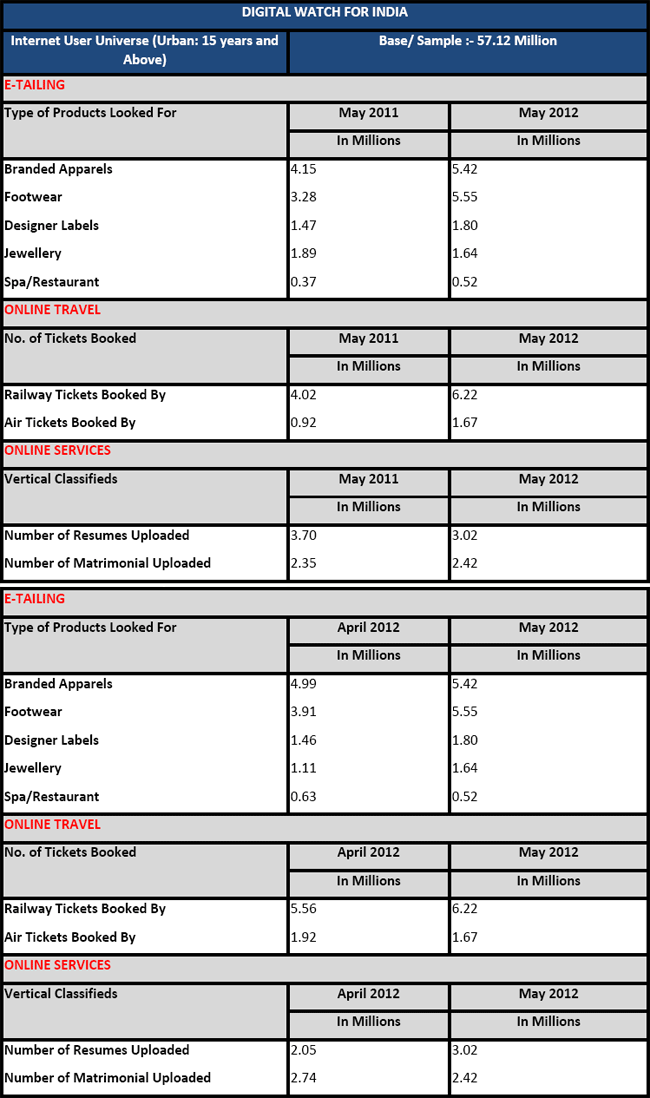
    There has been a surge in the e-ticketing category of the Indian Railway Catering and Tourism Corporation Ltd (irctc.com). In May 2012, IRCTC recorded over 6.22 million bookings as against 4.02 million bookings in May 2011, thus witnessing a year on year growth of 55 per cent.


    While there has been an increase in online railway ticketing and online air tickets, matrimonial profile uploads and activities on e-commerce sites; there has been a slight decline in the number of resume uploads on recruitment sites. These are some of the findings from the Internet Economy Watch data released by IAMAI (Internet and Mobile Association of India).


    The Internet Economy Watch data released is said to be based on absolute numbers captured from relevant sites of verticals encapsulating online usage for e-tailing, online travel and vertical classifieds.


    Besides the online railway tickets bookings, the data also reveals that there has also been an increase in the online air tickets as well. The booking of online air tickets is said to have witnessed an increase of 82 per cent year on year wherein on May 2012 online air tickets received 1.67 million in May 2012 from 0.92 million of the corresponding month last year i.e. 2011.


    Source: IAMAI/ Online Travel Portals


    Vertical Classified Sites:

    Interestingly, the number of resume uploads on recruitment sites have seen a slight decline in May 2012 as compared to the resume uploads in May 2011. Resume uploads on recruitment sites declined from 3.70 million in May 2011 to 3.02 million in May 2012. The resume uploads in April were however 2.05 million. The data captured from 28 online matrimonial sites however shows an annual increase in matrimonial profile uploads from 2.35 million in May 2011 to 2.42 million in May 2012.


    Source: IAMAI/ Vertical Classified Sites


    E- Commerce Sites:

    The study shows there has been an increase in user visits to branded apparel and footwear sites from 5.42 million and 5.55 million visits respectively in May 2012 as compared to 4.15 million and 3.28 million visits for the corresponding month last year. While the designer label segment has registered 1.80 million visits in May 2012 as compared to 1.47 million visits in May 2011. The jewelry category has witnessed 1.64 million visits in May 2012 as compared to 1.89 million visits in corresponding month last year.


    Source: IAMAI/e-Commerce sites


    Compared to April 2012, there has been a significant increase in e-ticket bookings at irctc.com, resumes uploaded on recruitment sites and visits in e-tailing of branded apparel, footwear and designer label segment in May 2012. On the other hand, there has been a notable decrease in online booking of air tickets and profile uploads on matrimonial sites in May 2012 as compared to April 2012.


    Source: IAMAI


  • Innovation is the key to enhance online travel & tourism industry

    By A Correspondent


    The online travel & tourism industry is set for unprecedented growth, provided payment and logistic issues are resolved. Speaking at the 4th IAMAI Travel & Tourism Summit, Himanshu Singh, Managing Director, Travelocity India & Chairman, Digital Commerce Committee, IAMAI, said: “The total travel market is around $800 billion and the online share is growing rapidly. Payment and logistics still pose a challenge and success parameter of business is about cracking these problems. These problems that we are facing today have to be countered by all players of the industry together, and this will help the market grow exponentially.”


    As per IAMAI ‘Internet Economy Watch’ data, e-ticketing continues to grow with irctc.com recording 5.56 million bookings in April 2012 as compared to 2.26 million bookings in April 2011. Airlines recorded 1.92 million bookings in April 2012, as compared to 1.01 million bookings in April 2011. The data for online travel is based on absolute numbers captured from nine websites.


    Speakers at the summit were united in their view that while, at present, group travel is the key to growth, the future will be more for the individual traveller. Sharing her thoughts, Swati Moha, Vice Pesident – Programming & Operations, Fox International, said: “While group travel is in vogue, there is a huge spurt in customized individual travel interests. People are looking for less explored destinations than before and with internet penetration on the rise, the industry is set for robust growth.”


    Globally travel & tourism market is pegged at about US$ 800 billion but the online market share has not reached its optimal point. With internet users inIndiaat around 121 million, focus is now to create a solution for travellers to plan travel online. “Innovative marketing strategy coupled with value additions will sway travellers to book hotels and tickets online”, said Devdutta Banerjee, Regional Director – Revenue Management, India, Bangladesh and Nepal, Starwood Hotels & Resorts. He added: “Online is the platform for growth. Integration of logistics and services is necessary to fuel further growth.”


  • Internet as a media has arrived: Hitesh Oberoi

    Hitesh Oberoi is  Chairman- IAMAI and CEO and Managing Director, Info Edge. In conversation with MxMIndia’s Robin Thomas on the sidelines of the IAMAI’s marketing conclave recently, Mr Oberoi spoke about the changing dynamics of internet and mobile in India, the trends to watch out for and much more.


    For long we have been referring to internet as a new medium. Would you still regard the internet as a ‘new’ medium?

    I don’t think internet is a new media any more, but a media which has arrived. There are already more than 120 million online users and this number will grow to 400 million in the next three to five years. Therefore, I don’t think internet is a new medium any more nor a medium that can be ignored.


    Has there been a shift in perception over the years among advertisers about the internet and mobile as media vehicles?

    Advertisers are definitely taking the internet a lot more seriously today simply because of the growing number of online and mobile users. With the kind of targeting options and the kind of measurement options, the internet offers have brought more and more advertisers on board. In addition to this, the internet is not only one of the cheapest medium to advertise but, also provides better ROIs to advertisers. So certainly these are some of the factors leading more advertisers to the internet.


    What about a credible measurement system? Why do we lack still one today?

    There are some challenges, there are different methods used by different measurement providers but, I think they realize that internet is getting big in India and are, perhaps, working towards a better measurement system. So very soon we should have a credible measurement system in India.


    What according to you are the opportunities and possible threats or challenges that 3G and 4G services could have for mobile advertising in India?

    As the internet grows faster, people will spend more and more time on the internet. Penetration and the speed of access are the two things needed for bringing in more people to mobile internet. What 3G and 4G will do is, improve the speed of access and when the speed of access increases, a user will be able to download content faster. So, a combination of faster internet on mobile, quick downloads, and good quality content and so on will lead mobile internet to a different level altogether.


    And the lessons that India can learn from their international counterparts on internet and mobile advertising?

    One thing we should be investing in is the internet economy. The truth is that internet is a great medium for consumers, and it is a great medium for small and medium enterprises to build their business. Internet is a great leveler of the two India’s (urban and rural). Just as the telecom revolution which has led to people being empowered, the same could happen on the internet. So, I think the lesson we can learn from the United States and China is that we need to invest more and more in broadband and we need to make it cheap for people, so that many more can get onto the internet.


    Any specific trends to watch out for in the digital media space?

    There will be many more people on the internet five years from now, Indians will spend more time on the internet and probably they will spend most of their time online, therefore, marketers cannot afford to not be online. In fact, a lot more access to internet will take place through mobile phones. So while in this phase, more people are accessing internet through their PC or desktop, the next phase of internet growth will come from mobile. Therefore, marketers need to adapt to these changes accordingly. These changes may take a while but, undoubtedly digital is the way forward.


  • Digital is the way to go, but…


    By Robin Thomas


    Consumers in India are evolving rapidly from print and radio to television and now digital. Just when you thought that digital was all about display advertising, bulk SMS, search, email advertising and online classifieds, in came the social media, video advertising, smart phones, tablets, apps, mobile advertising and so on.


    According to industry estimates there are 120 million internet users in India today, of which almost 30 per cent are from small towns. While India’s broadband internet penetration is still low, it is believed that the next phase of growth in internet will come from mobile users which are estimated to be over 800 million.


    As more and more youngsters gain access to various digital platforms, there is a greater need for marketers to not only engage the young consumers, but they must also be able to give them a unique experience across the digital platforms. The IAMAI (Internet And Mobile Association of India), which held its 8th Marketing Conclave, 2012 – ‘Digital Marketing 3.0’ on April 13 in Mumbai, extensively discussed the role of social media, video advertising and mobile advertising in the near future.


    Using Social Media:

    Today most companies have multiple social networking sites – Facebook, Twiter, LinkedIn and others. There are separate teams handling social media marketing for the company, but, are brands listening to their consumers? Do they interact and respond to queries and complaints? Do marketers understand the social media and know how to monetize it? Or are brands simply satisfied with the number of ‘Likes’ and views they generate on their social networking sites?


    Karthik Nagarajan, National Director, Social and Insights, Group M was of the view that unless one is not ready and mature enough as an organisation for the medium, the organization must stay away from social media.


    According to Usha Sangwan, Executive Director, LIC India, what brands lack today is the courage to be transparent, they don’t respond to negative feedback and fail to turn the customer as an advocate of their product. “Brands must not see social media as a mere marketing tool and limit to generating numbers alone, but social media must be used mainly for connecting with the TG and co-creating the product. Brands must try and understand their TG and become a part of their customer’s day to day life.”


    Virginia Sharma, Chief Marketing Officer, IBM India hit the nail on the head by stating that brands must have the ability to admit their mistake and apologise to the customer. She admitted that while there is a certain amount of fear among brands to apologise for a mistake committed because it may lead to negative public opinion, but felt it is always better to apologise and rectify the mistake which could lead customers to becoming an advocate of the brand.


    Vinay Bhatia, Customer Care Associate and Vice President Marketing and Loyalty, Shoppers Stop added that it a company’s reputation is harmed only when it fails to act responsibly to a complaint made, and not when it apologises for a mistake and tries to rectify it. “The problem with the companies today is that they make policies as if the consumer is a criminal. Accepting a feedback and acting upon it will not harm the brand but, if one chooses to remain silent about a complaint, that’s the worst one can do to his brand.”


    Leveraging Mobile Advertising:

    Besides the social media, mobile advertising is another challenge faced by marketers who have more or less failed to leverage the small screen. Sadly, mobile advertising is largely limited to only SMSes. Marketers are said to often mistake mobile as an extension of broadband internet and as a result they fail to give their consumers a unique experience on mobile.


    Speaking from a marketer’s point of view, Ajay Kakar, CMO, Financial Services, Aditya Birla Group stated that although the potential for mobile advertising is high, there is still a section of people who have not seen the mobile as an opportunity. He added that mobile industry must follow the ‘Jo dikhta hain, wahi bikhta hain’ policy and evangalise the benefits of mobile advertising. “Content is very important, don’t tells me about your brand, but tell me what’s in it for me? Give me the case study of successful mobile advertising. What I want to know is how much money mobile advertising is making for my brand and for my business? What you must do is to stop saying ‘buy me, buy me’ but, instead tell me ‘why me, why me’?”


    With the introduction of 3G and now 4G services, mobile internet is expected to be faster and with high quality content, better mobile applications, much better video and much more. In addition to these, smart phones and tablets are also said to play important roles in the growth of mobile internet in India.


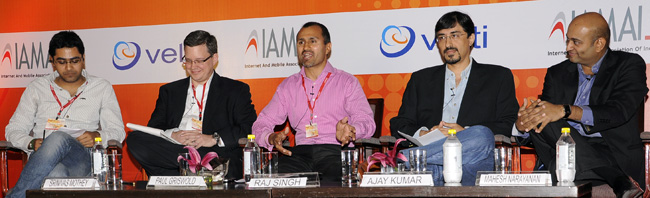
    Mahesh Narayanan, Country Head-Mobile, GoogleIndiasaid that there is not only lack of understanding about mobile advertising, but also lack of discussion about mobile as a medium in board room meetings. “The consumer shift is already happening from traditional media to mobile; however, great amount of content for mobile is yet to be created. People are looking for your brand on their mobile phones but, ironically brands are absent on mobile.”


    While mobile subscribers will continue to grow and more people will access internet through their mobile phones, the challenge lies in monetizing the medium and to find newer ways to reach out to consumers besides SMS advertising.


    Paul Griswold, Director Product Management, Mobile Marketing, Velti was of the view that mobile is not treated as an integrated part of marketing strategy, but is seen as an extension to online. “There has been a failure to take the advantage of the one on one interactivity mobile offers and just sending SMS is definitely not the way.”


    The participants outlined not only the problems but also possible solutions. According to Srinivas Mothey, Head Mobile Marketing and Advertising, One97, the first step is to educate advertisers and agencies about the benefits of mobile advertising. Although every advertiser may have a different view about the medium, nevertheless they need to be encouraged to invest in mobile. “We are also encouraging advertisers to create mobile assets and not just mobile apps. We are beginning to see the positive results but, in order to see more results, it may take some more, but the first step needs to be taken.”


    Video Marketing:

    Video advertising/ marketing is not a new phenomenon for marketers. Traditionally, marketers are said to be comfortable with video and we have been seeing that on television, and will probably see the same, and in a much bigger way, online and on mobile in the near future.


    According to Debadutta Upadhyaya, Vice President, Vdopia Media, there has been over 50 per cent growth in video consumption in the last one year alone, the fourth largest globally. “Unlike other countries,Indiahas made the leap from web to email to social media and now video. There is still a long way to go on the creative aspect because the primary advertising medium of a creative agency has always been television, so creativity in video advertising is bound to take some time.”


    As India’s broadband penetration and mobile internet accessibility increases, it would be just a matter of time when video marketing would explode inIndia. Besides online, with 3G and 4G services, video consumption on mobile should be an altogether different experience for users and marketers.


    But Shubhranshu Singh, Marketing Director-IndiaandSouth Asia, Visa cautioned: “There is a difference between video on web and video on mobile, and the difference between the two is galloping ahead in terms of content. Perhaps the youngest audience in our country today will watch television online for the first time which could be an opportunity or a threat if we are not ready for it.”


    Digital marketing in itself has become 360 degree for marketers. It has gone beyond display and banner advertising, to becoming more interactive and innovative to reach out to consumers. Digital marketing, as the industry players pointed out, is in a transition phase from web, to email and now brands are trying to reach out to their customers through social media, mobile and video.


    Marketers must stop considering mobile internet as an extension to online and, therefore, give mobile users unique experience of mobile advertising. Social media must not be seen as a mere marketing but, a medium to interact with their consumers, know their behavior and be a part of their day to day life.


    Brands must be receptive to both positive and negative feedback of customers, admit to their mistakes, apologise to the customer and rectify the fault. Digital marketing will undoubtedly grow but, marketers must first be evangalised not only about the benefits of the medium but, also ways and means to leverage it.

    Imaging: Rafiq

     

  • Digital Summit: Social media and content consumption

    By Shruti Pushkarna


    Day 2 of the 6th India Digital Summit organized by the Internet and Mobile Association of India (IAMAI) began with an informative session on where social media stands today. The session also touched upon some legal nuances with reference to the recent controversy on freedom of expression online.


    Social Media: Whose Food, Whose Poison?

    The panel consisted of Pawan Duggal, Advocate, Supreme Court of India & Cyber Law Expert, Pranesh Prakash, Programme Manager, Centre for Internet & Society, Shubho Sengupta, Digital/Social Consultant & Integrated Marketing Council, Coca Cola and Supriyo Gupta, Founder, Digilogue Communication. The session was moderated by Pradyuman Maheshwari, Editor-in-Chief & CEO, MxM India.


    Cyber law expert Mr Duggal started by outlining for the audience where the law stands on freedom of expression as far as the online medium is concerned. He agreed that as per the Constitution, every citizen has the right to freedom of speech but this is not necessarily an absolute right. The recent amendments in the law have changed quite a few things in cyber law jurisdiction; the most important being the introduction of the term ‘intermediary’. As an intermediary if one does not comply with the law, and allows inappropriate/offensive content to be published online, one can be exposed to both civil and criminal liability, depending on the case in question. While Mr Duggal agreed that there is no escaping the law, he also emphasized on the need for organizations like the IAMAI to step forward and ask for amendments to be made to the almost ‘draconian’ IT Act.


    For Pranesh Prakash the picture seemed grimmer than it’s painted out to be. He cited some examples of how the law is formulated in the country in a ‘cut & paste’ manner rather than with a proper understanding of the larger issue at hand. He expressed concern over how in the physical world law catches up in a very different manner as compared to the virtual world. He said, “Police can’t just walk into a bookstore and remove a book saying it is obscene, there has to be a valid court order banning the book. Then why should the likes of Facebook, Twitter etc. be held responsible for which they are not…”


    Intermediaries, said Mr Duggal, “…are not supposed to use their mind or judgment over an issue. They should just act upon a complaint or government’s advice.” It is when the intermediary starts using his/her judgment, that problem arises.


    According to Supriyo Gupta, the issue of intermediaries is not as big, rather it’s just a flawed process in a developing law. He noted, “The issue of intermediary is going to be a short lived one…the larger issue is that one has the right to publish but does one understand what it carries with it?” He said there is a need for companies to think whether they are going to be able to fix the way people are using social media, whether they use it responsibly or not.


    Talking about whether despite all controversy, social media is still the place for brands to be in, Shubho Sengupta was of the view that social media and brands don’t go together. He said, “Social media and brands aren’t an easy fit, and brands don’t understand this. What social media does is that it creates opportunity for two way communication. Brands need to understand that it’s (social media) the consumer’s world, and brands that are doing well in this space have taken cognizance of this fact that in social media space, consumer is the king.”


    The session concluded with all panelists agreeing with the fact that the law needs amendment and the government needs to be sensitized that for businesses to grow, legislation will have to be minimal. But unfortunately as Mr Duggal mentioned, “In an environment of coalition politics, amending the IT Act Is not a top priority.”


    Moving from Memorable to Meaningful

    The session started with a keynote by Anthony Rhind, Co-Global CEO, Havas Digital, and it was moderated by S N Bhaduri, Country Manager-Consumer Media, Thomson Reuters.


    Mr Rhind , in his presentation, stressed on the fact that we all live in an extremely well connected world, where consumers are influenced by choices and validations more so because of the growing social media experience. In such an environment, where consumers have ample choices to choose from, and where they also have the ability and option to avoid all kinds of communication, the big challenge faced by companies and brands is to engage the consumer at an all new level. For this to happen, Mr Rhind emphasized the need for data integration. He said, “Consumers are most likely to share their experiences post-purchase, especially if the experience is negative…” So there is a need for companies to target consumers in a more relevant way, and once that happens, more involved customers will influence a larger group. To target relevant consumers, it is important to ‘integrate and interrogate’ user-level data. Once you have the required data, companies can target the customers with personalized, more creative messages which will enable and encourage ‘dialogue’.


    So data integration is important to bring about more meaningful ways of targeting the consumer.


  • Digital Summit: Business in the time of the cloud

    By Akash Raha


    The second day of the Sixth India Digital Summit hosted by IAMAI and Ministry of Information & Technology got underway in Delhi on January 19, 2012. The last day of the summit featured a wide array of discussions and debates between prominent members of the industry.


    Leadership Session 3: The connected home: devices and service revolution

    In the current scheme of things there is a proliferation of newer devices. Each and every day there are a plethora of newer devices coming in the market. To support all these devices a new service industry came up to support them. The session spoke about the nexus of devices, connectivity and the service sector in the back drop of the nuances of the industry, such as security.


    The session was chaired by Mr Sanjay Trehan, Head MSN India, Microsoft and the stage along with him was shared by Mr R Sivakumar, Managing Director, Intel South Asia.


    The discussion started off with Mr Sivakumar talking about the connected home. He said that the times have changed from connected homes to connected life. Earlier, Home was where the first use of technology begins. We have been using technology over the past decade without knowing about it. But some of those ideas are fast dissipating as our devices are no longer wired and we can move outside the periphery of our house and hence the idea of connective life.


    As technology has developed, the proliferation of devices too has increased. He said that the technology in the future will be dominated by three screens out of all the new devices based on convenience and ultra mobility – smart phones, netbooks and large television screens.


    He spoke about the growth of ecommerce and gave the example of the Indian Railway site irctc.co.in which does business of Rs 500 cr each month. The service provided is getting more sophisticated and more available as time goes by. With proliferation of device and connectivity, services provided online are increasing.


    When posed a question on security threats by Mr Trehan, Mr Shivakumar said that the security capabilities are still at its early stages and have to be built on. In terms of new technology, the bogey that we often ride is the talks of national security. National security and integration of security protocol is very important and yet there has to be ways to streamline the whole process and allow newer technologies to come in.


    Power Panel 7: Cloud Cluedo – Solving the mysteries surrounding the cloud

    The following session tried to unveil the mystery of cloud computing technology. Even though everyone in the technological domain are talking about this technology and its use, few people know about the intricacies of it, which the panel tried to unveil. Cloud computing gives one the ability to put business applications on the ‘cloud’ which would then make it possible for the users to access it from wherever he or she wants to.


    The following session was moderated by Manoj Chugh, President India & SAARC, EMC Corporation while the panelists were Mr Fredric Moraillon, VP – Marketing, Asia Pacific & Japan, Akamai Technologies and Rajnish Menon, director – ISV & Cloud Strategy, Microsoft.


    In his opening remark Mr Chugh explained that there are various kinds of clouds, such as Private Clouds and Public Clouds… Moreover, there is a whole mix of these clouds which gives rise to Hybrid Clouds of all shapes, sizes and colors. Cloud computing saves cost of infrastructure and will help businesses grow in the future, thereby creating new job opportunities. Moreover, while the old skill sets are going to remain important, new skill systems are needed for Cloud.


    According to sources, 50% of the cost of infrastructure can be saved when a business employs and moves their infrastructure to the Clouds. The initial cost of the infrastructure will depend on what kind of a Cloud it is. No two clouds are alike and clouds constantly grow and make newer clouds.


    Mr Menon explained to the audience that Cloud is very useful as it standardizes IT capabilities. To show the efficacy of cloud, he pointed out how all the fortune 500 companies have some sort of Cloud or the other. The point is, that Cloud is already here and is all pervasive.


    The next question that Mr Menon talked about is, is Cloud secure? The answer that he proposed was, yes, it is one of the most secure one as authority is given to only one or two who can see all the data. For those who wondered how costly cloud is, Mr Menon told that “Cloud is really cheap, but it depends on what applications you are using etc.”  In terms of regulation, currently, there is no cloud law in place in India and it is all about interpretations of the other existing laws.  Cloud computing has therefore become a new way in which one can deliver and consume IT.


    Talking about the cloud, Mr Moraillon said “From the Cloud perspective the consumer and the business are constantly merging.” He said that one can put anything on Cloud…But the question is what do you want to put on the cloud but the question is what the security level you have to secure that data is? Information is of value and it is important to keep it in the vault. But yet Cloud is useful as it is helpful and makes work and processes much easier. “You can do a campaign, a budget, file travelling expenses etc… Cloud can do all of that very easily and efficiently.” Today, one feels disconnected when ones hard disk crashes – a lot of hard work goes away, but such a thing does not happen with Cloud as the data will be present and secure on the cloud.


    The three important aspects which Cloud is efficient on is Time, Money and Labour; Wherein, it saves time and money, and allows employees to work just the way they want to work, from wherever they want. In the modern times markets are extremely fragmented and clouds helps adapt, open newer avenues to connectivity and the way work is done. The only possible concern that some businesses still have today is that of accessibility and security, however, cloud is developing and is developing fast. It is imperative that businesses move to cloud to be successful in the future.


    The panelists explained that one should move easier process on the cloud first and then go on to bigger process which have legacy and are relatively harder to move. But to start moving to the Cloud, maintained all the panelists, is essential.


    Power Panel 8: “To be or not to be an Entrepreneur”

    Being an Entrepreneur and building a business out of the scratch is never easy. In the current session the panelist discussed and talked about their difficulties in becoming successful Entrepreneurs. The talked about their experiences and shared their visions with the crowds.


    For many, starting a venture was a triggered by their situation, for some it was a choice and for the rest it was a mix of the two. The session was moderated by Manish Vij, Founder and CEO, Vun Network. The panel members for this session were Dhruv Shringi, Co-Founder & CEO, Yatra.com; Dinesh Aggarwal, Founder & CEO, IndiaMart; Rishi Khiani, CEO, Times Internet and Anisha Singh, Founder & CEO, Mydala.com.


    Mr Shringi said that currently the entry barrier is low to get into the business and it is a very good time for people to get into the business as the growth rate is good. Yet, Mr Aggarwal warns that people should not get into the business just because there is opportunity and growth. What is really required is a will to do ecommerce.


    To start off a business, funding is an important issue… Ms Singh pointed out that to garner funding and make profit eventually one has to have conviction in once business. Funding is tough and one has to have the ability to convince the investor, moreover, immense trust in once own vision is required.


    A few of the members in the panel also had a co-founder and investor… Talking about the aspect, Mr Khiani said that it not important that your partners are like you and think like you, but it is important that they have the same vision as you and believe in the product as much as you do.