
Tag: IAMAI

  • The Future of Digital India lies in Voice, Video & Vernacular


    By Indrani Sen


    Indrani SenThe IAMAI-Kantar ICUBE report published in 2020 predicted that internet users in India would increase by 45% between 2021 to 2025 and will touch 900 million. The report also made a forecast that the growth will be driven by higher adoption of internet by users in small towns and rural areas. In 2020, two out of every five active internet users in the country came from small towns and there was a 13% growth in the number of rural internet users between 2019 and 2020. The report also estimated that by 2025, the number of rural internet users will surpass the number of urban internet users. In a country with 29 states based on linguistic divisions and 22 major regional languages (including Hindi), the emerging digital ecosystem is calling for urgent applications of voice and video in vernacular to reach out to the new internet users.


    An article in Economic Times by Rahul Sachitanand published on October 7, 2018 did an excellent analysis of India’s  changing internet landscape covering its past, present and future (https://economictimes.indiatimes.com/tech/internet/voice-video-and-vernacular-indias-internet-landscape-is-changing-to-tap-next-wave-of-users/articleshow/66102478.cms). The article talked about the three waves of internet adoption in India, the first wave (1995-2005) saw the arrival and early adoption of internet and digital content in India followed by the second wave (2005-2015) when internet took the centre stage and a variety of new businesses were built in travel, e-commerce and fintech riding on internet which not only attracted international players and investors but also laid the foundation of Digital India. The third wave, which began from 2015 (2015-2025), saw the validation of Indian Internet market with Flipkart’s sale to Walmart for $16 bn. Data prices crashed as reliance Jio entered the telecom market and mobile became the main device for accessing internet across the country breaking geographic and demographic boundaries.


    I wrote two articles here, the first one “The Deep Divide” published on February 5, 2018 dealt with the difference between the language of communication used by our advertising industry and the language understood and appreciated by their target audience across India in the digital age (https://www.mxmindia.com/2018/02/the-deep-divide/); and the second one published on November 4, 2019 dealt with the inevitable upcoming process of localisation of Indian digital market (https://www.mxmindia.com/2019/11/localisation-in-indian-digital-media-market/). However, in 2019 I was not able to foresee how fast the timeframe of reaching out digitally to the rural internet users would shrink during the three waves of the pandemic, national/ regional lockdowns and forced online education at primary and secondary school levels. A lot of water has passed under the bridge during the last two years and today a number of new entrepreneurs are ready to offer AI solutions for enabling Voice and Video in vernaculars for reaching out to the new Indian internet users from small towns and rural areas.


    The Indian internet which was initially designed in English for the top end of the market is now going through an explosion of vernaculars enabling usage of voice and video for enabling the new users to graduate from utility services to online transactions. Today, it is estimated that more than 60% of smartphone users in India consume various content in their mother tongue and about 30% consume content in multiple Indian languages along with English. Only 10% of the smartphone users consume content only in English and this percentage is expected to decrease with the increase in the number of smartphone users. According to Google, there has been a four-fold increase in rural internet users. India’s data consumption now can be easily compared with developed countries at an average of 8GB per month per user. The transacting audience kas gone beyond the large cities to touch 170 million. The next generation of Indian internet users would prefer to have content, communication and ecommerce in non-English vernaculars and would be more comfortable with voice rather than typing messages in their mother tongues.


    Google has introduced India First and India-only apps to bring in new users to its fold. It has launched support on its Gboard handset keyboard in all Indian languages; its voice assistant can understand and interact in eight Indian languages and its web browser Chrome can translate web pages into eleven Indian languages. More Indian languages would be added to the Google apps in near future.


    For over 10 years, Reverie Language Technologies, a vernacular language venture, has been building capabilities for search and discovery in multiple languages. They have gone beyond translation and have built interfaces to engage via voice the need of the new users of internet by focussing on customer relationship management (CRM) of this emerging digital consumer segments. Over the last couple of years, a whole new B2B sector with digital organisations like vernacular.ai offering AI enabled use of voice and video in vernacular has opened up.  VIVA or Vernacular Intelligent Virtual Assistant is one of the services which are offered by vernacular.ai today. All large ecommerce companies operating in India have started voice enabled transactions in vernaculars.


    YouTube, Hotstar, Voot, etc. along with first TikTok and then desi versions of TikTok have shown us the operations with videos, particularly videos in vernacular can reach a massive scale. Research has shown that close to 90% of marketing companies use videos as the main tool for digital marketing. More than 75% of all B2C content is delivered through videos which have higher engagement rate leading to greater penetration of the messages. In future with technological developments, search operations will be done through voice search or video search in multiple Indian languages.  While voice and video will be adopted in future by the entire digital world, Digital India will be clearly different market by the use of at least a dozen of vernacular platforms.

     

  • GST Rate to be continued at 18 % for online gaming

    By Our Staff


    The Internet and Mobile Association of India (IAMAI) in a statement issued on Monday urged the GST Council to continue maintaining the GST on online gaming at 18 percent. For real money games in particular the GST should continue to be levied on the Platform Fee only at the rate of 18 percent. Any increase in the GST rates in this sector will be detrimental to the overall wellbeing of the industry, seriously impacting the industry’s contribution to the nation’s economy through revenue generation, livelihood creation and foreign investments.


    IAMAI notes with concern that there is an ongoing discussion to increase the GST taxation rate to 28 percent for the online gaming industry. There is also no clarity on whether this will apply only to real money games or casual games as well, given that the former being a sub-segment of online gaming. Further, it appears from the reports in the media that for real money games this may be applied to the entire Contest Fee.


    IAMAI is of the opinion that any such increase in the GST rate is likely to turn businesses in the sector unviable, leading to complete shutdown, which in turn will result in loss of a large number of jobs and a loss of investor-confidence debilitating India’s online gaming industry, which is currently witnessing fast and exponential growth of 35 percent CAGR.


    That apart increasing the GST rate will lead to an erosion of tax-base on the one hand, and encourage the spawning of grey markets on the other.


  • Gaming to reach $3.9bn by 2025


    By Our Staff


    A report prepared by IAMAI in collaboration with OnePlus and RedSeer has estimated that the Indian gaming market is poised to reach USD 3.9 bn in value by 2025. The report also highlighted that 40% of the hardcore gamers pay for their games with an average spend of INR 230 per month. The Covid-19 pandemic has accelerated the organic growth of digital games as mobile app downloads grew by 50% and user engagement went up by 20%, the study says. The increased gaming time has spurred the growth of hardcore gamers in India, even as casual games remain the most popular genre in India.


    While launching the report titled ‘Building up the e-gaming ecosystem of India and the influence of smartphones’, by OnePlus, the global technology brand in partnership with IAMAI and RedSeer, Rajen Vagadia, Vice President and President, Qualcomm said: “We are at the cusp of a gaming revolution and the gaming ecosystem is working towards user-friendly smartphones and leveraging 5G technologies.”


    Saurabh Gaur, Joint Secretary Ministry of Electronics and Information Technology added that: “The [global] gaming industry can be matched with electronics, and consoles could be manufactured in India.”


    Speaking at the session, Navnit Nakra, Vice President, Chief Strategy Officer and Head of India Sales, OnePlus India, said, “Over the past few years, the e-gaming industry in India has grown tremendously, driven by the rising avenues for digitization promoted by the flagship initiative of the government, the Digital India program and improved accessibility centered around innovation and affordability by OEMs. At OnePlus, our community has always been at the heart of everything we do and therefore, we have been leading the charge in introducing the most advanced features and have built partnerships with industry leaders to provide a seamless gaming experience on OnePlus smartphones. We are happy to have partnered with IAMAI and Redseer as the report has served as a unique avenue for the industry to gain actionable insights and come together to drive meaningful discourse and innovative ideas”.


  • IAMAI-BACC appoints cyber security coordinator

    By Our Staff


    The Blockchain and Crypto Assets Council (BACC), an industry body formed under the aegis of the Fintech Convergence Council of the Internet and Mobile Association of India (IAMAI), has announced the appointment of Dr Gulshan Rai, the leading cybersecurity coordinator, as its Advisory Board Member.


    Commenting on his appointment, Naveen Surya, Advisory Board Member, IAMAI-BACC, said: “It’s a privilege and a proud moment for us to have Dr Rai on board. His vast experience will help shape BACC further and lay a very strong and secure foundation for this innovative industry. It’s an impetus for the industry, which is at a nascent stage but has bigger dreams. We feel privileged that Dr Rai’s rich experience will be tremendously beneficial for the council and continue to drive the industry in the right direction.”


  • Justice Sikri to chair IAMAI’s Grievance Redressal Board

    By Our Staff


    The Internet and Mobile Association of India (IAMAI) has announced that former Supreme Court Justice (Retd.) Arjan Kumar Sikri will chair the Grievance Redressal Board (GRB), formed as a part of the Digital Publisher Content Grievances Council (DPCGC). The GRB will address content grievances pertaining to any of the DPCGC member’s video streaming services.


    It will function as an independent body and act as the second-tier within the three-tier grievance redressal mechanism as envisioned by the Information Technology (Intermediary Guidelines and Digital Media Ethics Code) Rules, 2021.


    Under Justice Sikri’s leadership, the GRB will aim to provide independent adjudication on content grievances escalated to it. The members of the GRB include prominent personalities from the media and entertainment industry, online curated content providers, experts from various fields — including child rights, women rights, and media laws.


    The Grievance Redressal Board includes National award-winning actress Suhasini Maniratnam; Madhu Bhojwani, Indian film Producer and Partner at Emmay Entertainment and Motion Pictures; Gopal Jain, Senior Advocate, Supreme Court of India; and Dr Ranjana Kumari, eminent Civil Society Representative who currently serves as the Director of the Centre for Social Research and as the Chairperson of Women Power Connect. The two members from the Online Curated Content Providers are Amit Grover, Senior Corporate Counsel, Amazon India, and Priyanka Chaudhari, Director-legal, Netflix India.


    Recently, IAMAI announced the formation of the Digital Publisher Content Grievances Council as an independent self-regulatory organisation with an aim to provide a grievance redressal platform for Online Curated Content consumers. The DPCGC will empower consumers to make informed viewing choices and promote creative excellence, which are keys to the long-term success of the Indian entertainment industry.


    The appointment of GRB members is a crucial step towards setting up an independent grievance redressal mechanism in alignment with IT Rules 2021. The GRB will oversee and ensure the alignment and adherence to the Code of Ethics by the DPCG Council members, provide guidance to member entities on the Code of Ethics and address grievances that have not been resolved by the publisher within the stipulated period.


    The DPCGC currently has 14 publishers of online curated content as members, which include Amazon Prime Video, Alt Balaji, Apple, BookMyShow Stream, Eros Now, Firework TV, Hoichoi, Hungama, Lionsgate Play, MX Player, Netflix, Reeldrama, Shemaroo and Ullu.


  • IAMAI institutes grievance redressal cell

    By Our Staff


    The Internet and Mobile Association of India (IAMAI) has announced the formation of the Digital Publishers Content Grievances Council (DPCGC). Notes a communique: “Over the past two years, IAMAI has worked collectively with its members towards establishing a self-regulatory and grievance redressal framework for Online Curated Content [OCC] Publishers. In light of the Information Technology (Intermediary Guidelines and Digital Media Ethics Code) Rules, 2021, IAMAI is establishing the DPCGC as the Level-II Self-Regulatory Body for publishers of OCC as required under Rule 12, with the intent to empower consumers to make informed viewing choices.”


    The DPCGC will have an OCCP Council composed of publishers of OCC as members and an independent Grievance Redressal Board [GRB] — consisting of a chairperson and six members. The GRB will be chaired by a retired Supreme Court/High Court judge and the members would comprise eminent persons from the media and entertainment industry, experts from various fields including child rights, minority rights, and media law.


    The GRB will oversee and ensure the alignment and adherence to the Code of Ethics by the OCCP Council members, provide guidance to entities on Code of Ethics, address grievances that have not been resolved by the publisher within 15 days and hear grievances/appeals filed by the complainant(s).


    Said Subho Ray, President, Internet and Mobile Association of India: “IAMAI and members of the DPCGC are deeply committed to protecting consumer rights and empowering consumers with the right tools to make informed decisions, as well as have their grievances addressed. The formation of this body is an important step towards consumer choice, as more and more people are viewing content online.”


    IAMAI has notified the Ministry of Information and Broadcasting that they are in the process of forming the DPCGC and has also shared a list of publishers who have confirmed to be members of the Council. So far, IAMAI has received confirmation from 10 publishers, including 1.) Alt Balaji 2.) Amazon Prime Video 3.) Arha Media 4.) Firework 5.) Hoichoi 6.) Hungama 7.) Lionsgate Play 8.) MX Player 9.) Netflix and 10) Shemaroo. IAMAI is also awaiting confirmation from several other such digital publishers.


  • Brands, don’t let FOMO drive your social media strategy


    By Bhuvi Gupta


    Bhuvi GuptaUnless you have been living under a rock the past month the words ‘Pawri ho rahi hai’ would definitely ring a bell. Chances are that you did not see the original video from Pakistani content creator, Dananeer Mobeen, (link: https://www.instagram.com/p/CK9JmaXBEtc/) but the maelstrom of content around the phrase would have made you curious enough to Google it or go back to the original post and figure it out. (If not, I congratulate you; you are definitely more evolved than the rest of us.)


     

    Just like social media has created stars of people who are famous for being famous, content today trends for the sake of trending. The world of marketing and communications has changed in unimaginable ways post the digital revolution, but the real challenge is that the medium’s pace of evolution – by the time marketers learn about a particular digital best practice and start to apply it, it or facets of it are no longer relevant.


    So what do marketers do and what should they not do?


    Don’t become a victim of social media FOMO

    There was a time in the early 2010s, when Facebook advertising was still very new and the platform gave brands high organic reach. Hence, posting quality content regularly and often a few times a day helped brands build big communities and generate high awareness and drive sales.


    Those days are long gone but best practices of those times, which are bad practices today, still remain.


    The content calendar dilemma

    Google ‘number of posts brands should post per week on social media’ and you will get millions of responses, most of which is bad advice because it is dated. Unless you are a Fortune 500 company investing precious financial and human resources in ensuring that your brand posts content relevant to every single festival, special days (a construct of the greeting cards industry) and remain on your toes to play fastest finger first on any ‘trend’ is a waste of time.


    Brands have a positioning and clearly identified target audience – all trends, all festivals, all ‘days’ need not be celebrated. Case in point all brands made ‘Pawri ho rahi hai’ content, but even if it got engagement unless it helps strengthen your community, what’s the point?


    Trends often get created today because platforms are designed to make people scroll infinitely. As a result, content often trends not because of its quality but because of FOMO displayed by all and sundry on the platform to be seen as relevant. Thereby creating a vicious circle of creating content around a ‘trend’, which helps it ‘trend’ even more.


    Platforms today, unlike in the days of (their) yore, are limiting reach and engagement for organic content on basis of unknown defined parameters. Hence, even when posting trending content it gets little reach unless boosted.  Hence, forced content creation to reach an irrelevant target audience gets a brand no benefit and it must stop.

    WHICH PLATFORM WORKS FOR WHICH TARGET AUDIENCE?
    Platform Target Audience
    Facebook Millenials, Gen Y
    Instagram Gen Z, Millenials
    YouTube All users
    Twitter News enthusiasts
    LinkedIn Professionals
    Pinterest Women, Craft enthusiasts, Fashion enthusiasts


    The platform dilemma

    Brands do not need to be on all social media platforms. Every mainstream social media platform has a specific niche audience. To enable presence across all platforms, most brands end up reposting the same content on all platforms. While this can work for some posts, it defeats the very objective of being on different platforms.

    Ideally, brands should look at their website’s Google Analytics to assess where their traffic comes from and/or alternatively which platform gets the maximum engagement to identify priority platforms. Once identified, they must devise a social media strategy specific to the platform. The strategy should include three key parts – the content, regularly analyzing metrics to revise strategy as and when needed, and responsiveness on comments on posts.

    Social media bears dividends when a brand creates a well-engaged, loyal community. Hence, brands should utilise their limited financial and human resources to build an engaged community that can yield dividends rather than spreading themselves thin across all platforms without achieving anything.


    When used strategically with proper planning and thought, Facebook, Instagram and Twitter can be used to pinpoint-target very specific audiences at scale. They can be used to distribute valuable content that resonates with those audiences to create awareness, improve brand perception, and generate a predisposition to purchase and to encourage loyalty.


    As per the ‘Digital in India’ report by the Internet & Mobile Association of India (IAMAI), as of November 2019, there were 504 million active Internet users with 10% more rural users than those in urban areas. As hitherto unconnected users access the interwebs the most effective way of reaching them would be the Internet. It is a goose that can lay golden eggs, but brands can benefit only if they don’t get greedy by being everywhere!


  • IAMAI seeks public consultation on OTT

    By Our Staff


    Given the news that the government intends to notify guidelines for OTT streaming, members of the Internet and Mobile Association of India (IAMAI) have decided to not stay quiet.


    Notes a communique sent by IAMAI vice-president Gaurav Chopra: “IAMAI is of the view that they have recently in consultation with the Ministry of Information & Broadcasting agreed to a Universal self-regulatory code that has been adopted by 17 of the leading Online Curated Content Platforms [OCCPs] in India, and have committed to its speedy rollout through an ’Implementation Toolkit’. The self-regulatory code, which is under implementation, effectively delivers on the goal of providing strong consumer protection, while delivering a solid foundation for content providers to build from.

    “Unfortunately, as things stand, as a responsible industry body and an ardent supporter of all Government policies and regulations, IAMAI is surprised to be not consulted on the draft guidelines for OCCPs that is being quoted in the media. Also, apart from the 17 OCC platforms that are signatories to IAMAI’s Universal Self-Regulation Code, there are producers, actors and other stakeholders who too should have been consulted before the guidelines are published. We firmly believe that regulations arrived at through wide stakeholder consultations are much more effective and more easily implementable.

    “On behalf of its members, IAMAI would like to appeal to the concerned Ministry to consider initiating a public dialogue by inviting comments on the draft guidelines for OTT Streaming Platforms, as was done in the case of Personal Data Protection Bill, Non-personal Data Governance Framework and numerous other rules and regulations.

  • Game on! Digital Gaming, we mean


    By Our Staff

    The Indian gaming market stands at USD 930 million today and the industry is predicted to soon grow bigger than the music, movie and television industries put together, according to a report by the Internet and Mobile Association of India (IAMAI) and Ikigai Law, titled ‘Unpacking a Billion Dollar Industry: Digital Sports & Games in India’.

    According to the report, the industry presents a promising future and can be a key pillar of India’s digital ecosystem. This Report puts in perspective the value of digital games and sports for our society and economy. Hence, the report strongly suggests legal and policy changes that could help unlock the industry’s true potential.

    The report finds that there has been a rapid investment in the Indian gaming industry. India’s gaming industry has attracted approximately USD 900 million between 2014 and 2020. Marquee investors such as Sequoia and Softbank are key investors in Indian market, and the government also investing in the sector. The Karnataka government has set up an INR 20 crore fund for animation, visual effects, and gaming.

    Digital games and sports industry has opened numerous job opportunities in India with close to 23,000 gaming-based job openings in India, with annual salary packages ranging from INR 3 lakh to over INR 40 lakhs. Jobs for game design, technology, marketing, sales, data analysis, among others, have emerged. The industry has also created ancillary jobs for live streamers, coaches, mentors, sport therapists, and marketing agents.

    Here’s the executive summary of the report:

    From their humble beginning as pixelated games in the 1950s, digital games and sports have evolved into a USD 150 billion global industry. The Indian market is nearing the USD 1 billion mark. Smartphones brought heavy and complex games closer to audiences and have made them more immersive. At the same time, digital payments and other technological innovations propelled the industry’s growth. Consequently, the industry has garnered the attention of policy makers, world leaders, economists, industrialists, businesses, and educationalists. Digital games are also increasingly being viewed as more than recreation.

    Gamification, for instance, has become a growth driver in many key sectors like education, health, business administration, and governance. The Covid-19 pandemic further highlighted the social value of digital games, and how they help forge human connections in the time of ‘social isolation’. The industry has created  employment and attracted foreign investment, making it a crucial part of the national economic revival.


    The industry presents a promising future and can be a key pillar of India’s digital ecosystem. This Report puts in perspective the value of digital games and sports for our society and economy. In this Report, we describe the different types of digital games and sports and present key trends in the industry. We counter some of the negative societal perceptions around gaming. We also intend for this to be a starting point for legal and policy changes that could help unlock the industry’s true potential.


    Categories of Digital Games & Sports


    Digital games and sports are played for several reasons, ranging from recreation and learning, to competitive play, earning money, and better sports engagement. For your convenience, we have split the digital games and sports industry into 4 (four) categories: casual games, other e-competitions, esports, and fantasy sports.


    We use the umbrella term ‘digital games and sports,’ or simply ‘digital games,’ to encapsulate the wide range of games and sports. Casual games and other e-competitions fit the mould of a ‘digital game’. And esports are closer to ‘digital sports’. Fantasy sports, on the other hand, are a unique category in itself (associated closely with sports). This Report unpacks each of these segments.


    GROWTH DRIVERS FOR THE INDIAN INDUSTRY


    Emergence of mobile-first games

    Availability of cheap smartphones and affordable data has revolutionised mobile gaming in India, forecasted to grow to USD 1.1 billion by 2020. More than 43% of mobile users engage with at least one digital game.


    India has more than 500 million smartphone users today with forecasts to reach 859 million by 2021. Among these, mobile gamers are projected to reach 368 million by 2022.


    Growth of digital games as spectator sports

    Esports and other e-competitions command a loyal fanbase and are emerging as spectator sports. Globally, esports viewership is expected to compete with and possibly surpass traditional sporting events by 2021.

    Gaming tournaments have also emerged with televised competitions like UCypher and stadium events like the 2019 PUBG Mobile Club Open in Mumbai that was attended by over 5000 people.


    Increased marketing spends by gaming companies

    Companies rely on various marketing modes to attract users and promote their brands. Dream11 spent INR 222 crore to bag the title sponsorship rights for the 13th Indian Premier League. And Mobile Premier League became the official kit sponsor for Indian men’s cricket team. Brands also on-board celebrities for endorsement. MS Dhoni, for instance, is the brand ambassador for Dream11 and PokerStars, and Sourav Ganguly promotes fantasy sports platform My11Circle.


    Use of digital games as marketing platforms

    Games based on movie adaptations such as Dhoom 3: the game, Fan: the game, and The Sultan help create interest in the underlying movie and its songs. Digital games are also used to create awareness and social impact like the Chhota Bheem Swachh Bharat Run inspired from the Swachh Bharat Abhiyan.


    Emergence of local gaming content

    India’s push for ‘Vocal for Local’ and Prime Minister Narendra Modi’s emphasis on games based on Indian culture has pushed local games and regional gaming content to rise. The recent ‘AatmaNirbhar Bharat App Innovation Challenge’ saw games like Hitwicket Superstars, World Cricket Championship 2, and Scarfall: The Royale Combat emerge as winners. Digital version of traditional games like Carrom Clash and Ludo King are

    also quite popular with monthly average users crossing the millions.


    ECONOMIC GROWTH THROUGH DIGITAL GAMES AND SPORTS


    The Indian gaming market stands at USD 930 million today. The industry is predicted to soon grow bigger than the music, movie, and television industries put together. Investments in the sector have grown rapidly.


    Indian start-ups have boomed while local companies have also collaborated with global gaming brands. The industry has created significant employment opportunities. It has also given rise to allied professions.


    Rapid investments in the Indian gaming industry


    India’s gaming industry has attracted about USD 575 million between 2014 and 2020 (excluding USD 225 million raised by Dream11 and USD 90 million raised by Mobile Premier League recently). Marquee investors such as Sequoia and Softbank are key investors in Indian market, whereas Indian investors are investing in gaming markets outside India. The government has also emerged as an investor in the sector, with the Karnataka government setting up an INR 20 crore fund for animation, visual effects, and gaming.


    The rise of Indian game developers

    India has 275 game development companies with over 15000 game developers. Around 5468 Indian game publishers are present on the Google Play Store offering 19518 games across categories. India is also a global talent hub for the gaming industry. International studios like Electronic Arts, Ubisoft, Nvidia, and Zynga already have centres in India. With ‘AatmaNirbhar Bharat’ and ‘Make in India’, promoting Indian game developers will create huge returns and help India position itself as a market leader in gaming.


    Job opportunities


    Digital games and sports industry have emerged as a leading employer. There are close to 23,000 gaming-based job openings in India, with annual salary packages ranging from INR 3 lakhs to over INR 40 lakhs.


    Jobs for game design, technology, marketing, sales, data analysis, among others, have emerged. The industry has also created ancillary jobs for live streamers, coaches, mentors, sport therapists, and marketing agents.


    Revenue generation and tax collection


    Huge investments and rapid revenue generation in the industry can create sizable tax income for the exchequer, a rising trend in foreign countries. Collaboration between Indian game developers and foreign gaming companies also brings foreign exchange into the country.


    NEED FOR AN ENABLING LEGAL AND POLICY FRAMEWORK


    Every industry needs a robust legal framework to grow and digital gaming is no different. India’s gaming sector faces uncertain laws that are inconducive to innovation. While changes in state gambling laws create uncertainty, the inability of the law to address issues around tax, intellectual property, and content pushes companies to rehash business models. At the same time, unlike its global counterparts, India is yet to focus on the skilfulness of its labour that can fit into the gaming industry. We are also behind in leveraging the

    potential of gamification to boost key economic sectors. While fantasy sports can open a new dimension to sports engagement, recognition and promotion of esports as a profession will help to create global esports athletes from India.

  • MxMIndia is now under the jurisdiction of the government


    By A Correspondent


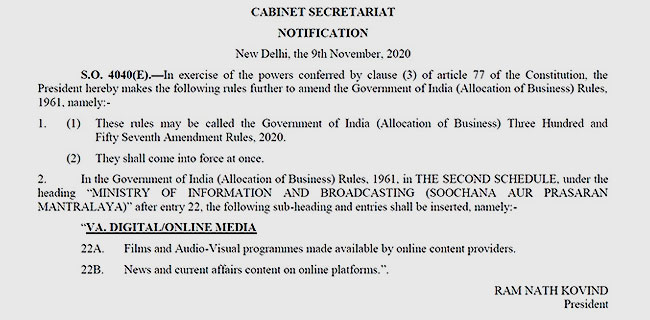
    The headline was clickbaity. So please ignore it. It’s not just MxMIndia, but all news, current affairs, films and audio-visual content will be under the jurisdiction of the Ministry of Information and Broadcasting of the Government of India.


    We don’t know what it will actually mean. We don’t know what the jurisdiction of the government will be. We don’t know if the PRB Act will also apply to news and current affairs websites. We don’t know if apps or platforms like InShorts and Daily Hunt will also be held liable. We also don’t know if platforms like Google News will also now be monitored closely. We don’t know if it will impact ownership rules of news/current affairs offerings on the Web… especially foreign ownership. And what about sites that are headquartered abroad. Uff. We don’t know so many things.


    There have been attempts to set up self-regulatory bodies by OTT players and there exist some associations of digital publishers. There is also the internet and mobile association (IAMAI).


    But we now have a situation where all these are under government jurisdiction. As we said, we need to get the interpretation.


    Prima facie, it may appear harmless.


    It may have been necessitated by certain content that has caught the attention of the ministry, Parliamentarians and the Courts.


    So let’s wait and hear it from the minister.


    Meanwhile, we must add here, that the law of the land continues to govern online content. One can still take an online content maker to Court if you believe it has harmed you/your reputation etc. For instance, there’s this online portal that was taken to Court by the close relative of a senior political functionary.


    And it’s not that an online media entity owner can’t be arnabed (err arrested indefinitely) if it does something wrong.


  • Mohit Joshi is now CEO, Havas Media Group

    By A Correspondent


    Mohit Joshi

    We thought he was CEO of Havas Media already, but now it’s formal and official. Havas Group India has announced the elevation of Mohit Joshi to Chief Executive Officer of Havas Media Group with immediate effect. Prior to this, Joshi was Managing Director of Havas Media Group. He will continue to report to Rana Barua, Group CEO, Havas Group India.


    Joshi has spent over 13 years at Havas Media and has 20+ experience in the media. He is also in the mancom of AAAI and IAMAI and is actively involved in other industry bodies as well.


    Vishnu Mohan

    Added Vishnu Mohan, Chairman and CEO, Havas Group, India and Southeast Asia: “I have had the privilege of welcoming Mohit to Havas almost 14 years ago. A true dynamic leader with an in-depth understanding of consumers, brands, and the changing media landscape. Mohit’s experience and long association with Havas makes him an ideal choice for the leadership role, as we look to significantly scale our presence in the media space.”


    Rana Barua

    Said Barua: “Over the last few years, Mohit has not just driven existing clients and business but has also played a lead role in driving the growth for the agency. He is a passionate and a visionary business leader, who brings invaluable expertise. His long-term vision coupled with his acumen will help us make a more meaningful difference to brands and consumers. I am happy that its Mohit who will lead Havas Media Group into the next phase of growth.”


    Added Joshi: “In today’s dynamic and evolving business environment, Havas overall is undergoing a massive change to stay differentiated, relevant and meaningful. I’m excited to take on this huge responsibility and new responsibilities and combating the challenges during this crucial time and I look forward to the next chapter working closely with Rana, the senior management of Havas Group India, my wonderful colleagues and clients and the entire team across the region and all our global offices.”


  • TRAI’s OTT recommendations uphold vision of Digital India: IAMAI

    By A Correspondent


    The OTT regulation recommendations by TRAI is a progressive judgment that upholds the Digital India vision of the government and will help achieve the vision of the National Digital Communication Policy (NDCP) as envisaged by the Ministry of Telecommunications, states the Internet and Mobile Association of India [IAMAI] while welcoming the recommendations by the Telecom Regulatory authority of India (TRAI) suggesting no regulatory intervention on digital services based on data services by telecom operators, referred to as Over The Top (OTT) services.


    Notes a statement: “IAMAI expresses gratitude to TRAI for upholding the Association’s longstanding position that digital services are not similar to conventional telecom services or even comparable to them in terms of regulating them. TRAI has also acknowledged the fact that the argument for economic loss does not hold given digital services lead to added revenues for telecom services in terms of data consumption. The decision to allow market forces to deal with the economic aspects of the popularity of OTT services is a landmark decision that augurs well for the fast-emerging digital services sector in India.


    TRAI has also satisfactorily addressed the concerns of security and privacy by giving due recognition to the ongoing developments and has categorically refuted any need for regulatory intervention in this regard. IAMAI had highlighted in its submission that the various new regulatory provisions like Personal Data Protection Bill adequately address all such concerns and hence no further interventions were required.


    On the overall issue of Regulation of OTT services, TRAI recognizes the various global development taking place and suggests putting matters on hold till more clarity emerges. IAMAI reiterates that the digital services under consideration are suitably regulated by the Information Technology Act or the forthcoming Data Protection framework or cybersecurity provisions being discussed. The sector is as well-regulated as any telecom service and any future needs can be adequately addressed without stifling its development.


    IAMAI expresses optimism that the Indian digital sector will respond positively to these recommendations that allows the sector to evolve unfettered.