The Advertising Club is organizing an evening meet with Mark D’Arcy, Chief Creative Officer, Facebook Creative Shop on Tuesday, 28th October, 2014 at 6.30 pm.
Mark D’Arcy is the VP, Chief Creative Officer of the Facebook Creative Shop. In this role, he leads a team of creative strategists tasked with creating and building ideas that transform how the world’s largest and most innovative marketers use Facebook to drive business growth.
After two decades working as a writer and Chief Creative Officer in advertising and media, Mark joined Facebook in 2011 to better explore the creative potential of the Facebook platform.
As part of this effort, last year he founded the Facebook Creative Council. Comprised of some of the most highly regarded and influential creative voices in the world. The council provides Facebook with invaluable perspectives and ideas to better engage and educate the global creative community, identify and celebrate breakthrough work and influence how Facebook develops to be an even richer and more engaging place to connect brands with the people they serve.
Prior to joining Facebook Mark spent seven years at Time Warner in New York, as Chief Creative Officer of its Global Media Group. Here he co-developed the first truly creative media arts practice within a global media company designed to better leverage the company’s extensive television, film, print and digital assets for its key marketing partners.
Mark has been widely recognized for his creativity and leadership in the creative industries and regularly speaks all around the world on the subject of creativity in social media, the transformation of marketing, the communication arts and the role and purpose of brands in society. Mark has served as a juror on numerous international awards shows including the CLIO Awards, LIA Awards, The International ANDY Awards and in 2013 served on the inaugural Innovations Lions jury at the Cannes Lions Awards.
Last month, a Bollywood A-lister actress lost out a Rs 3-crore-a-year endorsement deal for a multinational beauty brand to a relatively new actor. Reason: the latter was much more active on Twitter and Facebook and the brand wanted to reach out to social media audiences.
And despite Hrithik Roshan’s new release Bang Bang proving a super hit, consumer goods firm Emami, which signed Roshan for HE men’s deodorants this summer, is looking for a new face for social media. “Hrithik has a huge mass connect on traditional media. But with different audience logging on to social media, we may rope in a new face only for social media,†Emami director Harsh Agarwal said.
With social media emerging as one of the most popular hangouts for Indians, brand endorsement deals in the country are getting hugely influenced by how active celebrities are on Twitter, Facebook, Instagram and blogs. “Celebrities who engage actively on the social media space are getting paid at least 25-30% higher than those who don’t, even if the latter have huge mass connect,†said Vinita Bangard, promoter of talent management firm Krossover Entertainment, which represents Priyanka Chopra and Shah Rukh Khan.
“The socially active ones have a clear edge not only in terms of higher fees but also in getting more endorsement deals.†Chopra, with over 7 million followers on Twitter, is a hot favourite, along with stars like Amitabh Bachchan, Shah Rukh Khan, Aamir Khan and Salman Khan who all have more than 8 million followers. Some firms, including Coca-Cola India, have begun inserting a clause in their endorsement contracts that celebrities will popularise the brand on their social media assets, for an additional fee.
So, Farhan Akhtar, who endorses Coca-Cola, and Salman Khan, who is the face of Thums Up, not only feature on the brands’ advertisements but also are regularly tweeting and posting photos of themselves with the brands they promote. Many brands now go for exclusive social media endorsement deals at just about 10%-20% fees of a television endorsement deal.
For example, a reigning A-grade actress who charges Rs 1.5-1.7 crore for a television endorsement deal, charged only Rs 30 lakh to tweet for two months about an upcoming consumer brand, a talent firm head said. Endorsement deals exclusive to social media are being inked at Rs 20-50 lakh a year, while top celebrities’ fees for TV commercials range from Rs 2-6 crore annually. “It (social media) completely optimises spends and has become an extremely effective medium,†said Atul Kasbekar, promoter of celebrity management firm Bling Entertainment.
Chocolate brand Cadbury Dairy Milk has had a series of upcoming faces including Bollywood starlet Hazel Keech and model Karishma Kotak tweeting about their experience of eating Dairy Milk Silk Caramello chocolate. The tweets created the necessary buzz for the brand at about one-fourth the cost that Cadbury would have to otherwise shell out to rope in a well-known star for television.
Likewise, PepsiCo used hugely popular actor Ranbir Kapoor only on social media earlier this year for its biggest ad platform — the IPL T20 cricket tournament, though cricketers MS Dhoni and Virat Kohli were shown extensively on television ads. “We leverage our brand ambassadors through campaigns and activation via different mediums,†PepsiCo senior director, marketing (social beverages), Ruchira Jaitly said. With social media ad spends rising faster than traditional media, the online celebrity endorsement business is now growing 25%-30% faster than the traditional space. “Digital isn’t an option anymore.
It’s something we have to do to make ourselves future ready,†said KK Chutani, executive director for marketing at Dabur, which recently dropped Bipasha Basu as the face of Dabur Honey and roped in celebrity chef Vikas Khanna to endorse the brand on social media because he is active on Twitter and Facebook. Chutani said close to half of ad spends of Dabur’s juice brand Real is now directed at the digital space.
The last few months have seen an unprecedented growth in video consumption for Facebook in India. More and more people are uploading, sharing and discovering videos on Facebook. Video views grew more than 50 per cent from May through July of this year, and since June there has been an average of more than 1 billion video views on Facebook each day.
For marketers, digital video, particularly on mobile, is becoming more important as well. Combining sight, sound and motion, video creates experiences that are, at their best, memorable, moving and inspiring – the types of experiences that help brand marketers drive important metrics, including awareness, consideration and, ultimately, sales.
Facebook has announced some new features to its video ads offering. After introducing videos that start playing automatically in News Feed earlier this year, FB found that people discover significantly more content with this feature. And when used in combination with the new video views objective, businesses are seeing a significant decrease in cost per view for their Facebook video ads. So in the coming weeks, FB will extend the availability of videos that play automatically to more content from more brands in the US.
People will also begin to see how many views a video on Facebook has received. Views will be shown on all public videos from people and Pages. This will help people discover popular videos, and help businesses quickly gather information about how their videos are performing.
On Monday, @BudweiserIndia tweeted out a cheery message to its 6,000 followers: “How are you coping with your #MondayBlues! Keep your #Buds close and watch them disappear!” Does a tweet urging beer consumption constitute advertising? It’s not quite clear. The rules banning the advertising of liquor products are at least about half a century old and predate the computer age. Social media is, naturally enough, a grey area.
No matter, liquor companies have been happily making use of the platform. Diageo, the world’s biggest liquor company, the UB Group’s Kingfisher beer, Budweiser, Tuborg, SAB Miller, Johnnie Walker are all active on Facebook and Twitter, using them to spread the message about their brands, complete with visuals. Kingfisher tweeted to its 44,000 followers on Wednesday from @kingfisherworld: “Okay so beerheads, here we go. Remember that 1st #KFBeer you ever had?
We want to know the story! Tweet to #HowIMetMyKFBeer right away!” Last year, Diageo’s vodka brand Smirnoff, using the handle @SmirnoffIndia, had this to say: “You don’t need an occasion to gift someone gold! Treat your friends to the royal taste of Smirnoff Gold today.”
Samar Singh Shekhawat, senior V-P (marketing), UB, said: “The guidelines do not clearly define ban on social media and there are no clear clauses for liquor companies by the I&B (information and broadcasting) ministry on social media and online advertising.”
However, he added that liquor companies tend to self-regulate by strictly following the age-restriction policies of the sites. “So whoever comes on to the social media platform are well within the drinking age limit. Whatever is not allowed on mainstream media we do not put on as digital advertising unless it is age gated,” Shekhawat said.
However, while brands ask consumers to enter their age or date of birth in order to access their websites, there is no way to restrict the visibility of tweets.
A top executive at another leading liquor brand said, “The maximum traction that social media gets is from our core target audience. The absence of any law has made it easier for us to interact with them directly.”
Arvind Sharma
Arvind Sharma, former chairman of the Advertising Standards Council of India (ASCI), said social media messages from a manufacturer qualify as advertising.
“On the whole any message put out by a company is an ad,” he said. “It is not an ad if it is created by the consumer.
While ASCI is yet to receive any complaint against liquor brand related to social media activities, “such messages should not be allowed as social media is also a form of media”, he said.
Although the rules haven’t been amended in the last 50 years, the spirit of the law can still be implemented, said Prem Rajani, managing partner of legal firm Rajani, Singhania & Partners. “While one may argue that you need a clear statute to pin them, I would say the current statute if interpreted properly should be enough to pin them down.”
The information and broadcasting ministry hadn’t responded to queries as of press time. Interestingly, tobacco brands in India which are also barred from advertising, have not taken the social media route. Even international brands such as Marlboro don’t have any social media engagement with Indian consumers.
Facebook has signed its first agency deal in India with GroupM, WPP’s integrated media and marketing company. This partnership was announced during the recent visit of Sheryl Sandberg, COO, Facebook to India.
“Our partnership with GroupM will benefit clients to reach over 100 million people in India, 84 million on mobile - both smartphone and feature phone –  and custom audiences within the 100 million in urban and rural India,” shared Kirthiga Reddy, Head, Facebook India. “We’re excited about this wide-ranging collaboration which combines the strength of the world’s best global advertising platform with GroupM’s market-leading position to deliver personalized marketing at scale.”
CVL Srinivas
GroupM South Asia CEO CVL Srinivas said, “We are delighted with the Facebook partnership that can help unlock even greater value for our clients. We work closely with Facebook globally, regionally and locally. India is projected to be the largest country for Facebook by people very soon and we see exciting possibilities for our clients. This partnership adds to the set of enablers we have created over the years that can help drive digital adoption in our market.”
GroupM has been creating cutting-edge digital solutions for clients for close to 10 years. Given its leadership position and access to data and research, GroupM has been integrating digital with traditional media for its clients. GroupM agency brands today have fully embedded digital resources that are supported by the scale and leverage of the network.
The 2014 edition of the FIFA World Cup was special. While the social media existed in the 2010 edition, it played a huge rule in the build-up to the tournament and while it was on, and even after the final whistle was blown. Facebook’s data team looked at the overall conversation for the 2014 FIFA World Cup, along with the top social matches and moments, demos, countries, most-talked-about players, and the most-engaging content posted by World Cup athletes. The tournament was a unique moment for Facebook, which measured the highest level of conversation for any event in history.
From June 12 – July 13, 350 million people joined the conversation on Facebook, generating 3 billion interactions (posts, comments and likes) related to the World Cup. About 88 million people generated 280 million interactions for Sunday’s final between Germany and Argentina, making the match the single most-talked-about sporting event in Facebook history.
The stats include:
Most Social World Cup Matches
1. Germany vs. Argentina final (88 million people with 280 million Facebook interactions)
2. Brazil vs. Germany semifinal (66 million people with 200 million Facebook interactions)
3. Brazil vs. Croatia opening match (58 million people with 140 million Facebook interactions)
4. Argentina vs. Netherlands semifinal (39 million people with 83 million Facebook interactions)
5. Brazil vs. Chile round of 16 match (31 million people with 75 million Facebook interactions)
Most Social World Cup Moments
1. Brazil vs. Germany semifinal (29′):Â Sami Khedira scores Germany’s fourth goal in seven minutes, giving them an inconceivable 5-0 lead with a full hour remaining in the match.
2. Germany vs. Argentina final (full time):Â The final whistle blows, crowning Germany as World Champions for the fourth time.
3. Brazil vs. Germany semifinal (26′):Â Toni Kroos scores his second goal of the match, increasing Germany’s lead to 4-0 over a stunned Brazil team and home crowd.
4. Germany vs. Argentina final (113′): Mario Götze scores from a beautiful Schürrle cross to give Germany a 1-0 lead over Argentina deep in extra time.
5. Brazil vs. Croatia opening match (29′):Â Neymar scores his first World Cup goal, and Brazil’s first goal of the match, to level the score 1-1 with Croatia.
1. Brazil: 55 million people in Brazil joined the conversation about the World Cup from June 12 – July 13
2. USA: 48 million people in the United States joined the conversation about the World Cup from June 12 – July 13
3. Mexico: 19 million people in Mexico joined the conversation about the World Cup from June 12 – July 13
4. Indonesia: 18 million people in Indonesia joined the conversation about the World Cup from June 12 – July 13
5. India: 14 million people in India joined the conversation about the World Cup from June 12 – July 13
Popular social networking website Facebook has crossed 100 million users in India, it has announced. Furthermore, more than 84 million of the users are connected through the mobile, it has stated.
Talking about this milestone and its significance for India, Kevin D’Souza, Head of Growth & Mobile Partnerships, Facebook India, said: “The internet not only connects us to our friends, families and communities, it is also the foundation of a global knowledge economy. Today, we have more than 100 million people who access Facebook actively in India each month. We’ve only just begun. Facebook’s mission is to give people the power to share, and to make the world more open and connected.”
Adding further, D’Souza said: “We recently announced internet.org, a global partnership with the goal of connecting the next 5 billion people around the world, to make the same access and opportunity available to everyone. It is with this in mind that we look towards like-minded partners who want to innovate, and share the same vision as us, to understand better how internet access can be increased to reach millions more people across India.”
Pain-relieving brand Volini’s nine-day long digital campaign – ‘Volini Pat On The Back’ received a good response from the consumers. Conceptualized and conceived by Volini, the idea was executed by WATConsult and managed to receive 51,000 entries through ‘pats’.
With the core idea of acknowledging and appreciating the efforts made by women to give us a pain-free life, Volini launched the pat on the back campaign wherein people applauded the special women in their life. This was done through several digital medium viz. Facebook, a microsite, through the IVR by sending a SMS or making a call on the toll-free number. Best messages were gratified by sending a special gift to both the pat sender and the receiver.
Subodh Marwah, Vice President and Head Consumer HealthCare Business, noted: “Volini believes that today’s women seamlessly carry on with so many roles in their daily lives, effectively multitasking between work and home and are a source of strength and support for all the loved ones around them. Women’s Day and ‘Volini Pat On The Back’ create one such opportunity of thanking them for all the efforts that they take for us.”
A specially designed microsite and Facebook were prime sources of engagement. Besides IVR integrations through which the pats were sent, SMS and call on toll-free numbers were also introduced. The campaign was supported through Zoom TV with integrations, print with Times of India in key metro editions and radio tags and RJ mentions on Oye and Big FM. Apart from this, there were on-ground activations created in corporate hubs and malls in key cities to encourage people to participate in the campaign.
The year 2014 is turning out to be a turnaround year for political parties who are turning to the digital world to reach out to the masses. While their popularity with the masses on the medium is questionable, what is noteworthy is that it has managed to play the role of a catalyst in disseminating information to the people at large. But it is not as smooth for most politicians who are looking at the medium as an intrusion into their public life.
These and many more aspects concerning the digital world were discussed in detail at the session ‘Internet and Democracy: Interloper or Catalyst?’ The panelists at the session included Chetan Krishnaswamy, Head, Public Policy and Govt Relations, Google India; Suparna Singh, Director of Strategy, NDTV, and Managing Editor, NDTV.com; Ronak Samantray, Founder, NowFloats.com; Mike Best, Berkman Center for Internet & Society, Harvard University and Roger Fisk, PR Expert, President Obama’s Campaign. Jon Sopel, Senior Anchorperson, BBC Global News was the moderator at the session.
Chetan Krishnaswamy of Google began by warming up the audience on the spectacular growth story being put up by the medium of digital. “From what it was around a decade ago, internet has grown by 600 per cent to a $2.5bn industry today. In fact over the next six years, the country would have about half a billion users accessing the internet, easily surpassing countries like US and being a close second to China.” Krishnaswamy went on to add that much of the growth on digital was coming from the mobile platform with over 4 million users using the medium to access content. “What is interesting is the growth that is being reported from non-English websites or language websites that have grown by more than 56 per cent whereas the English websites have grown by just 11 per cent. All these are indications that the internet can only make the democracy better and act as a catalyst.”
According to Suparna Singh, what social media, in addition with players like facebook, twitter can do is become an apparatus of change. “What is being witnessed right now is that such platforms are becoming more opinion oriented and not informational; it needs to shed its baby weight and become more mature. There needs to be more dialogues and exchange of ideas and information on these websites,” reiterated Singh.
Highlighting the action that was being witnessed on the medium with the general elections around the corner, Singh said that though there has been an invasion from the political parties on these platforms, it is still in its infancy. “But that will change in the next general elections where a lot more political parties will take a liking to the medium and will be reaching out to the masses in a much profound manner,” affirmed Singh.
Highlighting the work done by his firm, Ronak Somantray said that the objective of his firm was to get businesses online and promote them largely through the medium of messaging (SMS). There is a lot of response that we have generated in the marketplace and are hopeful of making a big impact in the future as well, he said.
According to Mike Best, the role of social media is not being comprehended in a manner that it should. “If you see the impact that social media websites created on countries like Iran and Syria during the turmoil, it was quite an extraordinary effort.” Best bought up the example of Nigeria where his company had helped the country in the run-up to the elections by providing insights and data on the trends that were being spotted. This, he said, prepared the people to either vote for change or be ready for the worst. Highlighting his objective in 2015, Best said that his company will be monitor social media as well as well as observer missions at the same time when the elections take place again in Nigeria.
The panelists went on to discuss the intricacies surrounding privacy on the internet and how the process had to be simplified so that the owners do not face a harrowing time answering questions from the consumers’ end.
Diehard Whatsapp loyalists needn’t worry about the Facebook impacting the messaging platform. Like it happened post its Instagram buy, WhatsApp’s brand will be maintained.
On Wednesday, Facebook announced it had reached a definitive agreement to acquire WhatsApp, the rapidly growing cross-platform mobile messaging company, for a total of approximately $16 billion, including $4 billion in cash and approximately $12 billion worth of Facebook shares. The agreement also provides for an additional $3 billion in restricted stock units to be granted to WhatsApp’s founders and employees that will vest over four years subsequent to closing.
Over 450 million people using the service each month;
70% of those people active on a given day;
Messaging volume approaching the entire global telecom SMS volume; and
Continued strong growth, currently adding more than 1 million new registered users per day.
“WhatsApp is on a path to connect 1 billion people. The services that reach that milestone are all incredibly valuable,” said Mark Zuckerberg, Facebook founder and CEO. “I’ve known Jan for a long time and I’m excited to partner with him and his team to make the world more open and connected.”
Jan Koum, WhatsApp co-founder and CEO, said, “WhatsApp’s extremely high user engagement and rapid growth are driven by the simple, powerful and instantaneous messaging capabilities we provide. We’re excited and honoured to partner with Mark and Facebook as we continue to bring our product to more people around the world.”
According to a communique, Facebook fosters an environment where independent-minded entrepreneurs can build companies, set their own direction and focus on growth while also benefiting from Facebook’s expertise, resources and scale. Whatsapp’s headquarters will remain in Mountain View, CA; Jan Koum will join Facebook’s Board of Directors; and WhatsApp’s core messaging product and Facebook’s existing Messenger app will continue to operate as standalone applications.
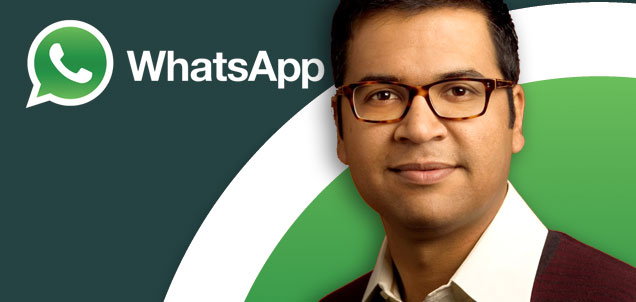
Neeraj Arora: The man who played key role in WhatsApp’s rise
From the WhatsApp blog:
By Anumeha Chaturvedi
Neeraj Arora says he is responsible for “all things business at WhatsApp” and considers himself “generally a good guy” on his website. His friends and batchmates agree, at Indian School of Business, where he earned a management degree.
From Times Internet to Google to WhatsApp, Arora has had an uncanny ability to identify opportunities, said Mohit Garg, co-founder of training software firm MindTickle and a batchmate at ISB. “He is well-connected and this has helped him move up the ladder. He’s also very unassuming and down-to-earth.”
With Facebook buying WhatsApp for $19 billion, Mr Arora, the vice-president for business development, is likely to be a very prosperous man indeed although everyone is tightlipped about just how prosperous.
“I feel great” was all that Mr Arora, 35, would tell about the financial implications of the deal for him.
“His career really took off with Google, where he was also thinking of either launching a startup or funding one,” said Shameek Chakravarty, director of product management at Yahoo, who was also the president of the entrepreneurship and venture capital club at ISB.
When Mr Arora went to Mountain View, his role involved hunting down startups for Google and that meant meeting and connecting with numerous people in the Silicon Valley to understand what was happening in the market, Mr Chakravarty said.
“It was not an engineering role and meant forging crucial connections with people in the Valley.” He joined WhatsApp in November 2011 when it had about 10 employees. He was specifically recruited for his corporate development background at Google. Text messages are the most costly form of data transfer and his role meant travelling to different geographies to connect with phone firms to negotiate SMS rates (users get an SMS after downloading WhatsApp; 450 million users means 450 million SMSes) and striking distribution arrangements and partnerships with them.
“Over the years, we have connected to discuss how I should manage my startup, which I sold in 2012,” Mr Chakravarty said, adding he had even told Mr Arora that WhatsApp would make a really good exit and that he should fund his friend’s startup with his share of that fortune. In May 2013, Mr Arora said in an interview that WhatsApp is very different Google, Facebook or Yahoo.
“Our founders came from Yahoo and they actually saw how the mechanism works with advertising. You have to collect a lot of data to have targeted advertisements. It’s a very strong stance that we have taken and I think we are going to stick with it.” Mr Arora, who studied mechanical engineering at IIT-Delhi, met his future wife Ruchi Bansal at ISB. She is a chartered accountant. “He is a really smart guy and had it all — the looks, the brains,” said Shrutkeerti Khurana, another batchmate.
“He always got things done on time, and used to wake us up after finishing assignments. We knew he will go places as he was not a cookie cutter guy, was diligent and knew where he had to reach in life.” Mr Arora said life will not change very much after the blockbuster deal.
Almost five years ago we started WhatsApp with a simple mission: building a cool product used globally by everybody. Nothing else mattered to us.
Today we are announcing a partnership with Facebook that will allow us to continue on that simple mission. Doing this will give WhatsApp the flexibility to grow and expand, while giving me, Brian, and the rest of our team more time to focus on building a communications service that’s as fast, affordable and personal as possible.
Here’s what will change for you, our users: nothing.
WhatsApp will remain autonomous and operate independently. You can continue to enjoy the service for a nominal fee. You can continue to use WhatsApp no matter where in the world you are, or what smartphone you’re using. And you can still count on absolutely no ads interrupting your communication. There would have been no partnership between our two companies if we had to compromise on the core principles that will always define our company, our vision and our product.
On a personal note, Brian and I couldn’t be more proud to be part of a small team of people who, in just under five years, built a communication service that now supports over 450 million monthly active users worldwide and over 320 million daily active users. They have helped re-define and revolutionize communication for the 21st century, and we couldn’t be more grateful.
Our team has always believed that neither cost and distance should ever prevent people from connecting with their friends and loved ones, and won’t rest until everyone, everywhere is empowered with that opportunity. We want to thank all of our users and everybody in our lives for making this next chapter possible, and for joining us as we continue on this very special journey.
Sanjay Menon, Global Capability Lead and India Marketing Services Lead, SapientNitro:
“The WhatsApp acquisition will enable Facebook to achieve a wider youth user base in the mobile segment along with access to real users since it is anchored to a phone number unlike Facebook users. There could be a possibility of intersecting data from both for context based promotion or targeting. We might also see a flurry of acquisitions in the wireless messaging/chat segment in the next few months. Typically, one would have imagined a company like Google to acquire WhatsApp since they have the infrastructure to leverage this additional massive consumer base to bolt on from mobile.”
Dippak Khurana, CEO & Co-Founder, Vserv.mobi:
Mobile is disrupting the dominance of PC Web era companies. Online-first companies are struggling to innovate in the mobile space, as many of them look at it as a mere extension to the PC Web, instead of leveraging it’s unique aspects. Many of the big players have realized this and have rapidly acquiring mobile first companies – for eg. Google acquired AdMob in 2009, while Apple bought Quattro Wireless in 2010 and Facebook acquiring Instagram 2012. The current generation of users is making the mobile their primary screen for living a connected life, so it comes as no surprise that companies are focusing their energies and investing top dollars to have the best mobile experience for their audience.
Facebook’s overarching charter has hinged on ‘connecting everyone’ in the world. Interestingly, the global youth population, a very relevant demographic is slipping away and exploring other social apps outside of Facebook. Estimates show 62% of global teens claimed to be active on Facebook in Q2 2012, which dropped to 51% in Q2 2013, demonstrating that a vital audience is on the decline as far as Facebook is concerned.
On the other hand, Whatsapp is the most successful and fastest growing social communication app. If you compare the growth rate over the first four years, Whatsapp also has the sharpest growth trajectory as compared to other social communication platforms such as Skype, Twitter, Gmail, Facebook etc. Over 450 million people are using Whatsapp every month, and 70% of them are active on any given day. This makes Whatsapp, a strong logical extension to Facebook’s ‘connecting the world’ goal, by helping them develop new mobile experiences which until recently was restricted to the Facebook app.
It will be interesting to see if WhatsApp moves away from its subscription model and adopts advertising. After all, in effect, Facebook is going to be able to have access to 450 million verified mobile numbers, many of whom may not even be on the Facebook app. Additionally with Google pushing Hangouts as a default mobile messaging app, Facebook was forced into doing something in the mobile messaging space and this was the best way to capture that market. This presents a distinctive opportunity for Facebook to garner increased user engagement and a greater fillip to their mobile strategy.
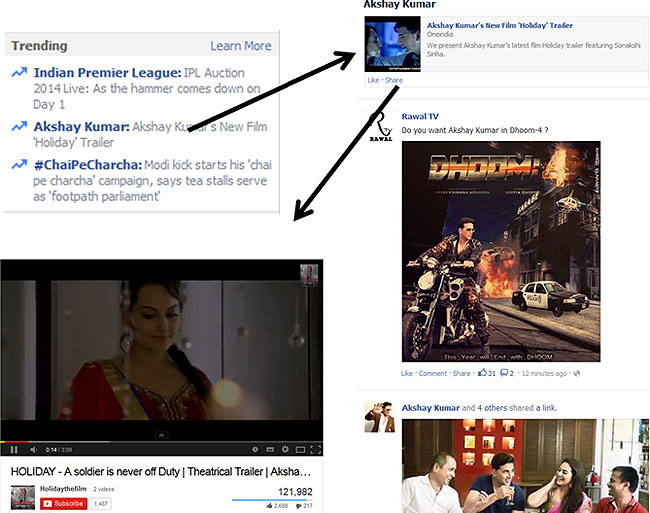
Facebook recently launched a trending section which is visible on the top right hand side of the homepage for its web visitors (not currently available on Mobile)
Since this is a major change on the homepage and seems to compete with Twitter’s trending topics it has generated interest amongst marketers. So what does trending mean for us marketers and can we use it to our advantage?
Here is my take:
1. First, what is trending?
It’s a personalized lists of the most mentioned words and phrases at the current time with short explanations of why each is blowing up. A click-through leads to a Page of mentions by friends, Pages, and public posts by anyone who lets people “Follow†them.
2. What is this ‘Explanation’ feature which Facebook is talking about?
Facebook's explanation features details why a particular topic is trending
The challenge with Twitter trends is that a lot of times one is not clear why exactly something is trending on Twitter but the explanation bit on Facebook clarifies that thus stoking a user’s interest and hopefully for Facebook getting more clickthroughs.
Compare the two trends on the same day.
Facebook explanation makes it clear why a certain topic is trending.
3. Is Facebook personalizing trends based on a user’s interests?
Facebook claims “Topics are personalized based on things you’re interested in and what is trending across Facebook overall.†However I haven’t seen this till now.
A quick analysis of trends basis what I have been seeing on my profile over the last two days:
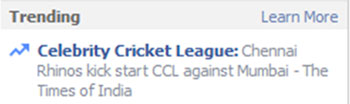
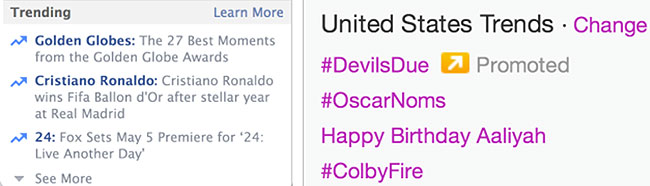
Day 1:
I have hardly liked any sports page and am as uninterested in Microsoft as Justin Beiber (had to clarify the latter). Even on my friends list, there are hardly any people who are talking about Jai Ho the day the trend appeared . In fact more people on my list spoke about it the next day but its not trending then.
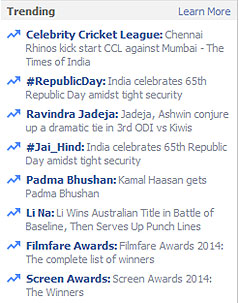
Day 2
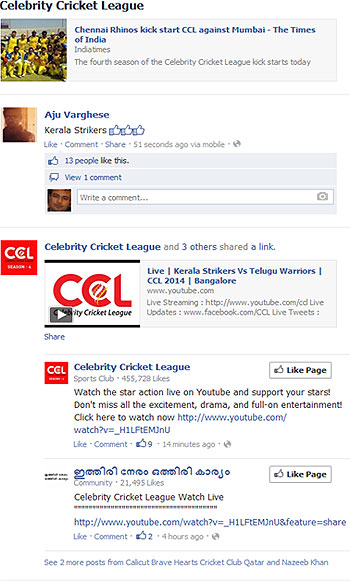
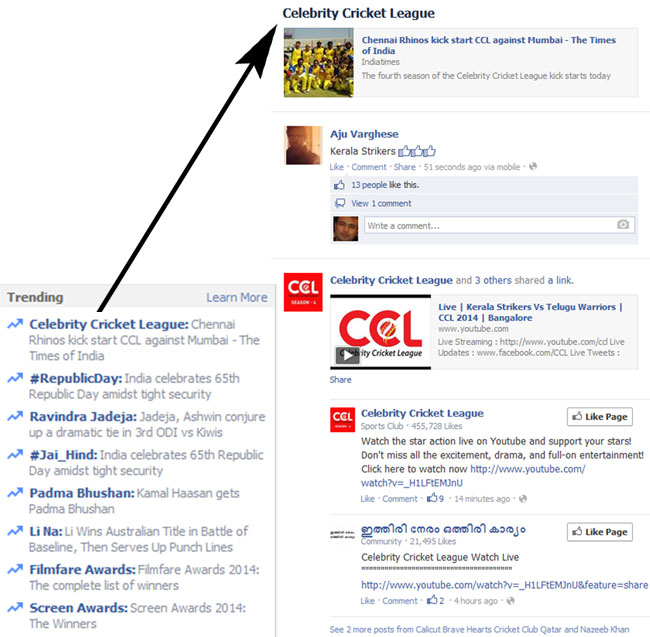
No one on my list is talking about ‘Celebrity Cricket League’ or ‘Li Na’. On ‘Republic day’ there are definitely a bunch of posts by friends or pages I like but that is still on second place for me.
So it appears that Facebook seems to take a more macroscopic view of trends, looking at the region (like Twitter-which shows trends on the city level) but nothing seemingly at an individual level.
4. How are the algorithms different -Facebook vs Twitter trending?
Facebook Trending aggregates the headlines of the day, while Twitter Trending Topics check the pulse of the moment. Â With Trend on internet being something very’ in the moment’, I think in the current avatar more users are would go for the latter than the former.
5. So can we as marketers use promoted trends?
Twitter has this feature but Facebook is yet to announce anything like that.
Even in the near future, I don’t think Facebook trends will directly be used as a revenue source at least not until Facebook gets the product right via various iterations.
It’s something which seems to be done to:
1. Build further engagement and clickthroughs via the users and get them to spend more time on the site
2. Serve Facebook’s objective of being the ultimate news destination (remember Facebook is currently the largest medium in the world.Bigger than any newspaper or TV channel… ever!)
3. By capturing current consumer interest Facebook could drive more real time marketing/advertising. Real Time is the goldmine which most advertisers are trying to target.This could probably help them in that direction.
6. Can we as brands tap in at all?
 Apart from brands which are involved in the highly topical stuff like movies, cricket, politics or current events I see this having little benefit to marketers in its current avatar.
So if you are promoting a new movie which will get mass traction on a specific day or a politician gets talked about a lot on a given day the trending features makes what’s popular more popular , but no it currently can’t make something which people would hardly be interested in trend.
For example, Akshay Kumar’s new movie ‘Holiday’ probably reached out to a much larger audience since it was trending across the home page of millions of people who logged onto Facebook yesterday in India. On the other hand, over the last two weeks this was one of the few movies which was trending. Parineeta Chopra started trending post the release of her movie when her performance was appreciated and not like this case when the trailer/movie was released. (Since obviously an ‘Akshay Kumar’ release has more interest to begin with)
7. Does that mean we should # everything and talk about current events?
 No,definitely not!
The challenge for Facebook is that most users do not make their profile public or allow everyone to follow them. Thus typically brand pages and a few users (usually celebrities) are the only ones which will be visible when we click on a trend. This would mean brands or celebrities which talk about current news will have more clicks.
CCL has no conversations from my friends list or pages I like
Brands can definitely talk more about current events and post news but hopefully most social media agencies won’t be dumb enough to do that.Since:
1. They will end up alienating their current user base by appearing more of a news site rather than what the brand is about
2. Even if they do that they will end up competing with news sites & may not even appear on the first page which completely defeats the purpose.
8.Given Facebook’s popularity in India, will this launch pose a bigger challenge for Twitter in India?
Not quite .The nature of the products (Their current definition of trends) is different. Facebook Trending aggregates the headlines of the day, while Twitter Trending Topics check the pulse of the moment.
Also since most content on Twitter is public and therefore I see opinions from people I know or have heard of (thus more personalization) whereas Facebook because of its privacy settings will be more restrictive & thus less personalized.
The trend for Facebook seems more in its goal of being a one stop news source rather than a brand medium. Brand messages will come up when Facebook as a news source is firmly established in the minds of the consumer.
And frankly considering the fact that it’s the largest platform in history seems quite possible, but definitely not now. Not this quarter or in the next six months. That’s all one can predict on the internet!
Saurabh Parmar is Founder, Brandlogist Communications (www.facebook.com/Brandlogist) and is a visiting faculty at Indian Institute of Mass Communications
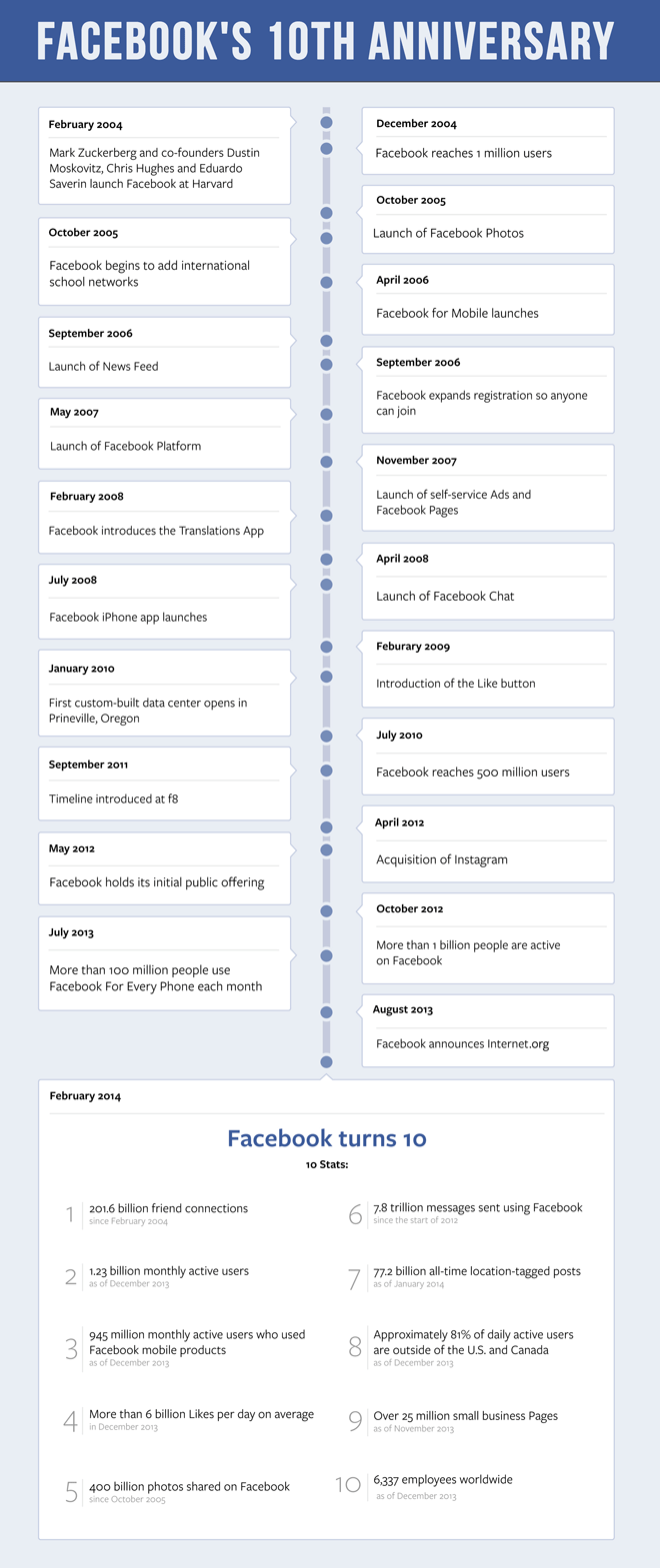
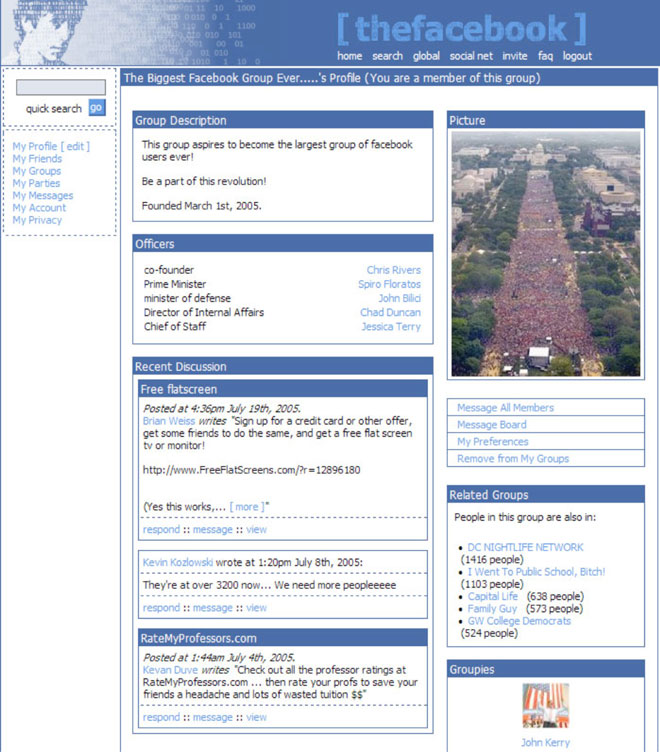
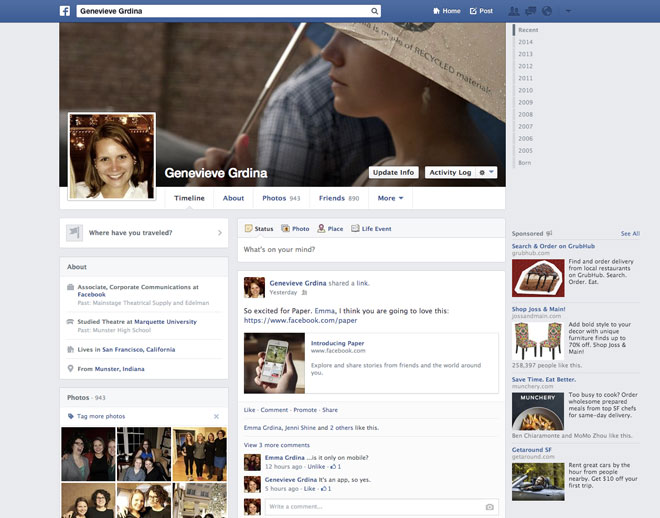
Today (Feb 4) is social networking platform Facebook celebrates its 10th anniversary. The site went live on February 4, 2004 in founder and CEO Mark Zuckerberg’s Harvard University dorm room, and since then has grown to become a global service with more 1.2 billion monthly active users.
Said Zuckerberg on the occasion: Â “It’s been an incredible journey so far, and I’m so grateful to be a part of it. It’s been amazing to see how people have used Facebook to build a real community and help each other in so many ways. In the next decade, we have the opportunity and responsibility to connect everyone and to keep serving the community as best we can.”
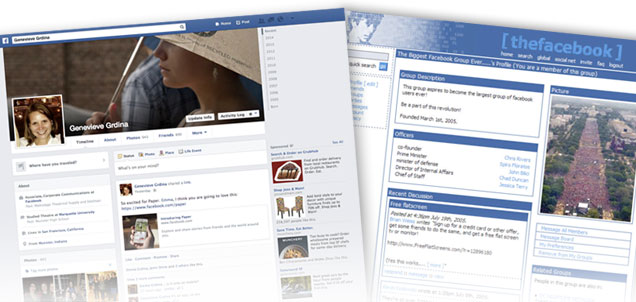
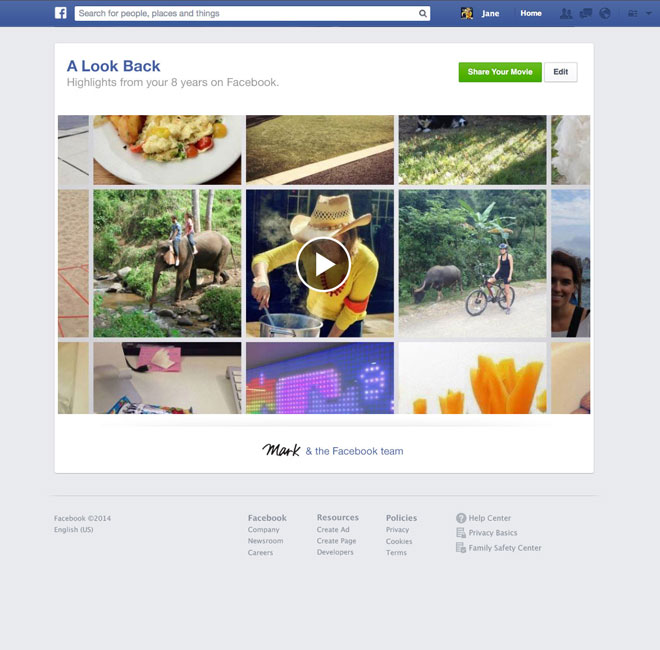
Take a look at the pages above on the site today and the way it was around 2004-05. Plus timelines, milestones and vital stats.
 The last few months have seen an unprecedented growth in video consumption for Facebook in India. More and more people are uploading, sharing and discovering videos on Facebook. Video views grew more than 50 per cent from May through July of this year, and since June there has been an average of more than 1 billion video views on Facebook each day.


 Day 1:
 Day 2
Day 2