Tag: facebook

  • With Raksha Bandhan in mind, Facebook to launch online shopping fest with GroupM

    By A Correspondent


    Social networking site Facebook is looking to tap the rising enthusiasm in India for online shopping by launching a shopping festival named Tied Together on the occasion of Raksha Bandhan. The plan involves setting up a website in association with media agency conglomerate GroupM between August 12 and August 29, the day of the festival.


    Media agencies said Facebook’s pitch note said brands can “unlock the power of social media that can reach 10 crore potential customers through this event.” Facebook’s role will be to use its subscriber base and social networking platform to drive traffic to the shopping site.


    Participating companies will have to pay a fee that will be shared by Facebook, GroupM and other media agencies. Facebook, which has 11.2 crore users in India, is said to be looking for a title sponsor at an asking rate of Rs 3 crore and a principal sponsor at a similar rate besides associate sponsors for Rs 1.5 crore each.


    Facebook and GroupM didn’t respond to emailed queries.

    “Online shopping festivals have become a popular trend in India, especially with the rise in the number of ecommerce companies, which are driving the growth of online shopping in the country,” a media planner said. “Facebook should be viewed as another media vehicle which has a huge database that can be utilised for commercial purposes.”


    Last October, Google held a shopping festival in association with GroupM and Amazon called the Grand Diwali Mela. A year before that, Google launched the Great Online Shopping Festival. Earlier this year, Google held the Great Indian Travel Festival (GITF) in association with media agency conglomerate IPG Mediabrands. In July, Magicbricks joined hands with GroupM and Google to launch a property festival that will be called the Great Online Home Festival. “Companies like Amazon, Flipkart and other ecommerce companies can host an online festival on their own website. But companies like Google and Facebook need to create a new one to host a shopping festival. The idea is to create online intellectual properties (IP) and to make them annual events,” said another media planner.


    Companies like Google and Facebook charge advertisers on a “per click” basis that ranges between 50 paise to Rs 100 and Rs 2 to Rs 20, respectively, “depending on the customer-targeting options that they choose,” said the planner. They will charge a fee for sponsoring these festivals on their website. “For media agencies that associate with such events there are no immediate financial returns and it is a long-term plan,” he said.


    Source:The Economic Times

    Copyright © 2015, Bennett, Coleman & Co. Ltd. All Rights Reserved

    Licensed to republish
     

  • HUL partners Star, YRF, Facebook, Google etc to weave its brands into their creations

    By Pritha Mitra Dasgupta & Sagar Malviya


    Toiletries-to-food giant Hindustan Unilever (HUL) is partnering over a dozen content creators — from Star Network and Yash Raj Films to Facebook and Google — to produce content across channels where HUL brands can participate, perhaps subtly, as part of the conversation.


    Last Friday, the maker of Dove and Rin invited 13 producers including broadcasters, radio channels, film producers and top-notch digital companies to its campus to ideate how they can seamlessly weave HUL brands in their content, messages and shows, instead of just product placement and brand plugs.


    “As media is changing, there is a skill that needs to get evolved — as content explodes, how to tell compelling brand stories and really cut through to consumers by making sure the brand is able to tell a story that consumer can relate to,” said Gaurav Jeet Singh, HUL’s head of media services in South Asia.


    While the latest move of HUL, the country’s largest advertiser, won’t replace advertisements, the company is trying to partner media channels beyond obvious marketing. “Through popular culture, how can we ride on content that is designed to entertain, engage and connect? Something that is not force fit. But something that naturally fits into the content and can carry the brand story seamlessly,” explained Singh.


    HUL’s media agency, Mindshare, is a partner in the initiative. “As the consumer’s media consumption habits change, we understand the need to create and curate differentiated communication platforms, to build lasting brands with an engaged audience,” said Prasanth Kumar, chief executive of Mindshare.


    “The consumer is no longer a passive viewer, but an active participant in the brand’s story-telling journey. Brand ideas and content that resonate with the audience are further seeded by them into their own circle of influence that has a far more powerful effect,” Kumar said.


    With over 35 brands across food, personal care and home care portfolios, cutting through structures and processes to execute an idea quickly becomes an issue. Hence, the company through ‘Content Day’ encourages brand team members to share ideas which can be approved or perfected quickly so as to become scalable.


    It wasn’t easy. In the last six months, HUL has been working on the novel concept — from identifying nearly a dozen brands to sending briefs to 35 content creators for ideas. The company that initially received around 300 ideas, narrowed it to 40 with 13 companies meeting individual brand teams on Content Day for possible brand integration.


    Two ideas from Star Network and one each from YRF and Disney made it to the top four, which were presented to the top management and the entire marketing team of HUL. “We want to create a strong ecosystem of for branded content as that is crucial to the future of marketing,” said Samir Singh, HUL’s executive director-personal care.


    Sample this. In the latest blockbuster Piku, while there were several brand integration, there were two that particularly stood out: Amul milk and Red Label tea. Both these products were placed on the dining table when the protagonists in the film were having breakfast and they effortlessly became part of the movie scene.


    “But they can be part of song lyrics, movie title, we can co-create product with the company and integrate the brand in several other ways depending on the marketing objective,”  said Ashish Patil, business & creative head and vice president at YRF. “The unique thing about Content Day is that it is not a random one off project, but HUL wants to make it an annual event. And, it’s a cultural shift for them. It is about looking at content differently, as an important marketing tool. And it is about infusing new thinking which they or their ad agency may not be geared to do,” he said.


    While executing ideas into branded content could be challenging, media partners are hopeful that HUL’s move will break the clutter. “There was no strict brief and it was unstructured and gave us a lot of freedom to do as we thought. It was a proactive and innovative idea. This is an opportunity that is more open about possibilities of collaborating across brands,” said Myleeta Aga Williams, MD of BBC Worldwide.


    Source:The Economic Times

    Copyright © 2015, Bennett, Coleman & Co. Ltd. All Rights Reserved

    Licensed to republish

     

  • Fear of Being Offline & other digi-facts


    By Dyanne Coelho


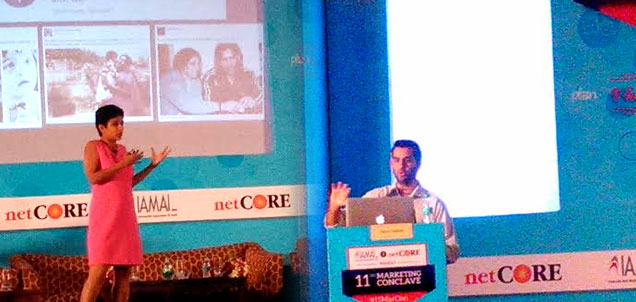
    The first Indian Facebook employee, Kirthiga Reddy, now Managing Director, Facebook India left quite an impression on the audience with her talk entitled ‘Winning in a mobile first world’ at the 11th Marketing Conclave organised by the Internet and Mobile Association of India (IAMAI). FOBO or the Fear of Being Offline is a new term that is picking up in this day and age, she said. On Mother’s Day, India had the second highest ranking in terms of interactions with 1.8 billion interactions on the network. The older generation did exactly the same things we do, she explained, the only difference is that they did it in a different way.


    63 percent of young people would prefer to give up TV rather than their phone, she said of a study. 62 percent of young people feel lost if they are not connected to social media. An IAMAI-BCG report estimates that by 2020, a whopping 500 million people will be connected to the internet. Back in the day, your kirana shop owner knew exactly what you needed when you walked into his store. That personalisation is missing today with the advent of the mass media, Reddy explained.


    Satyan Gajwani, Chief Executive Officer, Times Internet, backed her up saying, “Technology allows the platform of digital advertising to enhance and create advertisements targeted at certain consumers. Hence we are seeing the growth of native advertisement, which breaks clutter and stops disruptive ads.”


    “Facebook is constantly and consistently integrating virtual reality. Innovations on the creative side of the real estate industry has provided enormous boost to virtual reality concept. Brands are focusing on reaching out to consumers in a personalised and creative manner. And the digital platform provides the best solution,” Reddy said. Out of 1.44 billion people who are on Facebook, 1.2 billion connect to it on a mobile device; she informed highlighting the genesis of a mobile-first world. There is also a growing trend of visual communication, Reddy added. First it started with text, then photos and now the world of video is expanding. Reddy cited the example of Facebook’s feature that allows a user to watch videos without sound on the mobile phone. The feature that is one of the latest, plays a video without sound as the user scrolls through his newsfeed. This will allow users to watch videos on their phones even during a seminar or meeting at work, she joked. Marketers ought to strive to drive awareness and retarget their audience, she said. The ‘cookie’ the dominant web metric used to track customer behaviour online will soon be ditched as it doesn’t correctly evaluate business results, she explained. This is the mobile first world and if we don’t adapt, we will be left far behind, she said.


    There are 150 million smartphones users today, and that number is expected to go up to 500 million by 2018. Digital is the new advertising paradigm, Gajwani explained. The internet is driven by smartphones and the amount of digital content being created is skyrocketing. “The 300×250 size banner doesn’t have the same impact today, spots don’t have the same impact either,” Gajwani said. Smart and targeted advertising and marketing with precise solutions is what will drive the numbers, he added. We ought to be enablers and educators of what’s working and what is not. “The opportunity to get creative is here and is bigger than ever before,” he concluded.


  • Facebook and GroupM host inaugural FMCG Forum

    By A Correspondent


    Facebook along with GroupM has introduced ‘Brand Bazaar’- the inaugural FMCG Forum in India. The goal for this forum was to rethink the possibilities of the digital medium for brands in the FMCG category, the largest contributor to the Indian advertising expenditure. The Brand Bazaar forum was held in Gurgaon and Mumbai.


    The forum was a mix of presentations and panel discussions by experts from Facebook, GroupM, creative advocates and brand custodians. After an introduction by Kirthiga Reddy, Managing Director, Facebook India and CVL Srinivas, CEO, GroupM South Asia, the event began with a keynote address by Ashutosh Srivastava, Chairman and CEO – APAC & Global Emerging Markets, Mindshare. He raised themes in his presentation- the usage of data to effectively target consumers via digital media and creating relevant content to capture the consumer online.


    Commenting on the FMCG Forum, Kirthiga Reddy, Managing Director, Facebook India said, “The FMCG community in India has always been at the forefront of marketing. Now, with the consumer shift to digital and mobile, the whole ecosystem is redefining marketing once again. This forum is the coming together of experts from across the spectrum — marketers, media & creative agencies, researchers, and publishers — to leverage the power of personalized marketing at scale to build brands and move products off shelves in a mobile-first world.”


    CVL Srinivas

    CVL Srinivas, CEO, GroupM South Asia said, “At GroupM we are constantly prepared to give brands an edge in an evolving advertising industry. The main reason to create an industry forum such as ‘Brand Bazaar’ is to talk about the most relevant aspects of advertising in the FMCG category- from investment and creativity in digital advertising, smart usage of data to target consumers or develop new channels of distribution for products. We found a partner in Facebook to work with us to address new ideas and concepts at this forum.”


    This was followed by a panel discussion on Return of Investment on Digital. The panel in Gurgaon comprised Gaurav Jeet Singh Head Media Services- South Asia, Hindustan Unilever Limited, Balendu Shrivastava, Facebook, Dolly Jha, Nielsen, Kartik Sharma, Managing Directory Maxus, South Asia, Uday Kagal, Milward Brown, and moderated by Sunder Muthuraman, Global Chief Strategy Officer, Gain Theory. The ROI on Digital session in Mumbai included panelists Priya Nair, Executive Director, Home Care, Hindustan Unilever Limited, T Gangadhar, Managing Director, MEC Global South Asia, with Balendu and Uday.


    The second panel discussion was on Creativity and Content in Digital Media. Moderated by AnantRangaswami, Editor, Storyboard- CNBC TV 18, the Gurgaon panel included RuchiraJaitley, Senior Director, Social Beverages, PepsiCo, Joy Poole, Facebook and Fergus O’ Hara, Facebook. The Mumbai panelists were SrinandanSundaram, VicePresident and Category Head for Skincare, Hindustan Unilever Limited, Kunal Jeswani, CEO, Ogilvy & Mather India and Abhijit Avasthi, former NCD at O&M.


    The forum also had speakers on E-Commerce: opening a new channel of distribution for FMCG companies. In Gurgaon this session was with I Srinivas Murthy, CMO of Snapdeal and in Mumbai with MihirMukadam, Vice President, Marketing at LocalBanya.com


  • Your phone is a surveillance device, your ISP a surveillance provider…: Pranesh Prakash

    By Dyanne Coelho


    “In India there is no special privilege for journalists over ordinary citizens,” Pranesh Prakash, Policy Director at the Centre for Internet and Society began at the workshop entitled ‘Digital Security for Journalists’ organised by the Mumbai Press Club and the Centre for Internet and Society.


    “Even if you don’t care about your own security/privacy, think about you sources. Your sources want privacy,” Prakash said as he began the workshop on how to assess security threats, how to protect sources and how to prevent your ISP from leaking out information. With the growth of the internet since the 1980s, we know we can’t trust everyone; police stations, governments, all engage in surveillance of some sort, he pointed out. Prakash went on to explain the ‘Threat Model’, wherein journalists ought to ask questions like what are you protecting, who are you protecting yourself against, what do you hope to achieve and to what lengths are you willing to go?All of the measures you are going to take to protect your source are going to be inconvenient. Security is always at the cost of convenience he reiterated.


    Data threat can be intercepted at two levels, Prakash explained; data in transit and data at rest. The important question to ask is which you wish to secure, because the means to secure both are very different.Emails being sent to someone can be intercepted by an outside source in transit. It is easier to secure you own data on your computer, but an email is so much more difficult to secure because there are multiple points where the information is stored. Targeted surveillance is much more difficult to protect yourself against than mass surveillance.


    For WiFi, password protected networks form an encryption, one more barrier to protect you. However, a WEP encrypted network is easy to break through. You need at least a WPAII to be secure enough. Airport networks usually ask for a password after connecting to the WiFi. That too is easy to see through. Avoid using these networks for sensitive work.


    One must keep in mind who they want to secure the data from; whether from a casual threat or an Intelligence Agency like the National Security Agency (NSA), National Technical Research Organisation (NTRO) or Intelligence Bureau (IB).Mass surveillance or non-targeted surveillance is not legal in India. However. the NTRO engages in mass surveillance, for which it was criticised in a Mint article, following which they shifted only to the national borders for surveillance. It is also possible for the NSA to tamper with your laptop before delivery.The NSA’s ANT catalogue has been working on a technology that has a device that can fit within the connector that connects to your keyboards and it can last there years and years without detection. Hence Prakash suggests that if a journalist is working on a sensitive story that if leaked could cause a ruckus, he/she would be safer buying a new computer and paying for it in hard cash.


    The more important a source is, the less you must use your phone, Prakash pointed out. Phones leak information time and again, information of time and location. The NSA uses it, the police use it. If you are meeting with someone and you both have your phone, then information that you have met is transmitted. Even without GPS it can track your location, when you receive/send a call/message, as your mobile network needs to access the cell tower you are around in order to reach you.


    Encrypted emails still leak identities. If the police look into an encrypted email, they will still know who you are communicating with. Background information you are doing on a story can also give away a lot you don’t want to be given away. Even with an encrypted email, they have access to your location, IP address, the sender and the receiver of the email, time stamp, Mac id and IMEI.


    End-to-end encryption is the way out here.This means that no one in the middle, including the company can read the emails you send from your company server. End-to-end encryption is the most inconvenient. End-to-end encryption means that you and the party concerned need to come up with a code that the other party needs to be able to decrypt. The software both parties use also needs to be compatible.


    “I recommend using WhatsApp over Viber and Line, Skype over other alternatives and Twitter is also safe, but never use Facebook for sensitive conversations that you don’t want to get out,” Prakash said. WhatsApp is safer than normal text messaging he points out. Prakash recommended an app called Conversations to use for messaging on your phone. It is safer than both normal SMSing and WhatsApp. An SMS leaks metadata, he explains, that’s why it is preferable to use data or apps that use the internet.


    In the 2G network space, only Airtel and Docomo use at least a weak encryption.All the rest use no encryption. Anyone can snoop in on your conversations. Instead one must use data-enabled apps for calling like RedPhone, he suggested. This is a great way to protect your source.


    Most people are known to repeat passwords for various accounts. Never repeat a password, Prakash advised. Maintain different passwords for all your accounts. It is the safest. And if you are unable to remember them all, then use password managementsoftware like LastPass or KeyPass. These enable you to key in and store all your passwords in one place and you only have to remember the password to your LastPass/KeyPass account. But if you forget your master password, then there is no way to recover all your other passwords.


    The session concluded with Prakash working hands-on with the journalists, helping them to download the required software on their laptops and mobile phones. This knowledge is vital for all journalists in order to protect themselves and their sources when doing a high profile, sensitive story, Prakash said.


  • What makes WhatsApp & Facebook rule Indian Youth


    By Delshad Irani & Shephali Bhatt


    Her eyes shut still, she grapples around for the phone every morning. Then swipes to turn off the alarm and swipes some more to fire up apps — WhatsApp and Facebook, followed by Twitter and Instagram, in no particular order. They’re also the last things she sees before REM sleep. She is most millennials and Gen-Z, whose oldest members are barely 18. (If you do none of those things, then you are probably made of sterner stuff or are from another century or don’t own a smartphone. Take your pick.)


    Social media has altered the very fabric of human interaction, be it social or for commerce, for better or worse. A well-established fact, that. Facebook has helped us stay connected and find distant friends to give them an opportunity to marvel at our daily musings, accomplishments, babies, pooches and exciting lives, in general. It is also responsible for a spike in personality disorders and unhappy marriages, according to a study by a British legal firm. Incessant scrolling on Facebook has forever reconfigured the anatomy of the human index finger. There are 55 million daily active users (DAU) on Facebook and 49 million on mobile in India. The number’s a tad higher globally — 936 million DAU. And then a little over a year ago the biggest social network on the planet acquired instant messaging app WhatsApp for a mad sum, $19 billion, if we’re being precise.


    WHATSAPP & FACEBOOK: A TALE OF TWO NETWORKS


    We asked twenty-something Ruchika Sapehiya, senior producer, Ping Network, what she’d think if WhatsApp started letting advertisers advertise on the messaging service. “It won’t work. Because it’s too personal. It’s bad enough when I get bombarded by 100 photos from a furniture brand and have to block the user. Of course, if it doesn’t feel intrusive or a violation of my privacy that’s another matter.”


    WhatsApp founder & CEO Jan Koum in a blog post titled ‘Why we don’t sell ads’ wrote: “Advertising isn’t just the disruption of aesthetics, the insults to your intelligence and the interruption of your train of thought. At every company that sells ads, a significant portion of their engineering team spends their day tuning data mining, writing better code to collect all your personal data, upgrading the servers that hold all the data and making sure it’s all being logged and collated and sliced and packaged and shipped out… And at the end of the day the result of it all is a slightly different advertising banner in your browser or on your mobile screen. Remember, when advertising is involved you the user are the product.”


    On the other hand, according to company sources, Facebook has two million active advertisers, up from one million a year and a half ago.


    Facebook, of course, has its own app called Facebook Messenger. However, WhatsApp, with its monthly active user base of 800 million (of which an estimated 10 per cent is in India) is the one app to rule them all. According to the company, the fastest growing markets are Brazil, India, Mexico and Russia. Besides stream of consciousness texting, over half a billion active users are sharing more than 700 million photos and 100 million videos every single day. WhatsApp’s arrival and subsequent proliferation has rung the death knell for traditional SMS and it’s only a matter of time before the dancing girl in the red dress, a popular WhatsApp emoji, does the polka on its grave. To make matters grimmer than Wilhelm for traditional forms of communication, not two months ago, WhatsAppers began calling each other via the app. Hell, its usage and scope are expanding way beyond our wildest expectations. For instance, recently a sub-inspector in Kanpur send his resignation via WhatsApp.


    Says Ankita Chemburkar, senior writer, iContract, who, by her own admission, spends 16 of her 18 waking hours on Facebook and WhatsApp, scrolling and searching shareable content and chatting with multiple groups; “The last time I had a conversation via SMS was perhaps one or two months ago.” Says 27-year-old marketing professional, Mitali Bose, “WhatsApp is something I can’t do without. It’s the easiest way to stay in touch with people. Of course, I’ve stopped calling and talking to people for it’s easier to message and be done with it.” It’s highly unlikely people will give up on conventional chats altogether, though.


    Today, WhatsApp and Facebook are the No.1 and No.2 Most Exciting Brands in this country, respectively. Keeping them company in the Top 10 are five other communication brands, ranging from mobile handset manufacturers to telecommunications — Vodafone, Airtel, Samsung, Apple and Idea. Add Google (at No.5) and its video platform, YouTube (at 11), and it’s clear that no longer are traditional brands, the doyens of FMCG or the cola companies, for instance, top of mind for large populations of upwardly mobile teens and twenty-somethings. But there’s only so much excitement detergents can lather up in our humdrum lives, really. Besides a direct comparison between WhatsApp and Dove or Pantene would be as unfair as excessive humidity on perm day. Furthermore, as Karthik Srinivasan, national head, Social@Ogilvy, points out, “Facebook is something you’re checking day in and day out. WhatsApp penetration in India is phenomenal. The app is predictable, reliable. What makes them exciting are actually the people on it. So the medium isn’t directly communicating to the end user.”


    The fact is people do not see Facebook, WhatsApp and their ilk as brands and commodities. “It’s an intrinsic function of daily life, an extension of myself. People don’t perceive them the same way they do Pepsi or Airtel, for instance,” says Samyak Chakrabarty, chief youth marketer, DDB Mudra Group, “The excitement comes from continued utility and these platforms’ ability to constantly reinvent the product or aspects of it.” What traditional brands ought to take away is just that — constant reinvention of brand and product can be a virtue sometimes and not a marketing sin. Says Suman Srivastava, founder, Marketing Unplugged and chief strategy officer, FCB Ulka, “Earlier, there used to be this Levers’ Way of Advertising. While Unilever may have abandoned it decades ago, I see some brands are discovering it only now. Someone has to tell them all the dependence on regressive research is not going to work. Look at Facebook. The social media platform has been panned every time it’s tried to do something unpredictable. Like launching the IPO, for instance. And Facebook has been constantly proving its critics wrong.”


    The bottomline is: Let necessity no longer be the mother of product or marketing innovation. Meanwhile, marketers would do well to come up with ways to seem less like a brand and more like a pal. Or Facebook friends.


    Source:The Economic Times

    Copyright © 2015, Bennett, Coleman & Co. Ltd. All Rights Reserved

    Licensed to republish
     

  • Bracing yr Brand 4 Online Feedbk


    By Faisal I Farooqui


    Understanding the economic consequences of social interactions has always been a challenge in the regular, monetary economy. Where land, labour and capital were considered crucial elements in wealth generation, social interactions, private discussions and other ‘non-economic activities’ — while valuable and necessary — did not have any greater meaning. Until the advent of the internet, that is.


    While studies dating as far back as 1955 show us that word-of-mouth is an important source of product information and positioning, recent research by marketing gurus highlights that such word-of-mouth recommendation influences a consumer’s product purchase decision a great deal. The all-pervasive Internet has made it possible for thousands, or even millions of consumers to interact online — the consequences of which are now beginning to haunt every CEO and marketer involved in selling a product or a service. A rising culture of sharing experiences and opinions on everything, from goods and services, to the arts and attitude, is the result of a rapidly-shrinking world, with a global economy, global brands and global icons all well within reach of practically everyone.


    One thing is indisputable: social media is driving consumer choices and feedback. Social media’s growth relies around content that is primarily generated by users– or consumers in this case — and is bound by two common threads. The first thread is the platform’s binding medium, which is the internet with its software, servers, apps, websites and bandwidth.


    The second thread is human emotions: the passion of consumers who believe in empowering others by sharing their own thoughts and experiences. As the country’s landscape is rapidly flooded with products manufactured from all over the world, Indian consumers are taking to their laptops and various mobile devices to talk about the hundreds of thousands of goods and services on offer – and not always in a flattering way. But what is significant, though, is that with this trend, a sociological ‘mapping’ of the consumer space is also taking place.


    Various studies have indicated that more than 60% of online users in India do research on products and read reviews online before going ahead with their online or offline transactions.


    So, what makes people share their experiences online? These days, around the world, there is a set of extremely well-informed consumers who are trying their best to help other consumers. This ‘competitive altruism’ or the eagerness to help other consumers with honest opinions, is resulting in the creation of a unique and a powerful community of consumers. It is this community that turns the spotlight on both the good and the bad; the pros and the cons of things.


    The relative anonymity that the Internet offers has been known to enable people to shed their biases online, and review websites apparently draw out even the shyest of consumers and make them express their the opinions. And sometimes that feedback turns out to be quite influential.


    Such largescale opinion-sharing is creating a direct impact on the reputation and the bottomlines of brands. While consumers are calling the shots, companies can leverage such discussions to monitor these reviews and consequently improve their offerings.


    It is quite possible that if you are a brand manager or the CEO, you may come across opinions and reviews that criticise your products and services. You should have the ability to understand that most of the time, this is honest and unbiased feedback, and it would be good to address it.


    Six ways to engage the online consumer –

    1. Two-way communication: Set up a culture of dialogue. Build two-way communication with those who have written about your brand online.

    2. Listening: Don’t confront. The smart CEO will never confront reviewers, but engage and communicate with them instead

    3. Staff training and attitude: Empower your customer support team to quickly resolve issues. Often the cost of pampering a disgruntled customer is negligible, while the consequences of delaying it may only escalate matters.

    4. Analysis: The shift from word-of-mouth to offline-to-online provides the single biggest opportunity to measure and analyse an activity that has always been a challenge to economists. Analytical tools will help you analyse all online feedback

    5. Increase service quality allocation: Brands must spend more on service quality and customer support. If that means shifting some money from promotions and campaigns, so be it

    6. Reward: Thank those who talk about your brand online. Remember, millions of people who write reviews are actually providing you feedback — subtle or otherwise — without you paying them. It’s the biggest market research data available to you. And you don’t even have to hire an agency to get it!


    So get online, and listen to what your customers are saying.


    Faisal I. Farooqui is CEO of MouthShut.com, a leading consumer review and feedback platform


  • Flipkart to pursue online advtg, brand consulting like Facebook, Google

    By Aditi Shrivastava & Harsimran Julka


    Flipkart will soon offer online advertising and brand consulting for vendors using its electronic marketplace, its diversification into fee-based businesses much like Google or Facebook aimed at chasing new high-margin revenue streams to accelerate profitability ahead of a potential public listing.


    On the commerce front, the company has picked furniture as a category it will seek to expand in as part of this thrust into higher margin areas, sources familiar with the company’s plans told ET.


    The diversification into publishing online ads and brand consulting follows a recent top deck rejig that had founder and Group CEO Sachin Bansal shift from daily operations to focus on strategic initiatives.


    He will lead the new advertising revenue thrust, which will see Flipkart, one of India’s most-recognised Internet brands with a large web presence, become also an online ad publisher much like Facebook and Google.


    Flipkart’s IPO plans are driving it to explore new avenues that would help it turn profitable or at least lower its losses, people familiar with the plan said. “They need to show some solid revenue ground apart from its marketplace to go public,” said one person aware of the developments.


    Flipkart is the sixth-most visited website in India, according to website ranking site Alexa. Google’s various sites, Facebook and Yahoo occupy the first five spots. It already carries ads on its website from brands such as Max New York Life, Reliance General Insurance, ICICI Prudential, Franklin Templeton India and Bharti AXA, but presently earns only a minuscule sum from this.


    “We know something about the most important decision that a consumer makes, that is purchase. What you like on Facebook versus what you spend your own money on, the value of that data is a lot higher,” said Mekin Maheshwari, chief people officer at Flipkart.


    NEW TEAM BEING HIRED

    Sachin, who is hiring a new team for the advertising initiative, is exploring opportunities to be able to personalise and create ads that would be relevant to both customers and advertisers, he said. “Overall, there is a great opportunity to increase their revenues, and coupled with the fact these ad revenues will be at very high margins, this will definitely help these businesses from a profitability standpoint,” said Kartik Hosanagar, professor of ecommerce at The Wharton School.


    Ravi Vora, senior vice-president (marketing), will head a newly formed brands consulting group that will work with small and medium businesses to build their brands online. “(The initiative) is broader than just Flipkart and may not be completely online,” said Maheshwari. “We will enable emerging brands in India to carve out their Internet strategy.”


    Flipkart has about 30,000 small and medium business sellers on its platform, and aims to grow that number to more than 1 lakh in the next 12 months.


    FOCUS ON FURNITURE TOO

    As for furniture, the company expects it to emerge as a large category in the online retailing market on the lines of other high-margin categories such as electronics and fashion.


    The furniture category is a highly profitable business with margins in the range of 40-60%. “We will have an added focus on furniture category on our commerce platform, which we look to build ground-up,” said Ankit Nagori, head of marketplace at Flipkart.


    It was reported recently that Snapdeal could record a five-fold increase in losses going up to $250 million (Rs 1,500 crore) for this fiscal year. Industry experts estimate Flipkart’s losses would be at least double that number (over $500 million), with the company expecting to sell goods worth $8 billion in 2015.


    Sunil Wattal, who teaches management information systems at Temple University in the US, said that by being able to show profits earlier, Flipkart will be in a stronger position when it offers the IPO, and could possibly even expedite the timing of the listing.


    DIVERSIFICATION RIGHT STRATEGY?

    Vivek Wadhwa, a fellow at Stanford Law School and director of research at Duke University, doesn’t think diversification is the right strategy.


    “This is a mistake that many Indian companies make: try to become conglomerates that are in several businesses. It has worked for a few old line companies but does not work in the Internet space. Here you need to focus and execute with precision,” Wadhwa said.


    Over the past year, Flipkart, Snapdeal and Amazon India have been engaged in a cash-draining battle to acquire customers. Flipkart in January recorded a gross merchandise value of $3 billion while Snapdeal was on a $2-billion run-rate that month and Amazon at more than $1 billion.


    The Indian ecommerce market is projected to reach $43 billion in value by 2019, according to Nomura.


    Last year, Flipkart raised a total of $1.9 billion, at a valuation of about $11 billion (Rs 69,000 crore). In December, the eightyear-old company announced a $700-million investment round. Its investors include Tiger Global, DST Global, Steadview Capital and the Qatar Investment Authority.


    Source:The Economic Times

    Copyright © 2015, Bennett, Coleman & Co. Ltd.

    All Rights Reserved, Licensed to republish


  • Reliance partners Facebook to offer free data usage

     By A Correspondent


    Reliance Communications has announced a new partnership with Facebook to offer free data access to a few websites to Reliance customers through Internet.org. Internet.org provides access to popular websites and services with zero data charges in order to make it easier for people to access the Internet, across both the 2G & 3G platforms.


    To start with, these services will be available for Reliance customers in the telecom circles of Mumbai, Maharashtra, Gujarat, Andhra Pradesh, Chennai, Tamil Nadu and Kerala. The goal is to extend the services to the rest of the country in a phased manner, and gradually add more services and websites.


    Gurdeep Singh, Chief Executive Officer, Consumer Business, Reliance Communications, said: “We are delighted to announce the launch of Internet.org services in India. Through this partnership with Facebook, we aim to increase Internet inclusion and encourage more Indians to go online. This partnership will not only accelerate Internet penetration in India, it will also open new socio-economic opportunities to users in fields like education, information and commerce.”


    Chris Daniels, Vice-President of Internet.org at Facebook, said: “Today, we’re excited to make the Internet available to millions of people in India through the launch of Internet.org and free basic services with Reliance. This is a big step forward in our efforts to connect everyone in India to the Internet, and to help people discover new tools and information that can create more jobs and opportunities.”


    The launch of Internet.org helps overcome the data access barrier in customers’ minds, by offering them a set of websites which Reliance customers can access without any data charges.


  • Advertisers move to tweets & FB posts in regional languages

    By Ratna Bhushan & Varuni Khosla


    Coca-Cola posted its first tweet in Hindi last fortnight when the International Premier Tennis League was being held in New Delhi, and it got it 350 retweets compared to just 10-15 retweets of most of its English tweets. Nobody’s surprised.


    There’s a substantial increase in use of Indian languages on social media platforms such as Facebook, Twitter and Pinterest, and several large and small advertisers including Pepsi-Co, Bharti Airtel, suiting brand OCM and winery Sula Vineyards say use of regional languages in social media campaigns give them much higher resonance than the same thing in English.


    According to social media agencies, brands’ Facebook posts using Indian languages such as Hindi, Tamil and Marathi get almost 150 per cent more response than similar English posts, thanks to increasing penetration of Internet into smaller towns and cities. “Language is surely helping a better engagement,” said Anusha Shetty, CEO at Autumn Worldwide, a Bengaluru-based advertising agency specialising in social media.


    “This approach will start playing an important role in the next two years as Internet penetration increases and more people from tier-III and -IV (cities) join the social space,” she said. “We are seeing the birth of this approach now.” Ms Shetty said sprinkling languages such as Hindi, Malayalam or Tamil boosts engagement from consumers by 160 per cent to 220 per cent.


    For a recent Luminous ad, the video content on Facebook was in Hindi, which got replies in ‘Hinglish’, leading to ‘massive engagement’. PepsiCo’s Mountain Dew recently had a campaign in the south with one Tamil word in it, while Orient Electric had a campaign with Chennai Super Kings with Hindi words. All these campaigns received good response on the social media.


    Aneesh Madani, head of sports partnerships at Twitter India, said there has been 300 per cent increase in tweets in Hindi in 2014 alone. “Given that Twitter now renders in all Indian languages… we will see an upward trend in vernacular conversations,” he said. “Brands and partners are starting to explore the vernacular and the opportunity to stand out while connecting to users is ripe,” Mr Madani said.


    “Expect more during the ICC Cricket World Cup as well as the Indian Premier League.” Coca-Cola’s recent experiment on a refreshment-based post in Hindi, Punjabi, Tamil and Kannada got over 150 per cent response compared to the same post published in English.


    Source:The Economic Times

    Copyright © 2014, Bennett, Coleman & Co. Ltd. All Rights Reserved

    Licensed to republish
     

  • Facebook scales up missed call ad biz with VivaConnect

    By A Correspondent


    Keeping in tune with trends of emerging markets, Facebook has launched ‘Missed Call’ ad unit business in feature phone heavy Indian market. To scale-up its reach over mobile devices Facebook has partnered with VivaConnect for its missed call platform.


    The ‘missed call’ advertisement is Facebook’s first foray into mobile service to empower advertisers effectively reach their consumers in developing markets. India, the 2nd most populated country in the world is quickly catching up to the U.S. as Facebook’s biggest market.


    The new missed call ad format comes in action as around 66 per cent Indians access Facebook on mobile devices of feature phone segment and a whopping 95 per cent of India’s mobile subscriber base has a pre-paid connection. A place where it’s a common norm among family and friends, to dial a call and hang up after a ring expecting a response in return. The missed call ad format will definitely bolster brands advertising over Facebook, happening on mobile.


    “Consumer behavior in high-growth markets is changing very rapidly and we are poised to respond to that as quickly as possible. We see brands delivering useful and entertaining content like sports scores, news, or celebrity messages that people find valuable enough to take the time to listen to and interact with. There is also a good tie-in for direct response advertisers who can use the Missed call unit as lead generation, where a person is essentially raising their hand and expressing interest in a good or service,” said Maxine Schlein, Product Marketing Manager for Emerging Markets at Facebook.


    When a person sees an ad on Facebook they can place a ‘missed call’ by clicking the ad from their mobile device In the return call, the person will receive valuable content, such as music, cricket scores or celebrity messages, alongside a brand message from the advertiser, all without using airtime or data.


    The combination of user’s social data assembled over Facebook and the reach offered by VivaConnect’s missed call platform, together will allow brands to effectively target their consumers with right kind of advertising. Content will be personalized effectively, matching up the highly diverse Indian user base. Also, mobile access will grant an individual reach for retargeting consumers in brands subsequent activities.


  • Facebook announces rollout of India Client Council

    By A Correspondent


    Facebook has announced the next step in its efforts to better serve its partners – the India Client Council. Comprised of a diverse group of leading client and agency partners, the India Client Council is a forum where some of India’s leading marketers can listen, inspire and share ideas about the future of marketing.


    Sachin Bansal

    “Facebook has been one of the key growth partners for Flipkart and the e-commerce industry at large. As a Council member, I’m really keen on engaging in an open and transparent idea sharing platform with other people in the Indian ecosystem to find ways in which we can grow not just our business, but trade and commerce in general.” – Sachin Bansal, Flipkart


    In India and around the world, the rate of people with access to digital services and devices is skyrocketing, and for many here the mobile phone has already become a true lifeline, providing information about market prices, healthcare, banking, employment and entertainment.


    This rapid acceleration of mobile presents businesses with unprecedented opportunities to reach their customers, but also new challenges. Facebook is committed to helping businesses navigate this changing landscape, and the Client Council makes our clients and agency partners a key part of this journey.


    The India Client Council list comprises Delna Avari – Head of Marketing and Communication Services, Tata Motors; Sam Balsara – Chairman and Managing Director, Madison World; Sachin Bansal – CEO, Flipkart; Mohit Beotra – Head of Brand, Airtel; Sonali Dhawan – Director of Marketing, South Asia, Procter & Gamble India; Sujit Ganguli – Head of Corporate Brand and Communications Group, ICICI Bank; Ashish Kashyak – Founder and CEO, ibibo Group; Heavent Malhotra – Managing Director, Jabong; Daniel Meynen – Marketing Director, RB India; Ronita Mitra – Senior Vice President, Brand and Consumer Insights, Vodafone India; Vishal Sampat – CEO, SMG Convonix; Samir Singh – Executive Director, Hindustan Unilever; Jasmin Sohrabji – Managing Director, India and Southeast Asia, OMG; CVL Srinivas – CEO, GroupM; Vineet Taneja – CEO, Micromax; Sandip Tarkas – President of Customer Strategy, Future Group.