Tag: facebook

  • The Anchor: 7 painful social media trends

    1. Idiotic “movements”:

    Social media is a place to hang out and chill with friends. And inane conversations are part of the mix. But some of these private conversations are going public and turning into hotly debated topics, communities and even “movements”. Like the WTF or “Women Take Forever” movement that has caught the fancy of over 31,000 men who have hit the “like” button because they think women take too long to get dressed.


    2. Contests… and some more contests:

    The Indian social media scene is exploding with contests of all kinds. Not much wrong with that, except that it’s become one of the few ways to draw attention. What’s worse, each contest seems exactly the same as the previous one. In a single day, I spotted three recipe contests on Facebook from different brands.


    3. Cloned content:

    Everyone’s talking about the same thing, whether it is Sachin’s pending century, Farhan Akhtar’s birthday or a certain song about soup boys. And then comes the copy-pasting of one-liners, jokes, images and videos. Facebook Walls and Twitter feeds are the new SMS, perhaps.


    4. Meaningless Twitter fights:

    Person A (usually a celeb) tweets something. Person B objects. Or Random Person sends hate tweets to celeb. Celeb responds with anger, sarcasm, close to a personal attack. Fight ensues. Enough said!


    5. Everyone’s talking, no one’s listening:

    Conversations, discussions, polls are all great ways to talk to fans and customers. But how about listening to them for a change? Bad product and service experiences abound, and they aren’t necessarily on the brand’s Facebook Page.


    6. Missing the brand story:

    For most brands, the only constant is to post “something”, with the brand’s voice, depth of content and messaging almost an afterthought. For instance, most media brands use social media only to post links to stories on their website, rather than encouraging debate and discussion or positioning the brand.


    7. Lots of fans, no engagement:

    We all know Facebook brand pages with thousands or even lakhs of fans, but take a look beyond the numbers, and the community seems moribund. Very low or no engagement, silly comments and disinterested fans. Wonder what will take the page admins and brand managers to shake things up.


    Rohini Kapur works in social media and web strategy and runs a fashion blog

  • Airtel’s HFZ campaign goes viral

    Bharti Airtel, a leading global telecommunications company with operations in 19 countries across Asia and Africa, after the success of its ‘Har Friend Zaroori Hai, Yaar’ (HFZ) campaign, has extended this brand idea with the launch of an all new online viral campaign on its YouTube channel (www.youtube.com/airtel).


    Created by Taproot, these 20 videos are inspired by interesting ‘friend types’ or tags created by the online audience on Facebook (www.facebook.com/airtelindia) during an outreach programme which had been initiated by Airtel earlier.


    Over the coming weeks, the company will periodically release a total of 20 videos on the web and use the concept of ‘Gamification’ to excite viewers to unlock, access and share them.


    An interesting trend that depicts the way the current generation consumes and accesses information, Gamification is an infusion of gaming techniques and unique story telling that makes discovery content more fun and engaging. As part of this Gamification-led initiative by Airtel, everyone keen on watching these videos will need to visit www.youtube.com/airtel and will be provided interesting cues, by responding correctly to which they will be able to ‘unlock’ video levels and gradually move ahead.


    Commenting on the launch of the new HFZ viral campaign, Bharat Bambawale, Director – Global Brand, Bharti Airtel, said, “The youthful rendition of Airtel’s ‘Har Friend Zaroori Hai, Yaar’ campaign and its accompanying foot-tapping friendship anthem have resonated well with people of all age groups and backgrounds – much like the brand itself. Given the theme itself, focusing on the discerning online audience was a natural choice for us. With this in mind, Airtel launched an online campaign that encouraged everyone to create unique friend types on Facebook which received 65,000 entries in a span of days. We have now chosen the most interesting friend tags like ‘Status Update fried, Activist Friend, Dhinchak friend’, ‘Filmi Friend’, ‘Chipkoo Friend’ and ‘Proxy Friend’ to create new HFZ online viral videos. These videos will follow the increasingly popular global trend of ‘Gamification’ to encourage viewers to spread the word on these evocative videos that bring alive ways in which friends touch different aspect of our lives.”


    Tagging others and sharing these videos on social networks like Facebook, Twitter and Google+ will allow viewers to gather points on the leaderboard. And then finally one can upload their own friend type video in order to win a Nokia Lumia 800 and a trip toIbiza,Spainas the grand prize.


    A complete deviation from traditional media strategy, Airtel will release these videos on the web starting January 4.


    The original HFZ soundtrack is now also available through new interpretations in laavni, bhangra, hip-hop, folk etc.


  • The Anchor: 5 wishes for Santa to augment Digital growth in the country

    By Sameer Pitalwalla


    #1 Cheap android tablets taking off
    The first generation of Android 2.3+ tablets between $35 – $100, that feature 3G + Wifi and hopefully LTE radio’s by the end of the year. If that happens, the market will open like the way it has for smart-phones.


    #2 3G to mature and the first leg of LTE to roll out across major metros

    3G has plenty of issues, including price and connectivity, but hopefully it will grab more share from the current Edge/GPRS data market as it matures. The much awaited rollout of LTE services should begin in metros later in the year.


    #3 YouTube to continue its dominance

    With three media companies working on their own hulu’esque product intended to rival Youtube, Youtube itself will continue to grow in traffic and revenue as it gobbles up more premium content, Live TV and events.


    #4 Facebook to emerge as a platform for premium content

    Facebook has already done this with music (Spotify) and being the second largest destination in the world for video after Youtube, one would expect they will begin pushing towards leveraging their platform for content owners to distribute and monetize their content. They certainly have the reach and the ecosystem to pull of what could be an incredible media experience.


    #5 More Ad Money

    With 120 million internet users, it’s about time we breach the 1-2% of all ad money being allocated to digital. Even if the ad industry grows 50% on its current base in this market scenario, it will open up a lot more innovation in the digital media landscape.


    Sameer Pitalwalla is Senior Vice President, UTV Interactive and Business Head, Celebrity and Video

  • Social Media is here to stay: Jonathan Kopp

    Mr Jonathan Kopp, Partner & Global Director, Ketchum Digital was in India recently to launch its India division with Sampark. The company is betting big on Social Media. On the onset, Ketchum Sampark Digital (Sampark is the Indian affiliate of global communications network Ketchum Inc) will service its existing clients in India, offering digital media services of which social will be a big part.


    MxM India’s Rishi Vora spoke to Mr Kopp on the Social Media scene in India. Excerpts:


    Q: What was the thought process behind launching a digital agency in India now? Have you entered the Indian marketplace a little late?

    I think the timing is perfect. Right now we’re in the era of the social web. There used to be a distinction between digital media and social networks, and now we are in a period where everything on the web is social. So if you have a web plan, or a digital plan, you’ve got to have a social plan as well. Pure play digital agencies are good in creating destinations, but that is not very relevant any more today. What matters the most is how you drive the conversations, what sort of content you require to drive conversations. These are areas which we specialize in. As for the timing of the launch, I think it’s just the right time to be here. Companies and brands are more than willing to go social.


    Q: Do you think Social Media has enough money to sustain itself as a profitable, longterm business?

    I think the growth of Social in India is going to be upward for a considerable period of time. If you think about the penetration of Digital – the numbers are good but percentages are small. So the opportunity is very much there. Whether you succeed as a brand in the social media space is a matter of how you present yourself in that space. Mobile is a potent medium in India. Combining that with video and social, it becomes so much more exciting for users; yet another reason why content should be taken so very seriously – how can you be more creative, more compelling and interesting enough to engage many users online, on to the social networks.


    Q: Is it a big challenge to sell social media to clients?

    There is not a single company in any industry that can afford not to be on the social web right now. So I’m a big believer in the power of social media. If you’re not on it, then you’re losing out a fantastic opportunity to speak with your customers. As a brand, it’s mighty important to be in the social environment because the consumers are out there.


    Q: But they’re not necessarily there to speak to brands.

    Yes, people are not interested in becoming friends or having a relationship with a brand. What they really want is to connect with the people behind the brand and so the personalisation of the brand, bringing forward the humanity – the faces, the voice, the personality – this is critical in the brand’s success in the social space. Authentic and transparent voices. Immediate response to consumers’ queries – things like these can only happen in social media.


    Q: What are the learnings from other markets that you bring to the table for Ketchum Sampark Digital?

    It’s an important question. We have invested an awful amount of lot of time and resources to build the Ketchum Global Digital Network of about 180 digital and social media experts around the world; expertise and case studies working together to really create a global perspective. One of the first things we need to do with our clients is help them understand the power of social media. So social media training is important for us to start, our clients need to understand it. It requires a lot of change – mindset change and structural change. Digital is blurring the lines across traditional communications disciplines. Digital and social media is also creating a potential clash of messages from the organisation to the public. So marketing, advertising and public relations, sales, customer service – are all entering the social space at the same time without coordinating with each other. So it’s a mess in a way. As a company, you may want to hire expertise on HR, Operations etc. Similarly, the time has come for companies to look for social media experts. I don’t think there is enough expertise on things like managing work flows in social media, guidelines, the right approach etc. These are things we have learnt by being in the business for several years internationally, and in India, it is time that we bring our expertise in the marketplace.


    Q: How do you, as a social media professional, handle negative publicity on brands?

    It’s a very good question. One of the ways to try and prevent damage in social space is be there first. You first need to be in the social media space, because when you’re in crisis, it’s not the time to be going around and looking for friends. So we have a base of constituents, a base of supporters going into the crisis and you already have an established network to tell your story. So it is important to be there first. Second, things happen. They happen in traditional media, they happen in the interactive space, they happen offline, events; so you need to respond to them. Where companies go wrong is when they are not direct and as transparent. And if the consumer figures that out quickly, the problem gets worse. So if you make a mistake, apologise and explain the situation, and do it quickly.


    Q: Do you agree that a social media campaign will have minimal impact on a brand’s profitability?

    No, I don’t agree with that. I think social media can be proven to drive revenues. Very tactical small example: Dell has sold laptops through Twitter. When there were discounts being offered, Dell tweeted about them and sold huge numbers of laptops. Social transaction as a trend is only going to grow in the coming years.


    Q: Most of what we’re seeing in social media in India is Facebook marketing. Do you see that changing?

    Facebook is an amazing company and a great platform. Over 800 million users worldwide. Those who use the mobile phone to access Facebook – there are as active as their desktop counterparts are. Facebook is a force to reckon with and it’s admirable and enviable in every regard. At the same time I also believe that it’s never been about the channel. It has always been about the conversation and the content. So yes, today it’s Facebook but it wasn’t that long ago that it was MySpace, and before that, it want too long that it was AOL.


    Q: Social media picked up when Facebook picked up.

    Absolutely. But the first mover is not always the last. So will Facebook continue to dominate? Maybe. But, my concern more as a social media professional is not to be too invested in any one channel; rather it should be driven by where the consumer is. Right now, conversation is being held on Facebook, so it would be absurd to ignore Facebook. We’re going to use Facebook, but there are many other channels that we need to watch and learn from. For example, if you’re looking at corporate communications and executive positioning, Facebook might be important but I would want to look at Slideshare because that’s a perfect platform for you to share thought leadership. Similarly, if your concern is employee recruitment or professional networking, LinkedIn is the place to be on. So it really depends on what the purpose is.


    Q: What do you think about Google Plus?

    Google Plus is a new entrant. It is directly connected to YouTube. If you’ve got video and video is the way you’re telling your stories, then you need to consider Google Plus and YouTube. Just like the numbers tell us India is an important market to be in, the numbers tell you that Facebook is an important platform to be on. But, our job is to look at all of the platforms and all of the technologies that’ll help our clients tell their stories on the social web.


    Q: Do you see Google Plus catching up with Facebook?

    Google takes a very different philosophical approach to social web than Facebook does. It’s just got launched and Facebook has been around for some time now. But I don’t think Google Plus is as important as a standalone social network as it is for its ability to connect content and people across the entire social web. Facebook is about the Facebook platform and selling advertisements on that platform and creating social commerce on Facebook. So I don’t see them competing with each other – they both have a different role to play in the social web.


    Q: Can Social Media be a primary medium of communication for brands?

    I think the way we are going to be moving forward is really about integrating communications. It’s not about social over others. It’s about a consistent message and consistent requirement of content across all the channels where we need to reach the audiences. Broadcasting, print – newspapers and magazines are doing social media but some campaigns are starting in the social space and moving out to traditional. Some are moving from traditional to social. We really need to be everywhere.


    Q: There is a feeling that the medium is not taken seriously. Marketers and advertising professionals are talking about it, but in a way, they are the ones who are not really putting in the time, money and effort vis-à-vis traditional modes of advertising. Is there anything that social media experts need to look into?

    Metrics and evaluation is going to play a big role. The way we evaluate social media today – there is no single measure. TV, there’s GRPs; in traditional PR, it’s impressions. What we are trying to measure in the social space is engagement, and it’s a fuzzy concept right now. Facebook, with its analytics has gone much closer to measuring engagement in a very important way… The analytics behind a Facebook page drives you to not just the number of fans or friends but really the active user and the talked-about and how content is moving and who are the people that are moving it. As that science continues to move forward, I think people are going to be able to put a specific value on social media. You can certainly measure direct ROI if you’re seeing sales through social commerce.

  • AdAsia: From chat rooms to Twitter

    By Akash Raha

    That the digital revolution is already here, and is here to stay, is a given. But marketers are still perplexed on how to make full use of this phenomenon. In AdAsia 2011 a complete session was devoted to this very issue, and to be more precise, the subject of social media was discussed. The session in context was called ‘From chat rooms to Twitter… what next?’

    The panelists at this session were Kate Day, Communities Editor, Daily Telegraph Online, Arvind Rajan, Managing Director & Vice President, Asia Pacific and Japan, LinkedIn and Earl Wilkinson, Executive Director and CEO, INMA. The session was moderated by Rishad Tobaccowala, Chief Strategy and Innovation Officer, Vivaki.

    The session proposed that discussions were going to be a reverse of what this conference is about ‘Uncertainty: The new certainty’. What the session proposed was ‘Certainty: The new uncertainty’. It is certain that over the next few years the driving force will be social media. However, the uncertainty aspect is only what it means to marketers, media company etc.

    Ms Day said, “The question one often asks is, ‘What is the next big platform?’ My answer is it’s all about the people rather than the technology. Actually the underlying shift is with the patterns of behaviours of the people involved and audiences. Brand and customer relationship is the key. If that’s the case, then what platform is next does not matter because the people are here.”

    All the panelists stressed on the need to build consumer relationship and make the social media experience more real and humane. The consumers today want to interact with a human rather than with an automated interface, they want real conversation, moreover, in real time. It is essential to “get your own house in order and make the customers feel at home”. Also, often while we talk about social media, there are assumptions made about the product, content and consumers. Such clichés are something one should stay away from and not base one’s social media plans on them. Crating content and platform for ones invaluable customers is the key.

    FB, Twitter and LinkedIn are three global platforms, but as Mr Rajan said, the reason they are used still remain different. Twitter is a syndication platform. FB is for friends and family and LinkedIn is a professional network. The social media platforms are still new, there is still a lot to be done and lot of understanding needed. The essence is to have meaningful conversation with the audiences, connect with the customers and once that is done, it can be leveraged upon.

    Earl Wilkinson, of INMA also shared his learning in the field of social media apropos newspaper publishers across the globe. He pointed out how sharing has becoming the value added special sauce for journalism online. And in a way, he emphasized that digital times have saved journalism. Now that social media is here already, and everyone knows that communication is essential, the trick is how to structure the communication. For newspaper publishers, the way forward is going to be projecting newspapers and news brands as a trusted voice out in the community and the blog-sphere and get the audiences back on the websites.

    Arvind Tobaccowala of Vivaki said that the essence to being leader in social media space is differentiating content. Speaking about social media platforms he expressed hope for Google+. He said “Google is an amazing company… Believe it or not, Google+ will work, and it will work in a very big way. I don’t know how it will fit into broader eco system but it will be interesting to watch.”

    Pointing to sharing content on the social space as an interesting behavioural aspect and social media phenomenon, the panelists expressed hope that it will only grow further as it is a great way to engage with the audiences. Mr Tobaccowala also pointed out that on the social media space it is important to understand the behavioral aspects of the consumers. There are heavy users and heavy influencers. Right now the focus is less on heavy influencer… Heavy influencers can be further be divided into advocates and detractor. In a nutshell, he stressed that it’s imp to talk to detractors because they are the ones who are more vocal, even more than the advocates. Social media helps rediscover the idea of sharing in new and different ways to new and different audience. The essence is to start with Social media and start with it now. The panelists beseeched everyone to get on it and one might stumble upon something wonderful… “It is not necessary that you always know what you are doing,” said one of the panelists. Also, one should not look for any returns, one will get it eventually. Social media is new and still developing. Not everything that one experiments with comes out right, but one should try nevertheless. Ms Day emphatically suggested, “Don’t throw the baby out with the bathwater,” advocating that even if a few ideas don’t turn out right, it is a must to explore social media, as it is the big thing of the future.


  • The Anchor: 6 reasons why ‘Likes’ aren’t a good indicator of Facebook popularity

    By Rohini Kapur

    The Facebook rat race has begun, and everyone’s racing to beat competing brands by gathering as many ‘Likes’ as possible. So while the fight for market share and the next bestselling product rages on, marketers are doing their best to win the Facebook battle. Unfortunately, there are hundreds of brands on Facebook at any given moment vying for your target group’s attention, even as Mark Zuckerberg introduces changes every few weeks. Meanwhile, as Indian users become more discerning online, the number of ‘Likes’ (or fans) on your page has can be quite misleading. The top six reasons your page ‘Likes’ don’t really indicate how many people really like your Facebook page:

    #1 ‘Likes’ (or fans, as they were called earlier) are there to win goodies: Let’s face it– most Indians are constantly on the look-out for freebies. From stickers to sunglasses, MP3 players to mobile phones, they will do anything for a chance to win something cool. They may not be interested in your brand or your updates– they are just there to impress their new girl with the free BlackBerry.

    #2 ‘Likes’ does not mean engagement: One reason brand managers love the online space is because a user can “engage” or “interact” directly with the brand. Sadly, that’s not always the case. A large number of fans does not always lead to a highly engaged audience. So if you’ve got 1 lakh fans but only 15 comments and 50 likes in response to your updates, it’s time to wonder whether the remaining 95,935 people really bother reading your updates at all.

    #3 They like your brand or product, but not your page: Some of the most loved international and Indian brands have just as good pages with updated content, a distinct voice, and a vibrant community. But then there are those with thousands of ‘Likes’ that have run-of-the-mill content, generic updates and somewhat relevant information from time-to-time. The question is– are those people still on the page because they like your brand or because they like your page? There is a small but significant difference here– a consumer may joined your community based on a wonderful experience he had with your product, but is not enjoying the brand story on Facebook.

    #4 A fan has forgotten about your page: Very often, a user ‘Likes’ a page because he likes what he sees, but he joins other pages and gets busy with things such as his real life, friends’ kids’ photos and viral videos. As a result, his engagement with the page drops, the page’s Edgerank falls, and the page updates tend to disappear unless the user scrolls all the way down his news feed. If he doesn’t see you updates, do he still like your page?

    #5: ‘Likes’ could be lurkers, haters or wannabes: A number of fans on brand pages just want to know what people are saying about the brand, product or service, especially before buying high value products like cars. They want to know product features, new collections, prices, and how the brand responds to complaints about poor service. Similarly, a number of fans are there just to complain. And then there are the wannabes that you are almost everywhere– you see them ‘liking’ every post, competing with others to be the first to comment or advising others. They aren’t really there because they love your page, they are there for timepass on Facebook.

    #6: They ‘liked’ your ad, your welcome/ landing tab or the Mallika Sherawat picture you posted: As a reflex action, users have begun seeking the ‘like’ button (or a thumbs up, star etc) online when they see something that amuses, enthralls or captivates them. Pressing the ‘Like’ button on your page could be due to a variety of reasons– the very cool ad they saw on Facebook, the Facebook widget on your website, an attractive landing tab or a hot picture of their favourite actress.

    Rohini Kapur works in social media and web strategy and runs a fashion blog.

  • Nissan launches film audition on Facebook

    By A Correspondent

    Nissan India and actor Mr Ranbir Kapoor are searching for 20 passionate members of the public to star in the world’s first Bollywood movie auditioned entirely on Facebook.

    From October 19, movie-fans will be able to join in one of the world’s largest on-line talent hunts by uploading a short clip of themselves dancing for a chance to appear alongside Mr Kapoor in the three-minute Bollywood blockbuster – New Star of India.

    Members of the public will vote to decide who the 20 lucky co-stars will be, and will also help produce the movie by shaping the plot, choosing the music, picking the wardrobe and naming the characters.

    As well as being screened to millions on Facebook, New Star of India will be premiered at exclusive red carpet events in cities across India in January 2012, where there will also be a chance to win one of six all-new Nissan Micras.

    Mr Kapoor said, “I’m incredibly excited to be involved in this ground-breaking movie with Nissan – no-one’s attempted anything like it before. Speaking to all Bollywood fans out there, this is your once in a lifetime opportunity to join me in the magic of the movies. I’m looking forward to seeing your auditions and can’t wait to meet my co-stars, so get dancing, get voting and get involved!”

    Taking part couldn’t be easier. All would-be stars have to do is record a 45-second audition of themselves via their webcam, smartphone or video camera showing off their best Bollywood moves and upload it to the dedicated New Star of India page on Facebook, www.facebook.com/nissanindia.

    There are just three steps to stardom…

    1: Choose your favourite soundtrack on the Facebook page

    2: Get dancing – either solo or with up to nine friends

    3: Upload the clip to the site

    Nissan will also be taking New Star of India on the road and will be touring shopping malls across the country to film live auditions in Mumbai, Delhi, Bangalore, Chandigarh, Kolkata, Pune, Ahmedabad, Hyderabad and Aurangabad from October 22 – check the Facebook page for details.

    Even non-dancers can get involved. Everyone who votes, shares or takes a test drive from Nissan’s model range will be entered into a competition to win one of the hottest tickets in town – a chance to attend one of the movie premieres and win a Nissan Micra.

    Mr Kiminobu Tokuyama, Managing Director of Nissan Motor India Pvt. Ltd said, “Nissan is all about innovation. It’s in the cars we build, the way we do business, and now we are offering members of the public a genuine world’s first – an opportunity to become a Bollywood star”.

    Mr Kapoor added, “I love that this movie is going to take 20 people from their living room or bedroom and onto the movie set in three simple steps. If you’ve ever wondered if you have what it takes to make it in Bollywood, now’s your chance to find out!”

  • In your Facebook, in your brand?


    By Ritu Midha


    Though there have been, and are other social networking sites, none match Facebook – whose growth has been phenomenal – in terms of usage and the buzz around it. Brands, keen to be where their target audience is, seek it out and in spite of issues like low internet penetration, power cuts and low literacy levels, social media and more specifically Facebook is seeing exponential growth in India.

    A study by Experian India released in September 2011 indicates that Facebook, YouTube and Orkut are the top three social networking websites in the country.

    As per the study, search engines continue to be number one in terms of visit share in the month of August 2011 with 17.25 percent visit share, while social networking and forums are at number two with 13.99 percent.

    The study also indicates that social networking sites are amongst the top three sources of traffic for these industry categories: Automotive, Community, Computers & Internet, Education, Entertainment, Food & Beverages, Health & Medical, Lifestyle, Music, News & Media, Shopping & Classifieds, Sports and Travel.

    When it comes to specific social media sites Facebook is at number one with a 52.47 percent visits share, while YouTube is a distant second with 20.34 percent share (July 2011). And when one looks at percentage change this August vis-a-vis August 2010, Facebook has seen a whopping 88.46 percent growth from 27.85 percent to 52.49 percent.

    And as per a global Cisco study, within certain countries, including India, updating Facebook was ranked as the highest priority, even more than hanging out with friends. Of all the countries surveyed in the study India ranked highest in the frequency of Facebook interaction, with 92 percent of students and 98 percent of employees checking it daily.


    Facebook, thus, has arrived in India, and if the growth rate is any indication it is not a storm in the frying pan. However, one wonders if Indian brands have really begun to value the impact of social media, or is being on social media just a feel-good factor for them? Says Mr Ashok Lalla, President – Digital, Euro RSCG, “There certainly is a lot of enthusiasm among Indian brands to get onto the social media bandwagon. Unfortunately, most get on thinking that a fan page, or an app or a Twitter handle is all that it takes to crack the social media code. However, we are also seeing some brands take a more mature view of social media, and these also better integrate social marketing with the rest of the marketing and communications mix.”

    Mr Alok Kejriwal, CEO and Co-Founder, Games2win, too agrees that brands are at different stages of evolution as far as social media goes. He remarked, “Some of them use social media well, some of them are learning and some of them are completely ignorant. The brands who get it are those who have young CEOs and managers rather than the ‘Silver Foxes’ who run the companies that run the brands who live on the dark side of the moon. Think Vodafone vs Air India.”

    Talking specifically of Facebook, where most of the consumer action is at the moment, while a few brands are working on specific Facebook strategies, others just want to fit it in. Mr Lalla said, “I’m not sure if brands have reworked their overall communication strategies, but they certainly have recast and extended them to include social media. Facebook clearly is the first and most popular part of most social media plans. That’s not surprising, since it’s got the largest number of social media-active people in India.”

    Interestingly, one notices that brands look at gaining as many ‘likes’ as possible – a ‘like’ on a page can get a fan Rs 1,000 off on a luxury cosmetics brand – while a few others believe that the ultimate is to make the customers win a contest, and give away an expensive handset. These mostly work as tactics for the moment. As soon as the contests and discounts are over – so is the people’s interest in that specific page.

    What, then, would be an ideal Facebook strategy for a brand? Kejriwal explains, “Listening and not marketing. Brands and their decision-makers need to listen to the whispers on social media – their ears should be on the railway tracks picking up tremors and the train before it arrives in their face. Facebook is a reactive and conversational media for brands rather than a pro-active and defensive media.”

    It effectively means that ‘likes’ are not a good enough benchmark for a brand page on Facebook. Mr Kejriwal declared, “No way! Likes are silly. It’s like saying that the number of units sold of a sachet is the sign of the success of a brand! Less Is More on Facebook for a brand. The quality of conversation – not the quantity – is important.”

    “The real impact comes when brands look at ‘Life beyond the Like’. And focus on identifying and nurturing the ‘fans’ that have real brand love, and the potential to turn into brand advocates,” added Mr Lalla.

    Social media, and more specifically Facebook, opens doors for two-way communication between the brand and its audiences – and it is that conversation that brings the biggest value to a brand. Mr Lalla elucidates, “Today a brand is no longer about what marketers tell consumers it is, but it is what consumers tell other consumers it is. In this context, it makes immense sense for a brand to be receptive and responsive to its audience. That’s where a two-way communication (conversation) helps.”
    It is largely youth brands looking at a presence of Facebook – an effect of the perception that it is largely young and happening who spend time of Facebook. However as per Mr Lalla, the fastest growing demographic on Facebook worldwide is the over-50s. So, used right, social marketing via Facebook can make a difference for more than just youth brands. Brands, perhaps, are waiting, to witness a few big success stories before taking Facebook more seriously. In times to come it will become even more intrinsic to marketing, and brands will gradually learn to appreciate the influence it can create on their audiences.

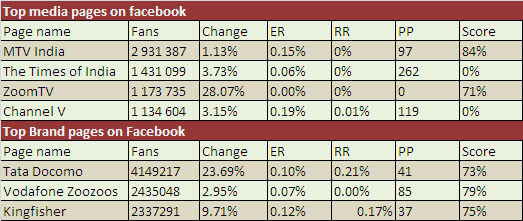
    ER = Engagement Rate, average number of total interactions to the pages posts divided by the number of fans in the last 30 days
    RR = Response Rate, the pages response rate to the user questions posted on the wall in the last 30 days
    PP = Page Posts, the number of the posts by the page in the last 30 days
    Score = The score of the Facebook page, a Socialbakers only metric that we create out of 30 different parameters

    Source:

    http://www.socialbakers.com/facebook-pages/brands/india/
    http://www.socialbakers.com/facebook-pages/media/india/
  • India ranks 7th in Facebook timespend

    By A Correspondent

    An international study into the use of social networks by global information services company Experian reveals just how much time people living in different countries spend on Facebook. Singaporeans emerge from the study as those who spend the longest on the social network site, with an average of 38 minutes and 46 seconds per session, while people living in Brazil spend just under half that with an average of 18 minutes and 19 seconds per Facebook session.

    According to the analysis by Experian Hitwise, the average session time on Facebook in August 2011 across the eight countries varied significantly. The average time spent on Facebook in August 2011 per session was – Singapore, 38 mins 46 sec; New Zealand, 30 mins 31 sec; Australia, 26 mins 27 sec; UK, 25 mins 33 sec; US, 20 mins 46 sec; France, 21 mins 53 sec; India, 20 mins 21 sec; Brazil, 20 mins 21 sec.

    Understanding average time spent on Facebook, the world’s most widely used social network, illustrates the importance of brands needing to be on social networks, the study said. By knowing that an average social network user in Singapore, will for example, spend an average of 38 minutes on Facebook means that a brand can increase the likelihood of capturing an individual’s attention by running digital marketing campaigns through Facebook. Content and advertising which is compelling will ultimately lead to greater engagement in social networks and consequently greater sales, whether on the brand’s own website or indeed within Facebook.

    Mr Navin Chandani, Managing Director, Experian Marketing Services in India, commented, “The power of social networks like Facebook is that in some respects they don’t have any boundaries and make the world a much smaller place. Knowing the market share social networks have in each country and the level of usage is key to social networking success. However, our research shows that the way individuals use social media can and does change according to cultural and personal backgrounds – therefore ‘one size definitely doesn’t fit all’ when it comes to digital. For any international brands to be successful in their digital campaigns, they must understand the local, digital and personal nuances that exist.”

    Social networking is now one of the biggest online pastimes across the globe. In each country there are thousands of social networks, varying from 3,245 in Brazil to 9,000 in the UK. Despite being one of the most mature social markets, the UK has the lowest market share of visits going to social networks and forums (12.2 percent). Brazil has the highest percentage of Internet visits going to social sites (18.9 percent of Internet usage) with 43 percent of all social networking visits in Brazil going to Orkut, the most visited social network in Brazil.

    Mr Chandani said, “Understanding how long people spend on Facebook in different countries is vital for any brand on the social network. With Facebook still finding its feet in the emerging markets of India and Brazil, lower session times are to be expected – users won’t have as many friends or groups that they have signed up to. However that doesn’t mean brands should ignore Facebook in those countries – with market share for Facebook in India increasing by 88 percent year on year and 16 percent in Brazil year on year, its influence and dominance is only set to grow.”

    Further analysis of the data reveals how different industries attract website traffic as a direct result of social networks. Social network users in Brazil, India and Singapore rarely go on to visit retail websites after being on a social network highlighting that retailers in these markets have a significant opportunity to increase their presence on social networks, ultimately driving website traffic and sales. This contrasts with countries such as New Zealand, where nine per cent of retailers receive web traffic directly from social media.

    Entertainment topped the list of the sites visited after social networks in the nine countries polled by Experian, with well-known sites such as the BBC’s iPlayer and Sky Sports featuring prominently.

    Other key findings from the survey revealed:

    In Brazil the number one social network is Orkut.com with 43 percent market share. This has fallen year on year by 18 percent with Facebook experiencing an increase in market share August 2010 to August 2011 by 16 percent

    The country to experience the fastest growth in Facebook use over the past year is India, with the social network accounting for an increase in market share of 88 percent in August 2011 compared to August 2010.

    The US also experienced a market share increase from Facebook of 5 percent year on year.

    Approximately 1 in 4 Singaporeans (18 percent) jump from one social network directly to another, demonstrating their love of social networks.

  • The Anchor: Pradeep Chopra on 8 mistakes marketers make about social media

     #1 Marketers treat social media like a short-term advertising campaign.

    Social media is all about building a lifetime relationship with your audience. However, marketers are still to understand and acknowledge that. It requires more of unlearning vs new learning.


    #2 Marketers measure ROI of social media like other digital marketing avenues.

    Unlike SEO, PPC or even email marketing, social media is not just about driving traffic to a website and measure the contribution in a typical funnel approach as used in SEO or PPC advertising. Leveraging FB ads for lead generation will be an exception.


    #3 Marketers underestimate the value of content and quality of conversations.

    Unfortunately, even today a significant percentage of marketers are focusing on metrics such as number of fans on Facebook. While the number of fans is necessary, it’s not sufficient.


    #4 Marketers don’t put required effort into defining objectives.

    While social media requires constant experimentation, laying down the objectives lays down the framework to think, execute and measure appropriately.


    #5 Marketers believe social media is about technology.

    A large number of marketers still consider social media more of a technology and less of a marketing activity. Thus, they don’t put the right resources in at the right place.


    #6 Marketers think that listening to their customers is optional.

    In the fear of confronting negative conversations about their brand, marketers don’t realise that they don’t control what others are saying about them. Hence, listening to their customers on social media is not a choice.


    #7 Marketers believe that they’ll jump in when it gets settled.

    It’s been over seven years and the only thing which is constant about Facebook is change. By the time social media reaches a stage of stability, the opportunity will be proportionally low of newer players.


    #8 Marketers still feel that social media is timepass.

    Unfortunately, a large number of marketers still feel that platforms such as Facebook are only for socialising or passing the time. While Facebook started as a social network, today it has taken the shape of a hybrid (social + professional) network and there are global case studies of B2B companies, such as Intel, Dell and GE, which have been leveraging Facebook to fulfil various business objectives.


    Pradeep Chopra is co-founder and CEO of Digital Vidya, and co-founder of dvBytes