Tag: facebook

  • Are we really Free to post online?

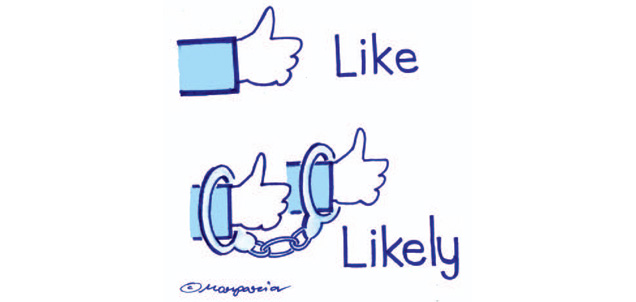
    Cartoonist Hemant Morparia’s take on the controversy. First appeared in Mumbai Mirror. Republished with the permission of the cartoonist


    By Ananya Saha


    “Everyday thousands of people die. But the world still moves on. Just due to one politician dead. A natural death. Everyone just goes crazy. They should know. We are resilient by force, not by choice. When was the last time did any one show some respect or even 2 mins silence for Shahid Bhagat Singh, Azad, Sukhdev, or any of the people because of whom we r free living Indians. Respect is earned, not given. N definitely not forced. Today, Mumbai shuts down. (sic)”


    These are the words, posted as her Facebook status, that got a 21-year-old girl arrested. Not only that, her uncle’s hospital was ransacked in protest. If you cannot say ‘what’s on your mind’ on Facebook, and share with your friends, what good is social media? Well, you could have ‘Liked’ the status, and landed up in jail too. That is what happened to her friend. Both have now completely logged off Facebook. And everybody is left asking, what is wrong with the system?


    Maheshwar Peri

    Maheshwar Peri, Chairman, Pathfinder Publishing opined, “It is ridiculous whoever accepted the complaint based on a Facebook status. Social media is all about interaction with my friends and whoever subscribes to or believes in my opinion.” According to him, if the private discourse on internet or otherwise has been intruded upon leads to a police complaint and the police acts on it, it is ridiculous.


    The girls were charged with 505 (2) of the IPC and 66 A of the IT Act, arrested and later granted bail. The last few months have seen some interesting places in this regard, whether it is Aseem Trivedi, Karthi Chidambaram or the present case, which only point to the inefficacy of Indian cyberlaw.


    Pavan Duggal

    Pavan Duggal, Advocate, Supreme Court of India and President, Cyberlaw Asia, explained, “The entire case has demonstrated the complete inadequacy of the Indian Cyberlaw. The language and scope of provisions used under Section 66A are very wide and are capable of distinctive varied interpretations. Seen from another angle, Section 66A can be effectively used as a tool for gagging legitimate free online speech. The problem under Section 66A is that it comes up with extremely wide parameters which have not been given any specific definition under the law. These parameters are capable of being interpreted in any manner possible, by the law-enforcement agencies. As such, while Section 66A talks about sending any information that is grossly offensive or having menacing character, the law does not give any guidance as to what is grossly offensive or information having menacing character. Thus, it is left to the subjective description of the law-enforcement agencies in this regard. Further Section 66A(b) talks about sending any information by means of a computer resource or a communication device which a person knows to be false, but has been sent for the purposes of causing annoyance, inconvenience, obstruction, insult, injury, criminal intimidation, enmity, hatred or ill-will, persistently by making use of such computer resource or a communication device. All these wide meaning terms used under Section 66A have not been defined, which itself provides huge amount of flexibility in Section 66A to be used in any circumstances perceivable. Thus, huge portions of legitimate free online speech could also be brought within the ambit of Section 66A of the amended Information Technology Act, 2000.”


    The present case has once again brought to the forefront as to what is the concept of liking on Facebook and its legal ramifications. Mr Duggal further pointed out that when a person clicks on “Like” button on Facebook, it does not constitute an offence under Section 66A. “Technically speaking, a person is only clicking the button of “Like” but is not per se either sending any information that is grossly offensive or has menacing character. Neither is the said person sending any information which he knows to be false but which has been sent for the purposes of causing annoyance, inconvenience, obstruction, insult, injury, criminal intimidation, enmity, hatred or ill-will. In the present case, Section 66A has been erroneously invoked,” he pointed out.


    While Pranesh Prakash, Policy Director at Centre for Internet and Society, maintained that just because something is published ‘online’, it does not mean that it is exempt from law, he added, “The online laws in India are even worse than the laws applied offline and some of those laws that are applied online, are unconstitutional.” The fact that people were posting their views about Mumbai Bandh on various other media, it remarkably shows the unconstitutional application of the applied laws.


    “Indian cyberlaw is only aimed to be an enabling legislation for promoting growth of e-commerce, m-commercial and online free speech. Indian cyberlaw should not act as an impediment to the evolution and growth of online free speech, nor should it be seen as a handle to suppress free online speech. Section 66A needs to be serious quickly reviewed and amended so as to ensure that it does not become a tool for silencing genuine legitimate online free speech, under the garb of the parameters detailed therein,” said Mr Duggal.


    But that is exactly what it is doing, according to Mr Peri. He said, “If you look at the entire ecosystem we are living in, you have a govt which enjoys control, you have a law which can be misinterpreted, you have law enforcement agencies which are not as free as they are supposed to be and you have a mainstream media which is fearful of the big and mighty. Three of the four pillars of democracy are fearful of repercussion. How can you and I enjoy personal freedom then?”


    However, as Mr Duggal explained, certain restrictions have been put online free speech. “For example, the online free speech does not give the license to defame. Similarly, the entire issue pertaining to the Facebook status needs to be examined more carefully. There are various nuances under the Information Technology Act, 2000 which could be applicable,” he said. The present controversial action arose because Section 66A provides parameters for its inherent misuse. There are tremendous loopholes under the existing law. There is a need for ensuring that the Information Technology Act, 2000 needs to be amended in such a manner so as to ensure that the provision like Section 66A of the amended Information Technology Act 2000 are not used to the detriment of online free speech.


    Mr Duggal asserted, “In this particular case, it is well possible for the Government to have adopted the route available under the Information Technology Rules, 2011. In this case, Facebook is an intermediary under Section 2(1)(w) of the amended Information Technology Act, 2000 and could be mandated by virtue of direction by the Government under the Information Technology (Intermediary Guidelines) Rules, 2011 to remove such content. Such an action could have been done best in a manner that would have ensured minimal disturbance and yet would have ensured that the relevant language is removed.” However, what we are now seeing on the Internet is that more and more people reproducing the same lines and content that the girls posted.


    Section 66A also brings up the huge conflict that it has with the Article 19 of the Constitution of India. Article 19 (1)(a) of the Constitution of India guarantees to all citizens the fundamental rights to freedom of speech and expression. The restrictions given under Article 19(2) are the guiding lights for regulating free speech including online free speech. However, the parameters and restrictions granted under Section 66A are far more broad and wider than Article 19(2) of the Constitution of India. “Seen from another angle, Section 66A appears to be perfect tool to promote and propagate the concept of Internet censorship and censorship of free speech inIndia,” said Mr Duggal.


    The complexity of India may make it easy for such assaults on freedom of expression. But the democracy of India is where the solution lies. Is India’s social fabric strong enough?


  • Young Track by Samyak Chakrabarty | Causes that Young India is fighting for

    What’s a 23-year-old writing a column on a site where the average age of columnists is… ? Ok, ok, we won’t reveal that number, but like it or not the youth constitute a majority of India’s population. Since the last few years, young Samyak Chakrabarty has been in and around media events and offices with his vision of how the youth can be targeted.


    In this period, he has organized a few conferences, participated in several of them in India and abroad, and works as Chief Youth Marketer with the DDB Mudra group. He’s organized a TedX youth conference in Mumbai, was invited to meet Hillary Clinton when she visited India and has co-authored a book ‘Generation Einstein 3.0 – India version’.


    Samyak’s column appears on Wednesdays and as the title suggests, it tracks the young – specifically keeping in mind the advertising, media and marketing fraternity – Ed


    Today’s urban youngsters are very socially conscious and aware. They do not want to live under the fear of natural disasters or any form of threat to their existence and ambition. Hence we see a large number of participants in protests, Facebook activism etc. Here are four causes that metro youth are most concerned about and taking the initiative to address:


    Freedom to enjoy: One won’t see many organizations taking this one up (as yet!), but as our system and its agents (police, municipal corporation, political parties) get more primitive in behaviour, a mass urban youth uprising won’t be far away. Things like arresting people for Facebook posts or using archaic laws to raid bars anger the new generation equally, as much as those below. Parallel to other advancements in the world, the definition of ‘a good life’ has evolved for those born post-1988, and these kids will do anything to ensure they have it!


    Education: Initatives like Akanksha, Raindancer (part of the Swades Foundation) and Teach for India demonstrate how young people’s energy and skills can be utilized for providing education to the underprivileged. Students from ‘good schools and colleges’ have begun to realize that one of the key solutions to resolving a number of India’s problem is to ensure that people from all sections of society must receive basic learning and training. Hence one will observe a number of youngsters even informally teaching kids of their home staff or those in the neighbourhood.


    Environment: Compared to a Japan or USA, India has been well shielded from major natural disasters. Through new media and easily available knowledge resources, youngsters in India are well aware of the consequences of not conserving nature. Therefore one will see a number of students starting projects like Batti Bandh, Indian Youth Climate network, etc, to create awareness and make a concerted effort to protect our environment.


    Corruption: I was not surprised to see Anna’s Lokpal movement attracting so many youngsters, including many from relatively affluent backgrounds. It begins when a kid with deeper pockets and/or powerful connections takes away the precious seat during admissions from a more deserving candidate … and makes your rage stronger when greedy enablers (of what work you need done – government offices, recruitment, hospitals etc) haunt you at every step. Youngsters find it necessary to take stringent action about this cause – in fact, when it comes to everyday life, more than anything!


  • Does social media boost ROIs for e-commerce sites?

    By Robin Thomas


    Merely setting up shop is not enough today, and brands are not limiting themselves to advertisements on television, print, radio or even the internet alone. They are logging onto social media in a big way, interacting with and updating their consumers about new products or other initiatives, and e-commerce sites are not far behind. Myntra, for instance is already said to have registered over 7 lakh Facebook fans. Myntra also has a fashion blog, ‘Style Mynt’, wherein it shares information about the latest celebrity fashion trends, new product offerings on Myntra.com and so on. Another e-commerce site, Indiatimes Shopping, started its Facebook page early this year and is said to currently have more than 2 lakh fans on Facebook.


    eBay on the other hand claims to answer over 1,200 queries every month across social media platforms. It is said to resolve over 120 post-transaction complaints every month and is ranked sixth in Social Bakers’ ‘Top 100 Global Brands on Facebook’ index and is also said to be the third most engaging FB Brand Page in India. In addition to these, eBay also conducts online contests enabling the e-commerce site to engage with its consumers. For instance, it conducted a contest called ‘Battle of the Fans’ around the IPL last year. It also launched a Facebook application called ‘Battle of the Fans FB App’ for the contest. As a result, the ‘Battle of the Fans’ app is said to have become the most popular Facebook IPL app two years in a row. Simultaneously, over 15,000 streams were said to have been published from within the app and is also said to have witnessed nearly 27 percent click-through from app-to-merchandise on the site. Besides Facebook, e-commerce sites like Indiatimes Shopping, Myntra, eBay India, Olx etc. are also active on other social networking sites like Twitter, Google Plus and so on.


    Social media vs sales targets

    Ashutosh Lawania

    According to industry estimates, nearly 25 percent of the time spent online is on social media platforms. Out of this, 50 million are said to be on Facebook, and 13 million on Twitter. The question however is, do social media activations lead to better ROI’s (Return on Investments)? Do the ‘likes’ and interactions or engagements with consumers translate into sales? According to Mr Ashutosh Lawania, Co-Founder and Head – Sales & Marketing, Myntra.com, “Though engagement is our focus on social platforms, the activities there do contribute to traffic and sales on Myntra, and we keep track of it. Contributions from these platforms are in the lower single digit figures (percentages) when compared to other channels but they do add up. Besides, Twitter and Google Plus, we also use Facebook for advertising along with generating organic traffic. About 80 percent of all Facebook traffic on Myntra is paid with the remaining 20 percent driven via organic.”


    Subhanker Sarker

    Myntra uses tools such as Facebook, Twitter, Pinterest, Google Plus to make announcements about new products, trends and to give out regular fashion updates which Mr Lanwania observed results in increased awareness and in turn influences purchase decisions.


    Having a slightly different take on the impact of social media activities on the sales, Subhanker Sarker, COO,Indiatimes Shopping was of the opinion that social media activities at times do result in better ROI’s. “Experimentation is the key. There is a certain tonality of communication, a very precise targeting of the message and a very strong follow through that can work magic. Social media is an excellent tool to keep expanding the circle of trust. The offer ads introduced recently drive a lot of sales for us now. The revenue percentage would still be in low single digits, but it all depends how you define it. Measured over a longer time period and favourable attribution logic, it touches double digit percentages.”


    Kashyap Vadapalli

    Kashyap Vadapalli, Chief Marketing Officer, eBay India observed, “Social media channels get us over 12% of our daily traffic which translate into deeper reach and higher conversions. In terms of ROI, they are one of the cheapest tools for generation of daily visits and excellent mediums for acquisition & retention marketing.”


    Anurag Gupta

    Anurag Gupta, MD, DGM India was also of the opinion that social media activities surely do reflect on the sales and revenues of e-commerce business. “Most of the e-commerce companies are using advertising on social media to drive transactions in addition to engagement activities. This is on an increase especially since platforms like Facebook have begun providing re-targeting capabilities. Sub-optimal use of social media platform by brands happened earlier, now brands have graduated and are using social media beyond likes and onto engagement and transactions.”


    The road ahead

    Social media is said to play a significant role in driving rapid growth for e-commerce brands. Only recently Myntra is said to have used social media platforms to launch its latest TVC before launching it on other media platforms. “It is an important platform to engage the audience, increase awareness and drive top of mind recall. It also plays a significant role in collecting feedback and giving customers a platform to voice their opinion and share their views on what they like or dislike” explained Mr Lanwania.


    According to Mr Gupta, social media activities for brands are increasing significantly. Most brands today have their presence on social media, including e-commerce brands. The brands are now using social media for engaging with users and a lot of e-commerce brands are increasingly using social media for commerce as well.


    However Mr Sarker was of the opinion that although social media has become a very significant platform today, brands must not be seen intruding their consumer’s privacy. “Social media can give you immense insights into your customers psyche. How you leverage that is up to you. Hence it is definitely significant for everybody. But one must respect the privacy of the audience. They are on social media mainly to socialize. If they were in the mood of buying something they would be on an e-commerce website. Intrusion is not taken kindly. We see social media as a customer insights opportunity rather than a sales one.”


    Taking social media onto a different level altogether, e-commerce sites are beginning to effectively use advertising on social media to drive their transactions. Although the revenue generated or the revenue percentage from social media activities are still said to be in single digits, it is believed to grow depending on the innovations and the engagement that e-commerce sites have to offer to their consumers.


    “Offline shopping tends to be a social phenomenon, and this will catch up with online shopping as well. We foresee online shopping getting integrated with social media as more and more enthusiasts will start seeking opinions before they indulge and seek compliments post indulgence. This could take the form of deeper and richer integration of social tools in the online shopping experience. One would also e-commerce players leveraging the social graph to add engaging ways to enable users to talk & share about shopping on various social media channels” concluded Mr Vadapalli of eBay.


  • Jaldi 5 with Sanjay Mehta: 1 billion users strong, Facebook can influence elections

    Sanjay Mehta

    When Facebook gently proclaimed that it now had touched the magical one billion users figure, most of us just dismissed it as a milestone. But it’s an accomplishment that cannot be ignored by not just individual users – but also marketers, sociologists, governments and all those who need to reach out to the masses.


    We asked Sanjay Mehta, Joint CEO, Social Wavelength some very fundamental questions on this achievement including whether there is any reason to fear the platform being abused of destabilizing nations.


    1 Would it be right to say that a good reason for the Facebook users reaching 1 billion would be thanks to the growth in recent years in India?

    LOL… no. We cannot take too much credit considering the Indian userbase, at this time, being a nominal 50 mn in FB’s total of 1 bn. So while the Indian user base has contributed to the overall numbers, it has been a nominal percentage.


    Would you say that Facebook is the single biggest marketing development of the 2000s?

    Well, I would say Social Media is the single-biggest marketing development. And Facebook is a key player in that social media space. Also though, I would also not claim this to be the greatest development of 2000s. That is a long period, and we have had other key developments including search engine advertising, which have been impactful. But in the last 2-3 years, it has been a clear emergence of social media as a marketing platform, and Facebook is its most significant component!


    With one billion users, Facebook users constitute the single largest community of individuals after China and India? Do you think it’s right for it to be seen like that?

    Well, yes, sure. So let’s take that analogy ahead.  What does a single group – be it citizens or China or India, or registered users of Facebook – mean?  That they do share some characteristics (citizenship in case of countries, Facebook in the latter case), but there are enough differences amongst them too. All citizens are not the same kind of people, nor are all registered users of Facebook. Likewise, there is no easy way for a marketer to reach “all Indian citizens” (wouldn’t THAT be a dream?!), and so also, there is no easy way to reach the billion Facebook users.


    Except perhaps, for the governments and for Facebook!! But the citizens and Facebook users do constitute a ‘group of sorts’ and there are opportunities built in there, for marketers.


    2 Do you think marketing in the present day can be done without a Facebook strategy in the media plan?

    All marketing plans may not need Facebook. So there IS a possibility for a few marketing campaigns to not include Facebook However, Facebook is making constant changes to become interesting for more and more brands and perhaps over time, most campaigns will have a Facebook extension! Or a Facebook core!


    But is there a lot of abuse of Facebook – fake likes, fictitious users and various strategies adopted to alter perception by marketers. Is there reason for skepticism when people refer to success thanks to ‘Facebook marketing’?

    The scepticism is with a few people only, and it is also misplaced. The number of fake accounts or fake likes is a small percentage again, and the matter has been exaggerated. There is also an extent of click fraud in Google ads. But due to good algorithms, this is controlled to a small level. Same is the case with fake profiles and fake likes. It is a small percentage. Facebook does not like these. Recently it identified about 80+ mn fake accounts and went about deleting those.


    Can Twitter be put in the same basket as Facebook for marketers?

    Well, it depends on what you’d call the basket. So yes, it is also part of the social media space, and in a sense, the marketer will reach the social media active user, via Facebook or Twitter. But within that framework, there is a difference between the two platforms. Not just that, within Facebook or Twitter usage also, there are different patterns of usage and user profiles. So marketers cannot just “go to Facebook or Twitter”. There is a further science in terms of what they want to achieve, whom they want to reach, etc., and based on which campaigns are planned and executed.


    3 Just as Orkut was a rage once upon a time and faded out eventually, do you think Facebook could see the same eventuality soon? What do you think is the next big idea?

    If I have learned something in the last 10-15 years observing the tech space, it is that, ‘nothing is permanent’ or ‘no platform / brand / service remains on the top for very long’. Facebook could be the exception to this rule, or it could also fall out of favor in sometime.


    However, at the present moment, stock price apart, Facebook is extremely well-entrenched as a powerful leader in the space.


    If something or someone can displace it from its position, I do not have the crystal ball to gaze into and tell you, what that may be! It could be a platform that is currently present and becomes larger, or it could be something that is being developed in some garage or lab in some part of Silicon Valley or Israel or even Mumbai or Bangalore!


    Let’s keep watching the space and discover when it happens!!


    4 Do you see social media like Facebook being used by politicians to influence public opinion?

    Absolutely! Politicians are also brands that need to be sold, no disrespect meant here! So like any other brand that uses the medium to influence its target market, a politician also needs to do the same, for their communication messaging.


    Whether social media will impact an election result or not, just yet, it hard to say. But it will definitely influence few votes!


    5 Can there ever be a fear of Facebook being misused to destabilize countries… just as there is a fear of various media vehicles?

    We live in interesting times. Many of us are logged into our Gmail accounts all day. There is a decent amount of our web behavior that Google knows about.


    We use applications like Whatspp or Truecaller, and we share our contact lists with these applications. And a lot of us do so, and the applications then, know a lot of our cross connections and relationships.  Likewise we use Facebook, where we share our relationships, we talk about our vacations, put our photos and videos, and let people know our political preferences or movies that we like.


    There is truly a lot of information about us, out there.  And this is with a variety of sources, whom we consciously trust, or sometimes do not realize, but end up giving our trust!  Just as data stored and flowing through electronic pipes is always susceptible to leaks like Wikileaks, so also our personal data is always susceptible to being abused.  Either by means of hackers exploiting some holes, or worse, if the sources that we trust, turn rogue!


    We live in hope that these guys don’t turn rogue, and there is no major abuse of our privacy. Each morning, along with the prayers for your health, wealth and prosperity, you must also pray that Google, Facebook, Whatsapp and other such applications do not turn rogue ever!!


  • MxM Mondays: Why do marketers not spend enough on digital media?


    By Ananya Saha and Robin Thomas


    According to the latest IAMAI-IMRB report on Digital Advertising, as of March 2012, the total advertising spends, including classifieds, was valued at Rs2,850 crore. It is expected that by FY2013 the digital advertisement spends will be Rs4,391 crore.


    Search advertising constitutes about 20 per cent of the total online advertising spend or about Rs570 crore. Display advertisement, which has many components, forms a sizeable portion of advertising spends. Advertisements on portals and vortals form 13 per cent of the overall pie (Rs369 Crores). Advertisements on Social Media, Email and Videos over the Internet form 3 per cent (Rs94 Crores), 5 per cent (Rs144 Crores) and 2 per cent (Rs59 Crores) respectively. Mobile ads form nearly 4 per cent (Rs90 Crores). A major proportion – around 53 per cent of the overall digital advertising spends – are classifieds listings (Rs1,496 Crores).


    These numbers seem impressive, but there has been some concern that marketers are not spending enough on Digital Media. The theme for this week’s MxM Mondays is ‘Why do marketers still not spend enough on digital?’ While marketing spends may be shifting to the digital media globally, in India, television and print still rule. Is it because digital still doesn’t reach the masses, and homemakers, in particular? Or is that the bucks (hence commissions) are still big in TVCs? MxM spoke to some players in the industry to find out:

     

    Ambika Sharma

    Ambika Sharma, MD and CEO, Pulp Strategy

    The shift to digital media is not happening as fast as the industry would like it to be. However, we are witnessing an increase in aptitude and attitude with regards to usage of digital media. Marketers are not using the media aggressively as they prefer to wait-and-watch. Even then, they are aggressive on ‘search marketing’, but not other aspects of digital media.


    There is hardly any youth brand which is currently not on digital platform. Education is one prominent category that has been using digital media. The cents for digital, however, remain restricted. But as the impact of digital media grows, the impact of mobile advertising has seen a decrease as most people now do not prefer to click on banner ads on mobile screens. Some studies show that in the past one-and-a-half-year, the user has been ignoring banner ads.


    The digital spends depend on ROI, search and impressions, which needs robust backend engine. E-commerce websites have been the heavy users of digital advertising to create impressions. But there is little or no response mechanism on impressions and the visibility is highly fragmented. The numbers, like there is TAM for television, are not available for digital media. If a marketer advertisers on three digital platforms, every platform gives their own numbers. So, there is no comprehensive measurable strategy.


    Going forward, digital media will grow, but it will be a long while before it catches up with other media vehicles. Lotof factors such as measurability, reach, people not preferring to buy online are affecting the growth.

     

    Gyan Gupta

    Gyan Gupta, CEO, I Media Corp Limited (IMCL), Dainik Bhaskar

    In the US, the online spend is 29 per cent of the total advertising pie; in UK, it is 26 per cent. Now if you see the figures in India, it is not even 5 per cent. The trend shows that there will be 50 per cent increase.


    But I will not say that marketers in India are spending enough yet. The typical spender (who spends on television) is yet not on-board. Till the main spenders come on-board, the growth will be limited. FMCG’s have a deep share of the pocket, and it is necessary that they spend on digital media. Auto companies, e-commerce companies, financial companies have been heavy spenders on this medium.


    What are the marketers spending on, and how they spend also becomes important. What needs to be analysed is if the cost of acquisition is happening, if the leads are getting generated, how much a brand is spending on digital activation vis-a-vis on brand promotion. Trending is happening. This year will actually showcase the brands spending on digital media.

     

    Harneet Singh Rajpal

    Harneet Singh Rajpal, Vice President-Marketing, Domino’s Pizza India

    The use of digital media is picking up in India. For any marketer present in India, the digital media is beginning to become a part of their media plan. It is on radar for everyone, especially in the categories where youth is the target.


    For Domino’s, digital media has been important ever since we began our online ordering platform. Currently, it helps us drive traction. Hence, our media spends for digital medium have increased over the last two years. For us the return-on-investment is visible for every buck we spend on this media, since it results from direct conversion from inventory to revenue generation.


    We now spend close to 4-5 per cent of our total advertising budget on digital marketing, from almost nothing in the last two years. We work with leading publishers in the domain to create applications for Google search, Facebook and social media. I must say that on Facebook, we have the largest number of fans in the food category, and also followers on Twitter.


    Social Media management needs time and investment. It is important that the brand keeps the target in mind when planning the digital activations. Going forward, marketers will have to evaluate the prospects digital media brings. Of course, that depends on category to category. Digital media is still limited because of its reach, whereas traditional media garners higher reach. Also, the confidence about using the media is not too high among the marketers since there are no hard numbers to prove its success. The penetration of internet and the efficacy of the media will be tested over time.


    Jonathan Bill, Senior Vice President and Business Development, Vodafone India

    Digital Advertising is a growing medium in India. It will be everything we are hoping it to be and that too quicker than we think, so I think the business is starting to get in a healthy shape. The advertisers are starting to embrace digital more openly and they should do so, because India has the third largest internet population on the planet.


    On TV and Print bagging bigger ad share, I think that is a legacy issue among advertisers, but I do get a sense that it is fast changing. In the West, however, TV and Print advertising have declined in favour of online advertising. Print, therefore, has very less revenue share from advertisers as compared to online advertising and now online is beginning to even threaten television as a medium.


    I think we just need to continue on the path we are going. The quality of sales and, to a certain extent, the market needs to be made. The West took nearly two or three years to be made as far as the start of digital advertising market is concerned and in India we are only about a year ready. So, I am very bullish on digital advertising in India, particularly on mobile on three to five years timeline.


    Narayanan SP

    Narayanan SP, Senior Vice President, and Head VAS Mobile Commerce and Long Distance, Idea Cellular

    Compared to the global benchmark, certainly advertisers in India are not spending as much money on digital or mobile, but this is something which will change over a period of time. Marketers are experimenting to see if it makes sense for them to connect digitally for certain set of products/features and whether digital is the right medium to communicate or engage their brands. Thus, lot of experiments are happening.


    On the internet front, we are already seeing a significant traction which may not be as big as the international market because of the low internet penetration in India. So if you are looking at a certain type of product wherein the target audience are already digitally connected, then it makes immense sense to go digital. Digital, I believe, will evolve as more and more customer profiling is done and advertisers are able to target their customers precisely. When advertisers are able to measure the ROI (Return on Investment), then we definitely believe that a lot more investment will come into digital.


    The fact that TV and Print still bag more advertising share will definitely change over a period of time in terms of mobile being one of the vibrant channels. This does not mean print and television advertising disappear but, you will see an increase in spends on digital advertising and mobile advertising in particular over a period of time. This is because mobile is able to give the advertiser not only a more precise profile of the customer which makes it a lot easier for the advertiser to reach out to its consumers effectively, but it also allows the advertiser to interact with customers and measure the results of their campaigns effectively.


    Mobile industry, for instance, has a wealth of data in terms of customer usage, but there has not been much mining of the data which can be heavily leveraged by the advertisers. However over a period of time, you will see a lot more advertisers leveraging this data.

     

    Rakesh Rao

    Rakesh Rao, National Sales Head, Zapak Digital Entertainment

    The digital media has been growing exponentially. The year-on-year growth of this media vehicle is close to Rs2,800 crore, and is supposed to reach close to Rs4,000 crore in a year. So to say that it is not a preferred media would not be the right statement. Of course, it is not a dramatic growth, but given the growth of internet and smart phones, digital media is becoming a part of our daily life. The marketers are also following the trend.


    The ROI, when compared to TV and radio, is much more measurable. Cost per lead and cost per click measure actual conversions. This is the only interactive platform too, while rest of the media only give reach.


    Education, travel, finance are becoming the biggest spenders on digital because of conversion aspect. E-commerce, and categories like travel that look at selling inventory believe in digital media.


    The challenges that this media is encountering is getting TV-centric brands such as FMCG onboard because of reach. It is a given that while TV is cost-effective when it comes to reach, digital media will catch up in some years. About 60 per cent of these brands are on digital, but 40 per cent need coaxing. There is no hindrance apart from the fact that broadband numbers need to grow. Digital media is here to stay and grow.

     

    Sandip Tarkas

    Sandip Tarkas, President (Customer Strategy) and CEO, Future Media and T24

    As far as Future Media is concerned, our advertising spends on digital have been increasing year-on-year. Despite a lot of digital activities done by marketers specifically on social media, it does not reflect in spends. The problem with digital is not a lack of a credible or universal measurement system, but the fact that it is too measurable as people try to measure every little thing. Although there are so many metrics which evaluate the digital medium, I don’t think it is a lack of measurability at all, as in digital we are clearly able to measure our CPM’s (Cost per Thousands) and so on. Digital is something we use for more engagement rather than reach because it does not offer reach.


    We look at advertising based on two things – reach and cost efficiency. And then you look at everything else – whether the medium is interactive and so on. So, it is primarily about reach and cost efficiency. Digital media spend in India is a reflective of India’s internet penetration, whereas in a lot of markets digital penetration is very high. In those markets both print and television advertising have declined and digital advertising has been growing.


    In India too, digital is growing much faster than the traditional media, and the growth of the media certainly shows the growing importance of digital. The current size of the digital advertising pie is reflective of the kind of inroads it has made in the country.


    On digital being a 360-degree medium in itself and the role of online video and social media advertising, the biggest gain happening in digital at present is the fact that it is changing quite rapidly. Since the late 90s when we first started using digital advertising until now, the role of the medium has changed quite drastically.


    Digital today not only offers more opportunities for engaging the consumers, but the vehicles used in digital have also been changing with time. For instance, in the early days television ads would continue for quite a lot of time, but today with more options, even the television channels have begun to announce that the programme will be back in say a minute or two. So as consumers have more choices, the way the medium gets utilized also changes. Digital, I believe, be it in any form – video, social, mobile – if it is not going to be interactive, it will not be very successful.


    For anybody targeting the youth, digital is an inescapable medium. I believe the biggest change in digital advertising will take place through mobile, particularly mobile VAS and the data cost. Growth spurt in digital advertising will also come through the increase in smart phone usage and the lowering of data cost will revolutionize digital advertising.


    This is because India has a very high tele-density and today mobile phones have reached the lower-most strata. I believe digital advertising in India will explode once mobile advertising comes of age but, right now it is still in its infancy.


    Eventually digital advertising will impact television and print ads as marketers will have to allocate their budgets for digital advertising, once it comes of age. It may probably hit print advertising first and then television but for that to happen there is still some time.

     

    Sanjay Tripathi

    Sanjay Tripathy, Executive Vice President – Head Marketing and Direct Channels at HDFC Life

    There is still limited spend on digital due to lack of knowledge about the medium and utilizing it effectively as a part of marketing plan; reach/penetration of the medium; and its ability to create impact in the short term. Digital still reaches about 10 per cent of the Indian population and there hasn’t been much of a development in building infrastructure to support the growth of internet. TV continues to be the mass medium which gets the maximum eyeballs and reach.


    While the ROI variables will drive spends to digital, marketing needs a serious mind shift to look at the additional advantages which digital brings along –  a medium which allows two-way dialogue  and measurability to the last mile.


    Thirty per cent of our budgets are dedicated to digital this year – a big move from the fact that we spent a negligible amount last year. As BFSI marketing and advertising becomes more ROI focused, digital media will play an important role. Digital budgets will have a healthy growth each year and will also account for a significant part of the marketing budget.


    While marketing spends may be shifting to the digital media globally, in India, television and print still rule. This is because reach plays an important role. Penetration of Internet in India is still low compared to international markets. The consumption of non-traditional online media is still low and 360 degree integrated communication planning in India has not evolved to have online as an integral part of marketing plans. Also, online medium do not works in sync with other media.


    While there has been a tremendous amount of growth in the usage of internet among SEC A, SEC B audience, internet is yet to gain as big an audience in tier 2 or tier 3 cities. TV continues to be the mass medium due to lack of digital infrastructure. It is the reach and channel affinity which mainly drives the spending and this is where a traditional channel like TV gets one up over digital. There is also a problem of lack of content on digital. Either the content has not been customized to cater to the audience or often the language becomes a hindrance in consuming the content.


    But digital media will make a huge impact. Level of engagement, interactivity and ROI afforded by the medium means it has big role to play. For brands which don’t engage their users online will tend to lose their relevance. As reach increases, the importance and level of competition will also increase –  YouTube already affords a higher reach compared to most of the TV channels and is increasingly becoming an important part of the traditional media mix.


    Digital offers tremendous potential for business – whether it’s about spreading awareness or generating business even in the face of a slowdown. In fact, as people tighten up their purse strings, they will want to do more research before they arrive at a purchase making decision and internet remains the primary medium of product research.


    I see the spends going up because the whole media pie has been asymmetric- if you look at the reach-frequency formula and compare it to TV, print, radio and then digital. There are more people spending time on digital in comparison to other traditional media touchpoints. I see the digital percentage increasing in the overall pie.


    Youtube and pre-roll videos have become a mainstay when it comes to hosting TVCs on digital and these unique ad formats are as effective in reaching out to audience as a TVC. For print QR codes help bridge the gap between offline and online world.

     

    Saugata Bagchi

    Saugata Bagchi, Senior VP, Tribal DDB India

    The primary challenge is the need of cracking an ROI metric, which is acceptable by advertisers across the board.  The media spends are happening, but is it delivering enough clickthrough rate goes unanswered. Digital media cannot ensure high reach like television, but with 12 per cent penetration among various categories it can definitely give high frequency. Currently, only 25-30 per cent of population is online; hence, the spending on this medium will remain lower than other mediums.


    The point of advantage is that there is a big influx of youth, and they are ready to spend. While the marketers would want to catch the youth online, they (marketers) get no justification in form of numbers to spend much on media. Hence, they prefer doing mall activation to spending on digital platform. The agency and publishing community need to be more forthcoming to speak to the marketers, and in their language.


    Digital media is currently registering 15-18 per cent year-on-year growth, but it is important to note the gap between digital and television media.


    Since the offices of MxMIndia are closed on Monday, August 20, there will be no MxM Mondays next week. We will announce the theme for the next edition on Tuesday, August 21.



  • The Crucial Social Media Question: Have fans? Now what?

    By Tuhina Anand


    Every marketer worth his salt wants his brand to have a presence on social media. However, the truth is that the marketers are still trying to figure how to navigate this medium.


    Having heard that it’s a ‘cost effective medium, can be tracked and is ‘the’ medium’ where the customers hang out, the marketer obviously wants to be there too. But the social media still has a long way to go before it is seen as the ‘vehicle of choice’ and not just as an afterthought.


    Yes, one agrees that marketers are warming up to the medium but they are still testing waters barring a handful who have taken the medium wholeheartedly.


    Once a marketer decides to go on social media, the next move is to create a presence on Facebook and maybe on Twitter. We have often heard the marketers talking about the large number of fans they have acquired on FB, so what do these number of fans mean to them and how are the marketers leveraging these fans to engage effectively with consumers?


    Chhaya Balachandran Aiyer, Founder and Managing Director, BC Webwise agrees that there is peer pressure to acquire more fans and clients often bow to that demand: “The number of fans and likes is a visible number, hence one can’t write it off completely even though many of the numbers could be dormant fans. These numbers are an opportunity to engage those fans in a meaningful way to create brand loyalty and brand recall.”


    She added: “Two years back, the common demand of a client was to be on Facebook, but we have seen a shift now where they have realized that it’s not the ultimate answer but social media too needs a 360 degree approach.” So it’s clear that there are different kinds of marketers and the early adopters are clearly asking the right kind of questions.


    Some of the brands that have effectively used the communities on FB are Fastrack, Café Coffee Day, Sunsilk while more are getting on the engagement bandwagon. Explaining the significance of the numbers, Rajiv Dingra, CEO, WATConsult, said: “While all readers of an ad do not become buyers of the product, similarly with FB, the marketers become a publisher of its page to reach out to the consumers. The aim is not always conversion to transaction for all people on its FB page, but with a large fan base the number of potential buyers definitely increases.”


    Mr Dingra is clear that there is no replacement for good content. He added that the numbers might reflect various objectives of a brand at different points, but if the content is good, the engagement with brands will become only much more involved and meaningful.


    Vineet Gupta

    Vineet Gupta of 22feet has been relentlessly engaging with brands to enable them to use their social media tools effectively. He explained: “We have brought out exclusive sale for Fastrack fans on FB and the brand has been doing a lot of stuff exclusive to the community. Scale has its own benefit and one can’t deny that. With people becoming familiar with social media, there are lots of activities happening which take people beyond the likes and the fans.”


    The agency has recently done activation for Lee titled ‘Shadows of City’, where people were encouraged to present their photographs of the city and the shadows they create which would then be put up in the stores.


    CCD is another brand that has been using FB to listen to its customers and also engage them via the medium. Ramakrishnan K, President- Marketing at CCD elaborated: “At CCD, we not only have numbers, but also a high level of engagement. Our fan base is 2.6 million and our monthly engagement level is 60 per cent, i.e. 60 per cent of our fans interact in some form with our page every month.”


    He added: “At CCD, we use social media base for regular tailor-made communication on happenings in CCD. We have a direct consumer feedback on cafes across the country which gives us instant information that keeps us on our toes. Most importantly, we use the fan base for co-creating many of our offerings – be it new menu, suggestions for improvement, live tasting of new introductions, choice of music among others. We engage fans to co-create their brand. As a result, we drive a very high level of consumer engagement, which in turn helps us drive sales.”


    One concern is that many fans on FB might be dormant, so then do the numbers really mean anything? Sanjay Mehta, Joint CEO at Social Wavelength explained: “I think that the key is to deliver message to interested people. If people receive the message but not respond, that is not a concern, but if they do not get the message in the first place, then it’s a bigger challenge. I think one should not be dismissive of the dormant numbers, but focus more on getting the right kind of messages that will get them to engage.”


  • Tourism Australia launches Facebook app

    By A Correspondent


    The ‘Discover Australia Through Your Friends’ app – the first of its kind – merges the best of Google Maps and Facebook technology to create a unique travel planning tool to not only help choose where to go in Australia, but also provide advice from friends who may already have been there.


    The app provides users with a location-specific snapshot of where all of their Facebook friends have previously ‘checked in’, photos they may have ‘tagged’ and also any comments they may have posted about their travel experiences whilst there.


    Currently, Tourism Australia has 3.3 million fans. Tourism Australia Managing Director Andrew McEvoy believes that the new app will be welcomed both by travellers and the Australian tourism industry.


    “We know from research that more and more travellers are turning to their social media networks for inspiration to help them plan and get the best out of their holidays. Tourism Australia has been a global leader in the digital space for over a decade and this innovative social media tool will make word of mouth from your trusted network of Facebook friends even more powerful,” Mr McEvoy said.


    The launch of the new app follows new research findings, released by Tourism Australia earlier this month, demonstrating the growing impact of social media on the way Australians travel around their own country.


    “Facebook remains a key plank in Tourism Australia’s social media strategy to promote the country’s tourism credentials at home and abroad through the power of advocacy,” he added.


    Tourism Australia Executive General Manager Consumer Marketing, Nick Baker, who has led the national tourism agency’s innovative digital and social media approach, said Tourism Australia’s Facebook page now enjoyed over three million advocates.


    “The new Discover Australia Through Your Friends app is also a great tool for the industry – allowing us to simultaneously showcase these postings as fantastic examples of things for visitors to do nearby, whilst spending time exploring our great country,” Mr Baker said.


  • After 1.5lakh+ views, Agnee’s ‘reveal yourself’ video is unmuted for launch of B’lue!

    By A Correspondent


    Almost a week back, on July 23, Scarecrow Communications had launched a silent music video featuring Agnee to promote Danone-Narang’s new drink B’lue. People were asked to lip-read and guess the lyrics. Through a specially designed Facebook application, one could type in the lyrics. On submitting their lyrics, every user got a score on the correct words revealed and more interestingly, the correct words got unmuted in the silent music video on replaying.


    In just a week’s time, the campaign got a whopping 1.5 lakh+ views. With engagement and curiosity at their peaks, on July 30, the original track – Reveal Yourself – was unmuted and released. Here is when the brand B’lue unveiled its association with Agnee and the idea behind the ‘Reveal Yourself’ campaign.


    Renu Bansal, Head-Marketing, Danone-Narang Beverages said: “Today’s youth is aware of what they want to pursue and don’t live a life dictated by others. With our new campaign ‘Reveal Yourself’, we wish to foster a passion to inspire people to pursue their dreams. Agnee has beautifully captured this sentiment in their music video. ‘Reveal Yourself’ is B’lue’s tribute, along with Agnee, to all Punekars.”


    The premise of the campaign was unique. Amitabh Sreedharan, AVP-Account Management, Scarecrow Communications said: “Before launching the brand nationally, Danone-Narang was looking to do a pilot launch for B’lue in Pune. While a print and outdoor campaign was created under the theme of ‘Reveal Yourself’, there still had to be a big buzz-generating activity that engaged the youth of Pune.”


    Kapil Tammal, Executive Creative Director, Scarecrow Communications said: “Since ‘Reveal Yourself’ is all about inspiring people to follow their hearts, team Scarecrow decided to help the brand philosophy come alive through a song that connects with the youth of Pune. While Agnee is today a popular national band, it’s still very much Pune-based. Agnee’s popularity among the youth of Pune and the roaring music culture of the city was only to leverage upon.”


    Team Scarecrow jammed with Agnee to draft the lyrics and roped in a technology partner to design this one-of-its-kind app. Sarvesh Raikar, Creative Director, Scarecrow Communications said: “Besides launching the silent video, we created a range of interactive elements that drove engagement further. Videos were shot with Mohon and Koco (the band’s lead singers) playing dumb charades and helping people guess the lyrics.  Fun stuff like lip-reading tutorials and crosswords were also uploaded to boost the buzz.”


    The band members also interacted with the participants through Twitter and encouraged them.


    To catch the teaser phase action, visit Agnee Facebook page: http://www.facebook.com/agneelive


  • Alpenliebe re-creates irresistibility in Ice Age 4

    By A Correspondent


    Perfetti van Melle India, the market leader in confectionery, has partnered with Fox Studios for the latest marketing campaign for Alpenliebe. The creative for the campaign is set in Ice Age, the internationally successful franchise from Fox, with the release of its latest installment – Ice Age 4: Continental Drift.


    The campaign aims to bring alive the “irresistibility” positioning of Alpenliebe. In this TV commercial, Scrat, who is one of most loved characters from the franchise, has turned this attention towards his favourite Alpenliebe. But his greed for Alpenliebe cascades into a hilarious chain of events.


    The campaign will surely surprise and entertain consumers and create an excitement around the brand. This campaign can be seen on all leading kids’ channels and on Youtube and Facebook.


    Commenting on the initiative, Nikhil Sharma, Director Marketing Perfetti van Melle India, said: “The objective of this campaign was both to bring alive the brand proposition and to entertain our consumers. Thanks to the support we received from Fox Studios, we have been able to produce a TVC that delivers very well on both counts.”


    [youtube width=”400″ height=”225″]http://www.youtube.com/watch?v=-Wcl2zVWQ14[/youtube]He added: “Scrat’s tireless chase of an acorn is a well established and entertaining part of the Ice Age story and the whole piece fit very beautifully to highlight the ‘irresistibility’ of Alpenliebe – something which is very rarely the case in such associations.”


    Vijay Singh, CEO, Fox Star Studios India said: “Ice Age is the most successful animated franchise in India, and highly beloved amongst children and families; we are really pleased on the association between Ice Age 4: Continental Drift and Perfetti van Melle. The Indian team is very passionate and creative. The idea has been seamlessly depicted in the TVC, from the perspective of both Alpenliebe and Ice Age franchise.”


  • Ranjona Banerji: Honey, you stole the show!

    By Ranjona Banerji


    It’s hard to choose the biggest noosemaker of last week. Was it Danny Boyle for his quirky, funny and very British opening ceremony for the London 2012 Olympic Games? Was it Madhura Nagendra aka Madhura Honey for gate-crashing India’s flag march in the parade of nations and not being colour coordinated at the same time? Or was it our old friends, the various members of Team Anna in their fight against corruption and the people of India who support them?


    This Honey or Nagendra person, depending on how affectionate you feel about her, has got no affection from the people of India – even less than they have for Anna Hazare. She smiled as she stole the show from our athletes but since then she has apparently even cancelled her Facebook page. The crime was double-fold: walking in the parade as if she belonged there, smiling away and then wearing bright red and turquoise which clashed horrible with the yellow of the Indian team. This is a rule which all gate-crashers must follow – at least attempt to blend in.


    Her daddy in Bangalore has tried to defend her (daddies are vital for the defence of all those connected with Indian sport as we discovered in the Bhupathi-Paes face off, especially daddies from Bangalore) and so funnily enough has Lord Sebastian Coe of the London Olympics. Nagendra got “over-excited” he said. She was supposed to be a performer which is why she was lurking about, but was not eventually selected which is why she had no business lurking about. Then there’s the other suspicion (mine) of the British propensity for cultural determinism. Someone put her there to make the Indians athletes feel welcome as they entered the arena, it was hinted at somewhere. This is because the British feel that Indians only feel welcome when they see other Indians. In this case it backfired – as cultural determinism normally does.


    So where does it leave Danny Boyle? Probably wishing he had selected Honey-Nagendra. What is this Honey thing anyway? The Indian press applauded the opening ceremony as did most of the world. Most even forgot that there was some speculation about AR Rahman being part of the show -which he wasn’t and no one cared.


    Mumbai Mirror’s headline “Tepid London Boyle’s Over” upset firstpost.com which pointed out that the headline and the body copy did not match.


    * * *


    That leads us to the latest fast by Anna Hazare and his anti-corruption crusaders. Last year over one lakh people supported him in Delhi and that was a lot and this year 6,000 people supported him and that was a lot. In Mumbai last year when 5,000 turned up in Bandra that was too little, and this year 2,000 people in VT is a lot.


    Thus proving that even mathematics is relative: If only my maths teacher had bought that argument when I was in school.


  • Storytelling through the years

    By Shubhangi Mehta


    The trend of storytelling in an ad began with actors in the campaign sharing a fictional story that connected with the masses and now taking it a step ahead, advertisers are trying to connect directly with the masses and asking them to tell their original stories in the campaign.


    Storytelling commercials capture the emotional side of an audience.

    How beautiful or charming your story is depends on the imagination of the creator. How beautifully and effortlessly it’s told, depends on the media plan.

    Some stories need more time, some don’t. While one understands that media comes at a price, one often forgets that the  poorly told story, even if it fits the budget perfectly, is money down the drain as it won’t reap half the rewards as a beautifully told story will.


    KV Sridhar

    As KV Sridhar, NCD, Leo Burnett India, explains, stories are a “means of communicating to the world in an interesting manner and advertisements are no different. The only challenge is to tell a story in 30-60 seconds. Products have become brands and household names because of use of this concept in our commercials. The concept provides a benefit for the brand as it establishes an emotional connect with the consumers, it’s not just a sales message, but about narrating a story. In other words, we can regard a story as a sugar coated medicine. Initially, story telling in commercials was a one way process -brands created a virtual story to connect with the masses – but today it has become a two-way communication. And due to the popularity of social media – Facebook, Twitter – it’s become easier to interact with the consumer. Brands no more control the story, consumers do.”


    Sumanto Chattopadhyay, ECD, Ogilvy & Mather, cites an example: “Pond’s created a very successful series of TV commercial a few years ago. It was a love triangle starring Priyanka Chopra, Saif Ali Khan and Neha Dhupia. These episodic films spun a classic love story with all the trademark melodrama of a top-rated TV serial.”


    Sumanto Chattopadhyay

    The only downside of episodic commercials is the high budget required to make and air multiple TV spots. But if made with skill and backed by deep pockets, they can be a worthwhile investment. The international trend in contemporary popular culture is marked by a penchant for realism combined with a desire for the limelight.


    From reality shows that hunt for talent to advertising that is crowd-sourced, it is all about letting people step into the light to tell their own stories in their own voice. Andy Warhol was prescient when, decades ago, he said: “In the future everybody will be world famous for fifteen minutes.” Today, that is the mantra of many – offering the people the chance to have their names, faces and stories in the spotlight – which is also a shrewd strategy for brand success. The resulting authenticity has an inherent appeal to the modern mindset.


    Storytelling is the means by which our culture has been passed down

    Storytelling is the means by which our culture has been passed down from one generation to the next. Sometimes, through stories expressed verbally by our elders; at other times through pictures drawn on cave walls and later through sophisticated dance drama. So it is hardly surprising that we took like ducks to water to story telling in movies, TV serials and TV commercials.


    Rahul Matthew, ECD, McCann Erickson said: “Storytelling, to get a point or ideology across, is not a creation of advertising. Stories have been used forever to sell ideologies, morals, and wisdom to people. Panchtantra or Mahabharata are all illustrations of the same. The only difference is that in advertising we use it to sell brands. It’s probably because story-telling makes anything less preachy and we’re always ready to hear a good story. A story also makes things more relate-able since it borrows from life; the same life that our brands and products have to be a part of. This so-called real story-telling has always been there. What’s called testimonials is just that. We used to use models to give the impression of a real-life consumer sharing his/her experiences with the product. And today instead of models we are recruiting real consumers to tell us what they feel or think.”


    Mr Matthew further states that it’s more a reflection of a change in consumer behaviour than a change in advertising: “We are reaching out to reviews from unknown people through blogs/social media to make our choices, and at the same time proactively sharing our views for others to consume. And advertising has always merely reflected consumer behaviour.”


    Minakshi Achan, co-founder, Salt Brand Solutions feels that storytelling has kept us riveted for centuries as it is part of popular culture and has shaped and defined us for the longest time through religion, entertainment, history and music. “Brands have simply adopted the art and used it to tell stories and shed light about their products and services. There is no better way to connect with your consumers and the greatest of brands know the profound impact it has on people. Brands are the greatest story tellers and if you count religion itself as a brand, we know the power of story telling, and the continued effect on us. The big change has not been in the concept of storytelling, but in the way we communicate because of the platforms available to us. In the yester world, there were no platforms for two-way communication or rather it was difficult to do so. Today’s world is open and the exchange and engagement with a consumer is far easier. Far greater possibilities exist thanks to social media – whether it is the internet or mobile,” she added.


    Co-creation is the new way

    Consumers have stories to tell and today brands can listen to them and have their contribution to impact their brands. This apart, the stories are more real, straight from the horse’s mouth, which lend great credibility to brands. Since the engagement models have changed, I think there is far more meaningful conversations possible today, feels Ms Achan.


    All in all, we can say that stories surely are for everyone and quite naturally work across categories and consumer types. The length of time, the canvas of the medium may change but the premise is the same, and the objective for brands is just to impact the brand and consumers with this format. Whether it s a 3-hour movie or a 30 second commercial, the principles of storytelling remains.