Tag: facebook

  • On-Device Edge AI – The B2C AI Business Waiting to Happen

    On-Device Edge AI – The B2C AI Business Waiting to Happen

    Image generated with prompts to Meta on WhatsApp


    Ashoke AgarrwalAs the ChatGPT excitement fades away, the capital markets are beginning to wonder whether the LLM gold rush is a bust.

    Over the past two years, Big Tech – Google, Meta and Facebook – have sunk hundreds of billions of dollars each in training LLM models and continue to burn hundreds of millions more in inference computing every week as hundreds of thousands of users freeload (or pay pennies) to flood the model with queries that are mostly borne out of curiosity or laziness with not real economic, quality or productivity value add. Further, hundreds of angels and VCs have pumped billions into thousands of AI-driven or AI-adjacent start-ups.

    Although trillions of dollars have been invested in the LLM ecosystem, the business and economic case has yet to emerge.

    In the B2B segment, corporations are busy building machine learning (ML) models that sit atop their proprietary datasets and whatever other data they can access. The ML models (the line between ML and AI) are, in essence, semantic until the day AGI emerges. Predictive pattern building based on complex, structured data and signals will be at the heart of these models. These models will access available LLMs but at the periphery to absorb unstructured data and speed up documentation.

    In the academic and professional world of science and technology research, deep-learning-based ML/AI is an increasing reality. For example, AlphaGo is at the core of research into discovering and synthesising new proteins that will drive the cutting edge of genetics and drug discovery.

    By contrast, the economic case for AI in the B2C arena still needs to be clarified.

    The trillions being spent on creating LLM models and inference testing them by offering them free (or nearly free) to millions of consumers can be likened to the early days of optical-fibre-based bandwidth building, much before the emergence of the deluge of mobile Internet, video-sharing, and streaming. In the final years of the nineties and the early oughts, many wrote off the vast investments in the optical fibre network as white elephants.

    History proved otherwise.

    Device-based Edge AI will create an economically viable future for AI in the B2C arena. This future will be predicated on the investments being made today in LLMs, which have an exponentially increasing number of parameters, increasingly customised hardware and software, and a wide variety of specialist AI agents sitting atop increasingly capable LLMs. Breakthroughs in design will decrease the cost of specialist LLM cloud farms and their environmental impact through greater energy efficiency and better green energy solutions.

    The contours of the device-based Edge AI that will drive the emergence of a viable B2C market for AIs are beginning to emerge.

    Samsung and Google have launched smartphones that are touted to incorporate device-based AI. A slew of laptop brands are also touting AI credentials. However, by the use cases these brands tout, they are marketing gimmicks that harm instead of heralding the B2C AI era.

    Apple’s Intelligence could be the actual start of the device-based Edge AI (EAI) B2C era.

    The launch event of the iPhone 16 mentioned the phone’s AI capability but did not present any use cases. In all the usual slickness of the launch, what went almost unnoticed is that while the hardware and probably the operational software were on the phone, Apple Intelligence would be ready for the consumer to use only a few months down the lines. The reasons could be Apple’s philosophy of not putting out anything half-baked and even regulatory approval.

    Reading between the lines, Apple Intelligence (AI) is the first AI engine focused on deciphering the individual, unlike the written/spoken word, visuals, and video at large that the LLMs are focused on.

    Smartphones are rich repositories of an individual’s lifestyle, interests, attitudes, and behaviour–a finer-grained repository permanently etched. Further variables like smartwatches and fitness rings will continue to add vital data to this repository. With the individual’s permission, the on-device AI can capture more information from conversations, laptops, office computers, and the increasingly innovative IoT devices at home.

    A smartphone-based Edge AI can then be the counterpart of the LLM – the Deep Personal Model (DPM) that is continuously trained to predict and anticipate. An individual needs to interact with her and the world to meet them. For example, if an individual is preparing for an educational test, the DPM could decipher her areas of weakness, alert her to them and provide specific inputs to overcome them. It could create a section of the DPM, her avatar as her professional – an architect, a journalist, a management consultant. This professional avatar could handle her professional communications and routine tasks.

    Another use case is for the DPM to detect signs in her vitals and situational stress and correspond with her doctor’s professional DPM avatar to get remedial recommendations.

    The DPM could take over the essential consumer functions of anticipating and ordering products within set limits and in interactions with market-facing AIs that allow her to access all relevant market knowledge.

    Of course, the consumer will be in complete control of the DPM regarding what personal data it can access and what functions it can perform for the consumer. She would also have the option to turn off and turn on the DPM. She decides based on her perception of access and utility trade-offs.

    The DPM will be charged as a service, much like Apple, at various subscription levels. A few years into the emergence of device-based DPMs, the device could come free with a subscription to a DPM, making the DPM market the largest B2C category in the world.

    The crucial aspect of a DPM’s success is the assurance of privacy and control for the individual. That’s why the DPM must reside on the device, not the cloud. Equally important will be trust in the brand offering the DPM. Apple with its brand positioning on privacy and its track record on that aspect has a leadership advantage in that area


    PS: I first wrote about a concept called “Concierge Intelligence” in my first MxMIndia column published on Jan 6th 2022; thirty-two short months later, the idea of what I now call DPM seems to be around the corner.

  • Social media can in fact do a fair deal of good…


    By Ian Anderson, Gizem Ceylan and Wendy Wood


    Is social media designed to reward people for acting badly?

    The answer is clearly yes, given that the reward structure on social media platforms relies on popularity, as indicated by the number of responses – likes and comments – a post receives from other users. Black-box algorithms then further amplify the spread of posts that have attracted attention.

    Sharing widely read content, by itself, isn’t a problem. But it becomes a problem when attention-getting, controversial content is prioritized by design. Given the design of social media sites, users form habits to automatically share the most engaging information regardless of its accuracy and potential harm. Offensive statements, attacks on out groups and false news are amplified, and misinformation often spreads further and faster than the truth.

    We are two social psychologists and a marketing scholar. Our research, presented at the 2023 Nobel Prize Summit, shows that social media actually has the ability to create user habits to share high-quality content. After a few tweaks to the reward structure of social media platforms, users begin to share information that is accurate and fact-based.

    The problem with habit-driven misinformation-sharing is significant. Facebook’s own research shows that being able to share already shared content with a single click drives misinformation. Thirty-eight percent of views of text misinformation and 65% of views of photographic misinformation come from content that has been reshared twice, meaning a share of a share of a share of an original post. The biggest sources of misinformation, such as Steve Bannon’s War Room, exploit social media’s popularity optimization to promote controversy and misinformation beyond their immediate audience.

    How social media algorithms drive misinformation.


    Re-targeting rewards

    To investigate the effect of a new reward structure, we gave financial rewards to some users for sharing accurate content and not sharing misinformation. These financial rewards simulated the positive social feedback, such as likes, that users typically receive when they share content on platforms. In essence, we created a new reward structure based on accuracy instead of attention.

    As on popular social media platforms, participants in our research learned what got rewarded by sharing information and observing the outcome, without being explicitly informed of the rewards beforehand. This means that the intervention did not change the users’ goals, just their online experiences. After the change in reward structure, participants shared significantly more content that was accurate. More remarkably, users continued to share accurate content even after we removed rewards for accuracy in a subsequent round of testing. These results show that users can be given incentives to share accurate information as a matter of habit.

    A different group of users received rewards for sharing misinformation and for not sharing accurate content. Surprisingly, their sharing most resembled that of users who shared news as they normally would, without any financial reward. The striking similarity between these groups reveals that social media platforms encourage users to share attention-getting content that engages others at the expense of accuracy and safety.


    Engagement and the bottom line

    Maintaining high levels of user engagement is crucial for the financial model of social media platforms. Attention-getting content keeps users active on the platforms. This activity provides social media companies with valuable user data for their primary revenue source: targeted advertising.

    In practice, social media companies might be concerned that changing user habits could reduce users’ engagement with their platforms. However, our experiments demonstrate that modifying users’ rewards does not reduce overall sharing. Thus, social media companies can build habits to share accurate content without compromising their user base.

    Platforms that give incentives for spreading accurate content can foster trust and maintain or potentially increase engagement with social media. In our studies, users expressed concerns about the prevalence of fake content, leading some to reduce their sharing on social platforms. An accuracy-based reward structure could help restore waning user confidence.


    Doing right and doing well

    Our approach, using the existing rewards on social media to create incentives for accuracy, tackles misinformation spread without significantly disrupting the sites’ business model. This has the additional advantage of altering rewards instead of introducing content restrictions, which are often controversial and costly in financial and human terms.

    Implementing our proposed reward system for news sharing carries minimal costs and can be easily integrated into existing platforms. The key idea is to provide users with rewards in the form of social recognition when they share accurate news content. This can be achieved by introducing response buttons to indicate trust and accuracy. By incorporating social recognition for accurate content, algorithms that amplify popular content can leverage crowdsourcing to identify and amplify truthful information.

    Both sides of the political aisle now agree that social media has challenges, and our data pinpoints the root of the problem: the design of social media platforms.The Conversation


    Ian Anderson is a PhD student in Social Psychology, USC Dornsife College of Letters, Arts and Sciences; Gizem Ceylan is a Postdoctoral Research Associate, School of Management, Yale University, and Wendy Wood is Provost Professor Emeritus of Psychology and Business, USC Dornsife College of Letters, Arts and Sciences. This article is republished from The Conversation under a Creative Commons license. Read the original article.

  • Brands Navigating the Social Class Divide: Lessons in Sensitivity from Past Campaigns

    Photo source: Tweet by Neeraj Ghaywan (@ghaywan) at https://twitter.com/ghaywan/status/1666667224273403908?s=20


    By Hamsini Shivakumar & Prabhjot Singh Gambhir


    Hamsini Shivakumar
    Prabhjot Singh Gambhir

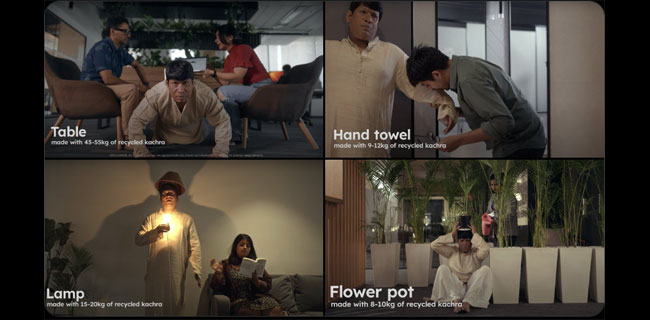
    Zomato’s recent campaign aimed to raise awareness about recycling waste on World Environment Day. However, the use of the character ‘Kachra’ from the movie Lagaan inadvertently reinforced stereotypes and perpetuates the devaluation of people from a specific class. Although the brand intended to employ wordplay in the video, the end-result appears culturally out of sync. The humour in the video appears to be mocking the already marginalised rather than challenging those in positions of power. The video received a lot of backlash on social media, which eventually led to Zomato deleting the video itself from all platforms.


    When faced with these social class divides, brands and their creative agencies are confronted with a unique challenge. Traditionally, marketing has approached class divisions as issues of affordability and accessibility for consumers. The solution typically involves offering products and services at various price points to cater to different segments of the market.


    Think of shampoo sachets, and phone recharges priced at Rs 10. Market segmentation based on affordability addresses the problem of access, ensuring that every consumer can afford and desire products within their price range, whether at the lower end or luxury segment of the market.


    However, addressing the social class divide as a brand in brand communication presents a distinct challenge, as it raises questions about portrayal and representation. It forces brands to examine their vantage point and ideological stance. If a brand aims to project itself as embracing progressive values, how should it navigate the complex issue of social class and class divides?


    This is particularly relevant when it comes to the portrayal of domestic help and their treatment in advertising, especially for brands selling household cleaning products and related items. How should they depict domestic help? Should they merely reflect reality as it is, or should they encourage consumers to adopt more progressive behaviours?


    To effectively navigate the intersection of brand communication and the social class divide, brands can draw valuable lessons from previous campaigns that approached similar subjects with sensitivity. Let’s take a look at some examples of how some brands have approached this issue in the past:


    Ghadi Detergent:


    In Indian popular culture, domestic help is often portrayed as solely responsible for the cleanliness and maintenance of households, perpetuating the notion that it is their sole duty while family members contribute little. Such stereotypes create a power imbalance between domestic help and the families they serve, with the latter holding all decision-making authority.


    Ghadi Detergent’s campaign, #SaareMaelDhoDaalo, deviates from this stereotype. Instead, it encourages individuals to recognise the importance of every task, no matter how small, and to treat domestic help with respect. The campaign depicts a young boy with a callous attitude towards the work performed by the house help. To rectify his behaviour, his mother decides to teach him a lesson by having him clean the house under the false pretence that the house help is on leave. In the end, he learns to appreciate the domestic help’s contribution and even pays him extra to celebrate the festivities.


    Women’s Day 2019 #YourSecondHome : An initiative by PregaNews


    Similarly, PregaNews launched its Women’s Day 2019 campaign, #YourSecondHome, which highlights the importance of domestic helpers and their contributions to households.

    The content begins with a woman scolding her domestic help and asking her not to perform her usual tasks. It appears that the domestic help’s job is at risk. However, as the narrative unfolds, we discover that the woman is actually reducing the workload of the domestic help due to her pregnancy and invites another domestic worker to assist. The campaign challenges initial perceptions by portraying the employer as caring and considerate, much like a family member would be.


    The messaging of the campaign promotes progressive ideals, advocating for empathy towards domestic workers and providing them with benefits such as maternity leave or reduced workload during pregnancy, similar to practices in the organised sector. The brand, PregaNews, seamlessly integrates into the narrative of the ad.


    Cadbury Dairy Milk – Driver


    The work features a boss driving his driver to his child’s school so that he could attend the parent-teacher meeting. While the content is only 45 seconds long, it is quite impactful. We immediately get to understand the dynamics between the employee and the employer and how this is a routine activity. We understand how his boss is being kind and patient towards him and goes out of his way to help him.


    The video shows how a small gesture of kindness towards one’s driver/staff can make a significant difference in their life. The brand integration of Cadbury Dairy Milk is also quite seamless, as it plays on the factor of the boss ‘being sweet’ and sweetness is associated with the chocolate in question.


    Oswal Refined Soyabean oil


    Oswal Refined Soyabean oil’s campaign portrays a positive image of domestic helpers by showcasing the relationship between the wife and her employee. While the husband is upset that the domestic help always leaves early to attend to her children, the wife, on the other hand, is accommodating as she knows that she works well and efficiently. One day, when the wife is out of the city, the maid bakes a cake for the husband and stays late at night just to celebrate his birthday so that he does not feel isolated on his special day.


    The video emphasises that domestic help is not just the staff of the house, but a part of the family, and employers should be accommodating to their requirements.


    However, while the ad’s story has a nice recall value, the brand takes a backseat here. The brand integration of Oswal is not quite as seamless because the story is not built around refined soybean oil. Even a slight mention of it in the narrative would’ve helped the brand integration.


    Facebook | More Together – Pooja Didi


    Facebook’s campaign, More Together – Pooja Didi, is a heart-warming portrayal of support staff. The content initiative can almost be categorised as a mini-short film, as it is about seven minutes long. It highlights the problem of unemployment during the pandemic and how the protagonist – Pooja, starts hiring people in large numbers to provide them with gainful employment solely out of her altruistic intentions.


    However, when she cannot pay the salaries and bills to the people she does business with, she is in a state of crisis. That is when the hired staff of her sweet shop utilises the power of social media to narrate the story of Pooja’s altruistic actions, which end up attracting customers to the shop, thus enabling her to pay all her bills.


    Conclusion

    All the brands seem to take the high power distance between employers and domestic help for granted as a given in Indian society and thus mirror existing realities. They don’t show the possibility of a different future for domestic help (except the Cadbury ad to some extent) in which they can be empowered and assertive of their rights vis-a-vis their employers.


    The convergence of brand communication and the social class divide poses both challenges and opportunities for brands. By being mindful of the implications of their messaging, brands can strive to create advertisements that promote empathy, understanding, and equality. Actively working to dismantle stereotypes and biases, brands can contribute to positive social change.


    Hamsini Shivakumar is a long-time culture-watcher, semiotician, brand consultant and co-founder of Leapfrog Strategy as well as Semiofest, the global unconference for applied semiotics. Prabhjot Singh Gambhir has done his Masters in Film Studies and is passionate about stand-up comedy. He has now turned his observant eye to cultural discourse and its intersection with brands. The views expressed here are their own.


  • LinkedIn @ 20: Transforming the business networking giant


    By Theo Tzanidis


    When someone says social media, you probably don’t immediately think of LinkedIn. But there’s no denying that the business networking site has gone the distance: it is now 20 years since it was founded in Silicon Valley.


    It was the brainchild of Reid Hoffman, a US entrepreneur who worked on an early social media platform for Apple before launching one of his own in 1997. SocialNet was a dating and professional connections site, but folded two years later after failing to find a big enough userbase in those early days of the web.

    LinkedIn founder Reid Hoffman talking at a conferece
    LinkedIn founder Reid Hoffman. Photograph credit: Marco Verch, CC BY-SA


    Hoffman went on to become a senior manager at PayPal, and made a substantial amount of money when it was bought by eBay in 2002. This helped him to co-found LinkedIn on December 28 2002 with a team of former SocialNet colleagues, becoming its first chief executive and later executive chairman.


    This was a period when everyone was realising the importance of individual interconnection and peer-to-peer interactions. LinkedIn launched in May 2003, just ahead of Myspace and Facebook. But where they and others like Friendster went after the consumer market, Hoffman’s venture was always focused on business.


    How it grew

    LinkedIn was originally set up as a place where users could share their CVs and establish a network of people who could recommend them. It took a while for the service to find its feet via innovations like allowing users to upload their contacts books (2004), as well as jobs listings (2005) and public profiles (2006).

    LinkedIn went international in the late 2000s, opening an office first in the UK in 2008 and introducing Spanish and French language versions the same year. Jeff Weiner, formerly of Yahoo, took over as chief executive the following year as the company morphed into a proper business.

    It made money from premium features that enable users to do things like messaging outside their network, send promotional emails and access analytics. It also sells advertising space and packages to help recruiters attract talent.

    It floated on the stock market in 2011 with a valuation of US$9 billion. This helped to finance an acquisition spree that has gradually bolted new features onto the platform, such as posting articles (2015) and videos (2017).

    The company was acquired by Microsoft in 2016 for US$26 billion (£21 billion). With Hoffman joining the Seattle giant’s board the following year and Weiner still LinkedIn’s chief executive today, Microsoft has taken a relatively hands-off approach to ownership.


    Pandemic benefits

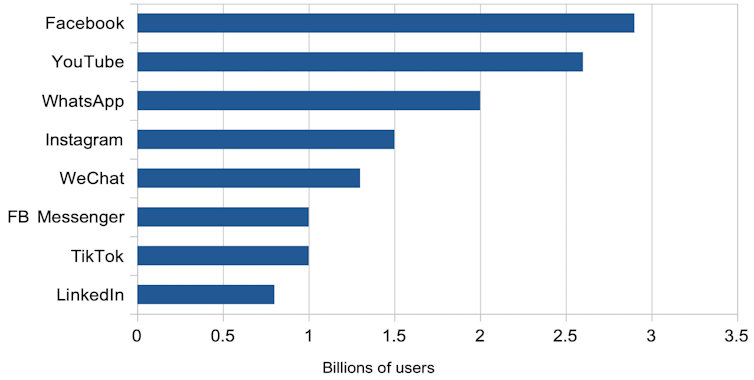
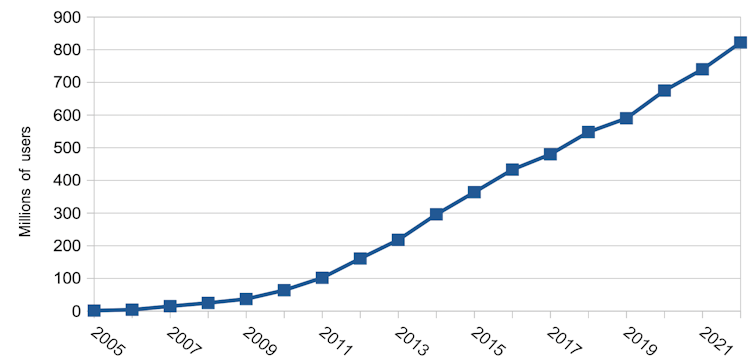
    Today LinkedIn is arguably the seventh largest social network after Facebook/Messenger, YouTube, WhatsApp, Instagram, Twitter and Tik Tok. In 2021 it had nearly 824 million users across 200 countries and territories, of which 6% (49 million) are premium subscribers, paying a minimum of US$29.99 a month.

    Not only does LinkedIn’s business focus attract an upmarket userbase, they are also youthful. The majority (59%) is made up of 25-34s, followed by 18-24s (20%) and 35-54s (18%). It generated revenues of over $10 billion in 2021.


    World’s biggest social networks

    Bar graph showing the largest social networks by user numbers
    All the data is monthly active users from January 2022, except LinkedIn, which just gives user numbers. Statista


    LinkedIn had a “good” pandemic, with conversations on the platform rising 43% and content-sharing almost 30%. It benefited from a shift in how people networked, related to findings from numerous studies that it’s the “weak links” in our professional networks who are the most important for gleaning critical information that leads us into jobs we genuinely desire.


    At a time when the usual barriers of time and space were less relevant and Zoom calls were ubiquitous, it became the perfect moment for reconnecting with these occasional contacts. Especially with so many people questioning their work situations, LinkedIn was the ideal place to see their posts and reach out to them.


    This meant that LinkedIn played a key role in the great resignation, particularly since like the platform, this movement was dominated by millennials. Users posting about changing or quitting jobs would attract large numbers of likes and comments, inspiring others to do likewise. The fact that so many people were connected on LinkedIn multiplied the effects, making it both the main catalyst and the main solution for employers.


    LinkedIn user growth over time

    Line graph showing growth in LinkedIn user numbers over time
    Various sources


    Meet the ‘work-fluencer’

    LinkedIn’s role as a lightning rod for work issues is also likely to determine how it develops, as a new category of social media influencer emerges – the “work-fluencer”. Companies are increasingly finding that employees’ LinkedIn profiles and postings can express the brand better than corporate accounts, allowing them to develop the corporate business network much more quickly and naturallyand naturally.

    When this is done well, employee posts are usually much more authentic than corporate PR. Rather than just curating articles on professional milestones and triumphs, people have become more open and honest about day-to-day work life.

    Over 13 million LinkedIn members have their profile set to “creator mode” to obtain higher exposure for their postings. Many use the hashtag #careertiktok to publish things like their wages and day-in-the-life vlogs about their professions, achieving over 1.5 billion views.

    This new “online watercooler” represents a change in the amount of information people reveal about their work on the internet. Workers are raising formerly taboo concerns like pay transparency, discrimination and professional undermining. Some professionals like lawyers, entrepreneurs and HR experts, have leveraged their posts into new content-marketing businesses and other profitable side hustles.

    Twenty years after LinkedIn was founded, this could enable the platform to enjoy the kind of trust and community growth that other social media networks would envy. Certainly it has challenges – fake accounts are an issue, for example. And LinkedIn inevitably attracts a lot of spam, which is probably one reason it doesn’t achieve the same amount of daily interactions as other social media.

    On the other hand, it benefits from not having a single direct competitor of scale. The nearest big ones would be Facebook Groups or Reddit, but LinkedIn’s purely corporate focus is always likely to be a plus against such players. At a time when traditional platforms like Facebook and Twitter are experiencing difficulties, LinkedIn has a real opportunity to continue succeeding as the one dedicated platform of its size.


    Theo Tzanidis is Senior Lecturer in Digital Marketing, University of the West of Scotland. This article is republished from The Conversation under a Creative Commons license. Read the original article.


  • Sandhya Devanathan to occupy Facebook hotseat in India, as Meta India boss

    By Our Staff


    Meta, formerly Facebook, has announced the appointment of Sandhya Devanathan as Vice President of Meta India. Devanathan will focus on business and revenue priorities as also supporting the “long-term growth of Meta’s business and commitment to India”. And perhaps also a watch on the socio/geo-political realities that concern Meta.


    She will report to Dan Neary, Vice President, Meta APAC and will be a part of the APAC leadership team. She will move back to India to lead the India org and strategy.


    On the appointment, Marne Levine, Chief Business Officer, Meta said: “India is at the forefront of digital adoption and Meta has launched many of our top products, such as Reels and Business Messaging, in India first. We are proud to have recently launched JioMart on WhatsApp, which is our first end-to-end shopping experience in India. I’m pleased to welcome Sandhya as our new leader for India. Sandhya has a proven track record of scaling businesses, building exceptional and inclusive teams, driving product innovation and building strong partnerships. We are thrilled to have her lead Meta’s continued growth in India.”


  • Ashoke Agarrwal: Big Brands, The Digital World and The Promise of Brand Platforms

    Ashoke Agarrwal
    Ashoke Agarrwal

    By Ashoke Agarrwal

    Time was when all a brand manager had to do was decide on the season’s marketing mix (summer and winter), get the agency to produce a new mass media campaign (or refurbish the existing one), and kickback.

    It all changed with the emergence of digital marketing. Managing brands is now a daily grind. Digital campaigns have shelf lives measured in days and, many times, hours. Pricing and price promotions are a flux controlled by rising e-commerce. Competition now stretches beyond the cosy, almost collegiate set of yesteryears to, driven by the phenomenon of contract manufacturing, e-commerce and D2C, into a kaleidoscope of threats.

    How have the older big brands in traditional FMCG (personal care, home and garment care, packaged foods etc.), durables (white and brown appliances, electronics, auto etc) and services (banks, credit cards, insurance, hotels, restaurants, travel, movies, broadcast/ cable TV etc) met the challenges of the digital age? To my thinking, their performance, by and large, has been poor and, at the core, indolent.

    Old habits die hard. The old brands are still stuck trying to run an AIDA (Awareness, Interest, Desire, Action) based on what is essentially mass marketing.

    At the cognitive level, everyone in the marketing team of old brands will enthusiastically endorse the notion that the digital world allows for one-on-one interactive communication with the individual. However, dig into their marketing communication plans, and one will discern the same laziness of yore when message targeting was left to the vagaries of communication channels. The difference is that now they have added Google, Facebook and Instagram to the mix. And of course, the lexicon of performance marketing – likes, shares and clickthroughs – to the mass media metrics of reach, OTS and GRPs.

    How many brands today are anchored in the essential promise of the digital marketing age? This fundamental promise is the ability to carry out cost-effectively and efficiently one-on-conversations with not just thousands but millions of individuals. And in the process generating not just sales but loyalty, increased lifetime value of each consumer and even passionate brand advocates.

    This is a model of marketing I call EIDA – Engagement, Interaction, Delivery, Advocacy.

    If there are brands keyed into this essential promise of digital marketing, they are most likely the disrupters who are upending existing categories. Even among them, going by my personal experience in India, these disrupters, spoiled by VC burn money, soon fall into the big-spending lazy AIDA framework of broad-spectrum targeting, consigning the EIDA framework to discarded business plans.

    Let’s get back to where we started this article – the big, successful brands in traditional FMCG, durables and services. It is, to my mind, a shame that nearly all of them have botched the promise of the digital age. With the resources, ecosystem and talent at their disposal, they could have been at the forefront of a new marketing era. Instead, primarily due to their failure, we have a marketing paradigm that is ever more dysfunctional than the pre-digital one, with marketing dollars now funding tribalism, conspiracy and hate-mongering through increasingly influential social media platforms. Unfortunately, the Arab Spring was not the only promise of social media that has been so severely belied.

    When I ponder the many ways successful brands could better use the digital world – the one idea that strikes me as robust and viable is positioning the brand not just as a product or service but as a platform for something larger than itself. Only a successful, well-resourced brand with high credibility could create a good platform with broader social acceptability. To my mind, this is a unique, as yet non-utilised, competitive advantage that big brands have in the digital age.

    Can a big brand in any category have the opportunity to build a platform larger than itself or its category that has wide social acceptability?

    To my mind, yes. In some categories, the platform idea might stare one in the face. In others, it might require brainstorming and creative thinking.

    As an example, let’s take Ariel in the fabric care category. I admired the Ariel campaign that promoted the idea of more equitable burden-sharing between genders. Can Ariel go beyond and promote a platform that a) enables the community to share ideas and experiences in this area b) enables individuals and others to offer workshops, tracking tools and other enabling services and products. Incidentally, when it comes to equitable burden-sharing, the flow is multilateral – woman-to-man and man-to-woman. In fact, it can go beyond gender to age – young-to-old, old-to-young, work – organisation-to-worker, worker-to-organisation. In other words, the platform could be about two-way responsibility sharing. Creative ideation and careful build-up could evolve the platform into a brand asset and a societal asset.

    How can such a platform be used as a brand asset? In myriad ways. I am sure the many marketing minds reading this already are brimming with ideas on ways to kickstart the EIDA cycle. I will be glad to take a conversation in this regard offline.

    So if Ariel built the responsibility-sharing platform, what is Surf – an equally large fabric care brand – to do? Well, the ladder up from fabric care can go in many directions. For example, fabrics and garments are how an individual signals her mood, character, class and ethnicity. So Surf could build a platform where people discuss clothes are and can be used as social signals. The platform can then expand to all forms of social signalling other than clothes.

    It must be kept in mind that the theoretical possibility of brand platform existed in the pre-digital era. However, it is only the cost-efficient reach of digital media, the burgeoning fields of data mining and analytics, and AI that makes it possible for brands to build platforms with viable levels of ROI. Furthermore, the likely emergence of the metaverse over the coming decade will add further dimensions and depth.

    I have deliberately chosen the rather mundane category of fabric care to illustrate the potential of brand platforms. Making the point that almost any product category offers exciting brand platform possibilities provided that the brand is thriving and has the resources and credibility. And that more than one such brand in the same product category can build effective platforms.

  • Digital Duopoly changes to Triopoly


    By Indrani Sen


    Indrani SenIt is established now, the Google and Facebook duopoly in digital advertising has been converted to a triopoly by Amazon. With the rapid growth of Amazon’s share, the global online advertising size is expected to cross $88 billion by end of 2021. Google and Facebook together hold above 50% market share with other major players like Amazon, Microsoft and Twitter competing with each other for the rest. The data released by eMarketer in October, 2021 for a period 2019-2023 shows that the combined share of Google and Facebook are going to decline further over the next two years to be just 50.5% in 2023 as against 55.2% in 2019. Along with Amazon, the triopoly will hold 65.1% share in the online advertising market in 2023. Industry experts feel that similar effects will soon be seen all across the world.




    A recent article (https://www.exchange4media.com/marketing-news/digital-advertising-is-not-a-two-horse-race-between-google-and-facebook-daryl-lee-117323.html) based on an interview of Darry Lee, the global CEO of IPG Mediabrands, was published using a quote from Darry Lee as the headline “Digital advertising is not a two-horse race between Google and Facebook.”


    In this connection, read recently an excellent analysis by P.K. Kannan, Dean’s Chair in marketing science in the Robert H. Smith School of Business at the University of Maryland, who analysed the impact of increased Amazon’s presence in digital advertising and the reasons behind Amazon’s success( https://www.clickz.com/amazon-presence-digital-advertising/220935/).


    Prof. Kannan argued that in order to understand the unique advantage of Amazon, we need to address the basic question of what marketers gain from advertising online, which is primarily acquiring customers at the lowest cost. He argued that “Google and Facebook provide marketers access to the online traffic they control and use sophisticated targeting algorithms to match a marketing message to the right set of online users.” However, as we all are aware the final effectiveness of this targeting is based on the motivations and inclinations of the online consumers as they surf through different websites on the internet. A consumer may just be interested in interacting with her friends on Facebook. A visitor at Google may just be looking for references related to his research studies. Against this the motivations for consumers on Amazon is either shopping or searching for making a decision related to shopping. So, the chances of a consumer reacting to a context-appropriate message is much higher for visitors in Amazon, which increases the click through rates. Internet users are also in the right mindset when they visit the Amazon site than when they are on Google and Facebook.


    As the platform itself is a marketplace, Amazon has a unique advantage of having previous knowledge of shopping behaviour of the consumer and can use that to position the message of the advertiser more effectively and also use AI and other techniques more effectively to provide recommendations to the advertisers. Prof. Kannan argues that “Amazon Prime shoppers are an especially attractive segment for marketers to go after, and Amazon could charge even more for online ads targeting them.” With precise targeting brands advertised on Amazon may become more prominent with the shoppers quickly. This has two built-in benefits. Firstly, it enables in relationship building with the consumers and secondly, it improves the organic search rankings.


    In addition, a marketer may have to worry about the type of user generated content his/her ad would appear on Google’s YouTube or on Facebook. Amazon, on the other hand has a complete control of all the content that appears on its own e-commerce platform. Advertisers may prefer Amazon as it reduces the risk of ads appearing in the wrong environment.


    So, it seems almost certain that the digital duopoly of Google and Facebook is in the process of changing to a triopoly not just in the US market, but across the world in developed and developing countries.


  • Indrani Sen: Monopolising the Metaverse

    Indrani SenBy Indrani Sen


    Seventeen years after he launched Facebook from his university dorm in 2004, Mark Zuckerberg announced in a virtual press conference on October 29, 2021, a change of the corporate name of the company from Facebook Inc. to Meta Platforms Inc. which is being referred in short as Meta.


    A recent Amul topical ad on the ‘Meta’ change

    As explained by Zuckerberg, internet technology has moved on and the corporate name Facebook no longer fits in with the future vision of the company which is being built around the metaverse. “Over time, I hope that we are seen as a metaverse company and I want to anchor our work and our identity on what we’re building towards,” Zuckerberg said.


    The rebranding of the company name would align better with the objectives of the company at this stage when it plans to broaden its reach beyond social media into areas like virtual reality (VR). The various social media platforms owned by the social media giant, i.e. Facebook, WhatsApp and Instagram would continue to retain their individual names and brand identities under the corporate branding of “Meta”.


    The metaverse a virtual-reality space in which users can interact, meet and play with a computer-generated environment and other users using virtual reality glasses, smartphone apps and other devices. The word “metaverse” has been coined from the two words “meta” and “universe”. Loosely defined, it is an extensive 3D online world where people interact via various “digital avatars.” The word meta is generally used as an adjective or as a prefix to a name, often indicating a change or a transformation or a great futuristic idea. Example of uses of metaverses, in some limited form, can already be found on platforms like VR Chat or video games like Second Life.


    Current development on use of metaverse is centred on addressing the technological limitations with modern virtual and augmented reality devices as well as expanding the use of metaverse spaces beyond business to retail applications, entertainment and education. Many digital technology organisations as well as entertainment and social media companies are investing in metaverse-related research and development for future usage.


    The metaverse in many ways is still a speculative future iteration of the Internet part of shared virtual reality, to be used in social media and other applications. The metaverse in a broader sense may not only refer to virtual worlds operated by social media companies but the entire spectrum of augmented reality across the world wide web.


    Critics of the metaverse are arguing that as a speculative concept it is overhyped. Same concept is being used as a part of public relation campaigns by organisations having vested interests. Privacy of user’s information and user’s addiction to platforms are concerns within the metaverse, as already found in the current challenges being faced by the social media and video game industries across the world.


    Mark Zuckerberg’s announcement to change Facebook’s name to Meta has caused a massive uproar in Israel as the word “meta” sounds like the Hebrew word for “dead”. There is also a news that a US-based Meta Company is contemplating to sue Facebook Inc. for Infringing on its it’s company name. Meta was founded by Menon Gribetz, then a student of Colombia University in 2013. Though the company met with some initial success, it had to declare itself as insolvent after its primary lender foreclosed in January 2019. It is doubtful if they have the financial strength to launch a legal battle against Zuckerberg’s company. A Berlin based migraine app developed by Newsenselab M-Sense Magazine has given a backhanded compliment to Facebook who seemingly has been inspired by the logo design of the e-magazine. It is unlikely that Facebook was aware about the existence of that app or its logo and the similarity id the logo design is most likely a creative coincidence which at times happen in the advertising industry.


    The change in the company name is an extremely clever move by Zuckerberg which can help his company to monopolise “the metaverse” space, though many other companies will be using such technologies and operating in the same space in near future. To a lay internet user, Meta Platforms inc. would appear as the original provider of metaverse technology and therefore would have an edge over many of their future competitors.  Meta Platforms Inc. would not be able to monopolise the metaverse, but the name of the company would surely create an illusion of a monopoly.


  • Hate Propaganda UnLtd


    By Ranjona Banerji


    Ranjona BanerjiFor years, India’s TV channels that pretend to be “news” channels have fomented Indo-Pak and Hindu-Muslim hatred, in order to please a particular “political” ideology and possibly because the anchors and their owners genuinely wanted to get society roiling. The effects have been and are dangerous and violent. As we saw after India lost a cricket match to Pakistan on Sunday. Rumours of Muslims letting off fireworks began, Indian cricketer Mohammed Shami faced vicious trolling… we have seen it before but that certainly does not make it tolerable.
     

    India’s cricketers took hours to respond in support of their teammate and colleague. Virendra Sehwag first propagated the rumour about the fireworks and the next day tweeted his support for Shami. A neat “watch me astride two horses but everyone knows I love the first horse” more trick.


    While all this happened, social media giant Facebook was involved in its own drama worldwide.


    Whistle-blowers revealed once again how Facebook helps promote right wing hatred and how its AI, its algorithms, are weak when it comes to tracking hatred and dangerous behaviour.

    https://www.businessinsider.in/tech/news/the-facebook-papers-dozens-of-stories-based-on-leaked-whistleblower-documents-just-dropped/articleshow/87259295.cms


    India is particularly vulnerable to Facebook’s “style”:

    https://www.bbc.com/news/world-asia-india-59006615?piano-modal


    The following extract from The Washington Post explains just how dire the situation is. We see the results around us all the time – let us never forget that Facebook also owns WhatsApp – and yet somehow, we find it acceptable.


    “In February 2019, not long before India’s general election, a pair of Facebook employees set up a dummy account to better understand the experience of a new user in the company’s largest market. They made a profile of a 21-year-old woman, a resident of North India, and began to track what Facebook showed her.


    At first, her feed filled with soft-core porn and other, more harmless, fare. Then violence flared in Kashmir, the site of a long-running territorial dispute between India and Pakistan. Indian Prime Minister Narendra Modi, campaigning for reelection as a nationalist strongman, unleashed retaliatory airstrikes that India claimed hit a terrorist training camp.


    Soon, without any direction from the user, the Facebook account was flooded with pro-Modi propaganda and anti-Muslim hate speech. “300 dogs died now say long live India, death to Pakistan,” one post said, over a background of laughing emoji faces. “These are pakistani dogs,” said the translated caption of one photo of dead bodies lined-up on stretchers, hosted in the News Feed.


    An internal Facebook memo, reviewed by The Washington Post, called the dummy account test an “integrity nightmare” that underscored the vast difference between the experience of Facebook in India and what U.S. users typically encounter. One Facebook worker noted the staggering number of dead bodies.”

    From: https://www.washingtonpost.com/technology/2021/10/24/india-facebook-misinformation-hate-speech/


    Speaking to a UK Parliamentary committee, Frances Haugen, who released Facebook’s internal documents to the world, made the interesting point that much of Facebook can be a pleasant experience for users. It is the remaining 20 or 30 per cent of hateful, violent and abusive content that Facebook’s algorithms either encourage – as according to the documentary The Social Dilemma – or are unable to monitor and control.


    Facebook is part of the problem. It is not the problem. The problem is the rampaging extent of hateful propaganda spread by governments, politicians and the mainstream media. The problem is the constant subversion of democracy by its so-called upholders. In India, WhatsApp is the medium. The perpetrators and controllers are far worse and they know that their followers and victims are remarkably stupid and malleable.


    Consider for instance the number of industrialists, former civil servants and illustrious members of civil society who before the India-Pakistan match began put out this “joke” about how Pakistan won the toss and kept the coin to bolster its economy. How rich is this, coming from India whose economy is in a right royal mess thanks to a government that these parrot-tweeters so love and support. And how daft does this “joke” sound after India lost the match.


    A demonstration of India’s democratic levels came with one more advertisement, for a product which tried to broaden its commercial appeal by reaching ignored customers. Fem, a face bleach which in itself many might consider regressive since it pushes the “fair is beautiful” narrative, tried to use the festival of Karva Chauth (the North Indian custom of fasting for your husband’s good health also considered regressive) to focus on same-sex couples. In this case, lesbians.


    As expected, some member of the BJP had hysterics and Dabur, the owner of Fem, took the ad down.


    If the media is the message, the vicious rightwing does the dictation.


    Ranjona Banerji is a senior journalist and commentator. She writes on MxMIndia every Tuesday and Friday. Her views here are personal


  • Eno collaborates with Facebook to build rural reach and engagement

    By Our Staff


    GSK Consumer Healthcare’s antacid brand, Eno, has partnered with Facebook given its ongoing focus on the rural audience. As part of this leg, Eno will be rolling out a series of digital comics and nnimation videos on the Facebook family of apps and target millions of rural and Small-town Hindi speaking audiences. The Chacha Choudhary characters, Chacha Choudhary and Sabu, while resonating perfectly with the brand’s personality, also provide a very authentic voice to all of Eno’s key messages – Quick Relief, and Product Superiority.


    Speaking on the partnership, Anurita Chopra, Head of Marketing, GSK Consumer Healthcare said: “The Rural markets are absolutely critical to win for a brand like Eno. This involves reaching more people, increasing brand penetration but also speaking to our audiences in a culturally relevant way. We are quite certain that the visual storytelling format amplified by the much-loved Chacha Choudhary world will allow to talk to our audiences authentically.”


    Added Arun Srinivas, Director, Global Business Group, Facebook India:”With more than 430 million people using Facebook every month in India, we offer the ability for our advertisers to reach their desired audience across the country. We know from external studies that the rural internet population is growing faster than the urban one, and we see increased interest from businesses to build for small towns and rural India. We’ve partnered with Eno previously as well to drive successful campaigns for rural India, and with this new one, Eno has the unique opportunity combine nuances around popular culture with targeted messaging to achieve strong business outcomes.”


  • Facebook releases Festive Marketing Guide

    By Our Staff


    Facebook India has released its Festive Marketing Guide for 2021 which called out social video, influencers, immersive experiences, and conversational marketing as the key trends that will drive the discovery of brands and festive shopping this year.


    The key insight from the Guide is that social media is a leading channel to drive brand discovery and purchase during the festive season. A Facebook-commissioned online survey by GFK showed that 96% of the surveyed people said that they discover brands and products online. Of the people who use Facebook platforms weekly, 83% who discover new brands and products online typically discover on Facebook platform. The same study showed that of the online shoppers who use Facebook platforms weekly, 96% ultimately purchased  fashion, beauty, furniture or consumer electronic products they discovered on the platform.


    Said Arun Srinivas, Director, Global Business Group, Facebook India: “The intent to spend on festive is higher this year and several businesses on our platforms have already seen strong results from their festive campaigns as early as August. Digital has emerged as the largest influencer of festive purchase decisions and with more than 400 million Indians on Facebook, we play a pivotal role in discovery and delivering truly incremental business outcomes. The opportunity for businesses, small and large, is to leverage digital to enable personalised discovery through video content, creators, immersive experiences, and conversational marketing.”


  • Google, Facebook to strengthen ASCI board

    By Our Staff


    The Advertising Standards Council of India (ASCI) has announced two new appointments to add to its digital expertise as part of its vision for the future. Aditya Swamy, Director of Google India, has been appointed to the board of governors of ASCI, while Sandeep Bhushan, Head of India Global Marketing Solutions at Facebook has been appointed as special invitee to the board. The appointments also mark ASCI’s fast-widening focus on digital advertising and platforms, which began last year with a partnership with TAM to monitor 3,000 digital platforms for misleading marketing claims, as well as the launch of the Influencer guidelines and influencer monitoring through an AI platform.


    Said Subhash Kamath, Chairman, ASCI: “‘I’m delighted to welcome both Aditya and Sandeep to the board, this is a landmark moment. As we strengthen our roots in the digital space and streamline its functioning, it is extremely important that we collaborate with and learn from the leaders. Google and Facebook are the biggest digital players. We look forward to them helping us become a better conscience keeper of the industry.”


    Added Manisha Kapoor, Secretary-General, ASCI: “Having Google and Facebook on our board is a great start to the new journey ASCI is embarking upon. It is vital for us to have a keen understanding of digital operations. We will benefit greatly from the expertise that both these companies bring with them.”