Tag: facebook

  • Facebook launches digital skilling and mentorship initiative- GOAL

    By A Correspondent


    In a bid to empower more women with digital know how and new age skill sets, Facebook announced GOAL- Going Online As Leaders, a programme aimed at inspiring, guiding and encouraging tribal girls from across India to become village-level digital young leaders for their communities. Spanning across West Bengal, Maharashtra, Jharkhand, Odisha, Madhya Pradesh, the initiative seeks to nurture and train young girls from India’s tribal heartland across three core areas – digital literacy, life skills, leadership and entrepreneurship.


    Said Ankhi Das, Public Policy Director, Facebook -India, South & Central Asia: “The internet, especially social media over the past few years has emerged as one of the most powerful tools for empowering women from across India’s diverse social economic backgrounds and varied cultural roots. With GOAL, we seek to make the digital medium more accessible and usable for young girls from our resource rich but economically weak tribal communities in the country. We are confident that this network of learners will employ these skills as a means of social and economic elevation for themselves and drive change making in their communities.”


  • Siddharth Banerjee quits Vodafone to join Facebook

    By A Correspondent

    Siddharth Banerjee

    Vodafone marketing head Siddharth Banerjee has joined Facebook India as Director – Global Sales Organisation. Banerjee will be part of the leadership team in India and will be responsible for partnering businesses to help them to achieve strong business outcomesby leading the Verticals, Agency Relationships and Solutioning Teams for Facebook India.

    Banerjee has had a four-year stint at Vodafone where he was last at EVP-Marketing. He joined the telco in 2015 after a 12-year stint in Unilever.

  • Three ChuChu TV videos cross the one billion views mark

    By A Correspondent


    We normally do not like to highlight YouTube views or Facebook likes because they are often (or mostly?) inorganic. But we do know that ChuChu TV is very popular, and hence this report, though we would like to say that we haven’t verified the claim on whether these numbers have been achieved without any boost.


    Three videos from ChuChu TV, the YouTube channel for kids has crossed the one billion views mark. The “ChuChu TV Johnny Johnny Yes Papa” video has more than 1.5 billion views, the “ChuChu TV Surprise Eggs Old McDonald” video has more than 1 billion views and the latest video from ChuChu TV to cross the 1 billion views is the “ChuChu TV Phonics Song with two words”.


    Said Vinoth Chandar, Founder, CEO and Creative Director of ChuChu TV: “It’s a very proud moment for all of us at ChuChu TV and is a testimony to our understanding of our audience. Our focus has always been quality content and its heartening to see the world embrace ChuChu TV so wholeheartedly. These milestones motivate us to do more, bringing joy and learning to babies and preschoolers around the world.”


  • SPN partners with Facebook to telecast LaLiga in India 

    By A Correspondent


    Sony Pictures Networks India (SPN) has partnered with Facebook to telecast the Spanish top division football league, LaLiga, on TV in India this season. With this deal, over 100 selected matches will be telecast on SPN;s sports channels, including the key clashes, El Clasico and Madrid Derby. All matches will still be available for free on Facebook.


    Said Rajesh Kaul, Chief Revenue Officer Distribution and Head – Sports, Sony Pictures Networks India said: “We have been committed to LaLiga for the past four years and we are excited to continue our partnership with one of the best football leagues in the world. This confirms our commitment to be the premier football destination for all viewers. TV is one of the strongest mediums in India and through this association, Indian audiences will continue to enjoy the LaLiga experience.”


    Added Joyee Biswas, Head of APAC Sports Partnerships, Facebook: “We’re excited to team with Sony Pictures Networks India to give fans in India even more ways to watch LaLiga this season. This partnership demonstrates our commitment to collaborating with broadcasters as we continue to explore a variety of different live sports business models.”


  • Mathrubhumi kicks off campaign for biodegradable flex boards

    By A Correspondent


    Media conglomerate Mathrubhumi has kicked off its campaign for bio-degradable flex boards. The initiative will include removing all the vinyl flex material used by Mathrubhumi from advertising billboards across Kerala and usage of only biodegradable government approved materials for advertising in the future.


    Speaking about the campaign, M V Shreyams Kumar, Jt Managing Director, The Mathrubhumi Group said: “This is a very small step undertaken by our organisation social responsibility towards protecting the environment, we hope we are able to make a difference and receive support from other media houses as well to practise the same.”


    The campaign will be promoted in trade media and social media platform Facebook.


  • The Digital Duopoly targets a Billion-plus


    By Indrani Sen


    Last week,a roundtable discussion on ‘Disrupting Mobile Advertising Duopoly in the Indian Media Landscape’ was held in Delhi NCR, where experts from A&M industry shared their views on the future of the existing market duopoly of Google-Facebook in India. Most of them were of the opinion that the duopoly will continue to exist in India in spite of the growing competition in the market (http://businessworld.in/article/Challenging-The-Digital-Duopoly-Has-The-Change-Begun-/06-06-2018-151336/). A probability of a triopoly including Amazon and its marketing services was tabled by an expert with another expert adding that OTT platforms have began to challenge the duopoly. The need forbrand safe environment with created content rather than curated content and regulations like GDPR was tabled.

    Bharat Sanchar Nigam Limited, which has a limited tie-up with Baba Ramdev’s foray to mobile internet, has also partnered with Call2Action Communication India Private limited recently for launching a new mobile advertising platform. This platform is expected to create disruption in the Mobile Advertising Ecosystem by offering lucrative price points and challenge the duopoly of Google and Facebook in India as reported by the above article in www.businessworld.in.

    Both Google and Facebook have high business stakes in the Indian market and have been investing a lot of time, talent and funds in local development.  Some of these efforts are not well known to the advertisers and agencies that use the two platforms for digital marketing. The common users of the platforms are blissfully ignorant of the same.

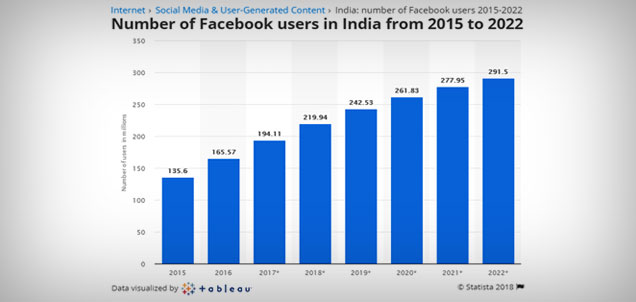
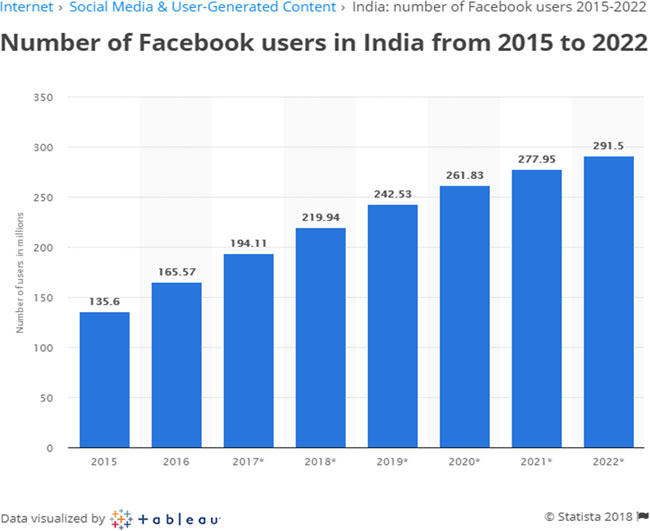
    India has been the country with the largest Facebook users since 2016. There were about 195 million Facebook users in India as of May 2016, against about 191 million in the U.S. and 90 million in Brazil (https://www.statista.com/statistics/304827/number-of-facebook-users-in-india/ ). The number of Facebook users in India is forecast to continue to grow in the coming years, and add up to nearly 320 million by 2021.The penetration of Facebook in India isexpected to jump from almost 15 percent in 2016 to around 23 percent in 2021.Facebook also owns three of the most popular social networks WhatsApp, Facebook Messenger and Instagram which help to increase its strong hold in the Indian market.

    Mark Zuberberg has claimed that globally, Facebook’s advertising-driven business has not been significantly damaged after the Cambridge Analytica bombshell dropped. Its share prices which dropped after March 2018 when the Cambridge Analytica reports broke, has climbed back to slightly above its price Facebook enjoyed before the news break.  Its ability to protect its users’ personal information shared and stored on its social network is yet to be proved to the complete satisfaction of the law makers across different countries

    Our Ministry of Electronics & IT has recently asked Facebook to explain if it allowed phone and other device manufacturers access its users’ data without taking their consent by June 20 following a recent report in media that Facebook has admitted to sharing information with a “small number” of companies including RBC Capital Markets and Nissan Motor Co., advertisers and other business partners (https://brandequity.economictimes.indiatimes.com/news/digital/facebook-kept-sharing-users-data-with-companies-even-after-saying-it-had-stopped-third-party-access-to-information/64516829).

    Google, the leading player in the Digital Duopoly, is comfortably settled in India. Google Search has 90% market share in India, Google’s Andriod OS is used by over 90% smartphone users in India, YouTube is watched by 80% of the internet users in India with a 225 million monthly user base, Gmail enjoys the largest user base in India and Google Map is consumer focussed and free to use. Google has been working steadily on India first tweaks and apps  such as offline videos for YouTube, two-wheeler navigation on Google Maps, Android Oreo (Go edition) to improve experience on low-RAM phones, Google Assistant for Reliance Jiophones, new apps like Google Go and Files Go, built from scratch, Google WiFi stations in partnership with Indian Railways and the mobile payment platform Google Tez, which within a month of its launch in September 2017, captured 60% share of m-payments in India.Facebook should take a lesson from Google and introduce some India specific social apps.

    India is a focus market for Google’s Next Billion Users Plan through which it aims to bring everyone online in India (https://brandequity.economictimes.indiatimes.com/news/digital/google-wants-to-bring-everyone-online-in-india-through-its-next-billion-plan/64457803). As a part of this initiative and based on intensive field research by its technical team, Google launched a multilingual app in Mumbai 10 days back (on May 31),  called ‘Neighbourly’ catering to only Mumbai.Thislocal discovery and community app works in English, Hindi, Marathi and six other Indian languages. The hyperlocal platform helps to find anything from a doctor, ATM or petrol pump to a mechanic or badminton coach, within 2 km radius.In coming weeks and months, Google plans to roll out the app across more cities in India.

    It is a difficult proposition to challenge Google’s total supremacy today In India as it is far ahead of its other competitors. Facebook, which has now become vulnerable, may have to deal with more competition in the sphere of social media. Itmay be compelled to spend comparatively more time to ensure protection of consumer data and implementation of its privacy policy, which may lead to erosion of its market share through competition in the global market. However, in India, there is minimal chance of a similar threat. So, the immediate future of the digital duopoly seems to be secure in India in spite of Baba Ramdev’s plan to relaunch Kimbho after a flamboyant launch followed by a silent withdrawal.


  • Facebook appoints Joyee Biswas as Head of APAC Sports Partnerships

    By A Correspondent


    Joyee Biswas will be joining Facebook as Head of APAC Sports Partnerships. He will report to Dan Reed, Facebook Head of Global Sports Partnerships.


    Biswas will lead a team that manages partnerships with APAC-based leagues, teams, athletes and media. He will be tasked with helping partners engage and grow their fan bases, deliver interactive and social content tailored to Facebook’s suite of products, and achieve their business goals across all Facebook platforms, including Instagram, Messenger and Oculus.


    Biswas most recently served as ESPN’s head of Southeast Asia, APAC. Prior to ESPN, Joyee was the managing director for Eleven Sports Network in Asia. He also headed sports content for Singtel TV as well as content acquisition and management for Fox International Channels and ESPN Star Sports for multiple linear and non-linear channels in key Asian territories


  • Facebook connects with users via inaugural brand campaign

    By A Correspondent


    Facebook has launched its first integrated marketing campaign titled ‘Live What You Love’. For the campaign, it has partnered with Wieden+Kennedy Amsterdam, to uncover commonalities in which the community is using Facebook and how the platform enables them to expand their lives and interests by connecting them to like-minded people, by surfacing the latest updates and information about their interests, or by providing a platform where they can explore and be more.


    Rolling out across TV, print, outdoor, cinema and online, including Facebook, the campaign, notes a communique, brings to life stories of people who are passionate, optimistic and constantly looking for ways to be better at their individual interest areas. The four films, out of which two are out – Sunny and Neha, depict unique stories of people doing extraordinary things that you wouldn’t normally associate with their archetypes. Similarly, the campaign idea when extended to the print and OOH executions, shows how diverse people and communities leverage Facebook to explore their passions.


  • Facebook educates businesses to drive growth in a mobile first era

    By A Correspondent


    In an attempt to reach out to marketers directly, Facebook hosted “Discover Growth”, an event which brought together marketers and advertisers to discuss key strategies focused on growth marketing and how Facebook solutions can help businesses drive growth.


    Speaking at the event, Sandeep Bhushan, Director, India and South Asia (who is also helming Facebook in India after the exit of Umang Bedi) said: “With over 217 million monthly active users in India – most of whom are active on mobile – Facebook is at the heart of a mobile-first shopping journey. We want to help all marketers and businesses drive revenue growth by tapping into the shift in consumer behaviour towards mobile, and help them adopt practices to drive both penetration and loyalty.”


    According to a communique, attendees at the discussion gained an in-depth insight into Facebook’s mobile solutions that can help marketers grow and engage consumers at every step of the purchase journey. Some of the top strategies included:


    – Acquiring customers and generate intent – consumer journey – with the adoption of products and platforms such as mobile – has changed so much, to wait for people to come to them. Brands need to acquire customers on mobile by reaching people earlier in the purchase journey. They can no longer wait for purchase intent, they need to create it.

    – Creativity: with declining attention spans and impatience on the rise, it is imperative to capture attention quickly with compelling short creatives. The short form creative ad formats on Facebook that are built to deliver better experiences on mobile can not just help drive awareness but also generate purchase intent.

    – Measuring what matters: what ultimately matters is measuring what is actually working so that marketers can refine their marketing spends. Facebook’s people based measurement solutions can help measure what’s working across channels to enable optimized spending to those attributing to the best results.


  • Twitter leads Facebook and Instagram in B2B channel initiatives, notes Pulp Strategy study

    By A Correspondent


    As many as 75 per cent of marketers chose Instagram as their most preferred channel for sharing image-based content, while Twitter and Facebook garnered brand approval ratings of 63 per cent and 56 per cent respectively for the same. Twitter, on the other hand, leads the charts when it comes to B2B marketing, garnering 47 per cent marketer acceptance in the non-conventional B2B channel distribution. These insights are amongst several interesting marketing facts and figures released by Pulp Strategy – a full-service experiential, digital, and interactive marketing agency – in its ‘The Future of Content 2017 – Chartbuster Trends in Content Marketing’ report.


    The Pulp Strategy report also mapped several other interesting trends for marketers. User-generated content was found to enjoy greater approval with social media users, with 76 per cent of users surveyed considering it more trustworthy than brand-generated content. Image-based content generated the highest engagement for marketers online, clocking about 55 per cent of the overall engagement, followed by clickable links at 24 per cent and videos at 12 per cent. LinkedIn had the highest number of links shared by users, garnering 76 per cent of the overall engagement volume.


    Said Ambika Sharma, Founder & Managing Director, Pulp Strategy: “While it is already hailed as the king of marketing, content continues to gain more prominence and has become one of the major influencers in the overall customer decision making process. Today, marketers can experiment with a range of content types, marketing channels, and strategies to generate quantifiable results for their business. The Content Marketing Report 2017 discloses some very insightful aspects of marketing which will help marketers and businesses in positioning themselves more optimally.”


    The survey also observed personalisation, user-generated content, and interactive media to be the key drivers in the content market space. The assessment made by the survey even disclosed in-depth insights such as how a split of body text with engaging images inclines the users to finish reading the whole content. The report on content marketing also included a range of industry examples and marketing endeavours undertaken by a variety of top-rated international brands.


  • Google, Facebook top media owners


    By A Correspondent


    Google and Facebook together accounted for 20% of global advertising expenditure across all media in 2016, up from 11% in 2012, according to the new edition of Zenith’s Top Thirty Global Media Owners, published today (May 8).These two companies captured 64% of all the growth in global adspend between 2012 and 2016.


    The Top Thirty Global Media Owners report is Zenith’s ranking of the world’s largest media companies, and has been published since 2007. For this edition there’s an updated methodology and focus purely on media owners’ revenues from advertising, excluding revenues from all other activities, which gives the true measure of their status in the global advertising market.


    Google (under its holding company Alphabet) is by some distance the largest media owner in the world, attracting US$79.4bn in ad revenue in 2016, three times more than the second-largest – Facebook – which attracted US$26.9bn. The largest traditional media owner is Comcast, which takes third place in our ranking, with US$12.9bn in ad revenue.


    As stated in Zenith’s quarterly Advertising Expenditure Forecasts, internet advertising has overtaken television to become the world’s largest advertising medium this year. Accordingly, digital platforms that are funded by internet advertising dominate the top 30 ranking. As well as Alphabet and Facebook, there are five more pure-internet media owners in the top 30: Baidu, Microsoft, Yahoo, Verizon and Twitter. Between them, the seven digital platforms generated US$132.8bn in internet ad revenue in 2016 – that’s 73% of all internet adspend, and 24% of global adspend across all media.


    Verizon became a media owner in 2015 when it bought AOL, and if all goes to plan will become a much larger one when it acquires Yahoo later this year. Verizon takes 21st place in the current ranking; adding Yahoo to AOL would boost it to sixth.


    The fastest-growing media owner in Zenith’s list is Twitter, which increased its ad revenues by 734% between 2012 and 2016. Tencent is second, having grown by 697% over this period, and Facebook is third, with 528% growth. Two other media owners have more than doubled in size between 2012 and 2016: Baidu, which grew 190%, and Sinclair Broadcasting Group, which grew 171%.


    Most of the media owners in the ranking – 20 out of 30 – are based in the US. The US dominates for several reasons: the US has the biggest ad market, US companies have invested the most in extending their reach abroad, and Silicon Valley innovation has powered the growth of internet advertising. China and Germany each have three media owners in the ranking (Baidu, Tencent and CCTV for China, and Bertelsmann, ProSiebenSat.1 and Axel Springer for Germany). Then there are four countries with one media owners each: France (JCDecaux), Brazil (GrupoGlobo), Italy (Mediaset) and the UK (ITV).


    “The scale of the biggest platforms highlights the importance of building strong partnerships between agencies and media owners,” said Vittorio Bonori, Zenith’s Global Brand President. “Brands need to deal with these platforms to communicate with consumers effectively and efficiently, and agencies need to ensure they do so on the best terms available.”


    “Zenith’s new ranking demonstrates just how much the internet advertising platforms are setting the pace for global adspend growth,” said Jonathan Barnard, Head of Forecasting at Zenith. “Google and Facebook alone have accounted for almost two thirds of global adspend growth since 2012.”


    Ranking of Top 30 Global Media Owners 2017

    Rank Media owner Rank Media owner
    1 Alphabet 16 Advance Publications
    2 Facebook 17 JCDecaux
    3 Comcast 18 News Corporation
    4 Baidu 19 GrupoGlobo
    5 The Walt Disney Company 20 CCTV
    6 21st Century Fox 21 Verizon
    7 CBS Corporation 22 Mediaset
    8 iHeartMedia Inc. 23 Discovery Communications
    9 Microsoft 24 TEGNA
    10 Bertelsmann 25 ITV
    11 Viacom 26 ProSiebenSat.1 Group
    12 Time Warner 27 Sinclair Broadcasting Group
    13 Yahoo 28 Axel Springer
    14 Tencent 29 Scripps Networks Interactive
    15 Hearst 30 Twitter


    Advertising Revenues in US$ million
    Share of Global Advertising Expenditure (%)

  • Facebook partners TLabs to strengthen mobile startup ecosystem

    By A Correspondent


    Facebook and TLabs accelerator have partnered to strengthen the mobile startup ecosystem in India. Both Facebook and TLabs will build on the knowledge and learnings of in-house senior mentors to engage and educate budding entrepreneurs. As part of this partnership, they will co-host multiple events for solving startups’ issues around user experience, analytics, app installs, monetization and more.


    Facebook will also provide FbStart referral codes to TLabs for use by TLabs’s mobile portfolio companies. FbStart is a global program designed to help mobile startups build and grow their apps. Startups with a live mobile app on Google Play/iOS stores or a working Messenger bot can apply for the FbStart Program and membership is awarded to selected start-ups, post a review from the Facebook team.


    These startups will receive ad credits from Facebook and benefits from more than 30 partners, including AWS, Dropbox, SalesForce and MailChimp, notes a communique. Said TLabs COO, Abhishek Gupta: “It’s an incredible step by Facebook for the mobile ecosystem, and start-ups would be highly benefited from being a part of the Facebook global community.”Satyajeet Singh, Head – Product Partnerships, Facebook India, commented that partnering with TLabs was a progressive decision towards creating an empowered start-up ecosystem in the country.