
Tag: facebook

  • Identity Crisis within Social Media

    Image courtesy: https://anchordigital.com.au/


    By Indrani Sen


    Indrani SenThe discussions about the identity crisis faced by the users of social media, particularly the younger generation, started almost from the inception of social media. Lately researchers, academics and industry watchers have been talking about other identity crisises within the social media. The first crisis relates to managing one’s identity on the internet across various work related and social media related accounts/ apps and it is often said that if a person has more than a dozen of such accounts with different IDs and passwords then the person needs a ‘password manager’. A movement has ben going on for some time advocating for an unique identity per every consumer on internet which will enable them to acces all internet accounts with the same ID and password. However, this may lead to a breach of trust between consumers and their individual internet accounts as all personal information shared by them on any account can be accessed through their unique identities.


    The second crisis is the intense identity aggregation of consumers by Google and Facebook which has started pushing some internet users from the two giants to other anonymous platforms. For the purpose of marketing through their networks Google and Facebook create such aggregated buckets of identities which many consumers find unacceptable.


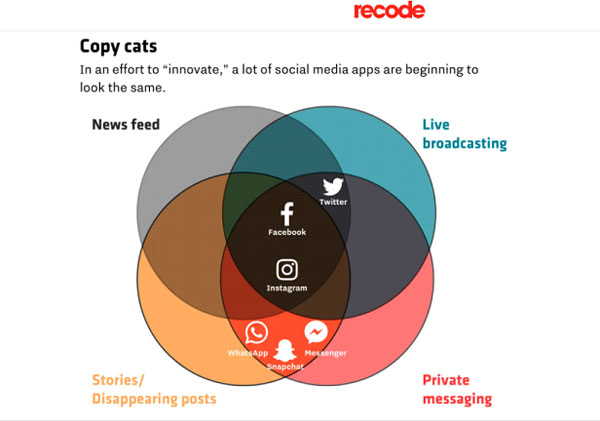
    The third and perhaps the biggest crisis is the loss of identity of different social networks / apps which has emerged during the last 5 due to the blatant copying or adopting of features of another social network. Last week I listened to an interesting podcast on www.emarketers.com talking about “…. what Facebook has become and is trying to be, what to make of social media platforms looking more and more alike, and which of these “copycat” moves might strike gold. We then talk about the significance of Nextdoor going public, how India’s social media content liability laws could impact Twitter (and others), and some changes as to what advertisers can, and can’t, do on social media.” The podcast can be accessed through the following link https://www.emarketer.com/content/podcast-facebook-and-social-media-identity-crisis-twitter-liability-retouching-ads?ecid=NL1009.


    Source: https://www.vox.com

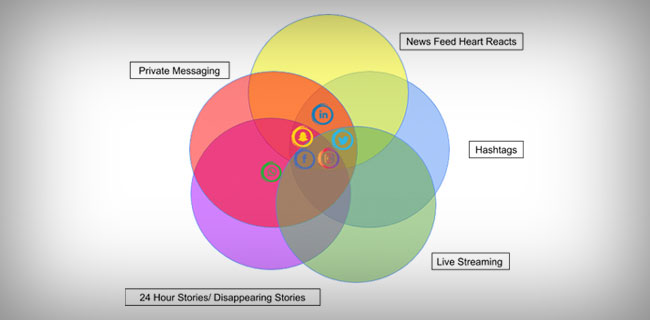
    There is an extensive list of services/ features which have been copied since their introduction in one social media platform by others. In 2010 Instagram launched with the feature “double tap to heart react”. Instagram copied Snapchat’s stories feature first which was followed by Facebook adopting the same application from Instagram. In 2012, Facebook acquired Instagram and adopted the “heart react” feature from Instagram. In 2015, Twitter replaced it “star react” feature with “heart react”. In 2019 Linkedin introduced a set of “react” features including the “heart react”. There are many more such examples.


    In the digital age, we have seen a shift of power from organisations to consumers which has been labelled as ’transformed consumer contexts’ by Neil Perkin and Peter Abraham in their book titled Building the Agile Business Through Digital Transformation. Consumers once experiencing once a satisfactory service or a tool on a social network, expect the same capability from all other social media networks. As a result, this trend of extensively copying from each other has started in the social media sector for winning over the consumers. This trend has attracted lot of criticism as it is becoming increasingly difficult to differentiate among the social media platforms, but no immediate solution for countering this trend is in sight for reversing the identity crisis within social media.


  • Taproot Dentsu & Facebook reignite love for books

    By Our Staff

    Taproot Dentsu India has launched a second film as part of the agency’s ongoing ‘More Together’ campaign for Facebook. The film illustrates the platform’s power of connections and communities through yet another story.

    Said Neeraj Kanitkar, Senior Creative Director, Taproot Dentsu: “This film is a sweet and simple demonstration of Facebook’s inherent power. Which is to supercharge the efforts of one person when the community gets behind it. It is quite rare to be in the advertising business without having some love for the written word. So when Gauri Burma – the most passionate book lover amongst us – came up with the idea, we knew we simply had to make it happen. We hope that it inspires people to consider using Facebook to give a new lease of life to old, forgotten and about-to-be-turned-into-pulp books.”


  • Facebook bats for stronger consumer connect

    By Our Staff

    Facebook has launched a new phase of its consumer marketing campaign in India – ‘More Together’. The 360-degree campaign has been conceptualised and executed by Taproot Dentsu and Dentsu Webchutney and will go live in multiple languages across TV, digital, print, radio and OOH.

    Said Avinash Pant, Director – Marketing, Facebook India: “Facebook is deeply entrenched in the cultural fabric of India. Everyday we see different ways in which people across the country come together on our platform to create meaningful connections, fuel discovery, and help and support one another. This ability to connect and share with the world can lead to endless possibilities, and we feel humbled with the stories where our family of apps have provided this value to the people. Our consumer marketing journey over the past year has been focused on showcasing these diverse stories with the underlying belief that people can do more together than alone, and we continue to rally behind it.”

    Added Pallavi Chakravarti, Executive Creative Director, Taproot Dentsu: “People want to be more, experience more, inspire more, help more, relax more, shine more – it’s in our DNA, this need to do more for ourselves and indeed for the world we live in. Facebook is a means to that end – a place where people come together resulting in delightful, sometimes entirely unexpected outcomes. This campaign will capture many such stories and trace the trajectories of people like you and me, who shared something with the world and got so much more back in return.”

    Said GD Prasad, Vice President, Dentsu Webchutney: “On Facebook, everyone is just a conversation or comment away from unlocking the potential of achieving more together. With #FBpePoocho, we are celebrating the power of community. Our aim is to encourage people to activate their network, and in the process, help themselves and others grow. We’ve done this through interesting, everyday stories of people who’ve come together through the platform to realise impactful, incredible outcomes.”


  • Spending on videos to reach consumers yielded highest returns: Octane CMO Report


    By Our Staff


    Spending on video to reach consumers during the lockdown period yielded highest return on investment, said the ‘Digital 2021: Adapting to the New Normal, a report prepared by Octane Research and DMAasia.


    Octane Research engaged with 250-plus Chief Marketing Officers (CMOs) and leaders – as part of its research study to gain first-hand insights and perspective on outflanking the impact of the Covid-19 pandemic.


    According to the report, as many as 62 per cent of India CMOs said that spends on video for consumer outreach delivered the highest return on investment. “The digital industry and streaming video players like Netflix, Amazon, Facebook, YouTube and others decided to temporary default their video quality to SD. This initiative was in consumer interest to ensure better access to the internet by maintaining the robustness of cellular networks,” said the Octane’s annual state of online marketing report published on its 10th anniversary.


    The report said video continues to be the most stimulating type of content for the consumer, as well as offering maximum engagement.


    Marketers said that video-along with live streaming—gave their brands the maximum amount of customer engagement, only social media had more. It was also noted blogs and email campaigns have continued to be among the Top 5 channels for customer engagement. Promotion and updates through the use of traditional SMS is also among the Top 5.


    “Content Marketing in India has finally found its place as a separate line item on the marketers’ budgets. Online is driven through effective content management practices and we anticipate surge in this area for the 2021 Annual. Engaging new audiences emerges as the no. 1 area of opportunity for India brands,” it said.


    Video continues to be the most stimulating type of content for the consumer. It continues to offer a solid ROI (return on investment), as 61.8 per cent of our responders deploy content marketing strategies within the videos & webinars.


    The report revealed that a video for “Nutrela” titled #AcchaKyaHua, and promoted with minimal budget, managed to garner over half a million views on Facebook during the lockdown.


    “With movement of people severely limited during the lockdown and even after that, companies swiftly adopted digital mode to reach out to wider section of people, the evidence suggest that the strategy worked,” said Punit Modhgil, Chief Research Officer, Octane Research.


    The research report said about 51 per cent of India CMOs admitted having leveraged branded pages, microsites and social media handles for marketing promotions and consumer engagement. Promotional microsites allow consumers to have a quick, focused journey based on their immediate need, rather than dispersing their attention. They are also cost-effective in increasing a consumer’s engagement by promoting brand specific content.


    CMOs in India also leveraged their brand’s social media handles to actively reach out and engage with their followers. They used their Instagram and Twitter handles to showcase emerging creative talent—and commissioned select creative work to help tell the brand story. The brand ‘Converse’ ran a campaign on new ways to create progress together with consumers.


    As regards emailers and newsletters, 43 per cent of India CMOs participating in the study ranked email third in terms of impact & return on investment generated. According to Campaign Monitor, open rates for email increased by 16 per cent in March and email sends increased by 19 per cent.


    2020 is the year influencer marketing became mainstream with marketers in India and a majority of them plan to invest in 2021 in influencer marketing programs because of its high impact in driving awareness & engaging consumers. Celebrities regularly conducted “Instagram LIVE” sessions to engage their followers. In addition, a number of BFSI (banking, financial services and insurance) and e-wallet brands utilized influencers to inform consumers on how their services were relevant during lockdown. An overwhelming 88 per cent of the participants said they would be trying influencer marketing in the next 12 months as “Consumers trust what influencers say about brands far more than what brands say about themselves in their advertising”.


    Thirty-three per cent of CMOs feel they would be running seasonal campaigns on loyalty programmes and an almost equal number vouched such initiatives in the short-term.


  • What ‘The Social Dilemma’ gets right, and what it misses by a mile


    By Bhuvi Gupta


    Bhuvi GuptaUnless you have been living under a rock the past month, you have probably watched, heard and discussed the Netflix documentary ‘The Social Dilemma’, which denounces the power that advertising-powered digital media today holds over connected audiences. That you may have read about the documentary’s impact on Facebook or/ and have watched it on Netflix is of course the irony that escapes none of the documentary’s proponents.


    The documentary covers how the objective of social media networks is to maximise the time spent by users on them so that they can better profile their users and serve their customers, i.e. advertisers with better audience targeting solutions, which are for sale to the highest bidder, irrespective of whether it is fake news or diet pills that is being advertised.


    The Internet and social media have dramatically changed our lives in the last decade. There is no denying how much positive change the internet has brought with it – reuniting families, facilitating blood transfusions and donations, and currently enabling a robust WFH culture which is allowing the global economy to function during a pandemic. However, the same connectivity that has been used to bring about positive impact has been exploited to bully individuals, spread propaganda, and win elections.


    The documentary does not make any big revelations. Since the 2016 US Elections, we have consistently heard how political parties have misused social media, specifically Facebook across the world to sway public opinion.  All ‘The Social Dilemma’ does is piece together much of what we already knew, in way that it created impact and will hopefully institute change.


    The Disruptive Power of digital advertising – pro for a marketer, con for humanity

    As a marketer, who has run too many Facebook and Google ad campaigns, my favourite tool to ensure a low CPM and high CTR are the LookAlike Audiences.  For the uninitiated, Facebook and Google allow you to target people similar to an audience that you share with them. All you have to do is list some demographic and interest based qualifiers or share a database of people who have visited your website to create a ‘Custom Audience’ and the platforms generate a Look Alike audience, which behaves just like your ‘Custom Audience’. The first time you use it and see your CPMs go down, it seems like magic. It is not.  It is the power of tracking audience behavior over long periods of time, which has helped classify audiences and behaviour patterns.


    As a marketer, the ability to find such audiences, and to be able remarket to them is a dream. Digital advertising has been a gamechanger for many businesses because of its measurability. Unlike traditional advertising, where you target the masses on Print or TV media and hence have massive spillage, digital ads are shown only to potential consumers, bettering the ROI.


    The flipside is that the ease in targeting audiences, which depict a certain behavior, is the same whether the intent is noble or malicious.  As the documentary explains, incendiary elements actually exploited Facebook’s algorithm to create a hoax scare called ‘PizzaGate’ amongst gullible audiences to successfully link the 2016 Democratic party Presidential candidate, Hillary Clinton with child trafficking, and hence, sway crucial vote banks.


    It has never been easier or cheaper to sway impressionable minds. Even those not so impressionable can get swayed when served fake news dressed-up to sound authentic.


    What The Social Dilemma missed – it’s not only Social Media

    The documentary solely focused on the power of social media networks driven by algorithms which work on a trifecta of engagement of users, growth of the network & increase in advertising revenues, it missed how other platforms which are not reliant on algorithms & ads such as WhatsApp, Reddit, 4Chan have also been leveraged to spread harm via fake news and doctored content.


    This problem is gargantuan, because it has transcended the level of doctored news whose veracity can be easily verified by a simple Google search to include Deepfakes. Deepfakes are synthetic videos in which the face of a pre-existing person is replaced by someone with a high likeness to them. The quality of Deepfakes is so advanced; today that it is very difficult to make out authentic videos from doctored ones.


    Reddit and WhatsApp have both facilitated the spread of fake news and deep fakes, which have been incendiary enough to incite rioting and lynch mobs in India.


    The Monopolistic Power of the FAANG

    FAANG or Facebook, Amazon, Apple, Netflix and Google together are synonymous with the Internet for most of the 4.5 billion people online today.  These companies own complementary parts of the ecosystem and often take advantage of this monopolistic ownership to prohibit competition. While countries in the EU and Australia are instituting regulations to protect their citizens, most countries, including India do not yet have strict regulations or competition laws to prohibit monopolies for digital companies like they do for other industries. As a result, FAANG continues to control what users see on the Internet to benefit their profit objectives. Last weekend, Google banned PayTM from the Google PlayStore claiming Paytm’s IPL promotion, which was offering scratch cards and cash backs was a form of ‘sports gambling’. 95% of India’s smartphones run on the Google owned Android operating system, and hence were shut out from Paytm.  It is ironic that such a ban was instituted when similar promotions have been used by Google Pay (a direct competitor of Paytm). While Paytm was reinstated after it removed the cash back feature, given that the ban was instituted without any warning sets a dangerous precedent for the monopolistic power wielded by Google.


    Hence, adequate regulations and competition laws are crucial to protect the online marketplace.


    Content Regulation

    Unlike rigorous procedures, which govern the licensing of traditional media companies i.e. Print TV and Radio, and industry bodies such as ASCI which monitor the veracity of ads shown in Indian media, digital media has no such eligibility criteria or monitoring to check the credentials of media owners or ‘content creators’.


    While many petitions are currently running against hate speech and defamation on TV news channels, the incendiary content on digital media is going ignored. Content posted online requires stringent checks including both govt. regulations and human monitoring to manage it. Currently, YouTube employs both Artificial Intelligence and human resources to protect copyrighted content. Similar checks and balances are required before any content is posted, as systems driven without human intervention cannot differentiate between fake news, sarcasm, exaggeration etc.


    Last week, former Facebook employee, Sophie Zhang who was employed as a Data scientist released a explosive memo (link – https://www.buzzfeednews.com/article/craigsilverman/facebook-ignore-political-manipulation-whistleblower-memo) on how Facebook did not attempt to stop coordinated campaigns by political parties to sway public opinions and incite civil unrest in countries ranging from Azerbaijan to Myanmar, because their attention was focused on markets which yielded higher revenues for them. The memo brought to the fore many of the problems highlighted by ‘The Social Dilemma’.


    While I do agree with ‘The Social Dilemma’ about individuals taking ownership and governments making regulations to monitor these platforms, I believe that the platforms themselves need to step up to regulate the content allowed on their platforms to both stem their misuse and ensure their long term survival.


    Bhuvi Gupta is a marketer with over 10 years across industries, of which the last six have been in Media & Entertainment. She has been a part of many launch marketing campaigns – specifically at the Times of India group, Republic TV and the latest in marketing a Bollywood film. She will write on A&M (mostly marketing, but often on advertising too) every other Tuesday. Her views here are personal. She tweets at @bhuvigupta3

     

  • Arun Srinivas to helm Facebook’s Global Business Group

    By A Correspondent


    Arun Srinivas

    Facebook has announced the appointment of Arun Srinivas as Director of Global Business Group to lead the strategy and delivery of the India marketing solutions charter that is focused on large advertisers and agencies. He will have the company’s key business vertical teams, agency teams, and business solutions teams reporting into him.


    Srinivas comes with 24 years of experience in senior sales and marketing roles at companies such as OLA, Unilever, and Reebok. He also did a stint at investment firm WestBridge Capital Partners where he led the consumer vertical. His last assignment was with Ola, where he was Chief Operating Officer (COO) and Global Chief Marketing Officer (CMO) at Ola Mobility. Srinivas started his career with Reebok and then moved to Unilever where he spent more than 15 years across food, beverages, skin care, and personal care categories. He is an alumnus of Indian Institute of Management, Kolkata.


    Said Sandeep Bhushan, Director and Head of Global Marketing Solutions, Facebook India: “Facebook is committed to enabling economic opportunities for businesses, and this charter is more important than ever before as we navigate Covid-19 and the economic crisis. Large businesses and agencies play a crucial role in the country’s digital economy and are critical to driving ecosystem standards for media. I am thrilled to welcome Arun as he joins our team as Director GBG, and leads the mandate to shape the role the Facebook family apps can play in enabling businesses, supporting India’s economic recovery, and building the digital advertising ecosystem of the country.”


  • Time spent on Instagram & Facebook leapfrogs: Kantar

    By A Correspondent


    In the wake of the Government of India banning 59 popular Chinese apps, Kantar has released insights on the impact of this ban on consumers’ digital behaviour. The ban as we know, came into effect from June 29, 2020.


    Summarising the learnings, Akhil Almeida, Vice President (Insights), Kantar, said: “Although consumers lost access to some of their favourite short-form video sharing apps, the bulk of consumers switched over to alternate platforms in an almost seamless manner. We saw that overall time-spent online was not as strongly impacted as one might have expected, given the size and scale of the affected platforms.”


    Key Learnings:

    A. No significant impact on Engagement

    The app-ban impacted platforms with a sizeable following. Given that users were spending hours every week across these platforms, one would have expected to see a dip in the overall time spent online once these platforms were no longer accessible. However, the avg. time-spent dropped only marginally (-6%), indicating that consumers were switching over to rival platforms much faster than anticipated.


    B. Big wins for rival platforms

    :: Instagram and Facebook saw an immediate increase in engagement.

    > Avg. Time/Day on Instagram more than doubled (2.3X), and Facebook too saw a significant 35% jump in time-spent on the platform with the bulk of this additional engagement being driven by smaller town consumers.

    > Among the youth audience aged below 24 yrs., Avg. Time/Day on Instagram grew by 35%


    :: Sharechat, India’s very own video sharing platform which focuses content around regional languages also witnessed a 2.5X increase in time spent.

    > This has primarily been driven by the younger faction of internet audience (aged below 24 yrs.). They have more than tripled (3.4X) their Avg. Time/Day on Sharechat since the ban came into effect.


    C. YouTube is still King

    The most impressive gain was seen on YouTube. Already the most popular digital video platform in the country, it saw a further 25% increase in time-spent!


    D. OTT also gets a boost

    Other players also enjoyed their fair share of rise in engagement levels. Hotstar, India’s leading Video OTT player saw their daily time spent grow by over 25%. Time spent in the video OTT space grew by 40% overall once the ban was imposed.


  • Instagram introduces Reels to entertain India

    By A Correspondent


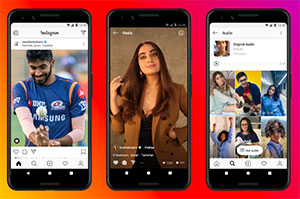
    Instagram has announced the extension of the testing of Reels, a new video format, to India. This format offers a new way to create and share short videos on Instagram, aimed at redefining the future of entertainment on the platform.

     

    Said Ajit Mohan, Vice President and Managing Director, Facebook India: “With the rise in video consumption overall and videos making up over a third of posts on Instagram in India, Instagram has a big role to play in unleashing expression in the country. People across the big and small cities of India come to Instagram to express themselves safely, and also to be entertained. With Reels, we’re unveiling the future of entertainment on the platform, in a way that ignites creativity. With the multiple creative formats, whichever way you want to express yourself, it can now be on Instagram.”


    Added Vishal Shah, Vice President of Product, Facebook: “Instagram has always been a place where culture is created, because people come to share the things they care about and be entertained. We’re constantly listening to our community, and have heard that they want to make and watch short-form videos on Instagram and have the opportunity to be discovered by our broader community.  We’re excited to expand the test of Reels to India and give the next generation of creators born and bred in India a chance to share their native and cultural context — and be potential global stars.”


    India is the fourth country, after Brazil, Germany and France, where this new format is being tested.


  • When Times of India boss Vineet Jain damns Facebook on hate speech & fake news…


    By Ranjona Banerji


    Vineet Jain, managing director of Bennett, Coleman and Company, set off an interesting discussion on Twitter the other day. Bennett, Coleman is the owner of The Times of India and Times Now amongst a large array of newspapers and television channels. India’s largest media conglomerate is how the company is often described. Jain is the MD and part of the family which owns the group.
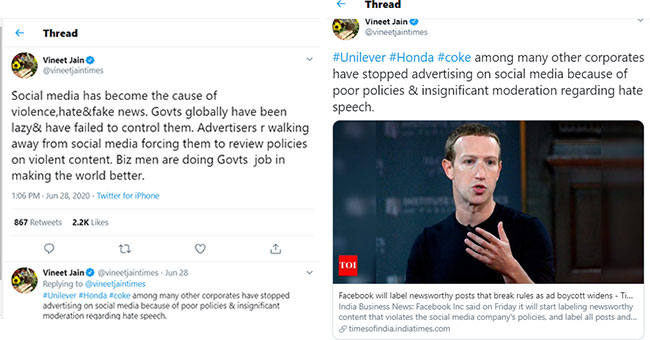

    Jain tweeted this, about ongoing discussions about Facebook, and advertisers applying pressure on Mark Zuckerberg’s social media platform to eliminate hate speech and fake news: “Social media has become the cause of violence, hate & fake news. Govts globally have been lazy & have failed to control them. Advertisers r walking away from social media forcing them to review policies on violent content. Biz men are doing Govts job in making the world better.”


    Jain went on to post a link to a Times of India article on the issue, and also tweeted this: “Unilever #Honda #coke among many other corporates have stopped advertising on social media because of poor policies & insignificant moderation regarding hate speech.”

    O the irony, the irony. Jain’s “news” channel Times Now is a regular purveyor of both hate speech and fake news, and has substantially helped to destroy the reputation of the venerable Old Lady of Bori Bunder, The Times of India, the group’s flagship publication.

    I can hear the scoffing. Because much of the destruction of the credibility of the Indian media is thanks to TOI. You could start with the hegemony of Response over editorial, the appointment of “brand managers” to oversee the hegemony, the introduction of Medianet where the company itself sold editorial space to advertisers and so on.

    But for all its many faults, there were many things – and still are – that are right with the Times of India. I myself have benefitted from a management that did not interfere and indeed supported us when we reported on the 2002 Gujarat riots from Gujarat, as I have mentioned many times before. And this is despite huge pressure from the Response section to get us to stop taking on Narendra Modi’s culpability as chief minister of Gujarat. I quit TOI just as Medianet began, so perhaps I did not see the worst of it.

    However, what Times Now does is far worse than anything that any print publication within Vineet Jain’s empire can conjure up. A non-stop barrage of anti-Muslim debates, a distinct pro-Hindu slant to what passes for news and for discussions, rabid anchors in Rahul Shivshankar and Navika Kumar, an absolute inability to question the Narendra Modi government at the Centre on anything, an endless blame game against the Opposition. It is essentially a propaganda channel for the Modi government, the BJP and the RSS.

    Here’s one small example of its behaviour. A recent poll run by the channel on how Modi had handled the ongoing China crisis had 60.2 per cent of the people saying it was handled badly and 39.8 per cent voting Modi handled it well. Times Now put up a pie chart where the 39.8 per cent was bigger than the 60.2 per cent. This ran until it was trolled on social media. I know there are many kind souls who will want to give them the benefit of the doubt but anyone who has followed the channel knows it was deliberate.

    Mr Jain might perhaps want to rephrase his observations about hate, violence and fake news being seen on social media alone. He might perhaps want to steel himself to watch his own toxic channel. The second tweet in his thread is particularly interesting because it comes to the conclusion, in the Facebook case, that it is business which does the government’s job by withholding advertising from FB and making it change its ways.

    Is this a message to Indian businesses to stop advertising with Times Now? I joke of course, but think about it. Perhaps a withholding of money is the only way that the company will consider getting Times Now to become a news channel rather than a purveyor of filth and fakery.

    It is unlikely that Jain wants government interference. The Newspapers Owners Association of India fight off any sort of government interference because it might interfere with their ownership patterns, not because they care about freedom of expression or a free press. The Association also fights against the Wage Board Commissions which work on fair-ish wages for badly paid newspaper employees.

    Or, is something strange brewing???


    Ranjona Banerji is a senior journalist and commentator. She is also Consulting Editor, MxMIndia. Her views here are personal


  • Anita Kotwani joins Carat India as CEO

    By A Correspondent


    Carat India, the flagship media agency from the house of Dentsu Aegis Network (DAN), has roped in Anita Kotwani as its chief executive officer (CEO). 


    Kotwani was until recently at Mindshare India where she held the position of Senior Vice President, New Business and Client Lead, The Walt Disney Business. In a career spanning more than two decades, 16 of which have been with Mindshare, Kotwani has been instrumental in leading client relationships for brands such as the ABG, Kellogg, ICICI Group, Facebook, Byju and The Walt Disney Company amongst others, for the West zone. Additionally, she has also helped build diversified offerings across data, digital and content, driving exponential growth for Mindshare India over the last two years.

    Kartik Iyer
    Kartik Iyer

    She will report to Kartik Iyer, President Media Brands and Amplifi and will be responsible for the agency’s strategic progress and business growth, nationally. She will also focus on developing and leading significant tools and capabilities within Carat to help deliver enhanced integrated solutions to clients. Speaking on her appointment, Iyer said: “I am delighted to have Anita Kotwani join our team at Dentsu Aegis Network India. In her new role, Anita will help futureproof Carat India as the agency gets ready to take on the new opportunities that the changing market dynamics has to offer.” 


    Anand Bhadkamkar
    Anand Bhadkamkar

    Added Anand Bhadkamkar, CEO, DAN India: “Anita is an industry veteran. She is known for her dedication and diligence and has worked across multiple categories including consumer durables, financial services, FMCG and other MNC brands. I wish her all the luck as she charts fresh new path for Carat India, beginning now,” 


    Elaborating on her mandate, Kotwani said: “Carat was the world’s first media agency to form with the belief that media has the power to transform businesses and this holds true even in today’s times. It is indeed Redefining Media. With DAN’s unique operating model under its single P&L structure, one can draw on the capabilities of its sister companies – including that of its dedicated OOH, Digital, Performance, Marketing Effectiveness and Creative agencies, to access world class specialisms and create bespoke teams to meet client specific needs. There is scale, specialisation and integration at the core, and with my expertise in leading client relationships and growing diversified offerings, I am super excited to lead the Carat brand for India.”

  • Facebook-BCG report on new path-to-purchase

    FB-BCG Guidance bo Brands based on Report Findings


    By A Correspondent


    Facebook India in association with Boston Consulting Group has released a report titled ‘Turn the Tide’ that focuses on how Covid-19 has dramatically changed consumer behaviour and altered the path-to-purchase. The report also shares actionable guidance for brands to build for the new consumer journeys in times of Covid -19 and beyond.


    Sandeep Bhushan

    Said Sandeep Bhushan, Director and Head, Global Marketing Solutions, Facebook India: “As business after business joins the dots to understand consumer shifts in both mindsets and behaviours as a result of COVID-19, we have invested in studying the new paths to purchase in continuing our commitment to enabling growth for businesses both large and small. The ‘Turn the Tide’ report outlines the opportunities that businesses need to embrace in the context of new consumer journeys and category needs. In response to consumers embracing the digital medium, brands need to focus on solutions that are relevant for the new normal such as hyper-localization, creating virtual experiences, re-looking at the media-mix to build efficiency, or building messaging around new habits such as DIY and the increased focus on health and hygiene.”


    Facebook and Boston Consulting Group are also expected to share vertical-specific insights to help businesses gain almost real-time insights, enabling them to ‘Turn the Tide’.


    The report delves into key consumer-shifts based on three societal-truths that have emerged as a result of the pandemic – social distancing, increasing focus on health and hygiene, and increasing income uncertainty. Within each of these shifts, the report finds that there are three kinds of behavior change movements that are being observed – reversal of past trends, acceleration of existing trends, and formation of new habits.


    Nimisha Jain

    Added Nimisha Jain, Managing Director and Partner, Boston Consulting Group: “We are experiencing unprecedented shifts in consumer attitudes and behaviors – 80%+ consumers will continue to practice social distancing and are bringing the outside inside, over 40% of consumers are dialing up on health and wellness spends, e-commerce adoption has already advanced by 2-3 years – to name a few. These aren’t just temporary surges, and many will last longer and become more defining traits. Our analysis reveals that only one in six companies emerged stronger in past crises – players who show the agility to reinvent their value propositions, go-to-market plans and business models to address these demand shifts will be the ones that set themselves apart from the pack”


    The reports especially calls out the massive acceleration in digital led by social media, the emergence of micro-market opportunities, an increase in value consciousness leading to more utility-led shopping, consumers embracing digital even in historically offline categories such as education, health, and fitness, the increase in spend on e-commerce in the coming months even for traditionally offline categories, a definite increase in spends on health, hygiene and wellness, and a rise in do-it-yourself (DIY) trends.


    Executive Summary of Turn The Tide report

    The COVID-19 outbreak has proven to be a global pandemic of an unprecedented scale impacting people, communities, and businesses across nations. In India, as with the rest of the world, the first few weeks of the lockdown saw the industry in a wave of panic and uncertainty as the disruption in business continuity threatened to potentially destabilize the economy.


    Facebook has always been committed to developing and sharing industry-leading full-funnel solutions for brands across all categories. As India opens up to limited business activity, this joint collaboration with the Boston Consulting Group  – a consumer sentiment survey, titled  ‘Turn the Tide’ – aims to serve as a reference point on consumer insights, trends, and guidance for the industry, brands, and agencies as they begin to negotiate the commencement of operations.


    What’s different about this report is that it’s not just a research study but that it also provides actionable guidance that brands can deploy right away. It brings together the expertise of BCG’s deep insights and years of consulting experience with Facebook’s experience across thousands of campaigns run on its platforms.


    Covid-19 has impacted lives in 3 big ways:

    :: Social Distancing

    :: Health & Hygiene

    :: Income Uncertainty


    Key points:

    :: Consumer journey has altered; brands need to urgently identify opportunities to build for new consumer journeys.

    :: COVID-19 has fueled the digital medium in an unprecedented manner. Some of these consumer trends are here to stay.

    :: Brands are already leveraging social media platforms to build for the new consumer journeys.


    Consumer Behavior has fundamentally changed: Emerging Trends (11 Uber themes)

    A. Reversal of Past Trends

    1. Bringing the outside inside: 79% people are not going out of house, except work

    2. Trust in Brand above all else: 63% people are paying more attention to origin of product

    3. Trading Down and Bargain Hunting: 43% people are expecting decrease in overall spend in next 6 months

    4. Shopping for Utility: Purchase triggers expected to become more “functional”


    B. Acceleration of Existing Trends

    1. Embracing digital services & experiences: 51% consumers saw an increase in payment via digital wallets

    2. Accelerated adoption of e-commerce and O2O: 50% of all consumers expect to increase e-commerce spend in next 1 month

    3. Strive for Health & Wellness: +40% may increase spend on Health and Wellness

    4. Rise of Smart Shoppers: Informed purchase decision; High salience of digital research


    C. New Habits:

    1. Remote way of living: The new normal

    2. Do It Yourself: Spike in new hobbies and habits

    3. Superior Hygiene and Clean Living: 91% Indian households washing hands more often


  • Shemaroo TV launches with simulcast on Facebook

    By A Correspondent


    Shemaroo Entertainment has aired content of its flagship Hindi GEC, Shemaroo TV on Facebook. The service was officially launched on May 1, 2020 at 6am and the viewers can watch it live on Facebook.


    Hiren Gada

    Commenting on the launch, Hiren Gada, CEO, Shemaroo Entertainment Limited said: “Shemaroo Entertainment is known to experiment and create new records in the media and entertainment space. With this unique and industry first initiative, where our viewers will see Shemaroo TV live on Facebook, we hope to reach out to a new & wide set of audience and offer content that they would like to watch and enjoy in their free time.”


    Speaking on the occasion, Manish Chopra, Director and Head of Partnerships, Facebook India, remarked: “We are excited to see Shemaroo Entertainment launch its Hindi GEC Channel Shemaroo TV on Facebook. Simulcast of their shows on Facebook in inaugural week, will not only bring back the magic of popular TV shows for people across India, but is also a unique way to expand visibility of their programming, at a time when lockdown and social distancing because of COVID 19,  has led people to tune into more TV and social media.”