
Tag: Avik Chattopadhyay

  • Happy 40th, little one!


    Avik ChattopadhyayBy Avik Chattopadhyay


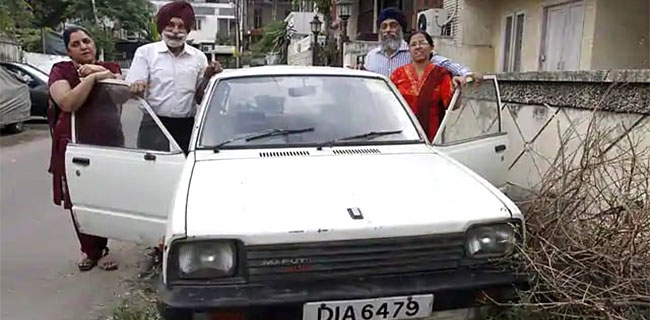
    Yesterday, happened to be the 40th anniversary of one of India’s most loved brands: Maruti. On December 14, 1983, the first batch of the Maruti 800 rolled out with the first car eventually registered as DIA 6479 was handed over by Mrs Indira Gandhi to Mr Harpal Singh of Delhi.
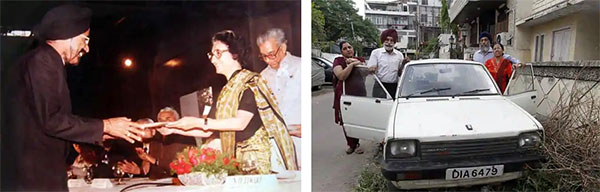
     

    The key of the first Maruti being handed over; the car before it was restored and displayed at the Maruti Suzuki brand centre adjoining their head office in New Delhi. Photos courtesy Mr KG Verma of Maruti Udyog Limited.


    Rarely has any brand once owned by the government firstly survived this long and secondly maintained its market leadership almost since inception. Rarely has a ‘subsidiary’ company overtaken its parent and become the de facto reason for the parent’s sustained global success. Rarely has a mass market brand, literally catering to millions of customers across every corner of the country, become a benchmark in customer-centricity. Maruti is indeed a rare brand, not only in India, but in any market and a case study for all management schools across the world.


    Legend says that on that eventful day 40 years ago, when asked to say a few words, Mrs Gandhi started with “Yeh ek chhoti si gaadi ki ek lambi kahaani hai…” [This is a long story of a tiny car…] obviously referring to her son Sanjay’s obsession with building a ‘people’s car’ in India, a la the Volkswagen Beetle, Renault 5 and Austin/ BMC Mini. He had started his early efforts sometime in 1975, with a break from 1997 to 1980. His sudden death in the same year spurred on his mother to ensure his dream gets fructified.


    While the numbers, the loyalty, the profitability and the sheer market dominance has done most of the talking for the Maruti brand, the corporate has been telling cagey about its history. And that is the very issue I raise today, as an alumnus and an individual who owes a lot of what I am to the seven rich years I breezed through there in two stints.


    There should have been a Maruti Suzuki museum by now, exhibiting all interesting pieces of history, experimental vehicles, the single-seater racing cars, the concept cars, documents, photographs, blueprints and so on. It should have been the pilgrimage of every Indian motorhead, just like the Autostadt for the Volkswagen group. The results the company posts every year, year after year, are… the results and not the reasons. The reasons should have been showcased and celebrated. Sadly, even if numerous proposals were put up for the museum, the top management thought otherwise.
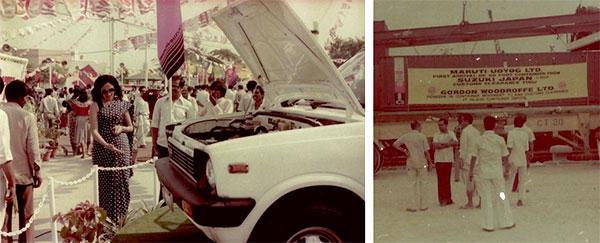
     

    On display before commercial launch at IITF in November 1982 in Pragati Maidan, New Delhi; arrival of the first lot of plant machinery from Suzuki, Japan in early 1983 at Madras (then Chennai) port. Photos courtesy Mr Rakesh Gupta of Maruti Udyog Limited.


    The company cannot wish its history away, however much the parent wishes to, for its own myopic reasons. ‘Maruti’ is Sanjay Gandhi’s concept and that needs to be recognised. His original office in the Gurugram plant was converted into a ‘Tool Room’. As if that was not disrespectful enough, it was unceremoniously razed to the ground in 2002, in spite of a few protests. Insiders say that in 1983, there were five working prototypes built by Sanjay Gandhi and his team of rag-tag engineers kept in one corner of the plant. There were ‘orders’ from way above to destroy them. Thankfully, one was whisked out and is in a closely guarded private collection. Basically, everything to do with Sanjay Gandhi was to be removed or destroyed.


    This is such a contrast to a brand like VW that does not run away from the fact that Adolf Hitler sponsored the idea and encouraged Dr Ferdinand Porsche to build what is popularly called the Beetle. At the Autostadt in Wolfsburg, there is a bust of Major Ivan Hirst, the British army man who revived VW after the war. There is no shame in admitting to the chequered history any memorable has had. Frankness and candour are virtues for any brand, more so a market leader. Running away from it is sad cowardice.


    A brand like Maruti is much more than Arena and Nexa dealerships, a robust service network and a digitised buying process. It cannot be constricted to mere products, which may come and go depending on their own brand lifecycles. It is a pillar of India’s story of slow but sure evolution from an under-developed to the world’s fastest growing economy. It stands for all that is good and not so good about India.


    The good is the ambition to be truly world-class. The good is to openly accept and incorporate a foreign management system and make it one’s own. The good is to establish the concept of customer satisfaction as the cornerstone of any business. The good is to demonstrate that a ‘sarkari’ [governmental] setup could be efficient, effective and profitable. The good is to help the consumer mature to a level where no brand, however global in repute, can take one for granted. The good is to make mobility affordable to millions of the emerging middle-class.


    The not-so-good is to be introverted about its rich legacy and accept the controversial with the laudable. The not-so-good is to not impress upon its parent that it needs both recognition and representation at the global level. The not-so-good is to be defensive about the quality of its people and see them being rightfully treated as global equals vis-à-vis its Japanese counterparts. The not-so-good is to stay away from causes of national importance that look forward to a stand taken by an icon. The not-so-good is to stonewall progress on issues of safety standards and emission norms using its clout to protect its own turf.


    Guess that is what truly memorable brands are made of… the good and the not-so-good. Being proud of one’s legacy and milestones is a mark of maturity of a market leader. Being the 40th anniversary, one would have expected major celebrations by the brand in the form of special editions, on-ground initiatives and customer advocacy programmes. And of course, if not a brand museum, at least a coffee table collector’s edition containing the huge repository of photographs and documents that the company and its alumni have. Given that nothing of this has happened and the day has just passed by, the onus lies on us alumni to take the initiative and do things to commemorate this milestone of one of India’s most loved brands ever!

     

  • Value Brand vis-à-vis Discount Brand


    By Avik Chattopadhyay


    Avik ChattopadhyayThere is an ‘End of Season’ offer from Levi’s that you get two pieces of apparel for every two pieces you buy. People in WhatsApp groups I am part of are already sharing this offer exclaiming it’s a terrific deal. At the same time, many in the same groups are writing off the Maruti Suzuki Jimny as it is going on Rs 2 lakh off the sticker price. One is great “value” while the other is simply a “discount”.


    What really distinguishes a consumer offer as a value offer from one that is scoffed at as a desperate one? I think there is a very thin line dividing them.


    Amazon Prime’s annual membership fee was terrific value.

    Netflix slashing its monthly single device fee to Rs199 was a desperate discount.


    Levi’s offering ‘Buy 2, Get 2’ as an ‘End of Season’ is terrific value.

    Cantabil offering the same throughout the year is a desperate discount.


    Having spent my life in brand management and marketing, I have always grappled with finding the balance between an offer and a discount…a strategic move versus a desperate measure. Having faced failure from close quarters, this marketing puzzle continues to put my fraternity in a tizzy, from soaps to SUVs.


    What must be going on in the mind of the brand manager of the Jimny?

    What must have always eaten into the minds of the people who run Cantabil?

    What makes Indian brands join the ‘Black Friday; bandwagon while we have our own Diwali / Puja season?


    Timing is critical

    When you plan your special offers sets the tone of the promotion’s correlation with the brand’s positioning. If it coincides with the traditional periods of promotional sales, you are not a sore thumb. In fact, people expect the most popular brands to offer their best on these special occasions the prospective customers save up for.


    If it is too soon after your launch in a market, be ready for the jibes and barbs. Even if you realise you need to make a strategic pricing recalibration, doing it soon after your launch is not very clever. If you need to clear immobile inventory, convert it into a special edition or a limited edition, add some features or freebies and then push it out. Luxury brands are masters at this game, from fancy coffee machines to cars. If you cannot think up such a fix, then just bear the pain for some more time and wait for the right time.


    Most apparel brands plan their offers during the bi-annual ‘End of Season’ periods. I know of uber HNIs waiting for these periods to stock up on their Hugo Boss wardrobes.


    Context is key

    You may also choose your ‘time’, based on brand milestones like anniversaries, founder’s day, sales numbers and so on. That justifies the reason to offer a special price as part of an overall celebration. Volkswagen in India started the ritual of the ‘Volksfest’ in October as a celebration of the brand including special offers. An India-specific initiative, it coincides with the traditional festive season and seemingly does quite well for the brand.


    For this to actually work for the brand, it has to be aspirational enough to expect customers to wait for such occasions that stand apart from the traditional periods. ‘Cyber Monday’ was created as an extension of the Black Friday week encouraging people to shop online only as recent as 2005. Amazon has created a brand out of ‘Great India Shopping Festival’ and a significant part of digitally-abled India wait for this half yearly promotion.


    Market leaders like Maruti Suzuki could create its own promotion festival coinciding with its foundation day. That way, customers get to appreciate the brand better as it is associated with a key milestone, helping build a bond more emotional than merely transactional.


    Discounts need not be desperation

    There are brands that have developed discounting as a virtue than a handicap. Amazon gives you not only the range but also deep discounts. Reliance Retail does the same through Trends and Digital. Vishal Megamart caters to a certain economic stratum with the same benefit proposition.


    For other brands, discounting need not be made to look as a desperate measure. Even if it is a price recalibration or correction, the brand has to have the candour to admit so and pass on the same benefits to all previous customers of the same product. That way, nobody feels cheated. In fact, you convert them into brand advocates through your demonstrated ‘transparency’.


    As an example, we have always seen automakers increase prices due to rising input costs and a plethora of reasons cited by them to justify the act. There have been occasions when input prices have come down but not a single automaker has even brought its prices down, even if symbolic.


    In hindsight, I do not think there is anything as a ‘discount brand’. They are all ‘value brands’ for the market segments they target. What is a mere discount for me will be great value for someone else. And vice versa. A discount is not derogatory. We love it when it is offered as a “customised” offer to us as an individual buyer. As long as the brand behaves confident and justifies its price offers, it offers great value. And that is what really matters.


  • Avik Chattopadhyay: Bidrohi Rahman!

    By Avik Chattopadhyay


    Avik ChattopadhyayA fair amount of controversy has been stirred up amongst Bengalis about a song in the recently released Hindi movie ‘Pippa’ about the 1971 Bangladesh Liberation War.

    The song, ‘Karaar oi louho-kopat’ written and composed by Kazi Nazrul Islam, one of the most celebrated literary comets of Bengali literature, has been freshly rendered and presented by AR Rahman in the movie as it was one of the key driving literary forces for Mukti Bahini and the then East Pakistanis. Composed by the popularly termed ‘Bidrohi Kobi’ or revolutionary poet in 1922, it first appeared in a Bengali magazine called ‘Banglaar Kotha’ [Stories of Bengal] and was then included by Nazrul in his compilation called ‘Bhangaar Gaan’ [Songs of Breaking Free]. It is an integral part of the Bengali psyche, on both sides of the border.

    A large section of Bengalis have not liked what Rahman has done with the song. In fact, some have called it sacrilege and showing utter disrespect to the poet and his legacy. How can someone just put an iconic composition to new music and change the meter of the song? This is sheer blasphemy, some scream. They have even gone to the extent of wanting the song removed from the movie. What a storm in a tea cup, literally!

    Can iconic creations not be freshly interpreted? Can venerable ‘brands’ not be reviewed to be made relevant to present situations and circumstances? Are things cast in stone? Are creations so rigid that they cannot be recast?

    In this context, it is important to understand the very brand Nazrul. He is the revolutionary poet. He is the one who broke all preconceived shackles of faith and dogma to go ahead and compose close to 500 songs that are part of some of the biggest Bengali Hindu festivals in the form of Agamani gaan, kirtans and Shyama sangeet. In fact, in the last genre of poetry, he is considered the uncrowned king. Nazrul was an iconoclast and humanist rolled into one bright flame, full of passion for freedom and compassion for all. He had criticised both the Khilafat movement for its “hollow religious fundamentalism” as well the Congress for soft-pedalling on the independence issue. He was a poet, a composer, a dramatist, an editor, a founder of a workers’ party and also an army man in his youth.


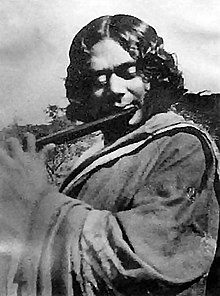
    Kazi Nazrul Islam
    Kazi Nazrul Islam


    In his landmark poem ‘Bidrohi’ [The Rebel], he roars…

    I am the burning volcano in the bosom of the earth,

    I am the wildfire of the woods,

    I am Hell’s mad terrific sea of wrath!

    I ride on the wings of lightning with joy and profundity,

    I scatter misery and fear all around,

    I bring earthquakes on this world!

    I am the rebel eternal,

    I raise my head beyond this world,

    High, ever erect and alone!

    The last thing that Nazrul would ever want is to narrowcast an idea or straightjacket a thought into chains under the garb of ‘tradition’. Tagore and Rumi were huge influences on his thinking and the philosophy he conjured up through his genre of poetry called ‘Nazrul Geeti’. He sent Tagore a composition called ‘Tirtho-Pathik’ in admiration of his writings. Tagore had famously said that darkness shall be banished when the first issue of ‘Dhumketu’ [The Comet], Nazrul’s bi-weekly publication was released. Tagore dedicated his play ‘Basanta’ [Spring] to Nazrul.

    Nazrul was invited to be the music composer by Naresh Chandra Mitra for the film adaptation of Tagore’s ‘Gora’. The Visva Bharati Board was of the opinion that the seven songs used in it did not do justice to the writings putting the film’s release was at risk. When Nazrul did a special screening for Tagore, he commented, “You have adapted my songs, and in what sense do they find you at fault? Do they understand my music better than you do? Can they honour it more than you have?”

    This is exactly what makes an iconic creation and a brand timeless – the flexibility to interpretations, the openness to debates, the ability to recast and the liberty to modify as appropriate. Brands have guidelines, not rules. Brands are open to evolution and modifications over time, not be cast in stone and locked away in a vault.

    The country today sings a particular tune of ‘Vande Mataram’ that has no connect with the original written by Bankim Chandra Chattopadhyay in 1882 and set to tune by Jadunath Bhattacharjee in 1883. What the cricket fans across India in the current ICC Men’s World Cup swing to is the 1997 version, interesting by Rahman.

    If we could so lovingly accept the new version of our National Song, wherein lies the problem in at least allowing the larger populace listen to the adaptation of Nazrul’s iconic song? The problem lies in letting go our own shackles in our minds and hearts under the garb of heritage, legacy and convention. Which is exactly what the Bidrohi Kobi fought against.

    Only the insecure and inept cannot cope with the shackles in the mind being broken. For, in the shrouds of convention and tradition lie their very existence.

    It is important to read the entire poem to smile at the sheer paradox of the current storm. The first two paragraphs of the original in Bengali are followed by an excellent translation of the entire composition by Sajed Kamal

    কারার ঐ লৌহকপাট

    ভেঙ্গে ফেল কর রে লোপাট,

    রক্ত-জমাট শিকল পূজার পাষাণ-বেদী।

    ওরে ও তরুণ ঈশান

    বাজা তোর প্রলয় বিষাণ,

    ধ্বংস নিশান উড়ুক প্রাচীর প্রাচীর ভেদি।

    কারার ঐ লৌহকপাট

    ভেঙ্গে ফেল কর রে লোপাট,

    রক্ত জমাট শিকল পূজার পাষাণ বেদী।

    Destroy those iron gates of prison,

    demolish the blood-stained stony altars

    of chain worshipping!

    O youthful Shiva,

    blow your horn of universal cataclysm!

    Let the flag of destruction

    rise amidst the rubble of prison walls

    of the East!!

    Play the music of the festival of Shiva!

    Who’s the master? Who’s the king?

    Who is it

    that punishes the truth of freedom?

    Ha! Ha! Ha! It’s a laugh–

    God is to be hanged?

    Rumour-monger–

    who teaches this pitiful “truth”?

    O you forgetful Madman —

    shake — shake the prisons

    with your forceful cataclysmic pulls!

    Send your Haidari call,

    play your war-drums–

    call Death

    towards Life!

    There, the Baishakhi storm is dancing–

    are you just going to sit through your days?

    Let’s see

    you shake up the foundation

    of that terrible prison.

    Kick – break the locks!

    All those prisons–

    set them on fire,

    burn them down, uproot them forever!

    Carry on, Bidrohi Rahman!


  • Obsolescence vis-a-vis Relevance


    By Avik Chattopadhyay


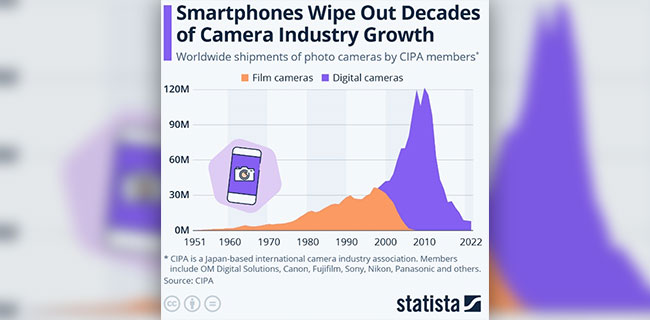
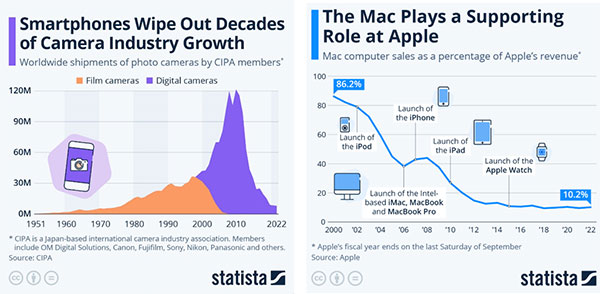
    Avik ChattopadhyayI came across two very interesting infographics by Statista last week. Though they are different pieces of information, to me they seemed bound by the common thread of a problem that every brand faces in its lifetime – obsolescence.


    Brands are scared by this very word. It is a stage in life that no brand wishes to ever experience. Yet, every brand must.


    I was discussing the infographic on cameras with a friend and he said, “These Japanese brands have become obsolete. They are nothing today. In just 15 years.” Little knowing, he had posed a crucial question that every brand manager would ask oneself and try the best to answer.


    Does a brand become obsolete?


    I do not think so, if it is a true brand in the first place. A brand is the promise of an experience, consistently delivered over time, as my guru Wally Olins used to say. Hence, a brand not merely a physical product, method or process. It is the experience that the product or method or process provides. Kodak was not about making cameras. It was about preserving memories. The day it forgot this basic and obsessed with making better cameras, it lost the plot. Just like Canon or Nikon or Panasonic or the hundreds of camera brands that believed their purpose was making a camera.


    Those that realised that their purpose was to help capture occasions, share experiences and create memories did not get bogged down by just one product format or process and devised new formats and methods. While many had written off the European camera makers in the 1990s due to the sheer dominance of the Japanese, they are back in business, collaborating with the smartphone makers in engineering their optics. So you have One Plus or Oppo collaborating with Hasselblad. Nokia had collaborated with Zeiss. Xiaomi has collaborated with Leica, which had a previous partnership with Huawei. Amongst the Japanese brands, Sony too realised its brand calling was much bigger than just a camera box, hence happens to be one of the largest optics partner for smartphone and smart device makers.


    If Colgate thinks of itself only as a toothpaste and not about dental health and happiness, its days are limited. Similarly if Maruti Suzuki thinks of itself as a maker of personal 4-wheeled vehicles and not as about democratising mobility in India, it will get gobbled up by someone who provides mobility solutions, however large it might be.


    A brand never becomes obsolete. A product does. A method does. A process does. And if a name thinks it is only the means and not the end, it surely does become obsolete.


    Now, the second infographic says that the Mac is now merely around 10% of Apple’s annual revenues. Which raised the second question in my mind – are brand relevance and obsolescence correlated? Which means, if a brand remains relevant, it cannot become obsolete, and vice versa.


    In just 22 years, the share of the Mac in Apple’s revenues has fallen by 8 times. Does that mean that the Mac is losing relevance in Apple’s future scheme of things? Does that imply that the Mac is on the verge of becoming obsolete?


    Not at all. The Mac continues to play a critical role in the larger ecosystem that Apple has created. Just that the ecosystem is so damn huge that its financial impact has reduced. However, it continues to do robust numbers, is always a focus at every annual product announcement day and is a critical lifeline for students and creative people. Without the Mac, the ecosystem will be incomplete and other business lines will get adversely impacted. And the fact that Apple keeps regularly upgrading the entire range demonstrates the key role it plays.


    So, a lesser share of revenue does never mean waning or lesser relevance of a brand both for the organisation as well as the marketplace. Even though share goes down, profitability can go up. And that critical brand can actually open doors for the organisation into other customer needs and applications. A student buying the first Macbook will certainly be a prime target for the phone, watch and every future solution that Apple comes up with.


    Just like the lesser numbers of the Tata Harrier does not imply it has lost its relevance vis-à-vis the Nexon and Punch. The Harrier plays a key role of demonstrating a certain level of engineering, design and performance shoulder to shoulder with a Honda, Hyundai and Kia. Hence, it plays a critical role for the larger Tata brand and its mobility ecosystem.


    The next time someone casually comments that a brand has become obsolete or irrelevant, just pause for a moment, give a deep think and then decide whether the statement holds any water, or is it just a temporary phase in the brand’s lifecycle.


    Peugeot had started off its brand lifecycle making water mills and steel knives and forks.

    So there!


  • Thompson, with a ‘p’


    By Avik Chattopadhyay


    Avik ChattopadhyayHere I am, on a blue-blooded advertising and marketing platform, taking a chance at expressing my opinion on WPP finally doing away with the famed “J. Walter Thompson” name. I am not an advertising professional, so do I have the very credibility to write on this subject? I think I do as I have been a ‘client’ for almost two decades dealing with various advertising agencies, including the one with a ‘p’.


    Since WPP decided to give the agency a new name, or impose a name of an existing much smaller agency on the bigger one, many advertising professionals have lamented and lambasted the decision. “How can you take away such a venerable name?” has been the common refrain. “Who on earth knows the new name? No one!” has been the second most popular one. Most of these people have had careers in HTA / JWT / WT and have moved on in life.


    So, will the name change see a change in business? Will it see a change in the ethos and culture? Will clients leave as they do not like the new name? Will employees leave as clients are leaving? Will the entire business come crashing down?


    As someone had told me early in my career, “An agency is as good as the client.” This adage has had a 100% success rate in my professional career till now across eight organisations, six as a client and two as an agency. At every stage, whatever the context or occasion, the communication output has been as effective, efficient and enriching as the quality of the brief, the level of the involvement and most importantly, the depth of the understanding. Right across conventional advertising to media planning to digital marketing to out-of-home to on-ground activation and event management.


    Just like brands have grown being with the right communications partner, so have the partners grown continuing with the right brands. The relationship is mutually impactful. If HTA / JWT / WP is the intellectual behemoth that it is today, it is because its relationships with certain brand behemoths have endured over decades. And these relationships have built its reputation. Just like any superstar, more than 50% of its work would be mediocre or pedestrian but it is that balance that has created the magic for it.


    Over the years I have realised that using “partner” in place of agency and “brand” in place of client works better if you keep repeating them a thousand times in your head as then you start respecting the agency more as a partner and a client more as a brand. That makes a huge difference in the relationship and the quality of the communication.


    Fiat became FCA. Peugeot became PSA. Then Fiat and Peugeot became Stellantis. One may argue that only the corporation names have changed while the customer-facing brands have remained the same. Okay. Ciba-Geigy and Sandoz became Novartis. ICI became Akzo Nobel. Sakura became Konika. Vam Organics became Jubilant. Phoenix became Firefox. Danone’s Bio became Activia. Bombay became Mumbai. The legacy brands wore new clothes and went about their work. The earth did not part consuming them for this act of blasphemy.


    In fact, most of them benefited from donning a new name. it gave a new sense of purpose and direction. And the customer was the biggest gainer. In the enthusiasm of the new name, new ways of customer delivery, product innovation and delight were conjured up by the same team, almost like saying, “We have not only changed, we have gotten better!”


    Advertising has evolved into communication. Communication is going through a tectonic change with the AI interface now rubbing shoulders with the creative human being. Mediums and methods are changing as rapidly as you can say “James Walter Thompson”. The new name VML has been consciously chosen to denote a fresh look at the world of communication. The consumer is changing. The brands needs to change. Should not the communication partner change too? As long as the people are the same and the intellectual capital only increases, the lamenters can rest easy. The clients will not run away. Neither will the employees. Nor will the operating standards fall.


    As long as the ‘p’ of Thompson remains intact.

    ‘P’ for partner.

    Cheers.


  • Avik Chattopadhyay: Bapu Bhagat Bahadur

    By Avik Chattopadhyay


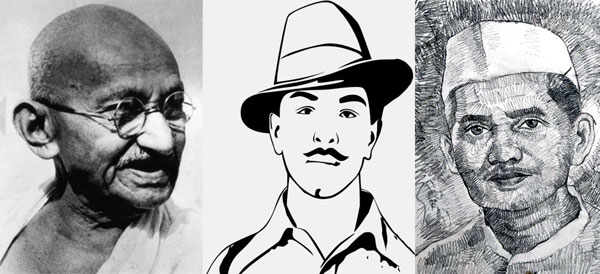
    Avik ChattopadhyayWithin a short period of just four days, the nation observed the birth anniversaries of three of India’s most talismanic statesmen, Bhagat Singh on September 28 and Mohandas Gandhi and Lal Bahadur Shastri on October2.


    Bhagat Singh and statesman: For sure, for he dreamt of a state and sacrificed his life for the cause. If Bapu is a statesman, so is Bhagat. Almost every 28th day of September, there will be a few media articles about the conflict between the two and as how the former could have done more for the latter. This debate is seemingly endless as the ‘camps’ the two have inspired want to score over each other. The two camps do not wish to realise that Bapu and Bhagat were almost inseparable in the freedom struggle. One needs to work hand in hand with the other to collaborate. The means and desired outcomes were different but the purpose was the same.


    Bapu and Bhagat were iconoclasts first and ideologues second. Their power lay in their ability to disrupt. Both realised that the systemic way of subjugated life had to be shaken up, at its core. Both had very clear goals before they went about their tasks.


    Non-violence was the paramount disruption. That is what really defines the Bapu brand. Many have brought freedom to their colonised people but he was the first one to lead a movement using non-violence as a strategic method. In the world of realpolitik it is as disruptively seminal as was the ‘Toyota Production System’ in the early 1990s. It emerges from a deep understanding of the psyche and sentiment of all the stakeholders and factor in all variables. If one needs to bind the entire 500+ kingdoms and principalities into a single line of action, it has got to be something that takes both the subject and the ruler by equal surprise.


    The history of this landmass had shown that the most sustainable and prosperous of reigns were those that focused on peace and non-violence. Yet every freedom movement adopted the conventional route of an armed struggle. While it might have worked in more homogenous scenarios, the heterogenous milieu of our subcontinent demanded a different tactic. An armed freedom fighter is instantly called a terrorist by the ruler. An unarmed one can at best be called a protestor. An armed one has to shun family life and be in hiding, always on the move. An unarmed one can finish cooking for the kids at home and step out to join a silent sit-down protest, wearing a black band and holding a placard in front of the police station. Violence begets violence. Non-violence begets sympathy.


    Parallelly, atheism was Bhagat’s disruption in an already deeply religious society that had now clung to faith as a collective solace against everyday oppression. Even Bapu had fallen victim to the same, espousing the concept of ‘Ram Rajya’ and encouraging prayer meetings at every congregation. Not for Bhagat. In his milestone article ‘Why I am an atheist’ written in jail through October 5 and 6, 1930, he says, “In God, man can find very strong consolation and support. Without Him, man has to depend upon himself. To stand upon one’s own legs amid storms and hurricanes is not child’s play. At such testing moments, vanity – if any – evaporates and man cannot dare to defy the general beliefs. If he does, then we must conclude that he has got certain other strength than mere vanity.”


    Through his writings while waiting for his inevitable death in March 1931, Bhagat was actively disrupting the mind of the youth across the country. He was not about collective action. He was all about revolutionary action, inspired by the thoughts and actions of Bakunin, Marx and Lenin. He propounded that criticism and independent thinking are the two indispensable qualities of a revolutionary. In one place he writes, “Because Mahatmaji is great, therefore, none should criticise him. Because he has risen above, therefore everything he says is right. Whether you are convinced or not, you must say, “Yes, that’s true.” This mentality does not lead towards progress. It is rather too obviously reactionary.”


    Both Bapu and Bhagat were convinced that their means justify the end. For Bapu, it was about carrying everyone together, from each corner of this landmass, with minimal collateral damage, along the path of non-violence, through meaningful peaceful negotiations, appealing to the human conscience of the ruler, towards independence.


    For Bhagat, it was about inspiring people, through his thought and action, to get up and protest, in whichever way they wanted and could, using whatever means. It was about lighting a million sparks all across the land that would finally lead to a huge conflagration unmanageable by the rulers, forcing them to capitulate.


    Both the means actually worked hand in hand leading to the final withdrawal, though not as dramatic as a capitulation would have been. The non-violent struggle would not have worked if not for the armed one dividing resources and attention of the administration and army. They had to fight on two open fronts, adopting two sets of strategies requiring teams of two different mindsets, stretching capabilities and patience.


    And their grudging respect for each other remained steadfast. Renowned historian Dr Chaman Lal says in an interview, “Bhagat Singh and his comrades thought that the Gandhian movement will end up in compromise, without achieving much. They wrote clearly that there will be no stable disciple of the ‘Sant of Sabarmati’. They respected him for his impact on the masses and asked revolutionaries to learn from his connectivity to the masses.”


    At the Karachi session of the Congress after Bhagat’s hanging, on being greeted with black flags and even flowers, Bapu said, “…I am trying to reach the same goal with them. Only I am following a method wholly different from theirs. In this country of self-suppression and timidity, almost bordering on cowardice, we cannot have too much self-sacrifice. One’s head bends before Bhagat Singh’s bravery and sacrifice. But I want the greater bravery, if I might say so without offending my young friends, of the meek, the gentle and the non-violent, the bravery that will mount the gallows without injuring or harbouring any thought of injury to a single soul.”


    Both were highly autocratic, Bhagat even admitting to being so in one of his letters. Guess the only time Bapu decided to shed his autocratic streak ended up in the Partition.


    Where does Lal Bahadur Shastri fit into this Bapu-Bhagat debate? He was the perfect blend of both personas, the left brain and the right brain working in tandem in the world of realpolitik for the greater good of this recently scarred nation. He was about carrying the people together towards collective and inclusive progress famously saying, “We must fight for peace bravely as we fought in war.” He understood the paradox well enough to create an operational template famously known as “Jai Jawan, Jai Kisan”.


    Three personality brands demonstrating a level of maturity, responsibility and mutual respect rarely seen today. They were distinct from each other, yet united by the common greater purpose of establishing and nurturing Brand India. Jai Hind!


  • Avik Chattopadhyay: India or Bharat?

    Avik ChattopadhyayBy Avik Chattopadhyay

    While the President of Bhārat has graciously invited G20 guests from across the world to an exposition of Indian [oops Bhāratiya] hospitality, cuisine and music, Salman is being taught by his colleague that when travelling by Delhi Metro, his name is Mukesh, has to know the Gayatri Mantra by heart, never carry any kababs to office even if from Tunday in Lucknow and, get his ‘new’ Aadhar Card pronto. Skills to save himself from getting lynched! 


    Welcome to Bhārat.

    Land of riches and home of the faithful.

    A land that knew answers to all the problems a human being would have in millennia to come much before you can ever fathom. We had all the answers for astronomy, medicine, governance, metallurgy, warfare, architecture and anything else one can think of before any other race. Our scriptures contain all measurements, predictions and remedies to alleviate human existence, right from the galactic system to the gastric system.


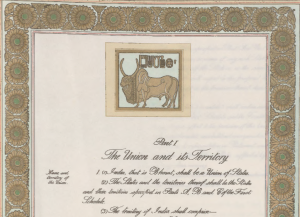
    Source: Cropped image of Page 9 from https://www.loc.gov/resource/llscd.57026883/?sp=9&r=0.262%2C0.146%2C0.258%2C0.132%2C0&st=pdf

    So what if a Meghnad Saha or a Jayant Narlikar questioned the narrative that we were the fountainhead of all knowledge, spread by the marauding Arabs to the rest of the world. We are the living centre of civilisation, unbroken for centuries. Sadly, we cannot claim the same for the birth of mankind, though we would have loved to. In fact, if the Homo Sapiens had actually originated from Jambudwipa, humanity would have been in a better state of being, already having spread to Mars and engaging in interplanetary travel over weekends. And our omnipresent faith would have ensured the galaxy wakes up to the reverberations of Om every solar day. That is the essence of Bhārat.


    Or is it Bhārath?

    Should it not be Bhārath instead of Bhārat?

    My friends from the southern part of the peninsula must insist it is spelt that way.

    Otherwise, the entire exercise will just not be inclusive enough. How can the ‘cow belt’ always have its say on everything of grave national interest? In fact, those in the south are the earliest settlers on this landmass and they have gone beyond their call of duty to preserve the core faith while the north has been soiled by outsiders. They adopted the caste system and implemented it to the hilt, so much so that the Brahmins are purer than the meat eating ones from Bengal, Bihar and Kashmir. They have let go their own languages to adopt Sanskrit and help it evolve over centuries. They have risen beyond the cause of the ‘lesser’ inhabitants in their lands to take up the cause of the pure Aryan civilisation. In fact, they are the original Aryans and not someone up north pretending to be one just by colour of eyes and skin. So, India must become Bharath, and nothing less, for that will be impure.


    Or is it Bhārata?

    Should it not be Bhārata instead of Bhārat or Bhārath?

    For those that want either of the latter two are an insult to the oldest living civilisation on earth and its language. It is not Ram but Rama. And it is not pronounced “Raamaa”… just simply “Raama”. Just like it is neither Mahabharat nor Mahabharataa, but simply Mahabharata. Similarly, it should be pronounced “Bhaarata” and neither Bhaarat nor Bhaarataa. And definitely not Bhaarath. As most of us are experts on the Vedas, Upanishadas and Puranas, we should have known at least how to pronounce the rightful name of our nation.


    For those who lament that India is a colonial name need to know that the word was first used by Herodotus in the 5th century BC in Koine Greek. And I do not think the Greeks really ended up colonising us. Even Megasthenes later used the name in his book “Indica”. The root of the word is “Indus”, the Greek name for the “Sindhu” river. If we are comfortable with the Indus Valley Civilisation, we should be pretty comfortable with India too. Someone needs to drill it down their hard heads that “India” is not a name given by the British, or the French, or the Portuguese, or the Dutch, or even the Danish. Least of all the Mughals, who preferred to call it “Hindūstān”.


    Also, to set the record straight, Bhārata or Bhāratavarṣa refers to the kingdom of the Bharata clan, starting with a king called Bharata. There are various versions of who really Bharata was, whether the son of Dasharatha or that of Dushyanta or Rishabhanatha. Even if we were to dismiss this triviality of historical accuracy, the region Bhāratavarṣa refers to the western part of the Gangetic plain, then recorded as the extent of Bharata’s kingdom. It does not even refer to the entire subcontinent and physical entity that we have known as India for the last 200 odd years. Hence, even considering such a name will be disrespecting the entire geophysical entity that we are today. And we cannot deny the simple fact that this entity was put together by the English East India Company in the first place.


    Article 1 of the Indian Constitution starts as “India, that is Bharat, shall be a union of states…” clearly giving priority to the name India over Bharat. The decision was taken after lots of deliberations in the Constituent Assembly in 1948 and 1949. Three names were shortlisted from the various proposals which included ones like ‘Hind’ and ‘Union of Indian Socialist Republics’ – India, Bharat and Hindustan. Hindustan was dropped as it referred to a larger landmass which had been partitioned in 1947 and also the association with the word ‘Hindu’. Between India and Bharat, the former was given priority as the name the world has known us by for centuries. Bharat was included as the second name, hence the structure of the opening sentence in Article 1.


    At the end of the day, India shall be as our holiest book, the Constitution: states, a union of states, minds, thoughts, beliefs, isms and convictions… all uniting the country more than ever before.


    Jai Hind!


    Avik Chattopadhyay is a senior brand and business strategy consultant based in Gurugram. He writes on MxMIndia every other Thursday. The views here are personal

  • Over the moon, and how!


    By Avik Chattopadhyay


    Avik ChattopadhyayWe made it. Once again. The Indian “Space Programme”, since it kicked off with the setting up of INCOSPAR [now ISRO] under Dr Vikram Sarabhai in 1962, has been one of the best  ambassadors of Brand India. It has embodied the true Indian spirit of inquiry, ingenuity and innovation. The age-old scientific temper of one of the world’s oldest civilisations comes alive not merely in the number of engineers and doctors that go abroad to work but in those that consciously choose to stay back to create institutions and ecosystems which are global benchmarks. As someone quipped in a WhatsApp group, “The Chandrayaan 3 mission cost less than the budget to make the movie Aadipurush”.


    While a large part of the nation was glued to the news updates for 30 full minutes, what I find fascinating is the genres and variety of memes and messages that took off as soon as Mr Somnath announced: “India is on the moon.”


    This piece is about the unique ecosystem of communication that is created around key milestones, good or bad. The fact that the memes I share here landed on my phone within minutes of the milestone show that there are hundreds amongst us who have invested time in preparing them well in advance, both as individuals as well as organisations or corporates.


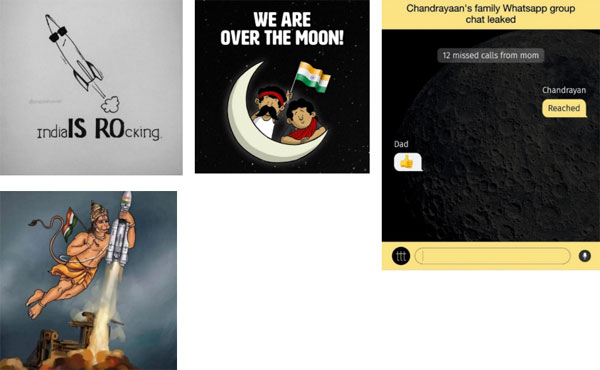
    I picked 17 specific memes from the close to a hundred I received across groups and individual contacts. The different levels of creativity are a wonderful sight to behold for they stand for the sentiment of the people at large. They can be classified as [a] celebratory, [b] topical and [c] corporate.


    The celebratory ones I share here range from the typical play of words to expected images to the excellent use of humour in the one on the right, shared below..


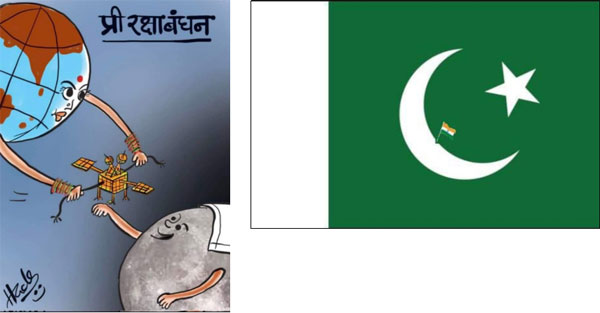
    Then we have the topical memes. With Raksha Bandhan coming up on the 30th of this month, there had to be one on that theme which was one of the more popular ones doing the rounds. Going by our obsession with Pakistan, there had to be one with a jibe at our neighbours too. It was however pleasant to learn of many from across the border wishing the mission all the very best on social media. I found the one about Pakistan very subtle as if implying that there is always a part of India in Pakistan.


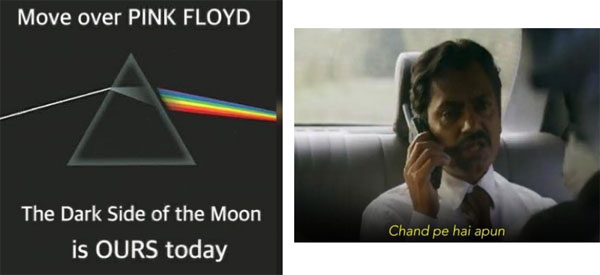
    There are two memes which I loved. Not to be understood by most but those that did, enjoyed both of them. One was with Pink Floyd’s iconic music album “The Dark Side of the Moon”. Given that Vikram landed on the southern and dark side of the moon lent itself to this meme. Given it happens to be the album’s 50th anniversary, there could not been a better coincidental tribute, especially for a fan like me. And then there was this wickedly corny take on Nawazuddin Siddiqui’s character in “Sacred Games”. Both deserve to be archived.


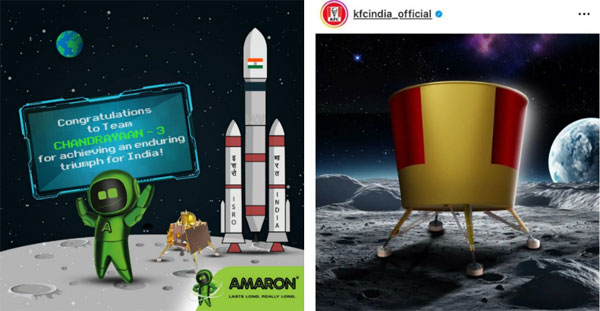
    Then we have the corporates who wanted to encash on this achievement and show solidarity with the mission.


    The one by Amaron was ‘cute’ while the one by KFC was surely over the top but does bring a smile, something more apt in an issue of Mad.


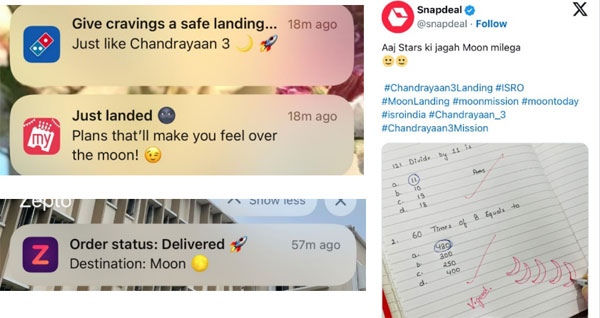
    Then there were posts by the e-commerce guys which were absolutely pedestrian and so predictable. If you do not have a really powerful thought, you might as well not communicate. But the fear of not being seen doing something on such a momentous occasion gets the better of you. When the Chandrayaan had taken off, Ixigo had come up with a brilliant little film which spread like wild fire [maybe not the most appropriate term to use right now].


    Here is the YouTube link to the simply loveable Ixigo video.


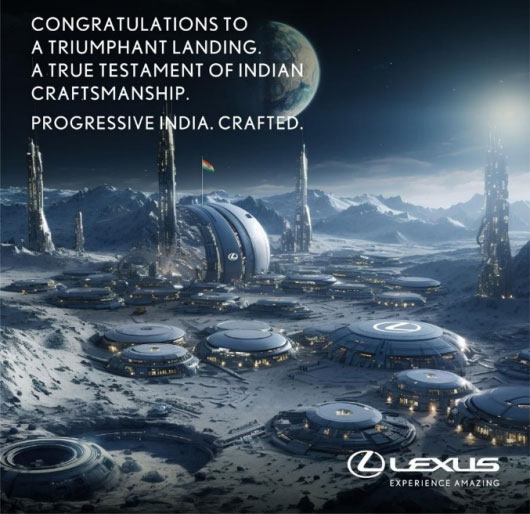
    And then there was this really esoteric one by Lexus. Obviously, it is the moonscape of the future with a Lexus branded building and a launchpad…hopefully. I really did not get it. Hope the Lexus owners have.


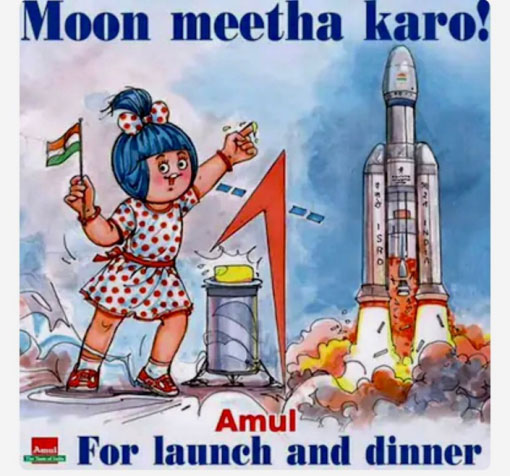
    How can corporates messaging be discussed without sharing what Amul did. True to its DNA, it came up with yet another little masterpiece using their unmatched play with words. Very correctly, the true taste of India and the occasion.


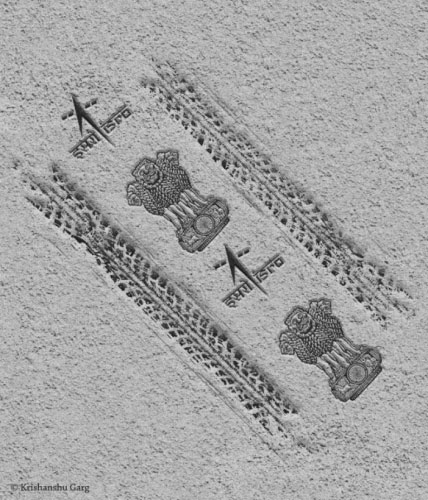
    My last two mentions span from the ridiculous to the sublime. The former is a meme created by one Mr Krishanshu Garg about the supposed permanent imprint the Pragyan rover has left on the moon’s surface. Much before landing happened. Yet people, in the sheer enthusiasm and enormity of the situation, shared this as yet another “moment of pride”. Tells you that creativity can go seriously overboard at times.


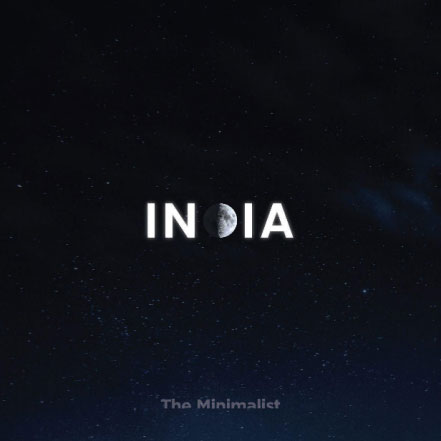
    I finish with the one I would preserve as the image I would retain for life if asked to choose just one. Created by The Minimalist, it is indeed simple and sublime. Possibly the best tribute to all our fellow citizens who have given us this rare moment of celebration and pride! Jai Hind.


  • Size 35 please…


    By Avik Chattopadhyay


    Avik ChattopadhyayAirport lounges can be some of the best places for stimulating discussions and rude revelations. Given that one needs to reach two hours before a flight takes off and you end up having one hour spare, ghost-shopping [for lack of windows] helps you stay updated with what people are ‘into’.


    I was looking at belts. Why, my colleague asked? Because all the trousers I have are of waist size 36 while I actually need 35. And I don’t get it in the brand I choose to wear. “The others don’t have them too,” he quipped. “Brands do not offer odd sizes in apparel and ½ sizes in footwear to Indian customers.” “Really?!” “Yes.” “No, that can’t be! Look at the market size…” “So what? We are still third world.” That was the rude revelation moment!


    Then started my little research. What sizes of clothing and footwear are offered to us Indians? Was my brand an aberration? Let’s check the global ones. Levi’s would be a good starting point.


    Levi’s India online store and Levi’s US online store


    As I was pre-warned, Levi’s in India offers no odd sizes while they do so in the US. There are different ‘fits’ available, but no odd sizes. Why would they do such a thing? Indian waist sizes are as varied as the Americans. Market size? Well, the upper middle-class that can afford one jeans per year is around 20 million odd, which is close to 8% of the US population. So, what would make Levi’s take this decision, given that they have had Indian bosses for a long time?


    1. Sheer convenience of lesser SKUs? Doesn’t make sense as I can charge you a bit more for the exact size you want. And there are so many ‘fits’ on offer.


    2. Sheer apathy for the Indian customer as we generally accept whatever is handed out to us? This could be the reason as I have personally experienced the same when marketing automobiles. “The Indian customer does not know what he/ she wants, so let’s give what we have. Why re-engineer or tailor-make?”


    3. Sheer lack of activism by the brand-struck customer? And, therefore, being more forgiving towards the ‘phoren’ brands?


    4. The ‘Unnees-Bees’ Syndrome as I call it, of the customer accepting particular drawbacks while other requirements are met. So, I can live with the erring waist size on offer as long as they give me the choice of five fits to choose from.


    The Indian ones should be more sensitive then. Let’s check out what our homegrown brands offer us.


    Allen Solly online store and M&S India store


    Louis Philippe, Allen Solly, Indian Terrain… all the same. Only even sizes. While offering choice in fits – classic, regular, slim, super slim, skinny, jogger, carrot and what not. The same applies to shirts only in even sizes, with ‘39’ being the only odd size on offer with the choice of fits. No customisation in the form of collar size and sleeve size. Let the ‘natives’ learn to adjust!


    Talking of natives, M&S metes out the same treatment to their customers back home in Blighty. “Sorry, we destroyed your textile industry to set up Manchester, so as a mark of solidarity, we shall wear your sizes.”


    Does the same apply to footwear? Will my colleague be once again proven right?


    Let’s start with our homegrown favourite Bata.


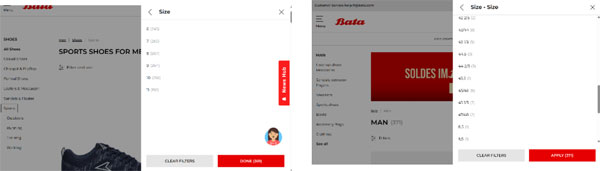
    Bata India online store and Bata France online store


    Now the thing with footwear is not about odd or even sizes, but the ½ sizes. An 8.5 or a 9.5 rather than compromising with a 9 or a 10 and swimming in the shoe for life. Bata India offers no ½ sizes while Bata France does. The same questions crop up in my mind. SKUs? Market size? Marketer apathy? Consumer adjustment?


    How do the global brands treat us? No different. Adidas and Skechers play the same game as Indian brands like Bata and Liberty. What a letdown. When I was close to losing all faith in humankind, the Nike India online store came up as the redeemer, offering not just the same product lines but also the same sizes as they do in the US and Europe. So, there is hope!


    Skechers India online store and Nike India online store


    What I am trying to put across to you is the rude fact that the Indian market, in spite of its size and potential, is still not treated at par with a China or Russia when it comes to most global brands. And it is not just to do with the sizes of apparel or footwear, it is also about the availability of their latest portfolio in the soon-to-be world’s third-largest economy. It is about the larger ‘mindset’ of the brand and the marketer in approaching and addressing the market. It is about the true respect that a brand has for the customer coming alive in its on-ground deployment of product and promise. Any amount of advertising, social media posts and press statements will not add up to the actual demonstration of respect.


    One may say that these are minor issues in the larger landscape of a country and market on the move, but thousands of these issues make up the attitude of an industry addressing the Indian consumer. In the apparel and footwear world, everyone seems to follow the same path while Nike is the exception. Imagine the potential word of mouth when someone is delighted to find his/ her perfect ½ size with one brand while being disappointed with the others. That keeps the cash counters humming. Respect the consumer and you will get it back in multiples. Otherwise you will remain a mere transaction and temporary fad. And, the 20-million strong market today will one day surely double in the next five to seven years.


    The fault does not lie only with the brand marketers and portfolio managers. We, the consumers are equally to blame for adjusting to compromises and not becoming vocal and visible activists for being given what we deserve. A social anthropologist will argue that this is exactly how we have been for eons, whether it be the pantaloon or the politician. So hang on, do I continue my search for a better belt?


  • Avik Chattopadhyay: A ‘kalaam’ for Dr Kalam

    By Avik Chattopadhyay


    Avik ChattopadhyayYesterday was eight full years since he left us. There was hardly a requiem for Avul Pakir Jainulabdeen Abdul Kalam on national media or even social media. We have conveniently forgotten a President who most gallantly displayed the ethos that Brand India is.


    Like millions in the country, I too was inspired by ‘The Missile Man’ without needing to meet him. His words and action were enough to light a spark in any progressive and liberal Indian. And to typecast him as a missile man would be the gravest injustice to a citizen who demonstrated every value that is expected of an Indian as visualised by those who fought for our freedom and those who created our Constitution. Dr Kalam was a living embodiment of all the chapters and articles of the holy book of our nationhood.


    Most of us do not know that along with cardiologist Soma Raju, he developed a low-cost coronary stent in 1998 called the ‘Kalam-Raju Stent’. They got together again in 2012 to develop a rugged healthcare tablet computer called the ‘Kalam-Raju Tablet’. This was much beyond his syllabus of designing missiles and rockets for the country.


    In the early 1970s, he was a key member of Project Devil and Project Valiant where the then Prime Minister Mrs. Gandhi had secretly allocated funds to develop missiles from the SLV systems.


    In spite of all visible opposition and public outcry, he vehemently supported the Kudankulam nuclear power plant proposal even if it meant becoming unpopular with a large section of activists and common people. He believed that nuclear energy was the best solution for our country, given the on-ground realities, and stood his ground against popular opinion.


    He knew the Quran as well as he knew the Bhagavad Gita. His spiritual guru was Pramukh Swami, the head of the BAPS Swaminarayan Sampradaya and he went on to write a book on this unique relationship, making him no less a devout Muslim.


    Dr Kalam stood for all that India was supposed to stand for, when envisaged in 1947 by our founding fathers. He stood for inclusiveness in diversity. He stood for courage of conviction against all odds. He embodied the spirit of enterprise and experimentation that defined the 1960s and 1970s of our nation. He embodied the spirit of ‘karma’ in the right essence of living life to the fullest without amassing objects that would be of no rational use. However, he played the veena and write poetry in Tamil as they possibly helped him become a more culturally complete human being.


    His sheer sincerity in making hundreds of youth take his famous oath at every lecture of his will remain etched in the memory of both those who were there as well as watched on television and social media. Never before has a President of this country ever endeared himself to one and all. While Babu Rajendra Prasad and Dr Radhakrishnan were hugely popular, they were part of the freedom struggle and thereby had their draw. Since 1967, there was not one another who was a crowd-puller and inspiration for the citizen.


    And his ending could not have been more fitting, dying of a cardiac arrest while addressing yet another bunch of students, this time in IIM Shillong on 27 July 2015. Sadly, we do not have his memorial in the national capital. It should have been a pilgrimage for every young Indian to soak in the spirit of the man and be inspired by his idea of India.


    As a tribute to the man, the government should have popularised the “Kalam-Raju Tablet” beyond healthcare and taken it to the world as a demonstration of the Indian way to social justice.


    In his book ‘India 2020’, Dr Kalam writes: “I have identified five areas where India has a core competence for integrated action:

    1. agriculture and food processing

    2. education and healthcare

    3. information and communication technology

    4. infrastructure, reliable and quality electric power, surface transport and infrastructure for all parts of the country, and

    5. self-reliance in critical technologies


    These five areas are closely inter-related and if advanced in a coordinated way, will lead to food, economic and national security.” The sequence of the five areas could not have been more apt for a nation like ours.


    I end with the first four lines from an iconic Bengali poem ‘Adorsho Chhele’ [Ideal Boy] by Kusumkumari Das as my tribute to the ‘People’s [Forgotten] President’…


    আমাদের দেশে হবে সেই ছেলে কবে

    কথায় না বড় হয়ে কাজে বড় হবে?

    মুখে হাসি বুকে বল, তেজে ভরা মন

    “মানুষ হইতে হবে”এই যার পণ !!


    When in our country will that boy be born

    Who will grow strong by deeds and not by words?

    With a smile on his face, courage in his heart and energy in his mind

    Resolves to become “a true human being”.


  • Democratising luxury


    By Avik Chattopadhyay


    On July 3, Harley-Davidson launched the x440 motorcycle in India at a starting price of Rs.2.27 lakh, in partnership with Hero MotoCorp. Two days later, in partnership with Bajaj Auto, Triumph, yet another luxury motorcycle badge, launched the Speed 400 at a starting special offer of Rs.2.23 lakh.


    While the auto-journalist fraternity had been expecting competitive offers by both luxury brands on their measured re-entry into the Indian market, they were sure taken aback by the price points. This was in Royal Enfield territory, they unanimously exclaimed. For a moment, the RE stock price also dipped, the boffins at Dalal Street taken aback by the aggressive posture two traditionally legendary luxury brands had taken.


    Two quintessentially exclusive brands had taken the decision to ‘democratise luxury’!

    It was almost as if they were paying a tribute to a man who had disrupted the haute couture world a few decades ago by democratising fashion and making his label affordable to millions of aspirants. Pierre Cardin’s birth anniversary was on the July 2.


    A flurry of questions come to mind.


    What makes a traditional luxury brand go democratic?

    Is it driven by the left or the right brain? Is it to primarily increase market share or to endear oneself to a larger base of customers?


    In the implementation of the decision to democratise, does the brand remain the same or a new one is created? If the brand is retained, does the promise and experience remain the same? If a new brand is created, does it operate independently of the mother brand, or is there an umbilical cord?


    Lastly, has it worked?


    First and foremost, one must be clear about the ethos of the word “luxury” before we even make an attempt at finding answers. Does luxury mean the experience or the exclusivity or the price point? Or is it a combination of all? Or does being luxurious not necessarily mean it is only meant for a few and comes at a commensurate price point to ensure exclusivity? I remember an interaction I had with my boss Frederic Fabre in Peugeot. We were working on a new car for India, way back in 2011, against a very competitive price point. When the prototype was shown I was taken aback by its styling and luxurious interiors. Frederic smiled and said, “Whatever is cheap does not need to look and feel cheap!”


    Luxury, according to me is a state of mind, at any price point. For, the benchmarks are different for different socio-economic strata. If a brand decides to address only one stratum, so be it. If it wishes to address multiple strata, it is most welcome.


    Mercedes-Benz offers the A-class alongside the S-class, at two different price points, with different performance characteristics and creature comfort features, but with the core luxurious experience remaining intact in both. The A-class offers an experience unmatched by others in the same price band. The experience keeps getting enhanced as one goes up the ladder. The moment Mercedes-Benz took the strategic call to explore a segment at a lower price point than the A-class, it realised it had to compromise with its experiential promise. Hence it created a new brand called “Smart”.


    BMW and Audi too stretched the brand downwards with their X1 and A1 respectively.


    Similarly, when Louis Vuitton decided to experiment with a new consumer segment of the young and the restless which was not an advocate of traditional luxury, it created a separate brand called ‘Trash & Soul’. Though the brand did not last for long, it was surely a bold step of a talismanic luxury brand to think outside the box, literally.


    Pierre Cardin tried the same with mixed results. He wanted to make his label accessible to people down the socio-economic chain. For this, he franchised his name across product categories, right from perfumes to ballpoint pens and even keyrings. His logic was that millions across the world wanted a piece of his creation, so what if they could not afford his couture. They could certainly belong to the global Pierre Cardin family by even owning a keyring.


    Does it always work? For Mercedes-Benz it did. For Pierre Cardin, it did not. For the simple reason that the former was intent on not compromising with the ownership experience while the latter, sadly, lost the plot there. Cardin had a terrific idea terribly executed. I would want to definitely own a pen carrying his famous logo and signature at Rs 1000 but would not want to buy it from the local stationery store. I would aspire to walk into a Pierre Cardin store that houses all his creations and rub shoulders with someone buying a Rs.10,000 linen shirt, carrying the same logo. I become part of the same family and I walk out feeling as exalted as the other gentleman.


    Brands like Armani and TAG Heuer possibly learnt from this blunder and got the implementation right. The Formula 1 watch, though eight times cheaper than the Link, was available at the same store, as were the spectacle frames, rubbing chain-links.


    Democratising luxury allows the brand to engage with the aspirational customer into encouraging gradual upgrades through the brand ladder…from the Formula 1 to the Aquaracer after 5-7 years finally to the Link. The customer basks in the ownership journey while the brand grows in profits, without diluting the brand essence which Cardin ended up doing.


    This is exactly what both Harley-Davidson and Triumph are attempting in their re-entry into the world’s largest two-wheeler market. Earlier, they were way too exclusive. Now they are within the reach of thousands who wish to own a piece of motorcycling legend. The rider on the x440 will be rubbing shoulders with the rider on Softail and feel the same pride in being a HOG family member. The day the x440 customer is treated like a Hero customer because of the price point, thee shall be a re-exit soon.


    And yes, I simply hate the word “masstige”. Whoever has coined it has the same sense of warped humour as the one who coined the word ‘phygital’. What H-D or Triumph or M-B or TAG have done do not make them masstige brands. They remain iconic luxury brands. Just that they have democratised the luxurious experience to reach out to many more aspirants. And prove that Monsieur Cardin was conceptually right, after all!


  • Tinker, tailor, marketer, sailor…


    By Avik Chattopadhyay


    Avik ChattopadhyayI attended a very interesting conference of CMOs yesterday. The one subject that took my fancy was that of “marketing in the era of technological disruption”. The panellists were CMOs from different industries, ranging from BFSI to consumer electronics, food and home improvement…from the totally digital to the totally physical consumer spaces. [I hate using the term ‘phygital’ as it sounds derogatory to both the spheres or spaces.] These people were in the thick of things, hemmed in between increasing personalisation and the rising head of AI and ChatGPT. I had some key takeaways from the session which I share here, as I believe these CMOs represent the larger community of marketers who chart the course that corporate India takes in building and nurturing brands and businesses.


    The role of the marketer fundamentally remains the same as before. The larger objectives remain the same while the ‘tools’ of the trade have certainly changed and proliferated. Given the rapid digital proliferation, the marketer now has to focus on reducing inefficiencies than ever before.


    While data is the ‘new oil’ and the ‘king’, it is easy to be burdened with tons of data without knowing what exactly to do with it. After all, the tasks of how to mine the data are also created by us humans, so anomalies may creep in till the time when AI totally takes over this job and we become mere implementors of orders from the ether. It is crucial for the marketer to draw the line between big data and usable data.


    Conversion continues to the biggest challenge for the marketer. While the funnel gets richer by the day, it narrows too soon leading to a rapid fall in % shares from prospect to customer. The marketer has to shift the focus of both the organisation as well as the investors from mere visitors / footfalls / followers to converts / advocates / consumers…basically from the passive base to the active base.


    The second biggest challenge is retention. As there is an overwhelming investment in getting customers, the required focus on retaining the existing base gets diluted on occasions. This is why the marketer has to look after the service aspect too, in terms of communication and engagement. We all know how expensive it is to get a new customer vis-à-vis retain one who gets more by word-of-mouth.


    The third biggest challenge is measurement. With the proliferation of channels and media, there is also an explosion of measurement systems, with each claiming to be the “right one”. The marketer looks forward to a single measure for all media and channels, and also a simplification of the process. Aspects like sustainability also need to feature in the measure, as it is a corporate regulation now. Both new media like OTT and traditional ones like OOH suffer from credibility issues when it comes to measurement.


    The use of jargon seems to bother today’s marketer. He / she wants the language to be simplified. Terms like “omnichannel” and “cohort” have been recklessly used to justify both esoteric strategy as well as on-ground non-performance. While the old guard would grapple with such terminology, the new-age CMOs do not fall for such smokescreens.


    The marketers agreed that every organisation has developed into a ‘software firm’ along with the business it conducts. Thankfully, learning tools have become more accessible and intuitive to allow people in marketing and sales to remain updated ‘over the air’. While AI and its tribe will take over the routine tasks of capturing data, processing it and churning out reports, the marketer will need much higher analytical and cognitive skills to use the reports for culling out insights. Will that mean that marketing teams will be down-sized? Remains to be seen. Will that mean that tools like ChatGPT will make the marketer dumb, as Harari fears? Not at all.


    As long as the human being continues to consume physical products, the focus on creating immersive sensory physical experiences will keep growing. The marketer has to create the smooth bridge “from the screen to the showroom”. After all, all e-commerce and q-commerce entities survive on delivering physical products from their physical warehouses. The bridge has to be intuitive, seamless and bespoke for each customer over a period of time. That is the final frontier in the career of a marketer.


    A new role added is to also keep a tab on competition or vested interests using technology to create deep fakes to damage your image and market. The same technology that holds us in awe, with its ability to insert a person into a video and put words in the mouths that never said them, can become a double-edged sword. We already have cases of deep fakes in advertising created to damage brand reputations.


    Finally, technology is not a disruptor but an enabler. It is the means and not the end. The marketer has to have complete control over it rather than become a victim of its whims. New technologies will always be fascinating but shall always remain the ‘tool’ of the marketer. How one uses it decides what one becomes of it.


    To draw inspiration from the childhood nursery rhyme,

    “Tinker, tailor, marketer, sailor

    Rich man, poor man, beggar man, thief!”