By Avik Chattopadhyay
 Within a short period of just four days, the nation observed the birth anniversaries of three of India’s most talismanic statesmen, Bhagat Singh on September 28 and Mohandas Gandhi and Lal Bahadur Shastri on October2.
Bhagat Singh and statesman: For sure, for he dreamt of a state and sacrificed his life for the cause. If Bapu is a statesman, so is Bhagat. Almost every 28th day of September, there will be a few media articles about the conflict between the two and as how the former could have done more for the latter. This debate is seemingly endless as the ‘camps’ the two have inspired want to score over each other. The two camps do not wish to realise that Bapu and Bhagat were almost inseparable in the freedom struggle. One needs to work hand in hand with the other to collaborate. The means and desired outcomes were different but the purpose was the same.
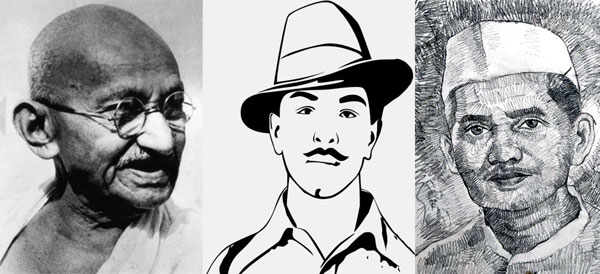
Bapu and Bhagat were iconoclasts first and ideologues second. Their power lay in their ability to disrupt. Both realised that the systemic way of subjugated life had to be shaken up, at its core. Both had very clear goals before they went about their tasks.
Non-violence was the paramount disruption. That is what really defines the Bapu brand. Many have brought freedom to their colonised people but he was the first one to lead a movement using non-violence as a strategic method. In the world of realpolitik it is as disruptively seminal as was the ‘Toyota Production System’ in the early 1990s. It emerges from a deep understanding of the psyche and sentiment of all the stakeholders and factor in all variables. If one needs to bind the entire 500+ kingdoms and principalities into a single line of action, it has got to be something that takes both the subject and the ruler by equal surprise.
The history of this landmass had shown that the most sustainable and prosperous of reigns were those that focused on peace and non-violence. Yet every freedom movement adopted the conventional route of an armed struggle. While it might have worked in more homogenous scenarios, the heterogenous milieu of our subcontinent demanded a different tactic. An armed freedom fighter is instantly called a terrorist by the ruler. An unarmed one can at best be called a protestor. An armed one has to shun family life and be in hiding, always on the move. An unarmed one can finish cooking for the kids at home and step out to join a silent sit-down protest, wearing a black band and holding a placard in front of the police station. Violence begets violence. Non-violence begets sympathy.
Parallelly, atheism was Bhagat’s disruption in an already deeply religious society that had now clung to faith as a collective solace against everyday oppression. Even Bapu had fallen victim to the same, espousing the concept of ‘Ram Rajya’ and encouraging prayer meetings at every congregation. Not for Bhagat. In his milestone article ‘Why I am an atheist’ written in jail through October 5 and 6, 1930, he says, “In God, man can find very strong consolation and support. Without Him, man has to depend upon himself. To stand upon one’s own legs amid storms and hurricanes is not child’s play. At such testing moments, vanity – if any – evaporates and man cannot dare to defy the general beliefs. If he does, then we must conclude that he has got certain other strength than mere vanity.”
Through his writings while waiting for his inevitable death in March 1931, Bhagat was actively disrupting the mind of the youth across the country. He was not about collective action. He was all about revolutionary action, inspired by the thoughts and actions of Bakunin, Marx and Lenin. He propounded that criticism and independent thinking are the two indispensable qualities of a revolutionary. In one place he writes, “Because Mahatmaji is great, therefore, none should criticise him. Because he has risen above, therefore everything he says is right. Whether you are convinced or not, you must say, “Yes, that’s true.” This mentality does not lead towards progress. It is rather too obviously reactionary.”
Both Bapu and Bhagat were convinced that their means justify the end. For Bapu, it was about carrying everyone together, from each corner of this landmass, with minimal collateral damage, along the path of non-violence, through meaningful peaceful negotiations, appealing to the human conscience of the ruler, towards independence.
For Bhagat, it was about inspiring people, through his thought and action, to get up and protest, in whichever way they wanted and could, using whatever means. It was about lighting a million sparks all across the land that would finally lead to a huge conflagration unmanageable by the rulers, forcing them to capitulate.
Both the means actually worked hand in hand leading to the final withdrawal, though not as dramatic as a capitulation would have been. The non-violent struggle would not have worked if not for the armed one dividing resources and attention of the administration and army. They had to fight on two open fronts, adopting two sets of strategies requiring teams of two different mindsets, stretching capabilities and patience.
And their grudging respect for each other remained steadfast. Renowned historian Dr Chaman Lal says in an interview, “Bhagat Singh and his comrades thought that the Gandhian movement will end up in compromise, without achieving much. They wrote clearly that there will be no stable disciple of the ‘Sant of Sabarmati’. They respected him for his impact on the masses and asked revolutionaries to learn from his connectivity to the masses.”
At the Karachi session of the Congress after Bhagat’s hanging, on being greeted with black flags and even flowers, Bapu said, “…I am trying to reach the same goal with them. Only I am following a method wholly different from theirs. In this country of self-suppression and timidity, almost bordering on cowardice, we cannot have too much self-sacrifice. One’s head bends before Bhagat Singh’s bravery and sacrifice. But I want the greater bravery, if I might say so without offending my young friends, of the meek, the gentle and the non-violent, the bravery that will mount the gallows without injuring or harbouring any thought of injury to a single soul.”
Both were highly autocratic, Bhagat even admitting to being so in one of his letters. Guess the only time Bapu decided to shed his autocratic streak ended up in the Partition.
Where does Lal Bahadur Shastri fit into this Bapu-Bhagat debate? He was the perfect blend of both personas, the left brain and the right brain working in tandem in the world of realpolitik for the greater good of this recently scarred nation. He was about carrying the people together towards collective and inclusive progress famously saying, “We must fight for peace bravely as we fought in war.” He understood the paradox well enough to create an operational template famously known as “Jai Jawan, Jai Kisan”.
Three personality brands demonstrating a level of maturity, responsibility and mutual respect rarely seen today. They were distinct from each other, yet united by the common greater purpose of establishing and nurturing Brand India. Jai Hind!