By Avik Chattopadhyay
 A fair amount of controversy has been stirred up amongst Bengalis about a song in the recently released Hindi movie ‘Pippa’ about the 1971 Bangladesh Liberation War.
The song, ‘Karaar oi louho-kopat’ written and composed by Kazi Nazrul Islam, one of the most celebrated literary comets of Bengali literature, has been freshly rendered and presented by AR Rahman in the movie as it was one of the key driving literary forces for Mukti Bahini and the then East Pakistanis. Composed by the popularly termed ‘Bidrohi Kobi’ or revolutionary poet in 1922, it first appeared in a Bengali magazine called ‘Banglaar Kotha’ [Stories of Bengal] and was then included by Nazrul in his compilation called ‘Bhangaar Gaan’ [Songs of Breaking Free]. It is an integral part of the Bengali psyche, on both sides of the border.
A large section of Bengalis have not liked what Rahman has done with the song. In fact, some have called it sacrilege and showing utter disrespect to the poet and his legacy. How can someone just put an iconic composition to new music and change the meter of the song? This is sheer blasphemy, some scream. They have even gone to the extent of wanting the song removed from the movie. What a storm in a tea cup, literally!
Can iconic creations not be freshly interpreted? Can venerable ‘brands’ not be reviewed to be made relevant to present situations and circumstances? Are things cast in stone? Are creations so rigid that they cannot be recast?
In this context, it is important to understand the very brand Nazrul. He is the revolutionary poet. He is the one who broke all preconceived shackles of faith and dogma to go ahead and compose close to 500 songs that are part of some of the biggest Bengali Hindu festivals in the form of Agamani gaan, kirtans and Shyama sangeet. In fact, in the last genre of poetry, he is considered the uncrowned king. Nazrul was an iconoclast and humanist rolled into one bright flame, full of passion for freedom and compassion for all. He had criticised both the Khilafat movement for its “hollow religious fundamentalism” as well the Congress for soft-pedalling on the independence issue. He was a poet, a composer, a dramatist, an editor, a founder of a workers’ party and also an army man in his youth.
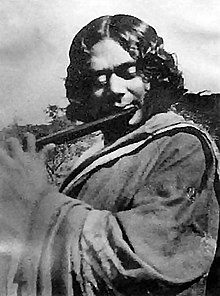
In his landmark poem ‘Bidrohi’ [The Rebel], he roars…
I am the burning volcano in the bosom of the earth,
I am the wildfire of the woods,
I am Hell’s mad terrific sea of wrath!
I ride on the wings of lightning with joy and profundity,
I scatter misery and fear all around,
I bring earthquakes on this world!
I am the rebel eternal,
I raise my head beyond this world,
High, ever erect and alone!
The last thing that Nazrul would ever want is to narrowcast an idea or straightjacket a thought into chains under the garb of ‘tradition’. Tagore and Rumi were huge influences on his thinking and the philosophy he conjured up through his genre of poetry called ‘Nazrul Geeti’. He sent Tagore a composition called ‘Tirtho-Pathik’ in admiration of his writings. Tagore had famously said that darkness shall be banished when the first issue of ‘Dhumketu’ [The Comet], Nazrul’s bi-weekly publication was released. Tagore dedicated his play ‘Basanta’ [Spring] to Nazrul.
Nazrul was invited to be the music composer by Naresh Chandra Mitra for the film adaptation of Tagore’s ‘Gora’. The Visva Bharati Board was of the opinion that the seven songs used in it did not do justice to the writings putting the film’s release was at risk. When Nazrul did a special screening for Tagore, he commented, “You have adapted my songs, and in what sense do they find you at fault? Do they understand my music better than you do? Can they honour it more than you have?”
This is exactly what makes an iconic creation and a brand timeless – the flexibility to interpretations, the openness to debates, the ability to recast and the liberty to modify as appropriate. Brands have guidelines, not rules. Brands are open to evolution and modifications over time, not be cast in stone and locked away in a vault.
The country today sings a particular tune of ‘Vande Mataram’ that has no connect with the original written by Bankim Chandra Chattopadhyay in 1882 and set to tune by Jadunath Bhattacharjee in 1883. What the cricket fans across India in the current ICC Men’s World Cup swing to is the 1997 version, interesting by Rahman.
If we could so lovingly accept the new version of our National Song, wherein lies the problem in at least allowing the larger populace listen to the adaptation of Nazrul’s iconic song? The problem lies in letting go our own shackles in our minds and hearts under the garb of heritage, legacy and convention. Which is exactly what the Bidrohi Kobi fought against.
Only the insecure and inept cannot cope with the shackles in the mind being broken. For, in the shrouds of convention and tradition lie their very existence.
It is important to read the entire poem to smile at the sheer paradox of the current storm. The first two paragraphs of the original in Bengali are followed by an excellent translation of the entire composition by Sajed Kamal
কারার ঐ লৌহকপাট
ভেঙ্গে ফেল কর রে লোপাট,
রক্ত-জমাট শিকল পূজার পাষাণ-বেদী।
ওরে ও তরুণ ঈশান
বাজা তোর প্রলয় বিষাণ,
ধ্বংস নিশান উড়ুক প্রাচীর প্রাচীর ভেদি।
কারার ঐ লৌহকপাট
ভেঙ্গে ফেল কর রে লোপাট,
রক্ত জমাট শিকল পূজার পাষাণ বেদী।
Destroy those iron gates of prison,
demolish the blood-stained stony altars
of chain worshipping!
O youthful Shiva,
blow your horn of universal cataclysm!
Let the flag of destruction
rise amidst the rubble of prison walls
of the East!!
Play the music of the festival of Shiva!
Who’s the master? Who’s the king?
Who is it
that punishes the truth of freedom?
Ha! Ha! Ha! It’s a laugh–
God is to be hanged?
Rumour-monger–
who teaches this pitiful “truth”?
O you forgetful Madman —
shake — shake the prisons
with your forceful cataclysmic pulls!
Send your Haidari call,
play your war-drums–
call Death
towards Life!
There, the Baishakhi storm is dancing–
are you just going to sit through your days?
Let’s see
you shake up the foundation
of that terrible prison.
Kick – break the locks!
All those prisons–
set them on fire,
burn them down, uproot them forever!
Carry on, Bidrohi Rahman!