
By Avik Chattopadhyay
 Airport lounges can be some of the best places for stimulating discussions and rude revelations. Given that one needs to reach two hours before a flight takes off and you end up having one hour spare, ghost-shopping [for lack of windows] helps you stay updated with what people are ‘into’.
I was looking at belts. Why, my colleague asked? Because all the trousers I have are of waist size 36 while I actually need 35. And I don’t get it in the brand I choose to wear. “The others don’t have them too,” he quipped. “Brands do not offer odd sizes in apparel and ½ sizes in footwear to Indian customers.” “Really?!” “Yes.” “No, that can’t be! Look at the market size…” “So what? We are still third world.” That was the rude revelation moment!
Then started my little research. What sizes of clothing and footwear are offered to us Indians? Was my brand an aberration? Let’s check the global ones. Levi’s would be a good starting point.
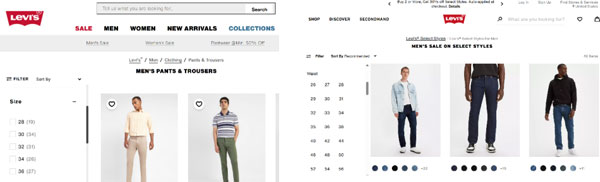
As I was pre-warned, Levi’s in India offers no odd sizes while they do so in the US. There are different ‘fits’ available, but no odd sizes. Why would they do such a thing? Indian waist sizes are as varied as the Americans. Market size? Well, the upper middle-class that can afford one jeans per year is around 20 million odd, which is close to 8% of the US population. So, what would make Levi’s take this decision, given that they have had Indian bosses for a long time?
1. Sheer convenience of lesser SKUs? Doesn’t make sense as I can charge you a bit more for the exact size you want. And there are so many ‘fits’ on offer.
2. Sheer apathy for the Indian customer as we generally accept whatever is handed out to us? This could be the reason as I have personally experienced the same when marketing automobiles. “The Indian customer does not know what he/ she wants, so let’s give what we have. Why re-engineer or tailor-make?”
3. Sheer lack of activism by the brand-struck customer? And, therefore, being more forgiving towards the ‘phoren’ brands?
4. The ‘Unnees-Bees’ Syndrome as I call it, of the customer accepting particular drawbacks while other requirements are met. So, I can live with the erring waist size on offer as long as they give me the choice of five fits to choose from.
The Indian ones should be more sensitive then. Let’s check out what our homegrown brands offer us.
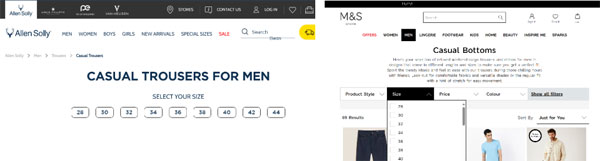
Louis Philippe, Allen Solly, Indian Terrain… all the same. Only even sizes. While offering choice in fits – classic, regular, slim, super slim, skinny, jogger, carrot and what not. The same applies to shirts only in even sizes, with ‘39’ being the only odd size on offer with the choice of fits. No customisation in the form of collar size and sleeve size. Let the ‘natives’ learn to adjust!
Talking of natives, M&S metes out the same treatment to their customers back home in Blighty. “Sorry, we destroyed your textile industry to set up Manchester, so as a mark of solidarity, we shall wear your sizes.”
Does the same apply to footwear? Will my colleague be once again proven right?
Let’s start with our homegrown favourite Bata.
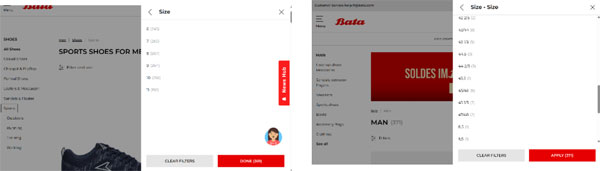
Now the thing with footwear is not about odd or even sizes, but the ½ sizes. An 8.5 or a 9.5 rather than compromising with a 9 or a 10 and swimming in the shoe for life. Bata India offers no ½ sizes while Bata France does. The same questions crop up in my mind. SKUs? Market size? Marketer apathy? Consumer adjustment?
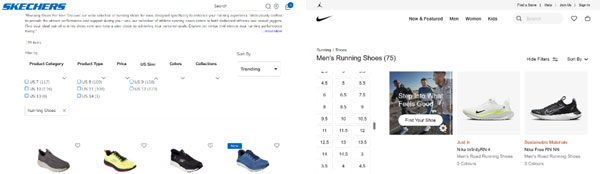
How do the global brands treat us? No different. Adidas and Skechers play the same game as Indian brands like Bata and Liberty. What a letdown. When I was close to losing all faith in humankind, the Nike India online store came up as the redeemer, offering not just the same product lines but also the same sizes as they do in the US and Europe. So, there is hope!
What I am trying to put across to you is the rude fact that the Indian market, in spite of its size and potential, is still not treated at par with a China or Russia when it comes to most global brands. And it is not just to do with the sizes of apparel or footwear, it is also about the availability of their latest portfolio in the soon-to-be world’s third-largest economy. It is about the larger ‘mindset’ of the brand and the marketer in approaching and addressing the market. It is about the true respect that a brand has for the customer coming alive in its on-ground deployment of product and promise. Any amount of advertising, social media posts and press statements will not add up to the actual demonstration of respect.
One may say that these are minor issues in the larger landscape of a country and market on the move, but thousands of these issues make up the attitude of an industry addressing the Indian consumer. In the apparel and footwear world, everyone seems to follow the same path while Nike is the exception. Imagine the potential word of mouth when someone is delighted to find his/ her perfect ½ size with one brand while being disappointed with the others. That keeps the cash counters humming. Respect the consumer and you will get it back in multiples. Otherwise you will remain a mere transaction and temporary fad. And, the 20-million strong market today will one day surely double in the next five to seven years.
The fault does not lie only with the brand marketers and portfolio managers. We, the consumers are equally to blame for adjusting to compromises and not becoming vocal and visible activists for being given what we deserve. A social anthropologist will argue that this is exactly how we have been for eons, whether it be the pantaloon or the politician. So hang on, do I continue my search for a better belt?