Tag: Avik Chattopadhyay

  • Our obsession with ‘One’

    Our obsession with ‘One’

    Avik ChattopadhyayOne nation. One election.

    The sequence continues with our new-found, or newly-created, obsession with ‘One nation’. The one about elections is the latest. We have had our brushes with law, language, colour, food, attire and so on.


    Another has been the renaming of Port Blair to Sri Vijaya Puram. It was done to do away with a colonial name and give it a national one. Therefore, a Sanskrit name. A language that is not indigenous to the Onges, Jarwas and Sentinalese. Basically, another colonial name. But in the name of ‘oneness’.


    What is this ‘one’ all about?


    One could be universalism.

    It could be about one with the world, the entire ecosystem, the entire human race and a common set of values. It could be about the universalism of man as espoused by Romain Rolland or Aurobindo or Tagore. It is about an open canvas whereon each individual could play her/his own role with a sense of liberty and contribution to the larger cause. It is beyond boundaries of nationhood.


    One could be unity.

    As kids, we were fed on the narrative of ‘unity in diversity’. It could be about the mutual appreciation and empathy in our diversity that makes us come together as one people, under one constitution that recognises the strength of the multiple cultures, faiths, thoughts, languages and ways of life. It’s a sense of equi-proximity to one and all.


    One could be uniformity.

    It can be about being bound by a common code of justice, regulations, accessibility, evaluation, recognition and reward that operates over and above the unity in diversity. It is about maintaining equi-distance from each bit of diversity, applying a more rational approach to oneness.


    One could be unitarianism.

    It could be about only one way of doing things in one nation. One language. One food plate. One attire. One colour code. And finally, one faith. Basically one way of life, determined by the vision of what defines the nation by the absolute powers that reign.


    In a recent television debate on the occasion of ‘Hindi Diwas’, on being chided by the anchor that Hindi was needed as a national language to unite the nation, one panelist pointed out that the nation is already united and does not need a unitarian language to do so.


    Last week, a senior minister stated that we need ‘our own Silicon Valley’. Pat came an apt response that Bengaluru happens to be a part of India. This is what happens when you get caught in the game of ‘one’ and one-upmanship.


    Countries, like corporations, need to consciously decide which ‘one’ they wish to be.

    In fact, countries, like ours, in the current state of flux, need to learn from how multinational, multi-business organisations successfully run as one. What makes a Coca-Cola retain brands like Fanta and Thums Up instead of steamrolling just one unitarian brand all across? What makes a Toyota retain brands like Daihatsu in the same market, in the same product segment? Or make a conglomerate like Raytheon keep brands like Otis, UTC, Chubb, Pratt & Whitney and Carrier when they took over United Technologies.


    Oneness does not come out of unitarianism. It comes out of inclusion and assimilation. It is immensely more powerful to absorb and preserve than acquire and subsume. The unique DNA and flavour of every brand as a microcosm adds to the overall uniqueness of the macrocosm. So, consciously celebrating all cultures, languages, attires, food styles, colours and scripts as part of the national ethos will generate more profits for the nation than trying to create clones in the effort to bring about uniformity through unitarianism.


    Port Blair should have been given an indigenous name.

    Tamil should be taught in CBSE schools as a language option, just like Hindi and Sanskrit.

    The states should have their elections distinct from that for the national parliament.

    It is not about saving costs, as we have not been the most careful spenders anyway.

    It is about preserving and promoting diversity if one is to be a truly successful country or corporation.


    This needless obsession with being ‘one’ by imposition rather than by assimilation reminds me of the last lines of the Queen song ‘One Vision’…


    One, one, one, one, one, one, one


    One flesh, one bone, one true religion

    One voice, one hope, one real decision


    Give me one night, yeah

    Give me one hope, hey

    Just give me, ah

    One man, one man

    One bar, one night

    One day, hey, hey

    Just gimme, gimme, gimme

    Gimme fried chicken!


    Jai Hind!

  • Marketing Lessons from the Polls

    Marketing Lessons from the Polls

    Avik ChattopadhyayThe dust has settled down. The celebrations and cribs are over. The oaths have been administered. And the machinery is getting into action once again.


    More or less, the country at large is pretty pleased with how things have emerged. Democracy clearly demonstrated who calls the shots. For some, it has been a fresh lease of life while for others it has been a wakeup siren. All in all, the utopian idea chosen by us close to 80 years ago seems to have been the right decision. Conceptually, India could never have been a monarchy of one or an amalgam of principalities like the 16 Mahajanapadas. With all our imperfections and paradoxes, democracy seems best placed as the individual impoverished and ignored voter does have the power to shake up comfort zones.


    For a marketer, in any industry and from any part of the country, a gargantuan event like the parliamentary elections, in its implementation and outcome, has important lessons to learn and remember in one’s own professional life.


    None of them are new revelations. All are one more round of reinforcing and reiterating deep ground truths that we sometimes tend to forget.


    1. Never underestimate your target segment. S/he she is far more intelligent and mature than what marketers typically would like them to be. S/he can spring surprises at the most unexpected of situations to drive home a point.


    1. What was very good for yesterday is not good enough for tomorrow. You need to consciously stop charting strategies for the future based on what you did in the past. You are where you are today based on what you did day before yesterday. The day after tomorrow depends on what you do today.


    1. Numerical targets are meant for internal communication. They are never to be used to communicate to your external stakeholders. Slip a little and they will hold you to them or even have a good laugh at your expense. And competition will definitely find ways of using them against you.


    1. Local leaders are needed for local issues. Your regional leaders are to be brought to the forefront to connect better with the local populace or potential customers. They speak the language the locals understand and know what specific buttons to press. The national level CEO or MD has to be selectively used and not overexposed.


    1. Nobody is an untouchable. In the market, you have no permanent enemies when it comes to channels of trade, regional collaborators and technology partners. While long-term relationships are always helpful, sudden reality checks may require you to reach out to facilitators tomorrow whom you has severed ties with yesterday.


    1. Never ever abuse competition. That is a sure sign of anxiety before both network partners as well as the potential customers. a minimum level of professional decorum requires you not to concoct lies about competition or be derogatory towards specific competitors.


    1. Mere edifices do not convert prospects. The target needs personalised experiences and promises. S/he is not enamoured by large showrooms or display zones just by themselves. S/he expects to be catered to one-on-one.


    1. Appeal to both left and right brains. Always try to maintain a healthy balance in your narratives and ownership experiences. While raising emotional issues, support them with ground level demonstrations of your intent and abilities. Those actually help create unique emotional bonds.


    1. Focus on yourself. Do not obsess with competition. Make sure your target knows all the right things about you, your offerings, your promise and your capabilities. Wasting time over discussing competition actually shifts the narrative towards them and the target spends more time researching your competition than you.


    1. Never sell fear. Whether you are selling a water tank or a luxury automobile, do not make the mistake of stoking the target’s inner fears and apprehensions as your route to success. Fear leads to unexpected reactions of the reptilian brain and rapid negative word of mouth which will be much beyond your control.


    Market well. Sell wise.

    Jai Hind. 


    Avik Chattopadhyay is a Gurugram-based business strategist and commentator. He is currently also working along with XLRI to set up the Indian School for Design of Automobiles. He writes on MxMIndia every other Thursday. His views here are personal.

  • Avik Chattopadhyay: Narratives, Nuanced & Nasty!

    Avik ChattopadhyayBy the time you read this, the world’s biggest democracy would have played out its biggest festival. The outcome will most likely be in line with the foregone conclusion, with the magnitude of the victory being a subject of primetime debate.


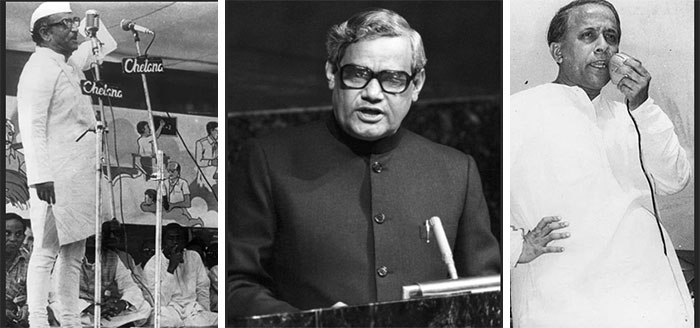
    With the internet and social media being our biggest mediums of consumption, the sheer excitement of going to a rally to hear a politician speak is something that most of middle-class India and Gen X have no idea of. Ask us quasi-senior citizens. I vividly remember each of the three times I went to a rally. the first was in Allahabad in 1977 to hear Hemwati Nandan Bahuguna arouse, the second in New Delhi in 1980 to hear Atal Bihari Vajpayee mesmerize and the last in 1990 in Jamshedpur to hear Jyoti Basu enliven.

    Bahuguna, Vajpayee and Basu – from the internet

    On the first two occasions, my father had taken me to hear people who were “experts in Hindi oratory”, to improve my own Hindi [something he needed more than I] and experience a level of narrative that does a young nation proud. Mind you, we were just 30 years young in 1977. I do not remember specific words or idioms or phrases either Bahuguna or Vajpayee used but I was sure caught in the electric atmosphere. I remember the huge silent crowd listening to what they had to say and only clap on occasions.


    In fact, on the third occasion, I happened to hear Jyoti babu by sheer chance. It was election time and there were rallies everywhere, including one close to where I studied. I asked a local as to whom had he come to listen to. “Bangaal se Jyoti Basu aaya hai. Bahot achcha bolta hai.” [Jyoti Basu from Bengal is here. He speaks very well.] Now, Jyoti babu spoke no Hindi, but the crowd had gathered to hear a leader speak as he spoke “very well”. That possibly is what defined political oratory till recently.


    I remember that on all three occasions, they spoke of the future, a better future with them in power, without any unparliamentary mentions of the opposition, forget about being abusive or vitriolic about specific people. Even the thought of target specific segments of society was unthinkable. The only specific mentions were of the poor, the farmers and the industrial workers. The crowds went back with more positive thoughts than depressive ones. They went back with more answers than questions. They understood that the nation’s key enemies happened to be the same as theirs – poverty, misgovernance, unemployment, inflation, lack of health and education facilities. The key divisions in society were between poor and rich, have-nots and haves, jobless and employed, malnourished and healthy, uneducated and empowered.


    My history teacher in high school told us that the political campaigns and speeches were an expression of the “state of the nation”. Politicians spoke in a language and tone of voice that the electorate would identify with and further amplify within families and friends. They raised issues and created platforms that resonated with the common man and woman on the street and in the village. The ugly speeches were aberrations. The overall intent was constructive, to create one’s own vote base on positive issues and promises, however unmet for decades. It was all about hope, ensuring that the fundamental ethos of “India” is preserved and promoted.


    Marketers could actually take leaves out of the political manifestos and speeches to learn how to craft strategies of market acceptance and leadership by creating the right narrative.


    Things changed with Y2K hitting us. The quality of the narrative took a downward direction. Both in content and intent. Years of unmet promises and perpetuation of poverty and deprivation led to the political campaigns and speeches becoming uncouth and ugly by the day, across political parties and ‘isms’.


    Initially the decline happened in the lower rungs of the leadership, at the panchayat, state assembly and regional levels. Gradually within a decade it escalated to the national level politicians and the leadership, whether in government or opposition. Decades of a faulty education system and scarcity of employment created a new section of the electorate that was shed of all decency and optimism. This voter base does neither understand not appreciate the nuances in oratory or the veiled sarcasm in pricking the opposition. This voter base is brazen, frustrated, depressed and prone to violence without a care for the outcome. Do not confuse them with the Naxals of the 1960s who were brilliant students from the best colleges of India shedding blood for a cause, however unjustified or utopian. The foundation of education, knowledge, spirit of enquiry and dialectics is totally missing here.


    The narrative is now nasty, naked and necrotic.


    The way the political leaders, across parties, speak and comment on social media makes one cringe. I just wish some social anthropologist undertakes a detailed study about the state of the nation in the context of the quality of the narratives that are woven and amplified.


    The current election possibly creates a benchmark of sorts, in terms of how divisive, derisive and derogatory political speeches and social commentaries can be. One cannot talk of a single political party that has chosen not to fall into this trap and continue to uphold the true spirit of the democratic process. One cannot point out to a single politician who has not used derogatory remarks, abused sections of society, driven fear into communities and indulged more in making the opponent look like scum rather than talking only about one’s own ‘report card’. This is not the traditional battle of the poets where one competed on the quality of composition and repartee, eventually to hug each other whatever be the outcome. This is like the pathetic cock fights with each having deadly blades tied to their feet, out to simply kill each other with the mob enjoying the blood sport.


    This year also happens to be the 100th birth anniversary of Abu Abraham, one of our finest ever political satirists and cartoonists. And the 60th death anniversary of Jawaharlal Nehru. While a certain sane part of India celebrated the former with an exhibition of 300 of his best in Kochi, the larger insane India possibly gave a fitting tribute to the man who had once expected us to rise to life and freedom as the world slept. As a certain Robert Allen Zimmerman sang, “Its not dark yet, but it’s getting there…”

  • Avik Chattopadhyay: Plasticky brands must go!

    Avik ChattopadhyayWe had yet another “Earth Day” on April 22 this year. Every year it falls on April 22, so no surprises there. Every year there is a theme. This year the theme is ‘Planet vs Plastics’ with the objective to build awareness and action in reducing plastic production by 60 percent by 2040.


    Which is why phasing out of single use plastics by 2030 is one key policy measure proposed under the Earthday.org ‘60×40 framework’. India had gallantly joined in on this wagon a few years back and took to banning plastic straws and shopping bags under a certain micron thickness. There was a lot of fanfare around this in 2022. Now India has decided to take it easy and made it clear we will not be able to meet those targets. Quite obviously, the industry, led by large organisations from all sectors, would have given the Ministry of Environment a hard stare.


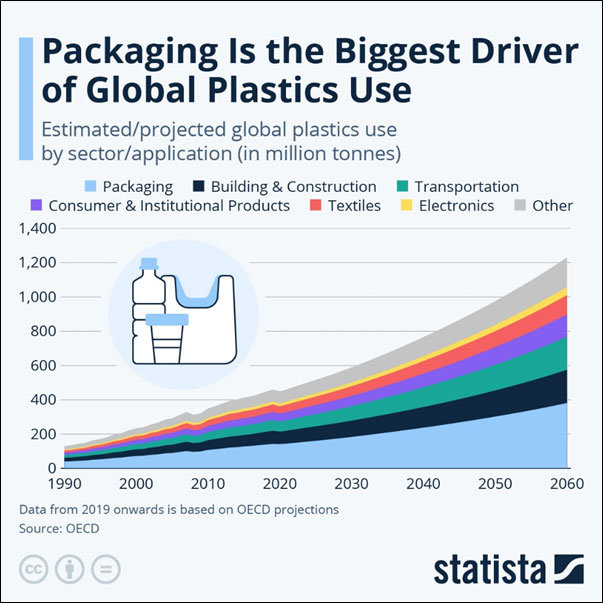
    This chart from Statista based on OECD projections is telling. Packaging will continue to be the biggest cause of plastic pollution, seeing a 67 percent increase in global plastics use by 2040 and a whopping one billion tonnes of plastics being used by 2052.


    While the increased use of plastics in building and construction, transportation and electronics will not be of single-use but for substitution of metals and light-weighting [like in electric vehicles], the increased use in packaging and textiles are criminal.


    And this is where the blatant hypocrisy of some of the world’s biggest brands in talking sustainability while continuing to use plastic in their packaging and all communication applications comes out in the open.


    Just because our rules on the use of plastic are comparatively lenient compared to developed and more socially conscious economies, many brands otherwise espousing the cause of preserving the earth and following the ESG norms, seem to forget their tall claims of greater purpose and refuse to reduce use of plastic.


    All beverage brands offer small servings in plastic bottles. They cannot kid themselves in saying those bottles can be used over and over again. The quality of plastic is such that long-term exposure to the Indian heat anyway is said to make them cancerous.


    Almost every consumer personal care product comes in plastic bottles, wrapped in plastic. While the bottles might last longer than the beverage ones, the wrappers are a sheer waste.


    All automobiles, at time of sale, have their seats wrapped in metres and metres of plastic. The excuse is that Indians do not wish to get their seats dirty hence keep the plastic covers on for a long time.


    Almost all tyres, especially the passenger car ones, come wrapped in plastic, carrying large plastic labels. The excuse given once again is that the consumer wants a clean tyre and the tyre retail environment is typically not very clean.


    We boast of being a 700 million smartphone market, now have many plastic sleeves are chucked as soon as we unbox the phone?


    Almost every consumer durable comes wrapped in sheaths of plastic, ably supported by generous helpings of thermocol or polystyrene. Very few have a policy of encouraging customers to return the plastic packaging, be it a Mother Dairy milk pouch or a Samsung television ‘protective’ cover.


    Fast fashion is another culprit growing like a hydra. An Earth Day report says that people globally buy 60 percent more clothes than 15 years ago but keep them for only half as long as before. More than 85 percent of the disposed garments end up in landfills or incinerators while only 1 percent is recycled. “Thrifting” as a fashion concept applies only to high-end labels and is a fad of the rich.


    One can find rampant use of single-use plastic in almost every consumer product sold in this country, where waste management is an almost non-existent concept and almost all the plastic goes into landfills. Delhi has created three artificial hillocks of plastic waste in Bhalswa, Ghazipur and Okhla giving competition to the country’s oldest one in Deonar in Mumbai. The regular fires that erupt in such places put lives of thousands at risk while gradually reducing that of millions through the poisonous smoke.


    Adding to products either housed in plastic or wrapped in it, is the irresponsible use of plastic flex films for advertising, signage and branding. Just see the millions of billboards sheathed in flex. Just see all the branding at any conference in flex. Just see almost all the retail signage in flex. Just see every cricket stadium holding IPL matches swathed with millions of metres of flex. This is more than being callous. This is being totally insulting of the need to reduce use of plastic and petrochemical products. No use of cotton, jute or hemp here. On the one hand we preach switching to electric vehicles to save fossil fuel while on the other we are absolutely comfortable with ordering flex banners by the thousands for our company promotion.


    Regulations will take time to be in place in our country due to vested interests. We need social activism to call out such hypocrisy. There needs to be an independent rating done of brands across different categories on their use of sustainable packaging and advertising material. Customers need to demand that brand walk the talk on reducing use of plastic as a corporate performance indicator than mere social responsibility lip-service.


    If we, as consumers do not act now, we will be damaging the eco-system of our future generations. As individuals we work for or with some brand on another and each of us should bear the responsibility of working towards lesser plastic, whatever be our function. For the brand marketers, it is time to rise above narrow corporate walls and really work for the greater good of community. You can force your operations into becoming more responsible in the way you pack, ship, display and deliver your products.


    As Pete Seeger once said, “If it can’t be reduced, reused, repaired, rebuilt, refurbished, refinished, resold, recycled or composted, then it should be restricted, redesigned, or removed from production.”


    Avik Chattopadhyay is a Gurugram-based business strategist and commentator. He is currently also working along with XLRI to set up the Indian School for Design of Automobiles. He writes on MxMIndia every other Thursday. His views here are personal.

  • The ‘Third Man’ of May

    The ‘Third Man’ of May

    Avik ChattopadhyayIn his book ‘South’, adventurer Ernest Shackleton describes a phenomenon called ‘The Third Man Syndrome’ that he experienced for the first time in his Antarctic expedition of 1914-17. He was convinced that a dead companion of his team accompanied them through the last arduous leg of being in snow for two years. he wrote, “During that long and torturous march of thirty-six hours over the nameless mountains and glaciers… it often seemed to me that there were four of us, not three.” In fact, TS Eliot’s ‘The Waste Land’ refers to ‘the third man’ from lines 359 through 365, inspired by Shackleton’s experience.


    Psychoanalysts say that the “third man factor” or “third man syndrome” is a phenomenon where, in cases of conditions of extreme resistance, destruction, isolation and even death, the brain sends ‘switches’ or signals to allude to the presence of another figure next to the victim, as a symbol of comfort and reassurance.


    The people of Gaza are going through their “third man syndrome” right now. There are young people, of all faiths, backgrounds, ethnicities and streams of education, thousands of miles away, in some of the most reputed of educational institutions, in the thousands, standing next to the dead, desolate and destroyed in a tiny strip of land merely of 365 square kms.


    Close to 1200 students from LA to NY have been arrested so far. And there are close to 10 times that number that continue to sit out in demonstrations, pitching tents, holding placards and delivering speeches, from UCLA to Northwestern to Berkeley to Columbia, where it all started.


    The movement has spread outside of the US, to Canada, France and Germany. The students have three simple demands – [1] complete ceasefire in Gaza as more than 35,000 have already been killed, [2] their governments should stop funding the war and supplying arms and, [3] their key corporations, like Google, should stop doing business with the government of Israel.


    While the protests and demonstrations have had their share of friction and violence with the “other camps”, they have largely been peaceful and purposeful. Decades after the “anti-Vietnam war” protests has the US seen a significant portion of the student community and the young American stand up united for a cause. They have been the ideal “third man” for the Gazan, while a large part of the world has chosen to look away.


    Tagore had written in a song, “When life is hard and parched up, come as a shower of mercy.” These students have done exactly that. Their teachers, who stand with them, have done exactly that. Both communities have risked their careers and jobs. There are videos of celebrated academics being literally manhandled and handcuffed by the police. Both are doing their jobs. The teacher is supposed to help widen horizons and encourage questioning through their teaching and action. The policeman is supposed to put an end to ‘disorder’ and ‘disruption’.


    In India, except for the ‘usual suspects’ like JNU who have declared support for the protests, we have chosen to remain quiet. We need not bother, as it does not affect us. It is about people being killed in a far off land that is any way not important to us, either for education or jobs or investments. In fact, even if it were about a neighbouring state within India, one need not be bothered at all, as long as it does not affect me today. About tomorrow or the day after, who really cares as I am not too secure about my today.


    Even though I ‘pooh pooh’ the demonstrators on social media as “wokes”, “libtards” and “le-lis”, and pass random judgments on how the universities can allow such anarchy, as soon as I am in class 12, I shall start applying to the same universities. If I am a parent, I shall ask my child to do whatever it takes to get admission into one of them. If I wish to do a masters or doctorate, I would give an arm and a leg to be there, for the calling card is so damn important. My clean, non-questioning, anti-anarchist upbringing and values do not come in the way at all.


    As Nietzsche had so rightly said, “There are no eternal truths, as there are no absolute facts.”


    We need to understand that these educational brands are where they are because of such instances of student activism and standing up for causes, against QAnon one time to Russia on another and Israel now. These brands are not what they are in spite of these key milestones in their timelines. They take pride in taking a stand, openly expressing opinion, constructively criticising and encouraging the spirit of inquiry. These brands do not step back from putting their hard-earned reputation at stake if the cause is justified.


    It is a lesson for our educational institutions who actually encourage students to “stay calm and carry on”. The likes of a JNU today or a Calcutta Presidency College yesterday are exceptions. Like most of us, our educational institutions are also equally servile and opportunistic. That is exactly why not a single institution rubs shoulders with the ones we are currently castigating.


    Remember, celebrating May 1 as Labour Day also started in the US way back in 1886. The poster boy of ‘capitalism; is also the pioneer of workers’ rights and trade unionism. So, having students demonstrate for a cause like Gaza is natural and expected. In India, Labour Day is not celebrated as a national holiday, so how can we expect students to leave the classrooms, hold placards and march to the city centre for some faceless people thousands of miles away?!


    I celebrated May 1 comforted by the fact that “the third man” is standing beside the homeless, maimed, scarred and orphaned in a land where I might never go but I shall forever belong.


    As the Canadian band Rush sang in “Nobody’s Hero”…


    I didn’t know the girl, but I knew her family

    All their lives were shattered in a nightmare of brutality

    They try to carry on, try to bear the agony

    Try to hold some faith in the goodness of humanity


    As the years went by, we drifted apart

    When I heard that she was gone

    I felt a shadow cross my heart


    But she’s nobody’s hero

    Is the voice of reason against the howling mob

    Hero… is the pride of purpose

    In the unrewarding job

    Hero… not the champion player

    Who plays the perfect game

    Hero… not the glamour boy

    Who loves to sell his name

    Everybody’s buying

    Nobody’s hero

  • Election time, Mr Kahneman!

    Election time, Mr Kahneman!

    Avik ChattopadhyayOn March 27, the world lost one of its sharpest minds ever, in the fields of human psychology and behavioural economics. Daniel Kahneman was the undisputed master of the study of decision-making, judgment, heuristics, biases and human rationality. Getting the Nobel Prize for Economics in 2002 for his work, Kahneman finally put down all his thoughts and theories into one awesome compilation that he called ‘Thinking, Fast and Slow’ in 2011.


    As brand managers and marketers, all of us, inadvertently, have used one or more of his ‘behavioural patterns’ in our work. I unabashedly dipped my hands into DK’s work and do admit to not crediting him for the same in innumerable PPTs. I hope there are a few more like me as, going by one of his patterns, I too am a victim of the ‘confirmation bias’.


    Given that the world’s largest reality show is going to commence from April 19, the ‘dance of democracy’, through the seven chapters of its recital, would be a delectable ground for testing his key human behaviour patterns. On his behalf, here is my attempt at the same.

    Let us take each of the 10 key patterns DK espouses and contextualise it to the Indian parliamentary elections.


    Our brain uses two systems: System 1 and System 2

    System 1 is fast, intuitive and automatic. It is prone to biases and errors such as overconfidence.

    System 2 is slow, analytical, and deliberate. It is necessary for complex tasks requiring focused attention.


    System 1 is what most political parties resort to in their communication for the electorate. They are ably joined in by many media vehicles who leave no stone unturned to amplify these pieces of communication, building a smokescreen of rationality and people-speak.


    System 2 is what the ‘woke’ community indulges in, focusing on the actual issues at hand that need to be addressed in the communication campaigns rather than hubris.


    System 1 brain says that the lord shall redeem the faithful soon. System 2 brain reminds you that you are still unemployed.


    Irrationality

    Humans are not rational. We all make a lot of irrational mistakes.


    We will vote for personalities and not issues. We will vote for promises, most of which never get fulfilled, and not for present performance. We laud those who posture and not those who have the capability to actually perform. Right from middle school we are taught to ‘look before we leap’. From childhood, we are taught that ‘man is a rational animal’. Yet, as a voter, I think I understand what the nation needs better than the others and I am smarter than those around me.


    Prospect theory

    A personal favourite, the prospect theory suggests that people feel losses twice as hard as gains.


    DK cites an example that many people don’t want to play a ‘Heads or Tails’ game where they can win $100 but risk losing $50. He goes on to suggest that one should take this bet every single day!


    So, it is shrewd and politically diabolical to spin the web of being ‘wronged’ for centuries together, magnifying the narrative of the deprivation and current ills as a result of the same. Such a story told in a compelling manner can sway the emotions and minds of the most rational of people. History holds up many such instances. As DK himself says, ‘A reliable way to make people believe in falsehoods is frequent repetition, because familiarity is not easily distinguished from truth. Authoritarian institutions and marketers have always known this fact.’


    Halo Effect

    The halo effect is a cognitive bias where your overall impression of a person influences your perception of their individual traits or qualities. If you like someone, you’ll overestimate their capabilities and vice versa.


    Don’t we all know this. Culturally, we love creating demigods of mere mortals. We address them as ‘fathers’, ‘mothers’, ‘saviours’ and even ‘sewaks’. The opposite is also true. We incessantly denigrate and abuse someone we do not support. We address them as ‘libtards’, ‘presstitutes’ and ‘pappus’. Little do we realise that verbal abuse is also a cognizable offence, yet we laud our political heroes when they frequently resort to the same, from interviews to rallies.


    Availability heuristic

    The availability heuristic is a cognitive bias where you judge the likelihood of an event based on how easily it comes to mind. Our behaviour during the pandemic is an example fresh in our memory.


    DK says, ‘The illusion that we understand the past fosters overconfidence in our ability to predict the future.’


    Sunk cost fallacy

    The sunk cost fallacy appears when you keep investing in something even if it’s not worth it, simply because you’ve already invested resources in it.


    To put things in context, imagine the pain we had to endure finish a ‘Pathaan’ or ‘KGF’ just because you bought the ticket.


    Similarly, in the election context, it’s about putting your weight behind a person or a premise not because you do not realise the fallacy of either but because you have been branded within your community as belonging to a certain ‘camp’. The emotional cost of moving out of line is just too high.


    Confirmation bias

    This is the classic one in most consumer research reports. People tend to seek out information that confirms their existing beliefs and ignore information that contradicts it.


    DK says, “This is the essence of intuitive heuristics: when faced with a difficult question, we often answer an easier one instead, usually without noticing the substitution”.


    As a voter, always talk with people who have opposing views. It will be very insightful. We are currently in a state-of-collective-confirmation-bias where we go to any length to justify convenient lies, looking away from the inconvenient truths. And this applies to every political affiliation, right from an authoritarian streak to dynastic trends, anachronistic discourses to opportunistic divisiveness.


    Hindsight bias

    The tendency, after an event has occurred, to believe that one would have predicted or expected the outcome.


    This is reserved for the June 4.


    Framing effect

    When the way information is presented influences your decisions and perceptions, we call it a framing effect.


    We have always been fascinated with hyperbolic claims like ‘biggest’, ‘tallest’, ‘fastest’, ‘largest’ and ‘longest’. In fact, we have an entire book of records that chronicles such trivia. We prefer to see videos shouting ‘Politician A destroys Politician B’ than saying ‘Politicians A and B debate subject XYZ’. Even the nay-sayers resort to such methods of presenting claiming ‘the death of democracy’. This is like dhaba cooking… all masalas are added to anything that is cooked, just to make it spicier. Election campaigning does not move away from this recipe.


    Anchoring effect

    This is the last of the human behaviour patterns DK talks about. The anchoring effect is a bias where you rely too heavily on the first piece of information you receive when making a decision.


    This is where media and the IT cells play such a crucial role in determining how much of fake news is both created and perpetuated before it gets called out by one of the anti-fake-news activists. The damage is already done as the first piece of communication has already been amplified through social media. That damage can never be undone. And that is what every political party, sadly, banks upon…the deliberately created and circulated fake news, as our regulatory checks and balances are too slow and ineffective.


    I wish DK had visited India once in election time. He would have loved the empirical affirmations of the patterns he had painstakingly worked out. Having close to a billion people play out your biases and effects would be an experience of a lifetime.


    As he says in his book, ‘The premise of this book is that it is easier to recognise other people’s mistakes than our own.’


    Do not forget to revisit the ‘Hindsight Bias’ on June 4.

    Jai Hind!


    Avik Chattopadhyay is a Gurugram-based brand and business strategist and commentator. He is currently also working along with XLRI to set up the Indian School for Design of Automobiles. He writes on MxMIndia every other Thursday. His views here are personal.

  • Are ‘Trust in News’ & ‘Happiness’ interconnected?

    Are ‘Trust in News’ & ‘Happiness’ interconnected?

    Avik ChattopadhyayTwo very interesting global reports have been published over the last one week. The first is the Reuters Institute Digital News Report 2023 and the second is the 2023 edition of the World Happiness Report. As a marketer and ‘brand-o-phile’, I see a subliminal connect between the two.


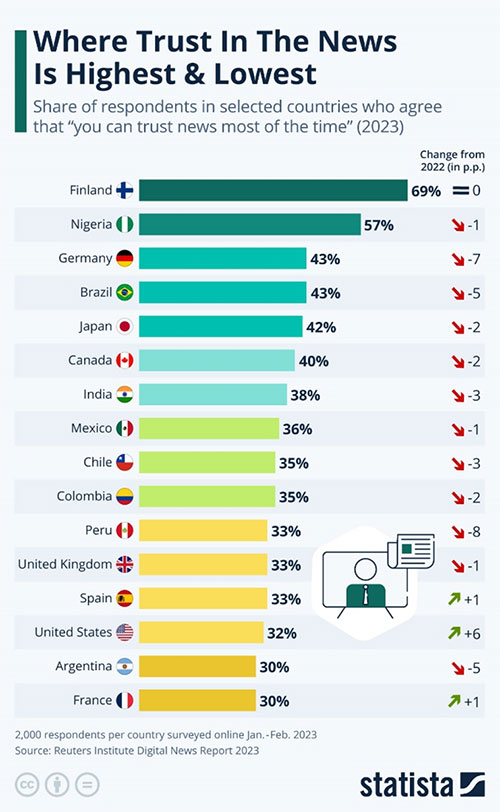
    The Reuters Institute Digital News Report is an outcome of more than 90,000 responses across 46 countries on how much one trusts news, through conventional as well as digital media. While the overall global trust score has dropped a few percentage points, the report states that “it is not surprising that news consumers are increasingly feeling overwhelmed and confused, and many are turning away temporarily or permanently. Selective news avoidance and news fatigue have been exacerbated by the challenging times we live in.”


    India is somewhere middling with 38% of news consumers trusting what they read and see. It has dropped 3 % points since the 2022 report. Now with the election season looming upon us, one can expect a sudden drop in the score with every political party resorting to downright unethical and fake communication without batting an eyelid on the impact on an already tense social fabric.

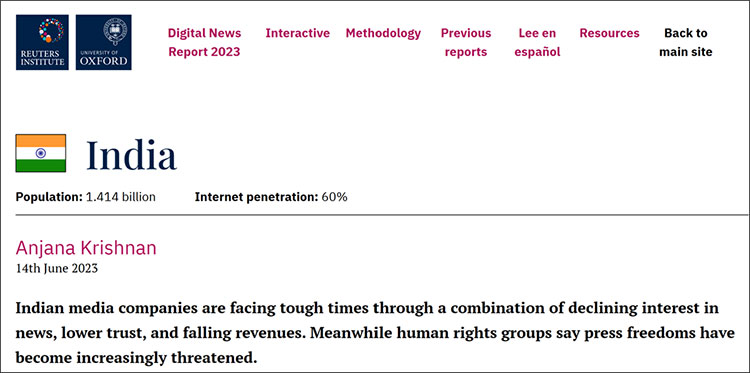
    The special note on India in the report is quite telling.


    Credibility is a huge factor. With the latest Press Freedom Index ranking of 161 out of 180, however much one may want to downplay the Reporters Without Borders study as being driven by agenda and deliberately disparaging towards the world’s biggest democracy, one cannot cross one’s heart and denounce it.


    The note states that “our Digital News Report survey finds steep falls in both the consumption and sharing of news. There was a sharp decrease in access to online news (12 percentage points lower than last year), particularly through social media (-11pp), the main sources of news for a predominantly younger audience. Television, popular among a large section of the population, also saw a 10pp decline as a news source with our younger and more urban-based sample.”


    While the government has brought checks and measures for media platforms, especially digital, on the authenticity of the news and its possible impact on factors like social harmony and national security, there are none for the social media teams of all political parties who deliberately churn out one-sided or fake posts, with the clear objective of misleading the populace and even instigating it into unrest. When the digital platforms dig up and expose these untruths, there is no legal recourse to punishing these people. All the Johnnies are consuming too much sugar without remorse.


    As the judiciary at the highest level seems to be the only panacea for most ills in the country, some sane citizens should file a PIL against such lie-spinners and let the court pull them to task.


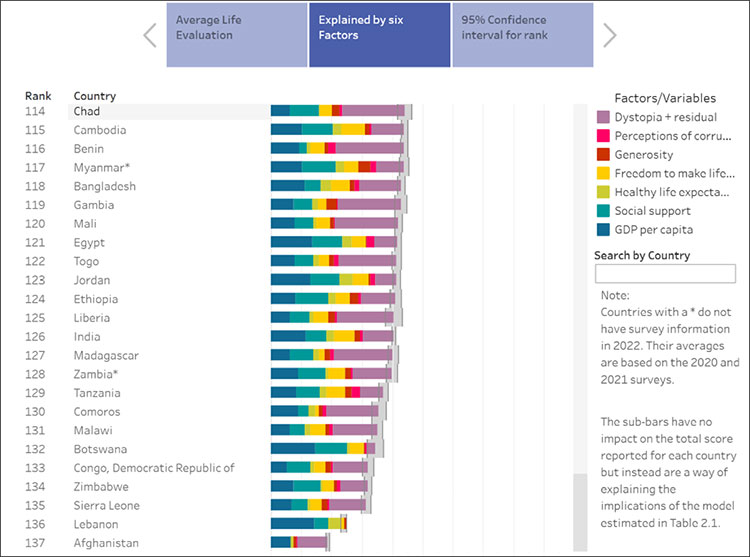
    The second report is the much debated and hated World Happiness Index by Gallup wherein certain sections of our thought leaders and citizenry cannot understand how can people in Pakistan, Bangladesh and Sri Lanka be happier than us, especially when we are going through our “Amritkaal” towards becoming the undisputed “Vishwaguru”. They need to understand that once again, this global report is not being undertaken with the sole purpose of showing India in bad light, but to help us introspect.


    If we study our score across the seven parameters in the second chart below, we will observe that we score badly on factors like life expectancy, corruption and generosity. These factors may not be as easily measurable like per capita income and are largely perceptual, but strong enough to take our score down. Also, the dystopia score is significant enough implying an undercurrent of social stress, possibly amongst certain communities.


    How are these two reports interdependent? Happiness is an active ingredient for trust. The lack of the first leads to increased scepticism and therefore the tendency to discount what you consume as news. You may put up a brave face in one report but the mask comes off in the other one.


    You posture to amplify the news that you opt to believe in as it shows you in better light. That is a fundamental defence mechanism, borne out of deep down insecurity and an inferiority complex. It is not that you openly consume and debate all sorts of news and digital content to logically establish that you are in the right. Similarly, you pose as happy, taking selfies next to objects, visiting places or doing things that take you away from your uncomfortable harsh reality. When it comes to responding to a survey, your disappointments with aspects of life around you get exposed. It is not the proverbial bed of roses.


    No external intervention can work in this case. Only a slow and gradual improvement in collective consciousness can shake the citizenry out of this sucrose-induced slumber.


    As a common citizen, you too are consuming enough sugar without even admitting to yourself. That is far worse than the media magnate spinning fake stories to drive you into a frenzy.


    The festival of democracy is less than a month away. Look before you leap.

    Jai Hind!


    Avik Chattopadhyay is a Gurugram-based brand and business strategist and commentator. He is currently also working along with XLRI to set up the Indian School for Design of Automobiles. He writes on MxMIndia every other Thursday. His views here are personal.

  • Excess is success

    Excess is success

    Avik Chattopadhyay

    Avik ChattopadhyayWhile a significant part of the nation was busy with discussing dance moves and dresses of the rich and famous gathered in a little town on the west coast of India, a bunch of medical students danced around in joy on the east coast of the US. While one of the richest people on this planet spent a whopping 100+ million dollars on a family function, a retired professor at the Albert Einstein College of Medicine in the Bronx donated a mere billion dollars to ensure free tuition for all medical students, almost for life.


    It is cultural. Very very cultural. The two nations make up the world’s largest democracies, and have their own share of unemployment and poor, yet the two are poles apart. In a discussion with a social scientist who requested anonymity, I was reminded that we are basically a monarchy in the garb of a democracy. We celebrate 75 years of becoming a republic yet are deeply servile. We boast of some of the world’s biggest people movements, yet revel in creating demigods of the rich and the powerful. “We will always be a land of confluences, cross-connections and contradictions”, the social scientist commented, trying to explain to me how Indian brands are thereby quite different in their DNA from ones from the US or France or Germany or Japan.


    “Indian brands love to show-off. We love to live in the now, more than for the future. For us, excess is success!”


    What is wrong with showing off? Or for that matter, living in the now? Nothing wrong. It is just a matter of perspective. The same rich person who gave a pre-wedding bash will also go ahead and build a hospital or school, but the bash is very important as that sets a context. It is like when the ‘benevolent despot’ of an emperor used to throw silver coins in the air for the commoners to scuffle for at his child’s wedding. While the poor would get their clinics, night shelters and rations, they had to be reminded of the grandeur and graciousness of the mighty powers from time to time. The living in the present moment is a clever diversion from the present state of life into a world of make belief, with the subliminal message that this is a life that one could aspire for.


    When the personality of the brand is derived from the personality of the ‘promoter’, things get very heady. The socio-economic and cultural background of the promoter clearly determines the way the brand behaves. If one’s legacy has been mired in a fair bit of controversy, the need for periodic demonstrations of power and pomp are crucial to establishing authority. If the background has been less than average, then the attempt is always to go over the top. “It’s a natural response of the reptilian brain,” explained the social scientist, born out of some kind of inferiority complex. The need to set the narrative from time to time is important or such personalities suffer from inadequacy.


    This is why most Indian brands come across as more pompous than proud, more combative than competitive, more conflicting than collaborative. We see that in most of our communication. We experience it most in our service experience. We see that in the way most business leaders present themselves. We have an obsession with using terms like “#1” and “the best ever”, be it a toilet cleaner or an automobile. We love using pompous words like “unbeatable” and “unmatched” because, somewhere, the promoter or brand custodian is insecure and needs such posturing to reaffirm potency and power.


    “It is like a stand-up comedian starting a show with the words ‘Mind you, I am the world’s funniest guy’”, said the social scientist, to put things in perspective. An American brand is running an enterprise. An Indian brand typically wishes to run an empire. It could be a response to the fact that we were a colony for close to 200 years that we are yet to be out of the mindset while our colonisers have adjusted with a post-colonial world.


    We react positively to symbols of regality, power and authority. Which is why both our politicians and judges sit on quasi-thrones whether at a function or in judgment. Simple chairs will not work for either. It is the same with corporate India. Most board rooms I have peeked into have a larger chair and a fixed place for the leader. Everyone knows who the leader is yet the symbols are needed as constant reminders. The chair plays the role of omni presence.


    It is the very same mental wiring that makes millions of us take voyeuristic pleasure in an exhibition of excess that thrives on our culture code of the need to overtly establish leadership. And nothing really can change that. We thrive on contradictions. While we believe in rebirth and the after-life, we prefer to live as if there is no tomorrow. While we revere saints and seers who excuse themselves from worldly pleasures, we choose overt displays of wealth and grandeur. While we preach the power of ‘karma’, we portray the potency of the ‘fruit’.


    Avik Chattopadhyay is a Gurugram-based brand and business strategist and commentator. He is currently also working along with XLRI to set up the Indian School for Design of Automobiles. He writes on MxMIndia every other Thursday. His views here are personal. 

  • Money for nothing!

    Money for nothing!

    Avik ChattopadhyayTwo news items caught my fancy last fortnight.

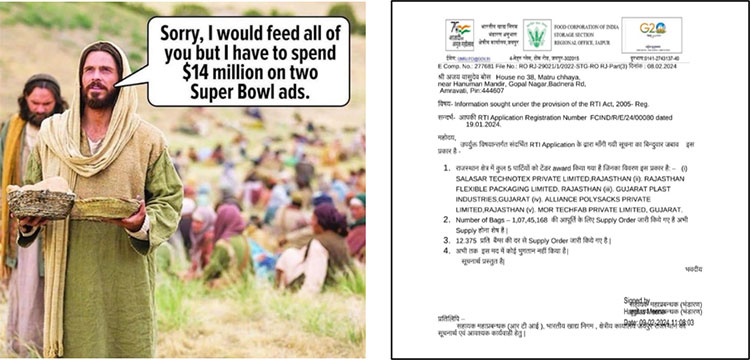
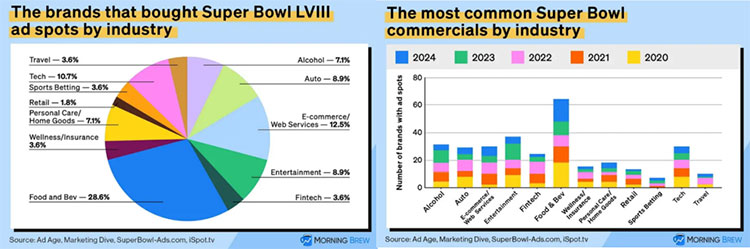
    One was a meme on some brand spending $14 million for two, yes just two ads during Super Bowl 58 in the US. That’s Rs117 odd crore at today’s exchange rates.

    The other was an RTI reply by Food Corporation of India that around Rs 13 crore were spent on printing the Prime Minister’s photo on bags meant for food rations in the state of Rajasthan alone. Multiply that same amount by the number of states under the current ruling political party and you get the math.

    The first one is an entirely private affair and probably the best demonstration of hyper-decadent capitalism at play. Every year, brands across categories vie for the right spot to buy for the sheer eyeballs one gets on the one single occasion which can also pass off as the official ‘couch potato day’.

    Madhvi Mavadiya of Finextra wrote a wonderful piece dissecting the madness that takes over all brand managers with every Super Bowl. You can read it at Super Bowl 2024: The fintech firms that spent $7 million on a 30 second ad (finextra.com).

    We too have our marketing media madness every year but it does not last for just one day. It goes on for 50 odd days. The IPL. Another example of gross display of marketing muscle. And it just keeps growing, year after year, as the broadcaster and organiser justify the stratospherical ad rates by the rise in viewership. In 2023 it increased by 30% over the previous year on television alone with another 15-odd % on pay-TV. In an interview, the head of ad-sales of the broadcaster mentioned that the CPM on IPL was the lowest at just Rs 50-60 per CPM. In 2023, the total ad revenues were a whopping Rs 10,000 crore while the fantasy sports platforms earned Rs 2800 crore. In plain speak, we gambled away Rs 2800 crore in two months under the garb of “team building skills” and nobody really raises an eyebrow!

    The broadcaster and the organiser will always justify to the potential advertiser that the RoI is the highest. They will justify the Rs 20 lakh per 10 seconds of advertising saying that the teams earn and the players earn and all the money goes into developing the sport and getting the best of the world to converge for this festival of sport.

    Cross your heart and ask yourself whether all this can really be justified. If the ESG regulators get down to their audits in all sincerity, will they not question such spends? All advertisers, in unison, sing out loud that their business gets positively impacted by advertising on IPL but has someone really audited and measured? If it were true, why would some of the key advertisers flounder in their business?

    Brands need to do some serious soul-searching on the way money is spent on advertising as all of it is passed on to the consumer in some way or other. A hedonistic institution cannot be propped up actually fleecing millions of gullible content junkies under the justification of freedom of choice and expression.

    The day some hard-nosed auditing is done of the spends against returns and the famous “50% that is wasted” is identified, many brand managers and marketing heads will roll. This is a cohort of people scratching each other’s backs to keep living the high life of a money-spinning capitalist enterprise under the garb of sporting excellence accessing 500+ million viewers in a country where 800 million are poor enough to get free rations from the government every year.

    Which brings me to the money wasted on printing photos of political leaders and sticking them up in any vacant space available. I once had the opportunity to ask a minister as to why did he want his face on posters of a government scheme. He was candid enough in saying that he wanted as much visibility and recall as possible… at government expense! Hence every minister uses the resources of one’s own ministry to propagate oneself, in complete contravention to the norms of governance.

    While one can still excuse a little known politician for using tax-payer resources to build awareness and recall, what really justifies the top leadership that everybody in the country recognises by a mile or a mere spoken word? To me, it is the incessant habit of loving to see one’s own face everywhere. Across all politicians, unless the party diktat forbids you as in case of the Left Front. Every measure of governance, from an airport for the rich to free rations for the poor is seen as yet another opportunity not to be missed, at the tax-payer’s expense.

    As students of economics, we had learnt that “money is a matter of functions four – a measure, a medium, a standard and a store. Somewhere, the function of “morality” has to come in. Academicians and activists together have to bring about this change in the definition of money. The moral compass has to be integral to evaluating how the money is being spent and how it is performing against parameters of ethical and sustainable use. The recent Supreme Court judgment on Electoral Bonds is one strong step in that direction. If all the money from that source of funding is blocked from usage in the elections to happen, it will be a litmus test of “moral money”.

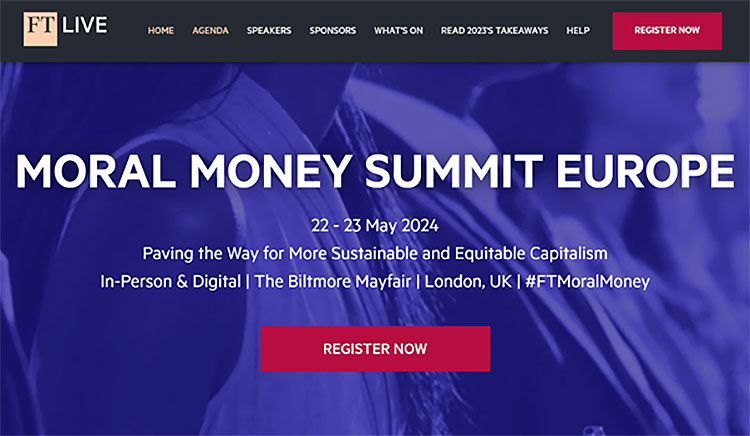
    Talking of which, there is a “Moral Money Summit” being planned in Europe in the month of May with the primary objective of giving naked capitalism some decent clothes. We need a similar initiative in our country at the earliest.

  • Happy Birthday, Brand India

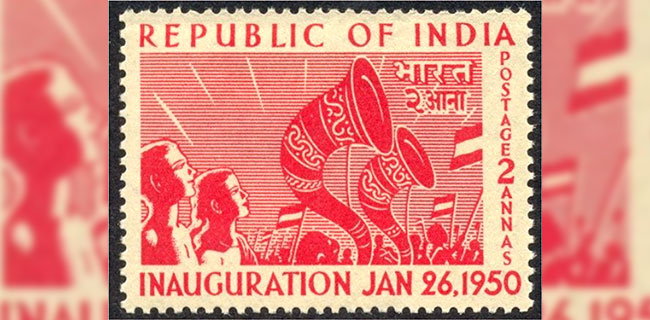
    Stamp issued to commemorate the creation of the ‘republic’ – Source: Government of India Archives


    By Avik Chattopadhyay


    Avik ChattopadhyayIndependent India was formed on August 15, 1947.

    Brand India was created on January 26, 1950.


    Since the “dominion” of India was created on the day the Indian tricolour was hoisted at Red Fort, we continued to be a constitutional monarchy with George V as the head of state and Mountbatten as the Governor-General till the 26th of January 1950 when we adopted our own constitution. It was only on that date that we had our first President in the form of Babu Rajendra Prasad. Till then this newly formed nation was governed by the Government of India Act of 1935.


    So, the significance of our Republic Day assumes greater importance when we realise that it was on that day, after two years, five months and 11 days of having become independent that we decided what exactly we would become in terms of a nation. The product India was rolled out as a prototype on August 15, 1947. The final production version, after all tests and validations, was finally launched for the citizens and the world at large, as a brand that said “Republic of India” on January 26, 1950. Till that day, no common citizen was aware of what exact shape and form we would take in terms of purpose, promise, values and personality. This task was entrusted to a team called the Constituent Assembly, a 308-member team made up of 21 committees headed by some of the sharpest minds like Jawaharlal Nehru, Vallabhbhai Patel, KM Munshi, HC Mookerjee, Bordoloi, BN Rau and GV Mavlankar submitting their reports to the drafting committee headed by BR Ambedkar. They met for 166 days painstakingly putting together the Constitution that was finally adopted on November 26, 1949.


    In an organisational context, it is almost like all functional teams providing their inputs to the brand strategy team that finally prepares the brand book, to be presented in a townhall before all employees for their feedback and necessary modifications before the entire organisation adopts it as its credo and ethos.


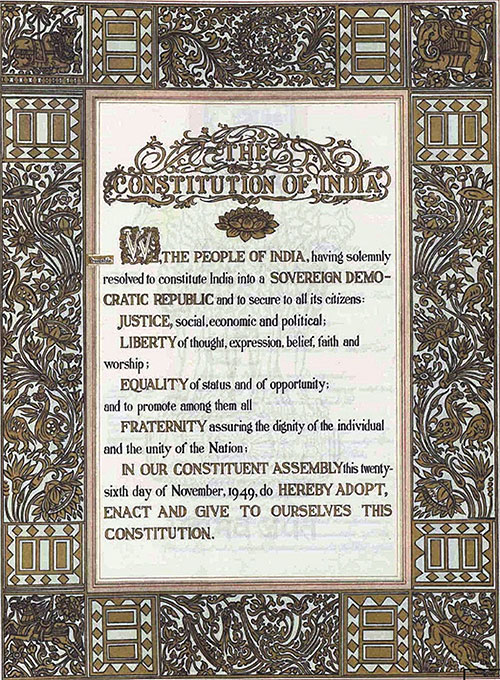
    The Preamble is the brand essence.

    It encapsulates all the pages that follow with their numerous chapters, schedules and articles. It describes the purpose, the promise and the operating values. In fact, all organisations in India could as well study the unique structure of the Preamble to design their own, in terms of brevity of expression and clarity of purpose.


    The original text of the Preamble – Source: Government of India Archives


    Of the Preamble, Ambedkar said, “It was, indeed, a way of life, which recognises liberty, equality, and fraternity as the principles of life and which cannot be divorced from each other: Liberty cannot be divorced from equality; equality cannot be divorced from liberty. Nor can liberty and equality be divorced from fraternity. Without equality, liberty would produce the supremacy of the few over the many. Equality without liberty would kill individual initiative. Without fraternity, liberty and equality could not become a natural course of things.”


    As a part of the debates before its final adoption, there was a proposal to call ourselves the ‘Union of Indian Socialist Republics’. Also, some had proposed that ‘God’ and ‘Gandhi’ be incorporated in the text. Thankfully, all such proposals were struck down as each would have been paradoxical to what we had aspired to nurture ourselves into as a nation.


    By the 42nd amendment of the constitution during the Emergency of 1975, the words ‘socialist’ and ‘secular’ were added to describing the republic over and above being sovereign and democratic. The brand purpose was expanded in scope. However, the promises of delivering justice, liberty, equality and fraternity remained as before, except for the word “integrity” being added to unity to describe the fraternity we aspired for. Very similar to what happens when the second or third generation of the founding family wishes to ‘revisit’ the brand purpose and ‘contemporise’ it, in sync with an evolving market and customer behaviour.


    These very later insertions or modifications are subjects of heated debates today. The brand purpose is being questioned by the new leadership. Like most organisations, the new CEO, especially if brought in from outside, wishes to leave a mark on the key aspects of the brand, especially the ‘vision’ and ‘mission’. That it typically the legacy the leadership wishes to create for posterity to marvel at.


    Even if those ‘controversial’ words are to be removed, the essence of the Preamble does not change one bit. In its very construct it espouses the fundamental principles of socialism and secularism. The word ‘socialism’ is part of the Directive Principles of State Policy and implies social democracy and distributive justice. The word ‘secularism’ implies that there is no state religion and that the powers of the state and any religion are clearly separate. The former cannot be partial towards any particular religion or religions while the latter cannot dabble or interfere in the functioning of the state. Reminds me of the occasion when MA Jinnah in 1919 implored Gandhi not to support the Khilafat movement as “mixing politics and religion” would have disastrous outcomes.


    Brand India is at the crossroads right now. The very brand purpose is being challenged by various factions and fringes by their operating principles [or lack of them] and socio-political acts. There has been no direct attempt to alter the fundamentals of the Republic but subaltern and diversionary tactics are certainly being used, citing the need to go back to our “pure past” to rediscover ourselves and reclaim our greatness as a teacher of the world. We are certainly at the crossroads as we enter the 75th year of being Brand India.


    I will conclude by quoting Ambedkar once again from his last address to the Constituent Assembly on November 25, 1949:


    “On the 26th of January 1950, we are going to enter into a life of contradictions. In politics we will have equality and in social and economic life we will have inequality. In politics we will be recognising the principle of one man one vote and one vote one value. In our social and economic life, we shall, by reason of our social and economic structure, continue to deny the principle of one man one value. How long shall we continue to live this life of contradictions? How long shall we continue to deny equality in our social and economic life? If we continue to deny it for long, we will do so only by putting our political democracy in peril. We must remove this contradiction at the earliest possible moment or else those who suffer from inequality will blow up the structure of political democracy which this Assembly has so laboriously built up.”


    Jai Hind.


    Avik Chattopadhyay is a senior business strategist and commentator based in Gurugram. He writes on MxMIndia every other Thursday. His views here are personal


  • Avik Chattopadhyay: The Pilgrim Prince

    By Avik Chattopadhyay


    Avik ChattopadhyayThe Prince finally rose from his throne to speak. Cheers erupted like thunder for miles together, till one’s eyes could see. There was not an inch of vacant space anywhere. People of all ages had converged on to the Holy City to catch a glimpse of their beloved Prince. Many were seeing him for the very first time, it had been just so long since he left home. He had walked down a path covered with marigold and rose petals, flanked by tall light towers adorned with radiant suns. Caparisoned horses, elephants and camels lined the path to the royal palace.


    He stood erect, his frame frail but the face radiant. “Brothers and Sisters of our land,” he said as tears welled up in his eyes. He looked back at his wife and brother. They smiled and nodded, encouraging him to continue. The crowd erupted in joy once again on hearing his voice. It was soft yet firm.


    “We are back from our pilgrimage.”


    “It has been an amazing journey for us, over all these years. We roamed across this wide and vast land of ours, exploring every nook and corner. So many things to see, so many things to learn, so many things to do. Every single day of all these years was an adventure… fresh experiences, new learnings, new awakenings. We had never imagined how enriching this exile would be when we set off from here. Then we were a bit downcast. We did not know what lay ahead of us. To be frank, we were a bit anxious. But as days passed, the wonder that is this land unravelled before us, as if a massive flower was slowly blossoming, with every layer of petals opening up into a new world to bathe in.”


    “We met so many people along the way, different from us, yet similar. They spoke languages different from ours, they ate food different from us, their attires different from ours and they had gods different from ours. Some do not even worship god in any form. They have interesting symbols to denote their faiths. They have wonderful prayers, similar to ours, yet different. There were wise men, sages, seers and saints of so many types we interacted with. We realised that there is a world much larger than ours and it is the co-existence that makes this land so unique and vibrant.”


    “I had to fight one battle in all these years. Just one, but was fierce. Here again, people of all kinds came to my help for each of them knew that I was in the right. When I finally encountered him, face to face, he looked me in the eye, smiled and said, ‘I have ruled strong but not wise. I built a city of gold but riches and prosperity have no meaning if everyone cannot benefit from them. And you have burnt it all down. You have given my people the chance to rebuild and I thank you for that. Do not make my mistakes. May you rule kind and wise.’ I put him down but with a heavy heart for he was a valiant warrior and a very wise man. But such is life. Your sins of the past have to catch up with you some time. Everything comes a full circle.”


    “Once I met a man on the western coast. A very unique man. Very frugal in his way of life. Just a small piece of white cloth, a stick and a watch. We seemed over-dressed in front of him. He washed my feet and wished that once I return, I rule with fairness ensuring peace and prosperity for all. He said there are issues to take care of like poverty, malnutrition, child mortality, employment and equality of gender than build magnificent palaces, forts and temples. He said that this vast land has since been united but only on paper and not in spirit. He encouraged me to explore as much as possible before we return. My exile had turned into a pilgrimage.”


    “On my return, my brothers and the wise men suggested a new palace be built for me. I politely refused. We do not need a new home. If I am to live in your hearts, as I have all this while, then I need to use the same wealth to build hospitals, seats of learning, centres of art and kitchens. Not a single person should lose sleep over the safety and sustainability of oneself and the family. So, we will build facilities and institutions that will help us live better for generations to come, irrespective of faith, colour or gender. When people visit this city in times to come, they shall experience a model community for the rest of Bhaarata to emulate. That is the legacy I wish to leave behind.”


    “I would like to conclude by quoting some lines written by yet another remarkable man I met on the eastern coast. He had deep pensive eyes, a long white beard and wore a long robe. I thought him to be a saint or seer. He said he was a mere poet. He wrote a wonderful poem called ‘Bhaarata Tirtha’ that goes so…”


    “Here Aryans, non-Aryans, Dravidians,

    Chinese, Sakas, Huns, Pathans, Mughals

    in one body, lo, were united.


    The doors today have opened

    In the West bearing gifts,

    Behold they arrive.


    All shall give and take,

    Mingle and be mingled in

    None shall depart dejected

    From the shores of the sea of Bhaarata’s great humanity.”


  • Rebel brands – love them, yet loathe them!


    By Avik Chattopadhyay


    Avik ChattopadhyayThe rude intrusion into the new parliament building on December 13 when Manoranjan and Sagar threw up yellow smoke amidst our lawmakers drove the nation into a tizzy. Five people were rounded up, with the sixth to be roped in soon. The others are Amol, Neelam, Vishal and Lalit, the last person still absconding. Their occupations cover the spectrum from being unemployed to being an autorickshaw driver, a competitive exam preparer, a plumber apprentice to a teacher. They came together for causes like the farm laws, unemployment, the Manipur crisis and the general state of affairs. Justified? Not at all. A most immature act, actually, as an independent, democratic nation provides enough methods of expressing angst and raising red flags.


    They claim they were inspired by an act of April 8, 1929 when Bhagat Singh and Batukeshwar Dutt set off two low intensity bombs in the Central Legislative Assembly hall. That was against the Trade Dispute Act and Public Safety Bill.


    The colour of the smoke bombs chosen by Manoranjan and Sagar was significant… the same as the colour of Bhagat Singh’s turban… ”Basanti”. They were there to make a statement, not to kill. While the media equated the act with the dastardly attack on Parliament 22 years ago, they felt they were emulating the act 94 years ago.


    They are rebels, with a cause, but without direction. They wanted to highlight the plight of the common man. They stepped in to the “temple” of the world’s largest democracy to wake up those elected by the common man to, what they claimed, bringing the key issues to the forth.


    The sheer hyper-histrionics that some sections of the media went into was something to be seen. The saner part of the media thankfully called it a “breach”. Two unarmed people and one yellow smoke canister seemed enough to make the house literally come down. What ensued was straight out of a Marx Brothers movie. The opposition created verbal terror. The chairs of the houses countered that with expulsion terror. Probes have revealed that the position of joint secretary of security was vacant for 45 days. Furthermore, the entire place was understaffed by 40%. When the yellow smoke billowed, the smoke detectors refused to get into action. Holy smoke!


    The Prime Minister could have actually met the five and had a candid discussion on what brought them take such a step. That would have been a great example of leadership, where immaturity can be given the back seat to assuaging anxiety and addressing frustration, setting an example for others who might have had similar ideas.


    Sadly, nobody likes to deal with a rebel. You wish your neighbour had one that you eulogised but never would want one in your own home. You garland the rebels in history but round up the ones in your own time. For society does not like rebellion as an act. You do not enjoy disruption. You abhor disturbance. The same goes for rebel brands.


    When you look up “rebel brands” on the internet, it throws up “challenger brands” to you. Even the Economist falls into this trap. Have a look at this article – The rise of the rebel brands (economist.com). Design firm Pony.insights says, “Rebel branding is an unconventional marketing strategy that contradicts traditional norms and breaks the existing rules of the industry. These brands position themselves as iconoclasts, bucking conventional wisdom, and challenging the status quo in innovative and often provocative ways. Rebel brands dare to be different, seeking not to fit into an existing market but to create new spaces and to redefine norms. They are unafraid to disrupt and they thrive on controversy, pushing boundaries with their unconventional approach.” And then goes about citing examples like Tesla, Patagonia, Netflix and Chipotle as rebel brands. Brand strategy platform BrandStruck cites examples of Lyft, Salesforce and Dollar Shave Club as how rebel brands have expanded their market appeal.


    These are NOT rebel brands. These are mere challenger brands. Brands that have challenged convention and the set boxes to redefine business solutions and metrics. That is all. Their deep down purpose was to eventually go mainstream and become as large as the then legacy or conventional brands, if not bigger and more profitable. To be challenged by yet newer ones. And the cycle of “Brand Darwinism” goes on.


    Rebel brands want to disrupt. They do not wish to sustain. They wish to deconstruct. They do not fuss with reconstruction. They leave a mark. They are both bothered with legacies. They wish to be rare. They are not looking to be copied. They are bothered about impact. They do not measure returns. They are very good from far, part of folklore and case studies in business schools. They are not about making pre-placement talks and recruiting people.


    Can I cite any example of a rebel brand? Trying very hard and by habit falling back to the automobile industry I can think of only three through the 140 year timeline – Gustav Trouve’s electric car in 1881, the “Wankel” engine in 1934 and the newly launched Tesla “Cybertruck” in 2023. All have huge shock value and have made the world sit up and gasp “aaahhhh”. The first two have had short lives and I do not see the last having a long one either. But just like the Nihilists do, they shook up the equilibrium, got people out of their comfort zones, whether through technology or design and mightily embarrassed the ‘establishment’.


    The next time someone cites you examples of this or that brand as a “rebel”, be careful not to get swayed by the enigma of the term and remind them that those are mere “challengers”. For rebel brands, due to their very nature, do not last for long. But surely leave a lasting impression.


    Avik Chattopadhyay is a Gurugram-based brand and business strategist and commentator. He writes on MxMIndia on alternate Thursdays. His views here are personal.