Tag: Avik Chattopadhyay

  • Sceptre, Sceptic & Brand India!


    By Avik Chattopadhyay

     

    Avik ChattopadhyayOn the 6th of May, the new monarch of England held up a sceptre.

    On the 28th of May, the reigning prime minister of India raised one too.


    Reminded me of a poem by Yeats aptly titled ‘The great day’ that goes…

    Hurrah for revolution and more cannon-shot!

    A beggar upon horseback lashes a beggar on foot.

    Hurrah for revolution and cannon come again!

    The beggars have changed places, but the lash goes on.


    Symbolism is very important in communication and strategy. When employed, at every event planning meeting, the key question used to be, “What will be the showstopper?”. Basically, our bosses used to ask us how we would make the event memorable enough for the employees or network partners to make it a talking point, a differentiator and a motivator for them to carry on with the task for one more year. This used to be the toughest bit of the event as everything else was almost the same as any competitor would do. This is where creativity would play a role, along with the ability to execute it. On occasions, the proposals were so audacious that the bosses would ask us to ‘take it easy’. But on those rare moments when the boss smacked his/ her lips and asked us to go ahead, it did end up creating the desired impact right then and the ripple effect for long afterwards.


    Event management is one of the toughest asks for anyone in marketing and brand management. That is why it has its own tribe of domain experts. Every event is contextual. There is an event purpose and an event objective. The two should never be mixed. The former is the long-term aim of the task while the latter has a more here-and-now role. The purpose of every annual dealer conference for an automaker is to relive, reinvigorate, recognise and recharge the network partners in the collective mission of maintaining market leadership. The objective for a specific year could be to improve service profitability, work on customer retention and focus on hybrids and CNG while the competition talks of electrification. The purpose is to carry forward the vision. The objective is to specifically focus and divert attention.


    And the balance is crucial. One cannot be sacrificed at the altar of the other. 

    And that is what makes the raising of the sceptre so impactful in the context of Brand India.


    We consciously gave up some symbols 75 years ago. And we deliberately did not want to incorporate some either. The Constitution was chosen as the symbol of a new brand called India. A symbol that painstakingly incorporated the best from the world to stand for a nation that was a new benchmark for a war-traumatised, colonial world for how to attain self-determination and independence while preserving one’s self-respect. The Preamble was not just the first page but the essence of this symbol that represented Brand India.


    562 kings, nawabs and princes were brought under the single umbrella of Brand India in 1947-48. Nehru had declared in May 1947 that any ruler who did not join the Constituent Assembly will be considered an enemy of new India. Jodhpur negotiated for a ‘better deal’ with Pakistan. Junagadh had actually joined Pakistan but brought back. Kashmir and Hyderabad had decided to be independent. While the tiny Piploda, a total of 155 sq kms. in the Malwa region, took time till March 1948 to join. Finally, monarchy was formally out. The foreign as well as the local. Though the mindset of “hukum”, “maaibaap” and “ji huzoor” could not be wiped out, a conscious effort was made not to visually keep any symbols of monarchy especially when the nation chose ‘democracy’.


    There have been good monarchs for sure in the annals of time but they have been so as exceptions. They chose to be good and so have been recorded in history as good. It was not by the choice of the people or even their circle of ministers. Ashok was ‘great’ because he chose to. So did Akbar and Rajaraja Chola. People did not demonstrate, carry a procession or submit a representation asking any of them to be benevolent despots. That is why in a 4000 year history of this land we have so few monarchs who have been collectively applauded by historians and sociologists as “great”. That is why as a new nation we consciously chose the “Dharma Chakra” from the Ashokan edict to be part of our national flag and the Lion Capital of Sarnath as our national emblem, both acts that I have always felt are improper and disrespectful of the Constitution.


    Democracy has no room for choosing to be good. At least theoretically. The representative is expected to be good, trustworthy, ethical and beneficial for his / her constituency. And the electorate always has the last word. Democracy is a fundamental pillar of Brand India. It has no room for any trait of monarchy creeping in, either in person or a product. If the Constitution as the conscience keeper of the brand abhors it, it has to be complied with.


    But even after 75 years of “independence”, we ‘rule’ and do not ‘govern’. The popular Sanskrit term used for the practice is “Raaj-niti” and not “Shaasan-niti”. Or not simply “Sushaasan”. Even the epitome of good rule has been termed and popularised as “Ram Rajya” and not the example of the Vajjika League of 6th century BC. The beggar has changed, as Yeats lamented, but the lashing continues.


    So, after 75 years, when our last, and possibly most brutal, coloniser was having debates about the relevance of monarchy in today’s England, with some even openly protesting about the entire coronation circus, we, its crown jewel, whipped out a symbol of monarchy and brandished it before the country and the world as an act of reaffirmation of our civilizational heritage.


    562 monarchs were removed in 1947 by the will power of a new democracy.

    543 representatives of the same democracy brought monarchy back 75 years later.


    As Tagore had described the British rule as, “Boniker mandondo pohale sarbari dyakha dilo raajdondo rupey.” [as the dark night ended, the trader’s weighing scale transformed into the ruler’s sceptre], we possibly are being part of some of the most exciting times in the timeline of Brand India, where showstoppers and symbols take centrestage to the joy of the event-hungry millions while a handful of sceptics look on!

     

  • Bangalore blues, Tesla talks & Brand India


    By Avik Chattopadhyay


    Avik ChattopadhyayQuite a shakeup in Bangalore, huh! Sorry, Bengaluru.


    The market leader was dethroned by the second brand. While some saw it coming, guess the incumbent saw it much earlier, loud and clear. After all, as the market leader, if you merely rest of your laurels and do not deliver on your brand promises, you know your fate when appraisal time arrives. Then you have two options – either you accept your deficiencies and ask for another chance, or, you believe that offence is the best form of defence.


    While the first option is the mature one, very few market leaders have the humility to accept so. That makes them looks fragile and vincible. No chest-thumping and bicep-pumping here. Very difficult for the also-rans itself, forget the market leaders. Have you seen any Indian brand ever stand up and say, “Sorry, we screwed this one up!”? Not possible as shareholders do not like that kind of talk.


    So, what do you typically do? Go aggro! Bring in the musclemen, throw in the cheerleaders, crank up the spinmeisters and pump in lots of money. This formula may still work if you keep it all local and relevant. But no, you decide to call in your CEO and COO to cover up for you. They sounded like the Englishmen shouting at the “natives” in Lagaan. And to top it all, they changed the focus. From ground level issues the narrative moved to the spiritual invoking gods and goddesses. To make matters worse, north Indian gods were called upon into action. And the icing on the cake was a veiled threat that if you do not patronise my product and services, all hell shall break loose. That was the proverbial last straw. Not only do you guys own up to your shortcomings, you intimidate me in a language that I do not understand.


    Every mistake in the brand textbook of “Things you must avoid for market leadership” was committed with full gusto:


    Admit your mistakes? No.

    Raise local and relevant issues? No.

    Speak in the local language? No.

    Never intimidate your customer base. No.

    Do not spread negative vibes. No.

    Do not try to impose views from outside. No.


    The competition did not have to do much.


    If the leader were yet to retain its position after all this, it would have been an insult to the values of Brand India. Peaceful coexistence. Collective prosperity. Positive outlook. Unity in diversity. Preservation of local cultural ethos.


    Which brings me to the parleys the Indian government is having with Tesla to wean it into setting up a manufacturing facility in India. Round 1 ended in a stalemate a year ago when the government stuck to its ground of making the product in India rather than merely importing and selling it. Round 2 was quite a surprise to me. Obviously, there is pressure from the US to reopen the case and look at an ‘arrangement’.


    There is no economic sense for Tesla to set up a facility in India of luxury electric cars as the very market does not and will not exist to justify the same. Unless it wishes to hedge the risk of its Chinese operation running into rough weather, or use India as an export base. We are still cheaper than China to make things and our government, in its fascination for hobnobbing with the Apples and Teslas of the world, would bend backwards in creating an incentive-laden offer more than what any local automaker would ever get. The narrative that iPhones and Teslas are now made in India is just too juicy to resist to demonstrate economic progress when elections are around the corner. Atmanirbhar Bharat can wait.


    This is the other side of Brand India. Still unsure of itself. Still besotted with trappings of the western world. Still needing ratification from the west on our achievements and progress. Still focusing on quantity more than quality. Still content with just manufacturing and not designing and creating. Still stuck in “Make in India” and not evolving to “Create in India”.


    Guess these are the typical signs of mid-life crisis of a 75-year-young nation. While we are yet to shake off the skin of the colonial past, we are sure of preserving the core fabric of what makes us a unique, rich and diverse eco-system. Just like any brand in its middle age… sure of what it must protect but confused about what it needs to project.


    Jai Hind.


    Avik Chattopadhyay is a senior business and brand strategist and commentator based in Gurugram. He writes on MxMindia on alternate Thursdays, and sometimes on other days as well. His views here are personal.


  • Happy 30th, little monk!


    By Avik Chattopadhyay


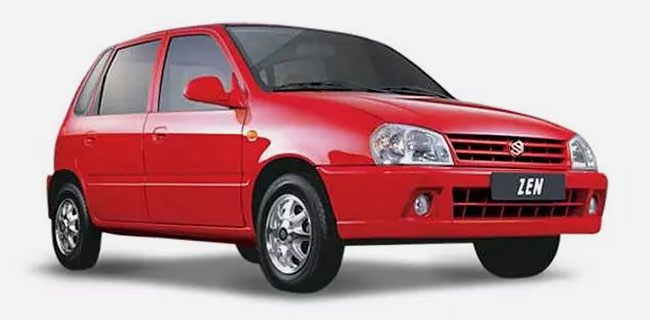
    Avik ChattopadhyayApart from being the International Labour Day, May 1 also happens to be the birthday of personalities like Balraj Sahni, Gordon Greenidge and Joseph Heller. And the Maruti Suzuki Zen.


    It was launched on that date 30 years ago, at the Maurya Sheraton hotel in New Delhi. Unveiled by then Finance Minister Pranab Mukherjee, the Zen went on to become one of India’s most loved brands. Codenamed ‘YE-2’, the little car was a big gamble that both Maruti and Suzuki played in the early 1990s as a new vehicle made for a new ‘liberalised’ India. For those of us who remember, 1991 is when we entered the third phase of our nationhood, the first being Independence in 1947 and the second being the emergency of 1975. This was a new India, wanting to open up to the world and dismantling the red-tapes and licence-controls that defined us in the first four decades of our development.


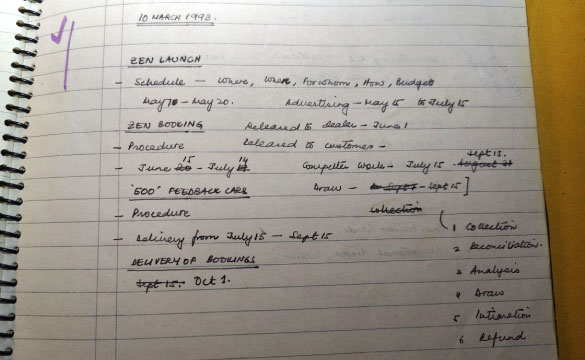
    Page from my notebook with notes on the Zen launch plan, dated 10 March 1993.


    The Zen defied convention. It was almost the same size as the popular Maruti 800 yet was a very different personality, beyond mere mechanical specifications. While it did have an aluminium engine as a novelty and major talking point, it did not rationally justify the price difference it commended over its older sibling. Till then, a product had to be physically larger than the other to command a higher price. The more the metal, the more the price. That was the only way to demonstrate greater value. Not with the Zen. It demonstrated that aspects like design, touch-and-feel, refinement, dynamic performance and comfort were, in combination, a higher value proposition than competition, even from your own family.


    Till 2006, the brand was built as a combination of some clever communication and lots of positive word-of-mouth. In fact, when launched in 1991, it took time to gain public liking. The Indian customer was used to the metal-price equation and the Zen was challenging that. The early adopters did the task of building the initial buzz around its performance and refinement that crucially helped in its gradual adoption and popularity. The initial seven / eight months were an actual struggle. While the network was given lots of “selling tools”, the value proposition was built only when the initial customers swore by it and the automobile journalists praised it sky high. I call this the “Sholay Effect” of hugely successful brands taking time to gain momentum from being almost written off, just like Sholay did.


    Magazine covers on the Zen in May-June 1993 – courtesy Team BHP


    There were four elements in the way the vehicle was launched which together helped build its formidable equity. First was the Suzuki badge on the vehicle. It was the first Maruti product to carry it, subtly stating that this was an ‘international’ product in the Maruti portfolio. There was a move to have the Maruti badge on the vehicle, but that was dropped in favour of the international narrative.


    Second was a term coined to describe its styling – ‘jellybean’. That was the best way to explain its harmonious lines, soft curves and aerodynamic shape, from the front bumper to the rear lights. That term caught the fancy of the media and it was all about jellybean styling after that.


    Third was the ultra-smooth all-aluminium engine which was so refined for its time that many, including Wikipedia, think the name Zen stands for ‘Zero Engine Noise’.


    Which brings us to the fourth element…the name Zen. It was given by me, in a competition within the company. The then director of marketing and sales Kozo Senga liked the name Zen. I explained that the vehicle was exactly as a Zen monk – you have the power within your outer calm that should be used responsibly and only when required. The vehicle looked sedate when parked but was a rocket when revved. Zen it was!


    Rare pic of a YE-2 with the Maruti badge in the plant – taken in Jan 1993


    The initial advertising for the Zen did not work. Though all the still photography was done by the amazing Hardev Singh, the advertising agency and the marketing team went overboard with the positioning statement of “Engineered for Exhilaration”. Nobody could either pronounce it properly or remember the statement. Thankfully, the word-of-mouth had started working its magic so the advertising really did not matter. The brochure however was a very popular item and almost all walk-ins into Maruti showrooms wanted one. It was a distinct square shape and the product in all its glory was the hero. Hardev Singh’s photography did the trick. People basically wanted a test drive and a brochure. Heady times indeed!


    Zen launch brochure of 1993 and one of 1996


    In 1994, the Zen started being exported to various countries, especially those in Europe. Badged as the Suzuki Alto, it was on the streets of London, Paris, Berlin and Rome. This made it the ‘world car’ for Maruti and India and that is what the next communication campaign was all about. This really worked in further building the brand’s appeal as the Indian was now driving exactly what a Londoner or Parisian was.


    By now, the sales numbers and growing popularity allowed the engineers in Gurugram to plan modifications and variants. A diesel Zen was launched in 1998 housing a Peugeot engine. Though it did not do very well, it demonstrated the company’s and brand’s engineering prowess as a trend setter. In 1999 a variant called the Zen Classic was launched but did not go well with the Indian design sensibilities. The reversals did not hold the company back from trying yet new things to cater to the Zen-clan.


    In 2000, Maruti launched the Alto and the WagonR, both hatchbacks catering to the same demographic target segment. In light of newer siblings, the Zen started losing some if its sheen and some crucial intervention was needed from both the product planning and engineering teams. To commemorate the tenth anniversary of the little monk, Maruti Suzuki did possibly its most audacious move of launching a limited edition 2-door Zen, exactly as it was sold in Europe. Out came 300 Zen Carbons in gleaming black and 300 Zen Steels in svelte silver, each vehicle individually numbered and badged. Even though just 600 units, they took the market by storm, being lapped up by both youth into their first jobs as well as retired couples. The brand was back in the reckoning with a very disruptive step. It was a statement that while the Alto and WagonR were selling in Japan, the Zen was being sold in Europe.


    The Zen Carbon and Zen Steel welcome letter – 2003


    Closely following the Zen ‘singles’ as they were called was a major restyling of the vehicle to give it a steroid boost. It did create some flutter primarily due to a high-decibel marketing campaign but the vehicle was on its old tired wheels. It had its best chance when Suzuki was planning its next big global launch in India codenamed the YN-4 in 2005. This vehicle would again disrupt the market in the way it looked and performed, just like the YE-2 had done 12 years ago. This should be the new Zen. That is the only way the legend could be revived in its new avatar. An attempt was made in the top circles to carry the Zen badge forward through this new vehicle. Consensus was otherwise. The new vehicle became the Swift, yet another uber successful brand till today.


    And the Zen? Well, a half-hearted attempt was made by slapping the name on a car that was a completely different personality from the Zen. It was called the Zen Estilo and launched in 2006. Thankfully the customers saw through the feeble game quicker than Maruti Suzuki had anticipated and the product sank without a trace in 2009. Thereby laying to rest one of India’s most loved and aspired for automotive brands, ever.


    Best wishes of the day, little monk.

    Rest easy!


  • Size matters, or does it really?

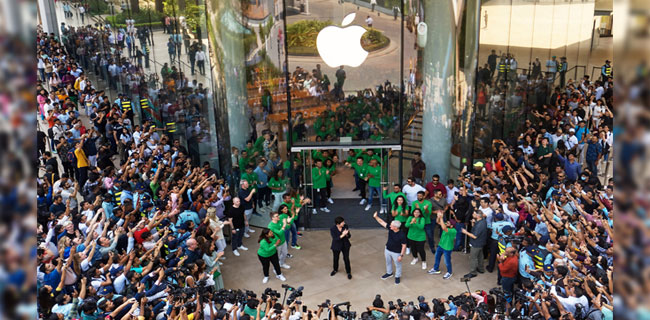
    Apple CEO Tim Cook and Senior Vice President (Retail and People) Deirdre O’Brien with staffers and crowds at the Apple BKC store opening in Mumbai on Tuesday, April 18. Photograph source: Apple.com/in


    By Avik Chattopadhyay


    Avik ChattopadhyayOn March 31, the former Reserve Bank of India deputy governor and noted economist Viral Acharya had commented that the ‘Big 5’ Indian mega-corporations needed to be broken up into smaller firms to dismantle their near-monopoly on pricing and market reach. They are Reliance, Tata, Aditya Birla, Adani and Bharti Telecom. “Creating national champions, which is considered by many as the industrial policy of ‘new India’, appears to be feeding directly into keeping prices at a high level,” said the professor of economics at New York University Stern School.  “The rising concentration of corporate power risks making inflation even more persistent and creating a vulnerability on the external sector front given India’s outsized fiscal and cyclically sensitive current account deficits,” he further commented in his report.


    Mega-corporations are not good for any economy or market. Through backward and forward integration, they end up controlling the entire value chain and price mechanism, virtually holding the end consumer at ransom. For example, a mega-corp retail chain will shut down competition by offering the most competitive prices and gaining rapid customer following finally leading to a situation when only that chain remains to serve the market, at a price it then wishes to operate on. This not only destroys local competition but also deters foreign players from exploring the market.


    When Standard Oil was broken up into 43 little companies in 1911 by the still fresh US Anti-trust Laws, it had assets worth USD400 million. It was 65-70% of the entire US market. When AT&T was broken up in 1974, it had revenues of USD70 billion. At that size, they could and were dictating governments on policy matters. They were monopolistic enough to manipulate both value chain costs as well as end consumer prices.


    On April 18,  India celebrated the opening of the first official Apple store. A USD400 billion mega-corporation! In the context of a Standard Oil or an AT&T, isn’t Apple Inc. not large enough to attract attention of the anti-trust regulator? Or is the very context of the market very different from before, being global in scope rather than just in the US which is what took the previous two down? Its nearest competitor, Samsung, is a bit more than just half its size.


    Are brand size and trust inversely proportional values of an organisation? Not really, if it is not monopolistic in its inherent behaviour and its size is spread across multiple markets with varying degrees of penetration with none being too large to be of competitive concern.


    Apple is one of the world’s most valuable ever brands with some of the most loyal following ever seen or recorded. It has thousands of stories about itself circulating in hundreds of languages and formats. Its founder is one of the most iconic global personalities ever, across business, politics, entertainment, sport and culture. Yet, the brand is not without the chinks in its shiny armour. It has not had a very good record on how it treats its workforce in countries outside of the US, though it tries to slither away citing they are contractual. It has been dodgy about its sourcing of materials and rare earths for its products. It has been known to use tax havens for years which technically speaking is nothing wrong but ethically is a misuse of lax regulations. There have been issues about its environmental impact, though it has made progress over the years to ‘clean’ up its image when it comes to recyclability and repurposing.


    Is the end-consumer really bothered about the negatives? When people line up at BKC in Mumbai from the wee hours for the first Apple store to open and then post millions of videos and photos to establish the love and admiration for the brand, you wonder whether looking at two sides of a coin does even matter when it comes to such formidable brands?!


    Even if five million iPhones are sold in a year in India, it will still not be 1% of a total market of 700 million smartphones. But size does not matter here as aspiration, admiration and benchmarking does. Size therefore is a contextual and relative measure to use when evaluating a brand. General Motors is large globally and very large in the US but not present in India at all. The same is with other global brands like Ford and Harley-Davidson. So, does it mean that in a market like India, with huge economic inequalities, brands need to play out different strategies of building the brand narrative and managing themselves depending on their product or service relevance? Can there be no universal truths that apply to all brands operating in India? Is there no universal truth about India itself?


    Or will history always be written by the victor, whether in battle or by ballot? There is a huge furore about the modifications being made in the NCERT history books. While the anger is welcome and justified, is this showing of just one side of India’s history being done for the first time? Are we sure that what was written in the 1970s and 1980s was the most balanced and unbiased? Are we certain that each constituent of this land’s rich and diverse history was given its due weightage, whether it be the Chola empire or Subramanya Bharati? Are we comfortable with a certain section of our freedom fighters being termed as “extremists” just because their method of action was not in tandem with the method of the majority? In fact, are we sure that we attained independence by using just one method of protest or was it actually a mix of many? There were half-truths then just as there are half-truths now. Just that the victors have changed and so have the overall agendas and resultant narratives. Just like when one CEO gives way to another and the ‘old order’ gives way to the new. New narratives are born and old shoulders are used to fire missives.


    However, that did not seem to happen in 2011 when Jobs gave way to Cook. The narrative remained the same. In fact, its application gave birth to new product categories and solutions that helped further reinforce the cause and level of addiction. That makes its fan and follower overlook its chinks and go only for all that shines. Hope NCERT adds a chapter on Apple in our history books soon. The learnings will certainly be deeper!


    Avik Chattopadhyay is a senior brand and marketing strategist based in Gurugram. He writes on MxMIndia every other Thursday. His views here are personal.


  • Avik Chattopadhyay: Does ‘provenance’ matter anymore?

    By Avik Chattopadhyay


    Avik ChattopadhyayAn ex-boss of mine currently heading a cutting-edge analytics firm in the automotive space shares this interesting infographic shown above from time to time. While the purpose clearly is to trace how Indian automotive brands are doing vis-à-vis others, this time I asked him a basic question: ”Does country of origin really matter to a customer anymore?”


    Source: JATO Dynamics
    Source: JATO Dynamics


    Being a brand practitioner for quite some time, this aspect of “country of origin” or, provenance, as the gurus address it, has been an important and integral part of a brand’s structure. German cars. French wine. Japanese engineering. Italian design. Russian vodka. The generation before me swore more by the country of origin than the brand by itself. German product, Grundig, is what my granduncle would say. That changed to ‘Sony makes the best television set… Japanese you know’, for my father. This generation buys a Samsung because it is a Samsung! Simple.


    Post WWII, the new world order saw legacy nations reinforcing their areas of strength while new ones entered he fray, the most notable being Japan and Soviet Union. In the case of the ‘softer’ products like fashion, food and movies, provenance played a key role in the cultural revival while the ‘harder’ products like automobiles, engineering, aircraft and electronics worked towards economic rebuilding. Thus, various countries developed their areas of ‘speciality’ or ‘association’ with the larger world. My colleagues in Peugeot used to lament that even after so many years, people typically associated France only with fashion, wine and cuisine and not for nuclear power, aeronautics or engineering. The Indian or the Brazilian would not associate Airbus, Areva or Alstom with France. They might easily come from Germany or Switzerland but… France?!


    My question to my colleagues in Paris remains till today – why do you want to be necessarily only French when you are already Peugeot? Provenance was an important ingredient of a product when the country it came from carried greater weight than the manufacturer of the product. So, if a machine made by an unknown company said “Made in Germany”, it automatically opened doors to business as the prospect naturally associated the country with engineering excellence. So, a “Made in Japan” television in the 1980s had to be good, whatever the brand. The country of “make” was a key factor determining choice.


    The other factor that supported provenance as a differentiator was the very origin of the product. An Italian pizza brand would certainly be the most ‘original’ and superior to any other. Similarly, the Russians would make the best vodka. And the Americans when it came to fast food. How could one ever accept a Mexican samosa? One could not simple imagine, let alone accept an actual physical product.


    So, post WWII, the country of origin became the calling card for organisations and corporation out to sell their products and solutions and become the new-age colonisers. For a common person to own or aspire to own such products or solutions coming from such countries was the coming of age. A German car. A Japanese television. An Italian coffee machine. A bottle of French perfume. A can of an American fizzy drink.


    All this worked very well in the fist phase of this new-age colonisation when production was largely based in the home country and markets were captured through importers and distribution channels. Also, many products took pride in the fact that they were only available in their home country and a few select markets and the customer had to take the pains of going there to own one. Hence the shopping lists from family and relatives when one visited Tokyo or Dubai or Paris. The artificially induced scarcity along with provenance enhanced the status of a brand and its universal appeal. One would get the latest VCRs only in Akihabara district in Tokyo. Or the latest Hermes perfume would be available only in London, Paris or New York. In fact, many fashion and cosmetic brands used to proudly write “London-Paris-New York” on their packaging for that added impact.


    The disruption came in 1980 with a man far away from all this who decided to “open” up his nation, break the shackles of an oppressive past and allow the average citizen to dream big. Deng Xiaoping started his reforms in a traditionally conservative and closed China. He famously said, “A cat may be black or white but as long as it catches mice, it is a good cat!” Pragmatic capitalism under the watchful eyes of the Communist Party was okay. That one move opened up one of the world’s biggest markets. The neo colonial organisations and brands had to have a share of this virgin market, waiting to be exploited. They were all welcome, but with a rider. They would have to necessarily manufacture in China to operate in the country, whether you wanted to sell fried potato wedges or supercars. This was to generate employment to improve the per capita income and maintain a low price to ensure affordability and acceptance. The world moved to China and we all know the rest of the story.


    The one milestone change for almost all brands in the world was the beginning of a label that said “Made in China.” You could be French, English, Spanish or Canadian but you were manufacturing in China. And manufacturing enough to sell to the world. So, the embodiment of all-things-that-are-good-are-American, Apple, started saying “Designed in California. Assembled in China.” Very soon, provenance was restricted to where a brand originated from and nothing more as there was a high possibility it was made in China.


    As globalisation spread, provenance contracted. Brands soon realised that they had to manufacture in all key large markets to be competitive and succeed. India and Brazil followed China. With the collapse of the Soviet Union, Russia followed too. And the global citizen was more interested in associating with a specific brand, irrespective of where it originated. The holy cows were being challenged. Finlandia made a vodka better than most Russian brands. Jacob’s Creek had nothing to do with French wine. One Plus could challenge any smartphone maker. Kia could win more Red Dot awards than a European carmaker. The South Koreans could be at the cutting-edge of lighting and not the Italians. Bang & Olufsen was not from Germany. Skagen could make a few Swiss watchmakers blush.


    The world was finally one flat marketplace where a brand could no longer take refuge in the country it came from as a key differentiator. And the post-war trip of nationalistic fervour that made you buy only brands that originated in your country had evaporated. India became part of the marketplace when we liberated our markets ten years after China did.


    The Indian market has matured enough to go beyond an anachronistic aspect like provenance. We buy Korean washing machines, Chinese phones, Bangladeshi apparel and South African wine. We are not emotionally blackmailed by slogans of “vocal for local” as we want that which is best for us. In his novel “Home and the world”, Tagore questions the very concept of ‘swadeshi’ through his protagonist Nikhilesh. If a home-made product cannot match the quality, durability and price of one imported from England, why should a value conscious commoner be forced to buy it?


    There has to be this balance of form, functionality, durability and price that allows us to make brand choices. Otherwise, we would have bought the Tata Indica by the millions by now. Or the Bajaj Chetak. If a Hyundai or a Honda offers me better value, I shall choose that. It is as Indian as a Tata or a TVS.


    Provenance is a vestige of the past.

    Period.


  • What a rocket, boys!


    By Avik Chattopadhyay


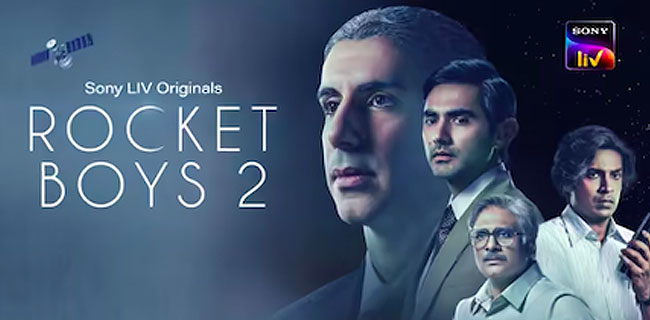
    Avik ChattopadhyayI just finished watching Rocket Boys Season 2 on Sony Liv.


    With my 79-year-old mother sitting beside me, wide-eyed, ears perked up not to miss a single dialogue. We had finished Season 1 in one sitting, so taking two sittings to polish off Season 2 was a bit of a let-down, by our own standards of binge-watching.


    It left a terrific after-taste… in the mind. Somehow it made me feel better about myself, the society I have grown up in and the ‘nation’ I belong to. Though not a great fan of the very concept of nationhood, this, for a moment made me break free from my self-imposed boundaries, and feel proud…very proud!


    What makes this web series work for me? It is definitely dramatic. It is not always factual. It does fall prey to some stereotyping, whether it be the grimacing CIA officials or the underdog Raza. It has taken definite liberties with situations and dialogues, given the very lack of any evidence to prove otherwise. Yet, it is a terrific story!


    It is not just the story of Bhabha, Sarabhai, Kalam and Ramanna. It is the story of a nation, just a decade young, trying to find its own feet and posture. It is the story of a nation that was carefully crafted, through a constitution, to be a lighthouse for the rest of the colonial world to admire and emulate. The India created in 1947 was more than a nation state. It was an idea whose time had come [to quote from Victor Hugo] of what a post-war, post-colonial, modern country should be like… diverse, inclusive, democratic, open, inquisitive, industrious, ambitious, assertive [not arrogant, mind you] and non-aligned. If a country of 300 million people of unending diversity could consciously choose be this in the 1940s, so could every new nation that followed.


    This exactly is the story of Rocket Boys [RB]. Each protagonist stands for a certain value or weakness of the new India. Each character is a certain shade of grey. Apart from the CIA that has been depicted in dark black, all others are shades of grey… from light as in Sarabhai to very dark as in Mathur. Nehru is vulnerable. Shastri is indecisive. Mrs Gandhi is fragile. Everyone has weaknesses. Nobody dons a masked suit with a cape and flies off to save a young India from the evil Pakistan and the hawkish US. They are just as commonplace we are. Just that circumstances made them be in places and hold positions that required of them to direct and define a legacy.


    This is what makes RB so endearing.

    And a terrific lesson for brands. Three clear inspirations can be taken by any brand manager from the Rocket Boys.


    Endless Engagement

    This is the first quality of any successful marketing campaign today. It has to build quick bonding and then carry the target segment through an immersive journey. RB is as racy as any thriller you have seen. It is a bit like Tom Clancy and K N Panikkar rolled into one. Right from the start it is a roller coaster ride of adventure, intrigue and crime without the Mumbai underworld. The only reference to ‘Bhai’ is how Bhabha addressed Nehru.


    Relatable Relevance

    The timing is perfect. So are the characterisations, or most of them. As we are entering into our ‘Amritkaal’ it is always good for the younger generation to know a bit about the early ‘Samudra Manthan’. The youth need to get a glimpse into how things of utmost import happened before issues like regionalism, religion and right[eous] ownership became the narrative.


    This is an era much before appeasement and invasions. This was an era of nurturing, questioning, scientific temper and a greater sense of bonhomie. This was an era that saw the subtle but sure transition from the Prime Minister being addressed as ‘Bhai’ to ‘Mrs Gandhi’. RB allows the young Indian to connect the dots and process the journey we have undertaken as a nation and where we stand today.


    And it has been deliberately made in English to cater to a wider audience across India and even overseas. Making it in Hindi would have restricted its viewership and national appeal.


    Inspiring Candour

    The tone of voice through the webseries is charmingly disarming. There are the obvious moments of high-sounding statements, but they are exceptions. The state of the nation has been shown in a truthful manner. There is no unnecessary bravado. There is no superhero. Every character has a fair share of strengths and weaknesses.


    Relationships have been sensitively depicted and nurtured, though a few characters like that of Kamla Chowdhry have been shown in a single dimension. But then doing otherwise might have digressed from the core narrative of how India became a nuclear power. There has been controversy around the fictional character of Raza Mehdi and how a stalwart like Meghnad Saha has been virtually ignored. But then, nobody’s perfect. Just like our nation is not. The characters grow and develop through the 16 episodes almost symbolic of the way the young nation slowly found its feet, reconciled with harsh realities, recalibrated after adversities yet relentless in its greater pursuit of creating a new world order… fearless, forthcoming and friendly with all!


    For the entire team that created Rocket Boys, there could not have been a better tribute to a still unsure, bit confused but totally committed 75-year-young nation!


  • Avik Chattopadhyay: Opportunities in Adversity

    By Avik Chattopadhyay


    Avik ChattopadhyayOn March 5, there was hue and cry on Indian social media. A video was shared on a set of banners and a tent set up on a quadrangle outside the UN office in Geneva when the UNHRC session was going on. The messages were disturbing, about child marriage, social oppression of women, atrocities on minorities, religious extremism and mistreatment of Dalits.


    It was a sure ‘diplomatic’ embarrassment with the UNHCR delegates getting to read all this in Geneva as well as coinciding with the G20 Summit in India. And then the wider exposure through social media!


    The government quickly swung into action right away branding the entire set-up as “malicious” and “anti-India”. The press carried the government’s message far and wide. And then of course social media machinery got into action of how such conspiracies are being hatched by the leftists, liberals, woke and anti-nationals who deliberately wish to do India down and break up the country at a time when it wishes to be the “vishwaguru” and teach the world lessons in democracy, social harmony, geo politics and economic growth.


    In every WhatsApp group I am a part of, there were outbursts. Incidentally, all by the male members. Not a single woman spoke against the banners. I found this singularly interesting. One reaction read: “These dirty works have been done by our own inhouse traitors who are living like parasites.” Another read: “This is how the ecosystem against India works. Keep your eyes and ears open always.” Yet another read, “The same scriptwriter as RaGa’s speech in Cambridge.” And then the diatribe quickly degenerated into open filth about certain categories of Indians and certain faiths. I directly reached out to a few otherwise women in the groups and asked them how they react. They all agreed the act was brazen but each was embarrassed to face certain harsh realities!


    Anger or embarrassment?

    This is the first thing that struck me – are we angry at someone spreading lies or are we actually embarrassed? If it is the latter, why did the men react so virulently? Do they actually believe India has no social evils like child exploitation, religious bigotry and untouchability? Do they think these are stories woven by vested interests for centuries to always bring us a bad name? Why did the women not react on the same lines then?


    This is so true for brands when they face such tests on issues like ecology, ethics and employee relations. Here too, their fundamentals are being questioned, not their existence. When protests are taken out against telecom or pharma companies how do they react? Do they get angry at the protestors or do they get embarrassed by their hidden realities that are now out in the open?


    Anti what?

    This is the second filter to be applied. What exactly is the protest against? Is it against specific deficiencies and ills in the country or the entire country itself? Is it based on concocted stories or realities? So, was the banner anti-child marriage or anti-India? Are we deliberately missing the wood for the trees? Would we be okay with the same protest happening in Gurdaspur in place of Geneva?


    What is true for a nation brand is also true for a product brand. If people in Kerala protested about mercury poisoning from an HUL plant there, they were not against the entire company but a specific operation. The company has to have the basic maturity to understand this and then respond accordingly.


    Introspective or seditious?

    The third filter is about the intended impact of the protest – is it to expose you on a particular aspect or create situations that encourage division and social strife. Does the action expose a certain method of governance or openly attack the Constitution of India? The latter is the only benchmark that allows one to measure any action as being either defamatory or seditious. If the protest does not attack the constitution but instead upholds the values of nationhood that it espouses, that protest is very much valid and within the rights of citizenship. Forget about applying Section 124A of the Indian Penal Code, the judicial system can uphold the very case for such a protest.


    The same applies to any other brand. One has to evaluate the protest as whether it allows the organisation to relook at its operations and improve or whether it is created by competitive forces to destabilise its very existence. The response will be accordingly either redressive or reactionary.


    Hubris or humility?

    This was such a wonderful opportunity for India to take the higher ground and react as a true “vishwaguru” that we so yearn to be accepted as. The Ministry could engage with the institution that put up the display and assure the world that we acknowledge and accept our shortcomings but shall certainly surmount them. “Thank you for reminding us of some of our deficiencies. Nobody is perfect but we are constantly striving to improve as a nation.” Instead we behaved as a typical bully, brandishing a hockey stick as offence is the best form of defence. We branded the entire exercise as “anti-India” and increased the embarrassment on the global stage, no better than how a Turkey or Russia would have reacted.


    Brands should never lose the opportunity of a protest to actually improve their connect with their stakeholders. Every adversity is another chance to renew ties and rebuild relationships. A protest is a warning to wake up, engage and improve. Not to refuse and rescind reality.


    Every time there is something like the Hunger Index, Happiness Index, Women Safety Ranking or a simple protest like in Geneva on March 5, as a nation we get into the ultra-aggressive mode of denial and denigration instead of engagement. And we lose yet another opportunity to take a higher, mature ground. Ending up being more anti-India ourselves than those banners on some quadrangle!


    On the occasion of the festival of colours (which has just passed us) I sign off with some words from Kanwal Dibayavi.


    Holi Mubarak!


    Avik Chattopadhyay is a senior brand strategist and commentator based in Gurugram. He writes on MxMIndia every other Thursdays and sometimes on other days as well. His views here are personal.


  • The identity of languages!


    By Avik Chattopadhyay


    Avik ChattopadhyayA few days back, the world celebrated the International Mother Language Day. Not that it would have mattered to most of us here in India, but in our neighbour Bangladesh it is a national holiday. In fact it’s the biggest national holiday there. Ask a man or woman on the streets of Dhaka, Barisal or Jessore what the nation’s biggest national holiday is and all of them unanimously will say ‘Shoheed Dibosh’ or ‘Martyrs’Day’. It is bigger than Liberation Day or any other occasion on the calendar of a Bangladeshi.


    Shaheed Minar, Dhaka


    It is the day when the nation pays homage to young students like Abdus Salaam, Rafiquddin Ahmed, Abul Barkat and Abdul Jabbar who laid down their lives at the legislative assembly to police firing for the sake of preserving Bengali as the main language of the then East Pakistan. That was on February 21, 1952. It was the first time in world history that a revolution was led on language. Since 1999, the UN celebrates the day to honour the “mother language”.


    To a lesser extent, the day is celebrated in West Bengal too as the language is the same. However, the fervour is much muted and frothy.


    Language is one of the biggest symbols of identity for mankind.

    For our language and ability to speak and express ourselves through words with their intonations are what make us “social” animals.


    Therefore languages are brands in themselves.

    Each language carries a certain personality quite distinct from others.

    Though our individual mother tongue is obviously above all others, to the general public, mention of a specific language elicits specific responses.

    One is lyrical. Another is guttural.

    One is scientific. Another is soft.

    One is pure. Another is an amalgamation.

    One is ancient. Another is modern.

    One is forgotten. Another is universal.


    The language one speaks also conjures up images of the speaker. And that leads to obvious stereotyping.


    In my last visit to Dhaka, I realised that the average Bangladeshi still carries this inner hate for Urdu as a language. While most of us regard it as one of the most lyrical, for them it is a symbol of imposition and colonialism. Therefore, they prefer to shun an otherwise beautiful language as the associations are negative. The same must be the case with colonies where their mother tongues were suppressed and sacrificed to impose the coloniser’s language. Russian was shunned by the ex-Soviet republics post dismantling of the USSR. So was the case with German after the end of the Second World War.


    Imposition of a certain language over a people or region that does not naturally speak it never works. While Pakistan tried with Urdu on the Bengali speaker, since Independence we too have been trying the same with Hindi on various regions and linguistic pockets. Interestingly, the first attempt was made way back in 1937 by C Rajagopalachari who wanted Hindi to be taught across all schools in Tamil Nadu [then Madras Presidency]. Post-Independence there was a concerted attempt to make Hindi the national language and switch from English to Hindi in 1965. Riots broke out in Madurai and spread like wildfire across the state leading to a loss of seventy lives. Finally in 1967 the then Prime Minister Lal Bahadur Shastri had to officially assure the people of Tamil Nadu and the nation that English would continue to be the common operating language through the union while every regional language would be preserved. It is important to note that the Congress lost the 1967 election in the state and has never managed a foothold since. Later, attempts by the governments in power, whether through the New Education Policy of 1986 or the Home Ministry order of 2014 have all been met with staunch protests leading to the powers in Delhi retracing their steps.


    Periyar’s periodical Kudiyarasu of 03.09.1939 saying “Down with Hindi”


    Linguistic imperialism has seen its ugly head in various parts of India depending on the agenda of the political party in power, at the centre and in various states. Organisations like “Aamra Bangali” and “Bangla Pokkho” emerged in West Bengal to lead the anti-Hindi backlash since the 1980s. Bengali faced the brunt in Assam and Bihar. Urdu faces the same in Uttar Pradesh and many north Indian states. Inclusion of Hindi in the Bangalore Metro signage in 2017 and the celebration of Hindi Divas in 2019 saw huge anti-Hindi protests in the city. There has also been this long-standing attempt at imposing Kannada over all else in Karnataka.


    This perpetuating linguistic imperialism over centuries has seen some of the finest reactionary literary movements across the world as in India. Most of it has been underground to start with coming into the mainstream with the periodic overthrow of the imperialist powers, be they from outside or from within. The socio-religious stranglehold of Sanskrit led to the birth of Prakrit and the Brahmi script way back in 3rd century BCE as progressive reactionary developments that believed in assimilation and proliferation, rather than be restricted as the domain of an elite few.


    The longevity of a language depends on how it keeps evolving over time and incorporates from other languages, to appeal to more and more people, to be flexible in expression as well as representation. The more rigid a language is under the pretext of being pure and scientific, the lesser it is to be readily adopted by the larger population, Sanskrit and Latin being two glaring examples.


    Ghoom railway station sign in West Bengal; Southall railway station sign in West London


    A train journey is the best way to see new languages crop up in various parts of the country with Hindi and English being the common features. The station signage is possibly one of the best symbols of inclusion and integration. Across West Bengal and Jharkhand, the railway stations in the Santhal areas carry signage in the local Ol-Chiki script too!


    Thriving languages are about co-habitation and cross-fertilization. The more languages a society or nation accepts, the more habitable it becomes. Trying to impose a uniform language overall will naturally see reactionary movements as it is an attempt to wipe out a certain identity and culture. And it leads to situations where a certain person who speaks a language as beautiful as Bengali refuses to accept another as beautiful as in Urdu.


    But then I guess if the imposition had not been tried, the reactionary movement would never have happened and the importance of the “mother language” would have never been understood!


    “Urdu hai jis ka naam hamin jaante hain ‘daagh’

    Hindustan mein dhoom hamari zabaan ki hai!”

    -Dagh Dehlvi


  • Naatu Naatu and Naren!


    By Avik Chattopadhyay


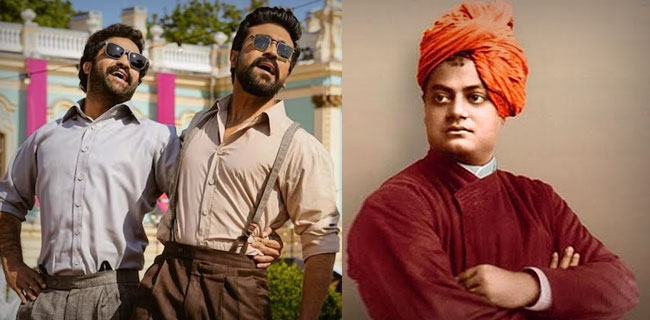
    Avik ChattopadhyayWe woke up on January 11 with the news that the song ‘Naatu Naatu’ from ‘RRR’ had won the Golden Globe for best original song. The nation erupted into celebration. It was almost as if Indian cinema was finally redeemed. Some celebrations also took curious routes. A very close national awardwinning friend of mine wrote on social media, ‘Naatu Naatu gets Golden Globe…bad day in wokistan. All agenda driven films of Marvel and Disney are failing…people are tired of woke messaging of diversity and inclusion…” Now, where did that come from seriously?! But it surely did!


    January 12 was the birth anniversary of Swami Vivekananda aka Narendranath Dutta. Along with the usual social media chatter and media articles, especially in West Bengal, some went into overdrive. Times Now news published a piece titled “How Swami Vivekananda’s ideals influenced PM Narendra Modi?” A certain MLA in West Bengal declared that the current Narendra is the incarnation of the then Narendra!


    Both are equally powerful brands – Indian cinema and Vivekananda.


    To me, the Golden Globe award was the perpetuation of the stereotypical image that a larger part of the world has created for Indian cinema…of escapist over-the-top song and dance! This is a far cry from the 1950s to 1970s when film makers like Ray, Ghatak, Sen, Kasaravalli, Gopalakrishnan, Benegal and their contemporaries across languages represented Indian cinema and helped create a certain image of sensitive neo-realism. Over the last 20-odd years the image of celebratory escapism has largely been consciously and deliberately created. And this award goes further into reinforcing that image. I do not wish to judge whether the image is the desirable one or not. But I do question whether brand “Indian cinema” wishes to continue operating in this very space or wishes to do a personality re-jig? Will it continue to be sustainable this way or will it have to paint a fresh image soon? Will it continue to thrive within the box it has created or have to look outside?


    For when one talks of looking and thinking outside the ‘box’, one must study brand Vivekananda.


    The prevailing image of the man within the country is quite different from that outside. Most Indians see him as a “Hindu monk” who was always about “Vedanta” and the pride of being a Hindu. This image has been appropriated and used to the hilt by the current political party in power to immense effect. The current Narendra almost takes refuge and recourse under the shadow of the then Narendra to justify his thought and action. It is like a “guru-shishya” relationship which has been conjured up. And that is most convenient as it miraculously panders to the sensitivities of the majority.


    Brand Vivekananda is about constant reinvention and recalibration of theology, thought and action. If one were to read his works and lectures, one will understand what brand revisioning is all about. The brand is like water, having a physical form but not confined to a fixed shape and always ready to change course. Yet it does not lose its relevance and core identity. From a non-believer he turned into the biggest disciple of Ramakrishna. In fact, the world would not have know about the teacher had the student not set up an institution like Ramakrishna Mission. He would have remained a local spiritual guru like his contemporaries Byamakhyapa or Loknath had it not been for the Naren who questioned and challenged him no end before agreeing with his theology. And he kept exploring and experimenting right through his short life of less than 40 years! He adapted to where he stayed and incorporated the customs and habits to both expand his mental horizon as well as evaluate what would be best for the India of his dreams. Hence, beef was his staple when in Chicago while it would always be fish when in Calcutta. In one his lectures he said, “I do not come to convert you to a new belief. I want you to keep your own belief; I want to make the Methodist a better Methodist; the Presbyterian a better Presbyterian; the Unitarian a better Unitarian. I want to teach you to live the truth, to reveal the light within your own soul.” Amongst his admirers and followers were Lord Kelvin, Nikola Tesla, Sarah Bernhardt, Herman Helmholst and Robert Ingersoll.


    On June 10, 1898, he writes to his friend Mohammad Sarfaraz Husain, “I am firmly persuaded that without the help of practical Islam, theories of Vedantism, however fine and wonderful they may be, are entirely valueless to the vast mass of mankind. We want to lead mankind to the place where there is neither the Vedas, nor the Bible, nor the Koran; yet this has to be done by harmonising the Vedas, the Bible and the Koran. Mankind ought to be taught that religions are but the varied expressions of THE RELIGION, which is Oneness, so that each may choose that path that suits him best. For our own motherland a junction of the two great systems, Hinduism and Islam — Vedanta brain and Islam body – is the only hope. I see in my mind’s eye the future perfect India rising out of this chaos and strife, glorious and invincible, with Vedanta brain and Islam body.”


    Simultaneously, in the same year he composed the song “Khandana Bhava-Bandhana” dedicated to his teacher and master, which has now become the anthem for the Mission.


    And then in 1899, his translation of the first six chapters of “The Imitation of Christ” were published in his periodical “Brahmavadin”!


    On a ship-ride together with Jamsetji Tata in 1893, he inspired him to set up a research and educational institution of world standard in the country. Yet in 1900, when Tata asked him to head the proposed Research Institute of Science [eventually the Indian Institute of Science in Bangalore], Vivekananda politely refused saying it required someone more dedicated to the cause as it conflicted with his spiritual journey!


    Brand Vivekananda is possibly one of the finest manifestations of Trotsky’s theory of “perpetual revolution”. It is a brand that has gained its stature by exploring, challenging, pushing boundaries, experimenting and thereby remaining highly relevant to people across countries and cultures. In spite of the attempts of institutions here, including the Ramakrishna Mission, to put him in a straight jacket, for their own convenience and limited benefit.


    Will Brand “Indian cinema” take inspiration from Brand Vivekananda, ever?


  • Brand, Baajaa, Baaraat!

    With apologies to the original ‘Band Baaja Baarat’ poster on Facebook


    By Avik Chattopadhyay


    Avik ChattopadhyayLadies and gentlemen, please settle down. I am so glad all of you could make it here at the resplendent new Central Vista on this cold December morning for a year-end round up. Myself, Brand India. I am your host. I end the year on a high…G20 and what not. As a conscientious brand committed to a greater purpose, I shall be the ‘Vishwaguru’ to the world in the years to come… economic growth, statues, temples, bullet trains, bridges, tunnels and whatever grand and gargantuan you can think of… name it and I shall have one to flaunt!


    Excuse me, what about unemployment, inflation, happiness index, hunger index, press freedom, women safety…


    And who is this utterly insolent brand in our midst?


    Well, I am Brand NDTV and I thought I might as well bring this up right at the…


    Always negative, always negative. Out to make ‘tukde tukde’ of the larger national narrative. No wonder you need support now. C’mon, be a sport…


    Talking of sport, I am Brand Indian Cricket. Nobody is bigger than me on this side of the Milky Way. And see the reforms I have brought about within myself. The women get paid the same as the men… finally. We have a new team at the helm. We have no holy cows in the playing teams who are waiting for their individual landmarks. And IPL… see how well the IPL went this year. The World Cup was a bit of a dampener, but then this sport… nobody can win every time, is it not?


    Listen Brand Cricket, if is not for someone like me, Brand Byju’s, you guys would keep a clean sheet… I mean, shirt. And I am doing all this at the cost of all the data I collect and use of the millions of parents and kids who are basically looking for the easy way out. Thank heavens for states like West Bengal who are demolishing the educational system to the ground that helps our cause and…


    How dare you, you ungrateful brand? How dare you denigrate Brand Bengal? Can you not see the decorations at Durga Puja and Christmas? Are you blind? Look at how social media went agog about the Park Street Christmas Festival! The entire city of Kolkata is decked up for “Borodin”. We even cleared out the job aspirants who have been on hunger strike for more than 500 days now from the sidewalks. The film festival is happening here…


    Talking of films, can you ever ignore me, Brand Bollywood? Just see my contributions through the year. Kashmir Files. Ram Setu. More such are planned. We have even dubbed films from the South so that the world can watch them in Bolly-tongue. Have you ever had such support from a dear friend like Israel on any issue before? Never. And we were part of the FIFA World Cup Finals too. Beat that!


    Football… talking of football… you guys all go gaga over Messi and Ronaldo. Have they ever scored against India? No! That is the power of Brand Indian Football. Messi was even compelled to sign T-shirts and send them to people in India just to ensure our support for him over Ronaldo and Mbappe. We might be down but not out…there are close to 100 countries below us right now in the order…


    Hey, talking of order, hope the nation is aware of the latest order to frisk yet another mosque and see if there are any tell-tale signs of medieval religious coercion.


    Who are you?


    I am Brand Shivling.


    What are such brands doing here? Who lets them in? They need to be covered up, or else…


    Cover up, did you say? That is exactly what I have been trying to make all you guys understand. We need to cover up, right from kindergarten…


    And who is this now?


    I am Brand Hijab, you self-serving cocoon!


    Gentlemen and ladies, please… let this not become a fish market. Please. Anyway we are all for vegetarianism and showing compassion to all our fellow beings, on land, in the air and in water…  No religion or connected issues as we close the year. We are all about ‘Vasudhaiva Kutumbakam’, remember? How else can we become the Vishwaguru?


    There we go again!


    Brand NDTV, you still here?!


    Send them to Ukraine please, will serve them right. By the way, are you guys are so insular that global events don’t ever bother you? Look at what is happening in Ukraine. China needs vaccines. Palestinian children get killed every day. Wars have broken out again in various parts of Africa. If you really want to be a world leader, time you guys looked out…


    This sound like my moral science teacher! What brand are you?


    Moral science, is it?! There go your free trips to NewYork.


    Ssshh, that’s Brand UN…


    Brand UN still exists?


    Quiet please! Quiet! No side talks. This conclave needs everyone’s buy-in…


    You mean buy-out, don’t you! Everything has been bought out. The press. The industry. The government institutions. The enforcement agencies. The social media. The…


    Mufflerman?


    No, take another guess…


    Hmmmmmm…


    This is the wiser…I mean, the beardo! Heh heh!!


    Dekho bhaiyya, you can say whatever you want about me, but I am getting the country together behind me.


    You mean, after you, don’t you! Heh heh!!


    Behind me, dogs, cats and all. Brand Congress is being revived. The entire nation is rallying around on the cause of Bharat Jodo. We are talking about unemployment, crony-capitalism, nepotism, inflation, corruption…


    These are their causes?! Weren’t they chucked out for these very reasons?


    Ssshhhh… they and the UN are alike. Alive but pretty much…


    Why is this entire conclave happening in English? Why do we have to pay obeisance to a foreign language even now? Why can we not take inspiration from our 10,000-year-old civilisation and revive our lost language and converse in that? The least we can do is converse in Hindi, is it not?


    Brand BJP has a point. The rest of this conclave should be in Hindi. This is good for Brand India as we embark upon our journey to be the Vishwa…


    But then Hindi is a mix of Sanskrit, Prakrit and Persian. Do we leave out the Persian words? And then, you should call yourself as Brand Bharat and not Brand India…


    Can someone please remove Brand Busters from here? Just random everyday people walking into such conclaves and messing things up cannot work. We need to pass a resolution on removing all symbols of foreign subjugation and citizen activism. We have had enough of the farmers and aspiring soldiers creating law and order situations that throw bad light on the country’s image.


    Totally agree! No agitations. No protests. No rebellion. No questioning megalomania!!


    I could hear multiple voices saying the same thing. Could you raise your hands so that I can make a note of the same when passing the resolution? We are Brands, not Brigands!!


    Hear, hear!


    Listen guys, I am Brand December. Every year you make resolutions in my timespace and then do nothing about them. Year after year it is the same story. Brands making resolutions to revise, revive, rejig, reorient, retrospect and what not. The only thing that happens every December is repeat. I am truly fed up. I shall call it a day in two days’ time. And you guys can do whatever you want!


    Amen!

    Ameen!

    Tathastu!


    Avik Chattopadhyay is a Gurugram-based business strategy and brand consultant. He writes on MxMIndia on alternate Thursdays. The views here are his own.


  • S-AAP Seedi: Lessons for Political Brand AAP


    By Avik Chattopadhyay


    Avik ChattopadhyayElections are the appraisal time for any political party. The outcomes tell one where it stands in the context of its KRAs and delivery against goals and targets. Just like any brand in the corporate world. The performances in specific segments, markets and customer targets do not tend to be the same, depending on the intensity of each effort.


    We have just gone through appraisal times in Delhi, Gujarat and Himachal Pradesh. In the first, the context was the Municipal Corporation of Delhi [MCD]. Three different political brands got A+ in the three markets. Of these, the AAP brand has taken my interest as it has seen ups and downs just like in the ‘Saap Seedi’ or ‘Snakes & Ladders’ game.


    It wrested the MCD from the BJP, lost in the Gujarat market and withdrew from the Himachal market. Three different markets and customer types and three outcomes. One has to see all three outcomes together than piecemeal to get the picture of how the brand is performing in a national context. Post-appraisal analysis of each market should be the next step of deep-dive analysis. Many brands do the analysis the other way round which robs them of the key indicators across markets and customer segments that helps in creating the bigger picture in the first place.


    Given this hypothesis, Brand AAP should be worried right now. It lies on the board of a Snakes & Ladders game right now even though it might think of itself being on a chessboard. Here are the reasons why…


    The numbers don’t add up

    Out of 250 seats in the MCD, it managed to get only 134. I am sure it would have internally expected a number closer to 170-180. The post-result media reportage used terms like “wrested control” and “managed to restrict BJP to 104”. This was not a landslide that their support base had expected.


    The assembly results did not reflect in the corporation result. The latter is the grassroots while the former is the superstructure. And that is worrisome if the grassroots do not recognise and reward you for your efforts over all these years! The target customer is not entirely convinced of your intent and actions as the initial euphoria has worn off and the dust has settled down.


    This should be a matter of huge concern within AAP. While it puts on the beaming smile for the outside, hope it does immediate assessment of what made it under perform. Has it been milking the past glory of its initiatives in health, education and electricity for too long? Does the customer not see any product in the portfolio? Have the initial products been upgraded and made ready for tomorrow? Portfolio management is crucial to any brand’s relevance and AAP has to work on the same with a clean sheet of paper once again.


    Living someone else’s life

    Entering the Gujarat market for the first time, you certainly have performed admirably by garnering 12.91% of all votes [roughly 3.4 million votes] even though it translates into only five assembly seats. The ‘funnel’ is rich and you need to convert better before the next appraisal. Also, the five constituencies should be nurtured so well that word of mouth helps you multiply next time.


    But is this enough or did you under-utilise your potential? Just like the current football World Cup teaches us, possession is not everything and attempts at goal count for nothing. AAP could have done much better if it would have stuck to its own narrative of “education + health + entitlements” instead of suddenly wanting to live someone else’s life, pointedly the BJP’s. it veered into the dangerous playground of religion and rituals…basically the territory of the main opponent, thereby losing its own identity. If the customer sees the new brand playing copycat of the market leader, might as well stay with the leader. It is like a Sensodyne trying to be a Colgate. Or a Hyundai trying to be a Maruti Suzuki. Sure recipe for underachievement and gradual erosion of the brand’s key promise. If it carries on in the same way in the Gujarat market, it should not expect any more than 5% vote share in the next appraisal!


    Management by remote control

    This has never worked and never will. The global CEO cannot run every market and represent the brand in all. Also, expats do not seem to work nowadays as the customer takes no brand at face value. The market-centric team needs to be created well before market entry. It does work the other way. Gone are the days when the customer missed the presence of a brand and queued up for it at launch.


    Appraisal reports of the market leader have also shown that merely flying down the global CEO for large functions and foundation stone ceremonies has not ensured an A+ in every market. In fact, in your own domestic market, it has not worked for the market leader, so why will you try the same in the leader’s domestic market? The market needs to see your regional team literally preparing the soil painstakingly before tilling it. However digital the world may become, trust is built on the physical presence of the local leadership team. Success in another market is not a guarantee of success in another. It is merely a testimonial of a brand’s capability and capacity to perform, not the intent.


    If I were in the AAP leadership team, I would be worried about these conflicting signals from the three appraisals my brand has gone through. In my victory lies vulnerability and in my defeat lies underutilisation of my brand’s potential. Both are equally worrisome requiring me as a newly-anointed “national” political brand to shift to a different board game altogether!


    Avik Chattopadhyay is a senior brand strategist based in Gurugram. He writes on MxMIndia every other Thursday. His views here are personal


  • Brand Lessons from Football

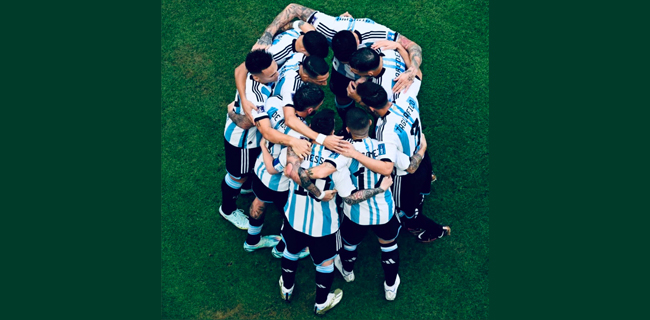
    Nicolas Otamendi’s photograph saying: Hoy más que nunca (today more than ever). Indeed! Picture source: @Notamendi30


    By Avik Chattopadhyay


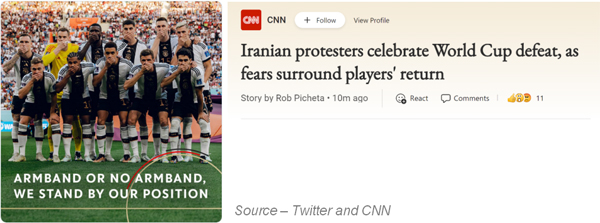
    Avik ChattopadhyayThe biggest sporting festival in the world is in full swing. Like every previous edition, this too is having its share of delights and controversies. Each day for the last 10 days, has thrown up one new story outside of the sport. Starting with the general narrative of human rights abuses and contract worker deaths in Qatar, the spotlight moved on to beer not being allowed in the stadia despite Budweiser being a sponsor, to the Iranian team not singing their national anthem in their first match, to the Germans doing the team gesture in support of the ‘OneLove’ movement, to the ex-Danish prime minister sitting next to the FIFA chief wearing a dress with rainbow sleeves, to a tweet before the US-Iran game showing the Iranian flag without the central crest and then to celebrations in Tehran on the national team failing to qualify for the next round. Guess Gianni Infantino has had his fill of hair-raising anxieties for one lifetime!


    Since we do not have actual wars and battles as frequently as till the 1800s, the sportsfield has been the battleground. Between countries. For movements. For protests. For spreading fear. For claiming ‘victories’. And football has been one of the biggest sporting platforms since the first World Cup in 1930. Given that 140-odd nations play the game and are ranked by FIFA, no other sport comes close by a mile in terms of popularity. It is the only team sport that has no hierarchies in terms of the elite performers and the also-rans. This is one team sport that has broken down barriers of colour, race, region and faith… time and again. Therefore, the lessons a brand can draw from the sport are priceless. And the current FIFA World Cup is no exception.


    The first 10 days have reiterated the following realities that every brand manager should pay heed to:


    No place for pedestals

    There are no hierarchies in the marketplace. There is a leader and a challenger. And that is all. What was good for yesterday is not good enough for tomorrow. And no challenger fears the holder of the crown. Champions are meant to be beaten. The higher ranked teams might not even go into the next round. They will be made to struggle for survival at every stage. Every new market or segment or target customer is a totally fresh playground.


    Possession is nothing

    This is the biggest learning from the game. One can possess the ball for only one-third of the time and yet win the game. In this edition too several teams have done so repeatedly. One does not get any point for possession but only on scoring goals. Quality over quantity!


    Counterattacks are critical

    The ability to react against intense competitive pressure is to take the game into the other camp and strike. For this planning counterattacks as part of the core strategy is important. The counterattack cannot be random and whimsical. It needs to be thought out, rehearsed and then deployed for maximum impact. The counterattack has the ability to break the morale of competition.


    Conversion matters

    One cannot come away from the game happy that the team made 17 attempts of which two hit the crossbar, five were parried away and six were corners. Every free kick within 25-30 metres of the opposition’s box needs to be converted. Same with every corner. These are opportunities given to you by the other team, so wasting them is almost a crime. Leads and footfalls need to be converted just like these chances, especially if handed over by competition.

    As I write, it is half-time in the Argentina-Poland game.

    Argentina must win this to move into the next round.

    It has had 65.8% possession, nine shots inside the box, seven shots on target, two shots blocked and one penalty saved. If this continues and Argentina cannot make it, who else is to blame? (Argentina beat Poland 2-0, and, yes, it has advanced to the next stage – Ed)


    Plan B in reserve

    Superstars can be injured. Pivots can underperform on certain days. Have alternatives ready in reserve. Also, have a balance of specialists and generalists. There will be the traditional defenders and midfielders who have clear roles but also the ‘liberos’ who can operate in different positions depending on the situation. Players who can use both feet to shoot are prized for any team. Ivan Perisic of Croatia typically switches flanks from his favourite left to the right when the game demands. And the opposition is typically not prepared for such sudden changes in plan. Multi-tasking works in football too as Johann Cruyff and his Dutch team demonstrated in the 1974 World Cup!


    Regard and respect

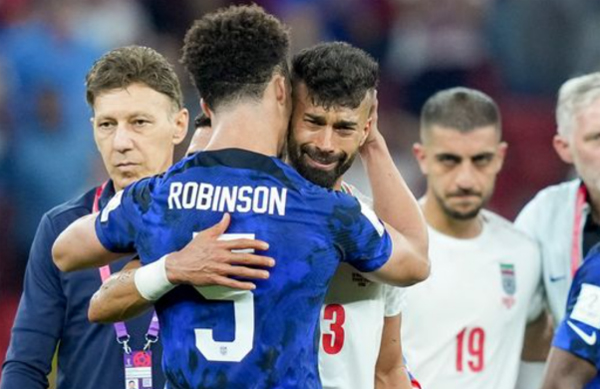
    At the end of the 90 minutes, once the battle is over, you go over and embrace the player of the other team. If you tackle a player, you give him a hand too to get up. When an injured opposition player is being tended to, you do share a bottle of water with his teammate. And when your opposition has been knocked out of the tournament, you do lend a shoulder to cry on. For it is a game after all. It is to win and not to kill, to defeat and not to destroy.


    Antonee Robinson of the US team comforts Ramin Rezaeian of Iran after the latter are knocked out of the 2022 FIFA World Cup – Source Getty Images


    Like a good Bong, Avik Chattopadhyay is nuts about football. Just as he is about brands, automobiles, advertising, culture, religion, Indian politics, American politics, British politics… almost everything. Like a good Bong, we told you. This is his column, which is published every other Thursday. His views are personal. And, yes, he’s a strategy consultant based in Gurugram.