Tag: advertising

  • The Anchor: Naved Akhtar on 5 things that have changed in advertising

    By Naved Akhtar


    1. Advertising has become a business:

    The pressure to perform is so high that many times creativity is given a miss. There is a role reversal – earlier the creative people were held in high esteem, now the client has become the one leading the show. Advertising has become a business with roles being changed.


    2. Work for awards v/s real work

    There are two different kinds of work that has emerged. The work that is done to purely win awards and then there is real work that is done to drive the product in the market. Twenty years ago one would see the same ads that were have worked for a business also winning awards but now there is just no connect. I think that now the award winning works are more like fine arts and done for self-exultation.


    3. The aura gone from advertising

    In the earlier days, the creative fraternity had an aura around themselves; and were respected for their creative genius. Now advertising is seen as just any other business and the appeal that people emanated who were a part of the business has gone.


    4. TV has become important

    Today television has become ‘the’ medium for advertising unlike earlier where press was given more due.


    5. Fun is low

    I think the fun has gone out of advertising because of pressure of work, win new businesses and remain ahead of competition. There was a time when people were into advertising for love of advertising now this is purely business and means of earning bread and butter.


    Naved Akhtar is the Founder at Shop Design and Advertising


  • The Anchor: Suman Srivastava on 5 Reasons why Marketing is a Creative Business

    By Suman Srivastava


    1. The marketer has to define the category he is in:

    Marketers should define their category by the way their customers see it, rather than the way the industry sees it wrote Theodore Levitt in Marketing Myopia. This is true even today. One can argue that a discount airline and a full service airline operate in different categories, even though they both fly planes.


    2. Pricing has become an art and not an accountancy exercise:

    Cost plus pricing is dead. Today consumers live in a “free” economy. Musicians give away their music for free from their websites and then make money on the concerts and the merchandize. Printers in the USA cost less than a full set of cartridges in them. Go figure.


    3. Marketers increasingly sell augmented products:

    You never just buy the car. You buy the car and the service and the resale value. As products become more commoditized, the pressure is on the marketer to differentiate the product in some other way. Hyundai offered to buy back cars from people who lost their jobs in America. That ensured that it increased its market share in a declining market.


    4. In India, creative distribution ideas can truly disrupt markets:

    Cavin Kare changed the rules of the game by launching shampoos in sachets. They started a revolution that has extended from personal care products to telecom (prepaid cards). Sachets could be placed in the smallest of stores and be within reach of the poorest of customers.


    5. Advertising doesn’t work as well as it did before, so marketers need to think of unique brand experiences:

    Smirnoff is not allowed to advertise, so it created a series of events where consumers were taught to make cocktails. These were fun events where the consumers left after not just having a few drinks, but also learning the right way to make and serve cocktails. Beats a 30 sec TVC any day.


    Suman Srivastava is Founder & Innovation Artist at Marketing Unplugged, a firm that helps firms create marketing innovations


  • Ranjona Banerji: Irritating ads that irritate

    Ranjona Banerji

    By Ranjona Banerji


    Am stepping on a few toes here and other people’s territory but then wothehell. As much news as you watch on TV (or as much TV that you watch, be honest) you’re forced to watch as much advertising as content.


    And sometimes it’s fun (like Hari Sadu and naukri.com) or even the poor chappie who thinks he’s eating chicken, but it turns out to be a doggie. Or Fastrack’s funny series on the risqué side with Genelia D’Souza and Virat Kohli. Or even the Flipkart ads where children play adults.


    But what does one make of Priyanka Chopra squirming about on the ground to a song that does not match the bizarre dance she does as she tells us she hates the “chip chip”. All that happens for Garnier is that most people throw up and switch channels.


    Through the telecast of Wimbledon on Star Sports you get to hear that “amazing Thailand always amazes”. Well, duh, couldn’t they think of another word? Or has someone done Thailand tourism in?


    The Kelloggs ads with that vastly annoying mother who does something as simple as throw a few almonds on a bowl of cereal and pretends she’s invented sliced bread is anodyne as such ads normally are.


    But the winners of the most irritating ads have to be Reliance Foundation and Coca-Cola. Insensitivity seems to rule the Coca-Cola ad in which a group of not very well off (how do I say this politely?) children play cricket in some dusty desert scrub land as a voice over tells us poetically how they have no cricket bat, ball, stumps, the pavilion has no roof and so on and ends some poignant note about how this is not play but the call of the earth or something. Then Sachin Tendulkar with his strange new hairstyle drinks a Coke and says play on. The children and Tendulkar never meet and you get the feeling that the children cannot afford to drink Coca-Cola, certainly not one each.


    And there’s the Reliance Foundation. I’m not getting to the connection with the programme Satyamev Jayate. For one, the ad looks like a copy of the Vedanta ad, which claimed to be saving the lives of various village children with schools and food and making their dreams come true. The ad ran into as many problems as Vedanta does with its mining projects and the company’s attempt to redeem itself with this real or exaggerated NGO social work effort did not work.


    If indeed Nita Ambani is moving into social work, an ad that copies an already discredited ad is surely not the best vehicle. Also, the figures put up for the number of children fed or schooled or clothed is embarrassingly small for a company the size of Reliance. Even worse, Nita Ambani’s look is so carefully crafted that it looks just that. Also makes her ears look unnaturally large.


    Hidden persuasion is fine. But these are attempts at such blatant manipulation that they are not just exploitative, they may not even work.


    For those interested in advertising and how it works, try and catch The Gruen Transfer on the Australia Network or Youtube. Hosted by Australian comic Will Anderson, it is funny, incisive, intelligent and hard-hitting. And did I say funny?


    All right, I’ll watch the news from tomorrow.


  • Are we Duhs in Digital Media?


    By Tuhina Anand and Shruti Pushkarna


    India has once again drawn a blank in the Cyber Lions category at Cannes 2012. From the 27 entries from India in this category, none made it to the shortlist. Considering that digital is the talk at all industry forum and the future, or is it actually the present, of advertising, its dismal performance at Cannes makes one realize that India is still miles behind on this medium.


    Nagesh Alai

    Nagesh Alai, Executive Director – India Operations at DraftFCB Group, pointed out: “It is not surprising not seeing a shortlist in the Cyber Lions from our shores. Most in our industry continue to see and use Digital as a ‘medium of messaging’ instead of seeing and using Digital as a ‘medium to engage with and start a conversation about the brand’. It is a classic case of getting stuck in hoary mindsets of a 30-second TV commercial. The day our digital specialists get out of this mindset, I reckon one will see a sea change in the digital executions and becoming award worthy. I am sure we will see that happen in the not too distant a future.”


    Talking about the digital in India, Carlton D’Silva, Chief Creative Officer, Hungama Digital Services Pvt. Ltd, said: “As I have mentioned in the past, the standard of good digital work in India to compete at the Cannes can only be made possible if the playing fields are even.”


    He listed the factors that go against good digital creative work, which remain remains the same – the inability to acquire the requisite budget for a digital campaign, the lack of time and the lack of risk taking (both from the client as well as agency side) the digital medium is still used more for its effectiveness than creativity.


    A senior mobility and digital media executive with a leading media agency felt that India’s performance in Cannes Digital categories should at least have some positive side-effects. “Why this happened? If I have to sum up in short, it is because of lack of respect for the Digital medium, which comes from ignorance about the medium and its possibilities; lack of budgets, which comes from lack of respect for the medium; lack of creative talent, which stems from lack of budgets,” she added.


    The executive explained that there is a need for a reality check on how evolved the consumers, marketers and agencies are, as compared to Cannes shortlisted entries or winners. “Look at the short-listed entries for Cyber Lions, they come from countries which have more than 75% internet penetration, while we are celebrating our 10% mark. Of course, one can argue that the population of these countries is lesser than some of our states but one also needs to understand that their consumers are also much more evolved. Again, take a look at the Mobile Lions winners, what do you see? Smart phones and Tablets! In our country Voice is the most penetrated medium on Mobile and we have 21 million smartphones in a mobile subscriber base of 900 million plus. If rich media creatives are the tickets to Lions, I would rather design mobile campaigns that work in Indian eco-system and bring value to advertisers in terms of media effectiveness,” she said.

     

    Vikas Tandon

    Giving his take on India’s performance in this category, Vikas Tandon, Founder and Managing Director, Indigo Consulting said: “To start with, I think we should recognise that Cannes is as big as it gets, the competition is really tough with hundreds of entries from all over the world, so there is no shame in not winning. We must keep learning from the experiences and pegging away at it. Let’s not write off the Indian team because we lost one tournament. But, definitely it must serve as a reminder that we need to commit ourselves a lot more to Digital than we are now. Among Indian marketers, it is still not as important/critical a piece in the marketing game plan as it is in many other countries and hence, while it seems to get some attention, it just does not get the time or budgets. One of the most frustrating challenges that digital agency invariably have to encounter in India is lack of execution time. Once you have an idea/construct, and even detailing it takes time. Execution is, of course, equally critical for success, and the time constraints often do not allow an idea to reach its full potential.


    So one thing has clearly come out from this, is that for Indian marketers, digital is an after-thought and not still a critical medium.

     

    Naresh Gupta

    Naresh Gupta, Managing Partner, Bang in the Middle when asked on what ails Indian digital advertising said that he would rather look from the perspective of why the Indian digital advertising is not growing up. Giving his take, he pointed out four aspects: “The digital advertising in India is stuck in a time wrap. The traditional method of advertising is about creating awareness, to generate Interest that creates desires that leads to action. More often than not, digital campaigns are built around the same parameter. Digital behaviour is really about search and share, and that is a paradigm that marketers haven’t been able to factor in. This is part of the reason why campaigns neither aid search, nor motivate share.”


    Mr Gupta also mentioned that Digital engagement has been reduced to a Facebook page and a Twitter handle: “I am not saying they are not important, they are, but they are just the tools. For a lot of brands getting the followers or number of likes becomes the strategy. Now that’s not really smart. The brands have to have a strategy for social media.”


    His third points is that the TV-led thinking for brands where an idea is crafted for TV and then adapted to digital is actually the biggest problem. Consider this, all marketing theories were written before the advent of Internet. The need to position, the need to leverage a singular attribute and build on one are all fine with TV-centric thinking, but not so for ‘word of mouse’-centric thinking. The digital medium has its own dynamics and needs a different take. The strategic thinking that leads to ATL idea needs to be interpreted keeping digital dynamics in mind.


    And lastly: “Most importantly, the brand owners need to recognize the importance of digital and craft the entire strategy accordingly. The brand owners too fret to get their TV brief right, but rarely debate to get their digital idea right.”

     

  • Need to monetize radio-social media connect (+Vdo)

    By Robin Thomas (Videos: Insiyah Rangwala)


    Social media has, more or less, become a necessity for every organization today because the consumers are out there and no brand can afford to not be interacting with them. Moreover, social media can also help  brands know their consumers’ thoughts, behaviour, likes and dislikes. It also allows brands to have a two-way communication with their consumers, and thus provides high level of interaction and engagement. And it is not just brands but other media like radio stations which are coming out with innovative ways to connect with their listeners through social media.


    At the sidelines of the India Radio Forum (IRF) 2012 industry veterans from the advertising fraternity discussed the importance of social media for radio.


    Mr Premjeet Sodhi, COO, Lintas Media Group said: “Social media is certainly important for not only the radio industry today, but also for every other medium. In the long run we will see more integration taking place between social media and radio.”


    Mr Raj Nayak, CEO, Colors- Viacom 18 explained: “Social media is growing by the day. Today almost 65 per cent of the people in India are below the age of 35 and 50 per cent are below 25 years of age. I believe this is the fastest growing medium, therefore, it is a very important medium and those that have not got onto social media, must get on before it is too late.”


    Mr Suman Srivastava, Founder and Innovation Artist, Marketing Unplugged said: “Social media is important for radio at two levels. One is to connect with the listeners and therefore, get much larger engagement which might even result in an increase in the reach. On the other hand, it is a fantastic medium for radio channels to build their own brands as well as the brands of their advertisers. In the future, I believe, we will see a lot more advertisers using radio and social media together along with, perhaps, ground activations to create events which could have a multiplier effect for those advertisers.”


    Speaking on the need for radio to partner with clients, Mr Vinay Bhatia, Customer Care Associate and Senior VP- Marketing, Shoppers Stop said: “The real big partnership for radio and their clients is in the digital space. Digital and radio have to come together and ally in such a way that they deliver joint value to the client, and I don’t think any of this is happening today. Radio is an out of home medium and we are increasingly seeing out of home consumption for digital. I think these two medium can go very well together and brands like ours which have large Facebook pages need content, we need engagement and I think radio channels that provide us that.”


    Mr Harshad Jain, Business Head – Radio and Entertainment, HT Media said: “Radio is a medium which is free of cost, it is the cheapest form of entertainment in the country, and if there are issues that can be interlinked with social media, it could call for a good integration. Having said that, it is still early days because radio as a medium still has to catch up big time before it starts integrating with social media.”


    While there are calls for integration between radio and social media, the radio industry must also find ways to monetize the radio-social media connect. Mr Sodhi pointed out that while social media can make radio activations richer, it is vital for radio stations to find newer ways to monetize this activation.


    Agreeing with Mr Sodhi, Mr Raj Nayak said that no business will work if there is no monetization. He added: “One of the biggest disservice broadcasters have done is that they have not woken up to the digital media.”


    So while radio and social media will see more integration in the long run, there is also another school of thought that believes that radio is still at a nascent stage and has a long way to go before it can get into integration with social media. However, monetization is the key for survival of any business and radio stations must find ways to monetize its social media activations.


  • The Anchor: 6 things that ail the PR industry

    By Toral Sanghavi


    1. Lack of awareness or poor knowledge on what PR can do for a company or a brand, leads to ineffective use of this marketing tool. Clients who have a different perspective of the role leads to a huge void in meeting the PR objective.


    2. PR is also looked upon as a short-term activity and expectations are far higher vis-a-vis advertising. Here it is to be appreciated that PR is not a quick fix and helps achieve goodwill – which cannot be earned overnight and has to be nurtured and sustained through long-term PR activity for the company or brand.


    3. There is no true value placed for PR activity and hence it cannot be truly measured by any accounts, which at times, leaves the client wanting for more and dissatisfied inspite of good media reportage.


    4. Lack of the right talent in this industry. Average time spent in the industry by professionals is not more than 5 years and then the general growth chart of a PR professional is to move to the corporate side of the business. This can leave a void for seasoned PR professionals in the business.


    5. Public Relations is an unpaid form of communication and hence dependent on an outside agency’s opinion and bias on the topic.  It is totally dependent on an individual’s rapport with the target media and hence media reportage and coverage can get unpredictable.


    6. The media universe is getting larger, in-depth and niche to a variety of target audience and industry. In such case, PR activities can get challenged and restricted in nature.  Also timeliness can affect coverage.


    Toral Sanghavi is Director – Clea Public Relations, India


  • Internet as a media has arrived: Hitesh Oberoi

    Hitesh Oberoi is  Chairman- IAMAI and CEO and Managing Director, Info Edge. In conversation with MxMIndia’s Robin Thomas on the sidelines of the IAMAI’s marketing conclave recently, Mr Oberoi spoke about the changing dynamics of internet and mobile in India, the trends to watch out for and much more.
     

    For long we have been referring to internet as a new medium. Would you still regard the internet as a ‘new’ medium?

    I don’t think internet is a new media any more, but a media which has arrived. There are already more than 120 million online users and this number will grow to 400 million in the next three to five years. Therefore, I don’t think internet is a new medium any more nor a medium that can be ignored.


    Has there been a shift in perception over the years among advertisers about the internet and mobile as media vehicles?

    Advertisers are definitely taking the internet a lot more seriously today simply because of the growing number of online and mobile users. With the kind of targeting options and the kind of measurement options, the internet offers have brought more and more advertisers on board. In addition to this, the internet is not only one of the cheapest medium to advertise but, also provides better ROIs to advertisers. So certainly these are some of the factors leading more advertisers to the internet.


    What about a credible measurement system? Why do we lack still one today?

    There are some challenges, there are different methods used by different measurement providers but, I think they realize that internet is getting big in India and are, perhaps, working towards a better measurement system. So very soon we should have a credible measurement system in India.


    What according to you are the opportunities and possible threats or challenges that 3G and 4G services could have for mobile advertising in India?

    As the internet grows faster, people will spend more and more time on the internet. Penetration and the speed of access are the two things needed for bringing in more people to mobile internet. What 3G and 4G will do is, improve the speed of access and when the speed of access increases, a user will be able to download content faster. So, a combination of faster internet on mobile, quick downloads, and good quality content and so on will lead mobile internet to a different level altogether.


    And the lessons that India can learn from their international counterparts on internet and mobile advertising?

    One thing we should be investing in is the internet economy. The truth is that internet is a great medium for consumers, and it is a great medium for small and medium enterprises to build their business. Internet is a great leveler of the two India’s (urban and rural). Just as the telecom revolution which has led to people being empowered, the same could happen on the internet. So, I think the lesson we can learn from the United States and China is that we need to invest more and more in broadband and we need to make it cheap for people, so that many more can get onto the internet.


    Any specific trends to watch out for in the digital media space?

    There will be many more people on the internet five years from now, Indians will spend more time on the internet and probably they will spend most of their time online, therefore, marketers cannot afford to not be online. In fact, a lot more access to internet will take place through mobile phones. So while in this phase, more people are accessing internet through their PC or desktop, the next phase of internet growth will come from mobile. Therefore, marketers need to adapt to these changes accordingly. These changes may take a while but, undoubtedly digital is the way forward.


  • Of Haldi, Chandan & all that makes Santoor

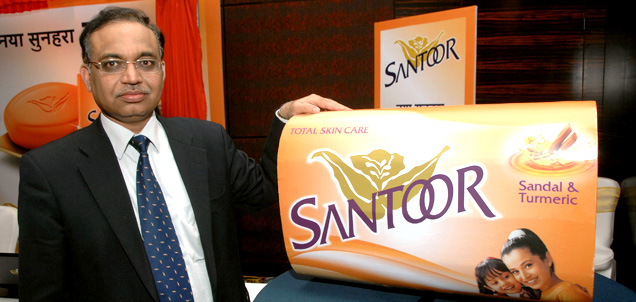
    Consistency in Communication: Anil Chugh, Senior VP, Wipro Consumer Care with a Santoor signage


    By Tuhina Anand


    Did you know that Santoor is the third largest soap brand in India? The brand, belonging to Wipro Consumer Care, has done well for itself by beating the international biggies and carving a niche for itself since it was launched in 1986. In the past 25 years, the run for the brand was not always so good, but a consistent and strategic communication has played a pivotal role in its success. Santoor is a Rs1,000 crore brand and has been growing at a CAGR of 23 per cent for the last five years.


    The communication has always focused on ‘younger looking skin’, but the portrayal has changed with the times to appeal women, who were earlier seen as homemakers to now those who excel in various professions – mirroring the changing aspirations of Indian women.


    Giving an insight into the Santoor story, Anil Chugh, Senior Vice President, Wipro Consumer Care, said: “Santoor is the third largest soap brand in India and the largest selling brand in the South + West India (value MS – 13.5 per cent). The ‘ageless skin’ campaigns and innovative marketing strategies have helped Santoor grow faster than the industry and gaining share over the years. One of the reasons for this is the consistency in communicating our core proposition of younger looking skin while keeping the message contemporary over the years. Also, our focus on providing the right value to the customer has contributed significantly to the brand’s success. The growth was also achieved on the back of a strong distribution network and communication in rural areas.”


    He added: “The strength of Santoor has been its promise which is consistent, powerful and eternally relevant to consumers. For over 25 years, the brand has delivered on the promise of ‘younger looking skin’ through superior product offerings which have used deep acting and trusted natural ingredients. Our campaigns have reinforced this message consistently. Over the years, Santoor has carefully chosen celebrities to endorse the brand and it has worked well for the brand.”


    While factors like distribution cannot be overlooked in the success of Santoor, the communication has been one of the key pillars. However, this was not the case always. MG Parameswaran, Executive Director & CEO, Draftfcb + Ulka elaborated: “When Ulka Advertising was assigned the brand in 1988, it was in a bit of a limbo, growth had stalled. The agency evolved the ‘younger looking skin’ and ‘mistaken identity’ as the key pillars for the brand. The advertising created history of sorts. The brand growth picked up momentum and Wipro has ensured that marketing money was well spent, through judicious correction in the messaging of the brand.”


    “In 1989, Santoor was basically selling in two states of Kerala and Karnataka. It was selling a fraction of what brands like Hamam, Rexona, Cinthol and Liril were selling. By focussing advertising on one promise and evolving it over time, Santoor has become one of the top three soap brands in the country.


    The advertising has evolved in many ways, but the core message of ‘natural ingredients for a young looking skin that will get you accolades’ has not changed. But the Santoor woman has evolved from being a pretty woman at a wedding to a confident woman who is doing aerobics, to a woman who plays cricket with her daughter, to a dress designer, to a TV anchor to a choreographer to a photographer. In a sense, the brand has reflected the aspirations of the new Indian woman,” added Mr Parameswaran.


    He is very clear that the success of its communication is purely because it tells a timeless story that always appeals. As he puts it succinctly, Santoor is about consistency in communication that adds a new layer with every new piece.


    In fact, as Santoor completes its 25 years, it has come out with a new campaign that is the Santoor anthem, giving it a contemporary look and feel yet telling the same story about a mother and daughter. The new advertising campaign features two ads – an anthem film that celebrates the achievement and pride of millions of Santoor women and a new theme film with new brand ambassadors – Saif Ali Khan and Mahesh Babu.


    Over the past few years, Santoor has grown from a single soap brand to talcs, deodorants, soap variants, liquid soap, facewash and so on. Mr Chugh said: “We will continue with our quest to keep the brand relevant and contemporary even in the future. The aim of new campaign is to take the Santoor brand to the ‘next level’. We are constantly looking at consumer needs and expanding/enhancing the brand to meet such needs. The brand has grown ahead of the competition in its core states and is now trying to break out of its traditional stronghold and make quick gains in other markets.”


    As a concluding note, Mr Parameswaran, who has been associated with the brand for almost two decades, said: “I am proud to have been associated with the brand for almost two decades. What is unique about the Santoor story is the great trust and regard this brand has spawned between the agency and client. It is has been a wonderfully rewarding experience and all of us in Draftfcb Ulka are proud of the association. It is not easy to take on large well-heeled multinational FMCG behemoths; we took them on and managed to find a place for Santoor under the Indian sun. The story is far from over. Santoor won against all odds and it will keep winning. I am sure of that.”


  • Amith Prabhu: PR frat needs a Goafest-like event

    By Amith Prabhu


    Goafest has become the annual jamboree for the advertising folks in India. And nothing wrong with that if it serves the purpose of those organizing and those attending. It is an expensive programme, especially for younger people. The cost to attend Goafest for a person varies from as low as Rs12,000 (if a person under 30 from Mumbai travels by road or rail and lives in very simple accommodation for 2 nights) to Rs40,000 (if a person over 30 from Delhi flies low-cost and lives in decent three-star accommodation).


    The point is that in all this effort and investment or spending (depends who pays the bill) very little is achieved for the industry in terms of learning. Most high profile speakers either use the opportunity to make a sales pitch or are not effective enough to make an impact (I have been to two events and seen for myself).


    The few who are impactful and are not making a sales pitch have few takers because they are either not well known, haven’t got the right publicity in advance and therefore those who should be listening to them are either on the beach or in their luxury rooms or sightseeing.


    The real achievement is for those who want a break and get it (most often fully or partially company sponsored), great work done in the year gone by gets rewarded (sometimes with controversy), people seeking a job change get to meet their potential employers and those who want to catch up in a non-work environment with former colleagues and buddies get to do that.


    Some PR professionals attend because they are involved in some way with the organizing and some others are connected with the ad agency that has a big role to play.


    But most inspiring of all the achievements is that all the big boys and girls in creative and media agencies who fight it out like bitter rivals in new business pitches and industry awards between May and March come together in April to celebrate the profession. And this to me is remarkable. No doubt there are a handful of boycotts that happen each year, but those are bound to happen and frenemies come and go.


    Cannes, around which part of Goafest is modelled, embraced PR a couple of years ago by including a separate category for PR and having a full-fledged PR jury. I’m not saying Goafest should do that. I’m here to seed the idea of a gathering of PR professionals from around the country. Head honchos of PR firms can collectively do a lot for the industry and the young and mid-level professionals. The three things they should do at break neck speed is put together a forum for PR professionals modelled on PRSA, create an industry award that is transparent, world-class and the gold standard for younger professionals to gain inspiration from and plan a gathering of PR professionals over a weekend to learn from each other. Networking is no longer a major need in the age of Facebook, Twitter and frequent after hours parties in the metros.


    There are several forums that function formally and informally in the PR space. But none that brings together corporate communication executives and public relations professionals, at all levels and of all ages, under one umbrella. It is time for a body that works closely and learns from PRSA. There is so much it does through several chapters for the betterment of the practitioner. With almost 15 of the Top 20 global PR firms present in India there is scope to even be handheld by one of the well-established forums.


    Thereafter, this organization should establish a PR award that enables entries to compete in the global arena. There is a major vacuum that needs to be filled and no one can help us on this but ourselves.


    Finally, the PR fraternity of India needs an annual event where PR professionals get together, listen to experts fromIndiaand around the world and celebrate the profession keeping aside differences for 48 hours at least, if not more. Maybe this could be called PondyPoweR and be held at Pondicherry on the east coast ofIndia. Symbolically, a quaint town with a rich heritage, near the beach for those who want to mix learning with fun.


    Hope this happens sooner than later, so public relations people can ponder on how to do some Public Relations for themselves, their firms and most importantly for the profession.


    Amith Prabhu is a public relations professional who spent a large part of his career in India and is now based in Chicago working for a PR major. Views are personal and do not reflect that of the writer’s employer. 


  • Need for industry leaders to deliberate on biz of advertising: Sam Balsara

    Always the one with the questions, Madison’s Sam Balsara was his usual self at the sessions as he questioned a few ideas and provided his solutions on the same. MxMIndia got Mr Balsara to briefly share his stance on the sessions this year and sought his recommendations for Goafest 2013.

     

    What would be the takeaways from the sessions over the three days?

    I think the sessions this year have been excellent; the quality of speakers has been high this year. I think it’s all credit to the growing brand equity of Goafest that we have been able to attract so many international speakers of repute. There have been some good broad learnings; it’s not that we didn’t know about them but these speakers of stature have reinforced the belief that advertising is moving from one to many – from conversations to stories. Clearly digital seems to be the mantra of today. The sessions were woven around the magic of advertising, I think John Philip Jones came out with a refreshing and different quantitative view on how not to get carried away on what you think and I think are the required numbers. His basic message of not having share of voice or a good share of the market means that you are getting into a dangerous area. I think it is pretty important for many brands inIndiato take note of.


    A word on the Media Abby awards held this year…

    Though we did emerge a big winner, I think the enthusiasm among the crowd was low compared to the earlier years. This possibly may be due to the awards being distributed far more in quantity this time – but this is a good thing for the industry and will encourage more participation.


    What are your recommendations for 2013 to the Goafest committee?

    A significant recommendation that I have is more related to the Business Conclave, which I feel needs to be relooked at. The original idea of a business conclave is for a few industry leaders across the spectrum of advertising, media agencies and so on to sit together in a roundtable and discuss the issues of business of advertising and how to make it profitable. Also, we need to invest more in talent and learning. Right now I think it has become an extension of the sessions and we need a sharp a dividing line between the business of the advertising seminar and the knowledge seminar. I think we need to bring that back.


    Click here to view all Goafest 2012 stories


  • All roads to a bigger, beerier Goafest!


    By A Correspondent


    It’s the time of the year when the adfrat congregates in Goa for the sun, sand and loads of learning. And may we add: gallons of beer. As Goafest 2012 begins at The Zuri White Sands in South Goa today with the industry conclave, one will see more than 3,000 people get together to celebrate creativity.


    Says an ecstatic Arvind Sharma, Chairman, Goafest 2012: “We were ourselves surprised with such an encouraging response. This year will see the biggest crowd gather in the history of Goafest.” If the number of registrations has skyrocketed, guess will so be the consumption of beer and assorted liquids. Remember, the excise levies are perhaps the lowest in the country in Goa!


    “Goafest 2012 is a brand owned by the advertising and marketing fraternity. The high numbers that will attend the festival goes to show that fraternity looks at it as an extremely responsible event that is representative of the industry. We have an outstanding line-up of speakers this year, the process of judging has been rule-based and transparent and the jury has been extremely happy with the quality of entries that have come in. I just hope that people will enjoy the Goafest, Mr Sharma adds”


    Goafest will start, as has been the norm, with the Advertising Conclave with the theme Ideas That Impact the Full Circle. The session will begin with the welcome address by Nagesh Alai, President, AAAI. Srinivasan K Swamy, Chairman, Goafest Advertising Conclave will give his address on the theme of the Conclave. This will be followed by introduction of speakers by Arvind Sharma, Chairman, Goafest 2012.


    Jean-Yves Naouri, COO, Publicis Groupe and Tim Love, CEO, APIMA, Vice Chairman, Omnicom Group will give a global insight to the theme of the conclave. Jayant Murty, Director of Strategy, Media and Integrated Marketing, Asia Pacific Region, Intel Corp will speak on building brands in the era of multiple degrees of freedom. The last session will be a panel discussion on the theme which will be moderated by Anuradha Sengupta of CNBC TV18.


    Post the Conclave, April 20-21would have seminars during the day and awards night. On Day 1, the sessions will start from 2.30pm and the speakers would include Lucas Watson of Youtube, Jonathan Mildenhall of Coca-Cola, Tim Love of Omnicom, Charles Wright of Wolff Olins. On Day 2, one would get to hear author and brand guru Prof John Philip Jones, Rishad Tobaccowaala of Vivaki, Erik Vervroegen, Publicis Worldwide and Simon Wardle. These sessions will begin from 11.30 am.


    This year, Goafest has included segments that would appeal and include the marketers to their fold. During the seminars, a leading marketer would pose questions to the speaker and also bring an Indian context to the entire session even giving his or her interpretation.


    Some of the marketers who would be part of the sessions include: N Rajaram of Airtel, Sanjay Behl of Reliance, Kainaz Guzdar of P&G, Rajesh Jejurikar of Zee, Viral Oza of Nokia, Gayatri Yadav of Star and Hemant Bakshi of HUL. Goafest has also introduced the Marketing Wizards encouraging marketers under 30 years of age to participate in the fest.


    In the case of the awards, the number of jury members in each category has been increased to give a better representation. The number of Grand Prix too has been extended to all 9 categories (10 if film and film craft is considered separately).


    The focus has been to make the awards bias-free (as they ought to be!) and the Goafest Committee has brought in many filters to ensure that awards are held in high esteem by the fraternity. Also there are entries and delegates from Sri Lanka, Pakistan and Bangladesh this year.


    On April 20, the Media Abbys Night will be held where Digital, Design and Direct Abbys will also be presented and on April 21, the rest of the awards will be given including the coveted Creative Abbys.


    On the downside, while Lowe continues to skip the awards, among the bigger agencies, McCann too did not send any entries though it is learnt that folk from the agency will attend the fest.

    Click here to view all Goafest 2012 stories


  • 8 days to Go-Goafest: Ajay Kakar on why the client frat should not attend Goafest!

    By Ajay Kakar


    I do believe that as a client/marketer you should definitely not waste your valuable time attending the Goafest…


    …if you believe that agency partners have no role to play in the building, nurturing and success of your brand


    …if you believe that the output of your agency partners is mere creatives


    …if you believe that your agency partners do not value your presence and encouragement


    …If you believe that your agency is a mere vendor


    …If you have not certified the entries made by your agency as your work, actioned by you


    …if you believe that agency partners do not want to share their success and joyous moments with you


    …if you feel that it is ‘their’ win and you have had no role to play in it


    …if you do not feel a sense of ownership and pride to see your agency win


    …if you do not want to partake in their success celebrations


    …if you do not feel the need to be by the side of your agency team, holding their hand – in case they do not win


    …If you do not hope and aspire that some day your agency will do work that is worthy of industry recognition


    …if you feel that there is nothing that you have not seen, or there is nothing left for you to learn from


    …if you do not feel inspired by work that has won the recognition of a distinguished panel of jury


    …if you do not feel the need to be inspired by speakers who have proved their mettle against the best of the best – in India and abroad


    …If you believe that the only place for good creatives to be displayed at is the Jehangir Art Gallery


    …If you would not like to see all the best work done, from across the country, from across agencies, across the year, at one place – at one time


    …If you do not like to meet your peers from the advertising, media and marketing fraternities


    …If you believe that the 3000+ people who went last year have wasted their time


    …If you….


    Rather than think, procrastinate and defer the decision, come and experience the learning, the networking, the inspiration, the bonding….kuch din to gujariye Goafest men. And I can assure you that you will come back for more. Take it from a client who has been there every year, with a contingent size that could be the envy of many an agencies.


    Ajay Kakar is CMO – Financial Services, Aditya Birla Group


    Click here to view all Goafest 2012 stories