Tag: advertising

  • Kajol stars in new campaign of Google Pay

    Lowe Lintas has recently launched a campaign in collaboration with Google Pay, digital payment platform. The campaign, starring actress Kajol, seeks to highlight the unparalleled confidence, solace, and peace of mind experienced by users while utilizing the payment app.

    Sharing his thoughts on the campaign, Naveen Gaur, Group Chief Operating Officer (Growth & Innovation), MullenLowe Lintas Group said: “With digital payments becoming an integral part of our daily lives, we wanted to reiterate and reassure users about GPay’s ability to handle their payment needs in a simple, secure and fast way. To bring this to life, we let the product take centre stage with the audio and visual mnemonic of the blue tick serving as a positive reaffirmation of a seamless payment on the app. Be it merchant payments, Fastag or mobile recharge, our protagonist Kajol and her family and friends go about using GPay effortlessly. Supported with a musical track in the background reinforcing ‘Sab Tick Hai’.”

    Added Mohit Pasricha, Unit Creative Director, Lowe Lintas: “Consumers are not writers; they don’t express emotions like we might. Their trust reflects in many different ways. One such way is how they enunciate and call out the brand’s name. This is the simple observation we proceeded with. The way one might say ‘Google Pay Hai’ says it all.”

  • Brands Navigating the Social Class Divide: Lessons in Sensitivity from Past Campaigns

    Photo source: Tweet by Neeraj Ghaywan (@ghaywan) at https://twitter.com/ghaywan/status/1666667224273403908?s=20


    By Hamsini Shivakumar & Prabhjot Singh Gambhir


    Hamsini Shivakumar
    Prabhjot Singh Gambhir

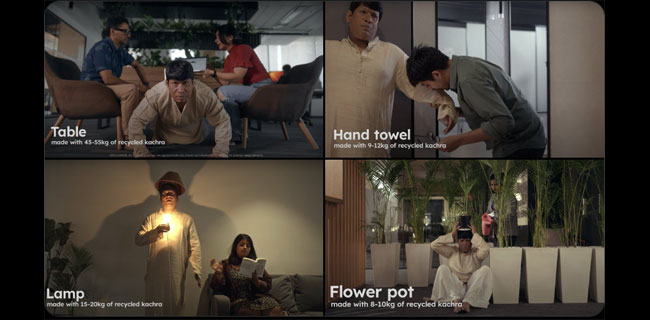
    Zomato’s recent campaign aimed to raise awareness about recycling waste on World Environment Day. However, the use of the character ‘Kachra’ from the movie Lagaan inadvertently reinforced stereotypes and perpetuates the devaluation of people from a specific class. Although the brand intended to employ wordplay in the video, the end-result appears culturally out of sync. The humour in the video appears to be mocking the already marginalised rather than challenging those in positions of power. The video received a lot of backlash on social media, which eventually led to Zomato deleting the video itself from all platforms.


    When faced with these social class divides, brands and their creative agencies are confronted with a unique challenge. Traditionally, marketing has approached class divisions as issues of affordability and accessibility for consumers. The solution typically involves offering products and services at various price points to cater to different segments of the market.


    Think of shampoo sachets, and phone recharges priced at Rs 10. Market segmentation based on affordability addresses the problem of access, ensuring that every consumer can afford and desire products within their price range, whether at the lower end or luxury segment of the market.


    However, addressing the social class divide as a brand in brand communication presents a distinct challenge, as it raises questions about portrayal and representation. It forces brands to examine their vantage point and ideological stance. If a brand aims to project itself as embracing progressive values, how should it navigate the complex issue of social class and class divides?


    This is particularly relevant when it comes to the portrayal of domestic help and their treatment in advertising, especially for brands selling household cleaning products and related items. How should they depict domestic help? Should they merely reflect reality as it is, or should they encourage consumers to adopt more progressive behaviours?


    To effectively navigate the intersection of brand communication and the social class divide, brands can draw valuable lessons from previous campaigns that approached similar subjects with sensitivity. Let’s take a look at some examples of how some brands have approached this issue in the past:


    Ghadi Detergent:


    In Indian popular culture, domestic help is often portrayed as solely responsible for the cleanliness and maintenance of households, perpetuating the notion that it is their sole duty while family members contribute little. Such stereotypes create a power imbalance between domestic help and the families they serve, with the latter holding all decision-making authority.


    Ghadi Detergent’s campaign, #SaareMaelDhoDaalo, deviates from this stereotype. Instead, it encourages individuals to recognise the importance of every task, no matter how small, and to treat domestic help with respect. The campaign depicts a young boy with a callous attitude towards the work performed by the house help. To rectify his behaviour, his mother decides to teach him a lesson by having him clean the house under the false pretence that the house help is on leave. In the end, he learns to appreciate the domestic help’s contribution and even pays him extra to celebrate the festivities.


    Women’s Day 2019 #YourSecondHome : An initiative by PregaNews


    Similarly, PregaNews launched its Women’s Day 2019 campaign, #YourSecondHome, which highlights the importance of domestic helpers and their contributions to households.

    The content begins with a woman scolding her domestic help and asking her not to perform her usual tasks. It appears that the domestic help’s job is at risk. However, as the narrative unfolds, we discover that the woman is actually reducing the workload of the domestic help due to her pregnancy and invites another domestic worker to assist. The campaign challenges initial perceptions by portraying the employer as caring and considerate, much like a family member would be.


    The messaging of the campaign promotes progressive ideals, advocating for empathy towards domestic workers and providing them with benefits such as maternity leave or reduced workload during pregnancy, similar to practices in the organised sector. The brand, PregaNews, seamlessly integrates into the narrative of the ad.


    Cadbury Dairy Milk – Driver


    The work features a boss driving his driver to his child’s school so that he could attend the parent-teacher meeting. While the content is only 45 seconds long, it is quite impactful. We immediately get to understand the dynamics between the employee and the employer and how this is a routine activity. We understand how his boss is being kind and patient towards him and goes out of his way to help him.


    The video shows how a small gesture of kindness towards one’s driver/staff can make a significant difference in their life. The brand integration of Cadbury Dairy Milk is also quite seamless, as it plays on the factor of the boss ‘being sweet’ and sweetness is associated with the chocolate in question.


    Oswal Refined Soyabean oil


    Oswal Refined Soyabean oil’s campaign portrays a positive image of domestic helpers by showcasing the relationship between the wife and her employee. While the husband is upset that the domestic help always leaves early to attend to her children, the wife, on the other hand, is accommodating as she knows that she works well and efficiently. One day, when the wife is out of the city, the maid bakes a cake for the husband and stays late at night just to celebrate his birthday so that he does not feel isolated on his special day.


    The video emphasises that domestic help is not just the staff of the house, but a part of the family, and employers should be accommodating to their requirements.


    However, while the ad’s story has a nice recall value, the brand takes a backseat here. The brand integration of Oswal is not quite as seamless because the story is not built around refined soybean oil. Even a slight mention of it in the narrative would’ve helped the brand integration.


    Facebook | More Together – Pooja Didi


    Facebook’s campaign, More Together – Pooja Didi, is a heart-warming portrayal of support staff. The content initiative can almost be categorised as a mini-short film, as it is about seven minutes long. It highlights the problem of unemployment during the pandemic and how the protagonist – Pooja, starts hiring people in large numbers to provide them with gainful employment solely out of her altruistic intentions.


    However, when she cannot pay the salaries and bills to the people she does business with, she is in a state of crisis. That is when the hired staff of her sweet shop utilises the power of social media to narrate the story of Pooja’s altruistic actions, which end up attracting customers to the shop, thus enabling her to pay all her bills.


    Conclusion

    All the brands seem to take the high power distance between employers and domestic help for granted as a given in Indian society and thus mirror existing realities. They don’t show the possibility of a different future for domestic help (except the Cadbury ad to some extent) in which they can be empowered and assertive of their rights vis-a-vis their employers.


    The convergence of brand communication and the social class divide poses both challenges and opportunities for brands. By being mindful of the implications of their messaging, brands can strive to create advertisements that promote empathy, understanding, and equality. Actively working to dismantle stereotypes and biases, brands can contribute to positive social change.


    Hamsini Shivakumar is a long-time culture-watcher, semiotician, brand consultant and co-founder of Leapfrog Strategy as well as Semiofest, the global unconference for applied semiotics. Prabhjot Singh Gambhir has done his Masters in Film Studies and is passionate about stand-up comedy. He has now turned his observant eye to cultural discourse and its intersection with brands. The views expressed here are their own.


  • PoV by Pallavi Mathur Lal: It’s time for brands to bring sustainability conversation to consumers

    By Pallavi Mathur Lal


    Sustainability is a complex encompassing term that refers to the ability to maintain resources for use but also for future generations. While it is often associated with natural resources, it includes societal and economic resources. As Sustainability or ESG (Environmental, Societal, Governance) movement gathers steam all over the world, we see many ‘push’ factors for businesses and companies.


    In India, we see many actions of global companies as they follow their global directives as part of the UN Global Compact (2000), to adopt sustainable and socially responsible policies and practices. We see many corporates and businesses, both in public and private sectors, refer to the SDGs (17 UN Sustainable Development Goals formed in 2015) as informing their wider sustainability strategies.


    While Governments, NGOs, and businesses have sustainability mandates, the consumer sphere is still lacking this new infusion of sustainability as a critical focus.


    Sustainability, however, is not easily sold to consumers: In a global survey conducted by Ipsos on consumer attitudes toward sustainability issues, it was found that consumers hold companies and governments responsible for sustainability. They are willing to act but feel that their impact as individuals is limited. This is true if you look at the stats – the responsibility for 71% of global emissions lies with the top 100 companies!

    Brands and businesses, hence, have a crucial role to play in promoting sustainability, as they are major drivers of consumption and resource use. Brands have the window with consumers to communicate directly about their values and benefits. India, however, as a market is not as mature as the Western, more developed markets and so the questions for us are: Are consumers ready for this? Will it help brands to strengthen their relationship with consumers, ultimately moving towards consumers considering, buying, and advocating their brands?

    As per the Ipsos Global Trends survey 2023, in India, 60% of consumers strongly agree that we are headed for environmental disaster unless we change our habits quickly. Even with this realization, we know that sustainability is not an easy sell to consumers – the say-do gap is real. From another BCG Global study we know that while 80% consumers in 8 countries (including India) were concerned about the environment, only 1-7% have paid a premium for sustainable purchases.

    Seeing this hesitation in consumers, brands are also holding back talking about the sustainability benefits for the fear of being perceived as being more expensive and losing consumer approval (and demand). However, in this circle of communication and action, brands need to bring more progressive messaging toward the environment and even the societal action that they take. In this way, they build more value around sustainability.


    What brands can do to establish the right connection?: This is like the chicken and egg situation: Should the brands start talking sustainability first (even when the consumers seem unwilling) or should the consumers start demanding it first and then the brands get into action. Sustainability will come into the conversation sooner than later. There will be some brands which would have started building the connect early and benefiting from it, while other brands will be slower and more reactive.

    In addition, for brands to talk about sustainability and use the right messaging is tricky. Unless brands have sustainability built into their core, into their strategic priority, the messaging can backfire. Consumers are wary of, and call out greenwashing, which can end up harming the reputation of the brand, and examples of Volkswagen in 2015, and of H&M more recently in 2022 are before us.


    So, what can a brand do to establish this right connection with their consumers? Here are some research-backed pointers:

    1. Communicate the Co-Benefit: Sustainability as the key benefit, with a higher price is not going to go down well with the majority. All said and done, we have seen that the mass consumer is not going to pay extra for just a sustainable claim or benefit. Consumers still need to see any product performing well on its functional aspects or cater to them emotionally, with sustainability at best being a co-benefit.

    2. The ‘Push’ doesn’t work: Any ask/ call-to-action that requires a change in set behaviour patterns or a habit is going to be difficult for consumers to adopt. Hence, marketers are looking for ways to make changes in their products and packaging which do not alter or modify the performance of the product, nor does it expect consumers to make substantial changes.

    3. Create the ‘Pull’: An Ipsos meta-analysishas shown that it is important to focus on people, and their problems, rather than just the brand which is providing the sustainability message. No surprises here – consumer-centricity is already a mantra we follow, but this means that we need to dig even deeper into concerns, behaviours, and problems to see how we first highlight the key problem that the consumers are facing. After establishing this, and showing the current non-sustainable practices, a more sustainable solution can be offered by the product or brand.


    Use authentic cues and messaging – Dipping into our cultural heritage, and sustainable practices: The way awareness about the climate crisis is increasing and sustainability conversations are making their way into many aspects of our lives, brands will have no choice but to directly or indirectly cue that they support sustainability, promote some cause, or propagate good practices to stay connected to consumers. Fortunately, we have some particularly good practices in India, from our heritage and cultural roots, that brands can leverage to cue their sustainability leanings.

    :: Living in harmony with nature: Our traditional ways are nature and animal friendly and about peaceful coexistence with them. Some of our religions have us worshipping plants like tulsiand using plants for medicinal purposes and for cooking and flavoring. We also have in our mythology, animals as avatars of gods and goddesses or as mounts, making us sensitive and protective about animals.

    :: Frugal, low wastage, savings ethos: In India, we have an ethos of wasting very little material or food and conserving our resources. Traditionally, we have always saved money for the future. Food wastage is also not in our nature. Worshipping Annapoorna Devi, the goddess of food and nourishment, ensures that we have a respectful relationship with food and food sources.


    Frugality, to some extent, is getting replaced by ‘living life to the fullest’, ‘living for the moment’, YOLO and what have you. However, the frugal mindset does exist in our collective recent memories and can be rekindled by showing the positives associated with the larger good.

    :: Sustainable materials: Our everyday utensils are made of stainless steel and traditionally of brass or copper – unbreakable and non-disposable. This ensures long-lastingness and a one-time investment that pays off for years. Traditionally we have also used banana leaves which can be discarded, are biodegradable, and avoid the use of any cleaning materials. Till even three decades ago, plastic had not made such inroads into our daily lives. We used sustainable materials like paper to wrap things and carry bags. Cloth bags were carried when we left home for shopping and used for bringing back groceries and vegetables. Using earthenware to keep our water cool, was another sustainable way – with refrigerators and ACs being a relatively recent phenomenon.

    :: Sustainable practices: Till some years ago, new clotheswere bought only on birthdays or festivals. Maintaining one’s clothes or other objects around the house (like furniture or upholstery) was a matter of pride and care was taken to preserve them for years. We wore hand-me-downs not only from our own siblings but also cousins and neighbours’ older children. We also had their toys and books. In fact, the ‘pre-loved’ clothing trend is a hark back to the same philosophy. Bathing was from a bucket and not from water-wasting showers.


    With all this context, it seems that brands need to start the conversation on sustainability with consumers already. Consumers understand and are concerned about the Climate, about the environment. The increased conversation – cued directly or indirectly – will help highlight the criticality and will increase the value of a sustainability benefit to the consumers. There are consumers who will appreciate a brand for its progressive portrayals and messaging regarding sustainability, consumers who will bond with brands who start these conversations with honesty and transparency, and consumers who are looking for brands that fit with their own values and ethics.

    Brands also need to look at ways in which their sustainability claims and benefits make the most sense to consumers, by viewing them from a consumer problem-solving perspective. Our recent foray into globalisation and our memories of sustainable practices that we followed not too long ago can become part of these brand-consumer conversations – making them more realistic and relevant to the consumers.


    Pallavi Mathur Lal is Senior Director and Head of the Knowledge Initiative at Ipsos India
     

  • AI, B2I, CI & Advertising


    By Ashoke Agarrwal


    Ashoke AgarrwalAdvertising sits at the interface between marketing and media.

     

    Therefore, the impact of technological change in the media world has had a lasting effect on advertising. Advertising’s first phase of evolution was from being a press-driven cognitive medium to the emotive resonance of the radio age. Then, in the television age, the emergence of video changed the very grammar of advertising. And now, in the Internet and social media era, advertising is trying to come to terms with a shift from being an intrusive form of mass persuasion to learning to be interactive and conversational.


    Historically, technological changes in spheres other than media have had a peripheral effect on the business of advertising. For example, computer technology has improved studio, planning and operations productivity.


    A new era of technological disruption is approaching with the gathering emergence of AI in its various avatars. But what will the effect of AI be on the business of advertising? Will the impact be peripheral, or will it affect the core? Two alternative scenarios emerge.


    Like the IT age, the AI age may only affect the productivity of advertising agencies. For example, the AI age could lead to a more efficient and faster path from idea to campaign production. Creative departments could use AI-driven CGI to create photographs and videos using avatar-licensing arrangements with celebrities, influencers, and models. Strategic and media planning could use Deep Learning engines that probe research databases and Big Data to deliver more effective plans. Operations could be more streamlined with meeting memos and day-to-day communications handled by bots. The lead in productive efficiency and effectiveness that the AI age brings to the advertising business could be as high or even higher than the IT age.


    The second scenario is when AI disrupts the very core of the advertising business. Imagine a situation where due to advances in AI, advertising as a business, if it was to continue to exist, has to sit between marketing and the individual and not as it currently does between marketing and media.


    Marketing in the AI age could morph into a discipline which truly owns the consumer relationship. Today companies act in the world of mass marketing. So much of a company’s marketing, sales and advertising budgets are wasted on addressing consumers who will never buy their products and brands. Tomorrow marketing could shift to being the art and science of marketing the brand to an individual, one individual at a time. Let’s call it B2I marketing. A B2I brand will focus on owning and nurturing the brand’s relationship with a specific individual, individual by individual.


    A B2I brand’s product development, distribution, marketing and marketing communication budget will be an accretion of the resources required to build and nurture the relationship with a specific individual, individual by individual.


    The age of B2I marketing will dawn when AI leverages a slew of other technologies. Robotics-assisted flexible manufacturing technologies will enable the customization of products. High bandwidth, low latency mobile and IoT networks combined with real-time Big Data analytics will drive true customization of services. In addition, the maturing of delivery drone technologies will facilitate D2C distribution. Finally, Deep Learning engines will sit atop the entire ecosystem to build ROI across the system.


    The brand will become, in essence, an AI entity in touch with individual customers. And marketing will shift to the next generation of the Service-Dominant-Logic (SDL) paradigm as outlined in my MxM India column dated 27th October 2022.


    The AI brand-side revolution in marketing will also have a consumer-side AI facet.


    As AI scales over the coming decade or two, it will develop as a “consumer appliance”, which I call Concierge Intelligence (CI). I have written about CI in my MxMIndia post on 6th January 2002 titled “The Coming Post-Digital Age.”


    An individual’s CI will communicate with the brand’s AI in two-way, always-on, low latency, Big Data cognisant communication. The objective will be to maximize the individual’s satisfaction levels with the brand while driving the brand’s ROI.


    The question now is if, in the AI age, marketing morphs into B2I marketing, what will become of the business of advertising?


    If it is to exist in the age of B2I, advertising will become the art and science of always-on, customised two-way conversation between two sets of AI engines- the brand-side AI and the individual-side AI (CI).


    It stands to reason that the business of advertising agencies will then become the business of creating proprietary AI designed to deliver the most effective communication between a brand’s AI and an individual’s CI. Brands would go to external agencies to develop this AI because of the same reasons they prefer external advertising agencies today over in-house cells – specialized expertise honed over multiple brands.


    The dawning of the digital and social media age allows agencies to develop the planning and creative chops to deliver effective two-way one-to-one conversations with consumers. But, alas, most traditional agencies are frittering away the opportunity by delivering digital and social media campaigns that follow the time-worn principles of aiming one-way campaigns at an amorphous mass of consumers.


    A few tech-driven marketing communication agencies are beginning to hone the technology and creative nous that will enable them to deliver the AI and two-way conversational advertising of tomorrow.


    To sum up, the age of AI in one scenario offers substantial productivity gains to both creative and media agencies. However, in the other scenario, the age of AI could make creative and media agencies obsolete.


    Under this scenario, marketing communication will morph into a specialised and customised AI engine that drives brand-building conversation between the brand-side AI and the consumer-side AI (CI).


    Tomorrow’s marketing communication agencies could then very well be AI specialists. Specialists who build and operate proprietary AI customised to a brand’s AI ecosystem to interact with various types and levels of individual AI (CIs). To nurture and develop brand-to-individual relationships.


  • 1 Minute View: Future Shock for Ad Agencies?

    1 Minute ViewMxMIndia columnist and veteran adperson Prabhakar Mundkur has very effectively pictured the state of affairs as they exist in the advertising business. His article appears on MxM today at: http://www.mxmindia.com/2019/01/future-still-fuzzy-for-communication-agencies/
    The advertising business in India has had one of its worst years last year. We don’t know if the state of the economy is the cause (demonetisation, GST etc) or it’s a global phenomenon where digital and consulting firms are taking over the business, but the future, as Mundkur writes, is indeed fuzzy for creative agencies. The going is set to be tough for media agencies as their role gets diminished by the Accentures of the world as well as standalone and more agile digital shops.

    So is it a cul-de-sac for advertising? Perhaps, if one looks at things from the traditional prism. However, one must remember that people hire the services of advertising agencies for creativity. Creativity in creative work produced, creativity in the form of innovative ideas and creativity in the form of strategy and effectiveness.

    If creativity continues to be be the primary driver of an advertiser-agency relationship, the path ahead for creative agencies needn’t be fuzzy. In fact it could well be fun.

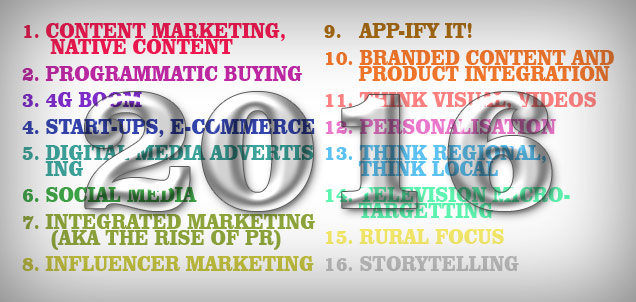
  • 16 buzzwords that will trend in A&M in 2016


    1. Content marketing, native content

    Yes, there may be a thin dividing line between advertorials and paid content being passed off as the regular thing, but in the digital domain, care is being taken to tag sponsored content and not devalue the brand. Other forms of content marketing will also gain ground, especially for products and services that need to promoted by editorial-like offerings


    2. Programmatic buying

    The large media agency networks and clients are talking of this already, but as the year progresses, programmatic will be the way to go on digital. Will it work for television and print? Not anytime soon.


    3. 4G boom

    Airtel, Idea and Vodafone already have their 4G offerings, and Reliance Jio recently launched it for its employees. Expect loads of action on the advertising and promotion front on this. But the real difference will be after the service becomes operational pan-India. Digital devices will boom.


    4. Start-ups, e-commerce

    We won’t get into the statistics of how many start-ups are launched every few hours in the country, but more than ever before, the start-up culture will proliferate. Not just in dotcoms, but also towards service-providers in the field of A&M


    5. Digital media advertising

    The smartphone is ubiquitous, not just in the towns and cities, but also in the hinterland. Once 4G becomes a reality — and with the government figuring that it is its telecom infra that will drive the nation — expect digital media advertising to finally take off.


    6. Social Media

    Social media just cannot be ignored when it comes to reaching out to the connected generation. There are already a category of goods and services whose primary medium is social. This is only going to increase as Facebook, Instagram and Twitter start doing their damnedest to reach out.


    7. Integrated marketing (aka The Rise of PR)

    Thanks to the rising costs of traditional media with doubts being expressed on its efficacy, there is a greater emphasis on integrated marketing. For instance, while public relations was always considered important by organisations, with social media around, it is now being actively integrated into the marketing function


    8. Influencer marketing

    While at one level it’s the way to go, given the rising influence of social media, reaching out to influentials in the environment they inhabit, also becomes crucial.


    9. App-ify it!

    Apps are everywhere, and a surer way to reach out to consumers and prospectives. In 2016, more and more consumer-facing organisations will app-ify their interactivity.


    10. Branded content and product integration

    With direct media costs becoming prohibitive, product integration with content – especially in films, television and print — is going to the order of the day.


    11. Think Visual, Videos

    With attention spans decreasing, the emphasis is on engagement and what better way to achieve this than with a visually-appealing presence. Digital is going to boom with videos. Okay, this was set to happen two years ago, but with 4G around, it’ll just become simpler.


    12. Personalisation

    It’s easier done in digital, and that’s the way it will be for websites and apps on all platforms. Give the consumer what s/he wants, goes the adage.


    13. Think Regional, Think Local

    With the growth of the digital medium, and digitally-served traditional media, the growth in going local will increase. With strong regional play, digital can leapfrog ahead. Shall we say, only with strong regional play…


    14. Television micro-targetting

    This isn’t new with geo/micro-targetting already on in television, and tried out much earlier in print. In digital, too, it’s easily done. More and more marketers will seek that in 2016.


    15. Rural Focus

    This is not just because of the recent introduction of rural audience measurement by the Broadcast Audience Research Council (BARC). Rural consumption is growing, and with better mobile connectivity, even media-dark pockets will see consumption of content and services.


    16. Storytelling

    With all the emphasis on technology and forms of delivery, remember what’s most important is the craft of telling a story. Often, strategy and the creative message are thrown out of the window, and it’s all considered a waste of time and money. Perhaps not.


    This first appeared in dna of brands dated January 4, 2016


  • Cannes Lions announce remaining jury line-up

    By A Correspondent


    The Cannes Lions International Festival of Creativity, which this year celebrates 60 years of creative excellence in advertising and communications, has completed the jury line-up by naming the members of the Design, Film Craft, Media, Promo & Activation, and Radio Lions categories.


    The remaining five juries will be led by Jack Klues, Chairman, Vivaki (Media Lions); Joe Pytka, Director, Joseph Pytka Productions, USA (Film Craft Lions); Mary Lewis, Creative Director, Lewis Moberley, United Kingdom (Design Lions); Ralph van Dijk, Founding Creative Director, Eardrum, Australia (Radio Lions); and Rob Schwartz, Global Creative President, TBWA Worldwide, USA (Promo & Activation Lions).


    Philip Thomas, CEO of Lions Festivals, said, “It is a privilege to have an assembly of such esteemed industry professionals in Cannes to judge and award the best work. And we are particularly delighted to count on 11 past Cannes Lions jury presidents amongst the total 308 jury members taking part in this year’s 16 different juries. The time, commitment and integrity applied to their task ahead will have a profound effect on moving the industry forward at a global scale.”


    The extended deadline for submitting entries is 19 April. Information and tips on how to enter are at http://www.canneslions.com/awards/. Judging and announcements of the shortlisted and winning work will take place in Cannes, France, during the festival week, June 16-22.


  • Madison Media appoints Amit Duggal as Director Digital

    By A Correspondent


    Madison Media has announced the appointment of Amit Duggal as Digital Director to head its Delhi and Kolkata Digital business. Mr Duggal joins Madison from Mindshare, and will report to V Achuthan Kutty, overall Digital head of Madison.


    Mr Duggal has about 10 years of experience in advertising and digital, having worked with agencies like Indiatimes.com, Yatra online, Travelguru.com, Geodesic, Attano.com on the digital side and Rediffusion DY&R, Leo Burnett and Percept on the agency side. His last position was with Mindshare where he was Partner Invention, leading the Digital practice for Pepsico.


    Said Gautam Kiyawat, Group CEO, Madison Media, “We are delighted to have Amit lead our team in Delhi and are confident that he will be able to add a lot of value to our digital clients and help them make Digital a significant driver of their business and also win new business”.


    Mr Duggal said, on his joining Madison, “I am excited with this new opportunity and looking forward to contribute to an impressive roster of clients that Madison has.”


  • Hot Wheels takes ‘Don’t Drink & Drive’ message to pub door

    By A Correspondent


    While Hot Wheels is known for epitomizing ‘thrilling vehicle experiences’, it wanted to also impart the message of ‘Don’t Drink and Drive’. O&M Mumbai studied the views and opinions of drinkers and from their discussions drew an insight – almost every drinker believes that it is absolutely safe to drive after a drink or even two drinks. However, the medical reality is that even a single drink can impair the senses of the driver and this fact is dismissed by most as trivial.


    Abhijit Avasthi, National Creative Director, said, “Drinking & driving messages can get too preachy. This is a fun way of reminding us of the consequences of drinking and driving. A simple idea with a strong message. Hot Wheels along with ‘The Little Door’ (a pub) and ‘Party Club Drivers’ (an after-party driver service) decided to do something unique to spread the social message  ‘Don’t Drink and Drive’. We wanted to impress this fact upon people but when they were least expecting it – this was the idea. So on a Friday evening with the support of our partner pub, The Little Door, we laid emphasis on this social message to people who were most likely to be casual about driving back after a few drinks.”


    When car owners arriving at the pub handed over their car keys for the valet to park, we attached specially designed key chains to the owners’ car keys. The key chain we attached had a damaged Hot Wheels car (depicting a car that’s recently been in an accident) with a message that read, “Even a Small Drink Is Enough”.  Attached with the keychain was a tag that had the phone numbers of the Party Club Drivers. When the car owners were exiting, they were handed out their keys with the attached Hot Wheels key chain that carried the social message.  This shocked and alarmed the drivers as the visual impact was powerful. “But most importantly, the reaction was positive. Many decided to call the driver service to drive them home and some called friends and family to pick them up,” Mr Avasthi shared.


    The Hot Wheels message was driven home: Drinking, no matter how less, should never be mixed with driving.


    Rahul Bhowmik, Director-Marketing, Mattel Toys India, said, “With this unique initiative we wanted to reinforce that pushing the envelope can be exhilarating, but it never pays to ignore the #1 rule of road safety: don’t drink and drive.”


  • Stop Not launches new campaign

    By A Correspondent


    Perfetti Van Melle India (PVMI), the market leader in sugar confectionery well-known for its clutter-breaking advertising is launching a fresh campaign for its latest offering in the snacks category Stop Not Disks. The new television commercial is woven around the product”s attribute of being super crunchy that in turn leads to humorous incidents. The commercial is slated to go on-air from the December 17 across all major channels.


    Commenting on the new campaign, Ramesh Jayaraman, MD, Perfetti Van Melle India, said, “The core idea of the new Stop Not campaign is derived from the brand”s attribute of being crunchy. The “Crunch” is so loud that it disrupts events all around with unexpected results. The TVC is high on enjoyment and humor, and we are sure it will catch on with the youth.”


    The campaign will be launched in two executions, portraying different situations and will carry the same message “Ekdum Bajedar”. The first situation features a family spending a lazy Sunday afternoon together at a park. The story changes track when a boy in the same park bites into his Stop Not Disks and the loud crunch distracts the father, who misses catching his son as he jumps off a tree. The second situation is a diving contest where the diver, who has a chance to win gold, completely misses his dive due to the loud crunch of Stop Not Disks.


    Credits:

    Client: Perfetti Van Melle India Pvt. Ltd.

    Agency: Meridian Communication Pvt. Ltd

    Creative team: Anurag Khandelwal, Satish Desa

    Account management team: Kevin Jacob, Sumera Dewan, Mohit Ahuja, Samrat Bedi

    Production house: Tubelight Films

    Director: Prashant Issar


  • Dentsu strengthens Southern India network

    By A Correspondent


    Dentsu Communications, a full service independent communications agency and a part of the Dentsu India Group, commences operations in Kochi.


     

    Rohit Ohri, Executive Chairman said, “Our commencement of operations in Kochi is part of our larger strategic plan of accelerated growth in India. We’re now fully equipped to offer integrated communication services to all our clients in the Southern India. Arijit Ray, CEO Dentsu Communications, Suresh Mohan Kumar, National Planning Head and Ashwin Prathiban, Regional ECD (South) will drive this new initiative. I’m confident that under their leadership, we shall see a new spurt of growth in this region.”


    Commenting on the expansion and the South market, Arijit Ray, CEO Dentsu Communications said, “We are extremely upbeat about our operations in the South. The Bangalore operation is our largest and most integrated with 3 pillar clients. Toyota, Nissin and TVS. With a clear focus on building the Bangalore operation into a hub of excellence to cater to all markets in the South, the capability and talent building process is bearing fruit. With a fully integrated, Creative, Events, Media and PR Team, that has conceived and executed the Etios Motor Racing programme, the team is set to leverage integrated opportunities on current and potential clients. What is heartening is that we have been able to build our strategic integrated capabilities around our clients brand and business mandates.”


    Adding further, Mr Ray said, “We see a lot of potential in Kochi. We have a great team that understands the local nuances to start our journey in Kerala. Saji Jayakumar our Kochi head and his team will surely do everything to make it a stellar operation.”


    Ashwin Parthiban, Regional Executive Creative Director, Dentsu Communications said, “Dentsu’s Kochi presence offers exciting creative possibilities, and an interesting opportunity to work on a mix of both local and national brands that are based in Kerala. There is a refreshing appetite for path-breaking creative ideas among clients here, and benchmarks are set very high. But most importantly, Keralites have a rich story-telling culture, not to mention a very evolved appreciation of film, and this mix provides delightful creative inspiration.”


    Suresh Mohan Kumar, National Planning Head, Dentsu Communications said, “Kochi office underlines Dentsu’s emphasis on and commitment to southern markets. Our key differentiator would be our ability to conceive and deliver totally integrated communication solutions. Bangalore will continue to be the planning and creative hub but we will tap into our teams’ local expertise to provide our clients with solutions that make a difference in the market place.”


  • Taproot India cleans up with 2 Golds at Campaign Asia-Pacific Awards 2012

    By A Correspondent


    Taproot India has bagged two Golds – Creative Agency of the Year Award and Agency of the Year for India and the Subcontinent – at the Campaign Asia-Pacific Awards held at Singapore on Monday, 10th December.


    The Campaign Asia-Pacific Agency Award is in its 19th year and continues recognizing inspired leadership, management excellence and outstanding achievements in advertising and communication industry.


    For Taproot India, the year began with a bang with 34 metals at Goafest, making them the second best creative agency in the country. Their work also picked up a Gold Cannes Lion, in craft category for ‘I am Mumbai’ campaign. With multiple awards, they were the runner-up independent agency at Spikes Asia 2012. A week back they won three gold metals at Ad Club EFFIE Awards and now, this achievement brings a well deserved end to the year. Speaking on this win, an overwhelmed Santosh Padhi, Chief Creative Officer and Co-Founder, Taproot India said, “It feels great to get recognition for your work. Every win inspires us to do bigger and better the next time. We have topped the table on many occasions, be it local or international awards or be it creative or effective awards.”


    Agnello Dias
    Agnello Dias
    Rohit Ohri

    Agnello Dias, Chief Creative Officer and Co-Founder, Taproot India, said, “In a small agency there is more transparency and the flow of communication is effective. As long as your client is content and the idea clicks with your audience, the size of the agency is secondary. The trend has changed and now it is your work that matters.”


    “This is a fantastic win for Aggi and Paddy and the entire Taproot team. A true testimony to the fact that Taproot is today the creative powerhouse of the region. They absolutely deserve this recognition and I’d like to believe that, in some small way, we brought them this luck”, said Rohit Ohri, Executive Chairman, Dentsu India Group. Taproot India is a part of the Dentsu Network after Dentsu Inc. acquired 51 percent equity in the near-four-year-old agency.