Tag: advertising

  • The Anchor: Sanjeev Singhai on 6 reasons how brands benefit by specific ad solutions

    By Sanjeev Singhai


    1) Advertising informs and educates

    Advertising delivers news around the brand to consumer. explains how brand is the best fit around taste, value for money or lifestyle that the consumer is looking at, thus making it easy for consumer to make the purchase decision. It can also be used to explain complex product feature or clarify consumer doubts around the brand or raise awareness among consumers about the new variety or categories of products and services that the brand has to offer.


    2) Advertising differentiates

    With advertising, brands can rationally differentiate themselves by highlighting their unique selling points which makes it stand different from other brands, making it easier for a consumer to make a purchase decision.  It also stimulates competition in the marketplace and allows space for the category to grow.


    3) Advertising persuades to purchase

    Advertising aims at persuading the potential customers, impacting their intention to purchase the product. Advertising attracts attention towards a product, and by sharing its unique features, advantage and benefits, creates desire to have the same and finally induces consumers to visit the market and purchase the same. Advertising has psychological impact on consumers. It influences the buying decisions of consumers.


    4) Advertising drives sales

    Advertising not only creates an emotional connect between consumer and the brand but can also be used to support the sales promotion efforts of the brand, allowing it to make positive contribution in sales promotion. Thus advertising help brand contribute to company’s growth and profitability.


    5) Advertising creates demand (drives trial)

    Advertising spreads information and encourages consumers to ‘try’ new products. Such advertising leads to product trials, thereby leading to creation of new demand. Various promotions are offered to consumers in the initial period giving them an inertia to try the new product and generate positive response which helps in creating new demand from non-users and build a relationship with brands.


    6) Advertising helps brand reinforcement

    Advertising helps in reinforcing brand’s name and image to the public, which can be part of a long-term marketing strategy. For example, when Nestle produces an ad for Aata Maggie, it is not only telling the benefits of that product but is also keeping the Maggie brand live in the minds of consumers, which can also help the sales of its other products. Advertising help build brand image with distinct personality of the product. Advertising builds brand image and this develops consumer loyalty towards a specific brand.


    Sanjeev Singhai is Business Director – Indian Sub Continent, Buchanan GroupIndia


  • Who’s better for brands – mascots or celebs?


    By Shubhangi Mehta


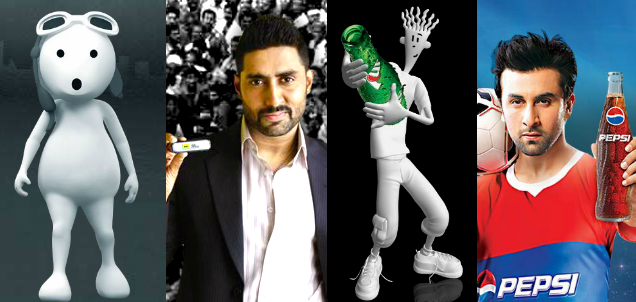
    Mascots can be regarded as the face of a brand. Be it the ‘Amul Girl’ who is a part of every household since 1967, ‘Chintamani’, 2005, the common man ‘RK Laxman’, 1954, ‘Maharaja’ 1946 or the latest ‘ZooZoo’. Mascots provide an identity to a brand which is equivalent to the brand itself.


    It was in the late ’90s when the advertising industry gained pace with more and more brands wanting to endorse themselves to reach out to the consumer is when the brands started associating with celebrities to create a mass appeal.  With Sachin Tendulkar, Amitabh Bachchan, Shahrukh Khan and every other celebrity promoting not one but half a dozen brands.


    So what does a consumer gets hooked to Sachin’s Pepsi commercial or Fido’s 7UP? Abhishek Bachchan for Idea or Zoozoos for Vodafone?


    Sameer Satpathy

    Says Sameer Satpathy, EVP & head, Marketing, Marico Ltd, “Choosing a celebrity or a mascot depends on your brand strategy. Both are a legitimate way to communicate your message.  The celebrity route has higher risk as you get both the positives & the negatives of your brand ambassador, but you can get results quicker as it only depends on the ability of your brand to leverage the equity of the celeb. The mascot needs to be built, invested into and in time can become a powerful and exclusive property. Also, certain categories lend themselves better to brand ambassadors like beauty brands and some categories to mascots for example brands targeted at children. For me the most memorable celebrity for a campaign would be Tiger Woods! J But for the wrong reasons.”


    Abhijit Avasthi

    According to Abhijit Avasthi, NCD, Ogilvy &Mather, “There is never a set rule whether a brand should go with a celebrity or a mascot. It mainly depends on the nature of the campaign. A well known celebrity face has its respective positives and so does a mascot. Though there is a great chance of a brand being lost in the clutter while using a celebrity. Mahendra Singh Dhoni is presently endorsing over 20-25 brands but when it comes to recalling a brand I can only think of 5-6 of those. Hence it is very important that the celebrity, if used, is used perfectly. For me the ‘Amul Girl’ and ‘Zoozoo’ are two of the most memorable mascots. When it comes to celebrities, I think Titan and Coke have used Amir Khan perfectly and so has Pepsi used Sachin.”


    It may be noted that a mascot is created by keeping in mind the brand whilst a celebrity being a mortal, may be a perfect choice to endorse a brand at a particular time but with time the image of the celebrity may change, which in return may or may not fit with the brand image.


    Ajay Kakar

    Says Ajay Kakar,CMO – Financial Services,Aditya Birla Group,, “It is true that a brand can ‘own’ a mascot. While a celebrity is an asset shared by many brands. But I do believe that both these mnemonics or devices are not necessarily interchangeable. Both of them have a unique role that they can play in the life of a brand. Now it depends on the specific brand, as to what is the desired role.


    “A celebrity can definitely create a more immediate pull for a brand, because the celebrity is already well known and has a fan following. On the other hand, a mascot may take time to ‘grow’ on its target audience. Similarly, a celebrity can help create a more emotional or personal connect, due to the ‘human’ factor. So, it is a question of horses for courses.


    “The Amul girl is a ‘mascot’ that immediately comes to mind. It has withstood the test of time, across ‘generations’. “As far as a celebrity-brand partnership is concerned, regrettably, today’s celebrities tend to take-on one too many brand associations, so it is difficult to associate them with any single brand. The two exceptions that do come to mind are Abhishek Bachchan and idea. And Yuvraj Singh and Birla Sun Life Insurance.”

    The fact also remains that a celebrity can give instant boost to a brand whereas a mascot needs time investment before it becomes a household name. At times a mascot may not click with the audience but the ‘non-click’ risk remains minimal in the case of a celebrity.


  • ASCI, Goafest come together on self-regulation

    By A Correspondent


    The Advertising Standard Council of India (ASCI), in a bid to encourage self regulation in Advertising, has announced its unique association with Goafest 2012. As a part of this partnership, ASCI will be a conducting a one-of-a-kind contest to promote responsible creativity, under the theme “Creativity with a Conscience” during Goafest 2012.


    The ASCI Mobile Movie Challenge contest, which is open for advertising, marketing and media professionals, revolves around creating short films using a mobile phone.  As per the contest, teams of 3 young professionals, under the age of 30 years, will be asked to create a short film (between 30 and 60 seconds), using their mobile handsets.  Each team will be assigned a mentor film-maker who can guide the team members on the nuances of film making. The teams will create the art forms on one of the four briefs provided by ASCI.


    The teams will create the art forms on the four tenets of ASCI’s code of self-regulation: Honesty & truthfulness in advertising; Decency in advertising as per generally accepted societal norms; Safety & avoiding exploitation of vulnerable sections of society, especially children; Fairness in competition.


    To register, one has to log onto http://www.ascionline.org/goafest2012/ and last date for registration is March 22.


    According to, Subhash Kamath, ASCI Board Member: “The theme ‘Creativity with a Conscience’ goes hand-in-hand with ASCI’s objective of responsible advertising. Our aim is to inspire professionals to abide by the guidelines set by ASCI and to take up self regulation on an individual level as the only other alternative is governmental censorship, which is, not desirable for a creative industry like ours.”


    He added: “By reaching out to young professionals, we’re ensuring that our efforts towards self regulation are understood by the people who will be implementing the work. Through this initiative, we want to instill the message in the mind of young professionals to always remember that with great creative power, comes greater responsibility.”


    These films will then be showcased at Goafest 2012 and will be uploaded on youtube.com and select online portals to inspire professionals to understand the importance of self-regulation in advertising. The entries will be judged by a jury of top creative directors and film makes of the industry.


    Four winning teams, one per brief, will be selected and each team member will be awarded during the Creative Abbys. Alongside, there will be a ‘Popular Choice’ award for the winner of a shortlisted best 16 film, which will be voted via SMS by over 3,000 participants at Goafest.


    Advertising Standards Council of India is a self regulatory voluntary organization of the advertising industry. The role and functioning of the ASCI and its Consumer Complaints Council (CCC) is in dealing with complaints received from Consumers and Industry, against advertisements which are considered as false, misleading, indecent, illegal, leading to unsafe practices, or unfair to competition, and consequently in contravention of the ASCI Code for Self-Regulation in Advertising.

    Click here to view all Goafest 2012 stories


  • Onida takes on rivals with comparative advertising

    By Shramana Ganguly Mehta


    Televisions and washing machines brand Onida is poking rivals such as LG, Voltas and Daikin through a new ad campaign as it seeks to regain share in the country’s Rs 35,000-crore durables and electronics market.


    “The idea is to provoke consumers to look out for products that are best for them rather than falling for brand names,” says Vipul Mathur, marketing VP at Mirc Electronics, which own brand Onida. Some advertising experts, however, feel it’s a desperate move and that such comparative advertising may not work.


    Onida launched its print campaign last week and TV commercials will soon be aired. It has earmarked Rs 100 crore for the campaign. One of the print advertisements says, “Let LG and Voltas debate who’s Number 2. Onida is Number 1 in AC innovations.”


    Another says, “Open your eyes. Are you buying any brand or a brand that actually cools,” complete with specifications of comparable AC models from LG and Daikin. While FMCG, auto and aviation companies use such comparative advertisements, it is being used in the durables space perhaps for the first time.


    Mr Mathur says Onida will roll out similar campaigns for its LCD, LED, washing machine and microwave ranges to establish itself as a brand that provides innovative and powerful products with substantial price advantages over competition.


    “We are competitive and have innovative products to offer. So we are not scared of the rivals hitting back,” he says.


    When contacted, LG refused to comment on Onida’s move.


    Mr Abhijit Avasthi, national creative director at O&M India, which worked on Onida’s campaign, says, “We’re not accusing anyone or hitting below the belt. We are just stating the facts.”


    Onida, like other homegrown brands such as Videocon, Godrej and Voltas, is trying hard to regain its durables market share lost to Korean rivals LG and Samsung in the 1990s.


    While Samsung and LG together have 34% share in ACs and 45% each in refrigerators and semi-automatic washing machines, their shares in some categories dipped last year due to tough competition from Indian and Japanese rivals. Samsung’s share in the AC market, for example, dipped to 11% in 2011 from 19% in the previous year, while that of LG slid to 23% from 28%. Voltas, at the same period, jumped to 17% from 12%.


    In the colour TV segment, Videocon is on the heels of market leader LG, pushing Samsung to the third position.


    Onida says it is the fourth largest air-conditioner brand in the country with 10% share in the market, fifth in washing machines with 8% share, and sixth in flat panel TVs with 6% share.


    Some experts, however, are not impressed by Onida’s new campaign. Mr Sudarshan Banerjee, business development director at DDBMudra, sees it generating little excitement among consumers. “The campaign is sad in the way it is done. It is not a nice ad,” he says, adding comparative advertising has not done well in recent times.


    Triton Communications’ Mr Sanjay Chakraborty says, “While it’s easy to look at a competitor and poke holes in its product or services, it’s harder, but definitely more valuable, to plug the holes in one’s own offering and build real competitive advantages.”  He says comparative advertisement helps consumers make informed choices provided it does not misrepresent the facts.


    Not so long ago, the advertising space saw war of words between detergent brands Uniliver’s Rin and P&G’s Tide war and health drink brands GSK’s Horlicks and Heinz’s Complan.


    The most brazen comparative advertising was perhaps the Jet-Kingfisher campaigns. When Jet Airways embarked on a campaign to announce: “We have changed”, Kingfisher hit back with a hoarding right besides Jet’s to proclaim: “We made them change.” The duo fought literally on one of most busiest crossroads of Mumbai in 2007.


    Source:The Economic Times

    Copyright © 2012, Bennett, Coleman & Co. Ltd. All Rights Reserved


  • 5 things that agencies must do to attract top talent

    By Rohit Ohri

    The advertising industry is guilty of ‘criminal neglect’ in its approach to recruiting talent. For an industry that sells original thinking, this is surely creative suicide.


    The good news is that no matter what the size of the company, attracting and retaining talent has more to do with one’s commitment to building a sustainable organisation, rather than how much one pays.


    My core belief on talent management revolves around proactive engagement. If organisations proactively think about how they should keep their employees engaged over a period of time, attraction rates go up and attrition rates fall.


    That said, here are five things advertising agencies must do to attract the best talent: I call it the REACH principle.


    1. Reach wallets

    It’s true that it takes more than just money. But it does take money. Beating the market is neither an attractive nor a sustainable practice when it comes to compensation.


    Many companies ignore this truth and apply a famine and feast mentality when it comes to compensating creative talent. First under-paying, when the company has the leverage and then over-paying later, in order to attract or keep that talent from being snapped up by eager competition. This breeds suspicion and kills loyalty.


    Instead, be relentlessly pro-active in maintaining market parity at every position, with bonuses and incentives for extraordinary results. This creates an environment in which financial resentment is not a motivation for your talent to look for new opportunities.


    Desperate competitors may still over-pay. But when talent feels valued, the premium required to convince them to leave gives you an immediate competitive advantage.


    2. Reach clarity

    Clearly articulate your vision and then build around it. As a species, we are united by our instinct to create. We want to make things… especially, a difference.


    Google’s success is driven by a simple premise – to organize the world’s information and make it universally accessible and useful. A goal that attracts informs and unifies some of the most original thinking of the last ten years.


    Define the change your company wants to make in the world. No matter how local. Nothing attracts like a clearly defined vision of a better future. Being made to feel that one plays a significant role in helping the company achieve its goals enhances performance and builds loyalty.


    3. Reach goals

    Measuring progress is one of the keys to harnessing creativity. A study in the Harvard Business Review showed that a sense of progress is the attribute which people value most in their day. Progress can only be measured on a continuum that has a beginning and an end.


    Defining the difference you want your business to make provides the latter. The former comes from individual reviews – a subject worthy of its own post. Annual reminders of how far the organization has come are also imperative.


    Celebrating the company’s anniversary with a retrospective comparison of where you were a year ago and now stand, is simple and powerful. It helps to reiterate goals and review the course…


    4. Reach out

    Be Open. Be Honest. Transparency is the most over-worked word in the English language at the moment. However, this does not make it less essential to attracting and retaining great people. Don’t build walls around you…break barriers and allow others to do too. If you want your people to respect your view points, respect their’s too.


    5. Reach hearts

    Say Thank You. The artist in all of us needs to be recognized. So does the human being. And yet most companies are slow to praise. Or even to thank. Thanking your people as often as possible is a small acknowledgement that you take neither their talent nor their choice for granted. Respect their choice to stay with you and chances are that they won’t go anywhere else in a hurry.


    These steps require investment – of time – and a little money. Practice them collectively and your company will be irresistible – and invaluable…


    Rohit Ohri is the Executive Chairman at Dentsu India Group


  • Amagi announces operations in 35 cities

    By A Correspondent


    Amagi Media Labs, the pioneer and leader in smart advertising on television, has announced its recent entry into tier-1 and tier-2 cities across the country with more than 400 small and medium businesses using Amagi platform for local TV advertising.


    Since the launch of Amagi platform nationally last year, hundreds of retail and regional advertisers across categories – education, jewellry, apparel, real estate, FMCG, white goods and auto dealerships have flocked to the platform to advertise on premium national TV channels.


    Amagi’s co-founder KA Srinivasan said: “Though every business dreams of being on national television, very few could afford it earlier. Through Amagi’s Smart Advertising TV platform, small and medium businesses have now been able to advertise on premium national TV channels at ultra low rates – targeting specific cities or regions.”


    Amagi offers smart advertising on TV in over 35 cities, including metros, tier-1 and tier-2 cities. Amagi has partnerships with 15 satellite TV channels, including leading news, music, lifestyle, movie and regional entertainment channels as well as more than 50 cable MSOs acrossIndia. Amagi platform is ideally suited for regional brands that want to reach their target audience without paying for wasted coverage.


    Hundreds of advertisers acrossIndiahave reaped strong benefits by using Amagi platform. SS Bhamra, Chairman, JLPL said: “I have used Amagi Smart Advertising platform to build my brand in Punjab on national TV channels at a very low cost – my campaign using Amagi Media has delivered overwhelming response from our customers and has helped position JLPL as the developer of choice in Punjab”


    Saumil Pandya, Vice President, MAS Financial Services Ltd, Ahmedabad said: “Amagi’s Smart TV Advertising platform is a boon for regional brands. I can now get the best of both worlds – national TV and local rates. Coupled with Amagi’s creative services, this platform has helped me get both branding and response at a reasonable budget”


  • Why FM is more than just a recall medium: Rabe Iyer

    By Rabe T. Iyer


    Old media don’t die! They just bounce back in new avatars. Not so long ago, radio had been written off as dreary, downmarket and not so cool. Television and, later, “new media” were touted as being media of the future. Thanks to advancements in technology and a change in lifestyle, radio has made an incredible comeback.


    FM radio stations are one of the most popular entertainment mediums, offering millions of Indians a great mix of shows covering music, contests, discussions, humour and gossip, delivered in local flavour by popular young radio jockeys.


    Radio is a medium of the senses, bringing the listener’s imagination to life and taking him into an exciting new world of his own. Thanks to local FM stations, marketers have been able to connect with their target group, especially the youth, like never before.


    According to industry experts and analysts, there are 250-300 million radio users today. This penetration is surprisingly more than that of newspapers, known to be the oldest among present day media. In addition, at 145-150 minutes per day, the consumption time of radio is more than that of television, which stands at 140.  Today, 80-90 per cent of mobile users access the radio on their phones.  The fact that the medium is mobile has clearly helped to increase its usage and popularity.


    With the rollout of Phase III licensing, the Indian radio industry is optimistic of huge growth. The industry, which currently brings in around Rs1,100 crore revenue, will see 800 new radio stations across 300 towns coming up.


    Here, radio-based advertising can be used effectively for communication and positioning. It is to be used well since it can target a large audience because of its immense reach. It is useful in increasing awareness about a brand or business and helps in enhancing the brand image. The past couple of years have witnessed a flurry of activity in the FM sector. Not surprisingly, the radio industry of today can be compared to television in the early and mid-nineties, and one that is all set to boom further.


    With carefully worded scripts, brilliantly created situations, and tailor-made strategies, radio advertising is getting more innovative and effective day by day. It is perhaps one of the simplest yet most cost-effective and powerful means of communication in today’s world.


    Studies indicate that instead of two back-to-back commercials on television, one commercial on television and another one on radio give about a 20 per cent higher brand recall. Also, a television commercial, if aired on radio, works very well as the listener can then visualize the entire advertisement. Hardly surprising that over the years, print based publications and television channels have been using radio as a support medium, as a reminder medium, and as a mean to building up frequency.


    As mentioned earlier, another interesting facet of the Indian radio story is the mobile phone explosion and its convergence with FM. This has exponentially increased the width and depth of the market.


    Radio offers tremendous opportunities for advertisers and media planners who need to explore various options, following which they can effectively use the medium in their media mix. Conversely, broadcasters need to develop the market by being more responsive to an advertiser’s needs. This will provide an opportunity for the market to arrive at the final verdict on the effectiveness of the medium inIndia.


    Rabe T. Iyer is Business Head, 92.7 BIG FM


  • Is radio not good enough for premium brands?


    By Robin Thomas


    Over the years, growth of Radio as a medium has been restricted, thanks to TV. But, to the credit of many a radio expert over the years and advertisers who have believed in the medium, radio continues to sail; and sail even more promisingly when times are choppy.


    Also, sample this: The FICCI-KPMG Indian Media and Entertainment Industry Report 2011 states that the radio industry in India is expected to grow at 20 per cent CAGR (Compounded Annual Growth Rate) from the current base of around Rs 1000 crore. Radio’s share of media spends is also expected to rise from 4 per cent to 5 per cent by 2015. Among categories that advertise on Radio, Real Estate, Telecom, Retail, Education and TV channels are the ones advertise the most.


    The medium promises reach, greater recall and marketing solutions that are cost-effective. Despite this, why do premium advertisers shy away from advertising on the medium? It is known that premium brands prefer speciality magazines, internet and mobile and TV more than radio.


    Harish Bijoor, CEO, Harish Bijoor Consults agrees that premium brands don’t advertise much on radio. “Premium brands look at radio as a non-premium medium. There is ample research available which reveals that premium-category shopper do not depend on awareness scores for luxury brands from radio. In fact, radio tends to negate effort for luxury brands as of now and proves counter-productive to the effort. Radio is much too mass for luxury brands.”


    According to B Surender, Senior Vice President and National Sales Head, Red FM, the share between national and local advertisers on radio are 50:50 of which premium advertisers contribute merely six to eight per cent of the overall national advertisers. BMW, Volkswagen, Mercedes, Skoda, Blackberry, Marks & Spencer, Louis Philippe, Tanishq, smartphones , Lufthansa , British Airways ,Virgin Atlantic, Singapore Airlines, Emirates are some of the premium advertisers advertising on radio.


    For most of these premium brands radio is more or less a reminder medium, it is an extension of the television or print advertisements. Luxury watch brand, Seiko for instance does not advertise on radio at all whereas Jet Airways and HDFC Life heavily advertise on internet and television.


    Both internet and television have an edge over radio on premium luxury brands. While television has the benefit of being an audio-visual medium, internet is a highly interactive medium.


    Manish Dureja, Vice President, Marketing, Jet Airways said that the airline brand banks more on internet and mobile as against radio. “We are not advertising much on radio or on television as most of our marketing budget is performance driven, where we look to generate sales through search engine marketing and predominantly digital marketing. With internet penetration and the emergence of internet mobile, it has become mandatory for us to be present in the online domain. Radio, on the other hand is a localised medium and caters to a specific city. More importantly through digital media, I am able to reach consumers far more effectively than any other medium.”


    For Sanjay Tripathy, Executive Vice President-Head Marketing and Direct Channels, HDFC Life, television and the internet are the preferred medium because of the reach and better ROI. “Television is the preferred medium for HDFC Life because of the awareness it creates, and maximum reach it offers, whereas the internet has delivered better ROI for us. Radio on the other hand is more of a brand recall medium so most of our marketing budge or the media spends is skewed towards television and the internet” he said.


    Disagreeing that premium luxury advertisers are apprehensive about advertising on radio, B Surender of Red FM said that although there was a perception issue in the past, some of them wrongly assumed that the quality of FM listenership profile may not be very good. “Contrary to this belief, there are instances of advertisers abroad specifically using radio to target billionaires and rich entrepreneurs, since radio could reach out to them better than other mass media. But, in the past one or two years there is a positive change in our country as well with more and more premium brands in automobile, international airlines, consumer durables, telecom, jewellery, finance, retail etc have regularly started using radio as a part of their media plan. However, I feel there is enough scope to further improve the usage of radio by luxury brands in the near future.”


    With the rollout of phase III, radio will see an increase in reach in India. Multiple frequencies will allow FM stations to offer targeted or niche programming for the elite listeners. However, there are many challenges too: The radio industry will have to educate the premium luxury advertisers, not only about the effectiveness of the medium in delivering better ROI for their brands, but also about the quality of its listenership profile.


    Perhaps for now at least, radio is too large, too ubiquitous; a bit too common a medium for the un-common luxury brand. There is more thinking required on the part of radio station heads to get premium brands on board.


  • Rural market is the new siren call for OOH

    By Robin Thomas


    According to industry estimates, ruralIndiais growing at a faster pace than its urban counterparts, atleast in certain product categories. The overall Indian rural market size is believed to be Rs800 crore, with a total advertising pie of Rs12,000 Crore in rural markets. FMCG products, consumer durables, agro manufacturers, banking and insurance, telecom companies are some of the big spenders in rural markets.


    A survey reveals that FMCG products account for nearly 53 per cent of the market share in ruralIndiawhereas consumer durables account for the rest.


    The last few years have seen a drastic increase in the standard of living and purchasing power in ruralIndiaand many marketers heading for the lucrative rural markets. Also people in rural areas tend to spend a lot of time outdoors, which makes the rural market an ideal target for OOH media. As a result, almost every OOH industry player believes that the next phase of growth for the out-of-home media will come from rural markets.


    In interactions with MxMIndia, Mr Nabendu Bhattacharyya, Managing Director, Milestone Brandcom – who had shared his plans to launch Milestone Rural – and Mr Rohit Samarth, Business Head – Rural, Percept- Out of Home, were of the opinion that out-of-home media is seeing a tremendous growth in rural markets as consumption power in smaller towns and villages is increasing.


    Mr Anirban Ghosh, Senior Vice President, Adz Edge opined that an increase in purchasing power of rural masses in recent past has fuelled lot of interest amongst clients across all categories in ruralIndia. “Once considered a market only for low end products, today companies are seeing rural market as the new growth avenue. Comprising more than 70 per cent of the total consumers in India and annual market potential in excess of Rs12,30,00 crore, rural India is being charmed in novel ways. Naturally, out-of-home has also taken an upswing in rural market. More and more clients have shown interest in tapping this market which has got tremendous potential and increasing buying power” he said.


    The main revenue stream in rural market will come through a media integration and activation approach such as van activations, road shows, wall paintings, melas or village fairs.


    Mr. Ashish Pherwani, Associate Director, Advisory Services, Ernst & Young is very optimistic about rural out-of-home media. He believes that it can reach 25-30 per cent of the OOH advertising share in 5 years and that as consumptions shifts from metros to the 35 to 100 of the largest towns, OOH spends will also follow.


    Although OOH in rural areas is on the growth curve, it still has a long way to go and in order to continue growing in the long run; industry players believe that there are certain challenges and concerns that need to be overcome.


    One of the biggest concerns is the fact that the rural market is very fragmented and there is neither a credible measurement system nor a clear census data that can provide a clear definition of ruralIndiaand the socio-economic classification, among other relevant details.


    Mr Samarth observed: “While advertising in ruralIndiais growing, fragmentation of the market is a big challenge; there is no distribution network and there is no credible measurement system either. Another set of challenge is about living up to the promise of delivery in the rural markets. However, on the positive side, the biggest change in the rural is the fact that there is much less central control because today a lot of large companies are decentralizing their budgets.”


    Mr Pherwani said: “The rural market is extremely fragmented and there is little or no transparency to provide confidence to advertisers. Therefore, transparency needs to improve with better demonstration of proof of delivery. There are also few national players who can support large campaigns.”


    But Mr Ghosh believes that the biggest challenge for OOH is the lack of quality properties in rural market and also the fact that it is even more unorganized as compared to its urban counterpart. As a result, execution and proper monitoring is another core challenge. “To overcome these problems, we need to understand the rural market in a better way. Major players from OOH media owning houses should take initiative to open up their operations close to these locations for better control. They should collaborate with the local authorities to implement uniform regulations and open up more quality properties in rural market” he suggested.


    Innovations are the need of the hour to attract the rural masses and the OOH approach needs to be more interactive and integrated with brand activation for high recall value. As product consumptions increase, OOH media spends will also increase.


  • Goafest 2012 to be held on April 19-21

    By A Correspondent


    Goafest, the much awaited yearly event from the Advertising Agencies Association of India and Advertising Club Bombay, has come out with its festival dates for 2012.


    This year’s Goafest will be held on April 19-21 at the same venue as last year, The Zuri White Sands resort on Varca beach.


    Other details of the festival will be announced following a committee meeting on January 9.


    Over the years Goafest has become the biggest congregation of advertising professional under the sun and sand inGoa. It is touted asIndia’s biggest advertising and awards festival.


    The theme for last year’s festival was ‘Ideas are all around us-can you SPOT one?’ Two of the biggest awards held during the festival include the Media Abbys and Creative Abbys.

    Click here to view all Goafest 2012 stories


  • IPL sponsorship assessment in new TAM volumes

    By A Correspondent


    TAM Sports, a specialized division of TAM Media Research, which has done extensive work in the field of sports measurement and valuation in the past few years and specializes in measuring the sports sponsorship Return on Investment (ROI), announced the launch of special features on IPL 3 and IPL 4.


    TAM Sports has done an extensive assessment on IPL 3 & 4, focusing on the dynamics of TV audience and sponsorships. This series of TAM Sports publishing aims at benefiting sports associations, broadcasters, advertisers and sports marketing consultancies and help them understand the complexity involved in expecting ROI. TAM Sports started this initiative with IPL Season 1 and has also released a book on IPL Season 2.


    TAM Sports’ IPL 3 & 4 books will include an in-depth study on the event’s viewership dynamics, commercial and non-commercial advertising (product placement) that brings out the nuances with respect to visibility of brands and branding units along with a comparison across seasons.


    It will have a detailed study on consumer impressions, brand placement, on-screen and instadia advertising along with a special section on franchisee advertising done during IPL seasons 3 and 4. One part of this offering will also include an analysis on PR exposure received by the franchisees and various brands associated with IPL.


    Talking about the IPL 3 & 4 feature, LV Krishnan, CEO, TAM Media Research said: “Based on the overwhelming response to our earlier book series on IPL 1 & 2, we are glad to release the combined book volumes of IPL 3 & 4. These two volume will also highlight the insights on sports sponsorship ROI on various platforms – instadia, on-player and on-screen, along with throwing light on the tournament viewing analysis like audience profile, how various markets have responded to the event, impact of IPL on other genres with a special new section on franchisee advertising and print in-content placement. While TAM Sports has alays had a big focus on cricket due to its large audience and advertising base, we will also continue to provide more such insights in other sports like F1, tennis and football as well serve the respective industry for its business requirements.”


    Some observations from the TAM Sports IPL study are:

    • IPL seasons have been successful in reaching maximum audiences year after year. IPL Season 3 reached 41 + million audiences whereas IPL 4 reached 46+ million viewers.
    • IPL 3 & 4 garnered maximum contribution from CS 35 + age group whereas IPL Season 4 has seen increase in kids viewing.
    • In comparison with IPL 3, IPL 4 witnessed 33 per cent growth in overall advertising while commercial, on-screen and instadia advertising witnessed a growth of 21 per cent, 50 per cent and 33 per cent respectively.
    • Commercial advertising during IPL Season 4 increased by 21 per cent as compared to IPL Season 3.
    • IPL 4 saw utilization of 60+ instadia platforms.
    • On player advertising has witnessed 37 per cent growth.
    • 57 brands got exposure through 16 accessories platforms and contributed 2 per cent share of the total ‘instadia’ advertising.

    TAM is a joint venture between AC Nielsen Research Services (Nielson Company) & Kantar Market Research. Besides measuring TV Viewership, TAM also monitors advertising expenditure of television, print and radio through its division AdExIndia.


    Since 2004, it extended its presence in the PR measurement & analysis space for Corporate/Marketing Clients by setting up a separate division, Eikona PR Measurement.


    In 2007, the joint venture introduced RAM (Radio Audio Measurement) service to track radio listenership for the Indian Radio Broadcast Industry.


    In year 2009, TAM launched a division, called TAM Sports that specializes in monitoring Sports Sponsorship ROI.


  • Media & Adland Wishlist 2012


    By Anil Thakraney


    The Indian media, in general, has got a number of things right. It puts serious pressure on the ruling government and sometimes the judiciary, so that the right things happen, and they happen fast. This crusading spirit is important in a slow- moving, chaotic nation like ours, so kudos on that front.


    However, there are a number of things that are not so right with our media, especially the mass media, and here’s hoping we get to see some course correction in the coming years. Here’s my Top Ten wish list.


    1. Radiagate was a wakeup call for all journalists. When access to the rich and powerful gets too close, one needs to quickly draw a line and back off. Some didn’t, and are lucky to still have their jobs. The scandal brought immense disrepute to the profession, and credibility will be hard to restore completely. Here’s hoping in the future the Indian media remains free of any such nonsense. We can’t afford it.


    2. The Broadcast Editors’ Association put out a 10-point code of conduct for news channels on how they should cover the Bachchan baby birth. And the very private family event passed off very privately without the channels breathing down their necks. What one would like to see in the coming year is that this practice becomes standard operating procedure during private celeb moments, and there is no need for codes any more. This would also delight Shri Katju.


    3. While it did change to a certain extent as the year closed, most editors behaved like Anna Hazare’s cheerleaders all through the year 2011. This is not just unfair, it’s against the fundamental principles of journalism. Here’s looking forward to less bias and more balance in the year 2012.


    4. It’s very clear that our media houses have aligned themselves with various political parties, and their respective biases keep becoming apparent even to the layman. This must change for sure, starting from 2012. Media without objectivity is like Rakhi Sawant without silicone. No one wants that.


    5. No more paid news. Repeat after me children… no more paid news. Repeat after me children… no more paid news.


    6. Here’s hoping all those TV anchors who indulge in hysteria and drama are promptly transported to the Bigg Boss house in the coming year. And are not allowed to enter newsrooms again. The junta wants news and views. Not nautanki.


    7. No more front half-pagers in the coming year. Where advertisers demand that the front page be vertically slashed. A fatwa needs to be declared against proprietors who agree to this criminal practice.


    8. Would like to see some kickass innovations in the print media this year. Both, newspapers and magazines. The digital media threatens big-time, it’s like a wolf at the door, and our old-world editors continue to pretend nothing’s happening, as they dish out the same tired stuff. I am also hoping editors who refuse to re-invent are shown the door before 2012 closes.


    9. Really wish that in the year 2012 the maha excitable radio jocks shut the eff up and play the effing music. Even if all the radio stations play the same ten songs at the same time.


    10. All the girls in the TV newsrooms need to glam up. I noticed the nails are becoming brightly coloured these days, but I want to see more. I mean, if I am stuck with the likes of Abhishek Singhvi, Chandan Mitra and Mani Shankar Ayer discussing the same tosh night after night, I need some joy to come from somewhere.


    Ad World 2012

    The Indian ad world, though it gives many awards to itself, hasn’t really set the world on fire. Okay, so we do score the odd international award now and then, but clearly we have a long way to go. Aside from that, our ad guys will face many serious challenges in the coming years, and quite frankly, I am not sure the industry leaders are ready as yet. I still get a sense of complacency and self-satisfaction when I meet agency bigwigs.


    Here are ten changes I would like to see in 2012.

    1. Once and for all, ad agencies must set aside their rivalries and egos, and must come together to work out a fee structure. It’s obvious the agencies are underpaid by their clients, and this puts serious pressure on their resources. This is also a common complaint I hear from agency heads. Well, grumbling won’t solve the problem. Start the New Year with many beers, and figure a way out!


    2. I think hot shops are back with a bang in the ad world, and in the coming year they will put real pressure on the large networks. Aggie and Padhi are just one example, but I predict more people will quit large agencies and set up their own boutiques. Since their rates will be lower, many clients will be tempted to defect from the traditional agencies. And I think this is a good development as it will result in superior work overall.


    3. Experts in TV media continue to head ad agencies, and I am hoping at least a few agencies will smash this system and promote young creative chaps skilled in the new media. Because old-world creative directors generally don’t understand the digital space, and they need to make way for the young geeks. Sooner the better.


    4. Simultaneously, I wish in the year 2012, youngsters in the ad agencies get off the internet (and that includes Facebook) and spend some time in the villages and small towns. There is a dire need for agency staffers to be well rounded in their skills. This is not Singapore. This is India, and a whole lot of people are still looking to buy their first colour TV.


    5. I wish ad agencies would bring back the lost pride into their strategic planning function. The number one reason many suits quit the business to join the world of marketing is the lack of brand planning within ad agencies. Ad agencies have become creative sweatshops, and this leaves no work for managers but to be good executors. Starting 2012, I am hoping this changes, because it’s bleeding the ad world of its talent.


    6. Dear Creative Director, please, please, please do at least ONE nice press ad in the year 2012. I beg of you. People still read newspapers in this nation. Puleeeeaze!


    7. I know the media buying function is now completely divorced from advertising. And it is my belief that this has badly affected media innovations. I recall those days when the three of us – the account executive, the media planner and the creative director – would lunch together and crack ad ideas. I hope at least once in the year 2012, Balki, Lynn and their client servicing person share a drink and discuss brands.


    8. No fake ads in 2012. Repeat after me, children. No fake ads in 2012. Repeat after me, children. No fake ads in 2012. Repeat after me, children.


    9. No noisy TV commercials in 2012. People don’t buy from shriekers. Repeat after me, children. No noisy commercials in 2012. People don’t buy from shriekers. Repeat after me, children.


    10. I am hoping at least one brand will show all of us how to exploit viral magic on the internet in 2012. At least one brand will become the Kolaveri of 2012.


    Cheers!


    Anil Thakraney has worn various hats in advertising and as a journalist for around 25 years. He is editor-at-large, MxMIndia. The views expressed here are his own.

    Visual: Rafiq