
Tag: advertising

  • Havas appointed global media AOR of Shangri-La Hotels

    By A Correspondent


    Havas Media Asia Pacific has announced its appointment as the global media AOR of luxury hotel group Shangri-La Hotels and Resorts. The agency has been tasked with handling the media planning and buying for the Hong Kong based hotel group, across all its markets and properties.


    The agency won the business after a pitch process, which involved several media agencies including Starcom and OMD.


    Pitch consultancy R3 managed the pitch process.


    Havas Media was selected for its ability to deliver media innovations and strong integrated solutions. The hotel account will be led out of the agency’s Hong Kong operations.


    Deryk Tang, Managing Director of MPG Hong Kong said: “This is an extremely exciting win for us and a testament to our extensive experience in the luxury and hospitality sector. We have a great synergy with the marketing team from Shangri–La.”


    Stuart Clark, Managing Director of Havas Media International APAC, said: “Shangri-La Hotels is a brand synonymous with Asian luxury and hospitality. They have produced some really interesting campaigns over the last few years, taking the brand into a unique territory within the category. We will leverage all our specialist resources in International and Luxury marketing to help them build on that platform in 2013 and beyond.”


    Shangri-La Hotels and Resorts currently has 76 hotels and resorts throughout Asia Pacific, North America, the Middle East and Europe and a room inventory of over 30,000. New hotels are under development in mainland China, India, Malaysia, Mongolia, Philippines, Qatar, Sri Lanka, Turkey and United Kingdom.


  • MxM Monday: Is BTL gaining acceptance as a must-have in a media plan?


    By Ananya Saha


    Is Below-the-Line (BTL) advertising gaining bigger share of clients’ advertising budgets over the last few years? How innovative has BTL become, and what are the challenges it still faces?

     

    Anwesh Bose, Senior VP, DDB Mudra Max

    BTL has gained prominence over the years and will continue to do so as advertising communication is evolving from a ATL-BTL model to a Through the Line (TTL) model. The lines have blurred between ATL & BTL giving rise to a new phenomena where a medium can take the form of ATL or BTL depending on the need of the communication. The challenge today is for the communication professionals to justify the Return on Investments on any form of media and the pitch will keep getting higher. It is time for the industry to jointly work on a multimedia optimization model that would justify investments.

     

    Narayan Devanathan, SVP, National Planning Head, Dentsu India Group

    That’s a very broad question, but going by overall trends, the answer is probably yes. The more pertinent question, how much bigger is “bigger?” Who is measuring this? How does it differ by category? What all goes into the definition of BTL? For example, with the expansion of modern trade in retail, you’ll obviously see a lot more BTL money being spent on in-store merchandising, POS and promotional campaigns. A second factor affecting expanding BTL investments will likely be the short attention spans and the myriad of choices and screens that consumers interface with today. TV, radio, web and mobile are probably vying for the consumers’ attention simultaneously at all times. But with definitive metrics, the impact of last-mile tactics and campaigns will be a key differentiator between brand success and business success. All this does factor into the fact that, yes, BTL as a share of clients’ ad budgets is seeing an upsurge.


    Innovations can happen on three fronts: technology, measurability and the balancing act between strategic and tactical objectives of the campaign.


    On the technology front, something like RFID, for example, can turn walking behind a shopping cart into inputs for a shelf-stacking strategy in-store. A combination of GPS, augmented reality and a promotional scheme can turn a mobile phone into a CRM platform. But innovations like these and others depend on the evolution of both marketers and the retail (and other parts of the brand) environment.


    Technology can also be the difference between best-case guesstimates and data-driven strategies that reduce wastage of marketing investments.


    Finally, marketers have to find ways to close the gap between strategic and tactical goals. If brand-building is a strategic goal, how do you use BTL not just be a one-off tactic or part of promotions but contribute to brand-building?


    All said and done, as with ATL, the point of all communications, regardless of medium, is to create stories, conversations and transactions (not always monetary) that people want to engage in. If that perspective is missed, then we will continue to see a “line” and see “below” and “above” this imaginary line that only marketers – not consumers – see.

     

    Nina Jaipuria, EVP and Business Head, Sonic and Nickelodeon India

    Nickelodeon has always believed in the virtues of experiential marketing through on-ground engagements. While TV helps in reaching out to millions of viewers, it allows for only one way-communication. On the other hand, BTL promotions despite the high cost per contact have the potential of making the engagement truly memorable for consumers. There is nothing that can replace the experience and thrill that kids feel when they meet their favourite Nicktoons Ninja Hattori, Dora, SpongeBob or Keymon in person.


    In addition to engaging our young viewers at schools, malls, retail chains etc, we also conduct van activities that helps us reach out to smaller towns and villages in the interiors of India. For example during the launch of Motu-Patlu, we engaged kids in over 30 towns like Lucknow, Kanpur, Allahabad, Varanasi, Agra, Mathura, etc in Uttar Pradesh and Gwalior Khandwa, Indore, Ratlam, Bhopal, Jabalpur, etc in Madhya Pradesh. We often do mall activities to celebrate days and occasions that are important to kids.


    At Nickelodeon, we are constantly seeking new and innovative ways of connecting with kids all through the year. In-store promotions and toon visits at retail stores further helps in strengthening our on-ground presence when it comes to merchandize


    Brand partnerships also play a very important role in creating unique propositions for designing innovative on-ground programmes. BTL promotions are thus an integral part of our media plan as they enable us to connect with our consumers and give them a ‘Touch. Feel. Play.’ experience. In today’s day and age, it is imperative to be present across multiple touch points and to tangibilize the brand.

     

    Uday Mohan, Executive Director – North, MPG India

    With the increasing fragmentation of the media space it is not enough to just make “contact” with the consumer, but more importantly to “connect” with him. First hand experience of the product/service offering and the customization of it allow this impact extending it to sales as also brand perception. It is here where the relevance of BTL in the overall marketing/media mix is increasingly gaining importance.


    BTL is now moving from its earlier perception of basic activation to being an integral part of the consideration set at the media strategy formulation stage itself. FMCG for the mass audience spends even up to 25 percent of their advertising budget, luxury would spend more. Auto, telecom, food outlets also see the merits of BTL as we see more spends and ideas. It is getting very innovative using insights and planning; 3M Scotch-Brite came up with Wash your Bill, where you had the choice of washing dishes over paying the bill, adding a fun twist to the old adage of ‘pay your bill or wash the dishes’. The activation connected with a younger audience, made them use the product, gave immediate gratification, put it up on YouTube and created word-of mouth.


    Lack of quality data is a major challenge that BTL faces as there are as yet no set parameters for evaluation. Another challenge is the infrastructure and operational co-ordination required from global and nationalized brands of mass appeal where delivery to target audience becomes an issue. For example even Pepsi in its ‘Open Happiness’ campaign could create the reach because of the use of digital and social, else the cost would go out of hand. BTL activation for a mass brand would require innovative use of the media mix to get the desired effect.

     

    Ambika Sharma, MD & CEO, Pulp Strategy Communications

    There is a definitive shift in perception, below-the-line is media that barrier is fading, it is new media which adds the rich creamy layer to the traditional media plan. Inclusion of BTL in a plan has increased steadily but has seen a stronger spike in the last 2-3 years. It is not in the perfect place that it could be in the consideration set but it is no longer ignored like it used to be a decade ago.


    BTL is now increasingly being evaluated and included when developing the mix, for the simple reason that it cannot be ignored, as it is the only media that allows people to experience the product outside of the retail format. Below-the-line activations can be great when done cleverly. The medium provides the freedom to engage with your core consumers and almost always has the potential if designed wisely to be quirky and attention-grabbing.


    BTL needs to be carefully considered in the planning process and not as an after thought. A well-thought-out, through-the-line campaign (or 360-degree approach), will always have more impact than one curtailed to a limited approach. This is perhaps the most positive change where in some marketers are consciously choosing BTL within their plan with specific deliverables in mind. This way the plan is tighter knit, and the ROI is richer. This change has reflected in a higher share of voice for activation in the media budget.


    Other factors have also contributed, one is what we call the “Ego” slice in the media plan, prominent some time back its the forced fit into the prominent / upmarket ATL mediums because “presence there was a must” at times this ate into the working budget which would have been considered for new media including activation. This is no longer the case. Activation / BTL is holding its own in media plans and gaining its due in media budgets.

     

    Samar Singh Sheikhawat, Senior Vice President - Marketing, United Breweries Ltd

    We do not call it BTL, but refer to it as activation or leveraging. I would say that activation has always been an important part in the UB Group’s marketing intervention. And today it is almost equal to our sponsorship amount. So if we are involved with an event, property or platform, and suppose Rs 50 lakhs as sponsor, we will spend an equal amount in leveraging it or BTL. I would say, it is practically 1:1 for UBL and our portfolio of brands when it comes to the ad pie division of BTL with other media.


    I think a lot of things are happening apart from the display being used in this medium. The kind of consumer touchpoints being used, digital and social media is becoming a big thing and is being used increasingly as activation by us. Video mapping, production technologies have improved a lot. There are new techniques we are using from overseas in terms of projections, holograms, video mapping on walls etc. the ways to reaching out to consumer is getting innovative whether it be direct mailers that we do or CRM or get-togethers. The kind of media being used in activations is seeing innovation and substance that is being used in production is getting innovative.


    This medium faces challenges in terms of credibility and execution capability. Anything that you do in BTL needs to be relevant to your product, your target audience and to your brands’ positioning. A large part of differentiation in BTL goes towards execution.

     

    Raghu B Viswanath, Founder & Managing Director at Vertebrand Management Consulting

    Media today is fraught with many challenges. While the overall ADEX spends has been growing at a much higher rate than GDP increasingly clients are questioning whether they are getting enough bang for buck they have spent by advertising in media.


    Earlier brands focused on getting more eyeballs translating to more awareness on the brand. Since the competition intensity was earlier relatively low mere awareness got translated to purchase. That is not the case today. With increasing competition and very little differentiation, it is important for brands to not just enhance the brand – building efforts on awareness creation, but to go beyond and engage their customers meaningfully. This in turn means that brands need to connect with their customers through as many touch points as possible. So, non-traditional (BTL) lends itself to this two-way communication. The rules of the game is not about seeing or hearing. It is about experiencing the brand with all the senses. Hence, touch feel and other sensorial connects with the brand, is the need of the hour.


    For many brands, BTL is becoming a more significant component of their marketing spends (almost equal to ATL). I believe this trend is expected to grow, as brands pursue serious efforts to engage better with their customers.

     

  • Hockey India wins for Meridian, OgilvyOne

    By A Correspondent


    Meridian Communication Mumbai has added the Hockey India League to its existing client portfolio, following a multi-agency pitch in Delhi a couple of months ago.


    Samrat Bedi, Head of Office, Meridian Communication, said, “Giving hockey its rightful place in India is something that we all talk about. The League is a superb opportunity for us to be a part of the team that will re-position the game in a manner that appeals to newer and larger audiences.”


    Hockey India Secretary-General and Hockey India League Chairman Dr. Narinder Batra said, “Meridian & Ogilvy One’s passion came through during the pitch. The league is going to showcase the world’s best talent and boundless energy. Meridian and Ogilvy One brought such energy to the table and we are happy to choose it as our communication partner.”


    Kunal Jeswani, President, OgilvyOne Worldwide, India said, “It is very exciting to have the opportunity to launch the Hockey India League and rekindle the country’s passion for the sport. It is a great challenge and we look forward to it.”


    Shashank Lanjekar, VP Planning, Meridian Communication, said, “Sport in India is uni-dimensional and that’s just so unfortunate. It’s easy to blame and complain about the lack of other sports facilities but it’s not easy to initiate a change. And that’s exactly what Hockey India has done. A spark that we hope slowly takes the shape of a flame and soon rages into a forest fire like the IPL. We hope to make this ambition our communication effort as well.”


  • The Company creates colourful TVC for Caprese

    By A Correspondent


    International premium accessory brand Caprese has launched its latest TV commercial in India, featuring top-end international models with stylish women’s handbags. Conceptualized by the ad agency The Company, the ad shows montage of colourful bags portrayed in a picture story format. The ad captures scenes from a fashion shoot and brings it alive with superior artistic finesse. The TVC shows Caprese handbags against contrast walls with chrome dressed supermodels. The concept is to showcase a medley of elegance and vibrancies of handbags through a theatrical lens. The ad, shot in Dubai, displays the autumn winter collection for 2012.


    Manish Vyas, Vice President Marketing, VIP Industries Ltd, said, “Caprese is a reflection of haute couture fashion of handbags, the brilliant execution of frames and depiction of colourful handbags against a contrast backdrop, make it a delight to view. It’s a little window of the world of fashion that handbags belong to. Caprese offers a wide range of beautifully designed handbags for any woman’s sensibilities. We are confident that the women of today will relate to this TVC, as it speaks to each woman’s innate desire to be fashionable and stylish.”


    KB Vinod, Managing Partner, The Company, said, “This communication introduces Caprese handbags to Indian market. The execution, featuring international fashion models and styled by global stylegurus, is inspired by the colors of Caprese fall winter collection. The attempt at this introductory stage is to establish the brand’s fashion credentials. Soon, we would like it to be one of the most famous and desired handbag brand in India.”


  • Harper’s Bazaar launches new brand campaign

    By A Correspondent


    Harper’s Bazaar, the fashion magazine with 29 international editions, has introduced its new brand campaign themed ‘Always in fashion’ in India to complement its international signature ‘Where Fashion Gets Personal’. The magazine has kicked off a new 360-degree brand campaign, which will see lifestyle malls such as Select City Walk in Delhi being branded with Harper’s Bazaar Campaign. ‘Always in Fashion’ – a tri-series outdoor ad campaign with Sonam Kapoor, Anushka Sharma and Priyanka Chopra will cover print, online, outdoors, events & PR.

     

    Targeting the luxury clients, top socialites, HNI consumers, fashion segment and trade, the campaign will run across several lifestyle magazines and trade newsletters apart from digital amplification through trade e-mailers and banners, social media amplification through various Lifestyle Brands with the campaign promoted on social media accounts of major lifestyle magazines such as cosmopolitan, Women’s Health & Harper’s Bazaar India.


    The India Today Group also announced the appointment of a new team at Harper’s Bazaar India led by Nishat Fatima as Editor and Ami Patel as the Creative Director.


    Sharing her insights on the new brand campaign and welcoming the new team at Harper’s Bazaar India, Mala Sekhri, Chief Operating Officer, Lifestyle Group, India Today Group said, “The new appointments comes at the right time as we unveil the new campaign for Bazaar India. We are happy to welcome Nishat back to the company. Her background and experience make her the perfect editor for Harper’s Bazaar India. We are confident that she will be able to lead the team and help the magazine retain its position as the must-read magazine for the latest fashion, beauty and lifestyle innovations.”


    Ms Sekhri added, “We are very excited about this next chapter for Bazaar India!”


  • It’s Ogilvy all the way at Effie 2012

    Click on the image for larger view


    By Ritu Midha


    As an event, one couldn’t have thought of a better way to spend a Tuesday evening than sampling the soothing breeze and top-notch refreshments at the Turf Club, Mumbai. Of course, the event was the Effie 2012, so the focus was necessarily on the awards.


    Piyush Pandey

    Perhaps unsurprisingly, the show was stolen by Ogilvy and Mather, who came ahead by miles, with the Man of the Moment being its executive chairman and creative director, South Asia Piyush Pandey once again. Ogilvy and Mather, with 280 points (more than 400 percent over its closest rival) was declared Effie Agency of the Year. When it came to clients, the competition was stiffer, although both Cadbury India Ltd (Effie Client of the Year) and No 2, Star India Pvt Ltd, are O&M clients.


    An emotionally charged Piyush Pandey said, “It is all by God’s grace. The credit completely goes to our team and culture. New blood joins with its own creative thinking and seamlessly blends with the existing creative thought process.” On being a repeat winner, he said, “It feels ecstatic to be winning again and again. To tell you the truth – the joy and thrill of winning increases every year.”


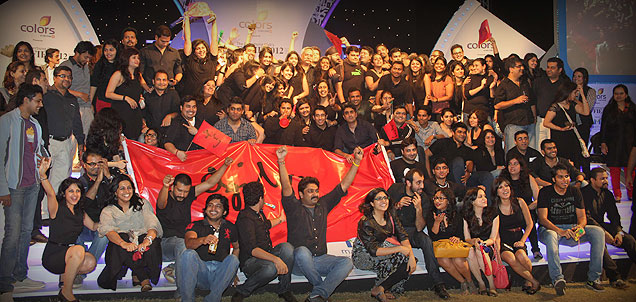
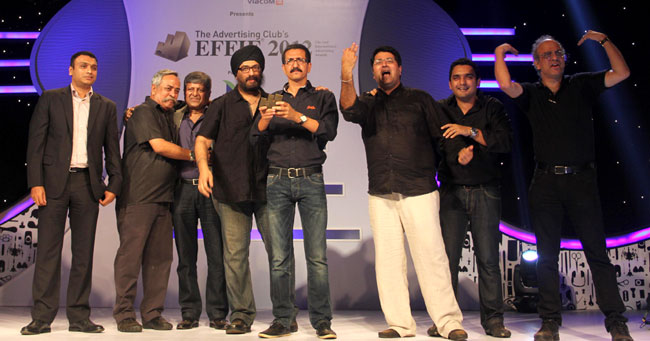
    The victorious Ogilvy team with Shashi Sinha (hugging Piyush Pandey) and Rajesh Iyer, Marketing Head of Colors (extreme left)


    Shashi Sinha
    Shashi Sinha

    The Effies themselves were enhanced in stature this year, both in participation and jury process. Advertising Club President Shashi Sinha stated, “It is special for two reasons: it is the first Effie under the aegis of the Ad Club post it becoming the Ad Club of India.” Also, he said, “This year the entire judging process has been conducted online – and the credit goes to Bipin Pandit and his team for managing it smoothly, considering that there were more than 100 jury members this year.”


    This year, the number of entries increased to 357. And while last year 29 agencies had participated – this year the number reached 50. Another feather in the Effie cap is that 50 percent of the jury members represented clients – best placed to judge the effectiveness of a campaign.


    Ajay Kakar

    Emphasizing the way the Effie is growing, Chairperson of the Organising Committee Ajay Kakar said, “This year, judging moved beyond Mumbai, and was extended to Delhi. We have also introduced two new categories – Direct Marketing and Ongoing Campaign.” He added, “It is a matter of pride that it is not a small set of agencies winning an Effie tonight; 13 agencies have contributed to the winning entries.”


    Ravi Rao

    Another point worth mentioning is the fact of a media agency winning two Effie trophies this year. Mindshare took away two bronzes – and considers it just the right beginning. Mindshare’s Leader, South Asia Ravi Rao told MxMIndia, “We bagged three bronzes, two for Axe Shower Gel and one for HSBC. I am really glad that we made it to the Effies. We will strive harder next time around.”


  • Saavn launches new ad platform

    By A Correspondent


    Indian music service Saavn has announced the launch of its new advertisement platform, Impact. This platform enables brands to identify, connect and engage with its 10.5 million users in India and across the globe.

     

    Impact is an innovative approach to digital and mobile advertising that gives brands 100 percent share-of-voice. Using Impact, brands get complete and exclusive access to all advertisement units on the Saavn web site and mobile apps for a set time period. These include Custom Skin, Web Display, Web Audio, Mobile Spotlight, Mobile Display, and Mobile Audio. Impact is a powerful model that allows brands to build positive associations with their products and services through music. The model has proven to create strong brand awareness, shape brand preferences and increase purchase consideration through undivided mindshare of listeners of Saavn across platforms.


    “In India, we all know that music plays an integral and meaningful part in every individual’s life. Impact is a powerful solution that enables the advertisers to build an emotional connection with their target audience during a passionate, social and engaging musical experience,” Vinodh Bhat, co-founder and CEO of Saavn, said. “The Saavn Impact model is based around engagement, curation and social sharing rather than the archaic click-through. Brands are able to measure ROI in meaningful ways, such as increases in perception, awareness, recall and purchase intent. The byproduct of our strong focus on the consumer experience is helping brands grow their businesses.”


    Some of the major brands utilizing Saavn to reach million of engaged users in India include: Samsung, Lay’s, Pantene, Pepsi, Nokia, Vodafone, Airtel, Hyundai, Domino’s Pizza, 7Up, Nielsen, MakeMyTrip, Max NewYork Life, Google Plus, Nokia, Vanish, Groupon, Intel and several others.


    Saavn delivers a comprehensive catalogue of Bollywood, Indian and regional South Asian music, licensed from more than 200 content providers. Saavn users can search, browse, and play a catalog of more than 1 million tracks; create and save their own playlists; and share their music tastes seamlessly via Facebook.


  • Tata Elxsi, Brash Brands partner for brand consultancy and integrated design services

    By A Correspondent


    Tata Elxsi and UAE brand consultancy Brash Brands have announced a major strategic partnership to deliver full service brand consultancy and integrated design services in India and other key international markets including GCC and Asia.

     

    Through this exclusive partnership, Tata Elxsi will build Brash Brands’ business in India and Brash Brands will represent Tata Elxsi’s portfolio of design services throughout its international offices such as Dubai, Abu Dhabi, Saudi Arabia, Qatar and Singapore. The relationship’s first combined service will be to set up joint operations in Bangalore to address brand development and consultancy services in India, and target product design, signage and way finding markets in the GCC and Asia.

     

    Commenting on the partnership, John Brash, Founder & CEO of Brash Brands said, “This is a big step for our organization and it vindicates our business strategy. We don’t want to be the biggest – we just want to offer our enterprise clients excellence to realize the potential of their brands. Tata Elxsi understands the power of this proposition and the need for excellent brand development services in India. Through this strategic partnership we are both committed to offering a set of high quality, focused services that will change the nature of brand consultancy in India and our international markets.”


    Madhukar Dev, Managing Director & CEO of Tata Elxsi said, “Brash Brands offers a best in breed service that fully complements our own. This partnership enables us to provide our customers a unique set of full-service offerings initially targeted at India, Dubai, Abu Dhabi, Saudi Arabia, Qatar and Singapore.”


  • What’s more important – Creativity or Effectiveness?


    By Ananya Saha


    Creativity vs Effectiveness: what is more important for any brand’s advertising? What is the point of the other if only one is more important? Is creativity a means to communicate effectiveness, or a means or gather awards?

    MxM India spoke to creative heads and marketers to get their views.


    Vivek Srivastava

    Vivek Srivastava, Jt. Managing Director, Innocean Worldwide India

    This debate is perpetuated by people who wish to create a divide in the business of communication. To my mind creativity has always been evaluated. In the case of art by artists and art connoisseurs, in case of scientific discoveries by scientists and the far-reaching impact around us, and in the case of advertising by its beneficiaries. So it is a rather frivolous way to look at a serious commercial and business building endeavour by saying that creativity and effectiveness are separate perspectives. They are intertwined. One without the other does not and cannot exist. Those who claim otherwise are merely perpetuating shallow myths.


    Not just Effies, but Cannes, Emvies or even Goafest, I presume, the endeavour is to reward creativity that causes impact to state it broadly. I guess if we allow ourselves to be driven by aimless scamsters who do one off ads/pieces for merely awards and succeed then we are giving too much credence to a set of renegades. The motto or credo for the business of advertising is one and will be that way forever – It isn’t creative if it doesn’t sell.


    Ajay Kakar

    Ajay Kakar, Chief Marketing Officer, Aditya Birla Group – Financial Services

    If you have creativity for the sake of creativity, them someone someday will ask us to put it at the National Museum of Arts. If we are spending money and so much money as marketers, the only measure should be the creativity that works in the marketplace. And therefore, it works. More and more clients are demanding to know ‘what is their campaign doing in the market’. On one hand, everybody wants effectiveness and on the other, rupee and budget is a scarce commodity and you want every rupee to work. To create work that works is imperative.


    Bipin Pandit

    Bipin Pandit, COO, The Advertising Club

    Effectiveness is supreme. How can one explain the rationale behind making an advertisement if it does not take the brand to the next level? The campaign should be designed or created in a way that it works in the marketplace. Yes, creativity is important but not at the cost of effectiveness.


    Bindu Sethi

    Bindu Sethi, Chief Strategy Officer, JWT

    The effective campaign is based on creative thought. The creativity, however, should stem from the strategy behind the product just like a fire behind the rocket. Creativity is absence of strategy would not work. But creativity can work wonders for the campaign if executed in line with the thought behind the product.


    N Rajaram

    N Rajaram, CMO, Airtel Centre

    It is important that the clients and creative agency sit and work together while devising campaign strategy. The agencies work for creative solutions while brands aim at effectiveness. There can be no mismatch between the two if both the parties work for creative solution for effectiveness.


    Anil Dua, Sr VP – Sales and Marketing, Hero Honda

    Effectiveness is about result. Effectiveness of a campaign lies in the saliency it delivers. A campaign grows your business and it should be sustainable in the longer run. A campaign, if creatively effective, will be advantageous for your brand and will take your business on higher growth trajectory. Of course, effectiveness is more important for a brand than creativity but creativity is important to attract more consumers.


    Satbir Singh

    Satbir Singh, Managing Partner and Chief Creative Officer, Havas Worldwide India

    Creative work that is effective works. Advertising exists speak about a product or service, effectively. If you belong to the brand or creative side, you cannot push people to buy your product or prefer your service. Yes, it is about effectiveness but not about boring people. The role of creative, depending on business strategy, is to entice people to prefer a brand’s product or service over another. How creatively can you do it is the question.


    Raghav Subramanian

    Raghav Subramanian, Founder, The Media Cafe

    One cannot do without the other. Effectiveness and creativity, to me, are not different things. Effectiveness is a metric while creativity is a means. Both go together and both fail without each other. It is like asking of the body can work better without the brain or without the heart. Creativity and effectiveness are an essential part of a successful and meaningful campaign.


    Prashant Mathur, GM, Contract Advertising

    Creativity and effectiveness lead to each other. Unless the message is effective, creativity fails. Effectiveness of a campaign measures creativity. It is important to see how the message is received. Sometimes when agency loses the plot, which happens very rarely, the intent is not to be less effective. It only happens when the intent of a campaign is not clear.


    Shiv Sethuraman, CEO TBWA\India

    Creativity and Effectiveness – these two words cannot and must not ever be used in opposition. There is no conflict; only complementarity. To ask which is more important is akin to asking, “Would you like a great journey or a great destination?” Obviously both.


    Effectiveness is the end. Creativity is the means to that end. If you focus only on the means you may have a lot of fun on the way but there is no telling where you will end up. If the end is your exclusive focus then you might find the ride there uninteresting and (often) more expensive than you’d imagined.


    The verdict on this particular case has come in many years ago. You need both. And both together provides better results than either alone. Effectiveness through Creativity is the Holy Grail.


  • Dentsu Media wins mandate for SEBI’s investor awareness campaign

    By A Correspondent


    Securities and Exchange Board of India (SEBI), the apex regulatory authority for the securities market in India, has selected Dentsu Media as the Media Agency for its Multimedia Investor Education and Awareness Campaign.


    Thirteen renowned agencies participated in the competitive pitch in an open tendering process, in which Dentsu Media was awarded the mandate. The Selection Committee was headed by Mr K.V.Kamath and comprised of senior persons from various fields such as Advertising, Marketing, etc along with senior SEBI officials. The appointment is for a period of two years.


    Dentsu Media, along with Ogilvy & Mather as creative agency, will provide communication planning to SEBI in its Investor Education and Awareness Campaign, which is aimed at educating and creating awareness amongst retail investors and also converting the current savers into investors.


    Commenting on this mandate, a senior SEBI official said, “We are glad on appointment of Dentsu as the Media Agency for our Investor Awareness Campaign. The appointment has taken place after a detailed competitive and transparent process and we now look forward to work together, so as to achieve the objectives set out for this campaign”.


    Divya Gupta
    Rohit Ohri

    Divya Gupta, CEO, Dentsu Media said, “It is an absolute honour to handle SEBI’s media business.  We are extremely proud to have won this opportunity of partnering with one of the apex regulatory authority of India and we look forward to the kind of work that we would be able to do in this category.”


    “This is a really prestigious win for us. We are hoping to be true partners to SEBI to help deliver the greatest value for the Investor Awareness Campaign,” said Rohit Ohri, Executive Chairman, Dentsu India Group.


  • Final countdown for Effies 2012


    By Ananya Saha


    Effies 2012 is drawing to to a close with the second round of judging held in Gurgaon (NCR). The last leg of second round is scheduled for November 29 in Mumbai. The 12th edition of Effie has shortlisted 128 entries from 20 agencies. The 2012 edition boasts of two new categories: Direct Marketing and Ongoing Campaign apart from sharpened categories of David vs Goliath and Integrated Category.


    Ajay Kakar

    Ajay Kakar, Chairperson – EFFIE Committee and the Vice President of The Advertising Club said, “This year we have surprised ourselves. We received 357 entries from 50 agencies, up from 300 entries last year. We have introduced Round 2 in Delhi. Last year, we only had Round 1 in Delhi.”  Effies boasts of being known to measure effectiveness, from the viewpoint of the client and agency. “And 120 judges from who’s who from media, marketing and advertising will be judging with a bit more than 50% of judges being clients.” The judges and Effies Committee is also kicked about online judging, “It not only saves paper but also helps the judges to take their time,” Mr Kakar said.


    N Rajaram

    The judges were also upbeat about Delhi hosting second round of the judging process. N Rajaram, CMO, Airtel Center said, “The second round of Effies held in Delhi effectively recognizes that fact that clients based out of Delhi has increased significantly. It is a good step in the right direction.” Anil Dua, Sr VP – Sales and Marketing said, “This edition of Effies has been unique since it is IT-enabled. It brings out the efficiency as a judge, and helps us to judge efficiently.” Bipin Pandit, Chief Operating Officer, The Advertising Club, called Effies the coveted affair.


    Shashi Sinha
    Shashi Sinha

    Though shy to talk for Delhi since he belongs to the Board of Effies, Shashi Sinha, President, The Advertising Club, noted that the participation in Effies had increased significantly in the past five years with lot of marketing and senior advertising professionals becoming part of this year’s edition. Bindu Sethi, chief strategy officer, India, JWT, said, “There is a good mix of representation from from Delhi and Mumbai. The quality of entries has also got better. It is fun judging such campaigns on effectiveness.” She also remarked about how the paperless judging made it easier for the judges to refer back to the case studies to make an informed decision


    Satbir Singh

    Satbir Singh, Managing Partner and Chief Creative Officer of Havas Worldwide India, is judging Effies for the very first time. He said, “The Effies are purely and single-mindedly conducted to measure effectiveness of the campaigns. As a judge we have to be mindful of the strategy, the execution, the background and the effectiveness of the final campaign while judging.”


    Mr Kakar summed up, “Effie remains the only award that awards the effectiveness.”


    For the record, the Round 1 of judging was held in Mumbai on November 20 and 21, and in Delhi on November 24. The last leg of the judging process will happen in Mumbai on November 29.


  • MxM Mondays: Is India ready for cross-pollination between varying media functions?


    By Ananya Saha


    Harris Diamond, a true-blue PR professional, has taken charge of McCann Erickson – a creative advertising network. We spoke to a cross-section of professionals who have been through this transition and have helped facilitate it, to ask: “Is India ready for cross-pollination between various media functions?”


    Ajay Kakar, Chief Marketing Officer, Aditya Birla Group – Financial Services

    Let me just pull back in history, and say that cross-pollination has been a way of life for many years. I say so as a person who has been through this journey himself. In 1991, I joined O&M. I had first started in Direct Marketing and was then into advertising. When I left in 2003, I was an Executive Director of financial advertising corporate relations at O&M. In 1991, there was a shift from direct marketing to advertising and in 2003, a shift again from advertising plus public relations and I was a Country Head for that. If you look back in time, there have been opportunities for people to cross-pollinate at middle-and-senior-levels.


    What you are today seeing is happening at the senior-most level, which is a great endorsement of a need for a brand perspective rather than a mere advertising or public relations or digital or direct marketing perspective. In normal talking, we equate brand to advertising and advertising to brand. If you ask a marketer, advertising is one cog in the wheel. In the communication mix, you have to take a holistic perspective. And to take a holistic perspective, it is ideal if you have a holistic experience. Otherwise, typically, if you have an advertising mindset, it will never be able to think out of the ’30-sec’ mould. I think it is very important to have and support cross-pollination and I think this is a great move.


    Secondly, advertising has always been the sexier, the more glamorous, and more attractive profession to be in. As I said, very often advertising is synonymous to its brands. But having been there, public relations is far higher in the strategic evolution order. If you are an advertising person, you get to engage with the brand manager or on a good day, with the marketing head who only talk to you about the brand. But if you are in PR, you have the power to partner CEOs and boardroom. And therefore, get a perspective on not only the brand but also on the business. And therefore, I feel that that recognition of strategic contribution that an agency can play a role in the brand or company.


    It has happened for decades, but rarely and not regularly. If you ask me top-of-mind, I cannot think of a second name. Anyone else who might have cross-pollinated like I did, I cannot think of a name instantly.


    As far as challenge is concerned, there is a perception barrier at both ends. An employee thinks that advertising is front-end, advertising is sexy, advertising is glamorous, and as perception other functions are not considered sexy or appealing – it is seen as not a move forward in one’s professional career. On the other hand, from the company’s perspective, you need a manager for business but you also need a leader. There is two-way of thinking. One perception is if I have managed one function with people, I can manage advertising, I can manage PR, I can manage direct marketing. The people have to know the discipline, and I do not necessarily have to know the discipline.


    People who have shifted from advertising in O&M to direct marketing included Prita Singh and Harish Vasudevan. They did not know direct marketing but their perception was “we do not need to know and we have to manage people, clients, business, and we have to manage people who know direct marketing”. On the other hand, there is a perception by the company that you have to be a leader and not only a manager. As a leader you have to talk to the client in the language he has come to me. If he comes to me to talk about PR and I talk to him about commercials, he is not going to be very excited with me. And therefore, why cross-pollinate.


    From an employee’s perspective, most people think it is not a move up in life and is not glamorous and for a company, moving people is seen as leader or not a leader. There is perceptional barrier to such moves.


    A person who actually cross-pollinates, benefits as they take the holistic picture of a brand and business. And therefore, agencies should encourage it at mid-levels so that by the time a person becomes senior, he has already had a 360-degree perspective.


    O&M used to have a mantra called 360-degree brand perception. Now that normally happens with an agency that has disciplines beyond advertising. O&M has many disciplines. They used to think that instead of going to clients as an individual discipline, why don’t they combine and approach a brand rather than just advertising or PR or direct marketing. They wanted to create a cadre of Brand Team Leaders (BTL concept). The leader was supposed to be discipline-neutral and he would lead a team of people who were specialists. That did not too well because of this hierarchical brahminical order, they filled up the roles with advertising people. They could not thus get out the best benefits out of other disciplines.


    A true brand leader is a member who has actually experienced, learnt and benefited from all disciplines. And therefore, if it happens at middle level, by the time he reaches senior level he can command leadership and lead the thinking. According to me, BTL concept could have worked very well and much better if it was a person who had experience of two-three disciplines and was then made a BTL.


    Cross-pollination is very good for businesses and brands if initiated at a relatively middle level so that real benefit comes at the senior level.


    Abha Kapoor, Executive Director, K&J Search Consultants

    K&J is known to place seniormost professionals from outside the media industry in a media company. Forget the cross-pollination among media affiliates, we have placed FMCG and Telecom person in to media: from heading radio stations, broadcast channels and entire media conglomerate. A recent example being Amit Jain from Coke who went on to head MTV, Sudhanshu Vats from Unilever who went on to become Group CEO of ss-Viacom 18. We believe in and encourage cross-pollination because talent gets jaded and you need fresh thought, fresh blood. Anybody who has that experience at scale and understanding of business as a whole and has maturity and leadership skills, can transition into a new industry.


    Forget the cross-pollination within media or media vertical, we believe that someone who ideally has the intelligence and education can easily transition into a senior management role from an unrelated industry. We are very happy when we see this cross-pollination because a completely different perspective comes into play. People who have come into media have handled people at much larger scale.


    The intrinsic challenge is to understand the business and the sector for a person who comes into media from having good experience in handling another industry or some other media vertical. This is an obvious challenge given that they have not been exposed to a different industry earlier. Somebody from FMCG would have come from a structured set-up, and would have worked with certain processes and systems while some of our media verticals might be chaotic. Someone who is structured in their thinking might not be able to transition so easily, whereas someone more dynamic can learn and run with the ball in a couple of months. They need to understand the dynamics of media. Creative people are obviously a bit different to handle, which is not so difficult when one has the capability and track record of running a successful business and has the capability to learn and bring a new perspective to a new challenge.


    Anita Nayyar, CEO, Havas Media India & South Asia

    Typically at the CXO level, roles are industry agnostic. There are the challenges of industry norms, processes, core domain knowledge, nuances and network but a whole supporting team exists and CXO’s are trained to manage and navigate these.


    On the positive side, cross-pollination can bring innovative business ideas. This is also not the first instance in Indian industry which does see its benefits but it is far from becoming a policy anytime soon, a trend yes. A lot here will depend on the mind-set, culture, objective and present need of a company. Also an existing group with multi-dimensional media arms will be more ready to work the shift as in this case as the candidate is experienced in the group’s culture and business ecosystem.


    Here Harris Diamond is not from the industry yet he is of it; understands business needs across industry, knows how to bring in the revenue and handle a group of agencies. He will bring in alternate views, positively contribute and revel in the creativity. Clearly McCann believed he would provide the edge.


    Vikram Chhachhi, Executive Vice President at DHR International

    Yes, it has been happening in India. I do not know of the names offhand. The cross-pollination is actually health for not only media, but for any kind of industry. It brings in new ideas, thoughts and concepts. It brings in fresh insights or styles with how people see, do or approach things. The entire media and consumer space is seeing a lot of conversion that is happening. And it will continue to happen for a long time to come.


    The challenges are based on how people accept or reject change and how people re-align themselves. The challenges are all around the acceptance of people to the changes happening around the marketplace: are they active, reactive, and responsive to these.