
With apologies to none at all
By Vikas Mehta
 My daughter is an avid book reader. She actually reads books. That’s offline reading. Not Kindle or from any online site, but physical books. And that is a rarity. Since childhood, she would never get any pocket money but a monthly allowance to buy books. I would try to gently nudge her into buying some books but her independence in choosing her own genres came through at a very young age. Even now, books are her indulgence. Maybe that’s the reason she is doing graduation in journalism with creative writing as her elective. Three months summer break and she has already bought around 25-30 books and is now stocking to take some to the university.
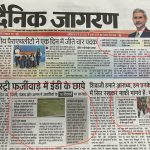 Needless to say, she is an exception. Reading as a habit is declining in Gen Z. Attention spans are also reducing. It’s not even videos but reels. Newsletters send summary with their articles. Even regional newspapers like Dainik Jagran summarise big stories into highlighted points; something which I noticed that some mainline English newspapers have also started to follow. (See image).
Podcasts are catching on. You can be driving and listening to a podcast or even watching cricket and listening to a podcast on the perils of investing in cryptocurrency. All major news sites also have audio version of the news.
So, what’s happening? Too much information, too little time? Multitasking and wanting to keep up with the Jones? Multifocus (does that even make sense?) and multifaceted? All valid reasons. But is there a cost to it?
My thinking is that the explosion of technology, in every field, have made people insecure. So, everyone is trying to know everything. And with Gen Z being born with a technology spoon, technology is not a medium or conduit but way of life. So, if I can do a masters in finance, I can also do a certification in AI, follow someone who gives tips about immigrating to Australia or Canada, learn how to retire at 40, follow stock market to get rich quick… you get the drift. Insecurity about the future, ironically caused by technology itself, forces them to try and know as much as possible
The width of knowledge of Gen Z is amazing. But the depth is a question mark? Jack of all trades but master of none is very applicable here. There is a view on everything but there is no confidence in that view. And proper lack of reading books is one reason why the depth of knowledge is missing. Reading books gives one a context. Historical perspective. Various viewpoints. Nuanced knowledge. A rich vocabulary. Ability to communicate, I can go on and on.
I was therefore eager to visit a book fair in Doon which my daughter discovered.
It was promoted online (the irony of it!) with 3000 books available as a hook and it promised books by the kilo.
And to my pleasant surprise I found that the venue was full of Gen Z, mostly students. Not to buy curriculum books, they hardly buy curriculum books nowadays its either some online repository or maybe in some cases library, but to buy books of various genres. I noticed that except me and my wife, there was just one more oldie parent. Heartening, to say the least.
At first, I was bewildered.
All I could see was books by unknown authors.
Self-help books.
Books advising on stockmarkets.
Books on romcom.
Books on psychology fiction, literary fiction.
And books on dark mystery.
I had hardly heard of these genres. But my daughter patiently took me through them.
Good girl guide to murder- it was a series of three or four books.
Before the coffee gets cold – sort of science fiction psychology
People we meet on vacation – Romcom
Cleopatra and Frankenstein – Literary fiction
I want to die but I want to eat but I want to eat tteokpokki – Psychological fiction
Normal people – Romance thriller
And most of these books claimed to be bestsellers. Published by leading publishing houses like Penguin or Bloomsbury publications amongst others.
But the most eyecatching thing was that most of the books had very young authors. Late twenties or early thirties. And mostly females. Holly Jackson (31 years), Anna Hueng (33 years), Emily Henry (33 years), Baek Sehee (33 years).
And most books were between 200-350 pages. No voluminous read that went for months.
In contrast, I hardly found the old voluminous classics like War and Peace or some of the Charles Dickens ones. The only old classics I could see were Crime and Punishment and Exodus.
There was a smattering of Dan Browne, Fredrick Forsyth and Jeffery Archer.
And then there were tonnes of self-help books, many by Indian authors, all men, on how to game the stockmarket, get rich quick, retire at 30 or 40 etc.
Most books had Hindi translations available. Alchemist by Paul Coelho was available only in Hindi. So were almost all help books and get rich books. And the Romcoms too.
Autobiographies and biographies were also available but mostly in Hindi or of Indian sports stars. Virendra Sehwag, Suresh Raina, Shane Warne and Nelson Mandela were the favourites, all in Hindi.
There were many detective and mystery books too and many by Indian authors. I guess the genre needs better situational and local nuances understanding.
By now my mind was buzzing with questions and I took the help of my ever-obliging daughter and wife to ask three-four youngsters some questions.
I am listing some interesting observations into Gen Z reading habits.
They usually do not have book reading as a habit but do come to such fairs as many self-help books and modern books are available cheap. By kilo. Strike one.
Mystery, politics, true events etc are more fun to watch on OTT rather than read about it. As one smartalec wisecracked, the daily newspapers are full of it anyways. Strike two.
They are comfortable in reading English as long as it is not Tharooresque. Not comfortable in communicating in English. But reading is a different ball game. Strike three.
Books do give them some sort of privacy. As its their personal area. But phones give them more privacy because no one knows what they are reading on it. Strike four.
They don’t read authors (my daughter disagreed), they read recommended books. Influencers and friends play a very strong role in their reading decisions. Strike five.
There is no budget for books. It’s a rare occurrence. Only at such book fairs where they buy in bulk in kilos. And they never keep the books. Exchange with friends or sell them off and that’s how they get recycled into such book fairs. Strike six.
But finally it was one guy who when asked about reading books for indepth knowledge, gave me a quizzical look and muttered: “Jab padai mein hum zyada depth mein nahin jaate tohi uski aadat kaise padegi” Loosely translated “When our education does not encourage us to dig deep then how will we get that habit.”
I will leave you with that deep thought as the master of all strikes.