Tag: Dainik Jagran

  • A Tryst with Books and Gen Z

    A Tryst with Books and Gen Z

    With apologies to none at all

    By Vikas Mehta

    Vikas MehtaMy daughter is an avid book reader. She actually reads books. That’s offline reading. Not Kindle or from any online site, but physical books. And that is a rarity. Since childhood, she would never get any pocket money but a monthly allowance to buy books. I would try to gently nudge her into buying some books but her independence in choosing her own genres came through at a very young age. Even now, books are her indulgence. Maybe that’s the reason she is doing graduation in journalism with creative writing as her elective. Three months summer break and she has already bought around 25-30 books and is now stocking to take some to the university.
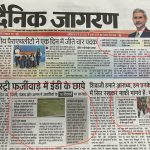
    Dainik Jagran clipping showing highlights of newsNeedless to say, she is an exception. Reading as a habit is declining in Gen Z. Attention spans are also reducing. It’s not even videos but reels. Newsletters send summary with their articles. Even regional newspapers like Dainik Jagran summarise big stories into highlighted points; something which I noticed that some mainline English newspapers have also started to follow. (See image).

    Podcasts are catching on. You can be driving and listening to a podcast or even watching cricket and listening to a podcast on the perils of investing in cryptocurrency. All major news sites also have audio version of the news.

    So, what’s happening? Too much information, too little time? Multitasking and wanting to keep up with the Jones? Multifocus (does that even make sense?) and multifaceted? All valid reasons. But is there a cost to it?

    My thinking is that the explosion of technology, in every field, have made people insecure. So, everyone is trying to know everything. And with Gen Z being born with a technology spoon, technology is not a medium or conduit but way of life. So, if I can do a masters in finance, I can also do a certification in AI, follow someone who gives tips about immigrating to Australia or Canada, learn how to retire at 40, follow stock market to get rich quick… you get the drift. Insecurity about the future, ironically caused by technology itself, forces them to try and know as much as possible

    The width of knowledge of Gen Z is amazing. But the depth is a question mark? Jack of all trades but master of none is very applicable here. There is a view on everything but there is no confidence in that view. And proper lack of reading books is one reason why the depth of knowledge is missing. Reading books gives one a context. Historical perspective. Various viewpoints. Nuanced knowledge. A rich vocabulary. Ability to communicate, I can go on and on.

    I was therefore eager to visit a book fair in Doon which my daughter discovered.

    It was promoted online (the irony of it!) with 3000 books available as a hook and it promised books by the kilo.

    And to my pleasant surprise I found that the venue was full of Gen Z, mostly students. Not to buy curriculum books, they hardly buy curriculum books nowadays its either some online repository or maybe in some cases library, but to buy books of various genres. I noticed that except me and my wife, there was just one more oldie parent. Heartening, to say the least.

    At first, I was bewildered.

    All I could see was books by unknown authors.

    Self-help books.

    Books advising on stockmarkets.

    Books on romcom.

    Books on psychology fiction, literary fiction.

    And books on dark mystery.

    I had hardly heard of these genres. But my daughter patiently took me through them.


    Good girl guide to murder- it was a series of three or four books.

    Before the coffee gets cold – sort of science fiction psychology

    People we meet on vacation – Romcom

    Cleopatra and Frankenstein – Literary fiction

    I want to die but I want to eat but I want to eat tteokpokki – Psychological fiction

    Normal people – Romance thriller


    And most of these books claimed to be bestsellers. Published by leading publishing houses like Penguin or Bloomsbury publications amongst others.

    But the most eyecatching thing was that most of the books had very young authors. Late twenties or early thirties. And mostly females. Holly Jackson (31 years), Anna Hueng (33 years), Emily Henry (33 years), Baek Sehee (33 years).

    And most books were between 200-350 pages. No voluminous read that went for months.

    In contrast, I hardly found the old voluminous classics like War and Peace or some of the Charles Dickens ones. The only old classics I could see were Crime and Punishment and Exodus.

    There was a smattering of Dan Browne, Fredrick Forsyth and Jeffery Archer.

    And then there were tonnes of self-help books, many by Indian authors, all men, on how to game the stockmarket, get rich quick, retire at 30 or 40 etc.

    Most books had Hindi translations available. Alchemist by Paul Coelho was available only in Hindi. So were almost all help books and get rich books. And the Romcoms too.

    Autobiographies and biographies were also available but mostly in Hindi or of Indian sports stars. Virendra Sehwag, Suresh Raina, Shane Warne and Nelson Mandela were the favourites, all in Hindi.

    There were many detective and mystery books too and many by Indian authors. I guess the genre needs better situational and local nuances understanding.

    By now my mind was buzzing with questions and I took the help of my ever-obliging daughter and wife to ask three-four youngsters some questions.

    I am listing some interesting observations into Gen Z reading habits.

    They usually do not have book reading as a habit but do come to such fairs as many self-help books and modern books are available cheap. By kilo. Strike one.

    Mystery, politics, true events etc are more fun to watch on OTT rather than read about it. As one smartalec wisecracked, the daily newspapers are full of it anyways. Strike two.

    They are comfortable in reading English as long as it is not Tharooresque. Not comfortable in communicating in English. But reading is a different ball game. Strike three.

    Books do give them some sort of privacy. As its their personal area. But phones give them more privacy because no one knows what they are reading on it. Strike four.

    They don’t read authors (my daughter disagreed), they read recommended books. Influencers and friends play a very strong role in their reading decisions. Strike five.

    There is no budget for books. It’s a rare occurrence. Only at such book fairs where they buy in bulk in kilos. And they never keep the books. Exchange with friends or sell them off and that’s how they get recycled into such book fairs. Strike six.

    But finally it was one guy who when asked about reading books for indepth knowledge, gave me a quizzical look and muttered: “Jab padai mein hum zyada depth mein nahin jaate tohi uski aadat kaise padegi” Loosely translated “When our education does not encourage us to dig deep then how will we get that habit.”

    I will leave you with that deep thought as the master of all strikes.
     

  • Ram Mandir Consecration: Opportunities drowned in Moment Marketing?


    With apologies to none at all

    By Vikas Mehta


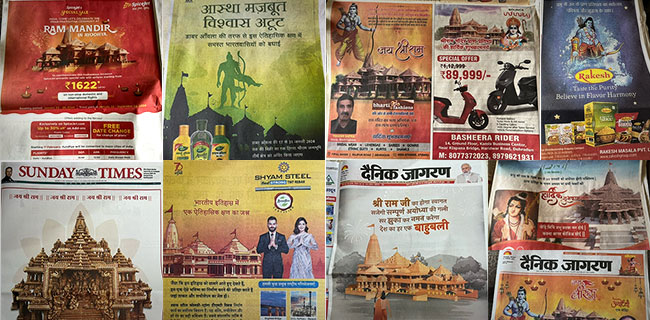
    Vikas MehtaJanuary 22, 2024, I guess, will become a watershed day in the Indian history. It was a culmination of a well-orchestrated movement led by the state and I think it may become a celebrated case study in marketing too. But my article today is not about the temple consecration or how it became a marketing case, lest I be accused of sacrilege, it is about how brands did or did not latch onto this moment marketing occasion. And as I live in Dehradun, close to the heartland of the temple movement, I shall look at it from this viewpoint.


    I take back my words. This was not a moment marketing case. It could have been an opportunity to take the whole occasion as an opportunity and drive maybe even a long-term marketing campaign for a brand. But, unfortunately, that’s not what happened. Brands and companies by sheer shortsightedness turned it into just moment marketing.


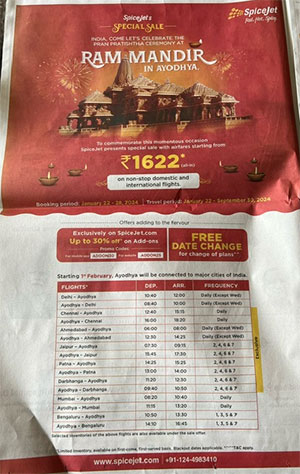
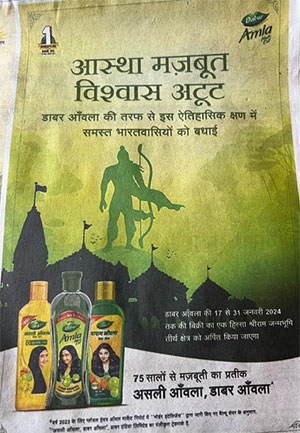
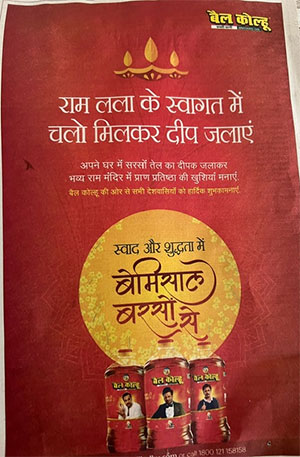
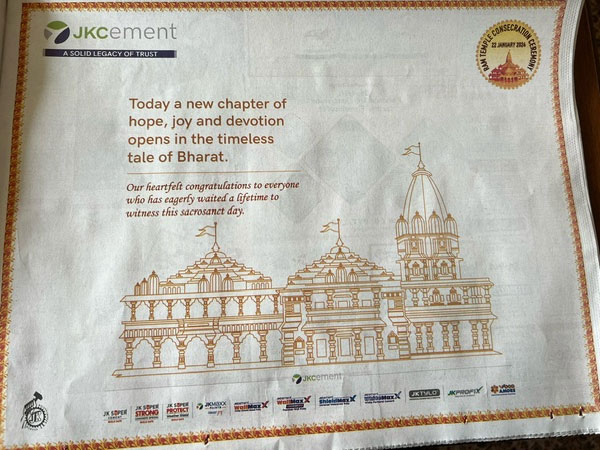
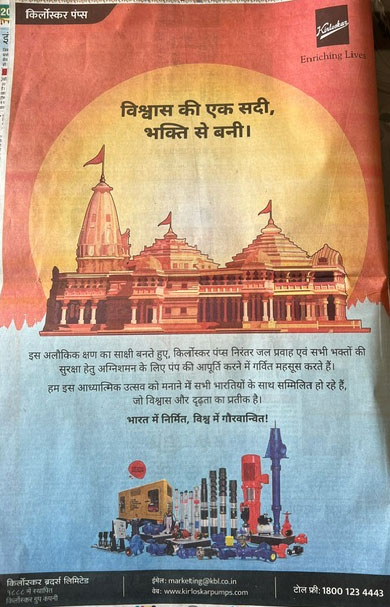
    Ok, I take back this also. As the first thing that I noticed was that very few national level brands did anything at all. There were some lame or limp attempts at moment marketing by the likes of Kirloskar, Dabur Amla, Dabur Gulabari, JK Cements, SpiceJet and Amul. These were the only national brands that were visible to me. Dabur Gulabari was the one brand which used some brand properties and kept it strictly related to the temple. SpiceJet used the occasion to give some discounts and freebies along with the schedule of Ayodhya flights. But the rest were just about cautious congratulatory messages. As I said limping moment marketing.


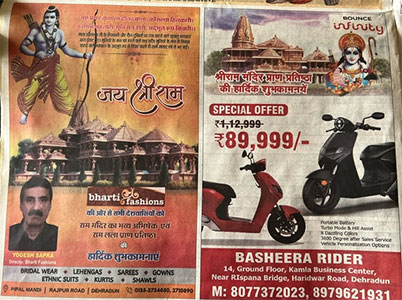
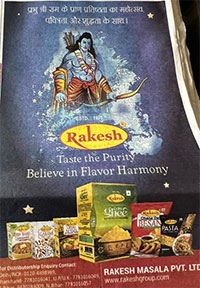
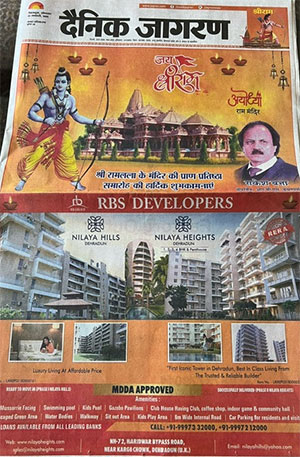
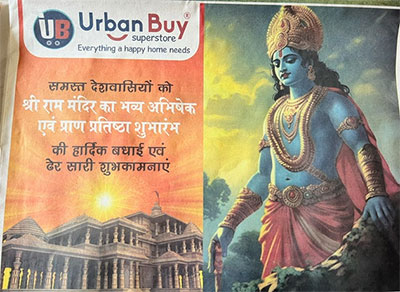
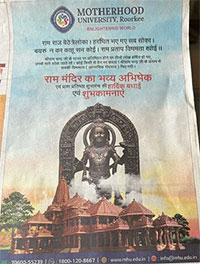
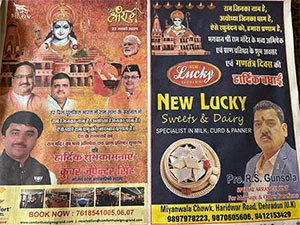
    It was local brands that ruled the roost. On the day, Dainik Jagran had two newspapers. One was a regular newspaper with some news in between a plethora of local ads. Sadly, even these were forgettable. But what was interesting was one the diversity of categories. From food masalas to construction companies to personal product companies to local fashion brands to local politicians to two-wheeler dealers to local cooking oils to local dairy and sweets brands to local jewellers to local event management companies to pan masala to resorts to medical centres and even local grocery stores. Some educational institutes, hearing aid centres, and local construction material retailers and brands added to the confusion. In my estimate, the news was maybe 45% and the ads took up rest of the space.


    The second newspaper was full of various articles on the temple. Historic angle, legal angle, the development in the city of Ayodhya… all of this was highlighted. And this was also full of ads as well, though maybe the ratio (of ads to editorial content) was more equal.


    A few weeks ago, a news portal had asked me to predict about what brands will do around the consecration ceremony. And my first instinctive reaction was that they will play it safe. Most brands will not do anything. Some will pay lip-service and a few who may have been involved with the construction of the temple may talk about their contribution. It looks I was correct in my initial thinking. Though I found it quite puzzling why brands which contributed to the building of the temple kept quiet. Initially I though JK Cement had contributed to the structure. But they did not mention it in their ad and I also read somewhere that no cement has been used in the construction. They too had just a congratulatory message.


    Why did most brands stay away? Because religion being a divisive subject, brands did not want to seen to be taking sides. And MNC, global brands are worried about repercussions in other markets too. That’s the main reason which explains the total absence of multinational or foreign brands. They did not want to alienate certain sections of the society and the world. Therefore, the few national brands that did advertise were Indian origin brands and some like Kirloskar did play up its Indianness. So, nationalism was the message. But that still does not explain the absence of many brands who have almost positioned themselves on nationalism. Kajaria Tiles, for example.


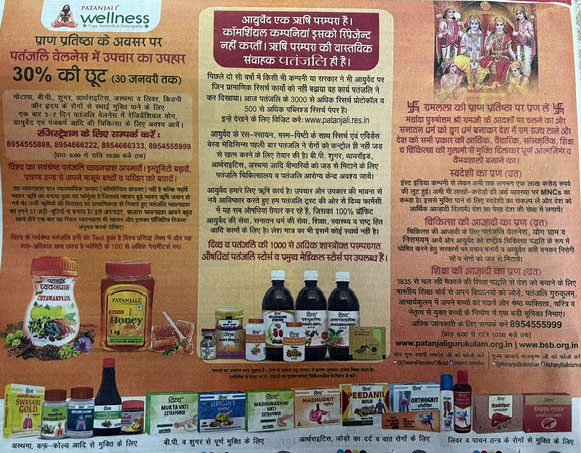
    Patanjali was the other brand which has for long played the nationalism card. Surprisingly, they were very low key. One press ad which looked like a 3-in-1 did appear. It spoke about an offer. About Ayurveda. And then some resolutions to take on this auspicious occasion. The last point was just about nationalism, whereas in my mind it could have been about some healthy resolutions combining the occasion and Ayurveda.


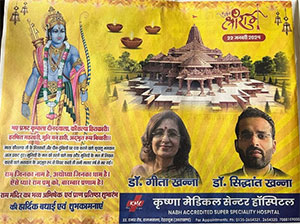
    The local brands had nothing to lose. Most of the brands who advertised, hardly advertise. So, this was a one-off which they could afford. Interestingly, the messages were quite brazen. Many of the ads had big mugshots of the owners. For once, some two-wheeler dealers found an opportunity to put their mugshots along with the product photo. Ditto for real estate developers, medical centre owners, dairy and sweet centre owners, construction material dealers. It was an opportunity to show themselves as Ram Bhakts. And I think that was the most important point for them. Announcing to the society and their circle of acquaintances about their religious and I suspect, even political beliefs.


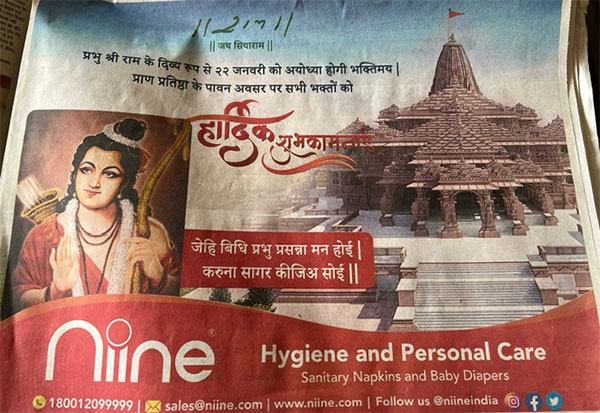
    There was a local brand for sanitary napkins and diapers, which also advertised. Would any national or MNC brand have the guts to associate an ostensibly (unfairly labelled) unclean product with Mandir?


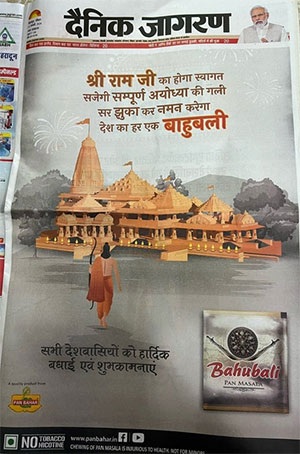
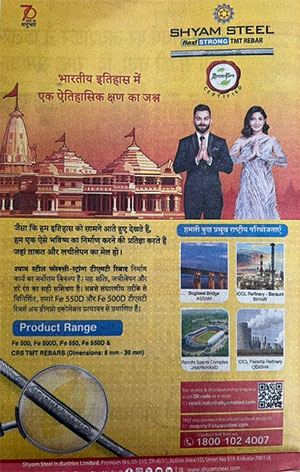
    Take Bahubali Pan Masala, and the brand is not about a surrogate. It openly says masala in the headline, very cleverly almost like a rhyme and has incorporated its brand name in it. Ayodhya ki galli and Bahubali. Shyam Steel has a prominent photo of Virat Kohli and Anushka with hands folded juxtaposed with a shot of the temple.


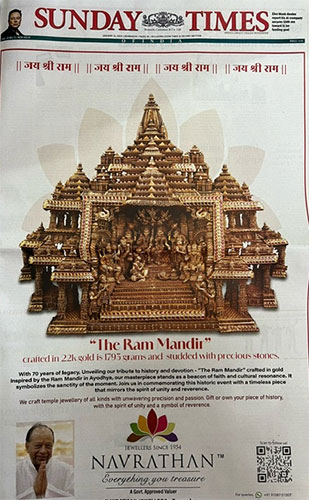
    And then there was one jeweller, based out of Bengaluru who had a full-page ad selling a model of Ram Mandir made in 22k gold weighing 1795 grams, studded with precious stones. The brand spoke about its 70 years of legacy and also had a mug shot of its owner with folded hands. Want more information and want to order? A QR code was provided. Religion, commerce and technology… a heady mix.


    In all this hullabaloo, there was another twist in the story. Republic Day was just four days later. And this is the time when durables, online stores, supermarkets etc have sale offers. And the advertising for the same starts a week before. Some of them tried gamely on Jan 22 too. But they were drowned out in the cacophony of the mandir ads. In fact, I don’t see many more brands or offers coming our way around Jan 26 as brands know that consumers have spent money for the Ram Mandir event. Every society, every mohallah, every market had some ceremony or an event or even bhandaras (free food). And it was all organised on the back of donations. People spent on bhagwa (saffron)-coloured clothes, flags, lights, diyas and crackers. Everyone contributed something somewhere. So, I guess Republic Day sales will be muted.


    Yes, I am being critical of brands. So, what more could they have done? For starters, they should not have looked at this as moment marketing. They should have seen this as maybe a property to associate with and organised activities around it. CSR? Offers and discounts to spur sales and not just to pay lip-service?  And do it according to the category and brand values. Patanjali could have set up shop at the railway stations, airports and bus stations and given wellness or Ayurveda products at good reduced rates while offering a loyalty programme. And rather than dress up the crew as Ramayan characters and earn derision, Indigo could have offered substantial discounts to all senior citizens travelling during a time period. Maybe tie up with some old age homes and offer few free seats per flights. Haldiram could have organised free bhandaras….


    The problem was that big national brands saw this as an aberration. A one-off. I think they have not realised that this day will be celebrated every year. Not just in a religious sense but also in a nationalistic and political sense. If the brands had looked at it through a long-term prism, they could have not only done more but also gained empathy and set the cash tills ringing. Let’s not forget that big brands including some MNC brands have thrived during Kumbh Melas. But this time they lost out on the big picture. The small brands did not see the big picture but they saw this as an opportunity to loosen the purse strings a bit and proudly proclaim their arrival.


    Frankly, moment marketing became the Achilles Heel for brands.


    Vikas Mehta is a Dehradun-based business strategist and educator. He writes on MxMIndia every other Monday, but sometimes on other days as well. His views here are personal.


  • Dainik Jagran invites applications for second edition of ‘Gyanvritti’

    By A Correspondent


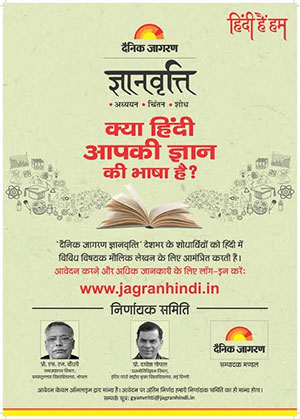
    In order to promote fundamental research in Hindi language, the online application for  applicants has begun for the second edition of ‘Gyanvritti’ under Dainik Jagran initiative ‘Hindi hai hum’. Dainik Jagran’s Gyanvritti is an initiative to promote fundamental research and original writing  in Hindi. Under this programme, it has been envisaged to promote academically sound  research on topics such as Social Science, Economics, Diplomacy, History and Political Science.
     

    The jury for the same comprises Professor S N Chaudhary from Barkatullah University, Dr. Darvesh Gopal, Professor of Political Science, Indira Gandhi National Open University (IGNOU) and editorial team of Dainik Jagran will also serve as jury of this fellowship.


  • It’s Bihar Calling for Bhaskar!


    By A Correspondent


    The print media has had strong patrons over the years. But in more recent times, where digital has taken rapid strides globally and in India too, while the number of people propagating the benefits of the media hasn’t diminished, if there’s one person who not only aggressively champions the cause of print but also asks the trade media to promote it, it’s Girish Agarwaal, promoter and director of the Dainik Bhaskar group.


    Agarwaal spoke of the rapid growth of print despite naysayers, quoting his own newspaper’s example which he says is indeed a “very big deal”.


    The rise in newsprint prices which saw at least one newspaper group declaring that it’s going to cut its print run to cut costs is not something that Agarwaal too bothered about. “It’s cyclical, and will come down in a few quarters,” he told mediapersons.


    On Tuesday, Agarwaal and team had convened a presser to announce the rapid strides his paper had seen in Bihar in just a year of launch. It commissioned Hansa Research, the agency which would undertake the IRS research until it was upstaged by Nielsen a few years back, to map the length and breadth of Bihar to conduct the study.


    A sample of over 2000 people conducted the study, and the results show that Dainik Bhaskar is a close #2 in the state, ahead of Dainik Jagran and Prabhat Khabar. As per the study, DB is at #2 with an AIR of 9.11 lakh and Hindustan continues to lead at 9.98 lakh. But in Patna city, DB is #1 with AIR of 5.07 lakh


    Interestingly, DB has attracted the highest number of women readers amongst its peers. Its number is 47 per cent, as against 44 per cent being the next best.


    Readership Survey Report Bihar 2018

  • Dainik Jagran aims to push research initiative in Hindi

    By A Correspondent


    The Dainik Jagran group has rolled out ‘Gyanvritti’to promote research in Hindi which will offer an opportunity to scholars to conduct research in subjects like History, Political Science, Social Science, and Economics etc. Scholars can apply online for this fellowship programme.


    The Gyanvritti jury will take a final decision to select a scholar based on his/her synopsis. The selected scholar will get scholarship minimum for six months and maximum for nine months. Gyanvritti will follow international standard to give Rs 75,000 per month. The selected scholar will have to present the progress report of research on every three months before expert panel of Dainik Jagran. They will also have to write book in two hundred pages on the research topic at the culmination of research. Dainik Jagran will help in publishing that book, the copyright of which will be with the scholar.


  • Fourth edition of Dainik Jagran Samvadi starts Nov 3

    By A Correspondent


    The fourth edition of Dainik Jagran Samvadi, a three-day festival celebrating the power of expression, will be held in Lucknowfrom November3 to 5, 2017.  The festival which is spread across three days will have 75 speakers participating through 30 deep-diving sessions.
     

    Said Sanjay Gupta, CEO of Jagran Publication Group and Editor-In-Chief, Dainik Jagran: “Dainik Jagran Samvadi is the expression of our commitment to bridge the gap between readers and writers and thinkers, enable more conversation between them and contribute towards building a society that is more open and significant in its expressions,”


  • Dainik Jagran iNext connects with agencies for Hindia

    By A Correspondent


    Dainik Jagran iNextis running a nationwide B2B umbrella campaign titled Hindia. The campaign was launched last month with a teaser mailer that succeeded in generating much curiosity because of its intriguing title. Unique logo design only added to the attraction and attention. The name and the logo follow the theme idea of bi-lingual reporting as introduced by Dainik Jagran iNextin India, a decade ago.


    Coming from the house of Jagran Prakashan Ltd, Dainik Jagran iNextis India’s first bi-lingual newspaper pioneered by COO AlokSanwal.


    Explaining the idea of the campaign, Siddharth Biswas, GM, Brand Development, Dainik Jagran iNext said: “In the interest of the advertisers, we have found and marked the boundaries of a virtual nation of sorts and are specifically identifying the not-so-perceived affluent spots of the region. Brands willing to reach the filtered TG and catch the right fishes now have Hindia as the right ocean and iNextas the right hook.”


  • Inext COO Alok Sanwal gets ‘Indian of the Year’ Award

    By A Correspondent


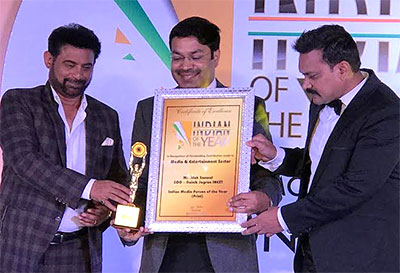
    Alok Sanwal, the man behind Dainik Jagran INEXT, was awarded ‘Indian of The Year Award’ Media Person of the Year – Print title in New Delhi last week by ‘Brands Academy.
     

    The engineer-turned-editor re-engineered the print media with Inext, the bi-lingual newspaper from Jagran Prakashan stable which spoke in the language of its target readership.


    Speaking on the occasion, Sanwal said: “I am delighted to have been felicitated by Brands Academy. It’s quite rewarding when your years of hard work and dedication are acknowledged by the legends of the industry.”


    Along with Alok Sanwal, a few more media persons were honoured at the event, including Rajdeep Sardesai and Shweta Singh. Other few key winners of the award included names like Kailash Satyarthi (Social Worker) and Chanda Kochhar (MD & CEO, ICICI Bank).


  • Winnning ways for Mindshare


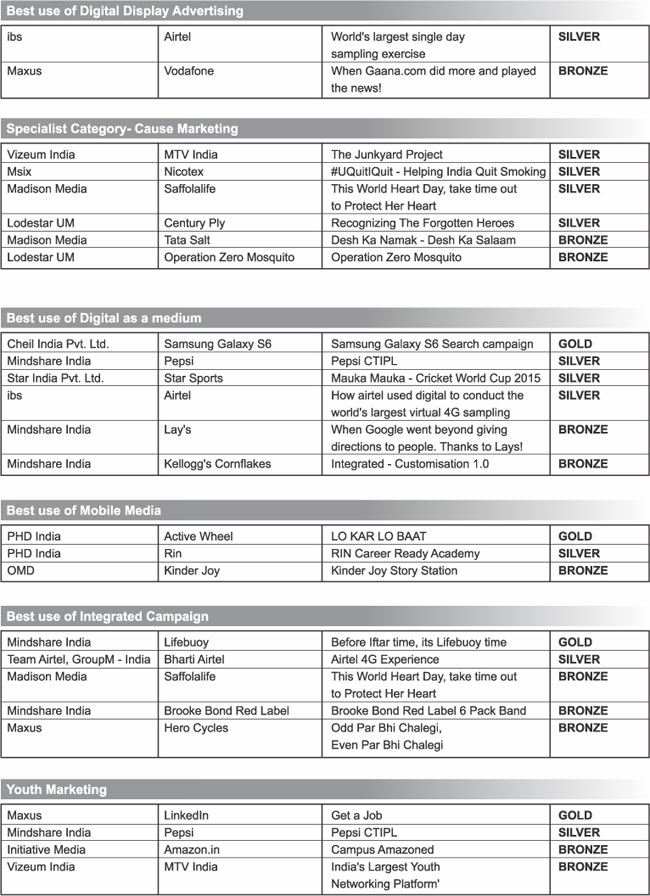
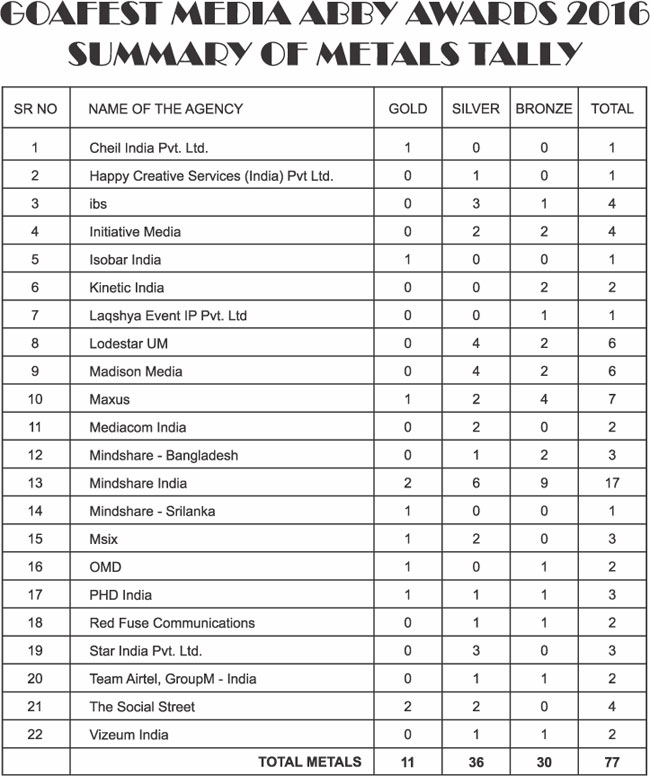
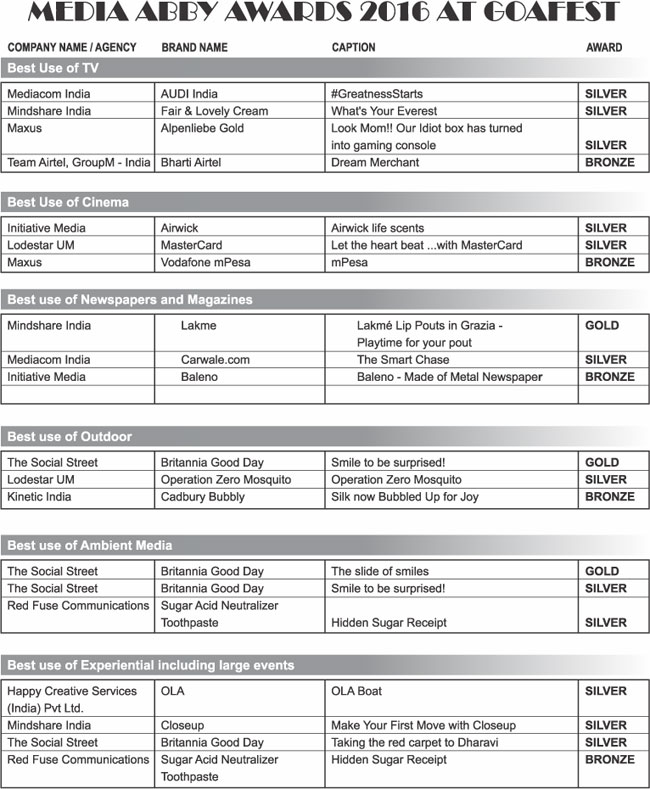
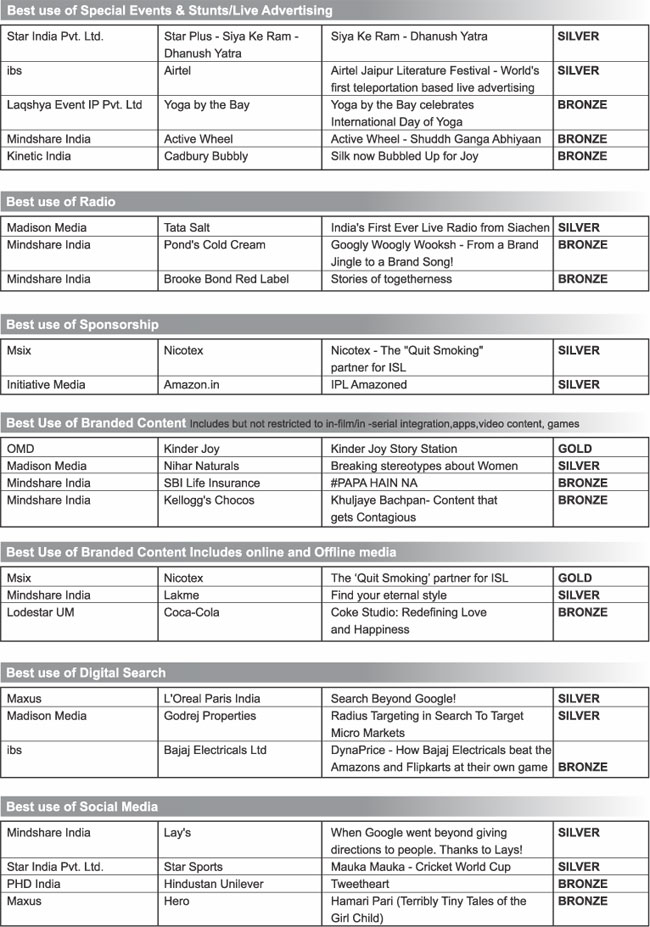
    Media agency major topped the metals tally at the Media Abby awards held on Day 1 of Goafest 2016. Mindshare was awarded two Golds, six Silvers and nine Bronze metals. The first runner-up was sibling Maxus with seven metals (one Gold, two Silvers and four Bronzes).


    The parameters we were looking for was work that is fresh and unique, said Pratap Bose, Jury Chair of the Media Awards, adding that the jury did not find any of the shortlisted entries making the cut for a Grand Prix, the highest level of the awards.


    Lodestar UM and Madison Media secured six metals each with four Silvers and two Bronze awards. New entrant The Social Street won two golds and two silvers.


    There were a total of 76 agencies which participated in the Media Abby, sending in 1015 entries this year. The number of jury members was 86 and a total of 77 metals were awarded (11 Golds, 36 Silvers and 30 Bronzes).


    For Prasanth Kumar, CEO, Mindshare South Asia, it is a continuation of the agency’s winning ways after the agency coming out tops at last year’s Emvies Awards of the Advertising Club. “Yes, we ended 2015 with 176 awards and this year has also been equally spectacular,” he said, adding that the emphasis is on providing innovative solution to clients to break the clutter and fragmentation.


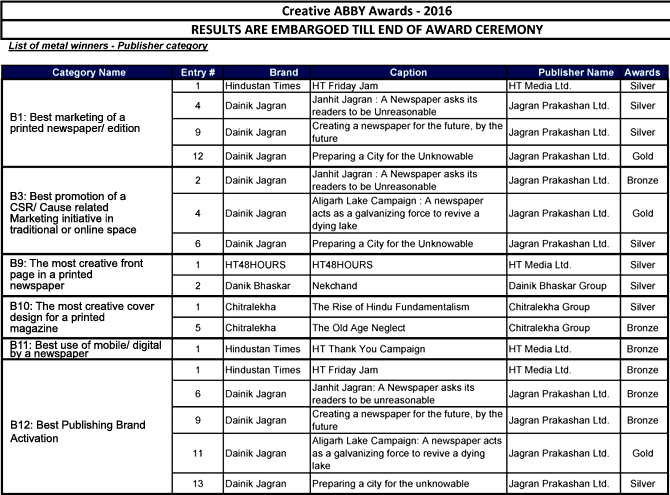
    Along with the Media Abby, the Publisher Abby awards were also presented. Dainik Jagran newspaper was presented 10 of the 17 awards.


  • Jagran unveils ‘The Cultural Legacy of Lucknow’

    By A Correspondent


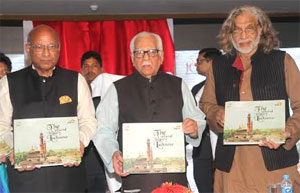
    Dainik Jagran released its Coffee Table Book titled ‘The Cultural Legacy of Lucknow’. The book was unveiled by honourable Governor of UP, Shri Ram Naik at a gala function in Lucknow last week. The launch function took place at the vintage Clark Awadh hotel of the capital and was replete with prominent bureaucrats and top Jagran Group brass, including the CMD Shri Mahendra Mohan Gupta.
     

    15th in the line of JCTBs, ‘The Cultural Legacy of Lucknow’ in the line of JCTB series, showcases exclusive pictorial details of the significant monuments, art & craft, tradition and music, which are the cultural heritage of the city. This coffee table book documents contemporary Lucknow, which is known for its cosmopolitan lifestyle, modern infrastructure, shopping and tourist destinations that embellish the city. Well researched narratives in the book illuminate the historical and contemporary perspectives that speak volumes about the understandable exclusivity of the city.


    Shri Mahendra Mohan Gupta said, “Jagran Prakashan Ltd. is publishing coffee table books for last six years. I am proud that time and again we come up with such illuminating books on different genres.”


    Editor and COO of i-Next & Project Head of Jagran Coffee Table Book – Alok Sanwal said, “Jagran Prakashan Ltd wishes to contribute to bringing alive the glory of the city of Nawabs to the world through this unique Coffee Table Book, which unfurls the unsung glory of this wonderful city. I thank Sharmishtha Sharma, author, and the entire research, editorial and marketing teams for their outstanding and extensive support throughout.”


    Priced at Rs. 1500, this 210-page book is available on Flipkart and Infibeam portal for sale.


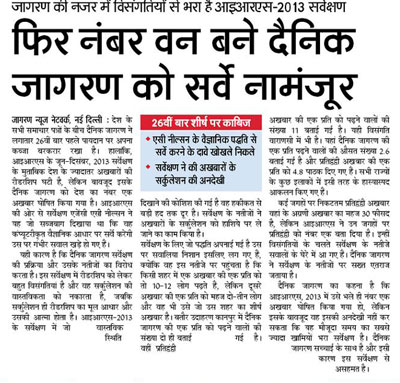
  • #1 daily Dainik Jagran damns IRS on its Page 1

    By A Correspondent


    When we wrote about dna’s questioning of the IRS findings, we had used the phrase ‘knives are out’ to describe the development. But now it appears newspapers are bracing themselves for the war.


    Leading news daily Dainik Jagran,  the numero uno daily in the  country as per the IRS 2013 study, has published a large front-page story say it doesn’t approve of the IRS findings. In fact it goes a step further and says the AC Nielsen’s claim of scientific method of surveying is ‘khokhla’ (Google translate: ~hollow, gossipy).


    Legal eagles are being consulted on how to combat the MRUC, RSCI and AC Nielsen in Court, but in the meantime those whose publications have gained much in the study or reflect favourably vis-à-vis competition are saying that it’s unfair to damn the readership study authorities.


    As reported by MxMIndia yesterday, some aggrieved dailies are considering collectively or individually filing law suits.  When alerted about this, a senior MRUC functionary told us that Court cases files by aggrieved members and newspaper groups after the publication of readership numbers is nothing new for the MRUC.


  • Mid-Day launches Fully Filmi

    By A Correspondent


    It is the 33rd anniversary of Mid-Day, and the publication is celebrating it in style. As the brand extension, the group has launched a Bollywood portal – Fully Filmi. The portal aims to address the need gap that the Bollywood-news websites have yet not been able to cater.


    Manajit Ghoshal,MDand CEO, Mid-Day, said: “When we thought of launching the website on Bollywood, we saw that there were hardly any websites that were doing breaking news. It was surprising, given that it is one of the biggest film industries in the world. The current crop of Bollywood websites does not dish out anything fresh; they do not have a dedicated team of journalists. They are more of news aggregators. We are going to focus more on coverage of authentic industry news.”


    The website has been getting positive reviews from the film fraternity, according to Mr Ghoshal. However, the website is due to get the responses from advertisers. Mr Ghoshal said: “We wanted to approach the advertisers only after the launch. Now that the web property has been launched, we will approach them in due time.”


    Among the target group of the website is the NRI community, and the audiences in interior India. The property will be promoted through Dainik Jagran’s Hindi dailies, and cross-referenced with Mid-Day to drive traffic. Other than this, the property is looking at film theatres and tie-ups for promotion.


    The group is trying also hard to regain its past numbers in Mumbai. Mr Ghoshal said: “We have been adding numbers to readership since last three years. However, we will be focusing more aggressively on that front. We wish to keep the trend up for the next couple of years. The group would experiment with newer formats, new innovations in our 33rd year.”