The second instalment of ‘With Apologies to None at All’, a fortnightly column by Vikas Mehta
By Vikas Mehta
 I remember that while growing up all major purchase decisions at home, be it a fridge or a mixer grinder or even a bicycle would heavily depend upon the suggestions and experiences of neighbours, relatives and friends. Not that there was much choice but even if one had to choose between a Hero or an Atlas bicycle the recommendation of someone who had bought and used the brand would matter. I still remember, how my father spoke to at least 6-7 users of Ambassador and Fiat before deciding that a secondhand Fiat will be a good choice for the family of four. That’s the car which introduced me to the world of driving.
But I deviate. The point being that in the days of thrift and limited choices, word-of-mouth really mattered. WOM was the initial marketing tool that was used by customers inadvertently It also played an important role in brand perception. So, if I remember correctly, all our acquaintances were clear that Lambretta was a better scooter, technically and for its reliability too. But its availability was always a problem and Bajaj became the family favourite as it had a better distribution and quicker delivery time, relatively (2-3 years as against Lambretta which was bhagwan bharose).
I have seen WOM evolve with the times. It actually became an important tool even in advertising. Some categories started using consumer testimonials as a strategy to influence consumer behaviour. Actual consumers who had used the brand became its spokesperson and seeing or hearing someone who one could identify with, talking good about the brand became a WOM experience. I think detergents as a category was the first to use consumer testimonials effectively. And Dove mastered it wonderfully. The protagonists in the ad were not glamorous or young or had a model type of smooth talking but were real consumers who seemed just like our everyday friends and acquaintance. Even real life doctors or scientists being used by brands were effectively WOM expert testimonials. The problem started when the brands became greedy and started using models, who were professionals paid to become a consumer or a doctor, who also appeared in other ads as actors, and the effect of consumer/expert testimonials was lost.
With the advent of Direct Marketing and CRM, marketing looked at WOM with a fresh approach. WOM agencies came into existence, which started amassing consumers who had similar demographics and psychographics and used these consumers as brand evangelists. Events would be organised, gatherings would be held where brands would entertain and educate these groups of consumers, who in turn would spread the good word around. They would also gain some benefits out of this. So, in effect WOM was commercialised. Digital made this not only easy but also more widespread.
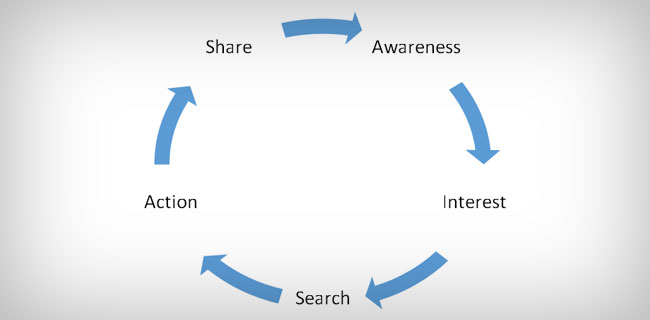
But the last three-four years have seen another factor come into play which has recast the role of WOM. And I will use the AIDA model of buying behaviour to demonstrate the same. For decades, the model was linear. Catch attention, gain interest, create desire and close the action through sale. Digital changed this model into a never ending circular, self-perpetuating one with two additions. Search and feedback.
Communication created interest. And thanks to the prevalence of the net, we translate the interest into search. We look for more information. We look for more brands/competition, we look for deals and then we tend to take action. Some may argue that this is not as prevalent in categories like groceries or commodities but I beg to differ. Search is still relevant. May not be for features or differentiation but definitely for bargains and offers. Even for weekly grocery shopping we do have a tendency to check if Big Basket or Jiomart or maybe even Amazon Fresh gives me better discounts or offers. Search is now second mature to us. So much so, that in US Amazon has almost 35% share in Search engines.
And we do not stop after buying. Social media gave us a habit to share our purchases with our circle of friends. So, while we may want to show off our latest phone purchase or a dress or even a good deal, we are quicker on the draw to complain about a problem or a purchase gone bad. The habit of giving a feedback has also arrived. The habit of sharing our purchase and its experience.
Therefore, when ecommerce companies ask explicitly for feedback on our purchases the feedback is provided for. Both good and bad. These are then classified as ratings and are posted on the product listing. Now tell me if this isn’t WOM, what is?
And this is a tool waiting to be exploited. Imagine, you are a new player in the home accessory business. You list on Amazon. You pay to be sponsored on Amazon. Your product quality is good, your delivery is good and your consumer care is excellent. You give discounts to get the first batch of consumers and maybe 5% of these give feedback. Most of it is good, so your rating is close to 5 out of 5. Now, someone who wants to buy a new kitchen rack sees your product, likes the design but is not sure about your brand. He sees your ratings and is impressed. He then checks some of the feedback and sees mostly positive ones. He trusts these. Because these are from buyers. People like him. He may not know them, but they have used the product and are speaking up for it. A positive WOM.
This positive WOM has now got a new customer. And the cycle continues. More positive feedback will get more new buyers. Will also reassure current buyers. The cycle will keep on expanding and a new brand can get success based on positive feedback. But if the feedback is not positive, the cycle will break. New consumers will be hesitant to buy. All because the feedback was negative. And the brand trial and usage may shrink.
With the advent of digital Tripadvisor started customer feedback ratings of hotels, restaurants and other tourism related services. It’s success was illustrated just by the fact that many hotels etc would respond to negative feedback with apologies and promise to make the service better. Today Makemytrip and such sites also use this feedback mechanism.
Feedback is the new avatar of WOM. It can be a strong and powerful tool. Ecommerce companies have realised its potential, travel and tourism companies have too. I think it’s time that brands in other sectors, especially new players, start looking at feedback as a digital WOM that can give them a true differentiation. It’s waiting to be exploited.
Vikas Mehta is a senior business and marketing strategy consultant and educator. He is based in Dehradun. ‘With Apologies to None at All’ will appear every other Tuesday. His views here are personal