Tag: Gen Z

  • A Tryst with Books and Gen Z

    A Tryst with Books and Gen Z

    With apologies to none at all

    By Vikas Mehta

    Vikas MehtaMy daughter is an avid book reader. She actually reads books. That’s offline reading. Not Kindle or from any online site, but physical books. And that is a rarity. Since childhood, she would never get any pocket money but a monthly allowance to buy books. I would try to gently nudge her into buying some books but her independence in choosing her own genres came through at a very young age. Even now, books are her indulgence. Maybe that’s the reason she is doing graduation in journalism with creative writing as her elective. Three months summer break and she has already bought around 25-30 books and is now stocking to take some to the university.

    Dainik Jagran clipping showing highlights of newsNeedless to say, she is an exception. Reading as a habit is declining in Gen Z. Attention spans are also reducing. It’s not even videos but reels. Newsletters send summary with their articles. Even regional newspapers like Dainik Jagran summarise big stories into highlighted points; something which I noticed that some mainline English newspapers have also started to follow. (See image).

    Podcasts are catching on. You can be driving and listening to a podcast or even watching cricket and listening to a podcast on the perils of investing in cryptocurrency. All major news sites also have audio version of the news.

    So, what’s happening? Too much information, too little time? Multitasking and wanting to keep up with the Jones? Multifocus (does that even make sense?) and multifaceted? All valid reasons. But is there a cost to it?

    My thinking is that the explosion of technology, in every field, have made people insecure. So, everyone is trying to know everything. And with Gen Z being born with a technology spoon, technology is not a medium or conduit but way of life. So, if I can do a masters in finance, I can also do a certification in AI, follow someone who gives tips about immigrating to Australia or Canada, learn how to retire at 40, follow stock market to get rich quick… you get the drift. Insecurity about the future, ironically caused by technology itself, forces them to try and know as much as possible

    The width of knowledge of Gen Z is amazing. But the depth is a question mark? Jack of all trades but master of none is very applicable here. There is a view on everything but there is no confidence in that view. And proper lack of reading books is one reason why the depth of knowledge is missing. Reading books gives one a context. Historical perspective. Various viewpoints. Nuanced knowledge. A rich vocabulary. Ability to communicate, I can go on and on.

    I was therefore eager to visit a book fair in Doon which my daughter discovered.

    It was promoted online (the irony of it!) with 3000 books available as a hook and it promised books by the kilo.

    And to my pleasant surprise I found that the venue was full of Gen Z, mostly students. Not to buy curriculum books, they hardly buy curriculum books nowadays its either some online repository or maybe in some cases library, but to buy books of various genres. I noticed that except me and my wife, there was just one more oldie parent. Heartening, to say the least.

    At first, I was bewildered.

    All I could see was books by unknown authors.

    Self-help books.

    Books advising on stockmarkets.

    Books on romcom.

    Books on psychology fiction, literary fiction.

    And books on dark mystery.

    I had hardly heard of these genres. But my daughter patiently took me through them.


    Good girl guide to murder- it was a series of three or four books.

    Before the coffee gets cold – sort of science fiction psychology

    People we meet on vacation – Romcom

    Cleopatra and Frankenstein – Literary fiction

    I want to die but I want to eat but I want to eat tteokpokki – Psychological fiction

    Normal people – Romance thriller


    And most of these books claimed to be bestsellers. Published by leading publishing houses like Penguin or Bloomsbury publications amongst others.

    But the most eyecatching thing was that most of the books had very young authors. Late twenties or early thirties. And mostly females. Holly Jackson (31 years), Anna Hueng (33 years), Emily Henry (33 years), Baek Sehee (33 years).

    And most books were between 200-350 pages. No voluminous read that went for months.

    In contrast, I hardly found the old voluminous classics like War and Peace or some of the Charles Dickens ones. The only old classics I could see were Crime and Punishment and Exodus.

    There was a smattering of Dan Browne, Fredrick Forsyth and Jeffery Archer.

    And then there were tonnes of self-help books, many by Indian authors, all men, on how to game the stockmarket, get rich quick, retire at 30 or 40 etc.

    Most books had Hindi translations available. Alchemist by Paul Coelho was available only in Hindi. So were almost all help books and get rich books. And the Romcoms too.

    Autobiographies and biographies were also available but mostly in Hindi or of Indian sports stars. Virendra Sehwag, Suresh Raina, Shane Warne and Nelson Mandela were the favourites, all in Hindi.

    There were many detective and mystery books too and many by Indian authors. I guess the genre needs better situational and local nuances understanding.

    By now my mind was buzzing with questions and I took the help of my ever-obliging daughter and wife to ask three-four youngsters some questions.

    I am listing some interesting observations into Gen Z reading habits.

    They usually do not have book reading as a habit but do come to such fairs as many self-help books and modern books are available cheap. By kilo. Strike one.

    Mystery, politics, true events etc are more fun to watch on OTT rather than read about it. As one smartalec wisecracked, the daily newspapers are full of it anyways. Strike two.

    They are comfortable in reading English as long as it is not Tharooresque. Not comfortable in communicating in English. But reading is a different ball game. Strike three.

    Books do give them some sort of privacy. As its their personal area. But phones give them more privacy because no one knows what they are reading on it. Strike four.

    They don’t read authors (my daughter disagreed), they read recommended books. Influencers and friends play a very strong role in their reading decisions. Strike five.

    There is no budget for books. It’s a rare occurrence. Only at such book fairs where they buy in bulk in kilos. And they never keep the books. Exchange with friends or sell them off and that’s how they get recycled into such book fairs. Strike six.

    But finally it was one guy who when asked about reading books for indepth knowledge, gave me a quizzical look and muttered: “Jab padai mein hum zyada depth mein nahin jaate tohi uski aadat kaise padegi” Loosely translated “When our education does not encourage us to dig deep then how will we get that habit.”

    I will leave you with that deep thought as the master of all strikes.
     

  • Beyond Stereotypes: The Complex Realities of Generational Differences


    By Geeta Lobo ad Ashwini Sirsikar


    In the contemporary discourse, generational differences are a compelling explanation for the ever-shifting landscapes of values and perspectives. Marketers are increasingly targeting generations with the belief that these are consistent cohorts. Gen Z and Boomers being at loggerheads, is an ever-present meme. At the same time, reasonable arguments are also made about how these generational differences are actually a myth. That these reflect differences in life-stages. Why shouldn’t the mindset of a twenty-something be different from those who are in their 60s or 70s?  Other arguments are about how these global stereotypes sweep aside stark differences in local realities in terms of social, economic and cultural context. How can the youth in Delhi, Manila, Kyiv, and Johannesburg be painted with the same brush simply because they share a 15-year birth window?

    With access to long-term data on opinions and attitudes from our work across different countries to understand the nature of generational differences, we have uncovered some interesting insights.


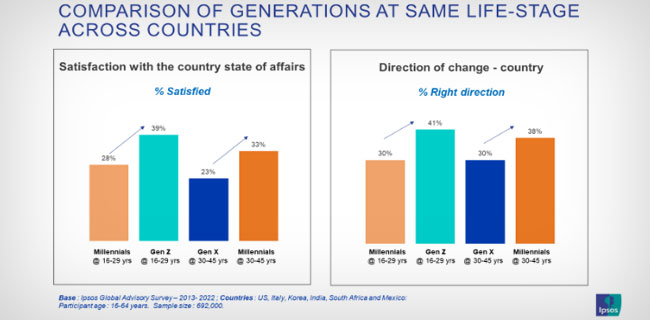
    Generational differences are not just life-stage differences: Our omnibus studies have been tracking people’s outlook on the state-of-affairs in their country and the direction of change it is taking. Using this data, it is possible to look at what various generations believed when they were at the same life-stage. We could compare the present Gen Z who are in their late teens and twenties with Millennials when they were at a similar age. Likewise, we could compare the Millennials at present in their 30s and early 40s with Gen X when they were at a similar age band.

    In both these cases, we see that at the same stage in life, newer generations are more positive about the current situation and more optimistic about the future. These are true generational differences. It is also completely understandable given that economic conditions have steadily improved world over (with a few exceptions) The sunnier outlook of the newer generations are rooted in the better economic circumstances these generations have inherited. In India too, this is the generation which has lived in an era of relative economic and political stability.


    Generational differences don’t always match stereotypes: The spotlight often casts Gen Z – the woke generation, as the torchbearers of change, fervently championing causes from climate activism to grassroots governance. However, our research has shown that Indian Gen-Z are quite apathetic even when it comes to politics.  They carefully select causes which are close to their heart and where they feel they can make a difference. Research conducted during Earth Day 2023 finds that though a large proportion of Gen Z are disheartened by the visible ravages of climate change, they exhibit a reluctance to modify their own behaviour in the fight against it. On the flip side, they are passionate activists when it comes to gender issues.

    The common trope of self-centred Gen Z – mesmerised by social media, who does not care for lasting relationships, also does not match reality. In study after study, we have found that Gen Z in India are as family oriented as other cohorts. They value and cherish their relationships with their parents and close friends. They consider family a key priority and parents their new 4-AM-friends. In India, Gen Z claims a lower internet dependence than Millennials. This is as many believe they can control their digital behaviour and can switch on and off at will.

    In our increasingly interconnected world, it’s plausible that the common threads that unite a generation might trump the differences in their local realities. Each digital interaction, each virtual exchange, contributes to a shared repository of ideas, culminating in a shared ethos that shapes values, influences perspectives, and moulds behaviour. Generational differences are real and may be gaining dominance over other macro factors. And this will enable brands to echo values that resonate with each generation that takes centre-stage. Gen Z may be the first generation who can be targeted in a globally cohesive way.   But factors such as cultural, social and economic realities have a strong play in shaping mindsets and cannot be ignored. And even with generational differences we should be careful not to impose lazy stereotypes – which oversimplify complex realities.


    Geeta Lobo is Chief Client Officer, Ipsos India and Ashwini Sirsikar is Group Service Line Leader, UU & Synthesio, Ipsos India


  • Pet care brand Wiggles is now ‘Lovemark’

    By Our Staff


    Petcare brand Wiggles has a new identity called ‘Lovemark’. It has been conceived by Ideosphere.


    Speaking on the brand’s new identity, Anushka Iyer, Founder and CEO, Wiggles said: “Pets are our kids for us and always will be an emotion that is now increasingly shared by my fellow Gen Z and millennials. And we want nothing more than our pets to be happy, healthy and safe. With this vision, we started Wiggles in 2018 and set out to revolutionize the pet healthcare industry. Our first logo- which will always be special to me, was about recognising and celebrating the relationship between pets and their human parents. We wanted to convey a brand that acknowledged the spirit of unconditional love in all our offerings and backed by the credibility of veterinary expertise. Our journey over the past four years has been greater than ever expected, we have listened to pet parents across the country and have grown to meet and raise standards of petcare to now offer not only pharma but also food and treats, health and wellness and even services.”


    Added Aniruddha Atul Bhagwat, Co-Founder and CEO, Ideosphere: “It is always challenging to define a differentiated space in a cluttered, highly competitive industry, like the booming pet care space. We wanted to ensure the new brand identity complemented the core purpose of Wiggles, to be better towards pets and animals, and for the identity and messaging to be able to connect to the emotion, passion and story of the Wiggles brand. It was truly a collaborative journey of discovery with the Wiggles team, and we are excited to see how the audiences respond to the change.”


    View this post on Instagram


    A post shared by Wiggles (@wiggles.in)

  • Keventers Dairy rolls out new campaign

    By Our Staff


    Keventers, the dairy brand, has launched a new campaign named K.O.A.T i.e Keventers which targets Gen Z. The campaign includes the launch of KOAT music video.


    The 360-degree campaign includes various channels like Social Media, Ads, Radio, and offline/online marketing strategies, through which the brand aims to create a stronger connection with the target audience.


    Commenting on the campaign, Aman Arora, Co-Founder, Director and CMO, Keventers said: “ As a brand, we value creativity, inclusivity and breaking barriers across all age groups Through our yearly campaigns, we aim to revolutionize the creative strategies at the brands front, and find interesting and collaborative ways to bridge the gap between our consumers and their expectations from the  brand. In 2022 the brand’s vision is to connect with the untapped talent across India, and find unique ways to give them a platform and highlight their talents, while also maintaining the authenticity of the brand.”


  • Nutshell Infotainment Channel crosses 1 mm Instagram followers

    By Our Staff


    Digital entertainment company Pocket Aces’ newest channel, Nutshell, which focuses on non-fiction infotainment content, has crossed the important milestone of 1 million followers on Instagram. The channel has been steadily growing across platforms with a highly engaged audience that consists of a mix of millennials and Gen-Z from Metro Tier I and Tier II cities, clocking in an average of 42M viewers a month.


    Said Andre Borges, Channel Head of Nutshell: “Over the last few months, we have been testing the market to clearly understand what audiences need and want to watch. We have thoroughly embedded Nutshell within communities of people in these interest categories, allowing the channel to have access to a lot of data about what the audiences are thirsty for. After scaling Instagram, scaling our content and subscribers on YouTube and Discord is next for us.” Andre’s understanding of virality and audiences comes from 5+ years of prior experience as a Content Creator, Video Producer and News Production Manager at publications such as Buzzfeed India.”


    Added Rayvanta Kumar, Business Head, D2C Content, Pocket Aces: “At Pocket Aces, we have already built large GEC channels such as FilterCopy and Dice Media, and one vertical focused channel in Gobble. Infotainment is a huge vertical globally, and works amazingly for Indian audiences who love sharing information with their families and friends. We get to use our playbook of the community approach even more deeply here, and that means we are creating a hyper engaged set of audiences. To give advertisers access to these audiences, we are now opening brand partnerships on Nutshell, and have already worked with some early partners such as Amazon Prime, Deserv, Edufund, Basis, Wint Wealth, etc.“


  • Will Audio become the New Video?


    By Ashoke Agarrwal


    Ashoke AgarrwalTime was when radio was the go-to mass media for entertainment and news.
     

    And then video sank the audio ship.


    Broadcast TV ruled the roost for close to five decades. But, over the past couple of decades, the internet, social media and streaming have begun to eat broadcast TVs’ lunch.


    However, though the delivery platforms might be changing, the content format remains the same – video and more video. From short-form videos to Netflix binge sessions, video probably accounts for more than 80% of media consumption among today’s young. So much so, that it is becoming a thumb rule in advertising that if you don’t say it in video, you have lost your young audience.


    But then, every coin has its other side.


    Screen fatigue is setting in with the young. Studies by The Mckinsey Global Institute and media research by IPA Touchpoints discern a significant shift in Gen Z, the generation born after 1995.


    Gen Z seeks new experiences and likes to experiment with new identities.


    In other words, they seek a greater agency for themselves – to be more in control of every experienced moment.


    The passivity involved in watching a video lessens the agency of the individual. To watch a video is to surrender your senses to the video.


    The consequence is that there are incipient signs of the young moving away from passive video watching.


    Some media mavens believe that the maturing of VR leading to more immersive gaming and the metaverse will solve the passivity problem.


    Perhaps so, but to my mind, the jury is still out on that assertion. Gen Z is also much more tech and marketing savvy than previous generations. As a result, they may see VR and the metaverse as marketing machinations that further reduce and not enhance their agency.


    While the genuinely immersive and convenient VR and the metaverse are still years away, there is a medium that may replace video as the principal media consumption format among Gen Z.


    There are already signs that streaming audio – music, podcasts and – audiobooks – are increasing their share of Gen Z’s media consumption. The IPA Touchpoints study offers an insight into why this is so. Many in Gen Z see streaming audio listened to on headrests as a pleasing, relaxing soundtrack to their lives. They dip in and dip out of it as they go about their lives – walking, trekking, shopping etc… An essential aspect of headset streamed audio is that it is intensely private, allowing one the choice to be secretly elsewhere when stuck in an unpleasant social situation. A recent ad campaign for Spotify India powerfully illustrated this. They depict teenagers’ content with their Spotify stream as they sit through otherwise awkward situations. Say, uncle types heatedly arguing about the obnoxious anchor as the TV news played in the background or auntie types harassing a talkative saree salesperson in a stuffy showroom.


    A friend in the publishing world tells me that literature is making a comeback with the young with the emergence of richly-produced audiobooks.


    The IPA Touchpoint study also reveals that Gen Z trusts information that they receive through podcasts more than through other media. This increased trust could be because they see podcasts as individuals’ products rather than faceless organisations. They also take them more seriously than social media posts as they recognise social media posts governed by a mad scramble for likes and followers.


    Audio could take over Augmented Reality (AR) as AR becomes a part of day-to-day life. Instead of outputting visually-distracting text or video on your AR glasses, users might prefer audio outputs streamed through smart earpods.


    Every science fiction film worth the label shows futuristic computers responding mainly to audio inputs. Siri and Alexa are leading the way. I believe that in the near term, an increasing number of smartphone functions will shift to intelligent earpods while the smartphone shrinks to become a wristphone a la Dick Tracy. Très chic!


  • Dhoni abandons his ‘Dream’?!


    By Vikas Mehta


    Vikas MehtaSo, it’s been a very usual and unusual IPL so far. Usual, because Mumbai Indians (MI) have lost the first two matches. But the MI captain Rohit Sharma felt it was business as usual in his post-match interview. Unusual, as Chennai Super Kings have also lost the first three matches on a trot, albeit after years. Unusual also for CSK as Dhoni, after relinquishing his captaincy seems to have taken it back and is also scoring runs as in his heydays.


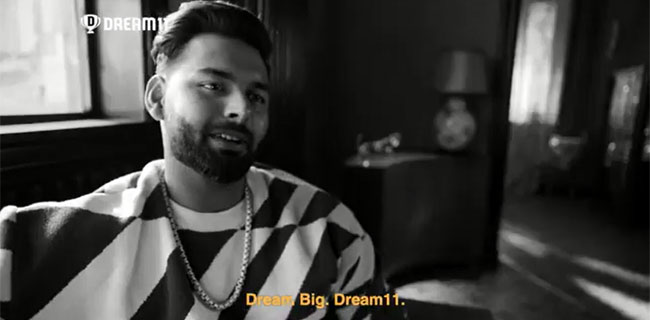
    And as usual, Dream 11 continues its dream run at IPL. The idea of “Dream Big” has seen many new frontiers. The series of various players like Shikhar Dhawan, Rishabh Pant, Rohit Sharma, Jasprit Bumrah and Hardik Patel reminiscing their struggles but not giving up on their big dream has two new creatives so far. One, with Pant and the other with Sharma. And this time, they pay tribute to some behind the scene people like the groundsman or even a stranger helping Pant at a gurudwara. The thought of one is never alone if one’s big dreams fits seamlessly into the Dream Big theme of Dream 11. Whew! Too many dreams here.


    https://youtu.be/3JazfubLOgI


    Dream big is also following a classical strategy of thematic and tactical ads. For the uninitiated, when advertising was the be-all and end-all of all communications, brand ads were created for brand equity, may be once a year, extolling the virtues of a brand and its personality. These were called thematic ads. Interspersed through the year were tactical ads which by nature would drive sales. These were by nature about inducements or sale pointers. Personally, I think this was more of a jargon-spitting marketer’s delight, as for the end-consumer. every communication is a message and she or he does not delve into it with a separate compartment of thematic and tactical in her or his mind. The ads with Dhawan, the Pandya brothers, Ashwin and even Pant in a metro asking people to try the Dream 11 seems to be in the genre of the tactical ads of yore.


    https://youtu.be/Dn7ixMGB_dM


    But one dream seems to be missing from Dream 11. Dhoni has disappeared from all communications and has now appeared for Winzo. Another gaming app. Winzo is not about a fantasy league. It’s about skill and social gaming and I presume it’s clear of any controversy related to “gambling” as Dream 11 is. Maybe that’s why Dhoni moved away from Dream 11. In the ad, Dhoni cheekily starts by saying that he is called gamechanger so he is changing his game from today. Very unusual but typically clever from Dhoni.


    Quite unusually, I am seeing Byju’s ads without Shah Rukh Khan. And these are good. Emphasising on understanding the concept rather than memorising for an exam. ‘Samjho seekho jeeto’ encapsulates the idea well. As a parent, these resonate with me more than the Shah Rukh ads which seemed more gimmicky. I also think Shah Rukh’s personality does not gel with that of Byju’s and made the brand more flippant.


    There has been a lot of buzz about the new Spotify ads. I like them because they amplify the generation gap between Gen Z and the millennials as also Gen X. While Gen X and the millennials are passionate about politics or shopping offline or any discussion and are more social, GenZ is more reclusive and more digitally social. So, Spotify is their ‘kavach’ or protective armour from these indulgences of the older generations. Unusual, yet simple.


    I also think that the Meesho ads capture a similar trait of Gen Z. The features of photo search or free delivery are neither new nor unique but they capture the essence of Gen Z. While millennials or Gen X prefer offline shopping and want to see all options, Gen Z is not only used to online but also wants trendy or happening products. So, these features serve them well.


    Does Aamir Khan have a triple role in his next film? The series of Netmed ads make me think so. Or, wait! Was it Pharmeasy? Or 1mg? At least Pankaj Tripathi was not about triple or double role. Not only are the names confusing but so are the generic benefits. From a consumer perspective, when I fall sick, I need medicines, fast. Not in a day or in a few hours, but in minutes. So, except for long-term medications like for diabetes or cholesterol, I am not sure how these medicine aggregators can help. What do the investors and these start-ups know that we don’t?


    And just when I was about to sign off, I saw two similar ads from PepsiCo company. For Pepsi and for Slice. It seems the company has taken competitive stance as a corporate paradigm. But then what’s the fun if unusual things don’t happen. More on the two ads next week.


    Vikas Mehta, a senior advertising professional, is now a strategy consultant and educator based in Dehradun. He has a considered, often contrarian view that we enjoy consuming (and contesting) on most things around him: cinema, cricket, advertising, politics and life in general. AdsOnIPL is a series of reviews of the ads aired around IPL programming. The column is in its second season. His views here are personal.


  • Mars Wrigley launches new Boomer campaign

    By Our Staff


    Bubble gum brand Boomer of Mars Wrigley Confectionery has unveiled a new digital campaign starring actor Radhika Madan and has also introduced its new Blueberry flavour. With a history of over 25 years and known for its iconic ‘Boom Boom Boomer’ jingle, Boomer continues to be a favourite across generations.


    Talking about the campaign, Varun Kandhari, Marketing Director, Mars Wrigley, India, said, “Boomer is a legacy brand for us at Mars Wrigley that has over the years become a favourite for our consumers in India. Building on the keen sense of nostalgia attached to the Millennials and Gen-X and to also recruit the Gen-Z Fruity gum consumers to Boomer, we have introduced a new flavour that is fruity, quirky and tastes like childhood. With the launch of Boomer Blueberry, we aim to bring more innovation in the gums category with a unique twist to a brand that consumers have always loved.”

  • Capgemini Research Institute Report: What Matters to Today’s Consumer

    By Our Staff


    Capgemini Research Institute has issued a report on ‘What Matters to Today’s Consumer’, which reveals the far-reaching impact of the pandemic on consumer behaviour and preferences. Gen Z and millennial shoppers are now more likely to order products directly from brands, and 72% of all shoppers expect to have significant interactions with physical stores once the pandemic subsides – up from 60% pre-COVID.


    More than two-thirds (68%) of Gen Z and over half (58%) of millennials have ordered products directly from brands in the past six months, compared to 41% on average across all age groups. Only 37% percent of Gen X and 21% of Boomer shoppers have ordered directly from a brand in the last six months. For those who have bought directly from brands, almost two thirds (60%) cite a better buying experience as a reason for purchasing directly, and 59% cite access to brand loyalty programs.


    In return for these benefits, consumers are willing to share their data. Currently, almost half (45%) of all shoppers say they are willing to share data on how they consume or use products and more than a third (39%) say they are willing to share personal data such as demographic information or product preferences. However, 54% of all shoppers say that offers, deals, and/or discounts would make it more likely for them to share their data directly with brands.


    Said Tim Bridges, Global Head of Consumer Goods and Retail at Capgemini: “Younger consumers’ willingness to go straight to brands when purchasing goods presents a real opportunity for consumer product companies. This enables them to collect consumer data and helps create a more mature direct-to-consumer channel. Being data-powered enables the consumer product and retail organizations to translate supply and demand trends into intelligent decisions on where best to stock their products, customize products and services, and enhance customer experience.”


  • Carat joins Arre to campaign for Intel

    By Our Staff


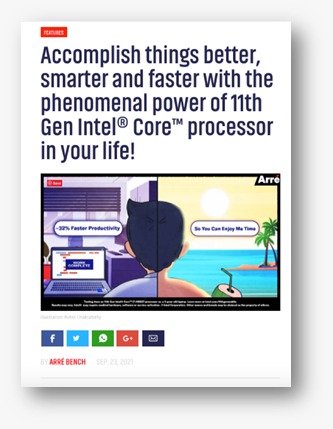
    Media agency Carat has joined hands with Arré to launch a campaign for Intel. The campaign aims to position Intel’s 11th Gen Core processor as the key device for enabling ‘creation’ in today’s world. It also allows Personal Computer shoppers to imagine and unleash all the things that they can accomplish with the device.

     

    Said Anita Kotwani, Chief Executive Officer, Carat India: “We are proud to be at the forefront of thinking out of the box for our clients and leveraging audience insights in every aspect of our campaign. We understand that if we want to speak to Gen Z, we must speak their language and also appeal to the creator’s economy by becoming a part of it.”


    Added Niyati Merchant, Executive Vice President and Head of Operations, Arre: “Arré has always pushed the envelope when it comes to branded content across formats. Our partnership with Intel was yet another multi-format content initiative across Arré Reads, doodles and short format video that gave way to innovation in messaging and sharp writing. We are excited that this collaboration has won so much praise and deep engagement from our readers and viewers. We look forward to a long-term collaboration with Intel and Carat.”


  • Brand Lessons from Clay & Grass!


    By Avik Chattopadhyay


    Avik ChattopadhyayThe French Open 2021 tennis championships just got over and the Euro 2020 football championships are currently on. Over the last three weeks, events have happened that bear implications for the world of brands and brand management.
     

    To me, the French Open winners were Novak S. Djokovic [quite obviously] and Naomi Z Osaka. While both are huge brands by themselves, this piece is about the way brands associated with them have performed over the two weeks at Roland Garros, for the world to see.


    “Novak ‘S.’ Djokovic?”, you would ask. Yes. The ‘S’ stands for ‘silent’. The man silently went about winning his 19th Gland Slam title, silencing a lot of his critics. If one followed him through this year’s tournament it was easy to observe his evolved behaviour on court and off it. Gone were the ebullient celebrations after each match, especially in the semis and the finals. There was an occasional roar, but that was it. He was smiling at his own mistakes. He was calm as a monk at the breaks. One expected that all the pent-up internal pressure would see an exit valve sometime, but no. And then he gave his racquet to a little supporter on the sidelines after winning, saying that was the best way to express gratitude to his “cute little coach”.


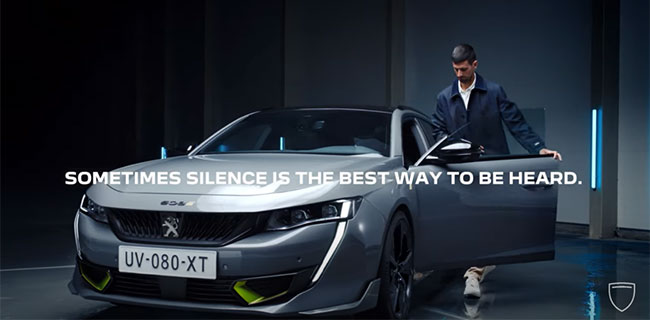
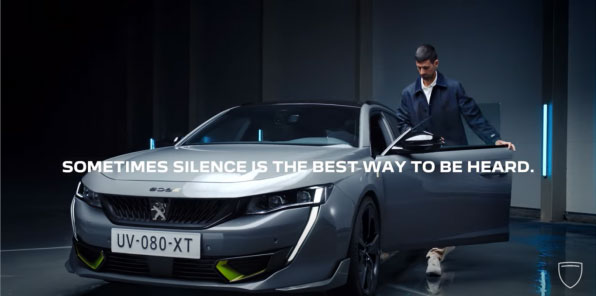
    Djokovic sports two brands apart from apparel sponsor Lacoste. One is a technology firm called UKG. The other is Peugeot. His association with the French car brand has been for more than six years now but this year, the brand, in a new avatar, took a really bold step to create a piece of communication with their brand ambassador released for Roland Garros. Announcing the launch of the Peugeot 508 SW plug-in-hybrid, it is a terrific demonstration of when the sponsor’s and ambassador’s DNAs totally are in sync.


    And the words at the end, captured here in the screengrab say it all. The commercial can be viewed at https://youtu.be/ugNSGoISTmg


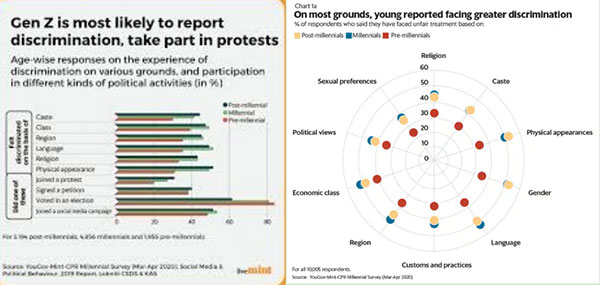
    Coming to Naomi Z. Osaka. Yes, the ‘Z’ stands for Gen-Z. It does take immense guts and candour to withdraw from a tournament of this stature because she could not agree with the rule of appearing at post-match press meets which made her uncomfortable. [Djokovic was one of the few who openly supported her stand.] Why not appear at a press meet when one gets more exposure, one would ask? But Osaka belongs to a generation that most of us managing brands are still coming to terms with. I went across and asked two of my friends for some insights to understand Gen-Z better. One, Subhash Chandra, a market research analyst shared lots of short clippings about the ‘post-millennials’ as they are also called. The other, Nirmal Dayani, shared the same sentiments of his Gen-Z son on this issue.


    [Source – YouGov-Mint-CPR Millennial Survey, March-April 2020]


    In the older times, the sponsors would have taken serious offence to such a sudden move by their brand ambassador, and one might have even decided to pull out of the contract due to an obvious breach of the same. Not in the case of Osaka. Nike, ANA, and Nissin all stayed steadfast behind her as if endorsing her decision. Also, that way they continue to connect with the Gen-Z whom Osaka represents, for their own business interests.


    Cut to the Euro 2020 being played across the continent right now.


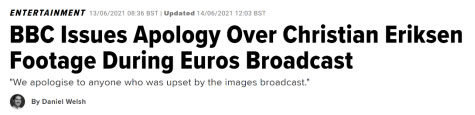
    On June 12, during a game against Finland, Christian Eriksen of Denmark had a serious medical emergency. While his teammates shielded him while CPR was being given and the stadium was in stunned silence, the television cameras were showing close-ups of the attempts to revive him and of his shocked wife being comforted by teammates Schmeichel and Klaer. After some time the cameras pulled back and stayed there. There was huge backlash on the broadcasters for getting too close to the medical activity and sharing personal moments. The BBC formally apologised the very next day.


    This is a clear indicator on the maturity with which brands need to handle totally unexpected situations. It is easy to get carried away and behave in a manner that may bring in immediate social media chatter but eventually lead to social media outrage. A clear pointer to the media brands across the world, more so in India, who tend to sensationalise events for personal gains, at the cost of social propriety!


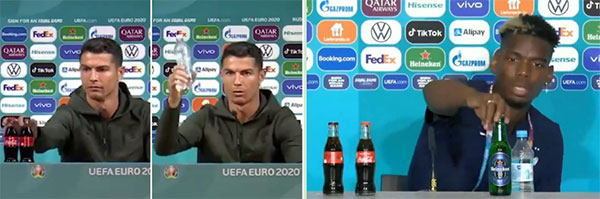
    A few days later, at their respective post-match press meets, Cristiano Ronaldo removed a couple of Coca-Cola bottles from the table while Paul Pogba removed a Heineken bottle. There were news items of how Coke lost $4.00 billion in the stock market due to that action. We are yet to know how much Heineken lost, but then Pogba is not as big a star as CR7 is!


    This is again a strong message going out to brands to be empathetic to people’s sensitivities. While one may question the very logic of having a fizzy drink sponsoring an event about fitness, the onus lies on the brand[s] to show respect. CR7 is known to espouse the cause of health food so it would be downright silly to position those Coke bottles in front of him. Pogba is a Muslim so would never like to have an alcohol brand with him. The logos of the sponsors are anyway on the backdrops, so why this urge to do the overkill with product placement? In todays times, these do not have the desired positive impact. In fact, if they boomerang, then they garner more social media space!


    Anyway, the Russians are leading the Finns by a goal while Turkey and Wales are warming up for their game which is a must-win for both. So, I better rush back to my place in front of the screen. Cheers!


  • Online chatting surpasses audio & video calling


    By Our Staff


    Almost seven in 10 respondents say that their chatting activity has increased in the last six months and 67% of those say that it shall remain the same or increase further in the next six months. These and more findings were revealed in the a study conducted by research major Nielsen for Bobble AI, the Conversation Media Marketing (CMM) platform.


    The study involved smartphone users both males and females, divided in two categories: 18-30 and 31-40 years conducted over a fortnight: March 2 to 16, 2021. 


    Key highlights of the ‘Conversation media’ focused survey report:

    1. Chatting is a daily activity which most of the people (94%) engage in EVERYDAY! Chatting has surpassed audio calling and video calling as the most common way of communication (by a significant margin – 13 percentage points over audio calling). Almost 7 in 10 respondents say that their chatting activity has increased in the last 6 months and 67% of those say that itshall remain the same or increase further in the next 6 months, establishing that chatting is here to stay as the most heavily used communication medium.


    2. The awareness and adoption of conversation media formats including emojis, stickers, GIFs across different demographies is very high– 95% users are aware of emojis in NCCS A and 93% in NCCS B and 91% users are using emojis in NCCS A and 84% in NCCS B. Similar pattern is observed for stickers – 92% users are aware of stickers in NCCS A and 85% in NCCS B and 81% users are showing preference for usage of stickers in NCCS A and 71% in NCCS B.


    3. Primary reasons for increasing popularity of chatting formats are that ‘its fun to use’ and ‘It helps in expressing oneself better’. The older age group score significantly higher for ‘makes messages easier to understand’.


    4. Awareness of re-sharing is similar across different chatting formats, however, the likelihood of re-sharing Emojis are significantly higher than stickers and GIFs.


    5. Emojis, Stickers & GIFs make the conversations real and personal as it allows people to express accurately and in a fun way. 80% of users believe that chatting formats make their message easier to understand.


    6. Emojis were ranked first as the most preferred chatting format, followed by stickers and GIFs.Moreover, Emojis are more likely to be used for ‘expressing an emotion’ and talk about various daily activities, whereas people prefer to use stickers to send best wishes on birthdays and festivals.

    a. 96% of users claim to use emojis, stickers, gifs to express an emotion (happiness, anger, or sadness to name a few)

    b. 85% of users claim to use these formats to wish on birthdays, anniversaries, festivals, etc.

    c. 81% of users claim to use chatting formats to express or tell something about an activity (eating, running, cooking, etc.)

    d. 70% of users claim to use these chatting formats to talk about trending topics, situations IPL, etc.


    7. When given a choice between a branded sticker & an unbranded sticker for specific situations, around 3 in 4 among the surveyed respondents claimed that they are likely to use a branded sticker vis-a-vis an unbranded sticker. Given that chatting is one of the main sources of communication these days and majority of respondents prefer branded stickers, it gives a powerful platform to the brands to advertise themselves and be a part of everyday conversations.


    Millennials and Gen-Z chats across platforms are evolving from just plain text to stickers, GIFs and emojis. Various keyboard and messaging platforms now understand what youngsters want and are investing to expand their content offerings in these areas. This, in turn, provides opportunity to brands to explore these unique chatting formats and connect with the intended audience most effectively.


    Commenting on the findings of the survey, Ankit Prasad, Founder and CEO, Bobble AI said, “The key findings validate the growing relevance of Conversation Media among GenZies and Millennials in the country and the rising inclination for chatting over any other means of communication. With more and more people working and living remotely and being compelled to multi-task, they are looking for new and innovative ways to express themselves better. Conversation Media like emojis, stickers, GIFs are a fun, engaging way for brands to break the clutter and connect with their audiences.  COVID-19 pandemic has caused gloom and Conversation Media Marketing serves as an opportunity for brands to drive positive impact and influence in the minds of consumers.


    The respondents for this survey are spread across 5 Metros across Zones (62%) including Mumbai, Delhi, Kolkata, Bangalore and Hyderabad and non-metro cities (38%) including Patna, Lucknow, Indore, Ahmedabad, and Jaipur. The fieldwork was done in an unbiased manner without intervention from Bobble AI and the quality control procedures were also followed very strictly.