Category: RADIO

  • The EY Report on FM Radio


    The INR21bn FM radio industry continues to hold a unique niche in the Indian media landscape. It is an effective reminder medium that can be localized at a city-level, provides free experiences for audiences and can easily reach all consumer strata.


    While the industry experienced an INR0.4bn— INR0.5bn dent in 2016 following demonetization, with on-ground activations hit particularly hard, the sector is expected to bounce back by Q2 20171. Buoyed by the continued operationalization of new Phase-III stations, the industry is projected to grow ~15% annually till 2020 — faster than other traditional mediums such as TV and print.


    Radio has finally been unshackled, and can now fulfil more of its potential. The need of the hour on the revenue side is maximization of sales efforts through ad sales analytics, account planning, customer segmentation and automation, as well as better sales reporting. In order to bring forward break-even, radio companies need to look at costs aggressively and dispassionately, covering networking, automation, robotics and improved expense controls. As the industry enters its next phase of growth, we explore several key trends in this space.


    The Phase-III auctions flattened the radio landscape, but future reserve prices will need rationalization
    India’s radio market today is top-heavy, and the country’s A+ and A category cities* comprised over two-thirds of total industry revenues in FY16. However, the FM landscape is flattening, with 140 frequencies in B, C, D and “Other” category markets sold in the industry’s Phase-III auctions 4. With nearly a hundred of these stations yet to be operationalized at the end of March 2017— including in 28 virgin markets such as Dehradun, Hubli-Dharwad and Salem — the medium’s reach is set to deepen significantly.


    However, to continue radio’s expansion into smaller towns, reserve prices will need to be rationalized in future auctions. Reserve prices for a fresh radio city have traditionally been set as the highest bid received in the prior auction for the same city category and region. But as this categorization is based on population — without factoring in paying capacity — the market potential of similar category cities can differ. Moreover, amplification of bid prices because of scarcity of frequencies can result in cities with similar revenue potential receiving different bids. It is also time to re-evaluate the possibility of reduction of inter-frequency separation so as to increase the number of frequencies available in larger A+ and A markets. However, doing that now could be seen as unfair to existing bidders, and would require a mechanism to equalize license fees.


    The effect of the current price-setting mechanism was seen in the second batch of the Phase-III auctions. High reserve prices elicited muted interest from operators, and 200 frequencies went unsold, including in B category cities such as Vijayawada and Asansol and C category cities such as Trichy and Mangalore. Meanwhile, one frequency in Muzaffarpur was sold for INR43.5mn, while three stations in the same city were sold for INR1.5mn apiece in the first batch. To prevent such scenarios, the Telecom Regulatory Authority of India recently proposed a mechanism to set reserve prices by taking into account variables such as GSDP per capita and local stations’ revenue, while de-linking reserve prices from prior auction bids. Going forward, such a framework could rekindle operator interest and help spread radio across the country.


    Content differentiation is on the rise — particularly in the largest cities
    The Phase-III auctions are having a unique effect on content in category A+ and A cities. Once all frequencies are operationalized, each of the 13 markets in these categories will have at least 6 stations — up from just 5 such cities before the auctions. To carve out a niche in a crowded market and create separate brands for second stations in the same city, networks are making a concerted effort to differentiate offerings. This is occurring across both genres as well as languages:

    • Radio Mirchi launched a romance-themed second brand Mirchi Love to complement its existing contemporary hits radio stations.
    • Retro-themed second brands were launched by Radio Fever (Radio Nasha, centered on music from the 1970s-90s) and Red FM (Redtro, centered on content from the 1990s).
    • Big FM re-launched its Delhi station, ensuring its positioning was more “mood and tempo-led” and more in-line with “on-the-fly” consumption, relative to its Mumbai counterpart 7.
    • Radio One converted its Bangalore station to an international format


    Radio is now able to offer relevant ad bouquets to brands
    India’s radio industry today is fairly consolidated, due to cost economies of scale and higher entry barriers relative to mediums such as print or digital. As a result, ~90% of revenues and ~80% of frequencies were held by the top 10 networks in FY16. This consolidation, coupled with the expansion of radio to over 400 stations in 114 towns, means that a single network can now offer an advertiser significant reach and create a viable alternative to TV or print. Large national networks (e.g. Radio Mirchi, Red FM, Big FM, My FM, Radio City and Fever FM) and strong regional players in the South (e.g. Hello FM, Radio Mango and Club FM) are increasingly able to offer brands wide-ranging bouquets targeting listeners in metros, tier II/III cities or specific regional clusters. We believe this will have a positive effect on the radio segment’s share of ad revenues in the medium term.


    Networks are complementing on-air offerings with multi-media campaigns and events
    With customers consuming more media non-linearly, advertisers have begun focusing on integrated multi-media solutions to reinforce messaging and raise brand visibility across platforms. Most major radio networks have an in-built advantage here, as they are able to leverage the print, TV or digital arms of their parent media groups. For instance, Radio Mirchi (Times Group) carried a Hero Cycles campaign during the odd-even rationing plan in Delhi across its print properties 10. Meanwhile on the digital front, Radio City (Jagran Prakshan Ltd.) launched an interactive mobile app for its program Love Guru 11.


    Advertisers have also been attracted to the physical touchpoints offered by experiential solutions and events. To meet this demand, radio networks have launched various properties in recent years:
    • Indigo FM (Jupiter Capital Ltd.) launched the international-themed “Indigo & Blues” jazz festival.
    • Big FM (RBNL/Zee Media Corp.) created the arm-wrestling property “BIG Panjaa League.”
    • Fever FM (HT Media) launched the “Entertainment Ka Baap Awards” celebrating radio.
    • My FM (DB Corp.) created the “Jiyo DilSe Awards” for recognizing individuals who are bettering society.
    • Radio City created the televised “Freedom Awards” for independent music.


    Events are showing strong growth potential, with major operators recording higher revenue growth for this category relative to on-air advertising. The appeal of on-ground visibility for brands means events and activations will continue to form an important revenue stream for the radio industry, and can grow to contribute up to 20%–30% of revenues for national networks.


    The industry needs effective account management and reporting to realize its next phase of growth
    Radio has traditionally been the focus for large corporate advertisers, who aim to buy coverage across the country. As a result, national corporates account for up to 75% of revenues for some major networks today. But this mix is changing. First, as consumption increases in smaller towns, local businesses are maturing in tandem and foraying into radio advertising for the first time. Second, as more frequencies become operational within a state and city, the value of selling a single geography to local advertisers rises. Finally, with marketers emphasizing ROI more than ever, the efficacy of localized messages over national communication is also driving the popularity of local campaigns. For these reasons, the share of national corporates to the revenue pie is falling. Radio City, for instance, has increased its share of revenue from local advertisers to ~50% today, up from ~25% when it was launched.


    With radio reaching more towns and local clients, a strong feet-on-the-street presence becomes crucial for reach and perception. These local sales representatives can also help teach new clients how to create effective plans. This is important, as the high churn rate of local advertisers in prior years has partly been due to operators failing to invest this time working with clients, and instead accepting any level of business they give.


    In order to scale effectively, account management also needs to be supported with robust systems. In terms of organization, clear value propositions can be developed by segregating accounts into geographies or categories (e.g. focus accounts, industry verticals and SMEs). In terms of technology, this can mean recording client information in an opportunity management system to streamline pitch processes, inputting sales in a centralized MIS to track KPIs, or arming representatives with mobile dashboards to enable decision-making. To boost productivity in this fashion, Big FM for instance deployed the tool CRM Next, which allows the network to measure client relationships and sales inputs.


    Radio networks have become more cost conscious
    The radio business is characterized by low variable costs but high fixed costs and one-time fees. Existing stations can incur significant migration fees, with Phase-III migration fees for B and C category cities such as Coimbatore, Patna and Chandigarh exceeding INR150mn 18. Meanwhile, aside from auction fees, new stations can require an initial capital investment of INR30mn— INR50mn in B and C category cities (if stations are not networked). But once stations recoup these investments and break even, 65%—80% of additional revenues accrue to the bottom line 19,20. As this breakeven proved elusive or occurred too late for many stations under Phase-II, the industry has become increasingly cost-conscious. This was reflected in the Phase-III auctions, in which nearly 240 frequencies went unsold in the first and second batches as networks became more judicious in entering markets.


    Profitability is also expected to improve under the 15-year Phase-III regime due to the networking of channels. Networking is now permitted across a broadcaster’s entire network, not just in C and D category cities as under Phase-II. This allows networked stations to share infrastructure with larger stations, and if content is reused, much of the INR10mn—INR15mn studio cost can be saved19. These networked channels are also able to realize sizeable operating efficiencies via lower overheads, payroll, marketing expenses etc. To leverage these cost savings, radio networks are employing a hub-and-spoke model, wherein smaller cities in a state or region are networked to the operator’s major market. As networks continue to expand, there is significant scope for shared services to help manage this scale-up and streamline processes involving RO entry, billing systems and digitized content management. Robotics process automation can also bring in significant savings, in addition to increasing accuracy and reducing time.


    Social listening is emerging as an alternative form of measurement
    Given the industry’s expansion into smaller towns and alternative genres, accurate radio measurement is imperative for networks looking to showcase their reach to advertisers. However, measurement of Indian radio listenership remains limited, with Radio Audience Measurement (RAM) currently sampling 480—600 individuals apiece in four cities (Mumbai, Delhi, Bengaluru and Kolkata) 21. To create a more robust system, industry stakeholders have recommended widening the net to 15—20 cities and replacing the current diary-based methodology with a form of electronic measurement not reliant on recall.


    As the industry waits on an updated ratings system, many networks have turned to social media as an alternative form of measurement. Social listening can take various forms and has the capacity to measure ratings via the volume of online posts, key conversations taking place via word clouds, sentiment analysis via classification of replies, identification of high-profile influencers and demographic profiling of listeners.
    Such analysis can be done at a granular city-level, allowing networks to discern differences between their own stations, competitors and local consumer preferences. The resulting insights can then be used to modify content strategies, customize launch marketing and focus on the most effective engagement channels.


    Published with permission from EY. The report can also be viewed at link

     

  • Honda Amaze engage with new age buyers via Red FM

    By A Correspondent


    Honda Cars India Ltd. (HCIL) has started a new campaign ‘Honda Amaze….IsmeFeeeel Hai’in partnership with 93.5 Red FM has started a new campaign.


    The pan-India campaign conducted across 36 cities and provides a platform for customers to share their stories of the Honda Amaze with Red FM 93.5 RJs.


    Elaborating on the initiative, Jnaneswar Sen, Senior VP Marketing & Sales, Honda Cars India said: “The family sedan Honda Amaze has received overwhelming success in the Indian market ever since its launch in India. Honda Amaze is a strongly preferred family car of over 2.3 lakh families in India. This campaign is our initiative to reach out to new customer pan-India and explore Amazing stories on air with us on 93.5 Red FM”.


  • 92.7 Big FM refreshes Bengaluru station with dual content

    By A Correspondent


    92.7 Big FM has revamped its Bengaluru stationality to deliver bilingual content offering the best of Kannada and Hindi music. The refreshed positioning of 92.7 Big FM in Bengaluru will now entertain listeners with its credo: ‘Sandalwood Jo​the Bollywood Blast.’


     

    Speaking on the re-launch, a spokesperson from Big FM said:“Bengaluru is the melting pot of diverse cultures. The revamp of Bengaluru station is our endeavour to offer fresh and engaging content that will perfectly coincide with the vibrant vibe of the city. As per market research, 92.7 Big FM as a brand will entertain the cosmopolitan listeners with a perfect mix of Bollywood and Sandalwood music under one frequency.”


  • Music Broadcast Ltd continues to be one of ‘India’s Best Companies to Work’

    By A Correspondent


    Music Broadcast Ltd, the parent company of Radio City 91.1FM, has emerged as a leader in the ‘India’s Best Companies To Work For – 2017’ study. Radio City has had a consistent presence in the list and the inclusion of Music Broadcast Ltd., has earned the radio network the coveted position for the sixth year. The list places Music Broadcast Ltd. amongst the Top 3 media firms and Top 50 companies overall in India. Conducted by Great Place To Work Institute, the study measures employee experience and evaluates the people practices of participating organisations to arrive at the final list of companies.


    Said Abraham Thomas, CEO, Radio City 91.1 FM:“We are honoured to receive this recognition for the sixth time. Radio City has been known for its work culture that seeks to empower and encourage employees to realize their full potential and work towards achieving their goals. It is a perfect blend of culture and process orientation that has helped Radio City retain its leadership position year after year. Our people are our biggest strength and we are happy that our employees value us, as much as we value them.”


    Added Sagorika Kantharia, Chief People Officer, Radio City 91.1 FM: “We are extremely proud to be listed amongst ‘India’s Best Companies To Work For’ once again. Our culture and value system allows our employees to innovate, grow and become leaders in their own right. Initiatives such as ‘Cheers to Peers’, Ring Aloud and Star and Sher of the month help us promote the spirit of unity while at the same time recognizing individuals for their extraordinary work.”


  • JWT to ‘bajaate raho’ for RedFM

    By A Correspondent


    Nisha Narayanan

    93.5 Red FM has handed over its creative mandate to J Walter Thompson India.Talking about the new association, Nisha Narayanan, COO 93.5 Red FM said: “We were really impressed with JWT’s young team and capabilities across mainline as well as the digital spectrum. Being a leader brand in the radio industry undergoing massive Phase III expansion, it was extremely critical for us at Red to consolidate the brand voice across different geographies and platforms including digital, trade and mainstream consumer touchpoints. With a creative giant like JWT coming on board, we look forward to infusion of fresh, creative thinking for developing the next phase of ‘Brand Red’. Looking forward to a partnership which takes the brand and the business to the next level with this collaboration.”


    Rajat Uppal

    Added Rajat Uppal, National Marketing Head, Red FM: “After a month-long pitch process that involved six creative agencies, we are excited to have JWT Delhi onboard as our creative partner for the RED FM Network. With the best creative minds on board from both sides, we look forward to some path-breaking creative campaigns and marketing communication for brand ‘Red’. I am sure they are equally excited to work on a young brand like ours, which allows them to experiment and explore under the positioning of ‘Bajaate Raho’!”


    Joy Chauhan

    Said Joy Chauhan, Senior Vice President and Managing Partner, J Walter Thompson Delhi: “We are absolutely thrilled to win the creative mandate for Red FM. This has been one of the most interesting wins for us in the recent past… Our mandate is very clear, how to elevate a very sharp promise to the next level and more importantly, how to extend it, beyond the radio frequencies to other mediums. A large part of our creative talent is under 30 years of age, so no prizes for guessing how excited they are to lay their hands on a brand like Red FM. Let’s Bajaate Raho!”


  • Big FM expands in North-East with four new stations

    By A Correspondent


    Big FM has expanded its footprint in the North-East region, with the launch of four new stations. The frequencies acquired by the network during the FM Phase-III auctions were 92.7 in Agartala, Itanagar and Aizawl and 98.3 in Shillong. With this Big FM is now present in 61 cities across the country. The newly launched stations will reflect the brand’s ‘SunoSunao Life Banao’ positioning, with a view to extend its legacy of curating original content and providing entertainment. As a part of its launch strategy, Big FM has taken its ‘Big City Pride Awards – For the City, By the City’ in each of these markets.


    Speaking on the expansion, BIG FM spokesperson said, “The north-east region comprises a varied mix of audiences that enjoy regional, Hindi and English music.  Based on this cultural diversity we aim to cater to listeners with differential music and our national and award winning shows. Also, now with our network across 5 markets we will have the largest presence in this region. We hope to offer advertisers access to the consumers across these cities, which so far have been under-served in terms of media reach.”


  • Praveen Malhotra appointed Chief Business Officer at BIG FM

    By A Correspondent


    Praveen Malhotra

    Big FM has elevated Praveen Malhotra as Chief Business Officer. Malhotra has been associated with the radio station network since inception as its Chief Revenue Officer and will now be responsible for all sales, marketing, planning and service functions.


    On her new role at Big FM, Malhotra said: “It has indeed been a pleasure to be a part of such an esteemed organization since the beginning. Having a natural flair for sales, I look forward to add more value to the firm with my abilities in managing large scale business operations.”


    On the development, Tarun Katial, CEO, Big FM said: “We are happy to on board Praveen who comes with a flourished experience and domain expertise. With her deep knowledge on our business, she will help us develop practices that will benefit in increasing business efficiency, manage costs effectively and deliver great services to our clients.”


  • Fever 104 FM unveils #FreedomFromGuilt

    By A Correspondent


    As the nation celebrated its freedom on August 15, Fever 104 FM decided to provide a platform for those who are still bound – by guilt. The #FreedomFromGuilt campaign features ex-prisoners of Tihar Jail expressing regret for their crimes and gives them an avenue to express their inner thoughts, their burden of guilt, for the first time, on air. The programme was supported by an extensive social media campaign.


    In designing this campaign, Fever 104 FM and Ogilvy were supported by Tihar Jail and the NGOs, The India Vision Foundation and Siddhartha Vashishta Charitable Trust, to approach those who had completed their jail terms and give them this unique radio platform.


    Commenting on the initiative, Harshad Jain, CEO Radio and Entertainment, HT Media Ltd. said: “Fever FM has always believed in bringing about demonstrable change in the society. Fever Voice of Change has been one of the biggest CSR initiatives in the history of Radio and within the ambit of the same we have taken up many a cause including rehabilitation of acid attack victims, celebration of the unsung heroes of the Indian Armed Forces and driving people to vote with ‘Each one Kheench One’ to name a few. Fever FM has always been a thought leader in the category and we are very proud to have taken up this initiative. #FreedomFromGuilt is a campaign that celebrates freedom in its truest sense and brings out a side of the society that few have seen. We hope to collaborate on many such initiatives and take up many such causes in future as well that air aimed towards creating a marked difference in the society”


    Speaking about the initiative, Ajay Gahlaut, Deputy CCO, Ogilvy India said: “Not all convicts in jail are hard core criminals. A large percentage of them are in fact one-time offenders who have committed a crime in the heat of the moment. On Independence Day, as an expression of Freedom, we felt that these people should be given a chance to express their repentance as a step towards mental peace and a Freedom from Guilt.”


  • My FM extends ‘Jiyo Dil Se’ proposition further in latest brand campaign


    My FM, the radio arm of DB Corp, has launched a new brand campaign with the punchline ‘Chalo Aaj Kuch Achcha Sunte Hai”, which stems from the brand proposition of ‘Jiyo Dil Se’. The idea takes form through a print and outdoor campaign supported by the station jingle. DDB Mudra is the creative agency.


    Said Harrish M Bhatia, CEO My FM: “My FM believes that it has larger role to play in people’s life than just entertainment, our attempt is to bring back the unadulterated entertainment, light hearted purposeful listening that radio promises. The current campaign is a huge reflection of that.”


    Commenting on the launch of the new campaign, Rohit Mehrotra, Brand Head, My FM, added: “We want to take the brand to the next level. The idea is to position ourselves as a complete “family listening radio station”. Chalo Aaj Kuch Achcha Sunte Hai’, is in sync with the product promise of providing content that’s meaningful, positive and energetic, the attempt is to inspire listeners to look at the brighter side of things.”


    Speaking on the campaign, Vandana Das, President & Management Partner, DDB Mudra North said: “My FM is a pioneering radio brand and it needed a campaign that was personal and had a connect with the listeners; a connect which will help evoke a sense of pride and ownership towards the radio station. This campaign does exactly that.”


  • Publicis bags Big FM’s creative mandate

    By A Correspondent


    Big FM has appointed Publicis as its creative agency. The brand’s activities will be managed by the agency’s office in Delhi.


    Srija Chatterjee

    Commenting on this victory, Srija Chatterjee, Managing Director, Publicis India, said, ‘We are extremely delighted to win the creative mandate for Big FM. This win means a lot to us, as Big FM proudly owns the most distinguished position in the radio category.’’


    Ravpreet Ganesh

    Elaborating on the win, Ravpreet Ganesh, Executive Director, Publicis India, said: “Big FM as a brand has established itself as a leader in the FM space and we look forward to a great partnership with them. Having similar creative inclinations and outlook, gives us all the more pleasure to work together. The vibe between the teams on both sides has been great and I think this is the beginning of an effective partnership. We are keen on doing some exciting work together and look forward to this journey ahead.”


    Praveen Malhotra

    Added Praveen Malhotra, Chief Business Officer, Big FM: ‘It gives us immense pleasure to announce our partnership with Publicis to take forward our creative mandate. I’m sure this association will be rewarding for the brand, as we place trust in Publicis and their diverse expertise. We look forward to an enriching association with the team and await to work on some great ideas together.’’


  • My FM celebrates 10 years in Bhopal

    By A Correspondent


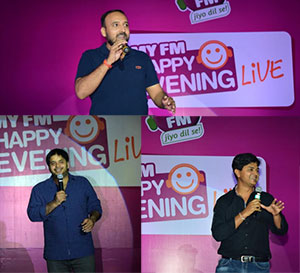
    MY FM has completed 10 successful years in Bhopal and to mark the occasion, it organised ‘Happy Evening Live’, a comedy evening with the stand-up performers Vipul Goel and Sundeep Sharma.


    The event was promoted extensively through a 360 degree marketing campaign.


    Speaking on this milestone, CEO Harrish Bhatia said, “My FM is truly iconic radio station and we have received immense love from our listeners in last decade. Our customer centric approach has led us to leadership position in this market. We will continue to strive for highest standard of entertainment through our differentiated content, innovative marketing initiatives and on ground activities”.


  • Amish Tripathi presents the story of Advitiya Sita on My FM

    By A Correspondent


    This Navratri My FM celebrates women empowerment with a show titled ‘Advitiya Sita’ by Amish Tripathy, popular fiction writer. The show runs across network everyday till September 30.


    Commenting on the show and the association, Amish said: “The fight for equality between men and omen, across all communities in India, is one of the most important issues confronting us today. A country cannot achieve its true potential if half its population is kept suppressed. Even one of our ancient scriptures has said that ‘Gods stop answering prayers and abandon the land where women are not respected.”


    Added Viplove Gupte, Chief Programming Officer, My FM: “What is one of the most noteworthy things that we at My FM intend to do every time is that break the rules of radio and bring out something that provides a pleasant surprise to our listeners. With our new positioning “Aaj Kuchh Achchaa Sunte Hain”, we have decided to bring “happy listening” experience for our listeners.