
Category: Opinion – Archives

  • An Appeal for Total Consumer Protection


    By Indrani Sen


    With the resolution of creating a New India, our government is working on a new consumer protection act which will ensure stricter guidelines on advertisements to ensure that consumers in India are not misled.  At the International Conference on East, South and South-East countries held last week in New Delhi, Prime Minister NarendraModi made the preliminary announcements. This new law, incorporating the revised 2015 UN Guidelines on Consumer Protection, will replace the Consumer Protection Act 1986.

    On October 28, Brand Equity quoted from the PM’s speech:“Stringent provisions are proposed against misleading advertisements. A Central Consumer Protection Authority (CCPA) with executive powers will be constituted for quick remedial action” The article also highlighted that “the proposed law, awaiting Cabinet approval, provides for fine up to Rs 50 lakh and up to three years’ ban in case of misleading endorsement by celebrities while manufacturers would face fine and jail term for similaroffence.”(https://brandequity.economictimes.indiatimes.com/news/advertising/law-to-curb-false-advertisements-for-buyer-safety-soon-pm-modi/61282918)

    The media and advertising industry in India has been conscious about misleading advertisements and has set up various self-regulatory bodies to take care of consumer complains related to news, other content and advertising. The Advertising Standards Council of India (ASCI) is the foremost among these self-regulatory bodies which is supported by all industry bodies and has a representation of the general public. ASCI have been trying to ensure that our advertising follows four basic codes, Honesty, Decency, Responsibility and Fairness and in the process evaluates complains not just by the consumers, but also by manufacturers/ advertisers against misleading competitive advertisements. In the new law proposed by our government, will there be any provision for fine etc by the Central Consumer Protection Authority for unfair competitive advertisement which harms the business interest of the competitor and in the process indirectly harms the consumer?

    The 2015 UN Guidelines on Consumer Protection lists the legitimate needs to be met as the following: (http://unctad.org/en/PublicationsLibrary/ditccplpmisc2016d1_en.pdf)

    • Access by consumers to essential goods and services;
    • The protection of vulnerable and disadvantageous consumers;
    • The protection of consumers from hazards to their health and safety;
    • The promotion and protection of the economic interests of consumers;
    • Access by consumers to adequate information to enable them to make informed choices according to their individual wishes and needs;
    • Consumer education, including education on the environmental, social and economic consequences of consumer choice;
    • Availability of effective consumer dispute resolution and redress;
    • Freedom to form consumer and other relevant groups or organizations and the opportunity of such organizations to present their views in decision-making process affecting them;
    • The promotion of sustainable consumption patterns;
    • A level of protection for consumers using electronic commerce that is not less than that afforded in other forms of commerce;
    • The protection of consumer privacy and the global free flow of information.

    Readers, please note the third point on protection of consumers from hazards to their health, etc.

    One would have expected that the further development of the Consumer Protection Act, in line with the 2015 UN guidelines, will be more all encompassing like USA where American consumers are protected not just from deceptive advertising, but also from unsafe products, fraud and unfair business practices including medical, financial and legal practices. Instead, from the preliminary announcement it seems that the only cat which the Government is planning to bell through enhancement of the act is the most visible one, advertising! While the penalty for misleading advertisements was highlighted by our PM, there was no mention of penalty for medical negligence or wrong treatment, etc. in government or private hospitals and nursing homes and various other offences related to consumer protection.

    Today American consumers are protected through a mix of national (federal), state, and local governmental laws and many private rights of actions. The main consumer protection agency at the federal level is the United States Federal Trade Commission (FTC). Created in 1914, the FTC has two objectives:  firstly, to protect consumers by preventing fraud, deception, and unfair business practices in the marketplace and secondly to maintain competition by preventing anticompetitive business practices. The FTC’s Bureau of Consumer Protection supervises over all issues related to the first objective. From the initial announcement it seems that the proposed Central Consumer Protection Authority has been designed as per the Bureau of Consumer Protection in USA without having the 360-degree approach for consumer protection.

    On behalf of the Marketing& Advertising industry, I would like to appeal to Prime Minister NarendraModi and Consumer Affairs Minister Ram Vilas Paswanfor a legal reform which provides “Total Protection” to Indian consumers from fraud, deception and unfair business practices and not just a law which gives lip-service to the 2015 UN Guidelines by making scapegoats of the marketers and the celebrities endorsing some advertisements in good faith.


  • Indrani Sen: Consumers find mobile advertising intrusive

    By Indrani Sen


    WatConsult, the digital and social media agency of the Dentsu Aegis Network, has published some useful reports in quick succession from its market research division, Recogn under the umbrella of WatInsights. The latest addition to the series is a report on “Consumers’ Perception and Effectiveness of Mobile Ads in India” (http://www.mxmindia.com/2017/11/mobile-ads-more-useful-less-engaging/). This is the third offering from Recogn, after the two earlier reports on “Internet of Things: Adoption and Growth in India” and “The Usage of Brand Apps and Their Impact on Brand Considerations”. The property WATInsights was launched in May 2017 with the first report on Brand Apps which was followed by the second report in July 2017 on Internet of Things and by the third report on Mobile Advertising in December 2017. Summary of the reports are available on their website  http://recogn.in/watinsights.php and full reports can be purchased at a nominal cost from Recogn. Their route map for sharing such consumer insights related to digital media with the industry at large is really praise worthy.

    I find one of the key findings perplexing, whichbecame the headline in this report. Mobile ads are perceived by the consumer to be more useful and less engaging than the desktop ads which are more engaging. As it is difficult to imagine different creative being developed for different devices for any brand, perhaps the shorter versions or edits of the commercials used on the mobiles are failing to engage the consumer. However, if the mobile is being used as the main platform for accessing the internet, then the various sites on the internet will have same advertising for websites accessed through mobile and the desktop.

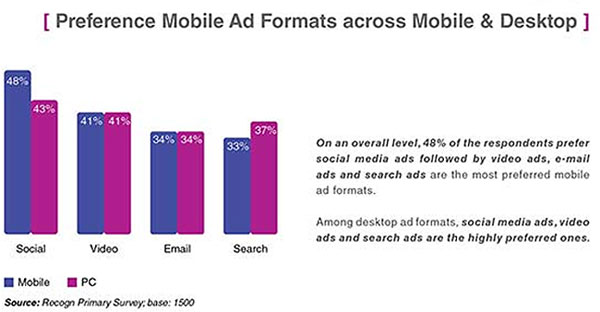
    As the above chart shows, the highlight of the report says “Social media ads, video ads and e-mail ads are the most preferred mobile ad formats. Among desktop ad formats, social media ads, video ads and search ads are the highly preferred ones. Around a third of the respondents prefer SMS ads”. The last finding about SMS is interesting both for creative planning and media planning as currently SMS is considered by very few agencies for the digital marketing plan. The small print in the above chart acknowledges the base as 1500.

    As expected smartphone screens are the most viewed devices for mobile ads, with 75% of the respondents using smartphone, followed by 42% who use laptops. 4G is the most used data connection followed by 3G and WiFi.

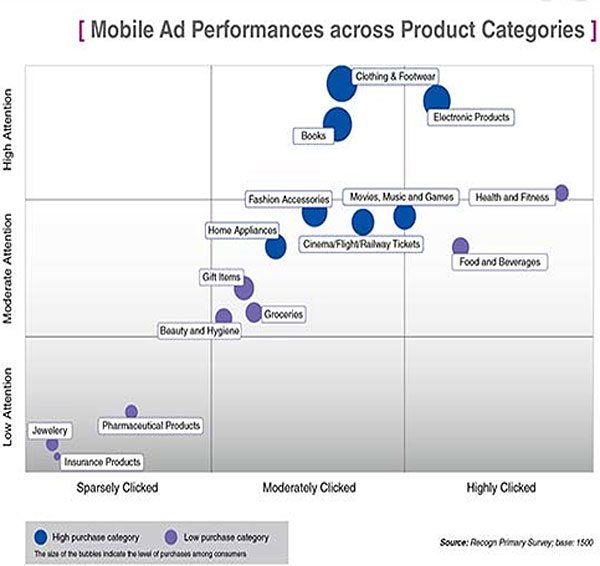
    The above findings on ad preference across product categories should be tracked across the months/ quarter to get a better perspective of the consumer preferences and to ensure that there is no seasonal bias in consumer preference.

    The highlight of the report points out a matter of grave concern: “Consumers feel that mobile ads appear too often and may get annoying, they are intrusive and give rise to security concerns.” The content of the mobile ads have to be more interesting and entertaining in order to engage and activate the consumer.At the same time, it is essential for the advertising industry to remove such doubts from consumer minds with the help of the service providers and the mobile manufacturers as mobile will be the main platform for internet access in India for a number of years, a phase which has already began.

  • LookBack 2017: Struggling & Taxing year for A&M


    We kick off our ‘LookBack 2017’ series with veteran adperson and MxM columnist Indrani Sen reflecting on the all-important AdEx barometer


    By Indrani Sen


    During December, 2017 we have seen quite a few industry reviews about estimated adverting expenditure for 2017, a struggling and taxing year for the Media & Advertising Industry in India. On December11, 2017 we learnt that AdEx for the year 2017 will probably be less than industry expectation, but industry is hopeful that AdEx will revive next year.


    The industry was on a roller coaster ride of growth from 2013 to 2015 when the annual growth rate of advertising expenditure went up from 11.3% growth in 2013 to 16.5% in 2014 to 17.6% in 2015 (Pitch Madison Reports). The sudden assault of demonetisation drove the growth rate down to 12.5% in 2016, but as predicted by the Pitch Madison Report in February 2017, industry was expecting an increase in growth rate to 13.5% in 2017. However, the early estimate of AdEx indicates that the growth rate will drop by at least 1% to 12.5%, or perhaps more. Recovery from the effects of demonetisation has taken longer time than expected by the industry analysts; on top of that the GST imposed from April 2017, created enough confusion in the market place and arrested the growth of advertising expenditure. It is now expected that the growth rate will be 11/5% or less.


    The entire retail and distribution system of FMCG sector in India use to run largely on the system of cash transactions. Demonetisation imposed in November 2016 created total disruption in that system which was carried forward to 2017. Subsequently, the introduction of  GST added more confusion. From the manufacturing companies to the distributors to the retailers to the small kirana shops, all of them and their tax consultants /accountants are still trying to understand the implications of the new tax system. During 2017, the consumers recovered from the effects of the cash crunch induced by the demonetisation, but the choking of the distribution system has led to decline in sales affecting the advertising expenditure.


    It is not only the distribution system of the FMCG sector which has been affected. Distribution of other manufacturing sectors and agricultural goods are also riding the same rolling boat in troubled water. There used to be a lot of cash transactions in agricultural sector which is still exempted from income tax. The entire sector is trying to come to terms with making payments through banks (not to mention the digital transactions preferred by the government) and the new tax regime of GST.


    Recently on December 4, 2017, Zenith predicted the market value of AdEx as INR 53,918 crore. Zenith report was first published in June 2017 and revised in December, 2017. It was followed by another report by Magna, the centralised IPG Mediabrands resourceon December 11, 2017 with a prediction that ad expenditure in 2017 will be INR 60,972 crore. The DAN (Dentsu Aegis Network) report published in afaqs in June, 2017 predicted a 13.5% growth for the year, same as the Pitch Madison predicted rate. Earlier in February, 2017 the reports by GroupM and Pitch Madison were published with prediction of varying projections.


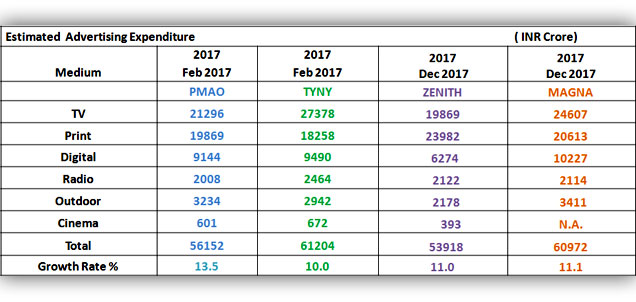
    While, the industry agrees that 2017 saw a decline in growth rate of advertising expenditure from 2016, the estimates for the growth rate and industry size vary from one source to the other as indicated in the following table.

    Estimated Advertising Expenditure     (INR Crore)
    Medium 2017

    Feb 2017

    2017

    Feb 2017

    2017

     Dec 2017

    2017

    Dec 2017

    PMAO TYNY ZENITH MAGNA
    TV 21296 27378 19869 24607
    Print 19869 18258 23982 20613
    Digital 9144 9490   6274 10227
    Radio 2008 2464    2122   2114
    Outdoor 3234 2942    2178   3411
    Cinema 601 672       393 N.A.
    Total 56152 61204    53918 60972
    Growth Rate % 13.5 10.0 11.0 11.1


    GroupM and Magna have estimated Indian advertising expenditure in 2017 as around INR 60,000 crore, while the estimates by Zenith and Pitch Madison hovers between INR 54,000 crore to 56,000 crore. While Madison predicted a growth of 13.5%, the other three agencies predicted growth of 10% to 11% in 2017 over 2016.  It is acceptable that estimates made by different agencies will vary to some extent. It would be a more comfortable situation for all of us if the ranking of ad expenditure on different medium remain in the same order. Currently, there is a difference of opinion on which medium has the highest share in the Indian advertising pie.


    As per an earlier Pitch Madison forecast, the industry was also expecting the AdEx to cross comfortably the mark of 50,000 crore in 2016, which fell short by few crores. In 2017, that mark will definitely be crossed, but without any fanfare as the overall moodin Media and Advertising industry is depressing. 2017 will go down in the history of Indian Advertising as an extended aftermath of demonetisation, which coupled with the woes of GST, slowed down the growth. Let us hope that in 2018, the industry will come to terms with GST, the distribution system will recover, the overall market situation will improve and growth rate of AdEx will rise.


  • Indrani Sen: The need of the hour: Spread of high speed data connectivity

    By Indrani Sen


    Last week while travelling from Mumbai to Kolkata by Mumbai-Howrah Dooranta Express, I read on my smartphone the ET Brand Equity report on “India’s digital media & entertainment sector is set to transform in 2018“ with a lot of interest and curiosity.  (https://brandequity.economictimes.indiatimes.com/news/media/indias-digital-media-and-entertainment-sector-to-see-a-transformative-year-in-2018/62360682). My appreciation of the viewpoint that the said transformation is riding on the high speed data connectivity now available in India did not last long as my 4G network dropped to 3G and then to 2G and then in no time to ‘no network’.


    Travelling from Mumbai to Howrah, one has to pass through Maharashtra, Madhya Pradesh, Odisha, Bihar, Jharkhand and West Bengal in the 28-hour journey. My 4G network played hide and seek with me throughout the journey, showing up when the train was nearing a major town and disappearing gradually after the train crossed that station! I would like to mention in this connection that I had a totally different experience regarding internet as well as network availability while travelling abroad by train and by road.


    By now, it is quite clear that the government’s plan for providing free internet access in public places will take many more years to get functional due to various financial and technical constraints. Ouradvertising and marketing industry acknowledges that internet usage and digital marketing in India will be riding on the rapid growth of mobile penetration with youth spearheading the adoption of digital media.To ensure uninterrupted network availability, it is essential to bring Tier II and III towns under the coverage of the telecom network as they play a major role in the distribution structure of various non-durables and durables and act as the gateway to rural marketing. More than 3000 towns belong to Tier II and III and almost 31% of our total population reside in those towns. Unless our telecom service providers can reach out to these towns with high speed data connectivity, the transformation of our digital media and entertainment sector will remain metro centric and will create a digital divide between large cities on one side and small towns and villages on the other side.


    The above article quoted Gaurav Gandhi, COO of Viacom18 as saying: “We have more than doubled our monthly active user base to more than 25 million users in the past six months, with the top 40 cities contributing close to 70% of the viewership…..Also, more than 25% of digital media consumption came from regional language audiences”. It is quite evident from the Viacom18 experience that the current digital media audience base is concentrated in the large cities. The growing importance of digital content in regional media also cannot be ignored.

    Reliance Jio has played a major role in accelerating the spread of high speed data connectivity in India. Jio connectivity was available in nearly 18,000 cities and 200,000 villages by September 2016. Recent search on the internet did not yield any update on that information. As per earlier EY estimates quoted in ET Brand Equity smartphone penetration is expected to be up to 59 per cent by 2020 from 31 per cent in 2015 and digital ad spend is slated to be Rs 185 billion by 2020, (https://brandequity.economictimes.indiatimes.com/news/digital/infographic-indian-digital-sector-to-cross-rs-20000-crore-mark-by-2020/56518988) constituting a larger pie (approximately a quarter) of the overall media spends.EY also predicted the rural internet user base would surpass the urban user base by 2020 with regional content as a key area of focus.

    With only two years to go before we hit 2020, it is doubtful if the number of rural internet users will surpass the number of urban internet users by 2020, but at the same time it may be possible if the high speed data connectivity is made available in the Tier II and Tier III towns. Rural connectivity will automatically improve as the surrounding rural areas between different small towns will get the spillover coverage. So, the need of the hour is to spread the high speed data connectivity as quickly as possible across India for turning our digital dreams to reality.


  • Print shines in IRS2017


    By Indrani Sen


    The IRS 2017 Topline Report released on January 18, 2018 has reinstated the advertising and marketing industries’ trust in audience research. Kudos must be given to MRUC, RSCI and Nielsen for getting the world’s largest readership survey back on track. IRS 2017 is a definitely a richer version of its predecessors, backed by enlarged sample size, changes in methodology, introduction of new readership metrics and concepts enabling in depth analysis of not just print media but overall media consumption. The strict scrutiny and quality control designed and deployed by the IRS TechCom helped in ensuring the accuracy of the findings.


    MRUC however has to revisit the common NCCS definition and the durable based grid as already pointed out by Shripad Kulkarni in “IRS 2017 Top 5 Takeaways” on January 19. With rise in electrification, LPG stove ownership, B&W TV production becoming obsolete and every third home possessing a two-wheeler, it is not surprising that NCCS D/E have been found as “Fast Shrinking”. However, the reality may be different riddled with power cuts and shortage of LPG Gas cylinders, particularly in rural areas. Ownership of colour TV provides the 24X7 entertainment to the entire family at a very low cost through cable operators and DD’s Free Dish. Ownership of two-wheeler is a necessity for a livelihood to many living in Tier 2 and Tier 3 cities. How far the ownership of ceiling fan, LPG stove, two-wheeler and colour TV will help us in the socio-economic classification indicating the disposable income of the house holds should be re-examined. At the upper end, NCCS A1 and A2 seems to be apparently stagnant, however, based on the growth in the number of total households, there has been a few crores growth in the numbers of A1 and A2 households.


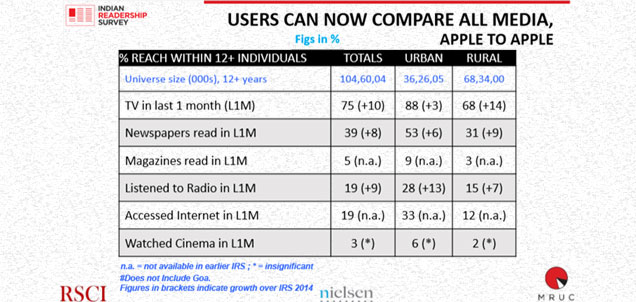
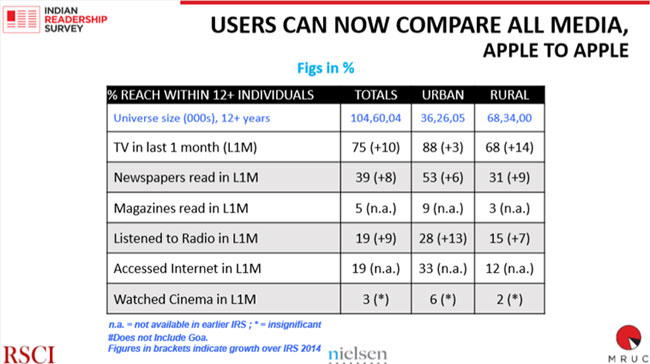
    In spite of the growth in urbanisation, 2/3rd of the almost 30 crores home in India still belong to the rural area. It is encouraging to note that TV reach and Newspapers reach are growing at a faster rate in rural area than in urban area.Again radio reach and newspaper reach are growing at faster rate than TV reach in urban area.

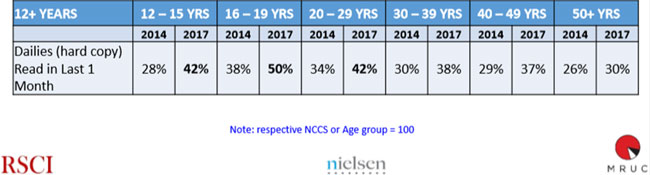
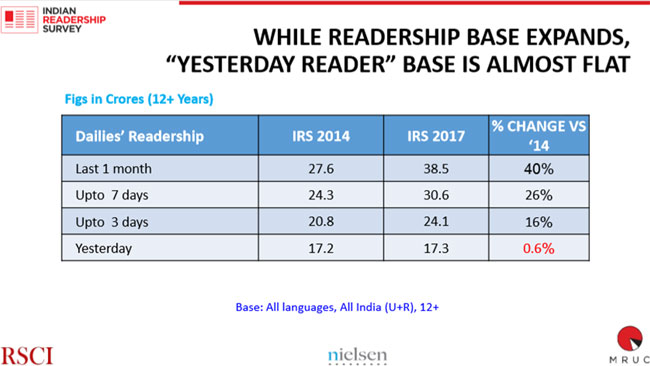
    All these reach figures are calculated on the basis of reach within 12+ individuals in last 1 month, the new readership metrics introduced in IRS 2017. Dailies added 11 crore readers in last three years, of which 4 crores came from urban India and 7 crores from rural India. On the demographic front, the readers among the younger age groups (12-15, 16-19, 20 -29 years) have shown higher growth than the older age groups. With more than 40% of our population below the age of 20 years, this trend is encouraging for the future of Print media.

    The high readership among the younger age group probably explains the stagnation in the yesterday readership against the growth in the other categories, up to 3 days, up to 7 days and last 1 month. Readers below 20 years and in their early twenties may not be regular readers of newspapers due to their pre-occupation with studies and other activities.

    This rise in readership of newspaper among younger age groups is a phenomenon of non-metro Tier 2 and Tier 3 cities and rural areas as we do not see the reflection of this trend among the youth in the metro cities, skewed to English medium and digital media. IRS 2017 has found that newspaper read online is only 26% among NCCS A1, so our educated urban youth probably are engaged with other content on the internet.


    Except Times of India which ranks 11th,the Top 20 dailies are all in Hindi and other regional languages. From 2014 to 2017 most of the regional languages dailies have grown more than the growth of English dailies (10%). The highest growth has been achieved by Oriya which, from a smaller base, has grown by 83% while Bengali has grown by 9%. Among the South Indian Languages, Telegu has grown by 66%, Tamil 44% and Kannada 37%. Malayalam newspaper market is more saturated and has shown only 19% growth. Marathi has grown by 31% with Gujarati scoring above it with a 45% growth. Hindi has also grown by 45% while Punjabi and Urdu have grown by 51% and 53% respectively from smaller bases.


    Armed with the findings of IRS 2017 and various other studies which show the growth potential of the smaller towns and rural areas, it is high time for the language newspapers to challenge the difference in the advertising rates of English and language newspapers in India. Marketing communication in any regional daily can work effectively when the content is also effectively designed in the same regional language and is not a poor translation from English or Hindi.As our creative agencies have not shown much interest in developing content in regional languages, perhaps the regional language newspapers can explore the option of developing advertising content for their own markets. If journalism can develop so well in regional language, it may not be difficult to develop advertising content and increase profitability in the new era of content marketing.


  • The Deep Divide


    By Indrani Sen


    The advertising and media industry has applauded the Union Budget 2018 focusing on the rural and agricultural sector with doubling of allocation to Rs 3,037 croreon Digital.By end of 2018, Wi-Fi hotspots in the country are expected to grow from 38,000 to 5lakh ensuring that every village has access to at least one Wi-Fi hotspot providing internet access to crores of Indians living in rural areas. The Budget has proposed broadband connectivity to 2.5 lakh Gram Panchayats under the Bharat Net project deploying high end Blockchain technology. Artificial Intelligence will be employed by NITI AAYOG for national development. Rs.10,000 crore has been allocated to telecom industry for early adoption of 5G.


    As we accelerate fast forward to Digital India, it is the right time for the Communication Industry to deliberate on the deep divide in the language of education and language of communication in India. If we have to effectively communicate with our audience in Digital India, then what will be the language of digital communication? How are we going to create effective and efficient content for the crores of rural citizens who are going to be digitally enabled within a very short span of time?


    Almost all smartphones selling in India now are enabled with regional language settings and we are increasingly noticing the use of regional language in texting and chatting on various platforms like Whats App, etc. The practice of using English typeface for writing messages in regional language is also a common practice among mobile phone users across our country. We have also started receiving on our mobiles sales and promotional messages in Hindi and other regional languages. Social media platforms like Facebook etc. as well as email services like Google Mail also offer the use of regional languages. We do not have any research which has explored the use of regional language by mobile phone users or internet users in India, so it is difficult to assess their numbers, but they are definitely growing.


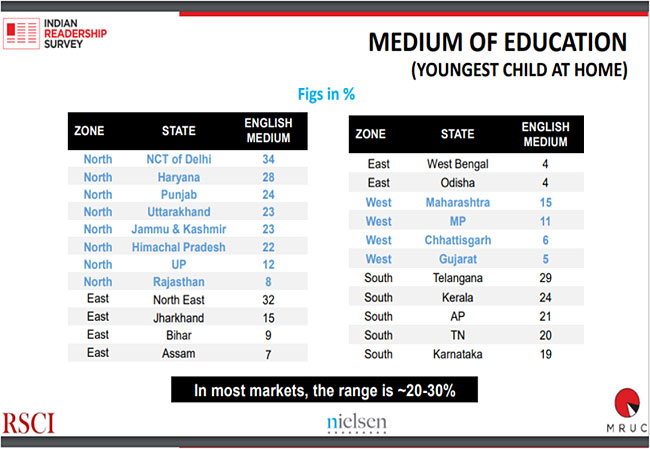
    According to IRS 2017, the percentage of children studying in English medium schools varies widely from state to state as seen in the table below:


    On Dec 1, 2018 DNA published a report stating that only 17% children in India go to English medium schools (http://www.dnaindia.com/academy/report-only-17-children-in-india-go-to-english-medium-schools-2278538). There have been lot of debates on how this issue should be addressed in our Education Policy which follows a three language (English, Hindi and mother tongue) formula for school education. The RSS-affiliated Shiksha Sanskriti Utthan Nyas has been asking the Indian government to make Hindi the primary medium of instruction across all schools in India instead of English or state language. On the other hand, educationists and researchers have been pointing out that a child understands any concept best in her or his mother-tongue. They have been arguing that India’s craze for English-medium schools is depriving many children of a real education.


    My intention is not to engage in such debates related to the medium of education, but to merely point out that our Media & Entertainment Industry (TV, Print, Radio and Cinema) is thriving on Hindi and regional language content in spite of our so-called craze for English medium education. The advertising industry has managed to keep pace with brand communication in various languages across India by outsourcing the copywriting or script writing in regional languages. As consumers become digitally enabled, they will find it more and more difficult to manage the digital content creation for their brands in regional languages.


    A deep divide seems to exist between the language of communication used by our advertising industry and the language understood and appreciated by their target audience across India. A partial solution may be provided through hiring resources proficient in regional languages and can lead the digital content creation in regional languages. An alternative business model for digital marketing and advertising may emerge to bridge this deep divide which may squeeze the shrinking profitability of the creative agencies in Digital India.


  • Indrani Sen: The Second Rising of Radio

    By Indrani Sen


    Radio has come a long way since Guglielmo Marconi sent his first radio signal in 1890s and the first radio commercial crackled over radio waves in New York in 1922. After advent of TV, it was written off by many of us in advertising and marketing and some of us thought that Digital will drive the last nail to close its coffin.  Contrary to popular belief, radio refused to die and we are currently witnessing its Second Rising in the digital age as the second most effective medium in driving purchase intent as revealed by a recent research conducted by Nielsen, commissioned by Music Broadcast Ltd (Radio City). The research showed radio outpaces social networks. social.htmlhttp://www.livemint.com/Consumer/vBLB4xcdPUmEHCzafXUUoI/Radio-emerges-as-second-most-accessed-media-outpaces-social.html.


    In 2012 UNESCO proposed February 13, the day the United Nations Radio was established in 1946, as the World Radio Day for promoting worldwide access to information and freedom of expression through radio, a powerful information tool which can reach remote communities and vulnerable people across the world. The date was proposed by France and verified by UNESCO through a feasibility study in 2011. On 14 January 2013, the United Nations General Assembly formally endorsed UNESCO’s proclamation of World Radio Day.  The fact that this decision was taken when internet and world wide wave were well established, goes to prove the enduring power of radio as a medium.


    In the two decades of this millennium, various research studies have shown time and again the utility and efficacy of radio as a medium in the digital age. I would like to cite a few of such studies done in this decade. In 2011, Bob McCurdy wrote “Consumers who listened to the stations with the manufacturer’s commercials were 13% more likely to consider buying its camera than those who did not listen to those stations” based on a research done for a camera manufacturer (https://www.mediapost.com/publications/article/152687/a-study-in-radios-effectiveness.html). Among many other articles on radio research, an interesting one by Matt Petronzio was published in www.mashable.com  in 2013- “Enduring Power of Radio in the Digital Age”. (https://mashable.com/2013/02/13/radio-in-the-digital-age/#YttXF21seiq3)


    In 2014, research done by Nielsen Catalina Solutions “found a direct link between radio advertising and brick-and-mortar retail sales—evidence that money spent on radio is money well spent. In this first major radio effectiveness study, the research found that each dollar of ad spend generated an average sales return of $6 from the listeners in the 28 days after they heard the ads.” (http://www.nielsen.com/us/en/insights/news/2014/for-advertisers-radio-is-worth-listening-to.html)


    In 2015, Campaign UK carried an article “Radio is ‘20% more cost-effective’ at building brands, research claims” based on research done by Radiocentre, the trade body for British radio. https://www.campaignlive.co.uk/article/radio-20-cost-effective-building-brands-research-claims/1414239. In 2016, Angela Jeffrey posted an article “Advertising Effectiveness – New Research Shows Radio Potentially Most Effective Medium” based on  “ABX research on how radio may deliver the best ROI and ROAS of all with some smart creative” with a caveat that the radio advertising must be smart and entertaining. (http://blog.adbenchmark.com/advertising-effectiveness-in-radio).


    In 2017, Nielsen, who has done maximum number of research on effectiveness of radio, complied several of such studies into a new compendium for distribution to their clients. The title speaks volumes: “Radio (Re) Discovered, A Brand Manager’s Guide To Radio”.  (http://www.insideradio.com/free/nielsen-pushes-radio-effectiveness-with-best-of-roi-guide/article_6814f010-889d-11e7-a4b5-7343ce99ae17.html).


    It is expected that after Phase 3 expansion of FM network is complete, nearly 60% of the geographies of our country will be covered by private radio stations which will increase the reach of the medium by many folds. Various recent experiments done in India by independent advertisers have shown that radio ads lead to searching on the internet and promotes e-commerce in the most cost efficient way.


    On the eve of the World Radio Day, let us hope that other private FM organizations will invest in research to bridge the gap in our knowledge of radio listeners In India and the Indian advertisers will realize the potential of this low cost medium and use it effectively  to get better ROI of their advertising campaigns.


  • Could ‘Deshnagari’ have bridged the Vernaculars?


    By Indrani Sen


    Over the last few weeks, various issues related to advertising communication in regional languages in India were highlighted.First, the IRS 2017 alerted us about the increasing importance of vernacular newspapers in India. Then we got the reviews and forecasts of AdEx in India: TYNY2018 and PMAO2018 and both pointed out the role which Hindi and other vernacular languages are playing in our media consumption and media revenue generation.

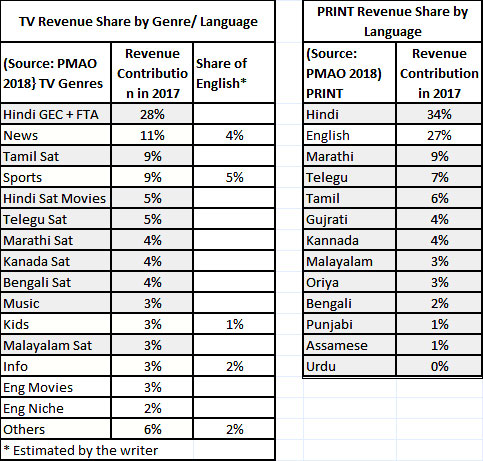
    In TYNY 2018, GroupM has mentioned 3Vs asthe future gamechangers, the key drivers for media consumption in 2018 – Video, Voice and Vernacular. PMAO’s analyses of advertising spend by languages for TV and Print in 2017 has confirmed the growing importance of communication with consumers in their mother tongues/ vernaculars as compared with communication in English. As shownbelow in the two charts, around 19% of revenue contribution of TV AdEx is made by English language channels. In case of Print AdEx, the share of English newspapers is 27%, while the growth in revenue is favouring Hindi and other vernaculars. Against this backdrop, our A&M industry continues to think, strategise, develop and execute advertising communication in English.


    It is not an easy task to think and design advertising communication in various regional languages in India, even though many/most Indian languages have their roots in Sanskrit. As all languages (except Hindi and Marathi) have different scripts, it is a very hard task for an Indian to learn anotherlanguage even if the person is efficient in her/his mother tongue or the official language Hindi. While musing over the issue, I suddenly remembered about “Deshnagari”, the dream project of a visionary communicator, late R K Joshi (1936-2008), who was awarded the Lifetime Achievement Award by Ad Club,Mumbai in 2004.


    During the early days of my career (1975 to 1979), while working with Ulka Advertising (now FCB Ulka) in Mumbai, I was fortunate enough to be come in contact withR K Joshi,Ulka’s legendary Art Director.An artist, designer, calligrapher, poet and a teacher, his passion was Indian typography and type design. He was associated with National Centre for Software Technology (now Centre for Development of Advanced Computing – C-DAC) since 1976.  Through C-DAC, he later got involved in the Microsoft Project and developed a series of O/S fonts for Windows 2000 to enable typing in Indian languages on Windows.


    RK used to teachus, the young entrants in advertising, about the importance of understanding Indian culture and values for designing meaningful advertising communication, about the need for communicating in vernaculars to Indian audience for ensuring effective results of advertising campaigns. He used to insist that everyone involved in advertising communication in India, should know at least one regional language well enough to judge a good copy from a bad copy.

    RK was deeply concerned that different scripts used by different regional languages stood as a barrier to our learning, understanding and communicating across regions and states in India. Hetold us about the work he was doing for designing and developing typographically a common script which can be used by all Indian languages, like the Roman alphabet and script is used by all most all European languages. RK named this new script “Deshnagari”. He redesigned our alphabets after researching on the phonetics of a number of regional languages and invented a common script which can be used for writing all vernaculars.

    After I left Ulka, I heard that RK made a presentation on “Deshnagari” to the Indian government, who praisedhim for his efforts andpromised to review his proposal in due course.Wikipedia (https://en.wikipedia.org/wiki/R_K_Joshi) mentions under R K Joshi’s association with C-DAC “Another series of multilingual fonts for 12 Indian languages were developed under project IndiX”. Most likely, this reference relates to the “Deshnagari” project and hopefully the archives of C- DAC still has records of this path breaking research work of RK Joshi whose thoughts and visions were ahead of his time.

    Just imagine how much easier life would have been today for all of us Indians and for our A&M industry, if in 1980s our government could have taken a decision to introduce “Deshnagari” as the common script for all Indian languages. Over last three decades, we would have been able to bridge all the vernaculars in India with a common script! But, alas, given the politics of linguistic states in India, such a move would not have been impossible during the 1980s and probablycannot be implemented even now. So, Deshnagari, a common script for our vernaculars would perhaps remain as an unfulfilled dream of a legendary communicator.


  • Mind the TV AdEx Gap!


    By Indrani Sen


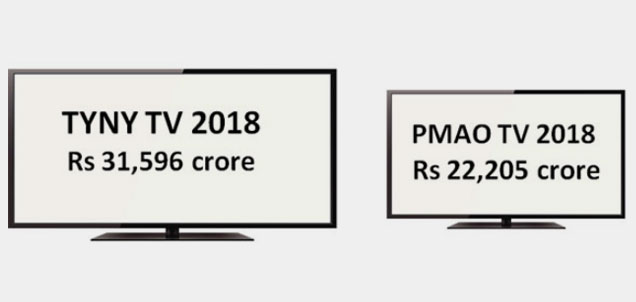
    For two consecutive years, TYNY by GroupM and PMAO by Madison were released during the same week, giving the industry lot of food for thought and facts and figures to chew and digest. TYNY or ‘This Year Next Year’ closed the estimate for total AdEx 2017 at Rs 61,263 crore with a growth rate of 10% over 2016, while PMAO or ‘Pitch Madison Advertising Outlook’ showed a growth rate of 7.4% in 2017 over 2016 and estimated the total AdEx as Rs 53,138 crore.

    After a year of stagnation and stunted growth in 2017, mostly due to the after effect of Demonetisation and Goods & Services Tax (GST),both the reports predict a better year in 2018 with a growth of total AdEx by 13% and 12% respectively.

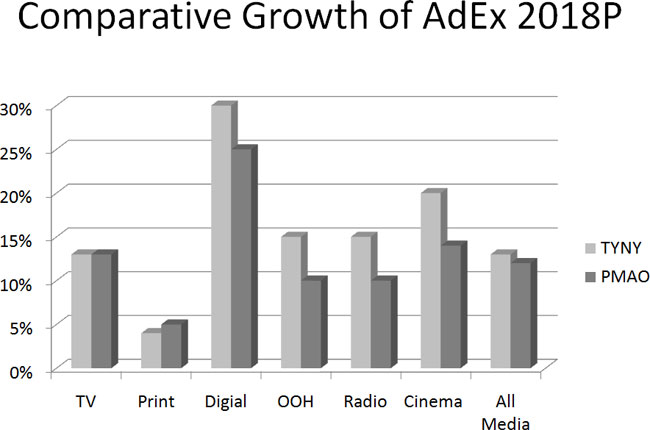
    According to both the reports, Digital is going to have the highest growth in AdEx in 2018, 30% according to TYNY and 25% according to PMAO. Both reports predict 13% growth in TV AdEx and 4% (TYNY) and 5% (PMAO)in Print AdEx. Both agree that the highest growth after Digital will be achieved by Cinema (20% TYNY & 14% PMAO) which has the smallest share of the advertising pie. Both have shown same percentile growth rates for OOH and Radio (15% TYNY & 10% PMAO).

    The chart below shows that PMAO’s estimates for growth for all media, except TV and Print, are more conservative than TYNY.


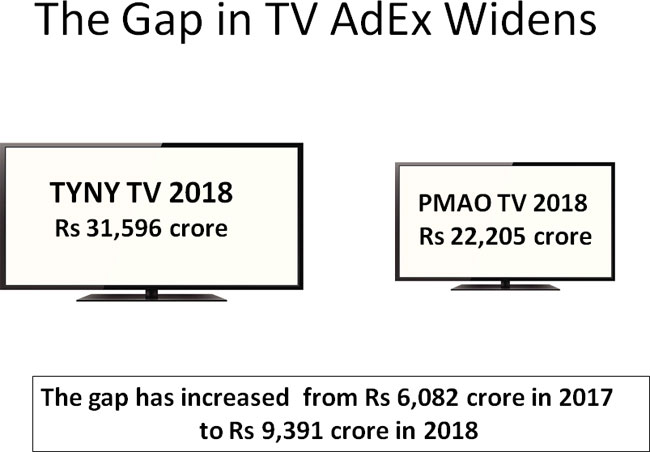
    In my analysis of the two reports last year (http://www.mxmindia.com/2017/02/what-is-the-real-size-of-indian-ad-industry/), I found a difference of around Rs 5000 crore between the two projections made by TYNY and PMAO for all media in 2017. The difference was mainly due to the disagreement between the projections for TVAdEx in the two reports with GroupM’s projection being almost Rs 6000 crorehigher than PMAO’s.

    In the projections for 2018, the gap in the all media AdEx between the two reports has widened to almost Rs10,000 crore with TYNY predicting the total industry size as Rs 69,347 crore and PMAO predicting it as Rs 59,530 crore. As seen last year, most of this difference is due to the Rs 9,391cr difference in the projections of TV AdEx shown in the two reports.


    Unless this widening gap in TV AdEx is reviewed by both the agencies and explained to the industry at large, it would become increasingly difficult for the A&M industry to assess the actual size of the TV AdEx. I think there must be a difference in the methodology followed by the two agencies for estimating TV AdEx which results in the different estimates.

    On behalf of the A&M fraternity, I appeal to both GroupM and Madison for a clarification so that we have a better perspective and understanding about growth of Indian advertising by media over the years.

    Indrani Sen is a veteran advertising professional and is now Adjunct Professor with the Symbiosis International University, Pune. The views here are her own


  • The Streaming Warriors


    By Indrani Sen


    The two biggest global video streaming services, Netflix and Amazon Prime, have shifted their focus to India over the last two years. Netflix, who was the first to launch in India in December 2016, has been overtaken by Amazon Prime, launched a year later, in their debut year. By end-2017, Amazon Prime held 10% share of the Indian OTT streaming market with Netflix holding 8% share according to the data shared by the London based firm IHS Markit with Quartz. (https://scroll.in/reel/868786/why-amazons-streaming-platform-has-overtaken-rival-netflix-in-india).  Globally, Netflix is the leading video streaming service provider except in Japan, Germany and India where Amazon Prime leads. In India, the Hotstar is the leading video streaming service, which along with Voot and couple of other home grown services controls almost 80% of the segment.


    Netflix focused on the top end of the market and aimed mostly at the early adopters of the video streaming services. Accordingly, more than two thirds of their content is in English with Indian language content limited only to Hindi and Bollywood. On the contrary, Amazon Prime targeted a wider group of audience with less than 65% of their content in English, 25% in Hindi and more than 10% in other Indian languages. According to research, Indians spend 93% of the time on online video watching content in Hindi and regional languages. So, the formula of only western content for the top end of the market or even western plus Bollywood content does not hold the key to successful winning of the emerging Indian audience for online video streaming.


    Netflix has lost out to Amazon also in the price war in the highly price sensitive Indian market. Amazon strategically decided to offer a significant discount for entering the Indian market after Netflix. Their launch price of Rs 500 per year was subsequently doubled to Rs 999 per year where as Netflix charges Rs 450 per month from their customers. The annual subscription fees paid by the consumer for Netflix are more than 5 times the annual subscription fees of Amazon Prime. Off course the Freemium model of Hotstar seems to be the top most favourite of Indian consumers with the free base tier (with ads), and a single premium tier that costs Rs 199 a month.


    Amazon has announced an investment of $300 million in 2018 for creating original content in Hindi and regional languages.  They have tied up with big production houses like Dharma Productions (Karan Johar), Vishesh Films (Mukesh Bhat), etc. They have struck a deal with Salman Khan allowing them to show his titles before satellite or TV channels. It is rumoured that they have tied up with more than a dozen of stand up artists across the country.  James Farrell, Asia-Pacific Content Head, Amazon Prime Video, said in a recent interview, Amazon Prime video content is growing faster in India than any other country.(https://www.exchange4media.com/digital/amazon-prime-video-is-growing-faster-in-india-than-any-other-country-content-head-apac_88861.html)


    Netflix bagged an exclusive deal with Shah Rukh Khan’s Red Chili Productions in 2016. This year they have released their first mainstream Hindi movie, “Love Per Square Foot”.  Their original India series, Sacred Games directed by Anupam Kashyap in the making. Comedian VirDas’s Netflix special was released in early 2018. Still they have some catching up to do to beat the multi-lingual content portfolio of Amazon Prime. Reed Hastings, Chairman& CEO of Netflix, recently visited India for attending the Economic Times Global Business Summit. During an interview with Economic Times, he said about Indian market “It’s a good market, a different market and we just don’t compete for advertisement revenues. We will evolve over the years to do more languages and more Indian content, again both for India and for around the world.” (https://economictimes.indiatimes.com/small-biz/startups/newsbuzz/india-is-a-key-part-of-international-subscription-growth-netflix/articleshow/63074317.cms).


    The market research firm, Counterpoint Research, has reported that Hotstar is the largest video streaming service in India, with around 75 million subscribers, followed by Viacom 18’s Voot with 22 million subscribers, Prime Video with 11 million subscribers. (https://www.androidcentral.com/netflix-getting-crushed-india-and-its-because-amazon-and-hotstar). In India Netflix (totally ad free) is in the fifth position with around 5 million subscribers. According to industry sources, Amazon is developing an ad supported, free version of its popular Prime video service, which may work well with the price conscious consumers in India.


    Hotstar, apart from offering the content from the Star Group, has the digital rights to HBO shows in the country. Currently, Hotstar streams Game of Thrones episodes same day they air in the U.S. This advantage along with the exclusive rights to stream cricket and football games in India has made Hotstar the most favorite Video Streaming Service. Voot has shows from TV channels which are owned or are subsidiaries of Viacom 18, namely MTV and Colors in various regional languages.


    Airtel Movies, also offers good movie content. SonyLiv, as well as HOOQ subscriptions, are all heavily loaded with Indian content which is helping their growth. ALTBalaji, a wholly owned subsidiary of Balaji Telefilms Ltd.launched on 16 April 2017, is the latest entrant in the home grown segment. Ekta Kapoor plans to create original, premium, and tailor-made content especially for Indians across the globe. But, she has an in depth understanding of the Indian audience and stands a good chance of attracting them to her streaming platform with good video content in various Indian languages.


    Needless to mention that availability of affordable data and easy access to internet are helping the growth of the streaming services. It is a full war out there on the internet for winning the Indian consumers with video content of different types, different colours and hues. As India reaches the “Digital Tipping Point” (please see my article http://www.mxmindia.com/2018/03/indian-me-industry-at-its-digital-tipping-point/) the war is going to intensify for winning over the emerging Indian users of streaming video services. The demand for content creation and marketing will also increase as brands will seek ways and means for reaching the emerging Indian audience of the video streaming services.


  • Indian M&E industry at its Digital Tipping Point


    By Indrani Sen


    “All the segments of the M&E sector are showing growth, consolidation and innovation led by digital, both on consumer side and the content supply chain,”noted Uday Shankar, Chairman, FICCI Media & Entertainment Committee in the introduction of FICCI-EY Report 2018.According to the experts from EY, Farokh Balsara and Ashish Pherwani, the Indian Media & Entertainment Industry has reached its Digital Tipping Point. In other words, thereare significant changes happening all around our M&E industry to cause a larger, more important change which will see the transformation of our country to Digital India.


    The FICCI-EY Report 2018 has highlighted quite a few of these changes: distribution of television has become largely digitised increasing its addressability and reach, the OTT platforms for TV and video content are growing rapidly, both print and radio segments are growing continuously with more focus on their digital presence, exponential growth (though from a small base) of digital subscription and online gaming riding on falling data cost, emergence of India as the second largest smartphone market in the world giving easy access of internet to consumers, rapid growth of digital micro-payment ecosystem across urban and rural markets, etc.


    The above changes are expected to grow our digital content consumption substantially which in turn would increase the size of the total industry from INR 1.5 trillion (USD 22.7 billion) in 2017 to INR 2 trillion + (USD 31 billion+) by 2020 at a CAGR of 11.6%.

    Source: FICCI-EY Report on M&E industry 2018


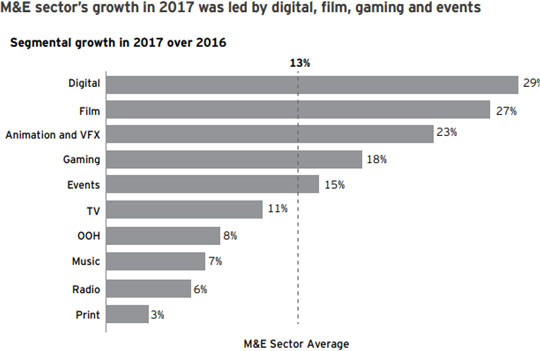
    As shown in the above chart, while the industry grew by 13% from 2016 to 2017, the growth was led by digital, film, animation & VFX, gaming and events. The same trends are expected to continue over the next three years. Another significant trend, which has been seen for the first time in the M&E sector, is outpacing of advertising growth (under10 %) by subscription growth (almost 15%) in 2017 over 2016. This trend will continue to be a major contributor to the Digital Tipping Point.


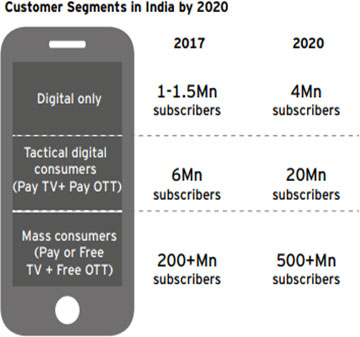
    Based on this new trend of growth in subscription,the report has made a forecast on new customer segmentation which will be an integral part of Digital India by 2020. This new consumer segmentation will be important for the A&M Industry for targeting their audience.


    Source: FICCI-EY Report on M&E industry 2018


    We can assume that there will be a process of continuous migration from the bottom tier of mass consumers to the tactical digital consumers to the only digital consumers as we go forward to the next decade. As far as deployment of resources for advertising is concerned, we will see online media campaigns slowly gaining over the combination of online and offline media campaigns at the top end of the consumer pyramid.


  • Mobile Magic on a High


    By Indrani Sen


    Last week, two interesting reports on usages of mobile and mobile advertising were released prompting strategic planners in media agencies to do quick reviews of the mobile advertising strategies recommended for their clients for the current year.The first one, the  ‘Mobile Internet Report 2017’, jointly published by Internet And Mobile Association of India (IAMAI) and Kantar IMRB predicted that the number of mobile internet users will reach 478 million by June 2018. The second study by InMobi surprised us with the insight that programmatic advertising expenditure on mobile has grown by more than 500% from Q1 2017 to Q4 2017.


    The writings on the walls, in this case the small screens, were there for the last few years, but the positive indications started coming from last year. Kleiner Perkins Caufield & Byers partner Mary Meeker descried India as the “most fascinating markets for the internet on the planet” and “an incredibly fierce battleground right now for hardware and software companies” while predicting on the trends of 2017 at the Code Conference on May 31, 2017. https://www.recode.net/2017/5/31/15720378/mary-meeker-india-annual-internet-trends-report-code-2017. Meeker highlighted in her presentation the dramatic and accelerated changes in Indian mobile market from 2016. She said that “Excluding China, Indian users spend the most time on Android devices. People in India spent nearly 150 billion hours on Android devices in 2016. They’ve also become the biggest downloaders of Google Play apps.”


    She further commented that Indian wireless data prices are still relatively high but they have been falling steadily over the years and was down about 50 percent from Q1 2016 to Q1 2017, after the Reliance Jio Launch.  Cheaper wireless data has accelerated the growth of smartphone ownership and has caused data consumption to jump year over year.


    The FICCI-EY report on M&E Industry 2018 showed that internet penetration in India is being driven by Mobile Internet. It estimated that 75% of the overall wireless internet base and 90% of the broadband subscriber base are mobile users, which supports the prediction of IAMAI.


    According to the media release by IAMAI, the number of mobile internet users increased by 17.22% from December 2016 to reach 456 million users by December 2017. Urban India had 18.64% Y-o-Y rise, while Rural India 15.03% during the same period. The report predicts with 59% mobile internet penetration, Urban India will witness a slowdown, while Rural India with only 18% penetration will be next area of growth. The report further confirms that Mobile Internet is predominantly used by youngsters, both in urban and rural areas.


    Programmatic advertising was still in its nascent stages in India in 2016. However, with the growth of digital advertising, it is inevitable that programmatic advertising would also grow in India. The FICCI-EY Report on M&E Industry 2018 estimated that 10% to 15% of all advertising expenditure was through programmatic advertising in 2017. It predicted that by 2020 its share may grow to 50%. The In Mobi report seems to differ from the FICCI-EY Report as it indicates an accelerated growth of mobile programmatic advertising spend by 534% (by ten times) from Q1 to Q4 of 2017.  https://www.exchange4media.com/digital/mobile-programmatic-ad-spend-grew-5-fold-in-2017 study_89173.html. The InMobi report indicates high growth of video content through mobile programmatic advertising has led to an acceleration of the process.


    The “Mobile Magic” is rewriting the script of media planning strategies in India and we may be witnessing major disruptions sooner than predicted by EY in the FICCI ME Industry 2018 Report. EY indicated (Digital Media – Page 42) that overall changes can be expected once programmatic advertising crosses 25% share of the advertising spend as Programmatic advertising then would put pressure on advertising rates which in turn might put pressure on advertising led models.