
By Indrani Sen
 Over the last few weeks, various issues related to advertising communication in regional languages in India were highlighted.First, the IRS 2017 alerted us about the increasing importance of vernacular newspapers in India. Then we got the reviews and forecasts of AdEx in India: TYNY2018 and PMAO2018 and both pointed out the role which Hindi and other vernacular languages are playing in our media consumption and media revenue generation.
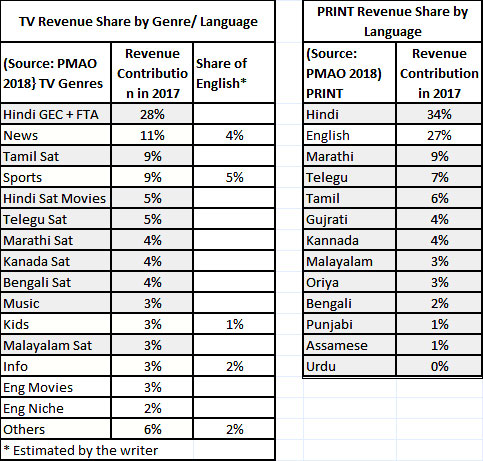
In TYNY 2018, GroupM has mentioned 3Vs asthe future gamechangers, the key drivers for media consumption in 2018 – Video, Voice and Vernacular. PMAO’s analyses of advertising spend by languages for TV and Print in 2017 has confirmed the growing importance of communication with consumers in their mother tongues/ vernaculars as compared with communication in English. As shownbelow in the two charts, around 19% of revenue contribution of TV AdEx is made by English language channels. In case of Print AdEx, the share of English newspapers is 27%, while the growth in revenue is favouring Hindi and other vernaculars. Against this backdrop, our A&M industry continues to think, strategise, develop and execute advertising communication in English.
It is not an easy task to think and design advertising communication in various regional languages in India, even though many/most Indian languages have their roots in Sanskrit. As all languages (except Hindi and Marathi) have different scripts, it is a very hard task for an Indian to learn anotherlanguage even if the person is efficient in her/his mother tongue or the official language Hindi. While musing over the issue, I suddenly remembered about “Deshnagariâ€, the dream project of a visionary communicator, late R K Joshi (1936-2008), who was awarded the Lifetime Achievement Award by Ad Club,Mumbai in 2004.
During the early days of my career (1975 to 1979), while working with Ulka Advertising (now FCB Ulka) in Mumbai, I was fortunate enough to be come in contact withR K Joshi,Ulka’s legendary Art Director.An artist, designer, calligrapher, poet and a teacher, his passion was Indian typography and type design. He was associated with National Centre for Software Technology (now Centre for Development of Advanced Computing – C-DAC) since 1976. Through C-DAC, he later got involved in the Microsoft Project and developed a series of O/S fonts for Windows 2000 to enable typing in Indian languages on Windows.
RK used to teachus, the young entrants in advertising, about the importance of understanding Indian culture and values for designing meaningful advertising communication, about the need for communicating in vernaculars to Indian audience for ensuring effective results of advertising campaigns. He used to insist that everyone involved in advertising communication in India, should know at least one regional language well enough to judge a good copy from a bad copy.
RK was deeply concerned that different scripts used by different regional languages stood as a barrier to our learning, understanding and communicating across regions and states in India. Hetold us about the work he was doing for designing and developing typographically a common script which can be used by all Indian languages, like the Roman alphabet and script is used by all most all European languages. RK named this new script “Deshnagariâ€. He redesigned our alphabets after researching on the phonetics of a number of regional languages and invented a common script which can be used for writing all vernaculars.
After I left Ulka, I heard that RK made a presentation on “Deshnagari†to the Indian government, who praisedhim for his efforts andpromised to review his proposal in due course.Wikipedia (https://en.wikipedia.org/wiki/R_K_Joshi) mentions under R K Joshi’s association with C-DAC “Another series of multilingual fonts for 12 Indian languages were developed under project IndiXâ€. Most likely, this reference relates to the “Deshnagari†project and hopefully the archives of C- DAC still has records of this path breaking research work of RK Joshi whose thoughts and visions were ahead of his time.
Just imagine how much easier life would have been today for all of us Indians and for our A&M industry, if in 1980s our government could have taken a decision to introduce “Deshnagari†as the common script for all Indian languages. Over last three decades, we would have been able to bridge all the vernaculars in India with a common script! But, alas, given the politics of linguistic states in India, such a move would not have been impossible during the 1980s and probablycannot be implemented even now. So, Deshnagari, a common script for our vernaculars would perhaps remain as an unfulfilled dream of a legendary communicator.