Category: Opinion – Archives

  • Jaideep Shergill: What makes the journalist-PR professional relationship so nebulous

    By Jaideep Shergill


    One of the most baffling relationships I have encountered in my work life is clearly the one enjoyed by the “Fourth Estate” and members of the PR/ Communications fraternity. It has always been a nebulous relationship to say the least. One hears only “whispers “in corridors and it is one of those classically closeted relationships.


    Having said this, we also know there is a level of symbiosis and mutual gain in this relationship. While the relative number of trustworthy and reliable PR pros may have dwindled in recent years, I assure you that time- and information-strapped reporters still appreciate the value offered by responsive PR folks who “get it”.


    We’ve long since entered an age when every company and every individual can be a media outlet with the capacity to create and syndicate content. At the same time, nimble media upstarts have mastered the art of headline histrionics. In so doing, they have siphoned off a growing share of the public’s ever-divided attention spans from legacy media, which today are struggling to retain the influence they historically have enjoyed.


    There are a number of reasons fueling the growing acrimony between the two professions, or at least the short fuses journalists have for many PR consultants:

    1. The ratio of PR people to journalists is skewed heavily in favour of the former group, resulting in email inbox overload and phone calls, texts and WhatsApp messages.

    2. New data-driven service providers let PR pros automate the media relations process, producing greater volumes of misguided or inane story pitches.

    3. Journalists have many other sources for story ideas, including those they follow in real-time on the social media.

    4. Journalists are asked to produce more, often in different mediums. Hence, they’re under tremendous pressure and have less tolerance for story pitches.

    5. Media relations is pushed to junior staffers at many big agencies — and inhouse communications departments — with relatively little supervision or mentoring.


    Coming specifically to India, the “state of love and trust” between the two groups leave a lot be desired from both sides.


    Here is how it plays out every day…


    PR person to journalist:

    In spite of the overwhelming number of pitches landing in your inbox, please at least reply, especially if the story idea is editorially valid.  We just seek closure, good or bad.


    Journalist to PR person:

    Take the time to learn and understand what exactly you are pitching. Be able to answer basic questions about your client’s business.


    PR person to Journalist:

    If the pitch is not in your specific coverage area, but still viable, please consider forwarding to an appropriate colleague.


    Journalist to PR person:

    Think twice about sending the same story pitch to multiple reporters, and again, know what each and every person on the receiving end covers.


    PR person to Journalist:

    Just as you have a job to do, so do we.


    And so on and so forth. I am sure you get the drift by now!


    Isn’t it time we played well especially since we are in the same sandbox whether we like it or not?


    It does seem that we are doomed to have an endless debate about the relationship between journalists and PR professionals. The fact is that we have a mutually dependent relationship. The press cannot do its job without PR and PR needs the press.


    It is time that the representatives of both the press and the PR industry has a serious discussion about the rules of engagement. It is not good for society that the critical faculties of the press are being blunted. Neither is it good that the genuine contribution of PR to the public agenda goes unrecognised. There is a mutual responsibility for a respectful distance to be kept between both professions and an equal responsibility for both to act respectfully towards the other, and that means honesty and integrity must prevail if society is to be served.


    Jaideep Shergill, Co-Founder Pitchfork Partners Strategic Consulting LLP is a PR and communication veteran and has always been contrarian about most things, drawing extraordinary amounts of irk and ire from industry peers. He can be reached on jaideep.shergill@pitchforkpartners.com. The Devil’s Advocate appears every Monday.

     

  • What is the real size of Indian Ad Industry?


    By Indrani Sen

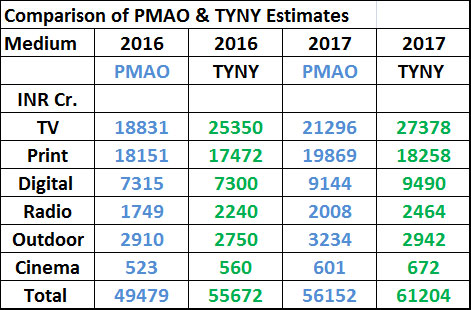
    Last week was exciting for the advertising and media industry as the two major reports on industry Adex were released on two consecutive days. GroupM released its ‘This Year Next Year’(TYNY) 2017 report on February 14 followed by the release of ‘Pitch Madison Advertising Report’(PMAR) 2017 by Madison on February 15. In the last few days, both the reports have been published and analysed in the business newspapers and websites, leaving hardly any scope for adding any comment on the same.

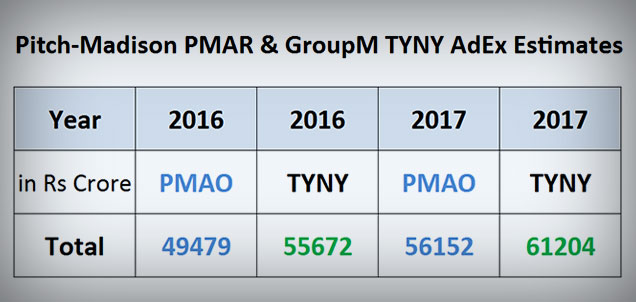
    As usual there is a difference between the two projections, this time it is of around Rs 5000 crore. The biannual report on advertising expenditure TYNY 2017 has forecast India’s advertising investment to reach an estimated Rs 61,204 crore in 2017 based on a growth rate of 10% over 2016. On the other hand, PMAR 2017 has projected a growth of 13.5% in 2017 over 2016 and has estimated the size of the industry to reach Rs 56,152 crore.

    According to Sam Balsara, AdEx dropped by Rs 1650 crore in the last two months of 2016 after demonetisation and as a result, the industry adspends narrowly missed the mark of crossing Rs 50,000 crore. On the other hand, the GroupM report, Indian advertising industry clocked Rs 49,758 crore in 2015 and crossed the Rs 50,000 crore mark comfortably in 2016 by scoring Rs 55,671 crores. Madison estimated Indian adspends as Rs 43,991 crores in 2015, Rs 49,480 in 2016 and has projected Rs 56,152 crore in 2017. The difference, between the two sets of estimates, has been hovering between Rs 5000 to Rs 6000 crore, which is not a small amount.

    If we compare the two sets of estimates by medium, we find that the major difference lies in the estimates of TV advertising expenditure, which is bit surprising as TV AdEx is very well-documented. Is there a difference in the way the two estimates are drawn up which leads to a gap of almost Rs 6000 crores between the estimated TV advertising expenditures?


    PMAR has shown more favourable estimates for Print and Outdoor than TYNY, while TYNY estimates for Radio and Cinema are higher than the estimates of PMAO. It is interesting to note that for Digital medium, the two estimates ran neck-and-neck for 2016 and are quite close for 2017.

    GroupM Report mentions that Media Adex reported do not include:

    • TV – special inventory like astons, L-bands, tickers, etc
    • Print – tender notices, appointments, classifieds/ matrimonial
    • Radio – activation spends
    • Digital – ad spends by SME segment
    • Outdoor – wall painting

    The above leads us to conclude that the numbers shown in the TYNY for the above five media would be actually higher than their estimations, particularly for Radio, where activation/ events tied up with digital has become a major source of earning for the FM radio stations.

    The Pitch Madison Advertising Report does not mention about the ad expenditures which are not covered in the report, but we can assume that Madison also has not covered the above expenditures which are not included in Media AdEx in their report.

    So, what is the real size of the Indian Ad Industry? Are we yet to cross the Rs 50,000 crore mark or did we cross it last year?


    Indrani Sen is a media services veteran, having worked with JWT, later Mindshare and then with Emami. In recent years, she is an independent consultant and academic. She is Adjunct Professor incharge of the Media Management programme at the Symbiosis Institute of Media & Communication, Pune. The views expressed here are her own.


  • Indian Magazine Industry needs to look beyond Print


    By Indrani Sen

    Last week I read the views expressed by Paresh Nath, Publisher, Delhi Press Group, that demonetisation, may have a long lasting impact on magazine circulation as consumers now consider it as a non-essential item. It is quite well known that once an item is removed from the list of monthly purchases of a household, then it is difficult for that item to find a reentry in that household. Mr Nath further noted that “they were disturbed at both ends during the months of November and December” due to drop in circulation as well as advertising revenue. Is demonetization going to have a long-term effect on the Indian magazine industry or is it going to be just a temporary phenomenon from which the magazine industry is going to recover soon? Nath commented that “Bringing back the customer’s reading habits will take some time”.

    PWC’s Global Entertainment & Media Outlook 2016-2000, albeit released before demonetisation hit India, predicted “Turning to magazines, the coming five years will see growing middle classes and economies drive consumer magazine revenues in developing markets, while developed economies wane. Total global magazine revenue — including consumer and trade — will likely be virtually flat through 2020, suffering a compound annual decline of 0.1%. But running counter to this trend, several emerging markets will exhibit healthy growth in total magazine revenue. Examples include India, with a 4.1% CAGR;…” http://www.pwc.com/gx/en/industries/entertainment-media/outlook/segment-insights/magazine-publishing.html. However, closer home, the FICCI-KPMG Media & entertainment Industry Report 2016 predicted a negative growth of -1.8% CAGR for Indian magazines for the period 2015-2000. The revenue contribution of magazines to total print industry which stood at 5.1% in 2015, is predicted to go down to 3.2% by 2020.

    Globally, the magazine industry has been going through a tough phase and India is no exception to that. The Indian Magazine industry was already in trouble before demonetization hit them. We have been witnessing over the last few year withdrawal of consumer magazine titles from the Indian market as they were considered to be unprofitable by the publishers.Newspapers supplementsand different genres of TV channels have been infringing on the content covered by magazines for some time. Recently, increased penetration of internet and adoption of the mobile have resulted in more Indians consuming news and specialized content on the web.

    Indian magazines have started exploring and distributing their content on the web and mobile platforms, but their efforts need to be stepped up through innovative marketing strategies and tie-ups.  There is probably a demand for high quality English magazines with specialized content at the upper end of the market, but consumer magazines in Hindi and regional languages catering to the middle class need to look beyond print for their survival.

    Last year, I read an interesting report http://www.foliomag.com/untold-story-magazine-media-winning/ of the American Magazine Media Conference (AMMC) held in New York in early February, 2016. The report said that the participants agreed that “It’s not a “magazine industry” anymore, it’s an industry of powerful brands that all have a print-magazine component. The print magazine is no longer the hub of the wheel, but it remains an important point of engagement with audiences and an ad vehicle that produces resilient revenue.”

    It was apparent from the report of the proceedings that print was not what the business growth of the American magazine publishers was about in 2015. The traditional hub-and-spoke business model with the magazine in the middle had evolved to a different wheel with the consumer at the hub and the magazine just one of the spoke, yet an essential spoke that completes the wheel. Digital marketing, social media marketing, data and marketing services, events, etc. have become the other spokes of the wheel apart from the traditional advertising and subscription revenue streams from the hard copy of the magazine.

    It is high time that the Indian magazine industry explores the opportunities beyond print for their survival in the post-demonetization era as well as their growth in future without depending on how long the consumers will take to revert to their old reading habits as consumers may decide to move forward without looking back.

    Indrani Sen is a veteran media agency and marketing services professional. She is currently an Independent Consultant and Adjunct Faculty, Media Management at Symbiosis Institute of Media & Communication, Pune. The views expressed here are her own.

  • Indrani Sen: Digital India: A Reality Check

    By Indrani Sen

    Last week, GroupM released ‘Interactions_2017’, an insightful and interesting report on global overview of digital marketing.  In the report there is no specific mention of how digital interactions are tracking in India, though along with many other countries of the world, India has also been covered. It is a must-read for Advertisers and Agencies in India, who can use it as a crystal ball for gazing into our digital future.

    The report contains from highlights of countrywise data along with a snapshot of interesting developments of interactions in that country and Appendices with data on E-commerce, Interactions Ad Investment, Adult Internet Users, etc. I have used the data for BRICS countries to do a reality check on Digital India, which shows that we still have a long way to travel to reach the top of the table among the five countries.

    Smartphone penetration as % of phone users

    2014

    2015

    2016

    2017e

    Brazil

    42

    62

    75

    89

    Russia

    42

    45

    50

    58

    India

    21

    26

    30

    33

    China

    45

    56

    71

    77

    South Africa

    85

    85

    85

    90

    Source: Intercations_2017

    In spite of having one of the highest growth rates of mobile penetration, India is still at the bottom of the table with 33% of smartphone penetration as percentage of phone users.

    Adult media usage percentage 2014

    Online

    TV

    Print

    Radio

    Total

    Brazil

    22

    44

    10

    24

    100

    Russia

    31

    38

    4

    27

    100

    India

    23

    59

    6

    11

    100

    China

    45

    33

    8

    14

    100

    South Africa

    32

    31

    10

    27

    100

    Source: Interactions_2017

    The dominance of TV in adult media usage was highest in India in 2014, when comparative data for all five countries were available. ‘Interactions-2017’ has shown the statistics for the other four countries apart from India from 2015 to 2017 (estimated) where figures from India have been shown as not available. Globally, on a population-weighted average, the media day grew by 9 minutes in 2016, riding on a 14 minute rise in online. It is expected that similar changes have also happened in India.

    Total E-Commerce in USD Billion E-Commerce per user USD

    2014

    2015

    2016f

    2017f

    2014

    2015

    2016

    2017e

    Brazil

    12

    13

    14

    16

    120

    114

    116

    115

    Russia

    18

    23

    26

    30

    413

    499

    460

    509

    India

    16

    21

    26

    33

    63

    61

    61

    66

    China

    413

    579

    742

    920

    844

    1107

    1325

    1533

    South Africa

    0.4

    0.4

    1

    1

    26

    26

    33

    33

    Source: Interactions_2017

    The total value of e-commerce has doubled in India from 2014 to 2017 (estimated). However, a comparison of e-commerce per user shows that India is at the bottom of the table among the four original BRIC countries. This is due to the huge rise in the number of adult internet users in India which has almost doubled from 2014 to 2017 (estimated) as shown in the next table.

    Adult internet users

    2014

    2017e Growth%
    Brazil

    102,387

    137,700

    34.4

    Russia (U)

    44,691

    58,347

    30.5

    India

    260,000

    503,000

    93.4

    China

    489,806

    600,000

    22.5

    South Africa

    16,705

    18,400

    10.1

    Source: Interactions_2017

    The huge number of users is pulling down India’s performance when it comes to advertising investments in digital media/ interactions per user and is again pushing India to the bottom of the table with only 3 USD per user against 82 USD per user of China.

    Interaction Ad Invest. USD million Interaction Ad Invest. Per User USD

    2014

    2015

    2016f

    2017f

    2014

    2015

    2016f

    2017f

    Brazil

    847

    1,524

    994

    915

    8

    13

    8

    7

    Russia

    1,359

    1,558

    1,895

    2,210

    30

    34

    33

    38

    India

    510

    742

    1,096

    1,423

    2

    2

    3

    3

    China

    22,787

    31,368

    40,628

    49382

    47

    60

    73

    82

    South Africa

    111

    152

    214

    268

    n/a

    n/a

    n/a

    n/a

    Source: This Year Next Year 2016 / Interactions_2017

    What is encouraging for India is the share of digital interactions of all media investments has doubled from 2014 to 2017 (estimated). We need to invest in an accelerated rate in this area to improve our performance among the BRICS countries as apart from Brazil, all other countries have much higher share of digital interactions in all media investments. China, which leads the table, is estimated to have 57% (estimated) interaction share of all media investments against our share of 14.9% (estimated) in 2017.

    Interaction Share % of All Media Investments

    2014

    2015

    2016f

    2017f

    Brazil

    4.3

    7.3

    4.8

    4.3

    Russia

    24.9

    31.5

    35

    37.2

    India

    7.8

    9.9

    12.9

    14.9

    China

    33.1

    42.3

    50.8

    57.2

    South Africa

    8.7

    11.7

    16.6

    20.7

    Source: Interactions_2017


    To sum up, it is evident from the statistics reported by ‘Interaction_2017’ that demonetisation has not been able to give the desired boost to digitising India. I think we may have to wait for another decade before we can even start dreaming of rising to the top of the digital interaction tables of the BRICS countries.


    Indrani Sen is a veteran media agency and marketing services professional. She is currently an Independent Consultant and Adjunct Professor, Media Management at Symbiosis Institute of Media & Communication, Pune. The views expressed here are her own.


  • Indrani Sen: The Missing Elephant

    By Indrani Sen

    Yesterday, Gowthaman Ragothaman or GMan (as we all call him) posted on the Facebook: “Digital Platforms still requiring advertising revenues to invest in technology that eventually disintermediates advertising. This is the biggest paradox in marketing today. Very soon these two forces will be at cross-purposes and from it will emerge the “subscription” model from the current “subsidy” model”. The post generated some thoughtful comments to which GMan replied that in the futuristic “subscription model”, we will subscribe for advertising –as in – willing to know more about a brand or a category. Ranjan Kapur applauded GMan saying that “We will have arrived the day people subscribe for brand communication. It is a distinct possibility and you are going to be in a position to make it happen.”


    Ashish Karnad added to the discussion by saying: “My take is that the subscription and advertising models will co-exist just like it does in television today”.  I responded to Ashish: “In traditional media, consumers do not have to pay for reading or viewing advertisements, the cover price of newspapers, subscription of cable or dish TV includes the cost of all types of content apart from the consumers’ time cost… Agree that as long as the consumers do not have to pay for the internet access cost, digital advertising will not have any handicap”.  I simply loved Gman’s reply to my comment:“This is the missing elephant everybody is playing around with!”


    The above chat on Facebook based on Gman’s post summarises our concern about the future of advertising in the world of digital media.  Yesterday, I also read an interesting article by Lucy Handley on www.cnbc.com (courtesy etbrandequity.com) titled: “Is Advertising Over? What the chief marketers are saying about the future of marketing” suggesting that “there are clear signs of nervousness among big business and recognition that ads can be super annoying.”  (http://www.cnbc.com/2017/05/26/is-advertising-over-what-chief-marketers-are-saying-about-the-future.html).


    The article referred to a report published earlier this month byForrester Research: “The end of advertising as we know it.”Forrester’s research suggests that 38 percent of U.S. adults who use the internet have installed an adblocker, and 50 percent claim to actively avoid ads on websites.Co-author James McQuivey has suggested that in future,digital assistants will replace Google search, and bots will become digital slaves who at their masters’ commands will scrape and remove stuff people don’t care about, including advertising before presenting people’s social media and other internet feeds back to them.


    The same article quotes Keith Weed, Chief Marketing Officer at Unilever saying: “Adblocking is a hugely hot topic… There has always been adblocking. Adblocking was the 30-second TV ad coming on air and you got up to make a cup of tea. That was real physical ad avoidance and what did we try to stop that happening is to create more engaging advertising…There is a huge fragmentation and clutter out there in advertising absolutely, and so people have more choice and I totally agree [that] this idea of the attention economy, of course people have choice, they can switch around more, and hence if we as advertisers don’t show great advertising, people switch around more.”


    We need to find out if people are using adblockers because they do not like the quality of the advertisements or they want to save the cost they are paying for accessing advertisement on the internet. If the consumers have free access to internet, will they still be using adblockers? This is the “Missing Elephant” that we are playing around with without knowing who will bear the huge cost of installing the free internet network in public places and who will maintain them.


    If advertising has to subsidise the system of free internet, then will the access of free internet in any public place be automatically denied to any platform with an ad blocking tool? The “subsidy” and “subscription” models of internet can co-exist in future with the first model based on free access to internet with an in-built mechanism of rejecting access to all mobiles, tablet, laptops etc. with adblocking devices and the second model based on subscription to the internet and digital content including selective information about a brand or a category.  We need to find the “Missing Elephant” before investing in creating great advertisements as once the consumers decide to block the ads, they will not be able to judge how good or bad the advertisements are.


    Indrani Sen is a media services veteran, having worked with JWT, later Mindshare and then with Emami. In recent years, she is an independent consultant and academic. She is Adjunct Professor in charge of the Media Management programme at the Symbiosis Institute of Media & Communication, Pune. The views expressed here are her own.


  • Indrani Sen: Reinventing the wheel: Mobile Theatre Vans

    By Indrani Sen


    On last Saturday, June 10, 2017, Brand Equity carried a report on the Digiplex mobile theatre vans introduced recently by Picture Times for promoting high quality movie viewing experience on large screen in a near multiplex ambience for rural audience. According to the report, the venture is attracting advertising and merchandising support from private as well as public sectors (http://brandequity.economictimes.indiatimes.com/news/media/rural-india-gets-its-dose-of-entertainment-with-mobile-theatre-vans/59079746).


    I found the headline of the above article “Rural Media gets its dose of entertainment with mobile theatre vans” quite intriguing. Mobile vans, also known as Video on Wheels, have been an integral part of rural media and marketing operations based on staple diet of filmy entertainment for rural audiences over last five decades. Beginning its journey asa media innovation, VoW became a part and parcel of distribution and below the line promotion in rural India.  At present,video-van campaigns during the day includeproduct promotion with playing of popular film music, audio announcement and product jingles supported by interactive games. During the evenings, the same vans usually screen Hindi/ regional language films interspersed with product commercials.The vans are equipped either with a projector and a screen or with a flat screen large TV set for the evening entertainment. In more recent time, some of the mobile vans are equipped with dish antennas and have tie ups with TV channels for playing TV programmes and news to the rural audience. The mobile vans are used independently on a pre-determined route or are tied up with rural fairs and festivals.


    So, what is new about the Digiplex mobile theatre vans launched by Picture Times? It is their scale of operation based on today’s technology which make the medium unique. On reaching the target village, the van converts a large land of about one acre into a DigiPlex marketplace with 100-meter-wide intranet sites, equipped with facilities offered by urban multiplexes with e-commerce enabled stalls for public and private sector organisations.


    There is also the facility of Wi-Fi hotspot there and a Micro ATM enabling the villagers to link their Aadhar card numbers with their bank accounts. This new avatar of the village fair/ haat rolled into one has the potential of becoming a regular feature in large villages.


    The entertainment offered by Digiplex does not come free of cost to the rural audience. The DigiPlex pitches a collapsible all-weather canopy that can accommodate at least 120 viewers and charge them Rs.30 per show for high quality movie viewing experiences. This approach reminded me about the travelling theatres in South India who used to travel in semi-urban and rural areas with a collapsible tent and movie projector and screens till TV became popular in late 80s of the last century. The paid for entertainment offering current movies will have a huge attraction among the rural audience as the VoW normally relies on old movies for entertainment. This offering with the internet facility and the state of the art market place makes the Digiplex mobile theatre vans a unique outreach medium for rural India.


    Marketers must distinguish the Digiplex mobile vans from the current mobile vans operation in rural areas.  Most advertisers have been hiring mobile vans for rural advertising from a local service provider, who knows the territory and regional languages. There are a number of such local operators in each region. Very few marketers have their own vans due to the on ground operational hassles, Eveready being a notable exception as they own a large fleet of vans and use the vans effectively for distribution as well as promotion. Among the large media agencies, only Madison has an independent rural unit Anugrah Madison, though many others have experimented with the format.


    Marketers have a different opinion about the value for money offered by the medium. Some are of the opinion that the medium does not offer good ROI while others have complete faith on its effectiveness.  The efficacy of the Digiplex mobile theatre vans cum marketplace will have to be evaluated afresh by the advertisers and agencies looking for bridging the gap in media consumption in rural areas.According to a survey “Masters of Rural Markets: From Touchpoints to Trustpoints — Winning over India’s Aspiring Rural Consumers”conducted by Accenture in 2015, rural India holds a large and attractive investment opportunity for private companies. It will require many more private enterprises to adopt the model of Digiplex mobile theatre vans for creating a viable outreach medium for entire rural India consisting of about 650,000 villages,  850 million consumers making up for about 70 per cent of Indian population and contributing around half of the country’s Gross Domestic Product (GDP).


    Indrani Sen is a media services veteran, having worked with JWT, later Mindshare and then with Emami. She is a consultant and Adjunct Professor in charge of the Media Management programme at the Symbiosis Institute of Media & Communication, Pune. The views expressed here are her own. 


  • GST: Good, Sad,Terrific?


    By Indrani Sen


    Today is the third day after the introduction of the new tax regime under “Goods & Services Tax”. From the various articles and interviews I have read so far on the subject, it appears that our industry experts agree the short-term hiccups created by GST will be cured in the long run. They are hopeful that GST will eventually contribute to additional advertising revenue and growth of CGPA of the Media & Entertainment (M& E) Industry.


    Vanitha Kohli Khanderkar has done an excellent analysis which appeared on June 28, three days before D-Day http://www.rediff.com/business/report/gst-how-will-gst-impact-indias-media-and-entertainment-industry/20170628.htm. Khanderkar pointed out how GST will impact Indian M&E Industry would depend on three issues. First, the segment of the industry (film, TV, Print, online or integrated), second, its operation in the value chain (content production, distribution or retail) and the structure and business dynamics of the operation and third, its ability to manage the complexities involved in implementing the GST.


    The rate of GST will vary by industry segments and within the segment by the size/ type of the components which are to be taxed. For example, while movie halls/ multiplexes will pay 28% GST, Cable and DTH operators will pay 18% GST. However, movie tickets below Rs 100 (only 5% of the total box office collections) will attract 18% GST, while tickets above Rs. 100 (95% of the box-office collection) will attract 28% GST. Within the entertainment sector GST will be 18% for circus, theatre, drama, Indian classical dance, etc. and 28% for amusement parks, casino, race, any sporting events like IPL, etc.


    The introduction of GST will abolish the current entertainment tax which varies from state to state. Whether movie-goers will benefit from GST will depend on if the current entertainment tax in their state is higher or lower than the proposed GST. Khanderkar mentioned in her above article “An analysis of 20 states and union territories by the Multiplex Association of India shows that a 28 per cent GST on tickets will have a negative impact in 12 states, neutral in one and positive in 7.”


    Mint carried an article on May 25, 2017 warning about entertainment becoming more expensive due to additional local taxes levied by local bodies (municipal corporations, municipalities, panchayats, local and district councils) http://www.livemint.com/Consumer/UbDxhzE60hghZVX3VWPUJP/GST-effect-Additional-local-taxes-to-make-entertainment-exp.html. The article reported “For instance, a bill amending the entertainment tax law has already been introduced in Maharashtra legislative assembly to replace state entertainment tax with the local body entertainment tax. Madhya Pradesh, Gujarat and Rajasthan are likely to follow suit.” Apart from taxing the cinema halls, this local tax will be levied on cable and direct-to-home (DTH) operators.


    The effect of GST will be sad for the end-consumerwho will end up paying more for movie viewing in cinema halls as well as viewing TV at home. On the other hand, the effect will be good for the film and TV producers as they will be allowed to set off the GST on revenues against that in their input costs which was not possible with VAT and service tax. This may result in attractive offers for viewing movie/ TV content on OTT platforms and accelerate their growth.


    Digitalisation of TV has solved the problem of undeclared revenues by the cable operators only partially. GST, which will require the cable operators and the MSOs to account simultaneously for their output and input, is expected to put pressure on them to declare their actual revenues and pay taxes on the same. The indirect effect of GST can be terrific for TV channels as they may get a sudden windfall in their subscription revenue.


    Print, which enjoyed a tax holiday for long, has been brought under GST regime. The GST on newsprint has gone up to 5% from earlier 3% taxation. Selling of space for ads in print and services by way of job work in relation to printing of newspaper, both has been notified with 5% GST. Circulation stays under 0% taxation. The large newspapers are confident that they will be able to set off the tax on newsprint against the tax on advertising, but for the small and medium newspapers the burden of GST may be difficult to bear. The Finance Ministry is yet to release the details of GST related to print segment.


    Under the GST regime, the media owners(newspapers, TV, radio, etc.) as well as the advertising and media agencies have to register in each of the states where they have their operations against the earlier system where only central registration was required. The GST returns also have to be submitted to both central and state authorities. Whether these multiple registrations will impact the transfer of services within the offices of the same company and affect the profitability of the companyis not yet very clear with the entire industry in a “Learning GST” mode.


    The current service tax of 15% on advertising expenditure will be replaced by 18% GST. The 3% hike in taxation on advertising may see some reduction in advertising budgets as most advertisers are unlikely to increase their budgets mid-term. However, under the GST model,expenses incurred on advertising will be available for input credit on taxes paid on advertisements, so it is expected that the advertising budgets will bounce back to the planned level within a few months.


    The Pitch Madison Advertising Outlook 2017 predicted a 14% growth rate in AdEx during the period May to October 2017, but it appears now that the growth rate may be marginally reduced due to implementation on GST from July 1. However, our industry experts feel the new tax regime will be good for the media and advertising industry in the long run. They argue that advertisers, who will benefit from GST, will plough back part of their tax savings to advertising and AdEx will see an accelerated growth by next fiscal year.


  • The Digital Duopoly


    By Indrani Sen


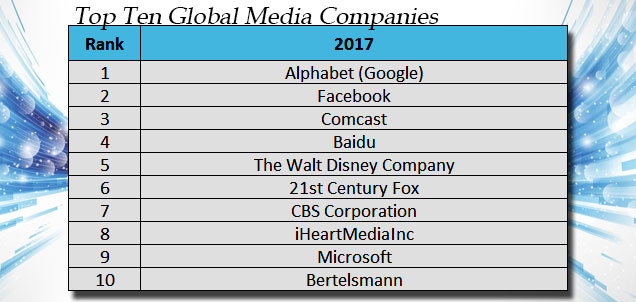
    Internet advertising overtook television to become the world’s largest advertising medium in 2016. Zenith’s The Top Thirty Global Media Owners report 2017 (https://www.zenithusa.com/top-30-global-media-owners-2017/) shows that Google and Facebook not only held the first two ranks, but also accounted for 20% of global advertising revenue across all media in 2016.  Alphabet, the holding company of Google, emerged as the largest media owner in the world, three times the size of Facebook, the second-largest media owner. While Alphabet retained its leadership in the rankings, Facebook climbed from 5th position to 2nd position. Comcast, the largest traditional media owner, retained the third rank with US$12.9bn in ad revenue. Baidu, the Chinese equivalent of Google, moved from 14th rank in 2014 to 9th rank in 2015 to 4th rank in 2016.


    Top Ten Global Media Companies

    Rank

    2016

    2017

    1

    Alphabet (Google) Alphabet (Google)

    2

    The Walt Disney Company Facebook

    3

    Comcast Comcast

    4

    21st Century Fox Baidu

    5

    Facebook The Walt Disney Company

    6

    Bertelsmann 21st Century Fox

    7

    Viacom CBS Corporation

    8

    CBS Corporation iHeartMedia Inc

    9

    Baidu Microsoft

    10

    News Corp Bertelsmann


    A comparison of the Top10 global media owners in 2015 and 2016 shows that apart from the first four mentioned earlier, The Walt Disney Company, 21st Century Fox, Bertelsmann and CBS Corporation were able to stay in the top ten, while Viacom and News Corp could not. iHeartMedia Inc and Microsoft were the two new entrants in the top ten in 2016. While iHeartMedia Inc moved up from 12th to 8th rank, Microsoft remarkably moved from 17th to 9th rank. The number of internet based media owners moved up to four from three in the top ten with Microsoft ranking 9th in 2016.


    It is interesting to note that Google’s media revenue grew by 33% from US$59.62 billion in 2015 to US$79.4 billion in 2017, while Facebook’s media revenue grew by 134% from US$ 11.49 billion in 2015 to US$26.9 billion in 2016. ZenithOptimedia named Facebook as the main beneficiary of the transition to mobile in its earlier reports. In 2013 mobile advertising revenue of Facebook crossed its desktop advertising revenue. By 2015, mobile advertising revenue was more than 70% in Facebook’s total media revenue. If Facebook continues to grow at such exponential rate, then the gap between Google and it will become less in future.


    Apart from Google and Facebook, there are five more pure-internet media owners in the top 30: Baidu, Microsoft, Yahoo, Verizon and Twitter, the last two being new entrants in 2016. The seven digital platforms generated US$132.8 billion in internet ad revenue in 2016, 24% of global advertising revenue across all media. In other words, these five media owners add only 4% to the 20% share enjoyed by Google and Facebook. Are we moving towards a digital duopoly in the global advertising market?


    The dominance of the US continues in the global media market. Out of the Top 30 Global Media Owners, 20 are based in the US. China and Germany each have three media owners in the list (Baidu, Tencent and CCTV for China, and Bertelsmann, ProSiebenSat.1 and Axel Springer for Germany). One media owner each from the four countries completes the list: France (JCDecaux), Brazil (GrupoGlobo), Italy (Mediaset) and the UK (ITV).Soon after the Second World War,the policy makers in the US realised the role that media can play in making US a super power in the world economy. US media companies were actively encouraged to invest for extending their reach abroad. The US also has the biggestadvertising market, which has been boosting the domestic growth of the US media companies. Finally, Silicon Valley innovation has helped in the growth of internet media owners with Google and Facebook now ruling the roost globally.


  • Rebranding Doordarshan?


    By Indrani Sen


    During the last week-and-a-half, after Shashi Shekhar Vempati, the newly appointed CEO of Prasar Bharati, announced the plan for changing the Doordarshan logo through a public call for new designs, we have seen on social media a lot of hue and cry.Indian TV viewers became nostalgic about the iconic logo and Twitter exploded with requests for not changing it.  It is doubtful if the requests from Twitteratis will be considered by Prasar Bharati as the whole aim of the logo change exercise is to woo the millennial generation who has no such nostalgic memory of the Doordarshan logo.


    The last date for submissions for the new logo design is August 13 and the winner will be awarded paltry prize money of Rs 1 lakh. We are seeing on social media entries from various aspirant designers and according to reports, the number of entries has crossed 2000.


    Redesigning of a brand logo is such a complicated exercise,that I have been wondering if a public call for entries and the almost one-liner brief can do justice to DD’s strategic need. The designer of the present logo, Devashis Bhattacharya, then a student of visual communication at the National Institute of Design (NID) who now runs his own design outfit, was quoted by Mid-Day saying: “If Doordarshan wishes to appeal to the young, they will have to look inwards, at the very programming of their content, and not just at logos designed by young professionals.”http://www.mid-day.com/articles/the-evolution-of-doordarshans-iconic-symbol/18483157.


    An organisation decides to redesign its logo for various reasons; when two companies merge or product line gets extended or when the logo design gets outdated or recharging of public interest is required or negative association with the logo needs to be changed. The first two reasons do not apply in case of Doordarshan. The current logo vaguely resembling yin-yang symbol is far from being outdated. However, there is no doubt that Doordarshan needs to recharge the Indian TV viewer’s’ attention and to erase the strong negative association about the national broadcaster among the Indian youth.  For achieving such communication goals, the first and foremost task is to change the quality of the programme content of Doordarshan followed by changes in its internal structure and culture. A complete new outlook for promoting and marketing Doordarshan is also essential.


    The senior IAS officers at the helm of Prasar Bharati and Doordarshan understood the importance of quality content for revamping the channel. In May 2016, Prashar Bharati took a decision to auction primetime slots between 7 and 11pm on the national channel of Doordarshan to private producers. After two failed attempt for auctioning, finally in the third auction held in December 2016 Balaji Telefilms and Saaibaba Telefilms were awarded six primetime slots (three each). The downward sliding of revenue was arrested and in 2016-17 Doordarshan recorded net revenue of Rs 827.51 crore, up from Rs755 crore in 2015-16. As reported by www.livemint.com in an article on August 3, “The broadcaster was hoping to generate Rs100 crore in 2017-18 from the auction—Rs20 crore as the collective bidding price of the slots sold in the auction and Rs80 crore in advertising revenue (from new programming)”http://www.livemint.com/Consumer/MvJZqDVMCFxaBI4gxqz8vK/Govt-review-of-Doordarshans-content-scheme-delays-release-o.html .


    The article above also announced that the Ministry of I&B has taken a decision to review the new content acquisition scheme through auctioning of primetime slots by Doordarshan. The two production houses have been working on youth-oriented shows, family dramas and reality shows expected to be rolled out from July 2017. The promos for the programmes were running on Doordarshan and according to industry sources quite a few episodes have already been canned by both the producers. At this point of time it is completely uncertain if the Ministry would allow Doordarshan to implement the existing policy or what changes it will make in the same. The decision of Ministry of I&B, which came immediately after the appointment of Smriti Irani as the Information and Broadcasting minister following the resignation of Venkaiah Naidu, proves once again the authoritarian hold of our government over the so-called autonomous Prasar Bharati.


    An attempt to change the Doordarshan logo without the support of quality content will be a disaster. There are number of case histories of rebranding failures where logo changes could not achieve the desired results. If the Ministry of I&B dictates Doordarshan to go ahead with a logo change without the orchestrated attempt for improving the quality of the content, it will be another addition in the list of rebranding failures.


  • Indrani Sen: Free Dish ki Ajeeb Kahani

    By Indrani Sen


    After BARC extended its TV measurement service to rural India, the major TV houses have been fighting for share of rural TV audiences which is 52% of the total TV audience. The strategic warfare for winning “Bharat” seems to have shifted to the battleground of free Dish TV offered by Doordarshan as it is estimated that 74% of its subscribers comes from rural areas. Strangely, our industry does not have a correct estimate of the number of subscribers of DD Free Dish, though everyone agrees that the number is higher than the subscribers of Dish TV and Tata Sky, the two leading private DTH operators with 25% and 23% share respectively.


    It is difficult to estimate the number of subscribers of DD Free Dish as the set top box and the dish antenna are sold in open market through various retail outlets and DD does not charge any fees for subscription. In spite of such confusion in accountability, private channels continue to avail of the platform for reaching out to the rural and semi-urban audiences.


    Three days back, the Telecom Disputes Settlement and Appellate Tribunal (TDSAT) refused to issue an injunction based on the complaint lodged by Dish TV and Videocon d2h to stop Star TV from re-launching its free to air channel Life OK as Star Bharat on DD Free Dish platform. TDSAT has directed Star TV to reply to the complaint in writing within four weeks, after which Dish TV and Videocon d2h will get another 2 weeks to respond. To relaunch Life OK as Star Bharat seems to be a strategic move by Star to get higher share of the rural TV Audience through DD Free Dish.


    In BARC Week 33, the Top 10 GEC channels in the rural market were Zee Anmol, Sony Pal, Rishtey, Star Utsav and Big Magic apart from the biggies Zee TV, Colors, Star Plus, Sony Sab and Life OK. The four flagship channels of Zee, Star, Viacom18 and Sony are not available on DD Free Dish, but their second-liners Zee Anmol, Star Utsav, Sony Pal and Rishtey, available on DD Free Dish, are thriving in the rural market and attracting more audience than their respective flagship channels. There is keen competition among the GEC channels in the rural market and the top ten rankings keep fluctuating almost in every week. Life OK, which is already featuring among the Top 10 channels in rural market, will surely do better if available through DD Free Dish. The strategic move may help Star to improve on its performance in the rural market with combined offerings of Star Utsav and Star Bharat on DD Free Dish.  It will be interesting to watch the next move by Zee on DD Free Dish for protecting the rural market share of Zee Anmol.  Zee TV currently is also enjoying higher weekly impressions than Star Plus and Color in the rural market.


    In a recent article “DD Live Dish Phenomenon”, Mint highlighted the revenue DD has been earning from auction of free time slots in DD Free Dish as a measure of its success. In FY 2016-17, Doordarshan’s revenue from the DD Free Dish was Rs. 264.17 crore which was 47% higher than the previous year (http://www.livemint.com/Opinion/K2WGrXErJaSly0dmKRvOAN/The-DD-Free-Dish- phenomenon.html).  The revenue from DTH platform was also 67% higher than the advertising revenue of Rs. 157.59 crores earned by Doordarshan from private sector advertising in 2016-17. Currently, it is a win-win relationship between DD Free Dish and private channels riding on it. The content of the private channels helps in increasing the subscribers of DD Free Dish, while the footprint of the Public DTH operator helps the private channels to secure better viewership which attracts more advertising revenue.


    DD Free Dish started its journey in 2204 with an offering of three channels. It gradually spread its wingsover next ten years. The spectacular growth happened after BARC went rural in 2015. Currently, it offers a mix of 80 channels including the private entertainment and news channels. Doordarshan has upgraded its transmission and plans to add 24 more channels and take the offerings to 100 plus channels. Apart from the variety of channels and attractive content, the compulsory digitization of the cable channels leading to the closure of all analog cable transmission along with the poor quality of transmission and fewer channels offered by the digital cable operators in small towns and villages are accelerating the growth of DD Free Dish.


    The Mint article quoted BARC estimated DD Free Dish subscribers as 22 million. Some industry sources believe that the actual number of subscribers of DD Free Dish is much higher than 22 million and it would be fair to assume that it has around 25% share of the total DTH subscribers’ universe. In January 2017, data released by TRAI showed 94.61 million subscribers of the six private DTH operators (http://www.televisionpost.com/dth/active-subscribers-comprise-65-42-of-94-61-mn-total-dth-universe/) and 65.42% of them are active users. The article gave 20 million plus as users of DD Free Dish. However, if we assume that DD Free Dish has a 25% share of the total DTH market, then it should be having 30/31 million subscribers with private DTH channels having 75% of the share (94.61 million) of the total DTH market of 125 million subscribers.


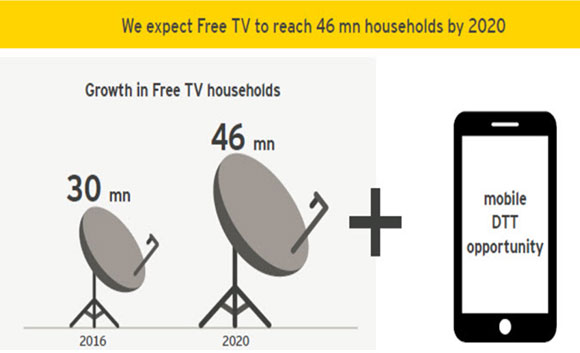
    The above estimate tallies with the EY report “India’s Free TV- A game Changing Opportunity” (http://www.ey.com/in/en/industries/media—entertainment/ey-indias-free-tv) published in July, 2017. EY has not only placed the Public DTH provider as the largest DTH distributer, but also has estimated the Free TV households as 30 million in 2016 and has projected 46 million subscribers by 2020. This estimate has surpassed all other estimates made by various other sources about the number of subscribers of DD Free Dish.


    Source: India’s Free TV- A Game Changing Opportunity by EY


    During the last week, Supreme Court ruled that Prasar Bharati can only carry the shared feed of sporting events on terrestrial network or DD Free Dish. In other words, Prasar Bharati cannot utilise the sports feed on a notified DD channel which is mandatory for the private distribution platforms. This ruling has come shortly after Star Sports announced in June 2017 its decision to launch the first Free to Air sports channel ‘Star Sports First’ on DD Free Dish. Some price conscious sports lovers, who currently subscribe to private DTH platforms, will surely shift in future to DD Free Dish, particularly in the Hindi Speaking Markets. DD Free Dish is indeed changing the game of broadcasting and will go down in the history as the major catalyst in the growth of TV penetration in India, particularly in the rural sector.


  • Indrani Sen: Celebrating with Print

    By Indrani Sen


    It has become fashionable among professionals in the media and advertising industry to denounce print media and debate how long it is going to survive in India against the onslaught of digital media. However, the reality seems to show a different picture at the beginning of this festive season. Yesterday’s Times of India, Delhi edition had 100+ pages including 45 full-page commercial ads. The “Cover on Cover” concept has probably created a record with the TOI masthead and front page news starting from page 10 after 9 full page ads!

    If the advertisers are willing to pump in so much of their advertising budgets on Print media during the festive season, we can write off the prophecy of Print Dying in India in near future. The question of arresting the decline in the rate of growth of revenue is a challenge which will keep on haunting the Indian Print media, but it will take many more years before the growth becomes negative.

    The festive season kicks off with Ganesh Chaturthi in Maharashtra and Onam in Kerala among some other regional festivals across India. This year, Mathrubhumi launched a campaign with integrated media solutions around Onam and reaped benefits both in terms of readership and revenue. (http://www.mxmindia.com/2017/08/mathrubhumi-offers-unique-integrated-media-solutions-for-brands-in-kerala/). Apart from the English newspapers, it seems that regional newspapers in most of the states are also doing well during this festive season. In West Bengal where Durga Puja rituals commence from September 26ty, decent ad traffic has been showing in all the Bengali newspapers apart from the English newspapers.

    Recently, we held a Communication Summit at Symbiosis Institute of Media & Communication, Pune, where we invited speakers from the industry to share “Stories from the Field” with our students. Among other speakers, we had invited Basant Rathore, Senior VP, Strategy, Business Development & Brand at Jagran Prakashan Ltd. The “Stories from the Field” shared by Rathore were a great learning experience for our students as well as faculty. I, personally, have decided to research more on Indian regional newspapers and to document reasons behind their phenomenal success.

    Ever since I have started writing this column in mxmindia.com, I have written only three articles on print media. Exactly two years back, on September 28, 2015, I wrote a piece “Why our Print Majors must come out of their Comfort Zones?” which was followed by “The Seismic Shift” on February 1, 2016 and”Indian Magazine Industry needs to look beyond Print” on March 6, 2017. I might have touched on print media in other articles which were not exclusively on the print media.

    We will be able to assess the total spend of festive advertising in print and its performance in comparison with other media after the Adex for the festive seasons get published. In the meantime, let us celebrate this festive season with Print!


  • Indrani Sen: The Future of TV

    By Indrani Sen


    Around the world, media experts are engaged in debates on what is going to be the future of TV in the Digital Age? While in India, the future of TV advertising seems to be secured for at least another decade based on various projections of the growth of Media & Entertainment Industry, we cannot ignore the fact that the rate of growth of TV viewership is declining. At the same time, the rise of on demand video and various OTT platforms along with a plethora of online streaming services are challenging the traditional television revenue model.


    Are we also heading towards a scenario when Indians will be consuming more and more of television or video content and watching less of live TV? In such a situation, TV ad revenues will start shrinking. As it stands now, we are beginning to see some of the tell-tale signs with content marketing writing the scripts for native advertising/sponsored content on TV. Smart Indian advertisers are experimenting with content marketing and exploring the scope of becoming publishers.


    In US, the revenue from native advertising is expected to grow from $ 17 billion in 2016 to $36 billion in 2021 (http://www.businessinsider.com/native-advertising-is-about-to-take-over-television-2016-5). The TV channels are reducing the commercial time per hour with the expectation that fewer minutes would be better targeted. Viacom has reduced per hour commercials by four minutes (http://adage.com/article/media/future-tv-advertising /303565). Apart from targeted advertising, advertisers as well as networks are considering sponsored content and product placements.


    While most of the media experts are predicting a decline in linear TV advertising, an article in www.mediavillage.com has propagated an interesting view by arguing that TV advertising will be growing at the expense of below-the-line promotion. Jack Myers, the publisher of MediaVillage.com, who has been tracking and forecasting media and marketing budgets through this decade, has found a shift from “below-the-line promotional budgets” to “above-the-line advertising budget”, in particular to TV advertising budget due to demand of advertisers for higher accountability driven by digital media and performance based metrics. Omar Sheikh, US Media / Cable Analyst from Credit Suisse in the same article has supported the views of Myers by arguing that TV will continue to grow even if the digital share in the advertising pie doubles (https://www.mediavillage.com/article/credit-suisse-the-future-of-tv-advertising-is-below-the-line/).


    However, the above trend of transferring the “below-the-line promotion” budgets to “above-the-line advertising” budgets may not happen in India as our advertisers are used to operating in a media dark environment and would not be perturbed by lack of accountability of the promotional budgets. While BARC has stabilised the audience research for TV, print and radio are still struggling with their audience research. However, Indian live TV shows have started facing challenges from on demand video and various OTT platforms, which has raised issues about the future of TV /Total Video measurement. BARC is currently gearing up for the launch of “Ekam”, its digital viewership measurement venture. Around the world, media researchers are exploring various methods for TV / Total Video measurement which clearly indicate that viewing of TV and on demand videos etc. are going to coexist in future, albeit with changes in consumer preference for content. The revenue model of TV may change, but TV revenue will continue to enjoy the highest share in the Indian advertising pie for many more years.