
Category: Opinion – Archives

  • Cable Operators Up in Arms


    By Indrani Sen


    Recently, cable operators have raised an objection to the new tariff order issued by the Telecom Regulatory Authority of India (TRAI) as they feel that the new directives would have more negative impact on their business. The All Cable Operators Association of India (ALCOAI) has brought their problems to the notice of TRAI in writing twice during the last one month. The Association claims that the cable operators have suffered losses running into crores in the last financial year due to the promotion of the OTT platforms by the broadcasting companies and the consumers taking advantage of the alternative viewing options.

    In its tariff order, TRAI has directed broadcasters to declare the maximum retail price (MRP) and nature of all their channels within 60 days from the date of notification issued on 03.07.2018.  However, there is no directiveon the tariff rates for telecasting the same programme content on internet via over the top (OTT) platforms. As per the current rules, the broadcasting companies can stream the channels on internet without having to worry about the tariff order or any permission from the government for downlnking the content.

    The ALCOAI has pointed out that due to technological changes, they have lost first a significant share of their customer base to Dish TV operators and more recently to OTT platforms, particularly after the launch of JIO leading to fall in internet data rates.

    The Association claims that according to information available with them, most of the OOT and IPTV operators have neither got permission from Indian Government to provide services in India nor are they registered as Distribution Platform Operators (DPO) by the I&B Ministry.  In this connection ALCOAI has citied an old notice of the Ministry of I&B dated 23.12.2015 restricting the broadcasters from giving access to their signals to any non-registered distribution platform operators. The cable operators have also claimed that pornographic content and non-permitted channels are being distributed without any regulatory control through the OTT as well as IPTV services.

    These allegations by the cable operators are serious if they are found to be correct. Our media lawmakers need to investigate into the complaints ASAP and take corrective measures.  However, it is difficult to believe that any prominent OTT/ IPTV player would start their services without completing the required legal formalities for operating in India. The consequence of such actions would be leading to legal actions against them with financial implications.

    Earlier this year, we learnt from media reports that TRAI was planning to regulate online video streaming platforms by inviting consultants’ views on the same. The sooner TRAI introduces such regulations would be better for all concerned. The technological changes which are sweeping over the global markets cannot be stopped or stalled by introducing media regulations. So, TRAI needs to ensure a fair playing ground for all the different types of operators involved in the distribution of the content of the broadcasting organisations as well as independent video content competing with the content of TV channels. TV will be enjoying the highest share of the advertising expenditure pie for quite a few years to come. It will be unfair for the cable operators, who pioneered the distribution of satellite TV channels in India,  if they get marginalised in the process of TV distribution through legal rigmaroles.


    Indrani Sen is a veteran mediaperson and educator. The views here are personal
  • Indrani Sen: IBF Pitching Against Pitch Discount

    By Indrani Sen


    Recently we saw an unprecedented move from the IBF chief Punit Goenka who sent an email to all agency heads asking them to take prior approval from the broadcasters before quoting any discount on their channels to the advertisers particularly during pitch presentations. So far, most of the agency heads have refrained from commenting on the same; advertisers, who actually instigate such practices and demand the same from the agencies, have been totally silent. We read an anonymous comment in exchange4media on August 13. “In a free market, only demand and supply determine prices,” said the head of a leading agency when asked to respond to the concerns raised by the Indian Broadcasting Foundation (IBF) on ‘pitch discount rates’.

    The process of an AOR pitch is supposed to be confidential and the idea of getting a prior approval on the rates quoted/ used for arriving at the savings would betray the confidentiality. Even if we imagine that agencies would agree to observe the IBF dictate, on what basis would a broadcaster differentiate the discounts offered to multiple agencies pitching for the same business? How can the agencies at the stage of pitching agree to the terms and conditions of the broadcasters offering the same or differential rate discounts to them based on certain guaranteed business without the consent of the advertiser concerned? Globally, there is no such precedence of getting approval from media owners on rate discounts before making any media pitch.

    Including an offer of rate discount in a media AOR pitch is not a new practice, it has been existing from Day One of the system. In fact, it is the crux of the approach on which advertising agencies were divided into creative and media agencies was the efficiency of media buying (read as discounted rate) based on large volume of media buying  Similarly, “Pitch Discount” has been an integral part of pitching for any media AOR business. This change in the mass approach of buying and selling media has been in practice for two decades, beginning in end of 1990s. It was accepted by the all the players in the market (media owners, advertisers, agencies) and has been running without any major hitch. So, what has prompted IBF to raise this issue with the agencies now?  Why are the broadcasters gunning for only the agencies without having a tri-party discussion involving the clients?

    It is the advertisers who actually gained most from the system of dividing the creative and media portfolios of their advertising agencies. When the break-up took place, the traditional 15% commission was split into 12.5% for creative function and 2.5% for media function. Working in the media segment, I never understood the logic of marginalising the value of the media functions to one-fifth of the value of the creative functions. Media agencies have been struggling to make profit within the frugal 2.5% service fees since then. In some cases, their service fees have been raised to 3% or 3.5% or some incentives have been added on ROI delivered by the media plans. On the other hand the service fees of the creative agencies have been delinked with the value of the annual advertising expenditure. The creative agencies now get annual fees for their services based on the terms of their contracts varying from 5% to 8% of traditional media expenditure. The practice of calculating the creative agency fees based on traditional media expenditure has been becoming obsolete over the years. So, it is the advertisers who have laughing all the way to their banks.

    It appears that the IBF members are concerned about the drop in their business margins. If there is a pressure on the margins, it is not just due to the rates negotiated by the media agencies, the growth in number of TV channels, rural ratings reported by BARC, rise of the digital media the change in the process of delivery of video content have all added to the pressure on the business margins of the broadcasters. Last week, we saw an article in Brand Equity on the phenomenon of Indians shifting from cable or Dish TV connections to OTT platform for video streaming and viewing(https://brandequity.economictimes.indiatimes.com/news/media/cutting-the-cord-many-indians-are-skipping-cable-to-binge-on-video-streaming-services/65383783). The shadow of Programmatic Buying getting extended to TV spots is also looming large on the TV industry. So, broadcasters have to take a pragmatic view of the overall situation instead of zeroing on the “Pitch Discount” offered by the media agencies.

    The IBF members are at a liberty to refuse a discount promised by any agency to an advertiser which will leave the agency to stew in its own juice. In order to implement such a step, IBF needs to have a control over their own members so that when one broadcaster refuses to accept any discount, another broadcaster would not agree to accept the same. Instead of controlling their own members, IBF is contemplating taking stringent actions against agencies even to the degree of revoking their accreditation (https://www.exchange4media.com/spotlight/margin-pressures-push-industry-to-find-solutions-to-pitch-discount-issue_91580.html) which is totally unfair. It is strange that when IBF includes representatives from agencies and advertisers, such a move has originated without a tri-party discussion at industry level involving AAAI and ISA.


  • Here’s how the various M&E reports compare…


    By Indrani Sen


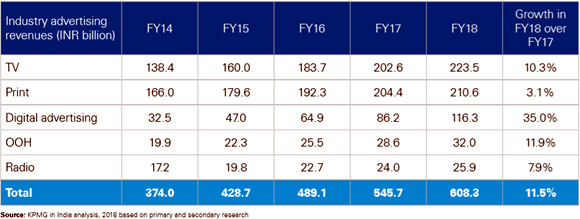
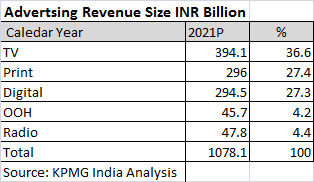
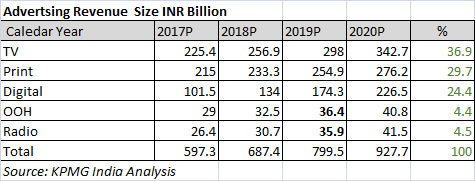
    The Media & Entertainment Industry has got another report which was released last week by KPMG, the longstanding partner of FICCI whose tie-upended in 2017 when FICCI awarded its M&E report mandate to EY. So, the Advertising and Media industry has now several reports to refer to for estimating the size and the growth of Indian Advertising Industry. KPMG has reported the following estimates and predictions for Indian Advertising Industry:


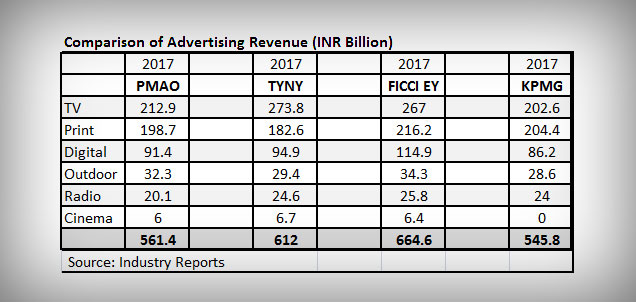
    How do these reports compare when it comes to estimating the total advertising expenditure in India? The following table will give the top line information:

    Comparison of Advertising Revenue (INR Billion)  
      2017 2017 2017 2017
      PMAO TYNY FICCI EY KPMG
    TV 212.9 273.8 267 202.6
    Print 198.7 182.6 216.2 204.4
    Digital 91.4 94.9 114.9 86.2
    Outdoor 32.3 29.4 34.3 28.6
    Radio  20.1 24.6 25.8 24
    Cinema 6 6.7 6.4 0
      561.4 612 664.6 545.8
     Source: Industry Reports    

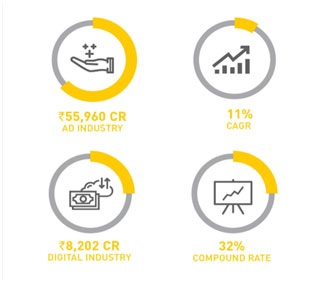
    The above analysis shows us that TYNY and FICCI reports estimates are in one bracket with PMAO and KPMG reports in another bracket with a large gap in estimates between the two brackets. For two consecutive years, the TYNY and PMAO reports were released during the same week in January. TYNY closed the estimate for total ADEX 2017 at Rs 61,263 crore with a growth rate of 10% over 2016and PMAO showed a growth rate of 7.4% in 2017 over 2016 and estimated the total ADEX as Rs 53,138 crore in 2017.

    Digital is going to have the highest growth in ADEX as perthe two studies, 30% according to TYNY and 25% according to PMAO. KPMG has pegged the Digital growth rate even higher at 35%. Both reports predict 13% growth in TV AdEx and 4% (TYNY) and 5% (PMAO)in Print AdEx. KPMG has reported lower growth rates for both TV (10%) and Print (3%).

    PMAO and TINY both agree that the highest growth after Digital will be achieved by Cinema (20% TYNY & 14% PMAO) which has the smallest share of the advertising pie. The FICCI EY 2018 report shows statistics for cinema industry revenue from domestic theatrical, overseas theatrical, cable and satellite rights, digital/OTT rights, in cinema advertising and home video.  KPMG has not been reporting in cinema advertising in FICCI reports over the last few years as they have been clubbing it with digital/OTT rights and home video as ancillary revenue stream and they have continued with that trend in their own report. As the FICCI EY report 2018 has shown the detail break ups and I have taken the liberty of using the in cinema advertising revenue as a part of FICCI-EY total advertising projection. However, the growth rate cannot be estimated without access to KPMG’s research data.

    Both have shown similar percentile growth rates for OOH and Radio (15% TYNY & 10% PMAO). The KPMG report also predicts good growth rate for OOH (12%) and Radio (8%). The FICCI report and the Group M report are closer in terms of overall projections, but they differ in details but more or less agree about trend of growth in digital media.

    Before KPMG, we also had the DAN Report with estimates closer to PMAO and now KPMG. The Pitch Madison report and the DAN report are closer in terms of overall projections, though they differ in details, particularly in case of digital media


    Source: DAN Report 2018

    The gem of an insight which KPMG has been able to mine and share with the Advertising & Media Industry is reflected in the following quote: “This year, we saw telecom-media-technology (TMT)convergence take centrestage and the emergence of media ecosystems…. media companies need to take a relook at their strategies and business models to successfully operate and thrive in the new paradigm.”

    This insight adds a tremendous value to the KPMG 2018 report and warns the industry about the significant changes which we are going to experience about how media is created, distributed and consumed by Indian consumers.  We will not be able to borrow a business model from another country, as the Indian model will be unique. Our law makers, particularly TRAI needs to tighten their belts and churn out rules and regulations capable of dealing with the changes in media consumption along with the ongoing changes at a pace which will keep pace with the TMT convergence.


    The KPMG report and executive summary can be accessed at :https://home.kpmg.com/in/en/home/insights/2018/09/india-media-entertainment-convergence-report.html


  • Indrani Sen: Wanted a stronger industry body for Telecom

    By Indrani Sen

    About two months back, on July 11, 2018 the Telecom Commission (TC), the highest decision-making body in the telecom ministry, approved TRAI’s recommendation on net neutrality rules that prohibit internet service providers (ISPs) from discriminating between their web traffic. This decision ensured that internet for Indians will continue to remain free without any discrimination or restriction.

    BBC said earlier that India has “the world’s most progressive policy on equal internet access for all” and we continue to hold that status. India’s reaffirmation of net neutrality has come at a time when the Federal Communications Commission (FCC) in the US repealed its free internet rules in December 2017 and allowed internet providers to charge more for certain content or giving preferential treatment to certain websites through commercial agreements.Recently, on August 31, 2018,California state lawmakers passed a bill preventing internet service providers (ISPs) from blocking traffic or providing so-called fast lanes. For the bill to become law, it has to be approved by the Governor of California by the end of September.

    The telecom operators in India are not very happy with this decision of the Telecom Commission as they feel that they need to have some control to manage the traffic going through their infrastructure for which they have made investment of crores of rupees. They also think the ruling would curtail the scope of innovation on the medium as ISPs cannot offer any fast lanes for content providers who are ready to pay for the privilege.Young talents within the Advertising & Marketing industry engaged in designing and implementing delivery of content, particularly on various OTT platforms will also be disappointed with the limitation on the scope of innovation.

    This decision also means the ruling that service providers cannot make any agreements with services like Facebook’s ‘Free Basics’ or Airtel Zero (services banned later by TRAI) offering only a set of services or websites for free, stays on. However, some critical services and emerging technologies like remote surgery and autonomous cars requiring high-speed internet lanes have been kept out of the ambit of net neutrality rules.


    The telecom secretary Aruna Sundararajaninformed the media that a committee formed by the Department of Telecom will shortly draw up a list of the technologies that will be allowed the exception and theTelcos will be allowed to use traffic management practices to maintain the quality of service for them as and when required. CDNs (content delivery networks) will also be treated as an exception and will be out of the ambit of the restrictions of net neutrality. It is not clear how the government proposes to regulate the operations of CDNs in India.


    Some of the media reports mentioned about Government’s plan for spreading WiFi hotspots to rural India. Hindu Business Line reported that “An official, who was part of the meeting, said that the TC has also approved installation of around 12.5 lakh WiFi hotspot in all gram panchayats with viability gap funding of around Rs 6,000 crore by December 2018”.(https://www.thehindubusinessline.com/info-tech/net-neutrality-telecom-panel-approves-trai-recommendations/article24389534.ece). The Commission also cleared the new“National Digital Communications Policy 2018” for approval by the Union Cabinet at the same meeting.


    Subsequently on August 19, www.livemint.com  reported about TRAI starting consultation for traffic rules for net neutrality – “The telecom regulator will soon start consultations over a framework for traffic management practices as well as the structure of a multi-stakeholder body outlined in the net neutrality principles, according to a senior TRAI official”. (https://www.livemint.com/Industry/cvf8xlYB4PpBy5NT25AmsI/Trai-consultation-soon-on-traffic-rules-for-net-neutrality.html).

    Currently, there is a need of a strong industry body for the telecom sector. In 1995, Cellular Operators Association of India (COAI)https://www.coai.com/about-usbut unfortunately the association does not function as the spokes person of the industry, nor does it take a leading role in negotiating with TRAI and the Telecom Ministry. There is strong competition among the telecom companies and currently the sector is facing a financial crisis largely triggered by price wars since Mukesh Ambani-led Reliance Jio’s entry. However, considering the emerging importance of the sector in shaping the digital future of India, the telecom companies should get together and form a stronger association to lead the interactions with TRAI and the Telecom Ministry for forming the rules and regulations.


  • A 4-tier formula for curbing #MeToo complaints


    By Indrani Sen


    A lot has happened during the last couple of weeks after the #MeToo movement started in India. I was holidaying among the tranquil hills in Himachal, blessed often by connectivity problems and it took me a while to catch up with the tide of events on my return to the plains. This website www.mxmindia.com has been most vociferous in supporting the #MeToo movement since its floodgates opened in India. Ranjona Banerji has posted three articles on the issue within a week, “Stop the silence about Sexual Abuse” on October 5, “Speak up and support” on October 9 and “All sexual assault is assault. And it needs to be condemned and action taken” on October 12.  Sanjeev Kotnala wrote on October 9 “Are you too guilty of silence?” and proposed #MeTooGuilityofSilence and #NotMe after evaluating your own behaviour. Shailesh Kapoor wrote “Time for men to shut up and listen” on October 12.

    I wholeheartedly support the views expressed by the three fellow-columnists. Banerji has done a great job and I am sure she will continue to fight for the cause till the industry leaders come up with a tangible solution. I doubt if Indian men will respond to the excellent suggestions made by Kotnala. There has always been a strong sense of belonging to the “Boys’ Club” among male executives across industries, so those who are not guilty of sexual harassment would hesitate to openly condemn the guilty boy and throw him out of their club. Kapoor’s call to men asking them to shut up and listen is most appropriate and we can only hope that out of the silence some sense and sensibility will emerge.

    I personally do not have any #MeToo stories to relate, but during my time in the industry I did witness some incidents where I always counselled the victim and tried to either speak to the predator or his boss which ever seemed to be suitable under specific circumstances.  In the process, I often picked up fights which definitely were not my own, but never baulked or regretted my actions. Recently a friend shared with me a column by writer Geetanjali Arora  on the issue. While I do not agree with all her views, I would like to quote a line which reflects my own belief “The Shakti does not wait for a later date to speak up; she silences the evil on the spot…”

    Women of the industry are lending all their support to the cause. Network of Women in Media in India (www.nwmindia.org ) is giving wide coverage to the issue and extending a helping hand to all women journalists.  A number of senior women executives of Indian Advertising issued an open letter to all ladies working in advertising on 10th October through Economic Times’ Brand equity https://brandequity.economictimes.indiatimes.com/news/advertising/dear-ladies-this-open-letter-from-senior-ad-women-is-all-about-hope/66150679 which was subsequently carried by all social media networks. Brand Equity followed up with an article assessing and reporting on the effects of the #MeToo movement and the reactions of different advertising and media agencies on 12th October https://brandequity.economictimes.indiatimes.com/news/advertising/metoo-times-up-for-indias-mad-men/66134945.

    So, where do we go from here? Will the exposures through #MeToo campaign stop the menace of sexual harassment in workplace from now on? Can we be assured that work places would be safe for all young girls aspiring for a career in Media and Communication Industry in India? Can we promise them that they would not be haunted any more by any male predator in their workplaces? No, it is not going to be so simple. There will be a lull following this social media storm, but the roots of the problem would stay buried under the debris of the scandals and unwanted mushrooms of sexual harassments will spring up in future. What we need is a continuous solution, an internal forum to address such complains and to take actions against the guilty men in order to assure the safety of our women at work places in media and communication industry.

    Union Minister Maneka Gandhi has been talking about a committee of judges to address sexual harassment issues but most victims in our industry would hesitate to get involved in such a complicated long drawn affair. I suggest a “four-tier formula” for addressing the issues of sexual harassment in workplaces in Media & Communication Industry. Firstly, our Industry bodies need to ensure that all their members adopt the “Vishakha Guidelines 1997”and the subsequent “Sexual Harassment of Women at Workplace (Prevention, Prohibition and Redressal) Act 2013”. Secondly,  all organisations must make it mandatory to mention in their appointment letter their policy for prevention of sexual harassment in the workplace and the consequences of such behaviour. Thirdly, there should be a dictate issued by industry bodies to all member organisations for conducting  workshops for all employees on the above Act from time to time and discuss the issues openly, a move that Hindustan Times has taken already as reported in exchange4media last week https://www.exchange4media.com/media-print-news/metoo-hindustan-times-to-organise-mandatory-workshops-for-employees-92499.html.  We can hope that these workshops will encourage women to report immediately about any sexual harassment which they may be subjected to in the workplaces. Fourthly, each member organisation should have a high level internal committee for looking into such complaints of sexual harassments by their employees. All such committees should have representation of women and in case the organisation does not have a suitable senior woman to take up the responsibility, they should invite senior industry ladies as honorary members of the internal committees. The committee would review the complaints and take suitable actions against their male employees if found guilty of any misconduct.

    We can hope that if such a four-tiered formula can be implemented in our media and communication industry, then we will be able to provide a safe working environment to all our women employees in future.


  • Just how much do we spend on media for Diwali ad campaigns?


    By Indrani Sen


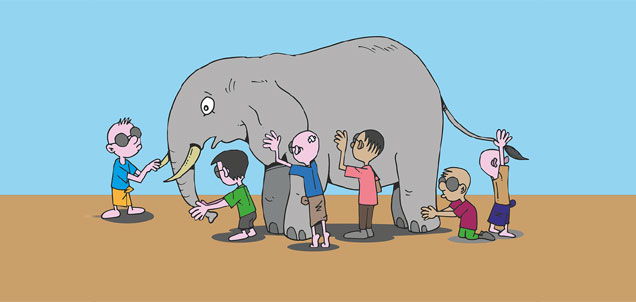
    Trying to estimate the traditional media expenditures during the three months, from August to October, is like the age old story of the blind men with the elephant. Each blind man made a guess based on which part of the elephant he was touching! In this case, please read it as based on the media agency or the advertisers own experience with rate negotiation for Diwali campaigns. The estimates put up by TAM India for Adex is therefore corrected accordingly.


    Well, TAM India estimates Adex for Print, TV and Radio which is based on monitoring of large number of media vehicles during the stipulated three months. As we all know, Adex is calculated on the basis of market rates and not on the basis of actual negotiated rates. Industry insiders are also aware of special discounts offered by media houses over and above their negotiated rates with media agencies/ advertisers for the Diwali campaigns. It is important for the leading media houses to get a fair share of the Diwali budget, the once a year bonanza for which most of them are prepared to bent backwards!


    The scheduling off course depends on the actual date of the Diwali festival, which falls on a date between mid-October to mid-November in the solar calendar based on the calculations given in advance about the auspicious dates in our lunar calendar published in our almanacs. So, it is debatable if we should look at the three months August to October or redefine the period as 12 weeks before the Diwali. For example, this year Diwali is on November 7, 2018 and we have been seeing lot of frenzied advertising activities in all traditional media as well as digital and social media since October 1. Obviously, if the TAM Adex reports compare August to October 2017 with August to October 2018, then a large chunk of the pre-Diwali advertising will not be reflected in the analysis.


    Last year TAM India published in their newsletter a comparison of pre-Diwali Adex for 2016 and 2017 https://www.tamindia.com/wp-content/uploads/2018/03/tam_newsletter_04.pdf and concluded that there was drop in print and radio expenditures in 2017 compared to 2016. Diwali festival in 2016 was on October 30, 2016 and in the next year the date fell on October 19, 2017. There is usually a huge drop in advertising traffic immediately after Diwali across all traditional media. Last year, therefore the Adex naturally dropped after October 19 while 2016 enjoyed the full thrust of Diwali advertising till October 30. Obviously the lull over the last ten days of October painted Print and Radio at a disadvantage in comparison with the same period in 2016.


    It is my earnest request to TAM India to change the period for comparing Diwali expenditures to 12 weeks before the festival instead of the standard three months August to December. Their calculations will still be on market rates, but at least the estimates would be comparable across the different media. We generally see a long diminishing tail of TV media after Diwali which are part of free spots or bonus spots which generally feature in the rate negotiations. Ideally speaking, the same TV spots should not be added to the overall cost of the particular advertisers’ Diwali campaign.


    TAM India is working on publishing a Digital Adex shortly, which will complete the process of estimating Diwali media expenditures by adding to traditional expenditures, digital and social media expenditures. There has been a trend since 2014 to link Diwali campaigns with social needs and year on year we are finding more advertisers climbing into that band wagon. Needless to mention, a considerable chunk of their Diwali advertising budget is being utilised through the new media channels.  We need to end this game played by blind men and have a robust estimates of how much we are spending on Diwali advertising on a year-on-year basis.


    Wishing the readers of www.mxmindia.com a Happy Diwali and a Prosperous New Year!


  • Indrani Sen: Digital has hardly affected popularity of TV and Print in India

    By Indrani Sen


    Last week, I read the Executive Summary of the eighth Global Media Intelligence Report by eMarketer (file:///C:/Users/Lenovo/Pictures/GMI-2018-ExecutiveSummary.pdf). As I am not a PRO subscriber of eMarketer, I was not able to access the full report which covers 40 countries across the globe and has been conducted by eMarketer in collaboration with Starcom on the state of global digital media.  But the Executive Summary revealed some interesting trends which are worth sharing with the readers of www.mxmindia.com.

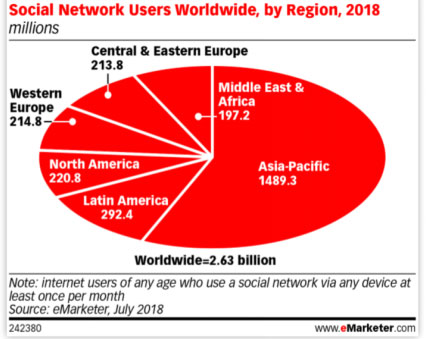
    Among the four key trends shown in the report, it reconfirms that the “World has gone mobile” and “World internet users have also embraced social networking”. On top of that, the statistics further shows out of the total social network users worldwide, the Asia-Pacific region accounts for 57% of the users as shown here.

    According to the data released by TRAI, India’s total mobile phone users have touched the 1 billion mark, of which smart phone users are over 300 million. In other words, we have a bigger number of smartphone users than each of the four regions, i.e. Western Europe, Central & Eastern Europe, North America and Latin America!

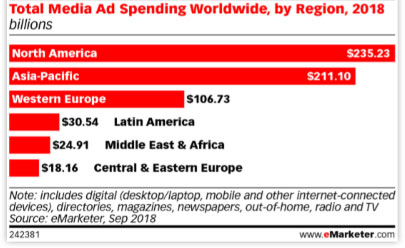
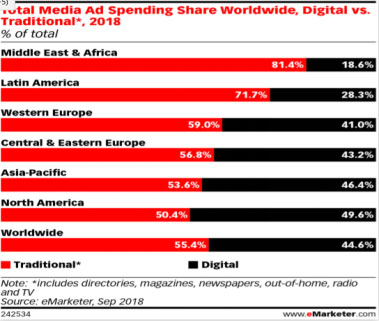
    The above chart shows the estimates of the total media ad spending by regions, where Asia-Pacific ranks second after North America.  The chart below shows the split between traditional media and digital media by different regions, where traditional media is enjoying 53.6% share in the ad spends of the Asia Pacific region.

    The report’s third insight says “Individual markets are just that: Individual” quoting different trends of different markets. It comments that “Print media were particularly strong in India; newspapers rivalled TV for penetration among internet users there in H1 2018”. The fourth trend quoted by the Executive Summary says that “Digital has hardly dented TV’s popularity”. The findings of the report have shown that television remains by far the most popular content-based medium despite the explosion of content over digital platforms. “In every country surveyed by GlobalWebIndex, a majority of internet users took advantage of the myriad options now available to view TV content at all hours, and on a range of screens—including TV channels’ catch-up services and video-on-demand providers such as Netflix and MUBI, as well as video recorders”.

    Indian advertisers, who use TV as their main medium for advertising and rely on print for creating topical/ immediate impact, will find the findings of this survey reassuring and useful.


  • Indrani Sen: Should the A& M Industry allow a TV Ratings blackout?

    By Indrani Sen


    Indian nroadcasters are apprehensive of the effect of the consumer friendly new tariffs order which TRAI plans to introduce from January 1, 2019 allowing the viewers to chose and pay for only the channels which they want to watch. According to a report carried by ET today, the Indian Broadcasters Federation (IBF) is worried about the implications of the new tariff order on the channels with relatively less viewership which are currently riding on the more established and popular channels from the stable of the same broadcaster. Therefore, IBF, which has majority shareholding in BARC, is planning to put up a proposal to the Board of the monitoring agency to suspend the TV ratings monitoring reports for 45 to 60 days (https://brandequity.economictimes.indiatimes.com/news/media/broadcasters-want-a-tv-ratings-blackout-of-upto-two-months/67018521).

    While I feel that the new tariff order of TRAI is restrictive in nature and puts a lot of constraint on broadcasters by dictating them how they should set up their pricing policies for the marketing their bouquet of channels to the consumers in the market place, I think it is also not right on the part of the IBF to request for a TV Ratings blackout for almost two months. If we look at the current marketing strategies and pricing policies followed by publications, we find that there are ample examples of newspapers and magazines offering combo-pricing of titles to the readers. Long time back, a few years after Independence, the government tried to introduce an act for controlling the number of pages and pricing of newspapers ie. Newspaper Price & Page ACT 1956, which had to be withdrawn later as the Supreme Court ruled it as unconstitutional. Currently, there are some pending legal cases filed by broadcasters against the TRAI tariff order pending in various courts.

    With three weeks to go before the new tariff order is to be implemented, the Cable & TV industry is in doldrums with no clarity on how the new tariffs order should be implemented.  The broadcasters are justified to be concerned about the future of the long-tailed channels which are riding piggyback on their more established channels. However, their concern does not justify their plan for a blackout of the TV ratings for two months. I presume by proposing a blackout, IBF does not want to put a stop to the continuous monitoring process which will be disaster. I hope IBF just wants to stop the publication of the ratings reports by BARC.

    While setting up the rules about who can operate as a Broadcast Monitoring Agency in India, our I&B Ministry was concerned about the ownership and shareholding pattern of the incumbent monitoring agency TAM, but they did not foresee the hidden implications of a Broadcast Monitoring Agency formed as an industry body with majority of shareholding by the association of broadcasters. If the A&M industry allows this proposal to get implemented, it may just be the beginning of many other high-handed moves by IBF exercising their majority shareholding of BARC.


    Indrani Sen is a media agency veteran and now an academic and strategy consultant. She writes fortnightly – and often weekly – for MxMIndia. Her views here are personal


  • Indrani Sen: OTT has entered media mix of our campaigns

    By Indrani Sen


    On April 22, ET Brand Equity carried a news item based on a report the research firm Gartner who has estimated that 65 per cent of all phone sales in India will be smartphones in 2018. The article while discussing the content of the report, mentioned that “report also said with increased push from the government for digital currency, as well as people becoming more open to using digital payment methods, the rise of digital currency is bringing a new use case for smartphones, which will trigger higher demands for smartphones”.


    This is a huge jump from the earlier estimates of the growth of smartphones in India and has created quite a stir among the global vendors, who are busy planning for strategies to get a higher share of category sales from India. According to Gartner, Indian consumers are becoming tech-savvy and they are willing to pay more for smartphones with better features. The next question, which comes up inevitably, is the Indian consumer ready to pay for the content which she/he would be consuming on smartphones? Advertisers however are not concerned whether the consumer is paying for the content or not. They simply want to be the first to catch him/her in this new media environment.


    Just the day before, on April 21, ET Brand Equity carried an interesting article on a related topic saying “OTT and VOD are steadily revolutionising the way we consume content, because of mobility and sheer range. They’ve seeped into our daily routine; be it catching up with the latest episode of our favourite web-series during loo breaks to late night binge watching.” The article described battle plans for capturing market shares by  Voot’s Gaurav Gandhi, SabGroup’s ManavDhanda, YuppTV’s UdayReddy and NexGTV’s AbheshVerma. They all were shining with positive notes about the changes in media consumption habit acrossand counting on favourable reactions from the Indian consumers.


    ManavSethi, Chief Marketing Officer at ALT Balajisaid in exchange4mediaon April19: “This change is more structural than cyclical in nature. This change is empowering. This change is latent and personal when it comes to entertainment. It’s not “prime time” only and it’s certainly not India’s prime time, it’s rather MY TIME; MY PLACE and MY VIEW, on MY DEVICE!”Sethi was optimistic about OTT’s future in India which he felt would soon take a definite shape through the interaction of more and more consumers (with access to smartphones) and the market forces.


    On April 22, exchange4media carried another story about Ogilvy creating history by making India’s first TVC for Milton shot on a smartphone, more precisely with an iPhone. Conceptualised by Ogilvy Mumbai, the TVC shows the tough journey which theTiffinbox has to undertake every day to reach the office from home through regular city life and the chaotic traffic. Stories of such technical triumph is bound get consumers exited about viewing the same and producing similar contents shooting with their smartphones.


    Informal interactions with industry experts indicate that OTT hasnot only arrived in India, but is steadilyclaiming its own share in the mix of traditional and online media for many campaigns. The media planners have no alternative but to work out thumb rule approaches for assessing the cost of OTT and its ROI. This state of flux will continue till BARC are ready to release their Ekam findings towards the end of 2018.


    Indrani Sen is a veteran media agency and marketing services professional. She is currently an Independent Consultant and Adjunct Faculty, Media Management at Symbiosis Institute of Media & Communication, Pune. The views expressed here are her own.


  • Indrani Sen: Will Ekam provide the missing links in digital measurement?

    By Indrani Sen


    Digital media measurement has been breeding a sense of dissatisfaction among global marketers.  Recently, Procter & Gamble chief brand officer Marc Pritchard, was quoted in media that he was tired of waiting for digital platforms to get their measurement act together http://www.thedrum.com/opinion/2017/03/28/why-marketers-should-follow-coca-cola-and-pgs-lead-overhyped-digital. Pritchard complained about the inadequate viewability data from Facebook, Snapchat, Google, and others who are reaping the benefits of the advertising spends in digital media by all leading brands. The article also referred to Marcos de Quinto, Coca-Cola’s global chief marketing officer, who a few months back criticized his company’s history of digital spending, and stated that TV advertising is still the best investment for brands.


    Jeri Smith, chief executive of Communicus, wrote in the above article “So far, only de Quinto has opened up his brand’s books to show evidence of effectiveness. Stating that “TV still offers the best ROI across media channels,” he revealed that Coca-Cola has reaped a return on TV investment of $2.13 for every dollar spent. Their return on digital? Only $1.26 per dollar spent.”


    In August 2016, Sir Martin Sorrel had cited the example of Procter & Gamble planning to cut investment in digital ad spends while predicting that the digital ad spend to slow over the next few years https://www.marketingweek.com/2016/08/24/sir-martin-sorrell-brands-are-starting-to-question-if-they-have-over-invested-in-digital/. All these comments make one wonder if digital media is really overhyped and why the digital industry is unable to get the their measurement act together.


    Digital media haveplenty of measurable metrics and other analytical data available in real-time, but a comprehensive measurement of these data across different digital platforms is lacking. The metrics are generally categorised into three groups, according to the flow of any digital marketing campaign from traffic generation to conversion to revenue. Overall site traffic, traffic sources, click through rate, cost per click are typically the traffic metrics which progresses to conversion metrics like conversion rate, cost per lead, average page views per visit, average cost per page view, average time on site, bounce rate, rate of return visitors, etc., followed by calculations of return on investment and cost to acquire a customer. With all these metrics being flaunted by the digital media and organizations like comScoreproviding measurement for cross platform audiences in digital media, why are the global advertisers complaining about the lack of measurement?


    Last year, when BARC announced their plan for measuring digital viewership and going beyond audience measurement of broadcast media, it also claimed that BARC will be the first to provide a TV+ Digital viewership measurement service across the globe. The press release issued data “BARC India to Solve the Digital Puzzle with its “EKAM” range of products” announces certain unique offerings in digital measurement. Ekam range of products needs to be studied in greater details through interactions with representatives of BARC to understand their full implications. We will have to wait for another 18-20 months for the reports to roll out before we can sample the results and proclaim it as “EkamevaAdvitiyam” of digital measurement.


    The irony is that better tools and techniques of measurement of digital media may not be able to improve on the ROI as the consumer becomes more and more elusive. In the digital age, we are getting bombarded by consumer-led demassification of media which is shrinking the value of the advertising budget. The return on media investment is bound to fall in future with proliferation of media types and vehicles in spite of best efforts through programmatic media planning and buying.


    Indrani Sen is an advertising and media services veteran and now an academic. The views expressed here are her own


  • Indrani Sen: FICCI-KPMG Report 2017: Scripting the Digital Decade

    By Indrani Sen


    I must confess that I am disappointed with the title of the FICCI-KPMG 2017 Report on Media & Entertainment Industry – “Media for the masses: The promise unfolds”! Has not the media always been for the masses? What is this promise which will unfold particularly in 2017? After last three years’ reports with exciting titles which spoke volumes: 2014 “The-stage- is-set”, 2015 “#shootingforthestars” and 2016 “The Future: now streaming”; this year’s title sounds drab though it is politically correct.


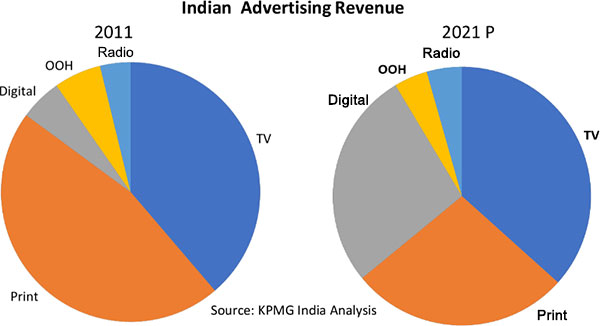
    After going through the report, I felt that “Scripting the Digital Decade” could have been an alternative title from Advertising Industry’s view point as the predicted growth in advertising revenue shows Digital ad revenue equaling Print ad revenue in 2021. The total advertising revenue will grow at 15.3% CAGR over 2017-21 with digital advertising revenue growing at double the rate of 30.8% CAGR over 2017-21.


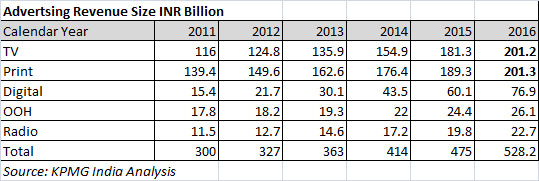
    Everyone is talking about the evolution of Free to Air TV channels post expansion of rural audience measurement by BARC and the impact of the 4G rollout as the highlights of 2016. It should be noted that as per KPMG India Analysis, TV advertising revenue for the first time touched the Print advertising revenue (201 INR Billion) in 2016 as shown in the table below.Further analysis shows that from 2011 to 2016, Print advertising revenue has increased by 61.9 INR Billion and a similar amount of 61.5 INR Billion has been added to Digital advertising revenue.  During the same period, TV advertising revenue has grown by 85.2 INR Billion to catch up with the Print advertising revenue.


    An analysis of the future projections show that in 2019 advertising revenue of radio industry will catch up with advertising revenue of the OOH industry and will have similar share of the Indian advertising pie by 2020.


    As per the FICCI KPMG M&E Industry Report 2017, the shape of the Indian advertising revenue pie will change completely during this decade. The rate at which digital advertising revenue has been growing and the digital industry is predicted to grow during 2017-2021, it will not be surprising if we find that the size of digital advertising revenue equalises the print advertising revenue even before 2021.


  • Indrani Sen: Effects of Union Budget 2017-18 on M&E Industry

    By Indrani Sen


    The M&E Industry has welcomed the Union Budget 2017-18 presented by the Finance Minister Arun Jaitley on February1, 2017 in spite of any specific reference to the industry. Industry stalwarts seem to be of the opinion that the general tone of the budget boosting the infrastructure and lifting rural income will help in the growth of the M&E industry. While Arun Jaitley did not highlight any direct plan for the M&E industry, he announced other indirect plans that could help the industry in positive way.


    The focus on digitisation announced by the FM allocating Rs10, 000 croresfor Bharat Net to boost the rural fibre optics network, seems to be the high point of this budget for the M&E industry.This plan, after implementation, promises to give digital access to over 150,000 gram panchayats. It will not only give a boost to the rural economy, but also result in acceleration of digital consumption of video content on various OTT platforms across India. This boost to the digital ecosystem is the beginning of the end of the urban-rural divide in terms of digital media reach in this vast country.


    While Indian broadcast media has welcomed the above move, Indian print media has remained conspicuously silent. Print needs to make plans for becoming a part of the upcoming digital India by moving along with the laying of the fiber optics network and adopting the gram panchayats as they become digitally literate. A constructive movement by regional dailies to make digital news hyperlocal may help also in monetizing the e-editions from the grass root level. After all, print can micro-control their footprint on the ground which is not possible for the broadcast media.


    The FM announced reforms in the financial sector such as the abolition of the Foreign Investment Promotion Board (FIPB) so as to facilitate a new policy for foreign direct investment (FDI). This move has been welcomed by the M&E industry, who are expecting further liberalisation in FDI policy during the course of the fiscal year. Bollywood has welcomed this move particularly as it expects the abolition of FIPB will induce more foreign studios to invest in India which will create more job opportunities and also will bring more international cinema to the Indian audiences.


    The quick action teams proposed by the FM, to look into cybersecurity infractions has also been applauded by the M&E industry as an essential requirement for a smooth transition to a digitally enabled India. Bollywood has also welcomed this announcement hoping that such a watchdog would also help in countering film piracy which has been pestering the Indian film industry for decades.


    While presenting the Budget, Jaitley has announced that GST will be implemented as per schedule. Except the print industry, the rest of the M&E industry seems to have no major quarrel with the implementation of GST. The broadcast industry, currently paying double taxes on TV channels, expects a lot of uniformity in taxation. Again, the film industry is looking forward to the GST regime which is expected to regularize the Entertainment Tax across the sates. As a result, it is forecasted that the rates of movie tickets will go down to about 15-20 per cent in the states where currently the Entertainment tax is high.


    A few leaders of the M&E industry have expressed some disappointment about the 2017-18 Union Budget. ABP News Network COO Avinash Pandey was quoted by Indiantelevision.com”The Union Budget 2017 was disappointing as far as the expected incentive for the broadcast business is concerned. Service tax remains the same. Most importantly, there is no parity with the print sector. The ‘wow’ factor was missing (in the budget) as far as the business is concerned. Disposable income is going to increase, and hence the quantum of spending. Economy may revive after the implementation of the budget.” http://www.indiantelevision.com/specials/budget/budget-2017/media-and-entertainment-industry-hails-union-budget-2017-170202.


    A Mohan, President – Legal and Regulatory Affairs, ZEEL, was quoted by MxMIndiatalking on the need of infrastructure status for the broadcasting sector. The sector deserves to be treated as Infrastructure industry, thereby qualifying for benefit u/s 72A(1) of the Income Tax Act, he said.. The same article also quoted Girish Srivastava, Secretary General, IBF: “The Foundation is extremely hopeful that the Government would consider the suggestion for granting ‘infrastructure status’ to the broadcasting industry, along with permission to carry forward of losses in case of amalgamation or merger as that would have made the M&E sector a more viable engine of speedy growth.” http://www.mxmindia.com/2017/02/reactions-to-budget-2017-18/.


    The FM has promised that effects of demonetisation will not spill over to the next year. It is expected the economy will get remonetised with consumer spends bouncing back to normalcy helped by the personal tax reforms. It remains to be seen if the advertising industry forecasts for adspends in the current year echoes the same promises.  To sum up, it seems the recommendations of the Union Budget 2017-18 would help inreinstating the growth rate in the M&E industry.