 By Indrani Sen
WatConsult, the digital and social media agency of the Dentsu Aegis Network, has published some useful reports in quick succession from its market research division, Recogn under the umbrella of WatInsights. The latest addition to the series is a report on “Consumers’ Perception and Effectiveness of Mobile Ads in India†(http://www.mxmindia.com/2017/11/mobile-ads-more-useful-less-engaging/). This is the third offering from Recogn, after the two earlier reports on “Internet of Things: Adoption and Growth in India†and “The Usage of Brand Apps and Their Impact on Brand Considerationsâ€. The property WATInsights was launched in May 2017 with the first report on Brand Apps which was followed by the second report in July 2017 on Internet of Things and by the third report on Mobile Advertising in December 2017. Summary of the reports are available on their website http://recogn.in/watinsights.php and full reports can be purchased at a nominal cost from Recogn. Their route map for sharing such consumer insights related to digital media with the industry at large is really praise worthy.
I find one of the key findings perplexing, whichbecame the headline in this report. Mobile ads are perceived by the consumer to be more useful and less engaging than the desktop ads which are more engaging. As it is difficult to imagine different creative being developed for different devices for any brand, perhaps the shorter versions or edits of the commercials used on the mobiles are failing to engage the consumer. However, if the mobile is being used as the main platform for accessing the internet, then the various sites on the internet will have same advertising for websites accessed through mobile and the desktop.
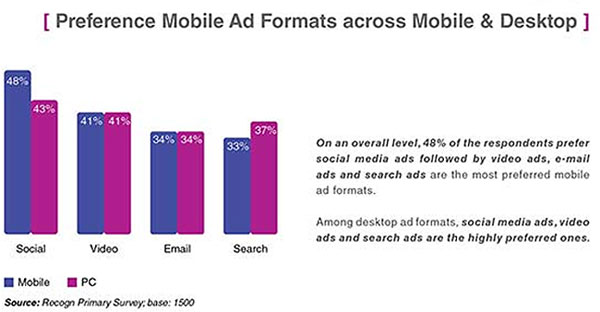
As the above chart shows, the highlight of the report says “Social media ads, video ads and e-mail ads are the most preferred mobile ad formats. Among desktop ad formats, social media ads, video ads and search ads are the highly preferred ones. Around a third of the respondents prefer SMS adsâ€. The last finding about SMS is interesting both for creative planning and media planning as currently SMS is considered by very few agencies for the digital marketing plan. The small print in the above chart acknowledges the base as 1500.
As expected smartphone screens are the most viewed devices for mobile ads, with 75% of the respondents using smartphone, followed by 42% who use laptops. 4G is the most used data connection followed by 3G and WiFi.
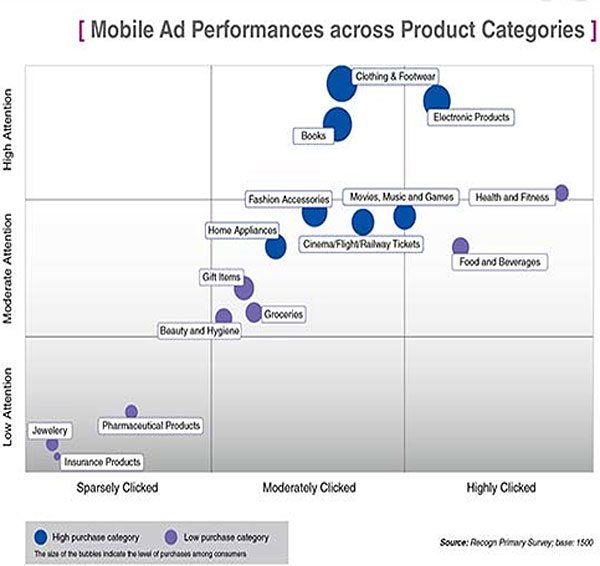
The above findings on ad preference across product categories should be tracked across the months/ quarter to get a better perspective of the consumer preferences and to ensure that there is no seasonal bias in consumer preference.
The highlight of the report points out a matter of grave concern: “Consumers feel that mobile ads appear too often and may get annoying, they are intrusive and give rise to security concerns.†The content of the mobile ads have to be more interesting and entertaining in order to engage and activate the consumer.At the same time, it is essential for the advertising industry to remove such doubts from consumer minds with the help of the service providers and the mobile manufacturers as mobile will be the main platform for internet access in India for a number of years, a phase which has already began.