Category: NEWS

  • Adani campaigns for Indian Oly contingent

    As the Indian contingent gets set for the 2024 Summer Olympics, its principal sponsor, the Adani Group, has pledged its support to the champions of the nation through a campaign with the theme #DeshkaGeetAtOlympics.

    Speaking on the launch of the film, Sanjay Adesara, CBO, Adani Sportsline, said: “At Adani Sportsline, we extend our best wishes to our champion athletes, and hope that we have more success than ever before. With the help of our programmes, we are fully committed to support our athletes all the way in their quest for excellence at the highest level in sport. And while they are fighting it out for the top prize, we must support them, cheer them on, and motivate them.”

  • Abhijat Bharadwaj is CCO, Isobar

    Abhijat Bharadwaj
    Abhijat Bharadwaj

    Dentsu Creative India has announced the appointment of Abhijat Bharadwaj as Chief Creative Officer (CCO) of Dentsu Creative Isobar.

    Co-reporting to Amit Wadhwa, CEO, Dentsu Creative India and Sahil Shah, President, Dentsu Creative Isobar, Bharadwaj will work very closely with the leadership team to drive the agency’s creative agenda forward. He will focus on further strengthening the creative prowess and the exceptional talent pool that Dentsu Creative Isobar has built over the years working with many iconic Indian and global brands.

    Commenting on his appointment, Wadhwa said: “Abhijat is not just an exceptional creative talent but a visionary leader for this new age. His passion for excellence in both work and team building will set new industry standards. Alongside our formidable team of creative leaders, we are confident that Abhijat will propel us to new heights of success and recognition.”

    Added Shah: “Abhijat’s entry unlocks a new level of growth for us. In today’s day and age, brands need a creative agency that solves problems, regardless of platforms or mediums, because that’s how non-linear and multi-platform the consumer is. And in this new era, I believe we have a phenomenal talent pool, with strong creative capabilities and the right culture to be in the pole position. With Abhijat leading our creative from the top, I am certain we are now a team to beat.”

  • Media.Monks strengthens leadership team

    Atif Rahman
    Atif Rahman

    Media.Monks has fortified its leadership team with the appointment of Atif Rahman as Head of Client Relationships.

    Rahman brings more than 21 years of extensive industry experience, having previously spearheaded the flagship portfolio for Samsung India at Cheil and played a pivotal role in consolidating the Coca-Cola business under the WPP banner during his tenure at Ogilvy.

    Said Robert Godinho, MD India: stating, “With Atif on board, Media.Monks India is fully charged  to deliver tech-first solutions and creative excellence,” adding:“Brands and consumers across the market are rapidly adapting to an increasingly social, digital and AI empowered world. Our unique approach is to harness the power of both creativity and technology to enable brands to gain competitive advantage in this dynamic environment. For example, innovations like Monks.Flow leverage AI and data to accelerate efficiencies and increase campaign effectiveness by up to 70%.” he added.

  • Olympics 2024: what new social media guidelines mean for athletes and their sponsors

    Olympics 2024: what new social media guidelines mean for athletes and their sponsors

    Representative pic: person taking a selfie. Courtesy: pickpik.com (Creative Commons Licene)


    By Layckan Van Gensen

    Cellphone cameras are ubiquitous at modern sporting events. Whether it’s a school swimming gala, the local rugby club squaring off against their bitter rivals or a national team fighting for tournament glory, every moment is a potential photograph.

    The Olympic Games are no exception. More than 10,000 athletes from 200 countries or regions are set to compete in 32 sports in this year’s host city, Paris, giving fans ample opportunity to fill their camera rolls with images of their favourite sporting heroes.

    And participants, too, will be able to memorialise their time in Paris – far more freely than ever before. This comes after the Games’ governing body, the International Olympic Committee (IOC), unveiled new social media guidelines in December 2023.

    Most of the guidelines are aimed at athletes; some relate to “accredited individuals other than athletes” such as coaches, technical staff and countries’ Olympic committee representatives.

    As a legal scholar specialising in sports law, with a focus on image rights, I’ve been closely following the IOC’s stance on athletes’ use of social media – especially photographs and videos. Image rights are a broad bundle which may include rights over the use of the individual’s still, moving and animated images, name, signature recorded voice, catch phrases, associated iconic acts, logos, trademark and brands.

    These rights can be worth a lot of money. For example, Indian cricketer Virat Kohli can earn anything between US$2 million and US$2.7 million per social media post.

    Overall, it appears that the IOC has tried to strike a balance between protecting the media rights holders while still recognising the value of a participant’s image rights. It allows them to show more content than before and, more importantly, to acknowledge their personal sponsors, who play an important role in commercialising their images and building their brands. Loyal fans will get a fuller picture of their favourite athletes’ Olympic journeys than they’ve been able to before.


    Social media at the Olympics

    Vancouver’s 2010 Winter Olympics have been described as “the first social media games”, marking the first time that the IOC created social media guidelines. These were refined for the London 2012 Summer Olympics.

    At the last Summer Olympics, hosted by Tokyo in 2020, athletes were not allowed to:

    • share any content from accredited areas used for a sporting competition or ceremony
    • post about their personal sponsors.

    These restrictions were designed, the IOC said at the time, to protect media rights-holders such as TV stations and other big media organisations.


    What’s changed

    Under the new guidelines accredited participants can share their experiences far more freely on social media platforms during what the IOC calls the “game period”, from 18 July to 13 August.

    They may:

    • take photographs and record audio and video inside and outside the accredited areas
    • share photographs on their personal social media platforms up to one hour before the start of the competition they’re taking part in, and after they have left the doping control areas
    • share posts from the training and practice areas, the opening and closing ceremonies and the Champions Park, where athletes gather after their competitions to meet and interact with fans.

    Of course there are still some restrictions.

    Videos may not be live streamed, may not be longer than 2 minutes and may not include actual competitions. So, coaches can’t film an athlete in action and then share the video or photos. Athletes also can’t record another athlete training, or post highlights from their personal competition on social media. They can only share such images or videos from official media rights-holders’ accounts.

    Perhaps most intriguingly, photographs and videos that use artificial intelligence may not be shared. It’s unclear how the IOC intends to police this rule.


    Not for commercial purposes

    Media rights-holders aren’t left completely unprotected by the new guidelines. Participants are not allowed to post for commercial purposes throughout the game period.

    A post will be regarded as “for commercial purposes” if its purpose is to generate financial profit or promote any third party or products or services.

    One of the main goals of the new social media guidelines is to balance the rights of media holders and those of the participants. This attempt at a balancing act can be seen in the new rules for non-Olympic partners – those who don’t sponsor or have official merchandise licensing contracts with the IOC.

    Brands or companies in this category may run generic advertising during the game period as long as it hasn’t been especially designed for the Olympics and has already been in the public eye for at least 90 days before the tournament starts. Advertisements in this category can’t be run more frequently during the Games than they have been previously. The IOC will apply these rules flexibly to enable “business-as-usual” campaigns.

    Participants are allowed to provide one “thank you” message to each of their non-Olympic partners during the games period but it may not include a personal endorsement.The Conversation


    Layckan Van Gensen is Junior Lecturer in Mercantile Law, Stellenbosch University. This article is republished from The Conversation under a Creative Commons license. Read the original article.

  • Sanjeev Kotnala: Celebrating India Style – Nation’s Collective Joy T20WC

    Sanjeev KotnalaFor India, cricket is a religion. The T20 World Cup in Barbados is another rare moment of unprecedented joy. The only other time cricket fans celebrate is when India beats Pakistan- which happens regularly in most World Cup formats. Something that has even given the chant mauka-mauka a cult status.

    Now, this is one of those rare wins after the World Cup win in 1983 & 2011, and the T20WC in 2007 and now in 2024—reason enough for large-scale celebration- more over when the trophy was sailing over the ropes before one of the most booed – Hardik Pandya and the Mr 360 Sky plucked it from a resilient South Africa’s hands. Hardik Pandya atoned for all his past sins – something that could be felt with the Pandya chant in Wankhede stadium. In the process, one would believe Hardik has ensured he will be the next to Captain India. Naturally, he will get all the love back at his original franchise in IPL- the Mumbai Indians.

    The T20WC 2024 win is a momentous victory that naturally sparked nationwide celebrations. The celebrations were scaled up with the team meeting PM on their arrival and then the iconic celebrations—the open bus parade of the winning team along Mumbai’s Marine Drive.  A delay in team return due to a hurricane did not dampen the mood. Air India’s charter AIC24WC was one of the most tracked flights online. What do people get by monitoring the flight? Nothing, but does it give fans the extra dose of being a part of the celebration and the team?

    This jubilant procession, though not that spontaneous and much pushed on social media, was not just a celebration of a cricketing triumph but a testament to the unifying power of sports in India. It reflects collective festivity and celebration, which is part of the Indian cultural fabric.

    The open bus parade along Marine Drive was a spectacle. Fans thronged the streets, waving flags, chanting, and dancing, waiting for the bus to arrive. No one wiser of the actual schedule. And everyone in the organising committee, including BCCI and Mumbai Police, crossed their finger- wishing no stampede- which was a major possibility. However, Mumbai’s self-discipline and comfort gained from local trains and the Ganesh Festival helped the situation. I am unaware if business offices in and around Marine Drive gave their employees half or full days off to manage their way better home.

    The cricketers, perched atop the open bus, waved to their adoring fans. The fans would not get more than a glimpse of their stars, but that was enough for them.  The energy in the city, known for its frenetic pace, was huge. The parade was more than a celebration of achievements; it was a community event where fans from all walks of life came together to share in the national pride. Such celebration provide a shared narrative that transcends regional, linguistic, and cultural differences, fostering a sense of belonging and national identity. Even today, people talk of Kapil’s inning and the catch, the Dhoni winning team, and they remember where they were when the win happened. This win has given the current generation a reference point of memory of a similar high.

    When a nation celebrates a sporting victory, it experiences a temporary but powerful sense of unity and happiness. In India, where cricket is a religion, the T20 World Cup win offers a much-needed respite from the everyday struggles. It unites people in a collective experience of joy and pride, boosting national morale. Celebrations like these also highlight the positive aspects of nationalism, where pride in one’s country is expressed through unity and collective happiness.

    Surprisingly, the event apt-for-moment marketing saw only a few unqualified brand messages. Zomato and  Swiggy played the delivery and arrival of the cup well. Other brands tried to stand out in the noise, but there was no flood, as was seen during the Tokyo Olympics. It was much subdued and entirely restricted to social media. How did that happen? Were the brands cautious of the possible backlash from the organisation in protecting the rights of legitimate sponsors? Or have they learnt the lesson with the Tokyo Olympics- when every brand threw their javelin faster than Neeraj Chopra? Have they realised that when every brand is saying the same thing and celebrating- none stand out? Besides the much-publicised 135 crore pay-out by BCCI – brands seem to be missing from announcing awards. Are they saving for the Paris Olympics?

    However, the whole event needs far better planning and execution, much more regulation and discipline, and something that will remain tough to achieve. There will always be another time to test them out. The authorities will learn and do better the next time. Until then, let’s enjoy the moment—see the highlights again and again from the 15th onwards. Enjoy.

  • Rajat Sharma elected President of NBDA

    Rajat Sharma, Chairman of India TV, has been elected as the President of the News Broadcasters & Digital Association (NBDA), for another term in 2024-25. The appointments took place at NBDA’s board meeting held on Tuesday.

    Addressing the NBDA, Sharma remarked on the significant challenges facing news broadcasters today. “There is a concentrated effort to discredit the news broadcast industry,” he said. “A section of the digital media is being misused to constantly attack news broadcasters. We have to work together to fight this menace.”

    Sharma further emphasised the pressures faced by those in the news industry, stating, “Our editors, anchors, and reporters are being targeted. They are working under tremendous pressure as an ecosystem has been created to consistently threaten their credibility. It is our responsibility to ensure that they get a fearless atmosphere to deliver fair news.”

  • Havas Media Network wins Muthoot FinCorp mandate

    Muthoot FinCorp, a Non-Banking Financial Services Company (NBFC), has appointed Havas Media Network India to manage its integrated media mandate. Havas Media’s Bengaluru operations will drive the media duties of the brand across OOH, digital platforms, television, print, and on-ground activations.

    Said Shaji Varghese, CEO of Muthoot FinCorp Limited: “We have partnered with Havas Media Network India due to their strategic expertise and understanding of our vision to revolutionize financial accessibility for all. Our collaboration is said expected to propel our commitment to innovate and enhance customer experiences while reinforcing our position as one of the leading players in India’s financial services sector.”

    Commenting on the win, Mohit Joshi, CEO, Havas Media Network India, added: “Havas Media Network India’s South operations has been consistently expanding, establishing it as a vibrant hub for partnering with leading brands and we are now delighted to join hands with Muthoot FinCorp – a prominent brand across India. We understand the critical role of the financial services sector in driving economic resilience and empowerment. Additionally, Muthoot Fincorp’s commitment to integrity and customer-centricity aligns seamlessly with our values designed on the philosophy of meaningful solutions in everything we do. Together, we strive to shape a future where financial empowerment and innovation go hand in hand.”

  • Nykaa rolls out new campaign


    View this post on Instagram


    A post shared by Nykaa (@mynykaa)

    Nykaa, beauty and lifestyle destination, has rolled out a new campaign in a nostalgic nod to the popular 90s TV show CID, Nykaa has brought back the iconic characters ACP Pradyuman and Daya in a collaborative video.

    Notes a communique: “The campaign fuses the world of skincare with the unforgettable catchphrases of CID to educate viewers on the essential Cleanser, Serum, Moisturizer, and Sunscreen (CSMS) skincare routine.”


  • Cheil X launches a new campaign

    Cheil X has launched a new campaign for MG Comet, showcasing it as a street smart car that adapts to the urban mobility needs with modern cities getting smarter day by day.

    Said Udit Malhotra, Head of Marketing, JSW MG Motor India: “The MG Comet EV is a car bred for the demands of the city and is loaded with features that liberate you from the shackles of narrow lanes and tricky turns. Besides, it has the ‘Big Inside Compact Outside’ advantage as well as the tech to navigate the daily surprises. So, in a world where people have grown accustomed to the inconvenience of city driving, MG Comet EV provides a refreshing new perspective on what a delight driving within the city can be.”

  • Ageas Federal Life Insurance launches rap video campaign

    Ageas Federal Life Insurance, has unveiled a new campaign for its latest offering, the ‘Ageas Federal Life Insurance Golden Years Pension Plan.’ The campaign is executed by the agency Left of Centre Marketing.

    Speaking about the campaign, Khushali Girish, Deputy Vice President and Head of Products at Ageas Federal Life Insurance said: “The ‘Golden Years Pension Plan’ rap video is a testament to our commitment to innovative marketing and customer engagement. Through our rap video, we aim to show that retirement is not just the end of a career but the beginning of a joyful and fulfilling phase of life. This campaign embodies our philosophy of living fearlessly and embracing the future with confidence. We believe that this campaign will add a touch of fun to the pension segment and also inspire individuals to take proactive steps towards securing their future in a stress-free manner.”

    Added Gautam Jain, Partner at Left of Centre Marketing: “We are thrilled to partner with Ageas Federal Life Insurance on this groundbreaking campaign. By leveraging the power of music and rap, we aim to create a strong emotional connection with the audience, making the concept of retirement planning exciting and relatable.”

  • Ranjona Banerji: Dancing with Bears!

    Ranjona BanerjiAll that matters in Narendra Modi’s visit to Russia, according to some Indian news outlets, is that evidently lots of Indians who live in Moscow are very excited. For some reason, these strange outlets also showed us people in New York who are very excited by Modi, although it is not completely clear why they are excited.

    Is this excitement over the fact that in India, people showed they were not quite as excited by Modi?

    In the days since the general election results, we have seen the following things happen in India:

    An increase in lynching of Muslims by Hindutva gangs, with affiliations to the BJP/RSS.

    A number of bridges collapsing in Bihar, 12 in two weeks.

    Massive floods in Assam, with loss of life and property.

    Massive rainfall, landslides in Uttarakhand, with damage and loss of lives.

    A stampede at the religious event in UP where at least 120 people died.

    Huge consternation over leaked papers in common entrance exams, mass cancellation and students in severe distress.

    Continued violence in Manipur over a year after the near-civil war began.

    Increasing economic distress, industry slowdown, inflation high, retail sales in trouble.

    Terrorist attacks in Kashmir.

    You can add anything you want to this list, almost none of it good news.

    What is most notable is that Prime Minister Narendra Modi has been missing from action in all these problems listed. Why the Indian media thinks random people singing and dancing in Moscow and New York is of any significance is not a question worth asking. Or is it? It underlines once again how Modi’s PR machinery and his captive media continue to sing to their own tunes, regardless of the reality around them.

    Editor in Chief Chamchagiri: “Find me six Indians in Moscow and make them say they are excited about Modi.”

    Staff: “Madam, what about Manipur?”

    Editor: “Don’t talk rubbish, you Rahul Gandhi stooge. We only exist for Modi ji and dancing foreign fools.”

    Something like that must happen in these newsrooms.

    It is not that the mainstream media is out of touch with reality. Or it does not know what’s happening. But because it remains unable to disassociate itself from the Modi-means-publicity dance it has performed for so long, it cannot provide sufficient coverage to matters of pain and suffering that the average Indian may feel.

    Consider the amount of time wasted asking people whether Rahul Gandhi had “insulted” Hindus by calling them non-violent or by saying that the BJP version of Hinduism is not Hinduism. This is a total non-issue and was only drummed up because Gandhi’s speech as Leader of the Opposition showed Modi and the BJP in a poor light.

    While media outlets wasted their consumers time on stuff like this, problems over NEET exam leaks escalated, the monsoon did its damage, bridges collapsed. Is it then business as usual for the media? Regardless of the election results, regardless of the voice of the people, can the media recover from over 10 years of supine worship? Is it worth wasting newsgathering expenses on happy Indians in Moscow when you did nothing for all the Indians who died in heat waves and are now dying in monsoon fury?

    The best is, you won’t even really find out what this trip to Russia has achieved, apart from dancing Indians and some bear hugs…
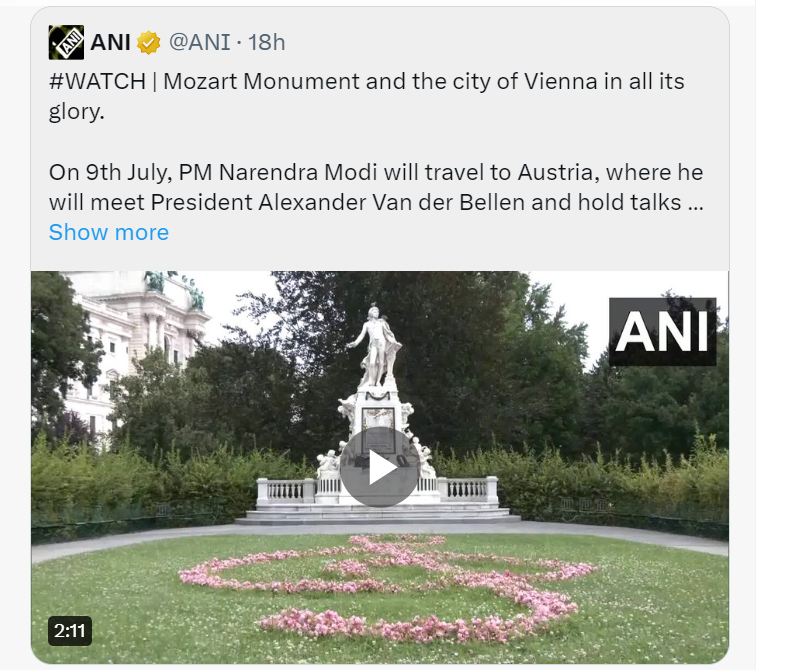
    ANI amused me the most in this “who loves Modi more” game. It put up a photo of a statue of the Mozart monument in Austria as a highlight of Modi’s impending visit to that country. How do you think ANI and other such lapdog outlets will now contrive to prove Modi’s lifelong connection to Mozart?


    Ranjona Banerji is a senior journalist and commentator. She writes on MxMIndia on Tuesdays and Fridays. Her views here are personal.

  • Pepper Content bags mandate for French Essence

    Pepper Content, a content marketing platform, has won the digital mandate for French Essence, homegrown fragrance and personal care brand.

    Said Nidhi Gupta, Chief Marketing Officer, French Essence: “At French Essence, we recognize the crucial role content plays in today’s digital landscape. Consumers are bombarded with a lot of content each day, hence creating relatable content that cuts through the noise is essential. We’re excited to partner with Pepper Content on this content transformation journey. Their expertise in crafting engaging content across digital channels, social media platforms, and search engine results pages will allow us to connect with our audience on a deeper level and build lasting brand love.”

    Added Anirudh Singla, Founder & CEO, Pepper Content: “French Essence understands the power of storytelling, and we’re passionate about helping them craft content that resonates with their audience. By developing relatable content tailored to various audience segments across the marketing funnel through our creator ecosystem coupled with tech and AI, we’ll help French Essence not only build brand awareness but also foster deep connections that lead to lasting customer love. This is a special win for Pepper Content, and we can’t wait to enable content transformation into French Essence’s brand story.”