
Category: NEWS

  • Complaint Management: Where bad experiences linger longer

    Complaint Management: Where bad experiences linger longer

    Sanjeev KotnalaWhenever there is a commercial transaction, there is a possibility of a complaint. The processes and responses to handle the complaints by a brand or organisation can transform perceptions, stabilise loyalty, and promote positive repeat purchases and references. However, most brands (including services) do lip-service to the concept. While they may standard operating procedures for complaint management, in most organisations, this department is the hidden face and unwarranted child. Most have a third-party call centre fronting complaints unless they have moved to Bot or IVR-based system, which is a different and equally horrifying story.

    All Complaint Management Systems work on set rules. They have scenario build-up for possible complaints and service delivery issues. The executive fronting the complaints is bound to play by the rule book. They are not expected to think. In fact, diversion from the SOP is not appreciated or encouraged. However, (one hopes) it is considered for future process refinement. The complaint handler is interested in the closure of the issue within timelines as they are evaluated on the number of calls and closures. The calls are mostly recorded for training purposes! Or so it is claimed. And surprisingly at times the complaint management systems suggest crazy solutions to the customer complaints.


    Can’t Find Fault with the Call Centres

    As a consumer, I have many issues and complaints with (some) brands. However, I realise that complaint-handling executives have hardly any leeway or authority to make decisions. Moreover, complaint escalation shows them in a bad light. I aim to register my complaint, hoping someone will look at it and resolve it. In the process, I would be helping the good brand learn and avoid repeating mistakes.

    Sometimes, I question this faulty thinking of mine. 

    Are these call centre executives not representing the brand? Don’t I have the right to a complaint resolution? Whatever the considerations, the interactions affect the customer’s disposition towards the brand and, hence, a critical part of the system.


    Differentiating Experience

    It is not that I have never had an excellent experience in complaint handling or it’s just that I am just a demanding customer. Trust me, a pleasant experience over a complaint or crisis helps create a stronger relationship.

    American Express Credit Cards is one of the brands with excellent timely customer complaint resolution and customer service/relations. The customer-fronting executive genuinely works and aims toward complaint resolution. At least, the impression is that they do, which is important.

    In Central India, at Dinshaw’s (dairy products) from Nagpur, all complaints land up with senior management, and they better be resolved as they are monitored.

    Brands like Make-My-Trip and Indigo (my experience) have good complaint handling. However, they have too many complaints appearing on social media.

    Then there are brands like Axis Bank, which tries to do its best and harness technology interfaces for a better experience. However, the unstable technology or a less than beta version of the apps is not resulting in the best of experiences.

    However, on the other extreme are brands like HappyEasyGo. Tough luck if you have a complaint with them.


    Complaining over Social Media

    A few trigger-happy, fastest-finger-first players use social media as the first port of call for complaint resolution. I believe people pin their complaints on social media when they don’t find a resolution in normal working. And if the complaint is addressed swiftly after it is featured on social media, it is still good as it kills the post. However, customers rarely go back to post a thank you or appreciation post after complaint resolution. I wish more of them would do so that others would know about the actual situation.


    Time To Take Customer Complaints Seriously

    In an idealistic situation, a complaint should not arise. However, as expectations and experiences differ, leading to dissatisfaction and irritation, complaints are a natural outcome. With increased social media interfaces and rising customer expectations in the challenging competitive environment, customers not only expect but demand the best experience and service – which a brand cannot ignore. They do not differentiate between local, regional, MNC, or start-ups. It is time for brands to wake up and take this part of customer complaint resolution far more seriously.


    Net-net

    People don’t buy products; they buy experiences that meet or surpass their expectations. No matter what you are selling, make them always feel better. People remember a bad experience more. They are likely to leave a bad review more than a good review. They will talk to more people about their bad experiences ( 5-10 times) than they will talk about a good experience. The brand has to nudge the customer to talk about a good experience or swift complaint resolution.

    In the new era of democratic voices, emotion and experience sharing, the experiences and the complaint management matter much more.

    ………………………………

    A story of mismanaged complaint handling

    Anupama, a young executive in an MNC firm, stays and works in Pune. Her parents stay in Aurangabad. Recently, on her father’s birthday, she used an urgent delivery service from an online flower and gift service company because she was a day late wishing her father. Forget why she forgot to wish on the day and let’s focus on what happened next.

    She went online- that’s what most people do. Like a new-age customer, she went through the process of ordering an urgent delivery from a reputed company that does flower and cake deliveries. She ordered a simple cake in a flavour that her father liked and a bouquet. She planned to call after the delivery of the make-good products.

    The company called to ask her if yellow wrapping paper would do as they were out of stock in the velvet colour she had chosen. Well, she appreciated their getting back and agreed to a colour change. The company, at this stage, earned a brownie point.

    As the delivery message came on, she called and wished her father.

    And that is when she realised they had forgotten to write on the cake. No message.

    It was the consignment bill that the delivery boy left in duplicate that her father knew who had sent the cake.

    In the phone call, her family told her that she couldn’t remember the date of her father’s birthday and, two, how stupid and careless she was- not to have any message on the cake. Was she so busy that she didn’t have time to add a message: say, dear Papa and wish him a happy birthday?

    It was not the desired experience and not what she was ready for. So she called the company with a. complaint.

    The next day, the front-line executive was all sorry madam- sorry madam for the mistake and then made the blunder of working by the book. The executive offered to send a complimentary cake to her father- this time with a message, not realising that it would amplify the error and make it messy.

    There was no way the diabetic dad was going to have another celebration and bite of the cake. The moment of glory and make-good was lost for the girl. And what was the compensation- well, a complimentary cake.

    Anupama knew there was nothing she could do. However, she made a mental note to refrain from using the company’s services again. She shared her experience on social media and with a few friends at the office. Anupama then deleted the 250 Rs digital voucher the company sent her as a goodwill gesture!

    I don’t know what would/should/could have been the best way to handle the situation. But the complimentary cake was not the right one. Hopefully, the company will review and recalibrate the response for the future.

  • White partners with Rohit Tugnait

    White, the media marketing agency, has announced its partnership with Rohit Tugnait, former Commercial Director of Vice Media Group, to launch ‘White Label’ division to start a new content solution division with the company.

    Expressing his enthusiasm about the partnership Tugnait, who is designated Chief Executive Officer of White Label, said: “Vishesh Sahni (Founder – White) has a clear vision of where he wants to take White as an organisation and what it needs to stand for; which resonates perfectly with what I envision for White Label, so it is a great collaboration together for us. We have got most of the Vice team aboard and are ready to create magic for clients.”

    Speaking on the strategic partnership, Sahni added: “We have grown rapidly as an organisation, by creating some of the industry’s most talked-about experiences. Our profound understanding of culture equips us to offer meaningful, new-to-the-world thinking for our partner brands. Amidst some conscious, strategic moves as an organisation; the next organic step was to round out the integrated marketing approach by bringing Rohit and the team on to start White Label.”

  • Indian Magazine Congress in Mumbai on May 3

    Association of Indian Magazines (AIM), is all set to organise the 13th edition of its flagship event, the Indian Magazine Congress (IMC). This will be held in Mumbai on May 3. This year’s theme is how “Magazine Publishers in India are Innovating for Building New Revenue Streams”.

    Speaking on the congress, Anant Nath, President of AIM and Executive Publisher of Delhi Press said: “In the digital age, marred by information overload and cluttered digital spaces, the need for highly engaged and involved communities is ever more important. Magazine brands nurture spaces for readers to break away from this clutter, allowing them to find solace and comfort in a manner that is aligned with their interests and with like-minded peers. Magazines have therefore innovated new ways of monetizing their rich content and the highly engaged and invested audiences, and the IMC will throw light on these evolving paradigms.”

    The conference will have a daylong programming on following themes:

    • Subscriptions and New partner alliance
    • Leveraging e-commerce for subscription growth
    • Editorial credibility and robustness at the heart of new publishing models
    • Building new IPs on magazine content
    • New paradigms in branded content
    • Creators as collaborators for engaging content solutions
    • Product management innovations for digital age
    • Magazines nurturing and monetising niche reader communities

    Speakers at the event include:

    • Elsa Esparbe Gener, RBA
    • Kerin James O’Connor, Atlas
    • Shashi Sinha, IPG
    • Thampy Koshy, ONDC
    • Prasanth Kumar, Group M
    • Alastair David Lewis, FIPP
    • Raj Chengappa, India Today
    • Gaurav Banerjee, Disney Hotstar
    • Suagata Mukherjee, Sony Liv
    • Sameer Nair, Applause Enterntainment
    • Hormazd Sorabjee, Auto Car India
    • Naresh Fernandes, Scroll.in
    • Alex Kuruvilla, formerly Conde Nast India
    • Pradeep Gairola, The Hindu
    • Manavdeep Singh, Pub Live
    • Aditya Berlia, Apeejay Education
    • Abhishek Baxi, Independent journalist/ tech influencer
    • Vanita Kohli Khandekar, Business Journalist
    • Rati Choudhary, Decor creator (Instagram)
    • Neha Anand, Mahindra and Mahindra
    • Aditya Gurwara, Qoruz
    • Arti Raghavan, Free speech lawyer
    • B Srinivasan, Ananda Vikatan
    • Anant Nath, Delhi Press
    • Manoj Sharma, India Today
    • Dhaval Gupta, Cybermedia
    • Anurag Batra, BW BusinessWorld/ Exchange4Media
    • Riyad Mathew, Malayala Manorama
    • Girish Mallya, NextGen Publishing

    The conference agenda is available at https://aim.org.in/imc13/


  • MSL appoints Sahil Chopra as COO for Publicis Consultants Asia

    MSL, Publicis Groupe’s strategic communications, has appointed Sahil Chopra as Chief Operating Officer (COO) for Publicis Consultants Asia (PCA).  In his new role, Chopra will be responsible for strategic guidance and oversee delivery of core services to client organisations in the entertainment, consumer and technology sectors. Chopra was until recently Vice-President for Marketing and Communications at Stanza Living.

    Said Amit Misra, CEO, MSL South Asia: “I am super excited to have Sahil join our team back. This appointment is strategic to our business needs at MSL, aimed at accelerating very specific communication and business needs of our clients. I am certain that Sahil will drive modern business communication impact and lead Publicis Consultants Asia to newer heights.”

    Added Viju George, Managing Director, PCA: “Category leaders operate in high-velocity environments and have a very specific way of working that requires specialists to meet their communication needs as these are tied to business outcomes. I am confident that Sahil has the understanding, the commitment to serve diverse needs of client organizations, and I am pleased to have Sahil a part of our team.”

    Chopra, as per his LinkedIn profile, worked with MSL for a little over two years — from June 2016 to July 2018.

  • Sociapa bags digital mandate for Tennishub

    Sociapa has bagged the digital mandate for Tennishub, an online Tennis store.

    Said Dheeraj Raj, Founder of Sociapa: “We are truly elated to join hands with Tennishub, a brand that exemplifies excellence in its field,” adding: “The prospect of embarking on this journey with Tennishub fills me with immense happiness and optimism.”

    Added Ronak Sachdeva, Founder, Tennishub: “We are equally thrilled to partner with Sociapa, recognizing the agency’s expertise and innovative strategies in the digital marketing landscape.”

  • Drone Destination appoints Dentsu for PR

    Drone Destination has announced its association with Dentsu Creative PR as its official public relations ad investor relations agency. The account will be managed from Dentsu’s Gurugram office.

    Commenting on the association, Sanjeev Anand, President, Dentsu Creative PR said: “We are excited to announce our partnership with Drone Destination. As we embark on this exciting chapter alongside Drone Destination, we are poised to set a new standard of collaboration that stands as a testament to creativity, innovation, and the pursuit of shared success. This strategic collaboration will allow us to service the company with our strategies and innovative ideas that resonate with Drone Destination’s vision and objectives.”

  • Ranjona Banerji: Journalism of No Courage

    Ranjona BanerjiThe Prime Minister of India, Narendra Modi while on the campaign trail in Rajasthan last Sunday, made one of his trademark speeches. In which he referred to Muslims as infiltrators, and claimed that the Congress, if voted to power, would prioritise Muslims over all others.
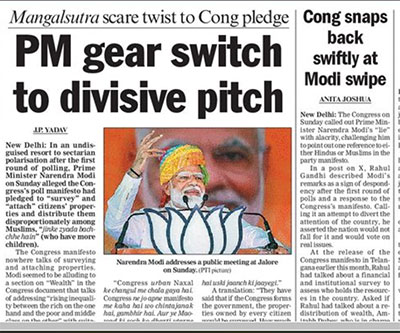
     

    I should correct the first sentence to “trademark communal hate speeches”. When it comes to Modi, there is nothing new or surprising here. His speeches are usually BJP campaign-related, and thus dripping with sectarianism and hatred for minorities and the less privileged, regardless if we have elections or not. And time and again, he gets away with it.


    And so, this time too, of course, the excuse-makers jumped in, which includes commentators, journalists and know-it-alls, all of whom belong to what I can the neo-lib-con brigade, with a strong emphasis on the “con”.


    One tranche of excuses goes like this: You must not point this out, because it is a diversion, it will only benefit him if you call him out, some politician in the past also said similar things once, someone in some other country did something similar.


    Another is: He is a master strategist with his finger on the pulse of the people, et cetera et cetera.


    We have heard all this, ad nauseum. It doesn’t say much for us as a people if a rabble-rousing liar has his finger on our collective pulses.


    This is one aspect of how Modi has got away with his hateful invective.


    The other is the state agency in charge of conducting “free and fair elections”. Sometimes known as the Election Commission of India. Which has been booking all sorts of politicians of other colours for hate speech and whatnot. But when it comes to the Prime Minister, well, reporters at a press conference were told that the EC “declines comment”. Perhaps the EC had no option. What could it say after all? We can infer from this that the EC also declines action.


    And finally, my dear, dear friends in the media. So many conversations.


    Was Modi referring to a speech given by Manmohan Singh when he was prime minister and had claimed that all benefits would go to Muslims? Some fact-checking was done. Turned out that Modi was indeed misrepresenting a speech made by Singh in 2006.


    Others looked at whether Modi’s snide remark that Muslims have more children and therefore get more benefits were true. Clearly not.


    And so forth.


    Actually everyone, from his most ardent admirers to his most fervent critics, knows that he lies and is a faithful follower of the RSS’s sectarian, Islamophobic principles. But we continue to play the game.


    Having sorted that out, the bulk of the media decided to play it safe. And here I tip my hate to former NDTV journalist and presenter Nidhi Razdan, who pointed out that while TV is often blamed for its biased coverage and its cowardice when it comes to the BJP, the print media was no better in this instance. In fact, worse if you consider that it has been marginally better than TV usually.


    Major newspapers like the Indian Express (journalism of the colour saffron) and The Times of India (all things to all people) were like the Election Commission – they “declined comment”.


    Instead, they presented his speech as it is, without context and framed it as an attack on the Congress Party. Together with his attacks on Muslims, they also showcased his attack on Sonia Gandhi.


    The Telegraph stood out with its front page (see screenshot): “PM gear switch to divisive pitch”.


    Some editorials were forthright.


    The Hindu:

    “One of the main features of Narendra Modi’s politics is his reliance on an unapologetic brand of right-wing rhetoric that is moored in demagoguery, hate speeches against minorities and the use of dog whistles — political messaging intended to please the bigoted sections of his support base.”


    Others urged all politicians to abjure hate speech for the sake of democracy – not that too many other than BJP members resort to hate speech to win votes.


    But not one of the members of the media that I came across had the gumption to demand action from the Election Commission. Or demand that democracy be respected. Spare me the lectures about fear and money and spare me your interpretation about how the media must fall into the bothsides-ism trap. I have worked for any number of publications which have run campaigns for the public good.

    And stopping hate speech is for the public good.


    With no state agency and no media to help, it is left to citizens who have the most to lose, whichever way the chip falls:

    https://scroll.in/latest/1066924/2200-citizens-write-to-election-commission-seeking-action-against-pm-narendra-modi-for-hate-speech


    Ranjona Banerji is a senior journalist and commentator. She writes on MxMIndia on Tuesdays and Fridays. Her views here are personal.

  • Is Marketing coming Full Circle?

    AI-generated image


    Ashoke AgarrwalTime was when marketing was confined to the bazaar. Goods and services were sold in one-to-one transactions between a buyer and a seller. More often than not, the buyer and the seller had a relationship, if not of trust, then at least of familiarity.

    Then, the eras of mass manufacturing and mass media dawned. After World War II, the industrial age shifted into high gear, leading to a proliferation of products and services. The prosperous 1950s and 60s, driven by the economic boom in the USA, marked the birth of the consumer era.

    Marketing underwent a significant transformation, shifting from the traditional model of building one-to-one relationships to a new era of mediated one-to-many brand-building. Modern media made this shift possible, revolutionizing how mass audiences could be reached.

    Marketing and media forged a symbiotic relationship, each playing a crucial role in the other’s success. With its ability to attract and retain audiences, media provided the platform for marketing to communicate its messages. In turn, through advertising, marketing financed the accumulation of these audiences, ensuring the continued viability of media.

    In the initial days of mass media marketing, brands were the pegs through which information about the product or service was conveyed. In the early days of the consumer age, many products and services had differentiated features, and advertising was then the art of conveying unique selling propositions (USPs) memorably.

    A few decades into the consumer age, as categories matured, competition heated up, investment flowed into consumer businesses, contract manufacturing emerged, and brands in many categories didn’t have differentiating features to hang their stories.

    Brands morphed away from information providers to signalers of personas and lifestyles. For example, the Nike user was a never-say-die enthusiast, while the Adidas guy strived for perfection.

    Brands’ dependence on mass media increased. Signaling a persona or a lifestyle on mass media allowed the entire market–loyal users of your brand, potential users of your brand, and, as importantly, loyal users of your competition–to know what your brand stands for. Brand equity was built on what the brand stood for and what it did not. The acceptance among loyal users complimented the rejection by the faithful users of the other brand. Pepsi’s equity depended not just on its persona but as much of the persona of Coke.

    While mass media might have been primarily financed by marketing, its importance went well beyond its role as a vehicle for advertising.

    In its heyday, mass media offered society a shared cultural arena that builds societal cohesion. Most religiously read the same one or two newspapers in the morning covering the same news, watched the same prime-time TV programs and went to the same movies.

    The arrival of Facebook and the subsequent social media juggernaut fractured this cohesion. Today, the average person gets his information, views, entertainment, and cultural content from various social media and OTT sources that may have little in common with those in his family, his colleagues, or his neighbors. The cohort that shares his principal information, entertainment, and cultural sources is not a community in the traditional sense – they might not reside in the same city or even country, they might not share the same profession or educational level, and they may not be even in the same age group. The only thing they have in common is the echo chamber of partisan views and attitudes they share. They are the modern tribe – divorced from the shared everyday space and civic responsibility that defined traditional communities.

    This fracturing of societal cohesion has also fractured the rationale that drives modern brand-building.

    The core function of a brand as a widely accepted signal of a persona or a lifestyle is fast losing its potency, mainly because, in post-modern society, there is little that is widely accepted. In an era when even facts have alternate facts, what chance does a brand have as a widely accepted symbol?

    In light of failing mass media, brands have shifted their marketing resources to new media. However, the paradigm that drives their brand-building effort remains the same as in the modern era. By and large, they are yet to find a new paradigm that better suits the changed reality.

    Lately, I have heard murmurs from the marketing fraternity that perhaps digital and social media are better suited to “performance marketing” (another name for baiting someone to click on a link) than brand-building. And they must reweigh their mass media spending to strengthen their brands.

    Instead, the new reality calls for re-examining the very purpose of brands. Instead of brands being broad-based signalers of lifestyle or persona to a market, brands in the emerging new marketing era become builders of permission-driven one-to-one relationships with their consumers. Like the shopkeepers and the shoppers of the bazaar of the old days, a brand and its consumers must develop an interactive relationship of trust and constantly deepening understanding of each other.

    With the maturing of Big Data, a digital-immersed consumer, e-commerce, and the economies of scale of cloud computing, marketing can today shift to a paradigm where a brand can build and nurture a one-to-one relationship with consumers at scale.

    Given my current obsession with AI, as marketing reverts to building one-to-one relationships, the day is close when the one-to-one relationship will be between the brand’s AI avatar and the consumer’s AI avatar, as I have written in many of my MxM columns, starting with the first one.

    Marketers at the cutting edge, including many D2C start-ups, have started working on this new paradigm.

    Post-modern marketing could address another shift. The younger generation of consumers – Gen Z and, over the next decade, the Alphas (those born after 2010) – are opposed to marketing messages touting lifestyles and personas and, simultaneously, intensely devoted to a chosen cause. Can tomorrow’s brands be built based on a cause it espouses, not just in communication terms but through on-the-ground action? An exciting area to ponder in a MxMIndia column to come?

  • Das ka Dum with Dr Bhaskar Das | Given the body of work one can see, do you think the days of the big agencies winning big are over?

    Bhaskar DasIf you wish to access the archives, please go to the Das Ka Dum tab on the website’s top navigation bar or click here: https://www.mxmindia.com/category/columns/das-ka-dum/


    Q: Since it’s awards time, and given the body of work we’ve seen in the last two-odd years, do you think the days of the big agencies winning big are over? Or it’s still sometime before that happens

    A: The fetish for holding on to big versus small agency debate is an Industry pastime. In today’s day and age, size is irrelevant. What matters is the body of work that complements a client’s business and marketing objectives and creates a memorable impact on society/ its addressable market. In the real world today, Davids excel Goliaths in terms of creativity, impact and speed.

    Goafest, for instance, the most coveted awards programme in India, reflects the changing mores of adland. Everywhere in business and life, the old order has changed, yielding place to the new. If one doesn’t go with the changing flow, one will be swept by the wave or left on the wayside. Nostalgia doesn’t help as a force multiplier for the future.

  • Goafest 2024 unveils theme

    The Advertising Agencies Association of India (AAAI) and The Advertising Club have announced the theme for Goafest 2024 – ‘The Age of Adaptability’. The three-day fest is scheduled to take place from May 29-31 at Westin Powai, Mumbai.

    Said Jaideep Gandhi, Chairperson of the Goafest Organising Committee: “The theme for Goafest 2024, ‘The Age Of Adaptability’, was chosen to reflect the current ethos of our industry. Adaptability is at the core of what we do – from adjusting to new media platforms to adopting innovative marketing strategies,” adding: “This festival will not only celebrate creativity but also the ability to pivot and thrive amidst challenges.”

    Added Rohit Ohri, Chairperson Goafest Content Committee: “This year, at Goafest 2024, our central theme ‘The Age of Adaptability’ has a chameleon as a mascot. The chameleon is a creature known for its remarkable adaptive prowess. Like the chameleon, which adjusts its colors to match its environment, our industry too must continuously evolve its strategies and creative approaches to thrive in changing landscapes. This year’s festival will celebrate and cultivate the chameleon-like ability to adapt swiftly and effectively, ensuring our practices remain on the cutting-edge of creativity and relevance. The Age Of Adaptability concept has been created and designed by the young and very talented team at Abnormal Design Studios.”

  • Thinkin’ Birds secures Royal Empire digital media mandate

    Thinkin’ Birds Communications has bagged the digital media mandate for Royal Empire by MB Infra, real estate developers in Maharashtra.

    Commenting on this association, Amit Babaria, Founder & Managing Director, MB Infra, said: “In today’s digital age, a robust online presence is key for business growth and profitability. That’s why we decided to partner with an agency capable of enhancing our brand in the online realm. Their successful track record with renowned real estate brands and proficiency in utilizing the latest technologies gives us confidence that they’ll deliver positive results for our company. We are optimistic about the positive impact they can make on our brand.”

    Speaking about the win, Bhavik Mehta, Brand Chief and Founder, Thinkin’Birds, added: “We are thrilled to welcome another esteemed account into our portfolio. Prepared with innovative ideas, we aim to enhance its digital brand presence and assist in achieving its objectives. This presents a significant opportunity for us, and we anticipate an outstanding beginning to this partnership.”

  • Vishal Sharma is back at LS Digital

    LS Digital, the digital marketing transformation company, has appointed Vishal Sharma as its new Deputy Vice President (DVP) of Media Buying and Trading. His expertise will be instrumental in enhancing the Media Buying division at LS Digital.Sharma will be responsible for the growth of Non-Biddable Media; branding and performance partnership solutions, building trading strength and brand planning for brand subscribing to media services and help build trust in the minds of the clients.

    Maanesh Vasudeo
    Maanesh Vasudeo

    Commenting on the appointment, Maanesh Vasudeo of the leadership team at LS Digital said: “At LS Digital, we recognize the ever-evolving landscape of media buying and the transformative impact it can have on businesses across industries. As we propel towards a landscape of digital marketing transformation (DMT), omnichannel presence and consistency, it is essential for us to continually integrate media and marketing practices to offer tailored solutions to our partners.”

    Vishal Sharma
    Vishal Sharma

    This is Sharma’s second stint at LS Digital, Vasudeo added, “Vishal in his earlier role at LS Digital was responsible for pre-sales, media planning and execution. In these years, I have seen Vishal grow as a professional and his strength in media buying will further help LS Digital’s ambitious global growth plans.”